Showing posts with label St. Clair River. Show all posts

Monday, October 20, 2025

Some random photos from summer and fall

This summer and early this fall, I have been able to collect a fair number of random railway photos that don't quite fit in with any particular theme or topic of a post. As I have done in the past, I usually give myself some time to store up a few and explore them in detail in a random post.

I suppose if there's a theme or topic that unites these photos, it's as follows. When you blog about railways and live in Ottawa, you need to be ready to take a railway photo anywhere and everywhere you can. To go one step further, you also need to constantly think of new places and new vantages points to take photos, so you can present some shots that aren't constantly covering the same ground. 

That's because Ottawa has very little to offer, obviously. 

I see this often online where railfans will take a shot of the same train at the same location at the same time of day. For them, it's fulfilling and worthwhile. That's not my thing anymore. I need to mix up the landscape and the background, not to mention the points of view, to keep things interesting. I think that's why a fair bit of my photography is now taken with landscape in mind.

I'll start with a shot that was shared with me by my sister. She and her husband were celebrating their 20th wedding anniversary in late September. They found their way to Alaska, where they took a ride on the White Pass and Yukon Route passenger excursion from Skagway, Alaska. 

 
Here's a shot of a few of the vintage 19th century vintage* coaches ready to welcome passengers for an excursion from Skagway to Carcross, Yukon, where the line currently ends. The railway, now owned by a company that includes Carnival Cruise Lines, operates in Alaska, northern British Columbia and Yukon. In recent years, there were talks about restoring service all the way to Whitehorse, Yukon's capital, but that has not materialized. Part of that discussion includes the line taking on freight service again, as mining interests still work along the route, although much of this traffic is handled via trucks. 
 
* - I neglected to mention in my original text that these vintage coaches are mainly newer builds made to look like 19th century equipment, although some are indeed very old and there are even some originals still in the railway's possession. Read the comments below for more.
 
It would be interesting to see this 3-foot-gauge operation back in action all the way to Whitehorse again, complete with freight operations, but this would require a fair bit of investment on the part of governments. I'm not sure there's a business case to be made right now.
 

A few days ago, I was on my way home from an appointment in Orleans, in Ottawa's east end, when I decided to avoid the westbound construction on the Queensway by taking some other city arterial routes back home. That path brought me by Ottawa's main train station on Tremblay Road. It was quiet when I arrived, save for this P42 and HEP consist pointed eastward, although the train was a double-ender. I am guessing this was a Montreal-bound train, as I have boarded eastbound trains on this track before. 
 
I didn't need to take another shot of a P42 and HEP consist, as I have hundreds of similar shots, but the thought occurred to me as I watched the train idle: How much longer will I see these trains? Even the engines with a face only a mother could love won't be around forever. The Venture sets are everywhere now and the legacy rolling stock is fasting becoming scarce. It's always worth a shot. 
 

In the summer, my family visited Sarnia and found our way to the Bluewater Bridge, which connects to Port Huron, Michigan over the St. Clair River. Beneath the bridge in Port Huron, near the Thomas Edison Inn, you will find this baggage/passenger car that once belonged to the Chicago, Detroit & Canada Grand Trunk Junction Rail Road. The railway connected Port Huron to Detroit beginning in the mid-1800s and became part of the Grand Trunk Western in 1928. 
 
Thomas Edison, a world-famous inventor born in Ohio, spent much of his earlier years in Port Huron, which is why the hotel is named in his honour. Edison also worked for the Grand Trunk, beginning as a young man when he told items, including newspapers and candy, to travellers bound for Detroit.  
 
Edison would later work as a telegraph operator for the Grand Trunk in Stratford, Ontario. You can read about his connection to railways in this earlier post. You can also see the historic Port Huron Railway Station behind the passenger car. 
 
 
This last image isn't exactly random as it's an image of Via Rail Train 84 headed eastbound toward Stratford Station en route to Toronto. I was lucky enough to catch this train while in Stratford this July, but I wanted to share this image, taken amid a sea of visial distractions. I liked the curvature of the tracks and the trees as a brackdrop. I will share my other photos of this meet later on, but I thought I would put this one out there to see what people thought. It was a bit of an experiment. I'm not sure about the concrete and metal poles framing the train. I like that there's a stop sign in there as well as some crossing signals. It shows you how the Guelph Subdivison snakes its way through the city in and around the station. In this image the consist is crossing Downie Street and making its way to Niles Street, which is the last street eastbound before it hits the station.
 
A bit of bric à brac from the last few months.  

Tuesday, July 8, 2025

Summer observations and musings

I spent a wonderful few days with my family in Southwestern Ontario for the Canada Day weekend. It was fun to be in my hometown for Canada Day for the first time in decades. While there, I was able to amass countless photos from the local railway operations. My challenge now is how to organize it all thematically so it makes sense in the context of this blog.

First, a bit of news passed along from a reader (thanks Michael F.). The City of Ottawa is planning to widen Carling Avenue and do away with a railway bridge over the road in the west end of the city. This old bridge carried transcontinental freight and passenger trains through Ottawa for generations, but the Beachburg Subdivision was torn up past Nepean Junction years ago, making this bridge a relic of the past. It will now go so that the one narrow stretch of Carling can be alleviated.

This is a photo I took from the passenger seat of my car three years ago. It always pays to take photos of the mundane, because you don't know when the mundane might become something worth remembering. I will be glad to see this stretch of Carling widened because the narrow fit beneath the rail bridge is dangerous and the rails are long gone, so it's time to do the practical thing. The city doesn't mention on its site whether there will be any bridge over Carling once the road is widened. I would imagine the old rail right-of-way would make a nice bike and pedestrian trail.

Isn't it interesting that, at a time when yet more of Ottawa's rail infrastructure is being removed, there are open musings from our federal government of building new railway infrastructure as part of the government's drive to devote two percent of the country's GDP on defense spending. Given how much of our area rail network has been removed, it would seem remote that there would be any strategic new rail infrastructure built here. However, those who have lived here for a while know that military vehicles and equipment were once delivered to CFB Petawawa via rail. I dare say this wasn't a huge source of revenue or regular thing for CP, CN or Ottawa Central, but there was a time when rail served our defense industry in the area. Check out this post from Trackside Treasure for more information about this piece of railway history.

Also, here's a YouTube video of Ottawa Central making a military delivery to Petawawa

Before I get to my treasure trove of rail images from the Sarnia area, I'd like to share a few attempts at rail photography on the 401/407 and the other major highways between Ottawa and my hometown. I did see two freight trains going through Kingston, but neither could be photographed from my vantage point in the passenger seat. 

Then there was the stretch of the 407 near CN's MacMillan Yard. This is wide highway and the safety barriers make a shot of the yard challenging to say the least, but with a little bit of cropping and luck, you can at least get a glimpse of this huge operation.

This image might look a bit strange. Why so much sky and so little actual railways? Well, that's because I had to crop out the highway safety barrier from the shot. You can at least get a small glimpse of a former CitiRail lease unit making its way toward the 407 while a string of autoracks to the right await their next destination. There are also some boxcars next to the CN building to the left of the shot. I wish I could offer something a bit more detailed, but I like scanning through this shot for all the various interesting elements.

Also, I did catch a passing container train making its way over the highway near Airport Road.

Here's one final shot that I had been meaning to get for years. It once again qualifies as one of those mundane shots that might not mean anything at the time, but can one day become more important. Here's a shot of the old CN ferry landing in Sarnia, as seen from Front Street. The old yard that the railway once maintained for shipping oversized cars over the St. Clair River is now occupied by a gravel dock. But notice how the rails are still there at the edge of the old ferry dock.
 

Given how quick CN is to tear up every last scrap of track here in Ottawa, I was surprised to see rails still there at the end of the old ferry dock, some 30 years after the new tunnel was put into use beneath the river, making the ferry operation obsolete. 
 
I also caught an interesting meet while looking over the old ferry operation, which was once connected by the CN Point Edward Spur, which is still in place today as it serves the grain elevator on Sarnia Bay.
 

Okay, so it's not the type of meet we usually like to see in a railway blog, but I thought it was cool to catch two Great Lakes freighters making their way north and south along the river. The southbound ship is the Mark W. Barker, an American ship owned by the Interlakes Steamship Company. This ship carries taconite, salt and limestone, although it has carried parts of wide turbines in the past. I was not able to get a clean enough shot to read the name of the northbound ship.
 
As I am about to head out on the second vacation with my family, which promises more railway photos to come, I thought a post with some random shots might work best, as I am still thinking about how to properly organize the stacks of images I intend to share from Sarnia in the months to come. Stay tuned. 

Friday, November 15, 2019

Postcard from Port Huron

This is the latest installment in an occasional series where I share my thoughts about a single photo. You can read the other postcard posts by clicking the links below.

Postcard from Chemical Valley (2015)
Postcard from Saint Laurent Boulevard (2015)
Postcard from Twin Elm (2016)
Postcards from Alberta (2016)
Postcard from Vaughan (2019)

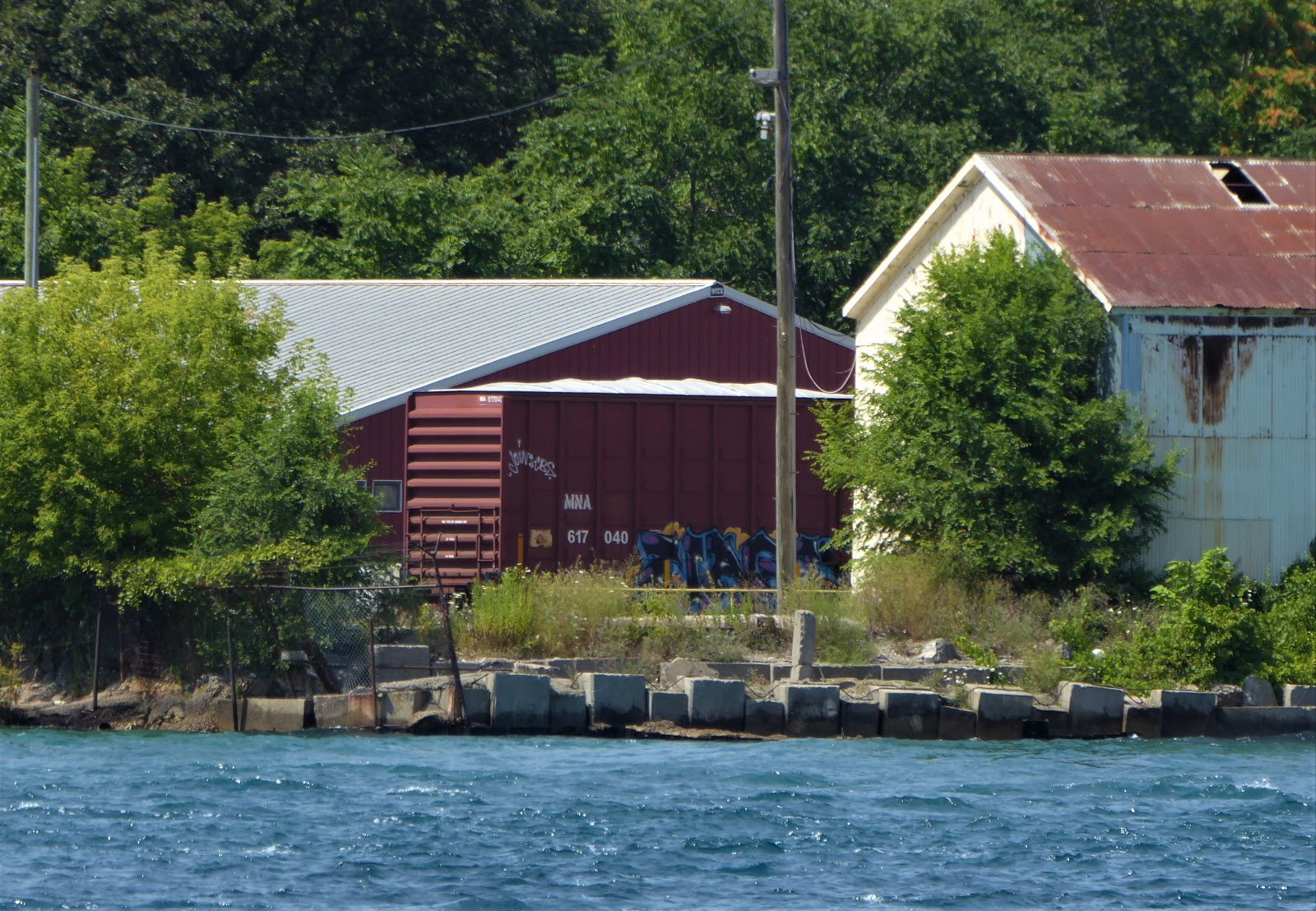
This photo makes me nostalgic for a few reasons. At first glance, it's not much. A large boxcar spotted at the end of a weedy spur. But upon closer look, you might see glimpses of railway history.


I saw this boxcar from across the water in Point Edward, Ontario, beneath of Bluewater Bridge. I brought my daughters and nephew there in the summer so they could run around at the playground and have some famous bridge french fries. As we were walking along the water's edge, I saw the boxcar and it made me smile for a few reasons.

The first reason is that there are still some active rail lines along waterfronts, even though many have disappeared from the urban landscape. This line, in particular, is a former Grand Trunk line, now part of the Canadian National system. I've seen some compelling photos over the years of old blue and red GT geeps crawling along this old right-of-way to serve the industry along the line.

Every time I visit the area, I almost expect this rail line to be removed. There is no place in today's modern world for tiny little spurs along the waterfront to be serviced by massive Class I railways.

Well, I guess there is still room for this type of operation.

I don't know what I like more, the weeds along the tracks, the fact that this car reminds of of the old high-cube boxcars that once carried auto parts or the fact that this photo also incorporates the stunning blue water of the St. Clair River.

For those interested in the operational details, this car carries paper, as it has been spotted at the Dunn Paper mill on Riverview Street in Port Huron. Someone with more knowledge of CN's local operations might be able to tell you about the frequency of this service.

For me though, I prefer just to marvel at the image itself. A boxcar on an old spur, sitting amid the weeds along the waterfront. This shot could have been taken in the 1970s or possibly 1960s and the scene would be nearly identical today.

In other words, timeless.

Thursday, January 11, 2018

FAQ Focus: The (no-so) curious case of CP Hobson

This is the first in an ongoing series that focuses on questions I sometimes come across in the comments section of the blog. The first question goes back to October 2016. A fellow railfan from Sarnia reminded me that I intended to tackle the question below from that fall post.

Q: What's the significance behind the CN Hobson sign near the eastern portal of the Paul M. Tellier Tunnel?

In October 2016, I was in Sarnia to visit family for Thanksgiving when I stopped by the Sarnia Via Rail station to catch some trains. I caught this westbound train heading toward the tunnel. As I did, I noticed that there was a curiously named control point sign west of where I stood on the station platform. For the most part, most of the control point signs I have seen have fallen into the category of geographic name or historical marker.

In the case of this sign, Hobson, the control point is a little bit of both. But it wasn't as straightforward as I thought it would be to find out why CN predecessor Grand Trunk named this CP Hobson.


Here's a closer look at the sign, blown up from the photo above.


In and around Sarnia yard, there are a few control point signs that you can see from public property. There's CP McGregor, which is named after McGregor Side Road, which I assume once crossed the yard. There's CP Blackwell, named after two nearby roads, Blackwell Road and Blackwell Side Road, which intersected at the site of old Blackwell station. The name Blackwell owes itself to Thomas Blackwell, onetime president of the Grand Trunk Railway, which operated the Strathroy Subdivision prior to its absorption into CN. You can read more about this CP here.

Okay, so you get the idea. Usually, a railway will name points along its lines for nearby geography or to pay tribute to its history.

CP Hobson is not named after any neighbourhood or road of the same name in Sarnia. I checked for any Hobson Road and found none. However, when I did a search on Hobson and Street, I found a reference to Joseph Hobson in a report on Sarnia's history.

Hobson, it turns out, was the engineer and architect who designed the St. Clair Tunnel beneath the St. Clair River. He was assigned the task by the Grand Trunk Railway in 1886. The tunnel was opened in 1891 and was considered an engineering marvel at the time, being the longest international underwater rail tunnel in the world at the time. Hobson went on to serve the railway as its chief architect.

I found a few articles about Hobson, but I found the best synopsis of his career was in his Wikipedia profile.

Here's another lesson I learned from this mystery. Always take pictures of the mundane because you never know when they will come in handy. Case in point. Here's a piece of the original bore that was used to drive the tunnel beneath the river. I snapped a photo of this monument as I was waiting for trains on the station platform.


I guess I should have paid some attention to the writing on this plaque when I was organizing my Sarnia photos in my trains images files.


It turns out that Mr. Hobson, in addition to having a control point named after him, also has a small monument devoted to him by the Canadian Society for Civil Engineering.

So, my guess is that milepost 59.2 CP Hobson was probably so named by the Grand Trunk and the name obviously was retained when the line became a CN line.

So CP Hobson is both a tribute to the man who designed the tunnel and likely also named for its close proximity to the old tunnel, which is just a short ride west of the sign.

If you ever have a question when you are reading any of these blog entries, be sure to let me know. I'm glad someone reminded me of this little piece of trivia. Sorry for the delay, but better late than never, I hope!

Thursday, January 1, 2015

The great disappearing train

Happy New Year!

When people ask me what the Sarnia area is like, I usually tell them, "Picture the prairies, only with more trees." That pretty much sums up the topography where I grew up. It's really flat. That makes chasing and photographing trains fairly easy. The one exception is the approach to the rail tunnel beneath the St. Clair River. The single track leading to the tunnel offers a surprisingly steep grade in an otherwise flat stretch of CN's rail network in this region.

On August 18 last year, I made a trip to the CN rail yard in Sarnia where I was taking shots from various vantage points. When I started shooting, I noticed a large train was being assembled in the middle part of the yard, where the tracks pass under the Indian Road overpass. Seeing that it was not ready to move, I started taking shots elsewhere. A little while later, I found myself at the end of a cul-de-sac, which abuts the yard, since I was trying to get a shot of this train (below). I noticed the train was stopped before entering the yard, waiting for something. Hearing a train roaring toward my spot, I knew a train was heading down the steep grade toward the tunnel.

In all my years of photographing trains, this was the first time I caught a tunnel train.

CN GP9 7270 waits to enter Sarnia Yard. The bridge behind the GP9 is known as the Donahue Bridge, which connects the City of Sarnia to the adjacent Chemical Valley, the area's massive petrochemical refinery district.

Unfortunately, the positioning of the sun and my vantage point made for some tough obstacles. The weeds were pretty high so some shots of the train turned out like the image below. But, sometimes when you scramble, you have to make do with you have.


Happily, getting shots of the train from another angle (below) made for some better shots. I was pretty happy to see that the second unit was CN SD60F 5550, a genuine cowl unit. I have not seen one of these units in many years. An excellent catch.


This is where things began to get interesting. As the third unit in this mixed freight, CN 2635 (Dash-9 44CW) came into view, the train began to disappear. Unknowingly, I had stumbled onto an excellent spot to catch the train's descent into the tunnel. As I reviewed the photos of the train, I was quite pleased to see the way I caught the train's disappearing act.


This shot below captures the grade nicely. You can see the initial string of steel coil cars bound for the United States. If you look closely, you can also see a truck parked beside a covered hopper car at a transloading facility (upper left). You can also see some refinery towers to the left.


I did pan back toward the sun a few times, since the train had so many different types of freight in its consist, including a few shallow gondolas filled with what looked like scrap metal.


This view below brought me back to my teenage years, when I used to watch long lines of autoracks making their way down the CSX Sarnia Subdivision and then being queued up in Sarnia Yard, where they were then ferried over the river on the CN ferry. Of course, CSX no longer handles autorack interchange traffic between Chatham and Sarnia. In fact, CSX doesn't even operate in the Chatham area anymore. I took a shot of the autoracks, just for nostalgia's sake.


Of course, all good things come to an end, but check out the variety at the end of the train. A few high-cube box cars, a lumber car, a white tank car and a few other loaded flat cars, all headed below the river. You can just make out the other train (right) waiting for clearance to enter the yard. I stuck around to catch that train, which turned out to be carrying interchange traffic for two waiting CSX GP38s, which were idling near the Via station. I shared a few shots of that train in this previous post. I will have more to share from that interchange in a future post. You can also make out some longer than usual rail ties, which indicate there was once a turnout located here.


So, all in all, I was pleased to get some decent shots of this tunnel-bound train, given my less than ideal position and the position of the sun. There's always something happening in a big rail yard. I can only dream of similar activity in Ottawa's Walkley Yard.

Thursday, October 9, 2014

More relics on the rails

My travels to southern Ontario this summer resulted in some interesting sites trackside, including a few run-ins with railroading history. It's always a good day when you capture a piece of the past, especially when these relics are becoming rare. I managed to snag a few notable relics. You can read my first entry about relics in this post.

The first relic I shot was located at the end of the line on CSX's Sarnia Subdivision, along the shores of the St. Clair River. This antique maintenance-of-way crane car was quite far from the parking lot where I was standing. There was no way to legally get close to the car, so I had to rely on my camera's zoom to get what I could. But the lighting was good and the view was mostly clear, minus a hydro pole.


As you can see, the zoom was stretched to its limits, judging by the look of the tracks leading up to the old car. This old Burro crane is still clad in Chessie yellow. I have seen this car tucked away here a few times, but this was the first time I had a fairly clean view of the car. You can see the St. Clair River in the background and Michigan on the other side. This car is pretty close to where the old CSX rail ferry was located. This ferry service ended right around the same time the CN ferry stopped its operations. What's interesting about the old CSX ferry is that I didn't even know it existed until recent years.

Later on the same day (August 18th), I made my way to CN's Sarnia Yard and was able to catch the CN/CSX interchange as a string of cars was being delivered for pickup by two CSX GP38s in the yard. This train contained the second relic. Below is a long shot of the interchange making its way into the yard. Can you see the relic? It may not be obvious.


Here's a closer look. It's an old Family Lines System hopper car, still fully clad in its original livery. It may not be all that significant to some, but for someone like me interested in the convoluted history of CSX, it's an interesting holdover from the merger era. You can see a second hopper with the same paint, although it has been re-lettered for CSX.


You can see the Louisville & Nashville lettering on the hopper and the all-encompassing logo to the right. Here's a closer look at the logo, below.


Family Lines System was one of the precursors to CSX. It is important to note that the system was itself not an actual railroad, but a common marketing scheme adopted by a number of allied railways, including the Seaboard Coast Line, Louisville & Nashville, the Clinchfield Railroad, the Georgia Railroad, the Atlanta & West Point Railroad and the Western Railway of Alabama (these lines were known as the West Point Route). You can see that all the railroads are represented in the logo. This entity was created in 1972 and lasted until 1982, when the Seaboard System was created. The Seaboard System itself lasted until 1986, when Seaboard and Chessie System were combined to form CSX. That's the simplest explanation. Technically, Chessie was brought into the CSX umbrella in 1987. I'm not sure I understand the specifics of how CSX, as we know it, came to be in 1986-87.

This next shot below isn't necessarily a relic, but more of an rarity or oddity. This is a manifest freight heading west toward the St. Clair River rail tunnel (I will have more to share about this train in another post). The middle unit pulling this train is CN 5550, an SD60F cowl unit. I only ever snagged one other cowl unit in my exploits around this yard. You can read about the other cowl unit I saw, a Bombardier HR616, here. This unit looks massive, with six axles and six safety stripes.


The final relic I found along the CN Strathroy Subdivision in Wyoming. Whenever I visit this area, I visit the tiny Via Rail station and wait for a passing freight train. I didn't end up catching a train but I did find this old loading ramp in the weeds. It appears that this ramp has not been used in some time. Still, it's interesting that pieces of the old track leading to this ramp still remain. You can see the main line to the left of the photo.


I was quite happy with some of these catches over the summer. As I mentioned already, anytime you can shoot some history, it's a good day.

Thanks for reaching out

I posted my email in a previous post and was happy with the messages I received from readers. I was happy to know that I have a good following from various points in Ontario and around Canada. Please feel free to contact me with any questions or comments you may have at hammond.michael77 AT gmail.com. One reader has reached out and will be featured as a guest blogger in the near future. He has already showed me some of his material and I am excited about sharing his photos and experiences. Stay tuned!

Thursday, November 7, 2013

The random photos have their day

As I prepare posts each week, I keep coming across photos that I'd like to write about, but never seem to fit in with my topic du jour. This week, I thought I'd do a little bit of house cleaning and present some odds and sods from my rail watching adventures past and present.

First case in point: A maroon Dupont covered hopper and the familiar "Sclair" orange covered hopper on an industrial spur at the Katoen Natie warehouse facility in Corunna. I took this photo in 1993. At the time, both the maroon Dupont and orange Sclair cars were a common site on this CN rail line, which extends south from Sarnia through Corunna and Mooretown all the way past Courtright. The orange hoppers were common on both the CSX Sarnia Sub and all around CN's Sarnia operations, due to the presence of the Dupont facility in Corunna. The Sclair brand now belongs to Nova Chemicals. The reporting marks on these hoppers now read NCLX rather than DOCX.

I remember finding an old brake shoe lying near the tracks and carrying it home as a souvenir. This line is still quite active, as it serves a number of refineries south of the Chemical Valley including Nova Chemical's Corunna and Moore facilities and a host of others.


This shot below was taken during this past Thanksgiving Weekend when I made a very brief trip to Sarnia and took a bunch of shots. This was a small logo I found on the side of a CN cylindrical hopper at a CN "transflo" facility where a string of hoppers were pushed up against a bumper and awaiting loads from dump trucks. This Agrium logo, complete with maple leaf-waving Kangaroo, shows that the hopper was once used in the west for transporting potash.


Here's another throwaway shot, at first glace. I took this as part of my recent Thanksgiving visit to the Sarnia area. I was able to get a bunch of great shots of CSX GP38-2s at the end of the Sarnia Sub. As GP38-2 2570 began to grind to a stop, I saw something in the distance, which was off limits to me, since it was on CSX property. I tried to zoom in and get a quick shot. Take a look just to the right of 2570 and you will see a yellow maintenance-of-way crane car. A very rare site on the Sarnia Sub, at least in my experience. You may also notice both 2570 and 2757 (to the right) have flashing beacons on the right side of their cabs. I assume this is for indicating when the unit is being remotely controlled. I'm sure someone more knowledgeable on such matters can clarify this, if I'm wrong. The next time I am in Sarnia, I will search diligently for that maintenance-of-way crane car.


The next shot is from Kitchener, where I lived for two years. This photo also marks an amazing opportunity missed. I lived very close to a park on the city's east end, called Kolb Park. The park is nestled against the Grand River, which separates the city from the town of Breslau. The Goderich-Exeter Railway runs through the park. This trestle was just begging for a railway-in-action photo, but I was not in the habit of taking photos of trains at that time. It's a shame, because this trestle hosts Via trains, GO Trains and freight trains on a regular basis. One sunny day in the fall of 2008, as I was biking along a riverfront trail, I thought that it was a good idea to get a shot of the trestle. I wonder how vandals were able to write so legibly so high up there.


The final shot shows the front of an evening Via train headed for Toronto in 1991. It was idling at Sarnia station. I'm pretty sure we were dropping off my sister as she headed back to the University of Waterloo after a visit back home. I wandered off the platform and tried to take a shot of F40PH-2 6441 from the edge of the track. I seem to remember standing at the edge of the rail and reaching my hands in front of the locomotive to get this shot. This is sadly the only shot I have of a Via F40 in the old paint scheme. I think I had better shots at one point, but these have been lost over the years. I must stress one thing: Don't ever do this to get a shot. I was young and stupid. I no longer take such risks. 

You will notice the intermodal cars to the left of the Via. What's noteworthy is that the containers are only single stacked, which was a necessity in Sarnia before 1993 when the new St. Clair Tunnel beneath the St. Clair River to Michigan was built. (Feel free to read Part I and Part II of the St. Clair Tunnel posts if you haven't already) The old tunnel's size restrictions meant intermodal traffic had to be single stacked, while autoracks and high-cube boxcars were ferried over the river. You can also see a tank car with an orange racing stripe. Don't see too many of those anymore.


Thursday, October 17, 2013

CN's St. Clair Tunnel (Part II)

In 1993, CN began work on a second tunnel beneath the St. Clair River to accommodate double-stack container trains, autoracks and other oversized rail cars that were being shipped via ferry. Unlike the original 1891 St. Clair Tunnel, which was dug from two sides, the second tunnel was to be excavated from the Canadian side of the river toward the Michigan side (see CN's St. Clair Tunnel Part I). The boring machine used, named Excalibore in a  newspaper contest, was installed and began work in the summer of 1993. The original tunnel continued to be used as the boring machine made its way west to Michigan.

Above: The preparations for the new tunnel take shape next to the original tunnel in Summer 1993. Note the small building, called the pumping house, next to the old tunnel.

It was not a smooth process for the boring machine, by any means. Several times during its initial forays under the river, the machine broke down and had to be fixed and cleaned of sentiment that had ground the machine's engine to a halt. At certain points, local media outlets were charting Excalibore's progress versus the men who dug the original tunnel by hand. At one point, the progress achieved by modern machinery was barely ahead of the record set by the men in the 1890s. This was a major embarrassment to the project's contractor and to CN.

Above: Excalibore being assembled in Summer 1993, as seen from a viewing platform set up by CN to accommodate curious locals and rail fans like me.

Despite the initial hiccups, the construction of the new tunnel generated a lot of excitement locally and beyond. Rail fans in London and other points along the CN system snapped photos of special trains that were used to deliver parts of the huge boring machine to the work site in Sarnia. This photo below, courtesy of Eric Gagnon of the Trackside Treasure blog, shows one such special heading through London, bound for the tunnel site in Sarnia. Eric mentioned that the two Via Rail business cars in the consist were likely Coureur des Bois and Sandford Fleming. He also mentioned that he saw a freight in Kingston in 1993 with "white circular 'containers' marked LOVAT." The consist of that June 1993 special through Kingston contained the following (according to Eric's notes):

CN 9665 / EMD(ex-Conrail, blue) 795 / CN, BCR boxcars / CN covered hoppers / CN 670103 / CN 677002 (one of a kind, four trucks, built by CN) / CN 670102.


Eric was also kind enough to pass long this shot below, which shows a more detailed close up of the pieces of the boring machine in gondola cars, again in London. Special thanks to Eric for sharing these images from his collection for this post.


Once the mechanical difficulties were ironed out, Excalibore began to easily chew threw the earth beneath the river and it finished its mission with a sizeable lead over the men who dug the original tunnel. The late surge of boring saved CN and the project's contractors from embarrassment. The new tunnel had the following specs:

Length: 1,898 metres (6,129 feet)

Diametre: 8.4 metres (27 feet, 6 inches)

Compare that to the specs of the original tunnel in my previous post about the tunnel.

More importantly for CN, the new tunnel once again gave the railway an enormous advantage over the Canadian Pacific Railway, which operated a rail tunnel between Windsor and Detroit beneath the Detroit River. When the new St. Clair Tunnel opened in 1994, double stack container trains could move through to Chicago with little delay. Soon after the new tunnel opened, CN's ferry service over the St. Clair River ended.

Meanwhile, the Windsor tunnel, known as the Michigan Central Railway Tunnel, could only handle rolling stock as big as autoracks. Considering the fact that 1994 marked the beginning of the North American Free Trade Agreement, the ability to seamlessly move container trains through an international crossing offered CN a huge early advantage that CP has yet to match. Plans to replace the Windsor tunnel have still not materialized, meaning double stack traffic cannot be routed through Windsor-Detroit, which is otherwise the busiest trade crossing in North America.


It's interesting to note that the new tunnel gave CN the same advantage that the original tunnel gave the Grand Trunk Railway in 1891. When the original tunnel was built, the Grand Trunk essentially gave itself the edge over the Canada Southern Railway, which was still using ferries in Windsor and in Courtright, Ont. (to be mentioned in a future post). The St. Clair Tunnel had officials with the CSR scrambling to match the Grand Trunk, but the Windsor tunnel would not be opened for traffic until 1910.

Above: A view of the old and new St. Clair Tunnel in Sarnia, Ont. on Oct. 13, 2013. Note the absence of the old pumping house.

Today, the new tunnel bears the name Paul Tellier in honour of the former CN president who oversaw its creation. It has seen its share of fanfare over the years, including a GO Train special, which made its way to Sarnia in 1994 and offered locals a free ride under the river to Port Huron, Michigan in the new tunnel. Sadly, passenger trains no longer use the tunnel, as the Canadian leg of Amtrak's route from Chicago through Port Huron to Toronto was eliminated in 2004. I used to ride on this train in my teens, which often included the Superliners. Back then, it was known as the International, and was jointly operated by Amtrak and Via Rail.

This above shot is of the new and old tunnels, taken over the Thanksgiving weekend on a brief trip to Sarnia. The old building that used to stand at the entrance to the old tunnel (see top photos) is now gone and the original tunnel has been sealed off, although the old right-of-way still acts as a service road. The new tunnel continues to be a source of pride for Sarnia and a vital link in Canadian National's network.


Thursday, October 3, 2013

CN's St. Clair Tunnel (Part I)

Sarnia has always been a railway town, thanks to its petrochemical industry and its location along a key rail corridor between Toronto and Chicago. The Great Western and the Grand Trunk railways were the first major railways to establish operations in Sarnia. By the end of the 1800s, the Grand Trunk's main line through the city was an extremely busy link between Toronto and Chicago. However, ferrying cars across the St. Clair River into Michigan was hurting the railway's business, which led to the construction of the St. Clair Tunnel, North America's first underwater rail tunnel. The tunnel was constructed at a cost of $2.7 million and opened in 1891.

Some quick statistics about this tunnel:
  • It is 1838 metres long (6028 feet). 
  • At its lowest point, it is 40 feet below the surface of the river. 
  • It was dug by hand by crews in Sarnia and Port Huron, Michigan, at a rate of 10 feet a day.
  • The width of the river where the tunnel is located is 698 metres (2290 feet). 
  • The tunnel's diameter is 6 meters (19 feet, 10 inches). 
Amazingly, when crews met and completed the digging process, they were off only by a fraction of an inch, which many consider to be an incredible feat of engineering for 1891.

The tunnel, seen in this undated Pesha Studio photo below, reliably served the Grand Trunk and its successor, Canadian National, for decades. Trains were originally pulled through the tunnel by Baldwin-built locomotives, which gave way to electric units and catenary wires in 1907 when concerns arose over engineers and crewmen suffocating in the tunnel amid the exhaust from the Baldwins.


Sarnia was proud of its tunnel, which was once regarded as the longest underwater rail tunnel in the world. The city was sometimes known as "Sarnia Tunnel" as you can see from this postcard below. Notice the two types of horsepower in the 1920s onward. The Baldwin locomotives were replaced by the Westinghouse electrics for the tunnel trips, but they were still used around the Sarnia rail yard.


In the late 1960s and 1970s, railway cars grew, mainly due to the advent of large boxcars (hi-cubes) and tri-level auto racks. These cars were essential pieces of rolling stock in southwestern Ontario, since so many auto parts and vehicles had to be shuttled between automotive production facilities throughout Ontario and Michigan. This presented a problem to CN, since the tunnel could not accommodate these cars. By the 1980s, the old tunnel became more of a liability, with the advent of double-stack container trains. CN ferried many of these oversized cars over the river, creating the same problem the Grand Trunk faced in 1890s. The flow of goods was simply too slow between Toronto and Chicago.

This created scenes like this one below from 1992, with CN workhorse SW1200s shuttling long lines of auto racks onto its Point Edward spur, which led to the CN ferry along Front Street in Sarnia's downtown waterfront area.


This also created the problem of lag time in the Sarnia yard (below photo from 1992), with hi-cubes like this Conrail boxcar (coupled to a Burlington Northern autorack) languishing in the rail yard for long periods. In an era of just-in-time delivery demands, CN knew it had to serve its automotive customers in a more timely manner.


Autorack traffic continued to expand on the CN Strathroy Subdivision, which ends at CN's Sarnia yard, and along CSX's Sarnia Subdivision, which interchanges with CN near the yard. This created a backlog of oversized freightcars at the ferry staging yard in downtown Sarnia. The photo below is from Summer 1993. I'm not sure what the cargo on that flatcar is, but my guess at the time was that it had something to do with what was going on in the photo at the bottom of this post.


In 1993, a boring machine called Excalibore started clearing the way for a new St. Clair Tunnel that would accommodate the oversized rail cars (below photo is from Summer 1993). This would usher in a new era of railroading in Sarnia.