Showing posts with label CSX. Show all posts

Monday, October 5, 2026

A reminder of better days

I saw something on June 30 in Sarnia that reminded me of better days. I almost hesitated in writing that in the headline, because I find it frustrating when older railfans (I suppose I'm edging into that demographic) insist that everything was better before. 

For younger railfans, this is their golden age. They will grow up, become adults, and become nostalgic for these days. In other words, I think we need to be mindful of dealing in absolutes. If you asked me whether trains were more interesting to watch when I was younger, I would say yes. But that is just my reality. I respect that people will have different perspectives.

That being stated, I will share that I miss CSX. I miss the days watching the old Chessie System and B&O pained GP38s rumbling through my hometown with long trains bound for Sarnia or Chatham. The old CSX Sarnia Subdivision is a shadow of what it once was, and that is indeed a shame. I won't get into the recent history. I've covered it all before. 

This summer, when I was in Sarnia visiting family, I spent some time in the Sarnia rail yard just to get my fix of main line railroading action. That was when I saw CSX's interchange (transfer, some call it) making its way into CN's yard. This was at the same time that a CN westbound was making its way through the yard.

CSX's operations are down to a very small crew and stable of power. The geeps working the CSX customers in the Chemical Valley are modified, with boxier cabs and other features. Personally, I think they are a step down aesthetically. In this shot above, the power has just curled its way around the LDS roundhouse. As per usual, the crew was pulling tank cars into the yard. CSX handles tank cars and covered hoppers almost exclusively in Sarnia.

This might be one of my favourite shots of the year. As the CSX interchange slowly made its way into the yard, the westbound freight was moving at quite a clip toward the downward grade to the Paul M. Tellier Tunnel. To be honest, I was afraid I wouldn't get any better shots of the CSX train, as this is more of a rarity than the CN freight. Thankfully, the westbound CN cleared the yard quickly, allowing me to capture both trains in motion beneath the gantry. 


Here's a better look at the train making its way west through the yard. What became clear to me as the consist inched forward was that this was an unusually long train. Since the years when I watched CSX trains passing through my hometown when I was younger, I have rarely seen consists this long. 


This shot doesn't really do the length of the train justice, but it was somewhere near 70-80 cars long, which is something I have not seen from CSX in many years. Granted, these are based on very limited observations when I am home visiting once a year. So take that it for what it's worth. You might be able to see another railfan taking in the scene on a bench on the station platform.

One final shot of the westbound transfer coming up to two CN yard jobs around the Indian Road overpass. You can see both of those trains amid the blur of the summer heat and the morning shadows. Three trains in one shot. 

That was one of the highlights of my time in Sarnia on a morning when I saw multiple trains in short succession. It reminded me of a time when CSX was a going concern and handled long freight trains between Chatham and Sarnia on the Sarnia Subdivision. Of course, those days are long gone, but it was nice to be reminded of busier times for a few minutes.

Wednesday, August 27, 2025

Off the main line

This July, I was in the Sarnia area to visit family and was treated to some great train watching around Sarnia's CN yard. Granted, many of my images from this spot were a bit drab as the scenery was lacking. I have tried in past years to incorporate interesting scenes in my railway photography, instead of just focusing on the train itself.

So for this latest post, I wanted to incorporate some of the other shots I took while I was in Sarnia, which were a bit off the beaten track. As I mentioned in my last post, I did get to see quite a bit of main line freight trains roaring through the yard, but there was also plenty to see in the yard itself, not to mention in other spots.

Just a short drive from the CN yard, CSX still maintains a small local operation, at the foot of Clifford Street, tucked away behind the Imperial Oil refinery. The old railway station is still standing and has been renovated over the years. It once housed passenger operations, back when the railway was the Pere Marquette, but those operations ended nearly a century ago in the 1930s, if my research is correct. 

But CSX still serves its industrial customers in the Chemical Valley and along its Sarnia Subdivision south of the city. At one time, you'd have seen 4-5 locomotives in Sarnia. Now, there are just these two refurbished geeps.

 
These geeps are considered Dash 3s, as they have incorporated a number of new features, including remote control operation (hence the beacons), newly enlarged cabs, inset lights on the hood and a number of other improvements. I have to say that I don't really like the look of these geeps. They seem overly boxy and not in an endearing, quirky GP30 kind of way.

I took a few other shots, but didn't want to wander onto private property. so I did the best I could from the end of the street, where I could legally take photos. The shot below gives you an idea of how far I was from the power. 


 That track in the bottom of the photo once used to extend all the way beside the station. I often saw covered hopper cars stashed on that track with manual feeders beside them. See the shot below for an example of how it was once used.

In the CN yard, the yard power of choice is still GP9s as well as some GP38s. The old SW1200s are long gone, although a few linger near the Lambton Diesel Specialists roundhouse facility, but they are units for lease in LDS colours. 

The curiosity among the yard power was a lone BNSF geep that had been sandwiched between two CN geeps when I was there. Local railfans told me it's been in the yard for quite some time, so it's either a leased unit or possibly a purchased unit that has yet to be repainted. I didn't see a CN stencil on the engine, so I'm guessing it's a leased unit.

In the image below, you can see the crew heading into the yard from the fuel pad, to get going on some switching duties. 

Truthfully, the unit was a bit hard to catch, as it was mostly hidden behind long strings of cars in the yard. I had to get creative to catch a glimpse of it a few times before it finally came out in full view.

 
There were many other cool sights at the yard that I was lucky enough to capture but I will save those for other posts.

Tuesday, February 11, 2025

Some rare mileage for some rare cargo

In November, I went to see family for a quick visit and to drop off some Christmas presents. It turned out to be a stroke of genius, as the postal strike scotched any mail delivery for Christmas shortly after my visit. I shared some details of my visit to Windsor on that journey, but there were other cool rail sightings and meets that weekend, including this incredibly lucky shot I snagged at Sarnia yard, as a CSX interchange move contained a most unexpected surprise.

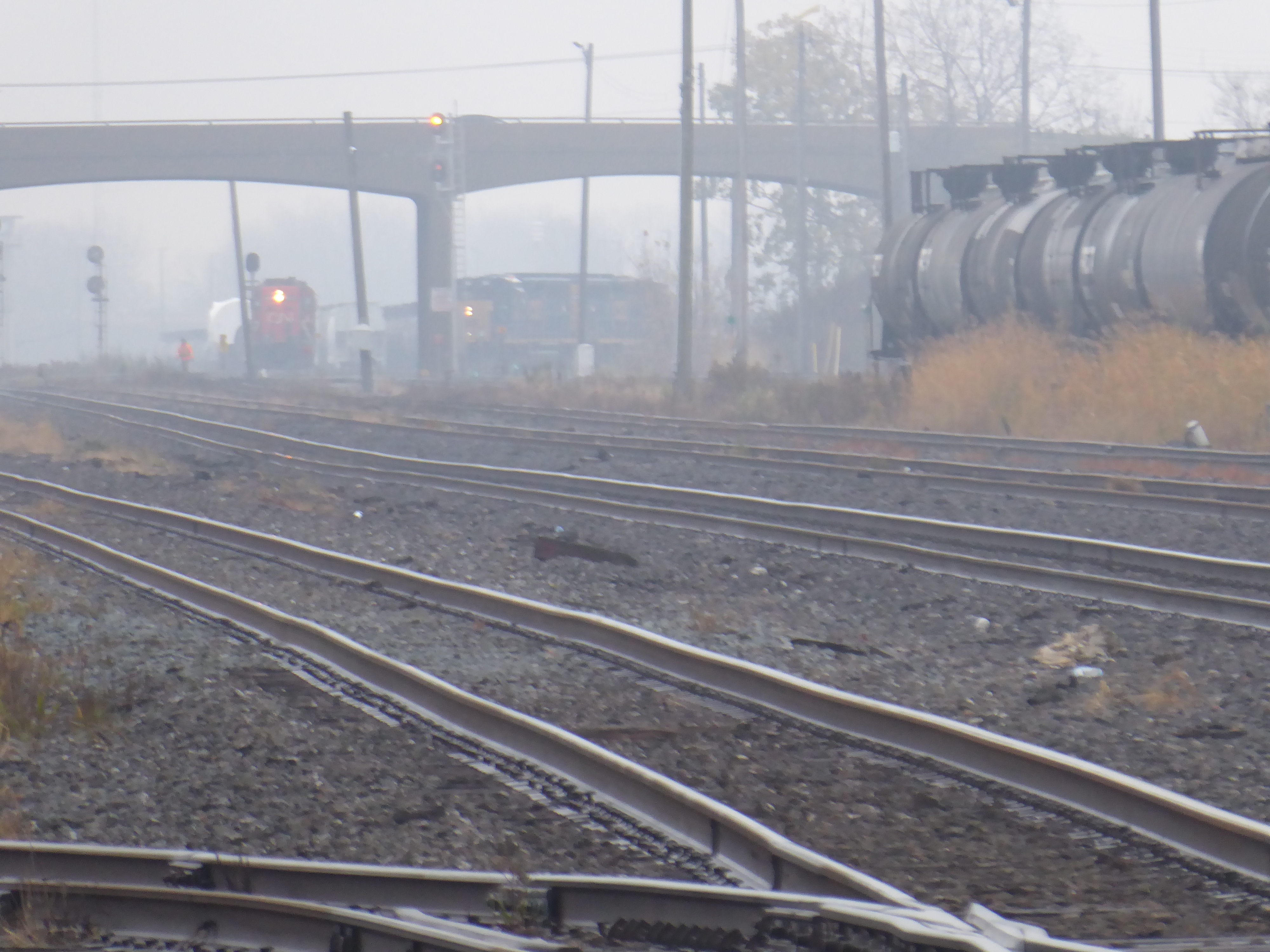
I dropped by the yard late on a damp November morning, and it appeared at the outset that nothing was happening.The yard was largely quiet, except for the string of diesels idling at the refueling pad near the old roundhouse (more images from that to be shared in a later post).

Deep in the yard however, east of the Indian Road overpass, I could see something happening in the yard through the fog.

A CN yard engine was idling there for a few minutes before I spotted an engine with a yellow nose emerging from the refineries and industrial operations east of Indian Road. I was a little surprised, as I have never seen a CSX train this deep in Sarnia Yard. I will admit that my time spent at this yard is quite sporadic, so it might be quite common. Still, every time I see CSX in Sarnia yard, its transfer or interchange jobs are usually situated closer to the Via station in the west end of the yard. So this train being this deep in the yard was unusual, at least to me.

As the train began to slowly make its way toward the station and toward its home rails, I noticed something interesting with the power, to say nothing of an oddity at the end of the train. First, the power.

You can see from the rebuilt cab that this is not the typical GP38-2 unit that has been the power of choice in this area for decades. This unit, with a boxier cab is actually a rebuilt GP40, from what I could find online. I see it referred to as GP40-3 6547, part of a series of old geep rebuilds that have been rolling out of CSX's Huntington shops for years. From what I could read, the new cabs are safer and more resistant to crashes.The units are also equipped with new heating and air conditioning, new control systems, new positive train control technology and refurbished starters. Both units pulling this train were rebuilds. The new cabs remind me a bit of the old GP30 cabs, which were a bit more boxy than their peers of the time. I think I might like these rebuilds better if the cabs had curved corners like the GP30s, but that's just aesthetics.

You can see from the photo above that I tried to capture the CN unit deep in the yard in my shots. I love capturing multiple railways in one shot. 

Here's a better shot, below, of the power from the side. You can see the noses and the cabs both look much boxier than the old geeps, with the headlines in the nose recessed and other features that have been modernized. Not sure what I think of this new look. It's something different for CSX in Canada for sure.

So let's focus on the back end of the train, with that impressively large cargo bringing up the rear. I was pretty stunned to see anything on a CSX train other than tank cars and covered hoppers. Its customer base is almost exclusively industrial operations in the Chemical Valley in Sarnia and related industry south of the city. The goods it carries are always in a tank car or hopper.


A giant tarp-covered piece of industrial equipment sat on a 12 axle centre-depressed flatcar, buffered by two empty gondolas.This is a serious piece of machinery. But what is it? For that answer, I turned to the Chesapeake & Ohio Canadian Division Facebook group, where people much more knowledgeable than me had an answer. There is writing on the tarp, which says Do Not Hump. That seems obvious, but a good reminder nonetheless.
 
 
I was told this car was carrying a gas turbine used in stationary power generation. It was produced by GE Energy in Greenville, South Carolina. From there, it was shipped via Norfolk Southern to East Point, South Carolina.
 
At that point, CSX took over the move as it moved it to Wixom, Michigan. 
 
From there, it was taken through to Flint, Michigan via Lake State Railway (LSRC). 
 
From Flint, CSX power took it to Port Huron on CN H710. 
 
In Port Huron,CN brought it through the tunnel under the St. Clair River into Sarnia. 
 
From there, CSX took it back to home rails where it was delivered to a customer in Courtright, a small town south of Sarnia with a number of industrial customers in the area, including the CF Industries plant (formerly Tera, C-I-L).
 
UPDATE: The one missing piece of information that I could not figure out was the identity of the customer that needed the turbine. That was, until the day I put this post online and a Sarnia local told me the turbine was delivered to Greenfields Energy, a cogeneration plant beside the CF plant. There are a number of power generation facilities in the Sarnia area that are producing vast amounts of electricity, some of this generation being fed by the output of refineries themselves.
 
So that is the story of how this piece of industrial equipment found its way to Sarnia and how I just so happened to be around when it made its final move onto the CSX Sarnia Subdivision. Here's a going away shot below of the train making its way around the tunnel gantry on the rails curving by the roundhouse.
 

 And one more shot around the gantry.
 
 
I didn't stick around much longer, as I didn't want to keep my family waiting. But it was nice to have a few quiet moments at the rail yard and be treated to a surprise.
 
I have shot mainly CN and Via Rail photographs in the past few years, so it was nice to be able to capture something different. In a way, the fog and cloudy skies also helped, as they cut down on the shadows that usually plague shots in this area on clear days. Some good railway karma for a change.

I'll take it.

Monday, December 30, 2024

Some final rough cuts from 2024

Well, the Christmas dust has settled. The decorations will be coming down soon and life will return to normal soon enough. I've had some great conversations and made some new connections through this blog this year. I've seen some interesting things trackside. There was a proliferation of Via Rail content, which was just a factor of what I saw for much of the year. I managed to see some more diverse railway scenes later in the year, which helped keep things interesting. But I cannot deny that it was a heavy Via Rail year.

So, as I close out 2024, here are a few rough cuts, photos with no home, B-sides, outtakes and other odds and ends that didn't quite fit in with other posts that still merit some consideration.

This shot was taken in November as I was waiting for an eastbound Via Rail train to cross Fallowfield Road on the northern edge of Barrhaven. I was returning home from a doctor's appointment and I saw the train making its way slowly toward the crossing. I had mentioned earlier in the year that this was the Year of ABC (Always Be Challenging), where I encouraged myself and everyone else to get out of the routine of taking the same old railway shots and try to get something new and interesting.

In this case, this shot was a matter of good timing, but it was also a chance for me to get a sidelong shot of a train near Fallowfield Road. I had never attempted to get a shot here before, so it was something a bit new. 

This shot was taken at Montreal's Central Station, as our train was about to head back west to Ottawa. As I mentioned, I tried to think of new images to get this year that were not the same old railway photos. I took a few shots in the limited lighting of the underground platforms in Montreal. This was one of the few that didn't have a reflection of my own car's interior, so I included it. It's the side of a Via Venture locomotive taking off. Again, nothing special, but I like it for some reason. It gives me the feeling of movement; of people going to or from some place; of the countless human stories that are waiting to be told once these trains get to where they are bound. There are many shades of grey here, just like with humanity.


Here's an interesting image from Tupperville, Ont., a tiny rural community of about 300 people in Chatham-Kent that is equidistant from Wallaceburg and Dresden. This is the site where the old CSX Sarnia Subdivision serviced the London Agricultural Commodities grain elevator on Centre Sideroad in Tupperville. The image doesn't show that the track over the road had been paved over, yet the rails remain in place through the elevator, awaiting the inevitable lifting up, whenever that happens. For years, efforts to get rail service restarted on this portion of the old CSX line were ongoing, but the end is definitely nigh. Interesting as well that the company's webpage for this elevator clearly shows the rails in place. Just a few metres from this spot, you can see the concrete abutments for the old rail bridge that once carried trains over the Sydenham River. A sad scene for someone who grew up watching trains on CSX rails through my hometown.

Here's a shot taken from the Hunt Club Road overpass as an evening eastbound glides toward Federal Junction en route to Ottawa's main train station. I tried to capture a shot that encompassed the beautiful evening sunset as well as the train. I don't know that I quite captured what I was seeking, but I like this shot nonetheless. It's the human stories aboard that train that are waiting to be told that fascinate me. You can even see the recently removed spur that once served Bentley Avenue customers. Those rails and the old switch stand still lie in the weeds trackside (in the bottom of the image). Here's a post with another photo I took the same night. The shot I used in that post did not include the evening sky to the same extent.

One final image from deep in CN's Sarnia rail yard. I dropped by the station one morning in early November when I was on the way to my sister's house. There appeared to be nothing happening when I arrived so I stuck around and took a few shots. There was a major surprise in store, which I will wait to share in a future post. But, when I first arrived, this was all I could see, other than the long line of diesels parked at the old Sarnia roundhouse.

Even though the fog made a clear picture almost impossible, I do like this shot, which is a bit eerie and wistful. 

So that is a wrap for 2024. Thank you everyone for stopping by. Lots more to come in 2025, I hope. Happy New Year!

Monday, March 20, 2023

Random photos from a random year

Last year was an odd year for my railfanning activities. There were some great moments where I was able to capture lots of images and material and then there were moments where high expectations met flat reality. In other words, it was a year of highs and lows. The challenge I always face as a blogger from Ottawa is that there isn't nearly enough going on here for me to maintain a weekly blog. You can only photograph Via Rail trains so many times before it gets old and before you run out of things to mention on a blog. I suppose if I had focused my blog on passenger trains exclusively, then I would be in better shape, but I never intended for this blog to be so narrowly focused.

Bloomington, Indiana, USA

Naturally, whenever I get out of Ottawa, I have high hopes of capturing something to share. In September, my wife and I travelled to Bloomington, Indiana, to attend a wedding. I was excited, as Bloomington was situated along the Indiana Rail Road's Indianapolis Subdivision, south of the state's biggest city. Sadly, in my research, it became apparent that this part of the railway's subdivision saw sparse traffic, with much of it passing through at night, mainly coal trains. Our hotel was within walking distance of the rail line, but it was quiet for much of my time there, except for a weekly local, which passed by on Friday evening. I only know this because I heard it while eating dinner in the city's downtown.

But the city has some fascinating railway history that is visible and accessible. Although Bloomington hasn't seen regular Amtrak service in many years, the town's former passenger station is still standing next to the rails, although it wasn't clear to me if it was a private residence, art studio or business. It looked like it could be any of the three, although there was no signage to indicate what it was used for. I decided to confine my photographs to shots taken from a small winding road that led to the station on the hill.

It looked to me like the station once housed a restaurant, where the station had an addition added on the left. The originals stone structure appeared to be a residence. Interestingly, the station sign still hangs on the side of the building. It would be a good thing, in my opinion, if some civic-minded person saved this sign, cleaned it up and housed in a local museum. I am always fascinated when I see old station signs and relics in local museums. They are a part of a community's history.

While in the city, I also came across what locals call the freight station. The building is a fairly nondescript maroon wooden building, which has an elevated main level, which is your first clue that it served the railways. Since the building served only freight purposes, it really doesn't have the architectural flourishes you would see on a passenger station. Still, the building was significant enough that it was declared a national historic site. After closing in the 1960s, it served as a restaurant at various points. Today, it is an office building.

The building has an interesting history. It was built by the Illinois Central Railway in 1906 in response to a local effort to attract a railway to compete with the Manon Railroad, which was the sole railway serving the city at the time. The IC depot was built after the IC finished its railway line through the city. The presence of the depot spawned economic growth in its immediate vicinity, which sustained the city for decades. It wasn't until 1963 when it closed, due to a decrease in demand for rail service. 

Still, as you can see, the elements of the building have been well maintained, including signage on the side of the building, indicating its original purpose. You can also read about the building's importance on the plaque amid the hostas. This was the rail line that connected America from north to south through its heartland, from Chicago to New Orleans. You might recall the famous Willie Nelson song, City of New Orleans. That song is about the train of the same name that rolled through Bloomington for decades.

Corunna, Ontario

This shot below could have been something special, had I been just a bit quicker. I was in the middle of a visit to my sister's house. My sister's property backs onto the CSX Sarnia Subdivision, just south of Corunna. I was caught in a bad place when an unexpected CSX local rolled by carrying a string of gondolas destined for the the old Ontario Power Generation Lambton Generating Station power plant, which is in the process of being demolished. I have meant to get a shot of one of these trains, which are a rarity on the CSX line, since this operation deals almost exclusively with tank cars and covered hoppers for petrochemical customers.
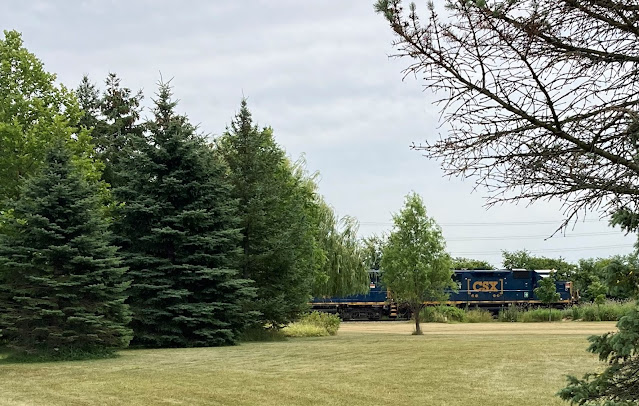
The biggest issue at this moment was I was in the middle of a conversation with one of my sister's neighbours and didn't want to be rude by bolting for the tracks. So I politely turned around and got this shot of a CSX local poking out from between the trees. There were two GP38s with the new CSX scheme pulling a load of about 10 AIM gondolas. A big missed opportunity, but at least I got something, right?

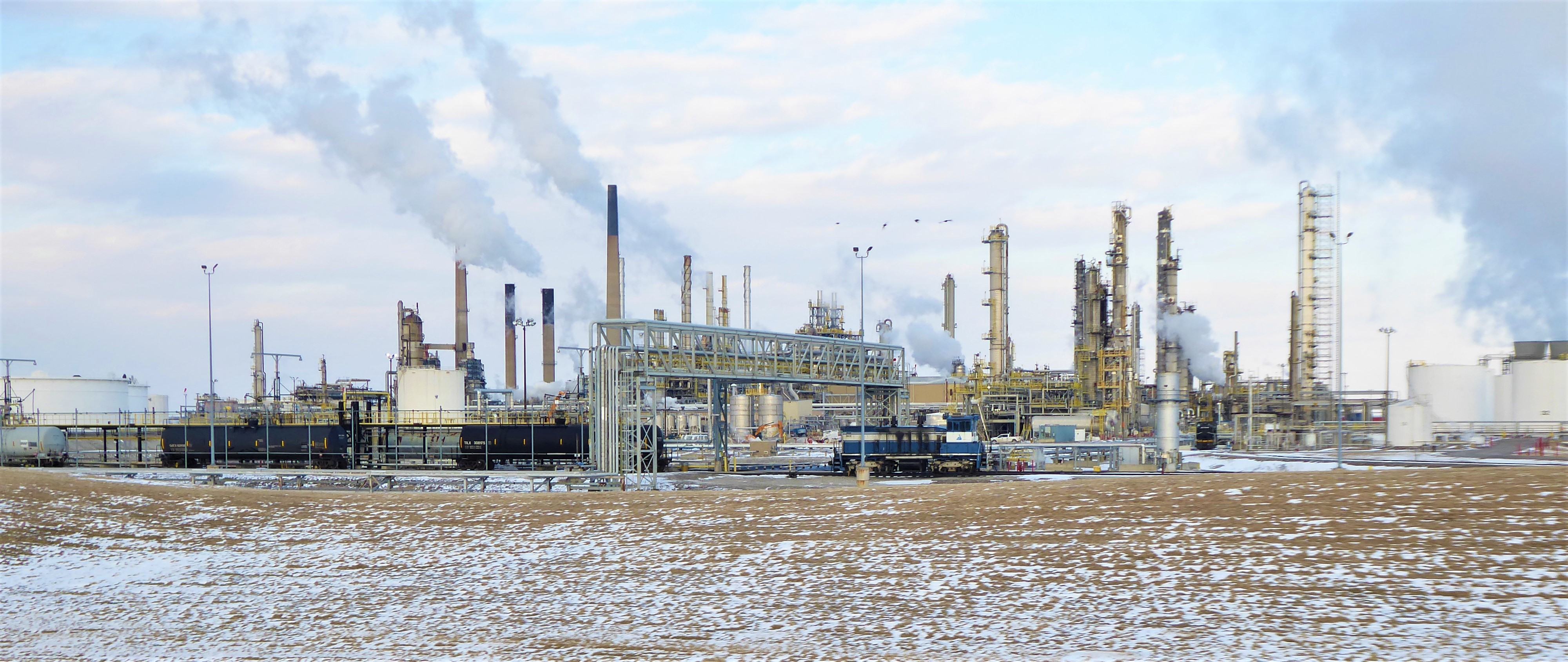
Earlier in the year, I was visiting family on the March Break when I passed by the Nova Corunna refinery on the Highway 40. Its rail operations have expanded a great deal in recent years, as the facility has undergone an immense multi-billion dollar expansion. The problem with getting a shot of rail operations here is you need to shoot overtop of the earthen berms. That means getting a shot from the highway overpass, which goes over a spur connecting Nova to the CN St. Clair River Industrial Spur. This can only be done if you are on the highway when it is empty or when you are in a passenger seat. In this case, I was riding shotgun in my brother's car, which made the shot easy to capture.

These are not easy shots to get, so any time I can capture Nova's old SW switcher, it's a win. I like the colours of the sky in this shot mixed with the smoke from the stacks. As I have mentioned a fair bit in the last year, I am much more interested in train photos that incorporate the surrounding landscape. I could have zoomed in on the switcher, but I wouldn't be getting the old story behind the shot. I will be doing a deeper dive into the SW switcher, as I have a few cool shots of these old beasts. They are rapidly fading from railways. Most of the survivors are in use on short lines or industrial operations. 

Ottawa, Ontario 

Most of what I captured in Ottawa in 2022 was shared in my posts. I only made it out to Via's Tremblay Road station once. When I was there, I got a quick shot of an O-Train on the Confederation Line heading west toward Tremblay Station. It was not a good year for the O-Train as its operations were disrupted a number of times by various mechanical issues, accidents and even a lighting strike. I don't generally like to shoot these operations, as I don't find them all that compelling from a photography point of view, but I made the exception on this turn, since the sunlight made for a quality image at that moment.

There are a few more odds and ends from last year that I considered throwing into this pot pourri of a post, but I have plans for those shots in some upcoming themed posts, so they will have to wait. I can't really complain about my adventures trackside last year. There were definitely more hits than misses, which you can see in this year-end post. But I am always taking shots trackside, no matter what. You never know when those random shots will come in handy.

Thursday, August 20, 2020

It's not the end of the world as we know it (and I feel fine)

The summer of my not-so-amazing luck continues, but before I get into some new content (finally have some new meets and pics to share!), I wanted to touch on something that seems to be top of mind here in Eastern Ontario and Ottawa these days.

No, it's not the perpetually awful O-Train.

It's the fate of freight railways in the capital. In case you've been living under a rock, you know that CN has filed to discontinue service on the former Ottawa Central in this region. It doesn't come as a surprise to me, since this is hardly a strategic or important operation for this railway.

But I do want to remind you of a few things. You might recall (or you might not) that the former head of the Ottawa Central told this blog that he thought there was a good opportunity for a short line to resume operations in the city. This is not a railfan offering his opinion. This is the guy who successfully operated OCR in this region for years, before a recession forced the hand of OCR's parent company.

Here's another item to consider. Closer to my hometown, there is a significant portion of the old CSX Sarnia Subdivision, which has been dormant for several years. The railways wanted to pull up the line, but the Municipality of Chatham-Kent bought the rails in its territory to try and salvage an important freight link for its businesses and farmers. The prospects of a new operation were dim for years. At one point, Ontario Southland considered the operation, but backed away.

Well, lo and behold, a company has indeed purchased the line with the intention of operating a short line, mainly for rural customers along the line. I mention this because I see the CN operation here in Ottawa as very much the same type of short line. It has a limited customer base, but the beautiful part is, there seems to be very little overhead, compared to what OCR had to shoulder when it operated here. And who knows what a company focused on carload business can do when it has feet on the ground in the city who are solely focused on small customers?

So, I will say once again that this is not the end of freight railways in Ottawa. Not yet, anyway.

Tuesday, May 12, 2020

Real life inspiration for a fictitious branch

The good news for my model railway in my basement is that the main line works and three spurs are essentially operational. There are rough spots causing derailments and the wiring is about 90 per cent complete. I have a rough idea of a piece of my town and a plan for a railyard and interchange track.

The bad news is I need a tonne of supplies and time (which I don't really have) to complete some of the important next steps. I'm trying to decide what next steps I can take with what I have. But I will share a few details of things I have done so far and give you an idea of where I found the inspiration in the actual railway operations I have photographed over the years.

A bit of context. I am not modelling any actual part of the CSX Sarnia Subdivision. Instead, I am taking elements from both the north and south ends of the line (Chatham had a number of rural agricultural customers while Sarnia had the industrial and petrochemical customers). There were points on the old Sarnia Subdivision that had both the agricultural and industrial customers. I am modelling what I would imagine to be a branch off the main sub that would include many of the elements one would have seen along this operation in the early to late 1980s.

One thing I am proud of is my maintenance-of-way spur that sits next to the mainline near the station.


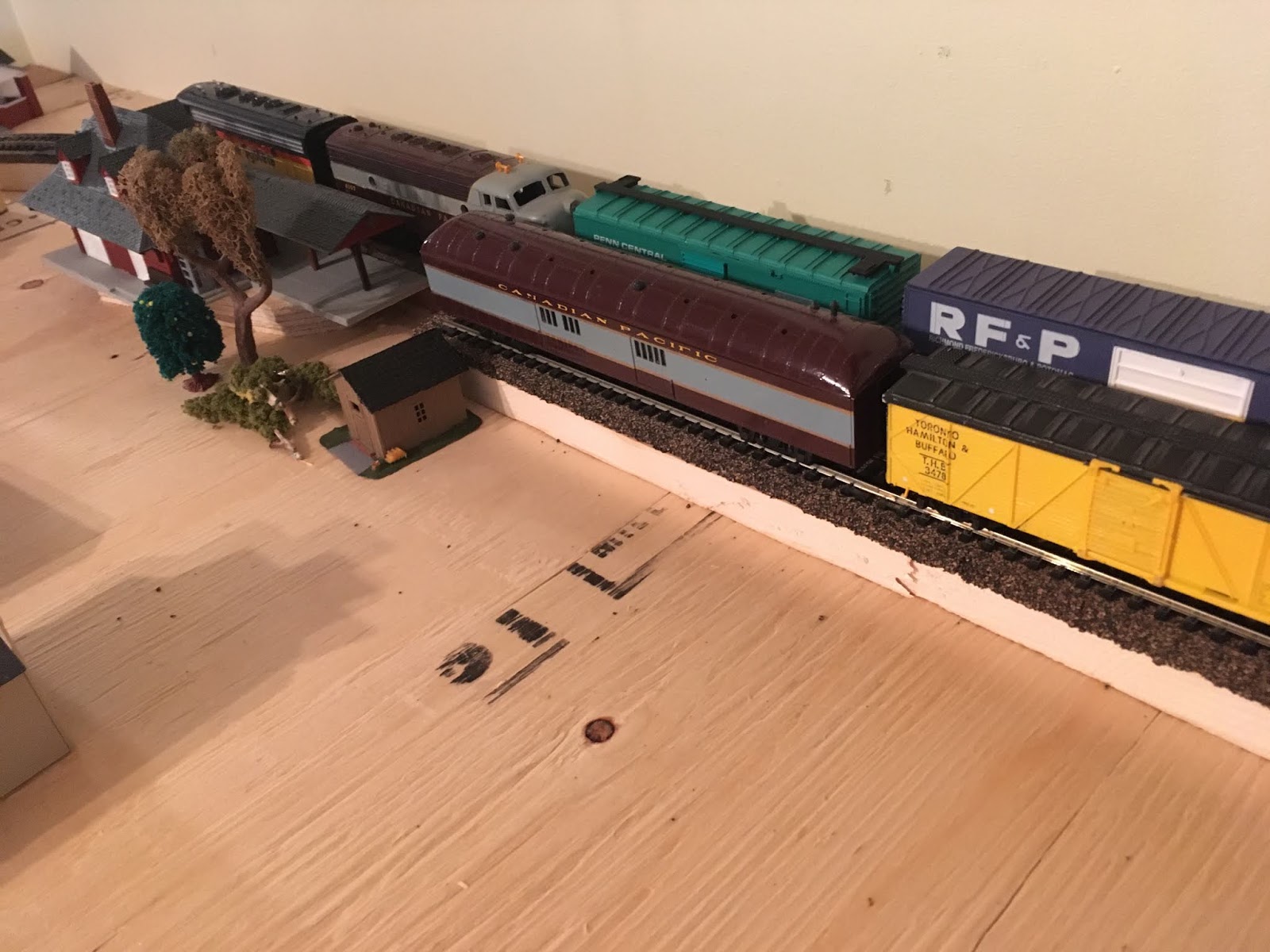
One half of the MoW consist has an old Canadian Pacific baggage car, which was not an uncommon thing for railways to use during this time. Since the Sarnia Sub intersects with the CP in Chatham, I took the liberty of blending both railways. You will also notice an old wooden TH&B boxcar. Some of these old wooden boxcars lived well into the 1990s as MoW cars. The photo below from the Sarnia end of the the CSX operations gives you an idea of my inspiration. I would love to one day put together a detailed C&O MoW boxcar like the one below, but the TH&B boxcar will have to do for now. It was once part of the CP empire, so it's a stretch, but I am not one for strict adherence to prototypical operations. I like to freelance a bit.


Here's the other end of the MoW consist. It features an old Cotton Belt gondola and a CP flatcar, which I built from an old Ulrich kit. I had to look up this company to see what it was. When I bought this car, I had never heard of this model train maker before. You can see the rooftop of an industrial building in the shot as well. I'm not sure what it is going to be yet. You can also see a short train on the mainline with AT&SF, Bangor & Aroostook, RF&P and a green PC boxcar trailing a set of F units. All of these boxcars, except the PC, were given to me last year by a friend who had them in his basement collecting dust. What a gift!


Here's a closer shot of the CP flatcar. It took a lot of work to put this 60-year-old car together and get it operational. The couplers that it came with I had never seen before. I had to put in a conventional coupler and modify the car a bit to get it to fit properly.


Here's a shot of a MoW gondola I saw once in Sarnia, which gave me the idea that I needed one on my own maintenance track.


Here's a final shot of the mainline train and the station spur, below. You can get an idea of the developing town from this angle. There are a couple of things to note in this shot.

One is I bought an extended platform kit for my train station but found that it wasn't needed for what I was modelling, which is essentially a small town. So I used the extra platform for a railway themed park across the street from the station.

The next thing is the Chessie System F unit. You will see that it is mated to an old vintage Canadian Pacific unit, which needs a lot of work to make it look a little more realistic. Again, the old CSX Subdivision from my youth did not include shared power, but there were instances in Southern Ontario, particularly in the case of the CASO Sub near Windsor, where shared power did happen. So, it's another liberty I am taking. To be honest, I was just testing the old CP dummy to see how it handled the tracks. It has a temperamental coupler in the back, but it's working really well so far.


Try as you might, you will not find any real world example of a Chessie-painted F unit. I looked into it and discovered that the Chessie System did not retain any F units for revenue service, so this F unit is someone's idea of what it would have looked like if the railway had saved any of the covered wagons from its predecessors' long gone passenger service. The closest thing I found was that the old Seaboard System retained a set of F units long after it gave up its passenger operations.

You will also notice that the station is sitting on a block of wood. It will, of course, be elevated from the town, much like the Guelph Via Rail station is situated well above that city's downtown. The station is a common kit from Atlas. I like the look of it, since it reminds me of the old C&O station at the foot of Clifford Street in Sarnia, nestled behind the Esso refinery. The station looks different these days. Back in the early 1990s, it looked pretty rough. My station is a bit more tidy, for sure.


So that's one part of my set that could be close to getting some scenery in the near future, since it is pretty much set from a functional point of view. There is another part of that spur, which will serve a small farming operation. The building itself (you can see a piece of its power in the second last shot) is an old lumber mill, but it's generic enough that it can double for just about any old industrial building. I'm hoping to convert it into a feed mill, so I can use my hoppers and cylindrical hoppers there. That's a topic for another post.

Tuesday, May 5, 2020

Takin' it to the basement

The trackside time has pretty much dried up for me, since there is so little happening in Ottawa to begin with, but with the stay-at-home orders, it's even tougher. I've been thinking of things to share in this strange time. I have a model railway in my basement, which doesn't receive a lot of attention in busy times. But it's seen a little bit of love in the last few weeks.

I have been trying to figure out how to take a decent shot of the set, which is far from finished. The walls of my den are also adorned with pictures and framed copies of some of my old newspaper stories from my journalism days. It makes photos pretty tough. There's also a lot of bare wood still showing and a lot of unfinished track work, particularly in my rail yard.

So, I decided I would content myself with a few shots of a few test trains that I have been operating, just to ensure my main line is somewhat operational. So far, my operations have gone quite smoothly, with almost no derailments. That's a real step up from my days of model railroading back in my teens, when persistent operational problems were enough to make me quit the hobby for long spells.

Here's a shot of my test train, led by Chessie System SD40-2 7614. It is passing by a spur that will serve some sort of plastic or petrochemical customer in the near future. I have a storage tank, tankcare unloading platform and a general purpose industrial building.

Right now, I have some intermodal cars parked there for no reason at all. Possibly my railway is relying on car storage fees before its official start-up. Those container wells were actually given to me. They don't really fit in with what I'm doing, but they look okay parked.

The covered hopper I picked up used a few months ago. Someone tried to apply their own West Virginian livery on the car alongside the Chessie cat, but I was able to get rid of the hand-drawn logo for the most part. What's left looks like old graffiti, which is okay by me. I used to see these hoppers an awful lot on the Sarnia Sub when I was a kid.


I should mention that the SD40 was an engine which did not prowl the Sarnia Subdivision, but I like to use it anyway, as it was a Christmas gift from my parents many years ago. I am not one to strictly follow prototype rules. I'm not sure what part of the old CSX Canadian operations I am modelling, but I am trying to blend a few of its operations in and around Southwestern Ontario.

My diesel roster also features a B&O GP35-2 and a Seaboard GP38-2. There was sometimes a blend of pre-CSX power on the Sarnia Sub before the CSX units began to take over. The Seaboard units were exceptionally rare, but they were not unseen, in my experience.

I also recently finished a secondary spur that ends at my station. The spur now houses an old Canadian Pacific baggage car, a wood box car, a flat car and a gondola, which will act as a MoW consist, if I ever feel the urge to operate one of these trains.

It reminds me of this MoW consist I once captured in Sarnia. In fact, this photo below was my inspiration.


I would be happy to share some thoughts about my model railway endeavors, but rest assured that I intend to continue my focus on real world railways when the world opens back up.

Take care. Stay healthy.

Sunday, March 29, 2020

Three shots, lots of history

I am always aware that many readers of this blog come across it accidentally and read these postings long after I posted them. So rather than expounding on the state of the world as it stands on March 29th, 2020, as I write this, let's just enjoy what we came here for. Let's explore our passion for railways together for a few minutes and consider ourselves lucky to be able to do so.

With that in mind, I recently came across some images I captured this past summer in Southwestern Ontario when I was visiting family in the Sarnia area. Those who are regular visitors here know I post a lot from this area, since it is where I grew up and it remains a spot I visit semi-regularly.

One day near the end of my last visit, I took my nephew and my daughters to the Sarnia CN rail yard on our way home from a visit to a museum in the downtown. We were treated to the sight of a tunnel train marshalling its load together in front of the Sarnia Via rail station. You can read all about that train here.

But as I was looking for other items of interest in the yard, I turned my attention to the old Sarnia roundhouse, where Lambton Diesel operates as a repair and refurbishment facility for many railways. That means you are often treated to the sight of rare or odd units in the yard, depending on the day you visit.

Take this image below. You can clearly see the long hood of an old CP geep in its action scheme It's most likely an old GP9, which was one of the last of the railway's GP series that was rostered on the railway in recent years. My guess is this hood was from a geep that was sold off to a shortline or industrial operation before it reached the end of its lifespan and was sold for scrap or parts.

You can also see the old Novacor SW series switcher, which appeared to be in for servicing. I have shot that unit at the Nova Corunna plant a few times in recent years, where it still operates alongside what appears to be a genset. And old CN warhorse GP9 is peaking out from behind the shell of the old CP geep hood.


Here's another shot with no shortage of interesting material. You can the see the exposed engine of an old CN SW1200 switcher in the centre of the frame. To its left, the old Esso SW switcher, which likely was in for servicing. As Imperial Oil still has a very large presence in the Chemical Valley, I'm sure that switcher is kept busy

Look to the left of the Esso unit and you can see a grey shell of another geep unit. The grey could be primer or possibly it's an old CSX livery. I am guessing it's been taken down to primer. Just a hunch. Looking to the right of the frame, you can see another grew SW unit behind the old CN unit. To the right of the frame, CSX has one of its GP38s in for servicing as well.


I almost missed this unit, but saw it at the last second, sandwiched in between a tank car and an NCIX covered hopper. I don't know how many of this GATX units are still in use on the CN system, but I'm guessing few, if any, especially given the dearth of business right now.


So there's a brief distraction for you. Lots of 1960s-1970s heritage units, all in a few shots. I always make sure to get a shot of these old locomotives when I see them in Sarnia because you never know which ones are destined to become parts for another engine.

Catch the history while you can.

Friday, January 31, 2020

Southern Comfort (Part II)

The second part of my plan to do some railfanning in Florida included a visit to the Plant City Railway Museum and the adjacent railfanning platform at the junction of the old Atlantic Coast Line A Line and the Seaboard Railroad S Line. (Here's the first post.) It all sounded very promising. The daylight wasn't terribly kind and the position of the buildings meant this was the only decent shot I could get of this caboose.


Those who read this blog know I am a fan of CSX's predecessor railways, since the Chessie System (former C&O, former Pere Marquette) served my hometown in Southwestern Ontario. That line still exists in a much reduced capacity as part of CSX's industrial switching operation for the Chemical Valley in Sarnia and a few scattered industries south of the city.

So a chance to see two historic predecessor rail lines in action was pretty exciting. The Robert W. Willaford Railroad Museum is located in the city's former Union Station in the downtown. It was not open on the morning I visited, sadly, but there was more than enough on the museum grounds to look at, including this wonderfully preserved and rehabilitated Seaboard Caboose.

Plant City is an area that is dotted with a number of railway tracks, but the activity in and around the city is mostly relegated to overnight freight action, which was a big disappointment to me.


This Whitcomb switcher is almost too small to be believed. You have to see these machines to truly appreciate what it must have taken to fit any type of railroad-grade horsepower into such a small box. I looked at the axles and wheels on this thing and wondered how it maintained its balance. This unit, ACL 508, was painted in an unknown-to-me purple and grey livery for the old Atlantic Coast Line. These engines remind me of the trackmobiles you sometimes still see in industrial switching operations.Here's an example of one, for comparison.


Since the S Line and A Line were so quiet, I made sure to seek out the details on the museum grounds, such as the Seaboard logo on the caboose. Here's an interesting piece of trivia. The Seaboard Railroad adopted the "Air Line" into its name as a way to compete with airlines. The Air Line nomenclature was meant to signify that the Seaboard routes were the straightest and most direct connections between destinations. So, in other words, it was like flying straight to your destination. Interesting marketing concept. I always liked this logo.


The ACL logo was incorporated into a number of railroad items on the grounds, including a few benches, which used old rails bent to act as supports for the wooden slats. I like that the old ACL listed its major destinations on the outside of its logo. It gives you a good idea of the reach of this old line. That tradition continued when Seaboard and ACL came together as the SCL, which in turn became part of the loosely joined Family Lines system (later Seaboard System). Here's an example of the Family Lines logo.


This is where I waited, and waited, and waited. The signals on the A Line and the S Line remained solid red in my time in Plant City, which meant that nothing was happening. I was really disappointed that not a single train passed through, although I did know going in that traffic was light to sporadic in the daytime. Welcome to modern PSR-obsessed railways. Sigh...

Another small piece of trivia I unearthed while in Plant City was that the town itself was not named after the famous strawberries that grow in the region. Chances are, if you buy strawberries with any regularity, as I do, you will likely buy Plant City strawberries at some point during the year. They are known to be some of tastiest in North America. But, the Plant in Plant City comes from the railway executive who originally laid the tracks through this area. So, like many other cities and towns across North America, the town name can be traced back to the railways.


The final insult in my time in Florida was my time spent with my kids at Disney World. Even the Magic Kingdom's famous steam railway was out of commission on the day I visited. The entire railway was undergoing significant maintenance and renewal, including the removal of some of its narrow gauge track. I will hand it to the people in charge through, who knew enough to park one of the trains in front of the Magic Kingdom train station for the Christmas season. A nice touch.

So, on the whole, my train karma wasn't great in my time in Florida, but I suppose it's better to have bad train karma and be warm than have bad train karma and shiver trackside, as many of us often do in Ottawa.

In case anyone is wondering, yes I have some strong opinions on the absolute disastrous launch of Ottawa's Confederation Line light rail service. But that post will have to wait for another day. 

Friday, May 17, 2019

My railway happy place

I’m tired. Tired from renovating my basement after a flood and tired of rehabilitating my property after we had a new pipe connected to our house, which destroyed our front yard and landscaping. So yeah, I’m tired from that. I’m also tired of this wet spring and cool temperatures. This spring has not been great and much of my time has been spent as a cut-rate Mike Holmes wannabe.

So the blog has suffered a bit. I was thinking of new things to talk about and there is no shortage of newsworthy items from Ottawa. Our new LRT is still not ready and doesn’t appear to be, even though it is more than a year behind schedule. Did I mention that one of the new electric trainsets derailed just outside of Belfast Yard recently? Okay, maybe this topic is not your cup of tea. How about the uncertainty over CN’s desire to pull out of Ottawa? How about CN’s recent (and vague) advertisements alluding to some sort of celebration they are organizing for Ottawa next year? I’m wondering if they’re even going to be here still.

I am not going to write about any of this. I’m bored with reality, tired of light rail and full up with day-to-day headaches. I want to think back to when I was young and just liked watching trains go by; a time when I simply admired them for the mechanical marvels that they are.

With that in mind, here are a few small anecdotes and observations from the railway of my youth, CSX’s Sarnia Subdivision. In many ways, this rail line is an anomaly that you don’t often find anymore. I was looking through some photographs of this line the other day when I noticed some interesting things that I hadn’t seen before.


1. In this shot, can you see the old telegraph pole? I never noticed it before and with good reason. They are pretty small, compared to the old poles I’ve noticed along other rights-of-way. Just a single pole and two measly wires leaning away from the roadbed.

As readers of this blog know, this line is actually quite old. It has changed hands a number of times and reads like a who’s who of CSX predecessors. It was the Erie and Huron Railway when it opened for business in 1886. It changed hands once and was renamed before becoming part of the Pere Marquette Railway in 1902. From there, it became part of the Chesapeake and Ohio in 1947, and then the inevitable mergers brought in the Chessie System group of companies before finally becoming CSX Transportation.

Unlike many other railways, this line shed its passenger service in 1933, much earlier than other lines. It’s a shame that none of the passenger stations have survived, other than the old Mooretown Station, which is located on the grounds of the Moore Museum.

But that little telegraph pole, barely noticeable as it is at the back of my sister’s property, which extends to the tracks, is a witness to the history of this line and its importance in connecting a very large and scattered group of settlements in Lambton County.


2. This is something I’ve noticed before but it was particularly noticeable behind my sister’s house. Usually, a railway’s roadbed is elevated a fair bit above the surrounding landscape for many reasons, not the least of which is to prevent washouts from floods. In many areas along this line, the roadbed is actually not elevated all that much higher than the surrounding area. I really noticed it in these images. It made me wonder if this was a factor of neglect in that the railway has not bothered to bolster its ballast in a while or if it was a factor of the line’s design. Did the elevation in this area suggest to the line's builders that it did not require that much of an elevation? I wonder.


3. I’ve shared this shot before, but I like the fact that this line still has concrete mileposts, like this one near Emily Street in Mooretown. I’m not sure how many are actually left but I like the fact that some of them are still around. I recall as a kid seeing concrete W signs as well, but as you can tell from this shot below, some of them have been replaced over the years.


4. I didn’t realize this until I was older, but this rail line has no speed or occupancy signals, and for good reason. The line, even in its heyday, connected with CN in Sarnia and CP in Chatham. The trackage through Chatham-Kent is now finished, of course, and the Sarnia connection is used only for once-a-day interchanges between CSX and CN at CN’s Sarnia Yard. CSX also connects with CN’s St. Clair River Industrial Spur at Terra Industries, south of Courtright, but this connection seems to be lightly used or unused at the moment. The point is, neither of these current connections require signals. The Chatham connection did have signals but I think that was it for this line. Up until the 1950s, the line also connected with the former Canada Southern St. Clair Branch in Courtright, but I have not seen any images of whether it was governed by any signals. A real throwback. I imagine the line was (and still is?) governed by OCS.


5. One more way this line was really different. I remember watching a competitive baseball tournament one summer when I was young and then hearing the rumbling of a GP38 (like this one pictured) on the adjacent rail line (this line in my day was the exclusive domain of this geep). Well, didn’t the engineer stop the engine next to the ball field so he could watch some of the action? How many rail lines have this type of casual attitude these days? It reminds me that numerous blog readers have told me that they see CN 589 stop at the March Road railway crossing in Kanata so the crew can pick up a Tim Hortons coffee on their way to Arnprior.

You know, I feel better now. It’s been a tough couple of weeks of hard work for me. And my commute to work has been changed by bridge closures, due to flooding. So, not a lot to cheer about, but I have plans to have a trackside day in the coming weeks. This was the same trackside day I planned a year ago. So, things are looking up.

What about you, fair reader? Where is your railway happy place? Or where was it?