Showing posts with label Sarnia. Show all posts

Monday, July 27, 2026

Before I forget

It's always a nice feeling when I remember I have a bunch of railway photos from last year that I still haven't shared yet. This week, I recalled a batch of photos I had taken in Sarnia and elsewhere that had not yet made it into a post. So here are some lost photos from my wanderings in the past year, as well as from this past spring.


Resting on an early November morning under a big Southwestern Ontario blue sky, a host of CN road power points east at the east end of the Sarnia Yard, likely awaiting the next train to pull toward Toronto. I would venture a guess that the power here is usually substituted onto trains that originated in Chicago and make their way east under the St. Clair River tunnel. I do know that significant cuts of cars from the Chemical Valley are put together here, so it is possible this power is for Sarnia-originated trains. I do see a CN 100 unit partially hidden behind a railway maintenance truck. 

I was aboard Via Rail Train 84 eastbound when I captured a few images in the yard. To be honest, one of the Via Rail service managers insisted on instructing me on the the safety features of the car, as I was one of the few people aboard. Being a good citizen, I listened patiently, even though I wanted only to capture a few photos before I left my hometown. 


 I like this shot as well, as it is a showcase of three different CN paint schemes from the side.


One final image from Sarnia Yard of a former leased unit, now stencilled as CN on the cab. This unit was sitting on its own, far from the area where the rest of the power was arranged. I would imagine this unit was between switching assignments. Usually in the yard, the switching is done by the older, smaller geeps without the wide nose at the front of the cab, but it's also not uncommon to find a larger unit like this one assigned to switching duties. 

This next shot was taken at Fallowfield Station in May. I don't generally take a lot of shots at this station anymore, because I think I've exhausted most of the photo possibilities there. However, I did see an opportunity to get low at the extreme east end of the platform. At this point, there is a shallow drainage ditch. I got down in the ditch a bit and took a shot from way down low, trying to see if it met my criteria as something different

As you know, Fallowfield is a place where you can get up close with trains, but the shots almost inevitably end up being very tight wedge shots. I like that we can see the gravel laneway to the tracks and the bundle of rubber strips that were used to refurbish the station platform between the main line and the passing siding. You can even faintly see the signals closer to Woodroffe Avenue. The clouds in the sky also lend this image a bit of interest.

 
Here's something from Stratford that I'll get into a little later in another post. I am lucky that I get to visit this town once a year to take in theatre, visit with family and make my way trackside to see both CN and GEXR in the city. Here's a shot taken against the harsh summer sun of a CN local heading into the city from Kitchener. 
 
 
As I was going through my photos from last year, I knew I had a few items from both Stratford and Sarnia to share. I'll share more of this meet in another post, but I thought I'd include one of my favourite shots, even if it's tainted by the harsh morning shadows. Even in touching it up, the shadows are still pretty profound. But how cool is it to see two GP9s (one GP9 actually, I didn't look closely at the second unit, which is a GP38...thanks to a reader for pointing this out) in the safety stripes scheme still soldiering on in 2025? This photo is timeless in certain respects. It could have been taken 10, 20, 30 or 40 years ago and you wouldn't be able to tell the difference to the scene today.

Friday, January 2, 2026

Make Railways Interesting Again

Being a railway enthusiast sure is different these days. I am not going to go down the road of saying everything was better when I was young. It wasn't. Some things I found were better while other things were not. But I will say this. Railways have taken on a sameness, for lack of a better term, and it's really affected my enjoyment of rail photography.

Again, I won't say that things aren't what they used to be, across the board, because there are some aspects of railways today I find fascinating. But I cannot get excited by endless container trains, at least in that, once you get your initial photographs of the power up front, there really isn't much left to photograph. The same can be said for most rolling stock. Most covered hoppers are endless strings of grey, with only their alphabet soup of lease company reporting marks to offer any variety. The same has always been true for most tank cars, as this continental fleet has been under the control of leasing companies for far longer than other cars.

The question is what can we do to keep this hobby fresh when there is so much blank space on cars and so little diversity? With most railways not investing much in new rolling stock, there's not much variety in the average freight train. Also, with much of the fleet of fallen flag cars on its way to the scrapper's torch, there's a scarcity of history to capture.

Over the last few years, I have found that I have begun to refine my approach to railfanning quite a bit, without even realizing it. These small changes I have made to my approach have really allowed me to make the most of what there is to capture out there these days. I'm not saying it's for everyone. I understand that there are people younger than me who don't have the same experiences I have in my arsenal, so they don't know what they're missing, so to speak.

For that matter, there are people older than me who could say the same thing about my outlook. I will never know the luxury of their past experiences, so I cannot say whether their time spent trackside while young was better than my time spent trackside when I was young.


So here is my refined approach to railfanning, developed with modern railways in mind. 

1. Don't begin and end your time trackside documenting power only This might be my biggest disappointment when I look at the work of others. It's also a critique I have of my own work at times. So many videos today essentially follow the power to the detriment of actually cataloging the entire train. I try to look for shots of the train from different angles. This means finding interesting trackside infrastructure to frame the entire train against. I find shots of engines with no context are not terribly interesting anymore. Unless I know where the shot is being taken and the context of the train's movements, I am not all that excited.

Look at the shot above from Smiths Falls in 2017 and look at the shot below, taken with details in mind. I know which one I prefer.


2. Try and get the big picture This is one of the hardest challenges of rail photography and it often goes against our natural desire to get as close to the action as possible. I think we spend so much time shooting the power that we forget how powerful an image can be when it incorporates an entire train. There is certainly a trade off here. Your shot will not be as close and the train will not be as prominent, but I think it's a good compromise sometimes, when it works out.

 
This shot shows the limitation of my former camera, as I took this shot outside of Sarnia in 2013. I shared similar photos of this train in a past post, but this one at least captures the majority of the train. It also gives you an idea of the train's length as well as the topography outside Sarnia and the time of year. There are many details to consider. 
 
3. Change your perspective This is where I find I am having the most success and fun. I am always on the lookout for a new perspective, whether is be down low, on a bridge, shooting a train on a bridge, or just finding a creative way to capture a train in a way that doesn't mimic a standard rail shot. I think the best recent example of this was when I shot some GO Trains in Toronto in November, when I was travelling between Ottawa and Sarnia. I will have a few posts from Toronto later on.
 

This shot, taken in November, is an example of all the different techniques I have been trying recently. I am on a bridge over the downtown tracks, which means I have a different perspective. I also deliberately framed the cityscape in the shot, and placed the train to the far right of the image. Finally, I didn't zoom in on the train, which would have meant I couldn't capture the entire consist. I deliberately kept the train small in the image, so I could capture the big picture. I also like the look of the many tracks in the photo. I am far more satisfied with this type of image than I would have been with a shot where I zoomed in on the train.
 
4. Look for history This might be the hardest technique as so much rail history has disappeared. When I write about rail history, I'm not talking about steam engines or something that you can only see in a museum, I'm talking about fallen flag cars. I used to shoot images of shortline railway cars and the incentive-per-diem cars that tiny railways built and were still in wide usage when I was younger. I also made sure to get photos of railway fleet cars, which seem to be quite rare now that many railways basically use cars that are part of lease fleets. But, since this is such a challenge, it makes a good catch all the more rewarding!
 

I know that these old Burlington Northern covered hoppers are still fairly common trackside, but for how long? I have photos of old Soo Line covered hoppers that I shot just a few years ago and I haven't seen any since. I like this shot above because I made sure to wait until the yard job in Stratford was passing between the cars so I could grab this shot of the old BN hopper in a unique image.
 
My first thought for this post was to do an exhaustive comparison of how the rail photography hobby has changed since I was younger, but I felt that this approach would come across too much like an angry man shaking his fist at young whippersnappers so I decided to try and take a more even-handed approach.
 
I will say that, unlike when I was younger, today's epically long trains with power on both ends, and often with distributed power in the middle, are something that I never saw when I was younger. And it's a definite improvement for those who are trackside these days. I also like how container trains look from a distance, with so much colour and variety, when taken together as a whole. 
 
See? It wasn't all better back in the day. I'm grateful for what I have now, just I am grateful for what I saw when I was younger. It's all what you make of it. My goal is to make the railways of today, with their lack of diversity, interesting again. Make Railways Interesting Again. MRIA is this year's theme. Let's get to it!
 
Happy New Year everyone. 

Monday, December 15, 2025

Thankful for everything, even the faceless grey hoppers

I once had a conversation with my former parish's priest when I was struggling mentally and he said something that changed my life. He asked me a few questions. Did you ever wonder what a miracle it was, he asked, that you walk into a room, flick a switch and light magically appears? Or when you go to the sink, you pull a faucet and clean water appears? He asked me a series of questions like these and it made me rethink my life entirely. His point was simple. He was telling me I was very fortunate to have all that I have in my life. Since that chat, I have come to recognize the blessings in my life at all times, which have made me much more successful in managing my mental wellness.

For our purposes here, I wanted to share a few photographs from my last few months, many of which I have yet to share on this blog. Many of these shots were taken in my journey to Sarnia by train and my journey home to Ottawa.

There's a saying that it's better to be lucky than be good. I'm lucky indeed. As we near Christmas, I'd like to share a few shots in the spirit of gratitude.

This first shot was taken around sunrise on a cold Nov. 24 morning in Sarnia before I left on Train 84 to head to Toronto and eventually back to Ottawa. This train was backing up in the yard when I arrived at the station, before heading west through the tunnel into Michigan. If you look closely, you can see Via Train 84 on the spur beside the station, before it backed onto the main track. The cloud bank over station made for a cooperative sky that cut down on the shadows. I decided to leave the photo as it was, with no correction. This is one of my favourite shots of the year.

 
Here's a quick shot I grabbed aboard my train home from Toronto. The sun was sinking fast and the light would soon vanish, making any further attempts at photographs moot, but I liked that I got two different GO Transit schemes in this shot, along with a bumper in the bottom of the frame. This looked like a layover yard, which was just a short distance east of Union Station in Toronto. I'm thankful that the train home was not heavily delayed anywhere, which as we all know from last week's fiasco in Brockville, is all too common.
 

Yes, I'm even thankful for the old P42s. This is the train that I took from Fallowfield to Toronto on my way to see family in Sarnia. The city was cover in a light film of ice from a messy evening of freezing rain and snow, so getting to escape that to spend the weekend in warmer climes was certainly a bonus. Also, the fact that I was on an older consist meant that there were no speed restrictions on this train. Granted, the delays from being held for freight trains is another story, but I'm trying to stick with my theme of gratitude.
 

This shot is from my July visit to Stratford, where I was lucky enough to catch a few Goderich Exeter Railway trains in the Stratford yard and on the GEXR Goderich Subdivision. I like this shot because I was able to capture a bit of smoke coming out of the old geeps, as the crew assembled its train in the yard before heading northwest down the Goderich Sub. I have many other photos to share from this trip, which I have yet to sort through for the purposes of a thematic post. 
 
 
Here's a shot from August when my family was in Waterloo for a music camp. I always try to make time to go up to St Jacobs to get some shots of the historic collection of locomotives and rolling stock in the Waterloo Central Railway yard. I like this shot because it captures the back end of an old heavyweight passenger car, a RDC Budd car as well as a repainted switcher. Then there are the axles in the foreground. This is the type of shot I am trying to capture more and more these days. I plan a post in the coming weeks to outline what I feel is the state of railfanning right now and how it has changed my perspectives on the hobby.
 
Looking for your thoughts
 
I'm thankful, as well, for blog reader Kevin from Windsor for alerting me to the fact that Firecrown Media has somehow decided to stop shipping its magazines to Canada, despite the fact that people have subscriptions. He told me he cancelled his subscription, as a result of this decision. I went online to see what was happening, as I have not received my latest issue of Classic Trains, which is a quarterly. It appears that the company that took over Kalmbach Media has indeed made this decision, although no one seems to have been notified. Needless to say, I have cancelled my subscription. Classic Trains was one of the few ties I retained to the United States after this spring's tariffs frenzy. Now, I have cut all ties.
 
I don't mean this as a slight against any blog readers from the States. I grew up on the U.S. border, have family in the U.S. and am an avid Detroit Tigers fan. Putting all politics aside, it's just a prudent measure for me to cut ties at this point. 
 
My question to my fellow railfans from Canada is which magazine should I subscribe to in this country to replace Classic Trains? I'm thinking Branchline, as I am a big fan of the Bytown Railway Society. Does anyone have any other suggestions? 

Tuesday, July 29, 2025

A quiet few moments to capture railway history

Last November, I visited my family around Remembrance Day because I hadn't seen my father over the summer and I wanted to visit with him in his new home. It was a busy weekend with not a lot of time, but I did manage to sneak a couple of minutes trackside to see if there was anything to see at the Sarnia CN Yard.

The yard was largely quiet, although I did manage to see an interesting CSX interchange train picking up a massive piece of equipment that was to be delivered to one of its industrial customers south of Sarnia. You can read about that here.

Other than that, I busied myself taking some shots of the odd assortment of locomotives parked around the old CN roundhouse, which is now the home of Lambton Diesel Specialists, which repairs, rebuilds and leases motive power. You often see old engines there, when they are stripped for parts. Sometimes, you see old units there that are given new life. It's always a mixed bag, which adds a little colour to your railfanning in this area.

This unit below was the one that really caught my eye. I had never seen this scheme before or heard of this railway. It was a misty, grey day so I did my best to grab a photo of it.

 
I was immediately stumped at to what GIO Railways was or where it would have operated. At first glance, the hood is a giveaway as to this engine's lineage. This is clearly a former CP Rail GP9. Thankfully, a couple of quick searches on this unit yielded some unexpected results. 
 
Since I no longer live in Southern Ontario, I didn't know about GIO, which is a fairly new shortline operator. This unit, which was leased from LDS, was first used several years ago when GIO took over operations on the dormant Cayuga Subdivision. The sub, which stretches from St. Thomas to Delhi (pronounced DEL-high), was once a CN concern before it was abandoned. After CN stopped operations, Ontario Southland operated the line before it went dormant again in 2020. In 2022, GIO Rail cleared the brush, laid some new ties and resumed operations, with this old GP9 as its first unit running light over the line.
 
That unit has since been returned to Sarnia, obviously, as operations on the line have been upgraded to include GP38s, judging by this YouTube clip. The newer units no longer have the GIO Railways grey scheme. Instead, they are straight black and are patched LDSX, which means the railway continues to lease its units from Sarnia. GIO Railways is perhaps better known as the company that bought Trillium Rail in the Niagara Region. 
 
This summer, when I returned to Sarnia, the old GP9 was still there, looking like it was either being readied to return to action or being kept in storage. It looked like it had been refurbed at the very least. Note the motors under tarps on flatcars right beside the old roundhouse.
 

While at the yard in November, I also caught this old SW switcher in a red and grey scheme. As this was the only vantage point I had, I couldn't get a side view of the unit. I'm not sure what railway it once belonged to, as I am not familiar with this livery. That's what I love about this old roundhouse. You never know what you are going to see. We live at a time when the number of railways is shrinking and many of today's trains cars are lease fleet blanks, which doesn't leave a lot of variety. This is a spot where you can see railway history.
 
There's also a straight red geep to the left of the image, with a livery similar to CP. I'm not sure where this unit might have originated, since I couldn't see its operating marks from where I was standing. In the centre of the image, there appears to be two other GIO units, one a GP9 of CN origin and a GP38-2 in the rear.
 

Here's a shot of some other SW units, including Nova Chemical's SW unit, which appears to be patched as LDSX 7316, meaning it's a leased unit in Nova colours. In my travels around Lambton County this summer, I noticed that a newer switcher is now handling the tank cars at the Nova Corunna refinery, where Nova handles its own industrial trackage, off the CN St. Clair River Industrial Spur. That means this old unit is either in for servicing or awaiting reassignment. 
 
 
Here's one last image from my November visit trackside in Sarnia. The LDS roundhouse is adjacent to CN's refuelling pad, which means when things are quiet, you can get a glimpse of a lot of yard horsepower in one image. Here's a shot of quite a few old warhorses sitting idle on a quiet November day.
 
 
It's always fun to see old engines that aren't common on railways anymore, like the SW1200s or old CP-style GP9s. I like sharing shots like these because you can look at the image for a while and always find something new. All of these shots have multiple elements that are worth exploring. It might not be as exciting as watching a mainline freight roar by, but for those of us who appreciate rail history, a few shots of a quiet yard can be quite illuminating.
 
UPDATE ON MESSAGES 
 
Since I have switched my messaging over to moderation mode, I'm happy to see that the spam messages have disappeared from my site. There are two sides to this, obviously. My messages from readers has also decreased, which is understandable. I don't want to make it harder for anyone to share their thoughts here or contact me, but I will be sticking with moderated messages for the time being, until I am satisfied that the spam scourge has abated. I'm curious to read what you think. 

Saturday, July 19, 2025

Odds and ends on my summer travels

My family has done a fair bit of travelling so far this summer, as our life is more stable. After a wonderful visit to my hometown around Canada Day, we were able to visit my wife's family in London and Stratford in recent days. 

This being vacation, I was able to make my way trackside quite a bit and was fortunately, saw lots of mainline action in both Sarnia and Stratford. I have not even begun to process some of my better shots and figure out how to present them thematically. So, as these are the lazy days of summer and I am not thinking too hard, here are a few random photos that I captured in my travels that I thought would be interesting to share.

This shot made me laugh a bit. This was taken in the eastbound lanes of the 407 as we approached MacMillan Yard. There is an overpass in this area where container trains are often passing over the highway. On the other track, a trio of engines sat, awaiting their next assignment. The unit in the middle was clearly an ex-BNSF unit that was hastily patched over by CN. I shared this with a couple of my friends, and they had the same reaction. Nice patch job!

Over the course of any year spent railfanning in Ottawa, it is inevitable that there will be a large amount of Via Rail pictures. A friend jokingly told me as we were preparing to head home to Ottawa, "It's back to Via Rail purgatory." Don't get me wrong. I will take photos of any trains, but Via Rail photos can become monotonous after a while, which is why I wasn't all that keen to capture passenger rail photos in my travels. This shot is an exception, though. I thought it was cool to catch Train 84 backing into Sarnia Station from its overnight parking spur.

Via operates one train out of Sarnia each morning and one train into Sarnia each evening. The new Venture sets mean that Via no longer has to wye its trains in the yard, as they are bi-directional. All they have to do is tuck in to the spur beside the station each evening and back in to the station the following morning. Easy. 

Via Rail used to have early morning service from Sarnia when I was a university student, but the train now leaves mid-morning, which is better for those who aren't earlybirds. I wasn't specifically seeking out Via trains on this morning, but I was happy to catch this move. 

When we first arrived in Stratford, I headed for the CN/GEXR yard to see if anything was moving. This isn't like Sarnia, of course. You need to know when things are moving on the CN Guelph Subdivision or you will be waiting quite a long time. Luckily, I had some good information to work from, which allowed me to catch both CN and GEXR action. However, when I first arrived, there was nothing happening in the yard and the familiar GEXR units were nowhere to be seen from the station platform, which I found odd.

So I took a walk across Nile Street crossing to Guelph Street, which gives you a different perspective of the yard. Deep in the yard, tucked away behind long strings of steel coil cars, were the two GEXR units, parked at an odd angle. I was told that these tracks are situated like this because they once led to the old Stratford roundhouse. I didn't know that until I shared this photo with a friend who knows the local operations.

So it was cool to catch these units framed against the massive Masterfeeds complex. Those elevators helped frame many of my shots over the course of my visit. 

It was a ridiculously profitable vacation for me for future blog content, but as mentioned, I need to get some themes together to properly share some of my photos. I look forward to the challenge. 


Tuesday, July 8, 2025

Summer observations and musings

I spent a wonderful few days with my family in Southwestern Ontario for the Canada Day weekend. It was fun to be in my hometown for Canada Day for the first time in decades. While there, I was able to amass countless photos from the local railway operations. My challenge now is how to organize it all thematically so it makes sense in the context of this blog.

First, a bit of news passed along from a reader (thanks Michael F.). The City of Ottawa is planning to widen Carling Avenue and do away with a railway bridge over the road in the west end of the city. This old bridge carried transcontinental freight and passenger trains through Ottawa for generations, but the Beachburg Subdivision was torn up past Nepean Junction years ago, making this bridge a relic of the past. It will now go so that the one narrow stretch of Carling can be alleviated.

This is a photo I took from the passenger seat of my car three years ago. It always pays to take photos of the mundane, because you don't know when the mundane might become something worth remembering. I will be glad to see this stretch of Carling widened because the narrow fit beneath the rail bridge is dangerous and the rails are long gone, so it's time to do the practical thing. The city doesn't mention on its site whether there will be any bridge over Carling once the road is widened. I would imagine the old rail right-of-way would make a nice bike and pedestrian trail.

Isn't it interesting that, at a time when yet more of Ottawa's rail infrastructure is being removed, there are open musings from our federal government of building new railway infrastructure as part of the government's drive to devote two percent of the country's GDP on defense spending. Given how much of our area rail network has been removed, it would seem remote that there would be any strategic new rail infrastructure built here. However, those who have lived here for a while know that military vehicles and equipment were once delivered to CFB Petawawa via rail. I dare say this wasn't a huge source of revenue or regular thing for CP, CN or Ottawa Central, but there was a time when rail served our defense industry in the area. Check out this post from Trackside Treasure for more information about this piece of railway history.

Also, here's a YouTube video of Ottawa Central making a military delivery to Petawawa

Before I get to my treasure trove of rail images from the Sarnia area, I'd like to share a few attempts at rail photography on the 401/407 and the other major highways between Ottawa and my hometown. I did see two freight trains going through Kingston, but neither could be photographed from my vantage point in the passenger seat. 

Then there was the stretch of the 407 near CN's MacMillan Yard. This is wide highway and the safety barriers make a shot of the yard challenging to say the least, but with a little bit of cropping and luck, you can at least get a glimpse of this huge operation.

This image might look a bit strange. Why so much sky and so little actual railways? Well, that's because I had to crop out the highway safety barrier from the shot. You can at least get a small glimpse of a former CitiRail lease unit making its way toward the 407 while a string of autoracks to the right await their next destination. There are also some boxcars next to the CN building to the left of the shot. I wish I could offer something a bit more detailed, but I like scanning through this shot for all the various interesting elements.

Also, I did catch a passing container train making its way over the highway near Airport Road.

Here's one final shot that I had been meaning to get for years. It once again qualifies as one of those mundane shots that might not mean anything at the time, but can one day become more important. Here's a shot of the old CN ferry landing in Sarnia, as seen from Front Street. The old yard that the railway once maintained for shipping oversized cars over the St. Clair River is now occupied by a gravel dock. But notice how the rails are still there at the edge of the old ferry dock.
 

Given how quick CN is to tear up every last scrap of track here in Ottawa, I was surprised to see rails still there at the end of the old ferry dock, some 30 years after the new tunnel was put into use beneath the river, making the ferry operation obsolete. 
 
I also caught an interesting meet while looking over the old ferry operation, which was once connected by the CN Point Edward Spur, which is still in place today as it serves the grain elevator on Sarnia Bay.
 

Okay, so it's not the type of meet we usually like to see in a railway blog, but I thought it was cool to catch two Great Lakes freighters making their way north and south along the river. The southbound ship is the Mark W. Barker, an American ship owned by the Interlakes Steamship Company. This ship carries taconite, salt and limestone, although it has carried parts of wide turbines in the past. I was not able to get a clean enough shot to read the name of the northbound ship.
 
As I am about to head out on the second vacation with my family, which promises more railway photos to come, I thought a post with some random shots might work best, as I am still thinking about how to properly organize the stacks of images I intend to share from Sarnia in the months to come. Stay tuned. 

Tuesday, February 11, 2025

Some rare mileage for some rare cargo

In November, I went to see family for a quick visit and to drop off some Christmas presents. It turned out to be a stroke of genius, as the postal strike scotched any mail delivery for Christmas shortly after my visit. I shared some details of my visit to Windsor on that journey, but there were other cool rail sightings and meets that weekend, including this incredibly lucky shot I snagged at Sarnia yard, as a CSX interchange move contained a most unexpected surprise.

I dropped by the yard late on a damp November morning, and it appeared at the outset that nothing was happening.The yard was largely quiet, except for the string of diesels idling at the refueling pad near the old roundhouse (more images from that to be shared in a later post).

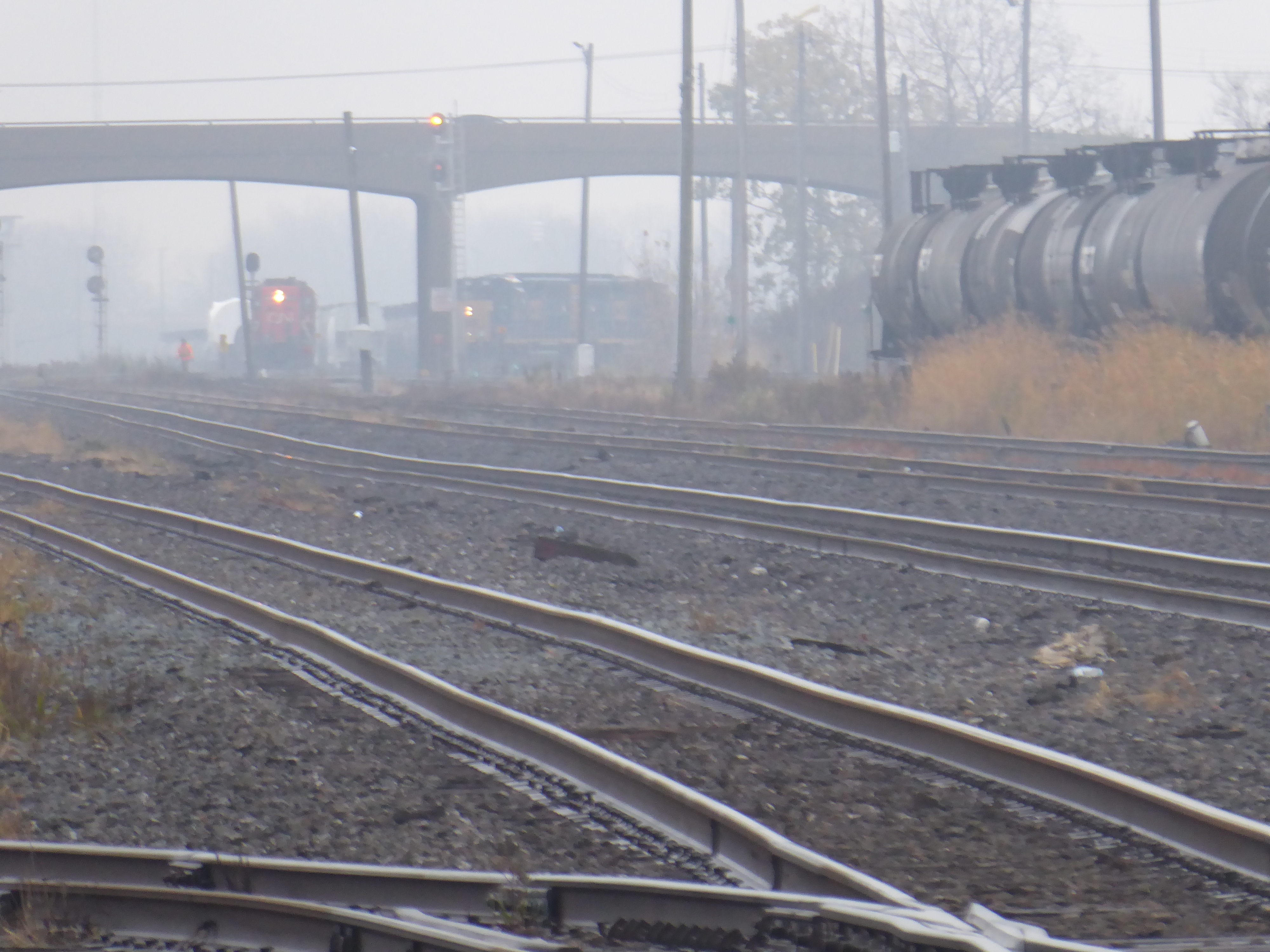
Deep in the yard however, east of the Indian Road overpass, I could see something happening in the yard through the fog.

A CN yard engine was idling there for a few minutes before I spotted an engine with a yellow nose emerging from the refineries and industrial operations east of Indian Road. I was a little surprised, as I have never seen a CSX train this deep in Sarnia Yard. I will admit that my time spent at this yard is quite sporadic, so it might be quite common. Still, every time I see CSX in Sarnia yard, its transfer or interchange jobs are usually situated closer to the Via station in the west end of the yard. So this train being this deep in the yard was unusual, at least to me.

As the train began to slowly make its way toward the station and toward its home rails, I noticed something interesting with the power, to say nothing of an oddity at the end of the train. First, the power.

You can see from the rebuilt cab that this is not the typical GP38-2 unit that has been the power of choice in this area for decades. This unit, with a boxier cab is actually a rebuilt GP40, from what I could find online. I see it referred to as GP40-3 6547, part of a series of old geep rebuilds that have been rolling out of CSX's Huntington shops for years. From what I could read, the new cabs are safer and more resistant to crashes.The units are also equipped with new heating and air conditioning, new control systems, new positive train control technology and refurbished starters. Both units pulling this train were rebuilds. The new cabs remind me a bit of the old GP30 cabs, which were a bit more boxy than their peers of the time. I think I might like these rebuilds better if the cabs had curved corners like the GP30s, but that's just aesthetics.

You can see from the photo above that I tried to capture the CN unit deep in the yard in my shots. I love capturing multiple railways in one shot. 

Here's a better shot, below, of the power from the side. You can see the noses and the cabs both look much boxier than the old geeps, with the headlines in the nose recessed and other features that have been modernized. Not sure what I think of this new look. It's something different for CSX in Canada for sure.

So let's focus on the back end of the train, with that impressively large cargo bringing up the rear. I was pretty stunned to see anything on a CSX train other than tank cars and covered hoppers. Its customer base is almost exclusively industrial operations in the Chemical Valley in Sarnia and related industry south of the city. The goods it carries are always in a tank car or hopper.


A giant tarp-covered piece of industrial equipment sat on a 12 axle centre-depressed flatcar, buffered by two empty gondolas.This is a serious piece of machinery. But what is it? For that answer, I turned to the Chesapeake & Ohio Canadian Division Facebook group, where people much more knowledgeable than me had an answer. There is writing on the tarp, which says Do Not Hump. That seems obvious, but a good reminder nonetheless.
 
 
I was told this car was carrying a gas turbine used in stationary power generation. It was produced by GE Energy in Greenville, South Carolina. From there, it was shipped via Norfolk Southern to East Point, South Carolina.
 
At that point, CSX took over the move as it moved it to Wixom, Michigan. 
 
From there, it was taken through to Flint, Michigan via Lake State Railway (LSRC). 
 
From Flint, CSX power took it to Port Huron on CN H710. 
 
In Port Huron,CN brought it through the tunnel under the St. Clair River into Sarnia. 
 
From there, CSX took it back to home rails where it was delivered to a customer in Courtright, a small town south of Sarnia with a number of industrial customers in the area, including the CF Industries plant (formerly Tera, C-I-L).
 
UPDATE: The one missing piece of information that I could not figure out was the identity of the customer that needed the turbine. That was, until the day I put this post online and a Sarnia local told me the turbine was delivered to Greenfields Energy, a cogeneration plant beside the CF plant. There are a number of power generation facilities in the Sarnia area that are producing vast amounts of electricity, some of this generation being fed by the output of refineries themselves.
 
So that is the story of how this piece of industrial equipment found its way to Sarnia and how I just so happened to be around when it made its final move onto the CSX Sarnia Subdivision. Here's a going away shot below of the train making its way around the tunnel gantry on the rails curving by the roundhouse.
 

 And one more shot around the gantry.
 
 
I didn't stick around much longer, as I didn't want to keep my family waiting. But it was nice to have a few quiet moments at the rail yard and be treated to a surprise.
 
I have shot mainly CN and Via Rail photographs in the past few years, so it was nice to be able to capture something different. In a way, the fog and cloudy skies also helped, as they cut down on the shadows that usually plague shots in this area on clear days. Some good railway karma for a change.

I'll take it.

Thursday, October 13, 2022

Guest Post: More GP9 memories from across Canada

I seemed to have hit a sweet spot in my previous post about the history of the venerable GP9 locomotive. As I mentioned in that post, this old relic is fast disappearing from most major railways, given its age. The last GP9s produced in Canada came off the line at the old GM Diesel in London, Ont. in 1963. CN and CP have used them for decades, although there are none left on CP and only a few dozen left on CN rails.

I shared a few photos of my meets with these engines over the years, including on the CP, CN and even the Goderich Exeter Railway. After I published that post, I received interesting feedback from a few fellow bloggers in appreciation of these geeps.

It occurred to me that perhaps my generation of railfan will wax poetic over these first-generation diesels the way previous generations bemoan the loss the steam locomotives after the late 1950s and early 1960s. I have to admit I don’t understand the fascination with steam locomotives at all, given my age and my lack of experience with them trackside. However, given my fond memories of old GP9s and even SW1200s, maybe I’m not all that different from steam fans after all.

One of those who seemed enthused about my GP9 retrospective is Steve Boyko, author, poet and prominent rail blogger extraordinaire. Most people who come to this blog will know Steve from his long-running railway and photography blog, traingeek.ca. It was one blog that directly influenced my decision to start The Beachburg Sub. Steve was kind enough to share a few of his own shots of GP9s from his time trackside, which I am pleased to share below.

I’ll start with a shot Steve took in Winnipeg, where he lives. The descriptions below the photos are Steve’s, not mine. Read on:

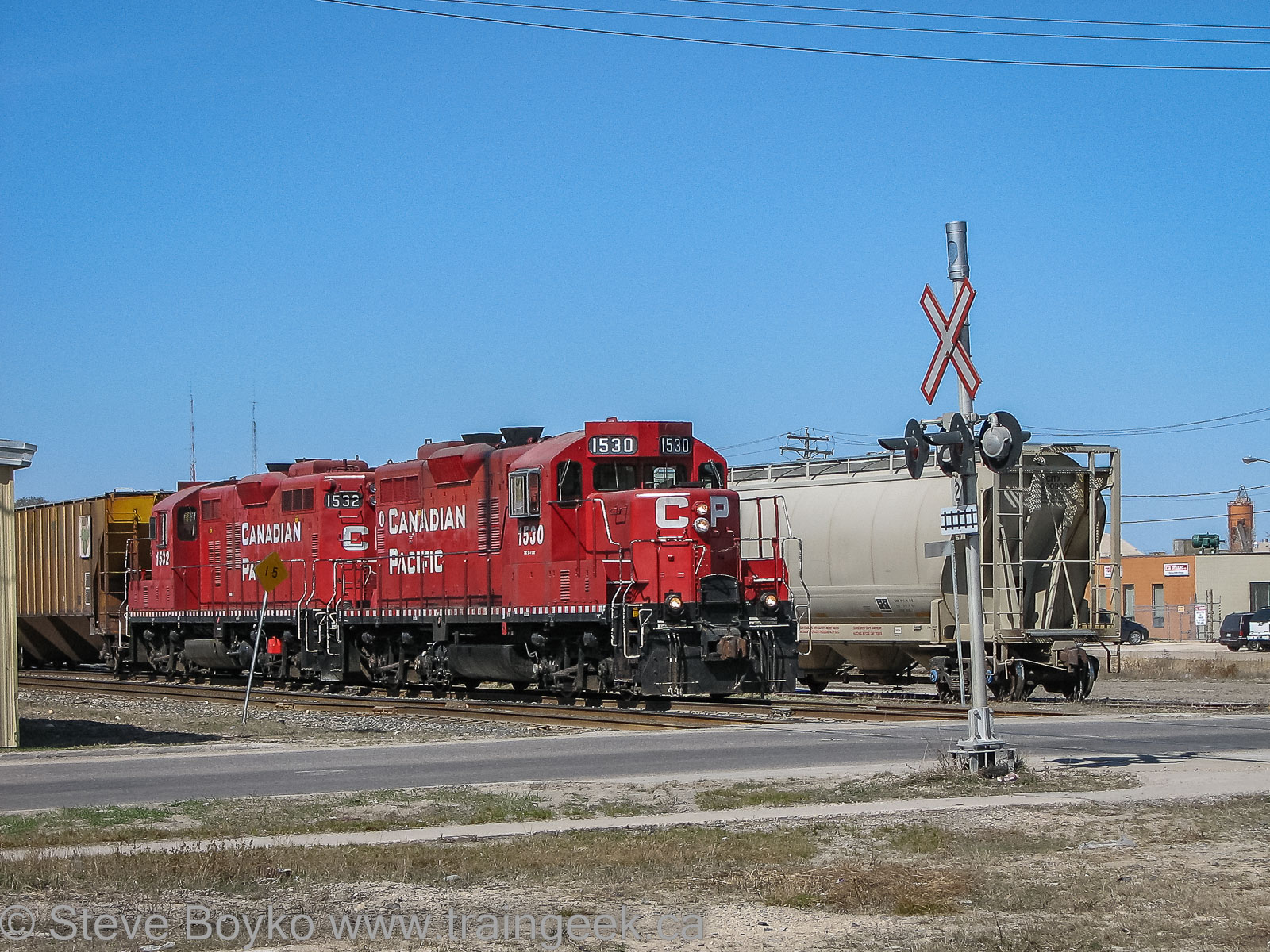
CP operated many GP7s and GP9s in Winnipeg in the first decade of the 21st century, in local switcher service and local yard service. They frequently operated in pairs, like these two about to cross Plinguet Street, south of Whittier Junction.

An overhead view of CP 1540 in yard service, October 29, 2011.

Many CP switchers met their end here in late 2009. A scrapper used a siding in Fort Garry to scrap quite a few locomotives over a few months. I documented many from a distance, including this massacre of four CP GP9s – 1558 and 1556, bracketing two SOO GP9s, 4202 and 4204.

You might wonder why a CN GP9 is at the famous McAdam, New Brunswick train station – a former bastion of CP power. This line has been owned by shortline NB Southern Railway for quite a while, and they leased a few CN GP9s for local switching in Saint John. Occasionally, one would be put on the Saint John-Brownville Junction freight for extra power. However, they are not permitted to cross into the U.S., so they would be dropped in McAdam. When I visited McAdam on July 19, 2008, 7038 was being used to switch the yard.


This is a very pedestrian shot of CN 7059 passing the Staples store near Island Yard in Saint John, coming back from perhaps switching the Irving refinery. I include it because I have one of the number boards that used to grace this locomotive, which has since donned Cando colours and a new number.

CN often used a pairing of GP9s and a slug for local switching in the Winnipeg area. Here are two pairings, with 7213 at Transcona (with modern CN.ca paint scheme) above and 7254 in Winnipeg below.

Here's an oddity below. Read Steve's caption of this scene below the image.

I’m not sure why this GP9 was on top of the hump in Symington Yard in Winnipeg. Typically, hump locomotives were GP38-2 locomotives at this time, but for whatever reason, 7258 and slug 268 were up high.

For a long time, CP 8251 was one of the very few active locomotives around Winnipeg still bearing a multimark. Here a rainbow graces the scene after a summer storm. CP 8251 was retired in 2013 but has been leased to Viterra to serve a grain elevator.

My thanks to Steve for sharing these photos. It’s a real treat to feature photographs and information outside my usual haunts here in Ottawa and southern Ontario. In keeping with this post’s theme of GP9 photos, I’d like to share three additional GP9 photos that didn’t make the cut in the previous post. 

The first is an old shot my Dad took at the GEXR yard in Startford in the early 1990s. Note the faded Shakespearan name "Falstaff" on the lead engine, in appreciation of the railway's hometown.


A few years ago, Eric Gagnon, author of the equally acclaimed Trackside Treasure blog and several railway books, shared this photo print with me of GEXR GP9 177 leading a string of old EMD power in switching the salt mine on the Lake Huron habourfront in Goderich. Date unknown, but it appears to be a 1990s shot. 


Finally, I'll add one last shot of my own that I did not manage to squeeze into my original post on these engines. Here's a great shot of GP9 720 and slug 223 leading 4761 in Sarnia Yard in August 2014.


So that just about wraps up my tribute to the venerable GP9. I am also working on a similar post about the equally venerable SW1200 and its family of switchers. Stay tuned for that one a little down the road. My thanks to Steve Boyko, the original Train Geek, for sharing his photos this week and his contribution to the cause on this blog. And thanks to Eric Gagnon of Trackside Treasure. It's been years since he shared a bunch of prints with me. I finally have the chance to share one of them.