Showing posts with label commuter rail. Show all posts

Thursday, July 16, 2026

Wrong place, right time

After the school year was through, my family headed out of town to Toronto to do some touristy things. While there, I was able to sit trackside for a little while, taking in the continuous movement of trains in and out of Union Station, most of them GO Trains as well as the Union Pearson Express. This time around, my family decided to stay at a hotel near the airport and commute into the downtown aboard the UP Express. This made our trip much easier, as the downtown was packed with fans for a Friday World Cup match at BMO Field, uh Toronto Stadium. 

I was quite impressed with the overall experience of riding the UP Express. At our hotel, you could catch an hourly shuttle to the airport, where the UP Express leaves from an elevated platform, high above ground level. The train itself is quite comfortable. The seats are very much a step above what you would expect to find on a commuter train. The fare for the downtown service is about $12, depending on your age. There are also family passes, which we used several times.

In total, the trip takes about 20 minutes. The cars feature lots of storage space for luggage, which is to be expected, given its purpose in serving the airport. What I did not expect was that the train is very much in use as a local commuter connection for Toronto residents. It makes stops at Weston, Mount Dennis and Bloor before ending its eastbound journey at Union Station. While aboard, I took a quick shot of the layup yard west of Union Station, where a few GO Trains were parked before heading back into service during peak times.

On our first day downtown, my wife took my oldest daughter to enjoy some theatre while my youngest wanted to go to the Hockey Hall of Fame, which is just a quick walk from Union Station. We had a good time there, as the Hall of Fame is very much geared toward young people. When we were done, we proceeded back to Union Station and took a quick walk along the Skywalk, which is an interior pathway from Union Station over the tracks to the CN Tower. At that point, it becomes an outdoor pathway to the Rogers Centre (I almost typed in SkyDome). 

After a walk to the Rogers Centre and a few photos, we decided to head back to the Union Station food court for an early dinner and a train ride back to the airport aboard the UP Express. I did get a few photos of GO Trains. I thought this one was nice, as the train is emerging from the shadow of the stadium as it makes its way to the station.

But it was on the way back to the station that I saw something I had never seen before.

I had to look twice before I realized I was seeing the Canadian, Via Rail's premier transcontinental* train. I have only seen this train one other time, just barely, as I caught a glimpse of it backing into Union Station from my hotel near the tracks. Those photos were mostly useless. 

(* - transcontinental is a bit of a stretch, as it covers the distance from Toronto to Vancouver in each direction, although in earlier times, the Canadian also served Montreal as well) 

This time around, I was able to confirm with a friend in Toronto that this was indeed Train 2, hours late, in the wrong place at the wrong time, essentially. My friend said the train was overly late arriving at the station and was parked in an awkward spot, as it was getting near to the evening rush hour, when GO Trains would be flocking to the station. It was bad timing for Via Rail, but perfect for me. 

 
Given the glass in the Skywalk is almost universally clouded, I had a hard time finding a decent pane that would allow me to get a good image of the train. This attempt was okay, but I would have liked to find a wider angle.
 

This shot from almost directly overhead was okay as well, especially since I was able to get an evening GO Train in the same frame. However, it doesn't do the Canadian justice, as you cannot really make out the train's true character from this vantage point. You can make out the two F40s, hitched to each other elephant style, but other than that, there aren't a lot of clues to let you know what train this is, unless you are in the know.
 

Here's one final shot, with another GO Train on the left of the frame. Again, since my choices were limited by the quality of the glass I was shooting through, I did the best I could and tried a few different angles. The other limiting factor was that the train was only partially visible from beneath the train shed.
 
That lucky meeting with the Canadian kicked off a week of epic railfanning, both in Toronto and in the Sarnia area, where I was visiting family for a few days afterward. Much more to come from my summer travels. 

Thursday, April 30, 2026

GO Trains return to Stratford, but what about Ottawa?

The recent news that Metrolinx is once again extending its GO Train service to Stratford, Ont., well west of Kitchener-Waterloo, got me to thinking about Ottawa's beleaguered rail transit service. My thought was, if GO Trains can regularly operate between Toronto as far west as Stratford, what's preventing Metrolinx from applying the same logic to Ottawa? 

A shot of an evening GO Train making its way through Stratford in summer 2023. That pilot service was cancelled soon after this photo was taken.

For those who might not know, the province agreed to work with Ottawa so that Metrolinx would take over operation of the O-Train. That arrangement has led Metrolinx to send new axles for Line 1 O-Train sets that had been damaged due to spalling issues. We need not get into the many, many issues that have plagued Ottawa's east-west Line 1, formerly known as the Confederation Line. Rails not properly installed, axle issues, catenary failures, door jamming problems and weather delays are just a few problems that have reduced the line's schedule many times since it launched. 

The end result is the city's electrified rail transit line is notoriously unreliable and the winters make the problem worse. The state of the line is such that, trains now have to slow at various curves to avoid derailing and causing further damage. The trainsets, which were once coupled end to end, are now single sets, due to the same track issues.

The eastern extension of Line 1, all the way into Orleans, is set to open this year. The western extension, which will reach as far as Crystal Beach at Corkstown Road, will take more time. 

 
A commuter waits for the next eastbound trainset on Line 1 in March.

So, here's my thought. How about some sort of GO Train service here in Ottawa?

The city has already committed to seeing the second phase of the Line 1 extension through to completion, essentially linking Orleans with Crystal Beach. Fine. The missing piece here is how to serve the booming west end of the city, namely Kanata and Stittsville? Also, how to properly serve Barrhaven, which is a city in and of itself?  

I suggest that, instead of extending the problematic electrified Line 1 operations, make use of existing track and serve Barrhaven and western Ottawa with diesel trains. 

Metrolinx knows how to do this. I'm not saying that we should see massively long double-decker GO Train consists like we do in the GTA, but who's to say we couldn't extend a slightly modified diesel service throughout the city along our lightly-used tracks?

Possibly the answer would be to use the existing diesel trainsets that are currently in use on Line 2, or the Trillium Line, which now runs from Bayview all the way out to Riverside South. 

A northbound diesel O-Train makes its way past the Walkley Diamond en route to Bayview Station in early spring 2025

This is why I think it could work, if there was a will. Consider the trackage we have in the city that is greatly underutilized, to say the least. Using the city's Via Station on Tremblay Road as a possible starting point, consider the possibilities of heavy rail going west. The one challenge would be to time all diesel O-Train runs between Ottawa's westbound corridor train departures in the morning and its eastbound arrivals in the evening. This is possible, as Via has installed a passing siding at Wass, and there is also a possibility of holding trains at Federal Junction, where the Beachburg Sub connects to the Smiths Falls Sub.

Using the Beachburg Sub from Tremblay through to North Kanata*, Ottawa has the potential to connect vast neighbourhoods with hundreds of thousands of people.

Beachburg could easily host stations where the tracks pass over Merivale Road, Woodroffe Avenue and possibly Greenbank Road. After Greenbank, there would be a possibility at multiple points to connect Bells Corners, after which the train could make its way to March Road in Kanata via the Renfrew Spur (* Then, if there was a will to reconnect the Beachburg line from the old Nepean Junction, the Beachburg Sub could link North Kanata, where many people work in the North Kanata Business Park). 

And we all know CN would desperately like to be rid of the burden of maintaining what little trackage it still owns in Ottawa. 

Easy, right?

No. 

The bridge over Carling Avenue that once took the Beachburg Sub into Kanata and beyond is gone. The rails from Nepean Junction running northwest are long gone. That part of the plan would require time, money and planning.

I haven't even mentioned the Smiths Falls Sub so far, but I don't think it's unreasonable at all to assume that diesel service couldn't be extended to Fallowfield Station, as there is already a Park and Ride facility there. Fallowfield Station was originally designed to be a commuter rail stop anyway. Why not use it for its intended purpose? The passing siding is already there.

What about laying tracks on the former Carleton Place Sub, which would link Bells Corners to Stittsville, where tens of thousands of people could make use of a link to the downtown? That old trackage was initially acquired by the former Ottawa-Carleton region as a possible commuter option. 

A meet between two Via corridor trains in May 2023 shows that this station was originally designed to be a frequent stop for commuter rail. Its name was meant to connect it to the Fallowfield Park and Ride facility, where people can park and take the bus.
 
The Barrhaven part of any diesel extension would be far easier to accommodate, as the rails are in place and the station is well established, with perhaps only some small changes to be made on the platform. You can see how Via stations operate side-by-side with commuter trains throughout the GTA and even at Dorval in Montreal.
 
I guess my point is, before the city doubles down on its electrified O-Train service, which most agree has been a failure, why not extend a proven technology? Diesel O-Trains work well and are almost never out of service. GO Trains or some form of heavy commuter trains (nor LRT, in other words) can withstand the Ottawa winters. There is no catenary to maintain.
 
Better yet, Metrolinx knows how to operate diesel commuter service in the GTA. Why not let this organization do what it can do, but here in Ottawa?
 
How could it possibly be worse than what we have in place now? 

Monday, January 12, 2026

One last kick at the can for the F59PH

Recently, I shared some photos and thoughts about GO Train service in Kitchener, where Metrolinx has enjoyed success with its Kitchener-Union Station service. I was camped out on an overpass this past summer to capture the morning run of Train 3962 eastbound for Union Station. That train was being led by 559, one of GO's old F59PH locomotives, a reliable warhorse that was built by the old Electro-Motive engine production facility in London, Ont. 

At the time, I couldn't help but wonder if the F59PH was into its final days with GO Transit, as very few still remain on the GO roster. Later in that same day, I was told that 559 had broken down between Kitchener and Guelph. 

Shortly after the Kitchener post went live, I got some interesting information from a blog reader, which I will share here in its entirety:

GO bought F59s from Los Angeles Metrolink and they are sitting in North Bay for rebuild so, by the looks of things, the last days in green of that loco type is some time away. I suspect the idea is to add to the power pool as newer engines get fitted with ECTS signalling, and also possibly 2MW battery packs to replace one Cummins on the MP54s. 

Shortly after that comment, I got further confirmation from another reader that, indeed, more F59PHs were on the way, which means that these old engines will be seen in and around the GTA for the time being. 

In November, I had a small layover in Toronto on my way to see family in Sarnia, so I camped out trackside near the Metro Toronto Convention Centre, when I found this GO Train heading eastbound toward Union Station, led by F59PH 561 in the old GO scheme. As I don't get a chance to shoot much but Via Rail trains in Ottawa, it was a treat to find a few GO Trains with different paint schemes. 

Besides the continuing presence of the F59PHs in revenue service, it was interesting to see a few of the old cab control cars in the middle of some GO Trains, as they had been refurbished and converted to regular passenger cars. A friend of mine was nice enough to meet me at Union. He was the one who pointed this out to me. 
 

Speaking of 559, it was back in revenue service when I was in Toronto in November. I caught it creeping eastward toward Union with a newer GO unit heading in the same direction a few tracks over.

In my last post, I made a point to explore the different approaches I have taken of late to rail photography. These photos would not be reflective of those new approaches. I was simply watching trains on my layover and taking shots fairly casually as I hung out with my friend. Still, any time you can get two trains in a shot, with different units, it's not the worst shot.

The London plant built 72 F59PH units from 1988 to 1994, along with 83 F59PHI locomotives for American customers. GO once rostered 49 of the original F59PH units, many of which have moved on to other railways or retired. 

The one thing that I don't know is if the F59s on their way to GO are the original models that we all know in Canada or the F59PHI models, which look different, especially near the cab

Personally, I kind of like the boxy look of the old GO 59s, as they remind me of the F40PH-2s that have served Via Rail well for decades. The Metrolink units have a sleeker nose and cab, but they seem a bit awkward aesthetically, in my opinion. Details, details...

I wanted to share on shot from the day when I caught these F59s that might be considered a little different from the usual 3/4 wedge shot. Although I was not trying to reinvent the wheel with the above two shots, I did try and get a shot of the train sheds at Union. The Skywalk overpass didn't do me any favours from this vantage point, but I did like that I caught a GO Train on one end of the sheds and a Via corridor train on the other end.

My chances to catch something from the platforms were limited, as crews don't want people wandering around the train sheds so I tried to sneak a few shots here and there.


I like this as a slice of life shot where passengers were waiting their turn to get on the escalators that would take them into the arrivals hall of the station. Sometimes, train shots can have the trains on the periphery and still tell a good railway story. I have a few other shots in and around Union that I took on my way back to Ottawa, but I will save them for another post. 

I have to say, I am happy that the F59s are going to continue to ply the rails for a while. The old boxy ones that have served GO well for decades are unsung heroes. Catch them while you can. 

Friday, January 2, 2026

Make Railways Interesting Again

Being a railway enthusiast sure is different these days. I am not going to go down the road of saying everything was better when I was young. It wasn't. Some things I found were better while other things were not. But I will say this. Railways have taken on a sameness, for lack of a better term, and it's really affected my enjoyment of rail photography.

Again, I won't say that things aren't what they used to be, across the board, because there are some aspects of railways today I find fascinating. But I cannot get excited by endless container trains, at least in that, once you get your initial photographs of the power up front, there really isn't much left to photograph. The same can be said for most rolling stock. Most covered hoppers are endless strings of grey, with only their alphabet soup of lease company reporting marks to offer any variety. The same has always been true for most tank cars, as this continental fleet has been under the control of leasing companies for far longer than other cars.

The question is what can we do to keep this hobby fresh when there is so much blank space on cars and so little diversity? With most railways not investing much in new rolling stock, there's not much variety in the average freight train. Also, with much of the fleet of fallen flag cars on its way to the scrapper's torch, there's a scarcity of history to capture.

Over the last few years, I have found that I have begun to refine my approach to railfanning quite a bit, without even realizing it. These small changes I have made to my approach have really allowed me to make the most of what there is to capture out there these days. I'm not saying it's for everyone. I understand that there are people younger than me who don't have the same experiences I have in my arsenal, so they don't know what they're missing, so to speak.

For that matter, there are people older than me who could say the same thing about my outlook. I will never know the luxury of their past experiences, so I cannot say whether their time spent trackside while young was better than my time spent trackside when I was young.


So here is my refined approach to railfanning, developed with modern railways in mind. 

1. Don't begin and end your time trackside documenting power only This might be my biggest disappointment when I look at the work of others. It's also a critique I have of my own work at times. So many videos today essentially follow the power to the detriment of actually cataloging the entire train. I try to look for shots of the train from different angles. This means finding interesting trackside infrastructure to frame the entire train against. I find shots of engines with no context are not terribly interesting anymore. Unless I know where the shot is being taken and the context of the train's movements, I am not all that excited.

Look at the shot above from Smiths Falls in 2017 and look at the shot below, taken with details in mind. I know which one I prefer.


2. Try and get the big picture This is one of the hardest challenges of rail photography and it often goes against our natural desire to get as close to the action as possible. I think we spend so much time shooting the power that we forget how powerful an image can be when it incorporates an entire train. There is certainly a trade off here. Your shot will not be as close and the train will not be as prominent, but I think it's a good compromise sometimes, when it works out.

 
This shot shows the limitation of my former camera, as I took this shot outside of Sarnia in 2013. I shared similar photos of this train in a past post, but this one at least captures the majority of the train. It also gives you an idea of the train's length as well as the topography outside Sarnia and the time of year. There are many details to consider. 
 
3. Change your perspective This is where I find I am having the most success and fun. I am always on the lookout for a new perspective, whether is be down low, on a bridge, shooting a train on a bridge, or just finding a creative way to capture a train in a way that doesn't mimic a standard rail shot. I think the best recent example of this was when I shot some GO Trains in Toronto in November, when I was travelling between Ottawa and Sarnia. I will have a few posts from Toronto later on.
 

This shot, taken in November, is an example of all the different techniques I have been trying recently. I am on a bridge over the downtown tracks, which means I have a different perspective. I also deliberately framed the cityscape in the shot, and placed the train to the far right of the image. Finally, I didn't zoom in on the train, which would have meant I couldn't capture the entire consist. I deliberately kept the train small in the image, so I could capture the big picture. I also like the look of the many tracks in the photo. I am far more satisfied with this type of image than I would have been with a shot where I zoomed in on the train.
 
4. Look for history This might be the hardest technique as so much rail history has disappeared. When I write about rail history, I'm not talking about steam engines or something that you can only see in a museum, I'm talking about fallen flag cars. I used to shoot images of shortline railway cars and the incentive-per-diem cars that tiny railways built and were still in wide usage when I was younger. I also made sure to get photos of railway fleet cars, which seem to be quite rare now that many railways basically use cars that are part of lease fleets. But, since this is such a challenge, it makes a good catch all the more rewarding!
 

I know that these old Burlington Northern covered hoppers are still fairly common trackside, but for how long? I have photos of old Soo Line covered hoppers that I shot just a few years ago and I haven't seen any since. I like this shot above because I made sure to wait until the yard job in Stratford was passing between the cars so I could grab this shot of the old BN hopper in a unique image.
 
My first thought for this post was to do an exhaustive comparison of how the rail photography hobby has changed since I was younger, but I felt that this approach would come across too much like an angry man shaking his fist at young whippersnappers so I decided to try and take a more even-handed approach.
 
I will say that, unlike when I was younger, today's epically long trains with power on both ends, and often with distributed power in the middle, are something that I never saw when I was younger. And it's a definite improvement for those who are trackside these days. I also like how container trains look from a distance, with so much colour and variety, when taken together as a whole. 
 
See? It wasn't all better back in the day. I'm grateful for what I have now, just I am grateful for what I saw when I was younger. It's all what you make of it. My goal is to make the railways of today, with their lack of diversity, interesting again. Make Railways Interesting Again. MRIA is this year's theme. Let's get to it!
 
Happy New Year everyone. 

Thursday, September 18, 2025

The last days of the F59PH

In my travels this summer, I managed to find myself in Kitchener for a few mornings. I used to live in this city when I worked for the daily newspaper, the Record. At that point, I was not in the practice of taking rail photos. So whenever I find myself back in the KW area, I always make sure to check out what is happening on the rails. 

Kitchener's rails have undergone a fair bit of change since I lived in the city back in 2007-09 For one, the Goderich Exeter Railway has given way to Canadian National on the Guelph Subdivision. Also, Metrolinx has a dedicated daily commuter train going to and from Toronto Union Station. One morning, I had the chance to catch the GO Train. I was surprised by what I saw.


I didn't know that Metrolinx still rostered any of its F59PH units. In this case, 559 was the power for the day. I managed to get some shots from the St. Leger Street overpass just east of the Kitchener railway station. You can see a member of the crew to the left of the old F59PH, getting some fresh air before the morning's departure.

The F59PH was GO Transit's power of choice for years, as the commuter service rostered 49 of these locomotives, which were built between 1988-1993 at EMD in London. They served GO Transit (Metrolinx) well, and a few remain on the commuter railway's roster, which I have come to learn. My information puts the number at eight in total.

On this morning, 559 was leading Train 3962. I did run into an F59PH a few other times, although mostly I see the MP40PH-3Cs and MP54AC units when I am in the Toronto area. Still, it's fun to see the old F59s, which bear some resemblance to the F40PH-2, a few of which Via Rail continues to use. 

I did get a few more shots on the overpass before I headed out to another nearby road for a shot at a level crossing. There are many level crossings in this part of the city, which tend to snarl traffic, particularly on Lancaster Street, which is right next to the CN yard. 

The shot above shows you how far ahead the Metrolinx engineer has to pull the consist ahead of the station (to the left of the rear of the train), just to get the people into the right cars. They certainly never envisioned passenger trains this long when they built this station.

The shot below gives you a better idea of the changing skyline in and around downtown Kitchener. The mix of the old and the new is quite striking in some places. In this shot, I was trying to get a glimpse of the old Krug building beside the train station. You can just see a hint of it to the right of the end of the train, mostly hidden by trees. Contrast that with tall, sleep towers in the distance. 

I had time to get another few shots, below, at the Margaret Street crossing, as the eastbound slowly geared up and made its way out of Kitchener toward Guelph. Truthfully, I was trying to catch CN freight trains near Lancaster Street that morning, but the crew had yet to sign on for the morning and I was pressed for time. I was fortunate to catch some freight action on another morning, which I will share in another post.

I also made sure to get a good going away shot, which is always a necessity when you can do so safely and legally. Control cab car 255 was bringing up the rear on a very sunny, hot, hazy morning. Getting clear shots in the harsh morning sun was not feasible from this angle. Sometimes, you have to work with what you are given.


As an interesting postscript, I later learned that the old F59PH broke down shortly after leaving Kitchener, which leads me to wonder how many more days these units have left in revenue service. 

Update on Moderation of Messages 

In recent months, I have begun to moderate my messages due to the proliferation of spam messages that were infiltrating my entire history of posts. I have found that the number of comments I get from readers is down sharply. The good news is the spammers have only tried to break through my moderation feature one time since I began moderating the messages. I encourage you to let me know what you think and point out any additional information or mistakes. I monitor the messages submitted regularly.

Update on my Book, 1999

My new novel, 1999, is now available on Amazon.ca. It is printed in Bolton, Ont. and the proceeds go to the Canadian arm of the company, as well as me, as per my modest royalty. I can assure you no one gets rich selling books this way. It was the best I could do to put something out there without running afoul of the trade wars. 


You can check out the book on Amazon or go to my author's website to learn more about the four books I have published over the years. I can say that 1999 has a few dramatic scenes featuring railways. Most of my stories features trains in some fashion.

Finally, you can check out my other blog, where I talk about random things related to my writing. My latest post is about how truly bizarre the year 1999 actually was.  

All the book links are also included in the sidebar. This will be a permanent feature to the blog.  

Tuesday, April 8, 2025

It's time to talk about the O-Train again

I've avoided it long enough. Mostly, my neglect of the O-Train has more to do with the fact that I no longer commute to work. But with federal public servants mostly mandated to be in an office three days a week, there is a good reason to check back in with Ottawa's ongoing efforts to convert its public transit into a well-oiled rail network. 

So far, the results are understandably and predictably mixed. That's being charitable.

We all know that the Confederation Line, which will soon run from Orleans in the east to Crystal Beach in the west, has been a failure from the get-go. It was built poorly and opened too early with trains that were not suited to Ottawa's climate. And many, many details were overlooked. That is likely the shortest way to sum up years of light rail turmoil here. The scariest part is that successive city councils deliberated over the best way to establish a citywide rail network for many years and the process still produced very few positive results. All that time and we still got it wrong in many ways.

I have blogged about the O-Train and its failures many times in the past. In fact, I looked back to the last actual post I completed that was solely about the O-Train and it was in 2020. Since that last post, we have seen news about trains with improper trued axles, tracks that were not built correctly, trains that had to slow down on turns due to the track issues, frequent weather service disruptions and the list goes on. Let's skip ahead to something a bit more positive.


As people in Ottawa know, the north-south Trillium Line, which is now called Line 2, has been operational for a few months and it seems to be operating well, as the diesel trains are much better equipped to deal with Ottawa's temperamental winters. I took this shot in the evening, facing west, from the Bank Street bridge several weeks ago. Most know this as the Walkley diamond, although in truth, it's a half diamond. 

The longer Stadler FLIRT trains are roughly twice as long as the old diesels and they now ply a 19-kilometre route between Bayview Station, on the western edge of the LeBreton Flats, and Limebank Station, on the northern edge of the Riverside South subdivision. Much of this extension of Line 2 follows the right-of-way of the old CP Prescott Subdivison, some of which was still in place up until a few years ago. 

The route has additional stops including Corso Italia (Little Italy), South Keys, Leitrim and Bowesville. The original O-Train line, the old CP Ellwood Subdivision, was the main focus of city council's rail ambitions years ago, when local politicians wanted to build on the success of this line. The thought initially was to extend the north-south line, as the right-of-way was already in place. However, that made too much sense, so that plan was shelved for far too long in favour of an electric east-west line (Confederation Line or Line 1). The rest is a miserable local history.

One bright spot about the new Line 2. Some might recall that, in the original plans, local politicians insisted that a new maintenance facility was going to be built in Bowesville, which despite the name, is largely unoccupied land on the edge of airport lands. At the time, the owners of the Ottawa Central Railway questioned why the city didn't want to make use of existing capacity at Walkley Yard.

Luckily, saner heads prevailed. Looking at Walkley Yard now versus what it was years ago, you would be amazed. The shot below is from the Bank Street bridge in 2017.


 And here's what it looks like now, in 2025. Walkley Yard hasn't been this busy in decades.


The area just south of the Walkley diamond is South Keys station, where Line 2 has a junction with what is now known as Line 4, the spur to the Ottawa International Airport. This line is also being served by smaller diesel trains that only operate between the airport and South Keys.

This shot was taken near the EY Centre, a convention centre near the airport, which has a station stop for people going to a convention. The trains are small compared to what is used on Line 2. The issue that has been raised in a recent opinion piece in the Ottawa Citizen is that the airport spur does not provide through service to the end of Line 2 at Bayview. Instead, those wishing to get downtown from the airport need to take the airport O-train to South Keys, then hop onto a Line 2 FLIRT train to Bayview, before transferring again onto an electric train on Line 1. 

This lack of through connections has been heavily criticized, as the process of linking a major source of passengers, in this case the airport, is not seamless. In reality, the Line 1, Line 2 and Line 4 trains all work independently of each other. Not a great option for someone unfamiliar with the city.

Comparisons have been made to the other major airport links in Canada, like Toronto's Union-Pearson Express and Vancouver's Sky Train. The consensus is that Ottawa's rail link falls well short of these other services, particularly since the airport O-Train station is not terribly visible unless you are in the departures level of the airport.

This shot, above, was taken when I was dropping someone off at the airport recently. As you can see, unless you are on the second level of the airport in the departures area, you might be hard-pressed to find the O-Train station. That is the criticism, anyway. I'm sure the station was well thought out and every effort will be made to ensure the station is well promoted within the airport. 

I have yet to ride on the new north-south Line 2, but I look forward to it, just to see the extension of the line into Riverside South. It was behind schedule and over budget, but at least Ottawa can say it has a light rail line that is reliably running. It's more than we can say for Line 1.


Monday, August 26, 2024

That time in Toronto

It's nice to be able to live again, without a cloud hanging over every aspect of my family's life. I am happy to share that our family is safely in our new home and our nightmare is pretty much over. That said, let's talk about trains. 

In early June, my family made a quick trip to Toronto to a Blue Jays game, which was a first for my two daughters. You can read about what we saw on the way to Toronto in this post. After we arrived, we stayed at the hotel attached to the Rogers Centre, so it was conveniently located near the downtown Metrolinx/Via tracks, which made for some great railfanning for me. Never mind the quick visit I was able to make to the Toronto Railway Museum, right across from the baseball stadium. I will leave those images for another post. 

Obviously, on a game day, my family was around the baseball stadium, which meant we were able to see plenty of GO Trains. I did even see one still being pulled by an old F59, but I was not quick enough to get an image of that one. But I did like this shot taken in front of the city's convention centre. The mix of old and new Metrolinx green is quite common on GO Trains still.

This shot below was taken from a pedestrian walkway above the tracks right beside the Rogers Centre. I like that this image captures the length of the train, the shadows mid-train and the signals. The lighting was tricky to work with, but a bit of colour correction helped define the train a little more clearly.


I wasn't able to devote a lot of time to train watching, as our goal was to fulfill a Christmas promise to take the girls to a game and let them choose one piece of team memorabilia at the team shop. However, given the steady stream of commuters to and from downtown, there was lots to shoot in a short period of time.

In addition to the GO Trains making their way to and from Union Station, I also managed to get a few shots of the UP Express, short for Union-Pearson Express. This is the three-car consist making its way past the convention centre. The UP Express has both three- and two-car consists plying the rails to and from the airport. The frequency of these trains was pretty steady as I was trackside. I know a few people who have made use of this service. They tell me it is a great experience. You can just see my daughter's hand in the bottom of the photo.

I have to admit that I hung out at my hotel room window way too much when I returned from the game. I found the steady flow of trains and the gentle rumble of the diesel engines oddly captivating. Here's a shot of a P42 with a Love the Way wrap leading a LRC consist past my window. The final car in this train was a refurbished HEP silver streamliner. The architecture of the hotel room meant I could not entirely crop out the part of the building that jutted out and obstructed my view. The grey cityscape really makes the yellow Via logo on the P42 stick out. It was fun to get shots of trains from up high. It's not something I've been able to do often.

Speaking of wraps. Here's a GO coach with a Desjardins message for riders.


Call this next shot a milestone shot, even if it was taken through a window at an impossible angle with some issues with glare. It's a moral victory for me because this is the first time I have ever captured the Canadian. You can see the multiple F40 units on point, as the consist backs into Union Station as a GO Train heads in the opposite direction with the control cab leading the way. The Canadian was on the track closest to my hotel, which made it hard to capture. It took me a moment to realize what this train was. I'm glad I was taking photos of it all the same. You can see some of the gargoyles from the Rogers Centre obstructing the view. Nothing to be done. Beggars can't be choosers.

I thought I'd finish with this shot. If you've ever been in Union Station and find yourself descending the ramp from the main hall to the area where people line up for their trains, you might notice this old plaque off the to the side. I find it interesting that the railway thought enough of its employees that it felt it had to erect a small monument saluting their service to our country during wartime. The plaque doesn't specify any war. It's quite a contrast to the railways of today, spanning continents and more focused on shareholder value than their employees sacrificing their lives for the cause of freedom. I'm not mentioning this as a critique, per se. Times change. It's just interesting to have a glimpse of where the CPR's corporate mentality was, once upon a time.

Those are my images trackside in downtown Toronto. It was fun to get a brief look at big city railroading. It made the awful baseball game we watched all the more palatable.

Friday, June 28, 2024

Summer Observations in Eastern Ontario

These last few weeks have epitomized the line from a Tom Petty song: "The waiting is the hardest part." My family is trying to sell our home, which is a difficult task. Until we do sell it, we can't move on to next steps that will prepare us for a new life in our new home. Even though I was unsure that I would have much time for blogging, I am making an effort to do the things I love, which helps me deal with the stress of this time of transition.

I decided it would be fun to share some odds and ends that I have collected over the last little while and put together an observations piece. 

I'll start with a recent observation of Via Rail Train 59 in a new place. As you might have read in this blog recently, I am trying to find new places around Ottawa to capture some railway photos. I captured some nice shots of Train 59 on the Rideau River bridge, just north of Hunt Club Road. A few weeks ago, I decided to get a shot of the same train crossing on the Riverside Drive flyover. I have never attempted a shot from this spot before, so I figured it was worth a shot. Here P42 916 leads the train west toward the Rideau River bridge and Federal Junction.

A few weeks later, I was at the Hunt Club Road overpass, as my time was limited while waiting for my daughter's dance class to wrap up. I waited for Via Rail Train 43 making its way east to Ottawa Station. I haven't been to this spot in a while. While there, I noticed that the remnants of the old industrial spur to Bentley Avenue were still not cleaned up trackside. The tracks beyond the fencing are still in place, but the rails removed from the Smiths Falls Sub are still lying to the west of the tracks, along with the old switch stand. You can see the remnants of the rails in the weeds as Train 43 passes by.

My family recently spent the weekend in Toronto, which allowed me to get months worth of railfanning in, which I will share in a series of future posts. I will share a few shots, however, closer to Ottawa. On our way home from Toronto as part of a J-train, I took a quick shot of the CP offices in Smiths Falls, or should I say CPKC. As someone whose family has a long history with the Canadian Pacific, I had mixed feelings seeing this new logo. I understand the nature of modern railways. There's no room for sentimentality. Still, I can't help but think we lose a little bit of our heritage when an iconic name becomes part of some corporate alphabet soup. I have similar issues with BNSF.

On our way to Toronto, I noticed that there was a long line of empty intermodal cars parked on a track near where the Smiths Falls Sub gives way to CP territory. Possibly someone with more knowledge can tell me if this might be the last remnant of the old CP Chalk River Sub? I know that railways often keep short stretches of old subdivisions for car storage purposes. I don't know if this is the case here. It seemed odd that these cars would be here rather than the CP yard, unless they were here so they could be kept out of the way.

While we're on the subject of the Smiths Falls Sub, there was chatter online about the spur at SynAgri in Twin Elm being disconnected. I can confirm from my trip to Toronto that this spur has indeed been lifted. There isn't much freight trackage still connected to the Smiths Falls Sub, save for the Kott Lumber facility on Moodie Drive. Here's a shot of some hoppers at SynAgri from 2015. I'm glad I have these shots now.

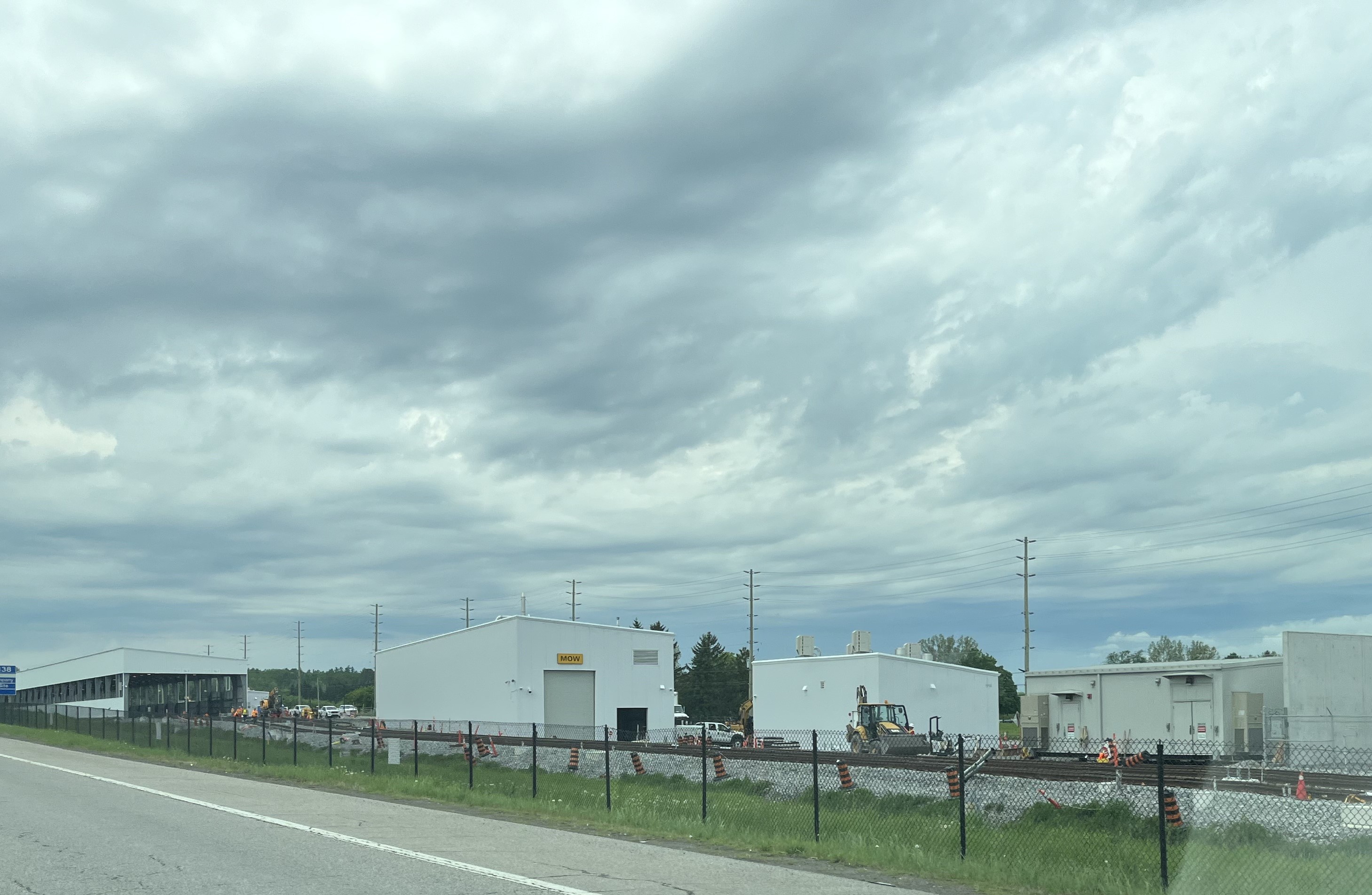
In the west end of Ottawa, rails have begun to appear alongside the Queensway, where the end of the second phase of the Confederation Line is taking shape. The project is behind schedule, which is no surprise, given that the pandemic pushed most projects back quite a ways. I have seen some MoW equipment on the rails lately near the Corkstown Road station, but haven't been able to get any shots.

This shot was taken from the passenger seat of our car, as my wife drove toward the Tanger Outlets further west. The next part of the O-Train system that will come online will be the long-delayed north-south Trillium Line (former CP Ellwood/Prescott Sub right-of-way). When it is complete, it will operate from Bayview Station, near the Ottawa River, all the way south to the Riverside South community. The spur to the Ottawa International Airport is also nearing a point where it will come online as well, which will give travellers another option for getting to the airport. 

One final bit to share. My girls are on a break from their evening dance classes, which means my Wednesday evenings trackside have taken a hiatus. Here is a recent shot of Via Train 59 at the Merivale Road level crossing. I didn't have any plan in mind. I just happened to be there so I took a few shots as the train sped by. You can see the symmetry of the Via wraps on the P42 and the first three cars.


 The end of the train was a bit different, as this was a double-ender.

So those were a few observations from Ottawa and Smiths Falls from the last few months. I have quite a bit to share from my trip to Toronto recently, but that will have to wait until life settles down a little. I am also going on a day trip to Montreal on the train, so I am hoping to have more to share. It's always nice to have too much material. A rare challenge for me.

Wednesday, August 30, 2023

The curious history of Fallowfield Station's name

Fallowfield Station is 21 years old this year and, for its entire history, has drawn confusion over its name. Look through old news coverage of the station when it opened in 2002 and you will see that people wrote letters to the editor of the Ottawa Citizen, asking Via Rail to change the name of the station to Barrhaven, where it is located in the southwest of Ottawa's urban area. 

There are a few interesting points to consider when considering why the station is named Fallowfield. The most important point is that the station is technically located on Fallowfield Road, which is an arterial road on the northern edge of the massive suburb. That is a reasonable enough explanation on its face, but it's not that simple. Those who know their geography in the Ottawa area know that a small rural village, located between Bells Corners and Richmond, is called Fallowfield. This beautiful rural community traces its routes back to the 1870s. It boasts a beautiful old stone church, St. Patrick's, which sits atop Steeple Hill (naturally), just off Old Richmond Road. 

For our purposes, it's important to note that the Fallowfield community is located nine kilometres away from the actual station that bears its name. Using St. Patrick's as a reference point, Google Maps shows that the distance from the Steeple Hill area, where many Fallowfield residents live, to the station is 9.1 kilometres. For Ottawa area residents, this is no longer an issue, as most people understand the station and the community are not the same thing, but for people unfamiliar with this city, it begs the question why the station would be named Fallowfield.

The second point to consider is that the station's name is not without precedent. Consider that Via Rail's suburban station in Scarborough is called Guildwood, although in that case, the station is located in a community by the name Guildwood, that eventually was subsumed by Scarborough. Also, Via Rail's station in Hamilton is called Aldershot. Both of these names predate Via Rail, so neither of these unique choices can be credited to Via. But for our purposes, there is historical precedence for giving a station a name that does not align with the community it serves. 

It's important to note that railways have often located their stations in areas that are most advantageous to them, rather than what is convenient to the town they serve. This was often done to discourage land speculators from benefiting from selling overpriced land in an area where a railway was expected to be built. In some cases, a station was built along a rail line that bypassed the nearest town altogether. Look at Gananoque's station in Cheeseborough as an example. In the case of this town, a branchline was opened to the station so the town wouldn't be left behind. Also, look in Ottawa's south end, where the old CP Prescott Subdivision as once located. Consider how far the Manotick Station area is, where the line was went through, from the actual community of Manotick.

In the case of Fallowfield Station, the name is not the product of Via Rail shenanigans. It was the product of an OC Transpo suburban pack and ride facility for its city buses. The park and ride facility was built at the corner of Fallowfield Road and Woodroffe Avenue before Via Rail began to consider opening up its station.

This is where the bizarre railway policy in Ottawa municipal politics enters the picture. When Nepean city council began lobbying for a train station in Barrhaven, one idea was that the Via station would be a useful resource for people in the west end of the Ottawa urban area, who didn't want to travel to the Ottawa Station, east of Ottawa's downtown to catch a train to Toronto. 

But even more than the convenience factor for west end residents, the Via station was seen as an important potential link in a commuter railway network using existing rails in the city. Look at the news coverage from the late 1990s and early 2000s and you will read about numerous local politicians extolling the virtues of a multi-modal commuter station that linked together buses, commuter trains and Via Rail. The idea was for the station to be a GO station, in addition to a link on the Via Rail network.

When I was researching the history of the station, there it was in black in while: proof that this city once had a coherent, reasonable commuter railway policy that included the common sense notion of using the infrastructure in place to move people to and from the suburbs into the core using existing rail. 

Of course, those notions of using existing rails were repeatedly dismissed by so-called progressive visions of a more European rail network, using electric light rail vehicles on a new right-of-way on an east-west axis. We know the rest of that story, which is still sadly unfolding today.

So, why Fallowfield Station? Well, because at one point, Fallowfield Station as supposed to double as a commuter rail station for OC Transpo, so it needed to have the same name as the OC Transpo park and ride bus station that was already in place.

When successive councils repeatedly quashed the idea of using existing rails to serve as a basis for commuter rail service in the city, the name for Via Rail's Barrhaven station became even more questionable. Eventually a decision was reached to include the name Barrhaven in parenthesis on the station signs. 

As Paul Harvey used to say: Now you know, the rest of the story.