Showing posts with label Southern Ontario. Show all posts

Thursday, September 3, 2026

Quickly

Sometimes I find the most interesting railway photos happen by accident or at least when I have no time to think about them. Sometimes, you just happen upon something and it's moving fast so you have to capture it without any preparation. I think this newfound desire for spontaneity stems from my boredom over modern railway photos and the relative scarcity of diversity in freight train consists these days. After all, if all we're doing is taking shots of the head-end power of freight trains, which are themselves long lines of containers or grey hopper cars, then things will get stale quickly.

That's how I feel anyway. 

Since June, I have had several chances to capture railway photos in Toronto, Sarnia and Stratford, as well as places in between, as my family made its annual pilgrimages to see family and enjoy the Canadian summer. I want to share a few unplanned shots as a way or promoting spontaneity in rail photography.

The first shot I captured as my family made its way to our hotel in the Toronto suburbs for our short weekend in the city. East of the city, CN has this bridge over Highway 401. I have caught trains on this bridge a few times. This time, I caught a string on container cars trundling over the busy road. The sight of these containers isn't all that interesting on its own, but I like the overall image, with the busy highway very much part of the scene. 

Here's a closer shot, with the highway sign very much a part of the image. The angle of the tracks over the highway becomes more noticeable as you pass under the line. I like this shot as well. It's something different, anyway.


On the same trip, I caught the tail end of an eastbound CN freight train around Ajax, with some borrowed power at the end. I was in the passenger seat, shooting across the highway at the time. It would have been cool to pull off a better shot, but the traffic and highway signs conspired against me. Still, it's a shot of something different.
 
 
I had a few other shots in this sequence, which show more of the power, without the highway sign, but those shots were equally imperfect due to the shrubs near the tracks and the traffic heading eastbound on the highway. I like this one since it shows the BNSF logo and the front of the unit. Again, this is far from an ideal shot but it at least captures movement and something atypical. 
 
I have noticed, from my limited observations this summer, CN is making use of a fair bit of leased power. I have more shots from Sarnia that bear this out, but that will wait for another time. 
 
Closer to home in Ottawa, my daughter took this shot of a passing eastbound Via Rail corridor train making its way past Woodroffe Avenue en route to Ottawa Station. Whenever she is in the car and a train passes, she tries to get a shot for me when I'm either not present or driving. I've taught her well. 
 
 
Yes, it's another shot of a Vanture set in Ottawa, which I have in spades, but I like that it has the traffic in the shot and the crossing guards activated. Again, there is a sense of movement and drama in this shot. Whenever I try to capture images in and around Ottawa, I try to take this approach to Via Rail corridor trains. If I cannot find an element that sets the shot apart, I won't take it. I always try to find a bit of the cityscape in my images. I like this element of the image. 
 
Finally, in my trip to Sarnia in July, I was making my way around Sarnia Bay when I stopped for a moment to take a quick shot of the Cargill elevator, which is in the news in the city these days. You can make out a lone crossbuck in the shot, minus crossing signals. This gives you the idea that the line is not terribly busy. This is the end of the Point Edward Spur, which exists the serve the elevator. It once extended into Point Edward itself, but was cut short decades ago. You can just make out a hopper in the shot. 
 

Cargill has been in the news of late as it is trying to block a city plan to build housing a few hundred metres from this operation. The development is slated to be situated on the site of a former harbourfront restaurant. Cargill claims there are regulations preventing residential developments within a set distance from operations like this elevator. The company says the noise and dust from the elevator will become a source of friction in the future. It wants to avoid any future problems and has appealed to the province to block the development. 
 
Some area municipalities near Sarnia, with substantial agricultural economies, support Cargill, as they do not want to see any disruption to this operation's business, which would have an impact on local farmers.
 
The city, and another local restaurant, which is within that restricted area near the elevator, both feel there is no potential issue. The matter will be settled in the coming months.  

Thanks to everyone for their best wishes on the blog hitting 500 posts. This is post 501. Onward we go.

Monday, March 30, 2026

It's time to change the approach to . . . everything

I've been trying to put into words what it is that I have been trying to do with my rail photography recently, but I think I've fallen short. That was until I read the comments to my last post when a few fellow railfans commented and the words came to mind. So thanks to Steve and J.D.

And here is how I came to clarify my new approach to rail photography. It started with a memory of what my counsellor told me many years ago when I was struggling with my mental health. His name was Woody and what he told me I never forgot. He said, "No one makes you feel anything. People act and you choose how you REact." It was a revelation to me at the time.

That made me think of how I am approaching my photography right now. I thought back to what my counsellor said and I applied it to my hobby. I have no control over what railways do, which is in line with another thing my counsellor told me. He said, "You have no control over anything but yourself." I am applying those lessons in my photography. Since I have no control over how the rail industry has changed, I can at least control how I approach my photos.

So here is my new approach, boiled down to something more pithy, thanks to recent comments from readers and old lessons from my counsellor.

Railways might be more standardized, boring and faceless these days. I don't know if anyone can argue this. I cannot change this.

If you can't change the trains, change everything else in your camera's frame. That means change your angles, your spot, your height, your lighting, your choice of background, your location, your time of day, your approach to the sky, your . . . well, everything. 

This photo above is perhaps not the ideal image to prove my point, but bear with me. In this frame, you can see the interior lights of my Venture coach and the reflection of the laptop screen of the young lady sitting in front of me. I tried to get images that would avoid the interior glare but this is the best I could do. In the image, you can see a string of GO coaches in the background and part of an old Via F40PH-2 in the foreground. The Via engine looks like it has just completed a run from Montreal or possibly Ottawa. It needs to go through the washing station, for sure. The buildings in the background tell you this is Toronto and the platforms tell you this is near Union Station. Put all those elements together, and you have some context about where this photo was taken. 

As for the computer screen in front of me, I do have a funny story to share about that. I couldn't help but notice via the reflection in the glass that the young lady in front of me was attempting to study for an exam or possibly upcoming test. However, she was also clearly messaging friends, which meant her attempts at studying were distracted at best, and I say that nicely. She was mostly messaging. At times on the ride, I wondered when she would give up the ghost with her studies. Whatever it was she was trading messages about was clearly her main focus.


Here's another image that I have come to enjoy. I took this shot at Via Rail's Windsor Station when I paid a very brief visit to the city in 2024. Here you don't see the front end power or much of the train, but you get to see a timeless scene of people boarding an eastbound train for Toronto at the station. I like that you can see the people in silhouette (sort of), a beautiful fall sky, the coaches and the station. It's a scene that could have been captured 20, 30, 40 or even 100 years ago. The trains and stations might look different but the scene is the same. Timeless. 

How many times do we stop to capture a bit of humanity in our images? After all, trains are still a very human endeavor.


Here's an example of angles. I have more photos of Via Rail corridor trains than anything else, so I have given a lot of thought in past years as to how I can capture images of them in different contexts. This is a shot of incoming Sarnia-Toronto Train 84 making its way into Stratford across Niles Street. I deliberately stepped back and made sure I got the people waiting at the crossing (on the left) as well as the cars waiting on the other side. You can also see the railway stop sign. There are many elements in this image, which made the task of framing the train a bit of a challenge, but I like the end result. So often, I find we obsess over getting the train or locomotive itself but lose sight of getting its surroundings. 

I would have liked to attempt this shot from the other side, but the harsh summer sun meant the shadow side of the train would have ruined the image of that train on the curve.

Here's one final image that I captured in February 2021 on the Canadian Pacific Winchester Sub at Bedell, Ontario. There was a maintenance of way crew working on the South Prescott Spur to Oxford Station, with a genuine CP caboose sitting on the spur, offering a warm place for crews to get out of the biting cold. I took a few shots of the caboose but I made sure to back up and get a shot of all the surroundings, so I could have a complete picture. The fencing in the foreground and the enormous pile of ties gives you can idea of the scale of the work being done here. I only wish I could have done a better job with the morning sky, as it did not turn out nearly as crisply as I would have liked. 

With these images, I hope I have made my new approach clear. It's time to change my approach to everything in my rail photography outside of the trains themselves. I've done this in fits and starts over the years, but I'm really trying to make it a major focus going forward. It doesn't mean I'm not taking standard photos anymore. I am. But at a time when everything tends to look the same, the one major thing about rail photography that provides endless variety is your background. And that is what I am trying to change in my images.

Thursday, March 5, 2026

Fresh perspectives in Stratford

Last summer, I was in Stratford to visit family and take in a show at the Stratford Festival. While there, I was able to carve out some time at the town's train yard to capture some images of the local freight operations. With a little help from those who are familiar with CN and the Goderich Exeter Railway's moves, I was able to catch several freight trains and some yard action. 

Here's a post featuring some GEXR freight movements on the Goderich Subdivision after leaving the yard.

CN's presence in Stratford is quite noticeable. It has a large maintenance yard where it keeps all sorts of supplies for track repairs. Of course, the Guelph Subdivision is hardly a speedway these days, but CN has still clearly invested in a maintenance operation here. I would say that it is much more extensive than what GEXR had in place when it was the sole leaseholder on the Guelph Subdivision.

 
This is the first shot I grabbed of an incoming CN local, which originated in Kitchener, as it came to do some yard work and move on further west to St. Marys. I took this shot because I wanted to capture a glimpse of the overall operations in Stratford, including the maintenance yard. You can see piles of ties to the left as well as a few structures. 
 

The local was led by an old GP9 and GP38 in the safety stripes scheme. It looked like 9555 was due for new paint, for sure. The train was a pretty typical consist of covered hoppers mainly, which is common in this yard. 
 

As the crew assembled the consist it would need to go west into St. Marys, I made sure to make my way to the Niles Street crossing, which allowed me a chance to get a different type of shot. As I have mentioned before, I am on a mission to capture new and different railway images. I could have easily taken shots from the station platform, as I have done many times in the past, but I wanted something different. 
 
Even though this angle was on the shadow side of the train, I though the angle of the tracks in the yard would give me a unique perspective of the train in its entirety. I thought this shot was more satisfying than an image of a long line of blank grey covered hoppers. Some of those hoppers were destined for the cement operations in St. Marys, which are served by CN.
 
Speaking of different angles. 
 
 
On my first day in Stratford, the yard was quiet but I did catch GEXR's local power at an odd angle in front of the Masterfeeds elevator. I was told this track is one of the last remnants of the old roundhouse complex that was once in place to service the steam engines of the Grand Trunk and the CN.
 
I could have gotten a much closer view, but I decided it would be cool to capture a shot of the long string of steel coil cars and the brooding summer sky in the image as well. I think this shot gives you a much broader picture of local operations.
 
That is a brief summary of my first days trackside in Stratford, I'd be curious to read your thoughts about how to capture different railway images. In two of these shots, the train or engines that were my main focus were actually quite small relative to the overall frame. Do you have your own ways of keeping things fresh while trackside?

Friday, December 5, 2025

Via Train 84: The forgotten stepchild of the corridor

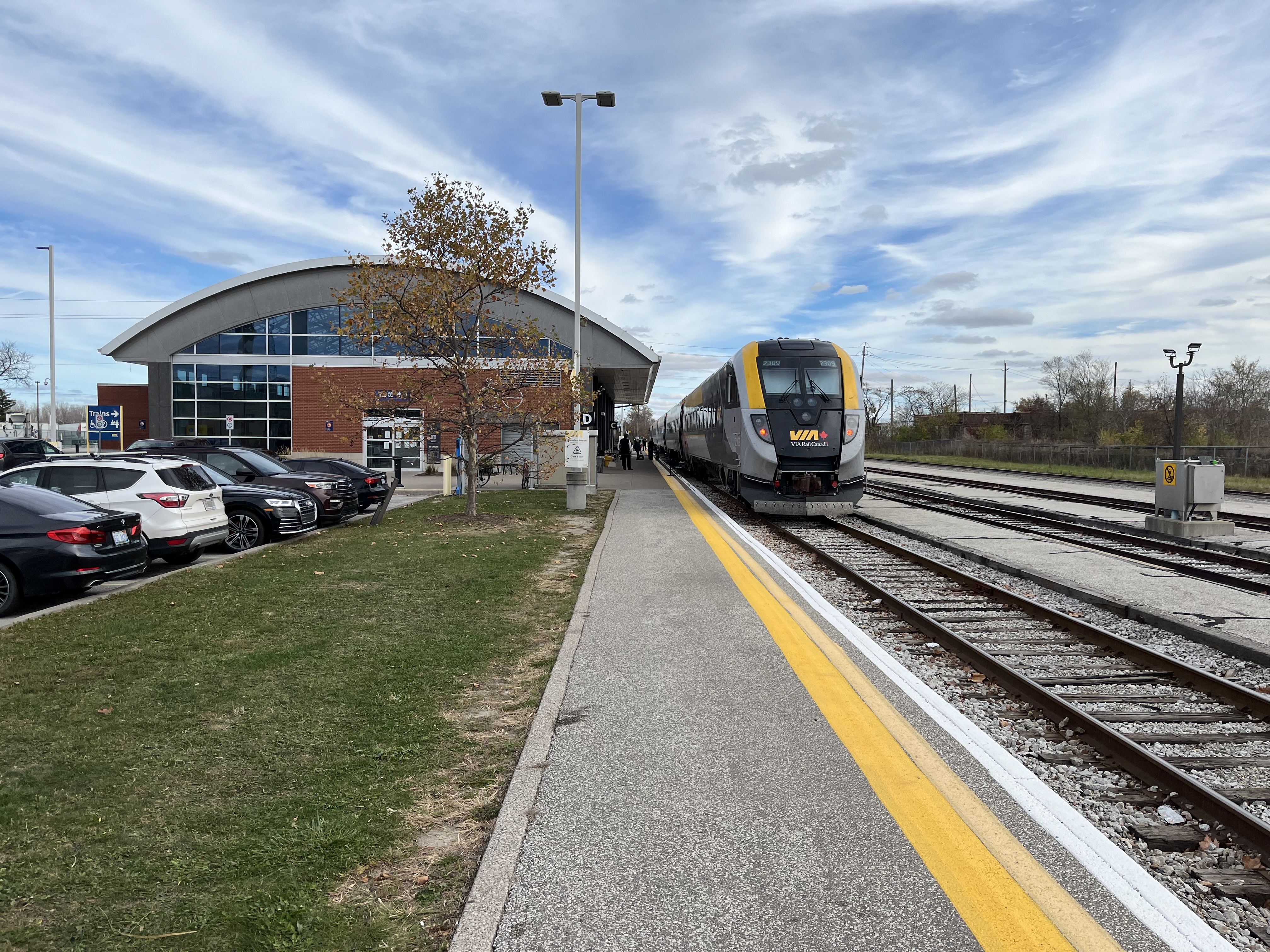
After a recent trip home to see family in November, I took Via Rail's Train 84 east from Sarnia Station to Toronto on November 24. A great deal has changed since I last took this train. I would estimate it has been 26 years. 

And I have to say the experience was a little disappointing. I mean no disrespect to the excellent crew who took care of the passengers on the train. They are great ambassadors for the company and are not to blame. However, the general state of Via Rail's operations in the Windsor-Quebec City corridor are to blame, without a doubt. Does that mean it's all CN's fault? I'm not nearly knowledgeable enough to assume this. On the other hand, one cannot blame Via Rail entirely, either. The state of Via's relationship with its landlord in the corridor, CN, has never been worse.

This has to do with CN imposing speed restrictions on Via's new Venture trains at grade crossings. CN contends that these 24-axle trainsets increase the risk of crossing gate failures by a large degree, while Via disputes this finding and has made more than one comment in legal filings to suggest CN's network infrastructure might be to blame. To be fair, Via Rail has been quite consistent that no safety issue exists. These opposing opinions have resulted in Venture sets being held back in the corridor, which has harmed on-time performance and increased congestion in the network. It's a mess to be sure and there's no end in sight.

Read Eric Gagnon's latest post about this in Trackside Treasure for a much more comprehensive breakdown of the issues.

This brings me to Train 84, the daily morning eastbound that departs Sarnia at 8:40 a.m. with stops (some on demand) in Wyoming, Strathroy, London, St. Marys, Stratford, Kitchener, Guelph, Bramalea, Brampton and Malton. The train travels on CN's Strathroy Subdivision, through CN rails in London before following the Guelph Sub most of the way into Toronto before its lays over at Union Station before becoming an Ottawa-bound train later in the day (this was my train home to Ottawa, which I will write about in a later post). 

This shot above shows Train 84 backing out of its layover spur next to Sarnia Station on the morning of Nov. 24. The good thing about Via Rail using the Venture sets is that their bidirectional capabilities do not necessitate a wye movement to turn the train around in the yard. The train can simply be left on the spur when the evening westbound arrives. The spur is under video surveillance, which I suppose helps CN Police thwart any would-be vandals.

Rather than getting into a blow-by-blow of the entire trip, I will mention some of the highlights and low lights. The initial move out of Sarnia Yard was mostly smooth sailing, so to speak, as the train was able to move fairly quickly on the Strathroy Subdivision. This stretch of the CN network is well maintained and is able to accommodate freights at higher speeds, given that it is a crucial link between Toronto and Chicago.

On the morning of Nov. 24, our train encountered no freights on the sub and the station stops in Wyoming and Strathroy were skipped, as no passengers were there to get on board. At this point, the train was likely at five-percent capacity. It was quiet and peaceful.

 
Hello, Goodbye: Wyoming station early in the morning on Nov. 24. No one's home.
 
I have to admit that I didn't feel any noticeable reductions in speed as Train 84 encountered the level crossings on the Strathroy Sub. I credit the engineer for making the ride fairly consistent. I know this speed restriction mandate is a pain for Via crews on lines like the Strathroy Sub, as there are many country roads crossing the tracks.
 
Our train began to slow east of Strathroy where our train proceeded to enter busier CN territory near London. As you might expect, we were briefly stopped at a junction west of London, although I can't be sure it was the Melrose connection with the CP Windsor Subdivision or the Komoka Junction with the Chatham Sub. The area was the subject of a fair amount of maintenance of way crews. Possibly they needed to give the all clear before we crossed. Either way, the train's speed gradually slowed as we neared London.
 
A bit of a surprise. I saw an Essex Terminal Railway engine in London as our train made its way through the city toward the station. I have to say, I miss the old yellow, green and black ETR scheme. This one is okay, but not nearly as distinctive. ETR is cycling its engines to Lambton Diesel Specialists in Sarnia for maintenance and work. Since these units can no longer be routed via CSX's old line in Chatham, the easiest connection is from Windsor to London and then down the CN Strathroy Sub. 
 
ETR engine awaits its move to Sarnia by laying over in London. 

This is where Train 84 began to suffer from elements that are out of its control. After our station stop in London, the train had to pass onto the CN Guelph Subdivision toward St. Marys. Long story short, this stretch of the CN network between London and Kitchener is in rough shape. Our train made its way through the countryside at a fairly constant 46 km/h, which everyone can see as the train's display panels show you its speed in real time. 
 
This is not at all acceptable for a passenger train today. It's unfair to compare this train to the Sarnia-Toronto train I rode more than 20 years ago in my university years, but I can distinctly remember the train being able to move much more quickly back then. Did the Goderich Exeter Railway take better care of this track when it controlled the Guelph Sub on a long-term lease from CN? I can't say. That's just my impression. The trains didn't seem as slow when I was in university.
 
I've been told that CN would likely be glad to hand over the tracks from London to Kitchener, so it can rid itself of the maintenance burden on this lightly used rail line. Already, the Metrolinx-controlled tracks east of Kitchener show how much better things can be when a motivated owner is in charge. I can't imagine that Via Rail would like to take on the burden of owning the tracks between London and Kitchener, given it only uses this line twice a day for the Sarnia-Toronto trains. This means the line will continue to be operated and maintained by CN, which has very little reason to upgrade these tracks for fast passenger operations. CN's local freight service can operate at slower speeds given there is so little traffic on this line.  
 
What surprised me was was the number of passengers that got on from St. Marys to Guelph, despite the speed restrictions on this line. This train does much of its business east of London. 
 
All aboard in St Marys. This little town had lots of people who "love the way."
 
St. Marys is a good example of a small town that relies on Via Rail service, although the service is spotty. I fear for these small towns, as they are often the first to lose service when bigger issues are at play and threaten margins. 
 
I missed the old stone GTR station in St. Marys but caught the caboose.
 
There was no opposing traffic for our train to contend with on the Guelph Sub, thankfully, as our speed was already pretty slow. By the time we arrived in Kitchener, the train was already behind schedule, but not by a wide margin. Thankfully, the tracks east of Kitchener are maintained well by Metrolinx, which is expanding its rail service to Kitchener and points east in the coming years. This meant our train could actually stretch its legs and move at a more reasonable speed.
 
Kitchener's CN operations getting started for the day with lots of grain and covered hopper cars ready to serve agricultural customers in southern Ontario.
 
As we got closer to Toronto, our train was stopped for quite some time in Brampton as we had to wait for a meet with a GO Train because CN had a freight train blocking an interlocking east of the station. This delay, combined with the speed restrictions east of London, not to mention the delay in Komoka/Melrose, made for a slower-than-usual ride. This has to be frustrating to passengers and crews alike, as this train's scheduled 1:38 p.m. arrival in Toronto is already a pretty generous schedule. I can't imagine many people in Sarnia and London would take this train for its timetable. You take this train if you have to.
 
Passengers in London, in particular, have better options, as the eastbound trains that take a different route (Dundas Subdivision) through Woodstock, Brantford and Aldershot (Hamilton) are much quicker. I took a train west from Toronto to London on this route on my way down to see family and it was a much quicker ride, even with the occasional slowdown.
 
From a business point of view, this has to be troubling. If you cannot offer a fairly timely service, people will be less likely to take the train.
 
Finally in Toronto: Our train was more than a half hour late, which wasn't 
so bad considering the obstacles it faced. The Via Rail engineers are likely exhausted.
 
When we arrived in Toronto, I felt exhausted, given my car was quite loud, with screaming babies and a boisterous group in St. Marys. I'm not complaining. It was nice to see a full train, but I have to wonder how long Via Rail can count on its passengers' patience as it sorts out its Venture dispute with CN. Neither side appears willing to budge while the federal Transport Minister does not appear eager to step into this mess.
 
I went into this trip from Sarnia to Toronto with a certain excitement as it was a chance to revel in the nostalgia of taking the train in the late 1990s. How times have changed! Via Rail is struggling in every respect. It has not done a great job explaining to its passengers why its brand new trains are performing worse than its aging LRC and HEP fleets. Meanwhile, CN appears to be in no hurry to accommodate Via Rail in any way.
 
I suppose in a perfect world, Via Rail would have its own tracks that were free of freight trains that more often than not are prioritized higher than passenger trains. Of course, this is impossible. For every train that is rerouted to a theoretical Toronto-Ottawa-Montreal route via the Kawartha Lakes Railway and a potentially reactivated line east of Havelock, you lose all the passengers along Lake Ontario from Port Hope to Cornwall. This is just not feasible. You have to serve the cities on the lake.
 
And, although Via controls rails between Chatham and Windsor, Brockville and Ottawa as well as Ottawa and Coteau, Quebec, it is still very much at the mercy of CN. And there is no solution. 
 
And sadly, trains like Train 84 are the hardest hit. 

Monday, November 17, 2025

Details matter

I found myself passing by Fallowfield Station recently when I decided to stop in and see if something was imminent. Luckily, a westbound from Ottawa's main station was making its way to the station, so I took to the east platform to get a few shots. It turned out to be a double-ended consist of the silver streamliner (HEP) cars with two P42s. I figured it was worth a few shots, just to get some seasonal variation in the photographs I share here. You can see a hint of the snow plowed off the end of the platform.

The first detail I noticed was how dirty the train was. The lead P42 920 clearly needed to go through the wash stand, but I suppose it's a tough assignment to keep these trains clean shortly after the first snowfall of the season, combined with the subsequent melt and the rainfall in the various regions where these trains operate. 

 
The second detail popped out immediately. Do you see it? Unlike the lead P42, the trailing engine still has a bit of its as-delivered blue paint shining through the wrap. It was a bit odd to see this, as it looked out of place. I have seen many wraps, but most have the plow of the front repainted.
 

Speaking of paint schemes, you can see the original lettering peaking through the wrap on this dirty trailing power. I'm guessing such minor details don't matter much right now, as I'm sure these units aren't long for this world. The Venture takeover will soon mean many of these older locomotives will retire from revenue service or head to another railway. 
 

This is a shot I took this summer of a genset locomotive that handles the plant switching duties at the Nova Corunna refinery. The detail I liked in this photo was the line of towers and power lines. Anyone who has been in the Sarnia area knows how much energy is needed for these refineries to operate. This is also an area where an immense amount of energy is managed through cogeneration, solar, battery storage and other means. And the power supply just keeps increasing. I could have zoomed in on the locomotive, but I also liked that I captured some of the refinery and the massive pipes in the bottom right of the image. This would be great information to use if I had a model railway setup right now.
 
 
Here's one last image from this summer that has a lot of details, like the photo from the Nova refinery. I wasn't really enthused about catching another Via Rail Venture consist while in Stratford, so I set up across the yard on a side street. The details in this photo are what make it more interesting than a standard railway photo. These are the details I wanted to catch: the station undergoing renovations; the rail yard; the grain elevator and the crossbucks. I left a piece of the tree in the shot intentionally, mostly because it was protecting my shot from a complete washout due to the sun.
 
The harsh sunlight required a fair bit of colour and lighting correction, but I think it was worth the effort. As I have mentioned quite a few times, I have been aiming of late for images that are more than just the standard wedge shot. I think setting a scene where a train is operating makes for a much better image.
 
The details are what fascinate me now as much as the trains themselves. 

Tuesday, February 11, 2025

Some rare mileage for some rare cargo

In November, I went to see family for a quick visit and to drop off some Christmas presents. It turned out to be a stroke of genius, as the postal strike scotched any mail delivery for Christmas shortly after my visit. I shared some details of my visit to Windsor on that journey, but there were other cool rail sightings and meets that weekend, including this incredibly lucky shot I snagged at Sarnia yard, as a CSX interchange move contained a most unexpected surprise.

I dropped by the yard late on a damp November morning, and it appeared at the outset that nothing was happening.The yard was largely quiet, except for the string of diesels idling at the refueling pad near the old roundhouse (more images from that to be shared in a later post).

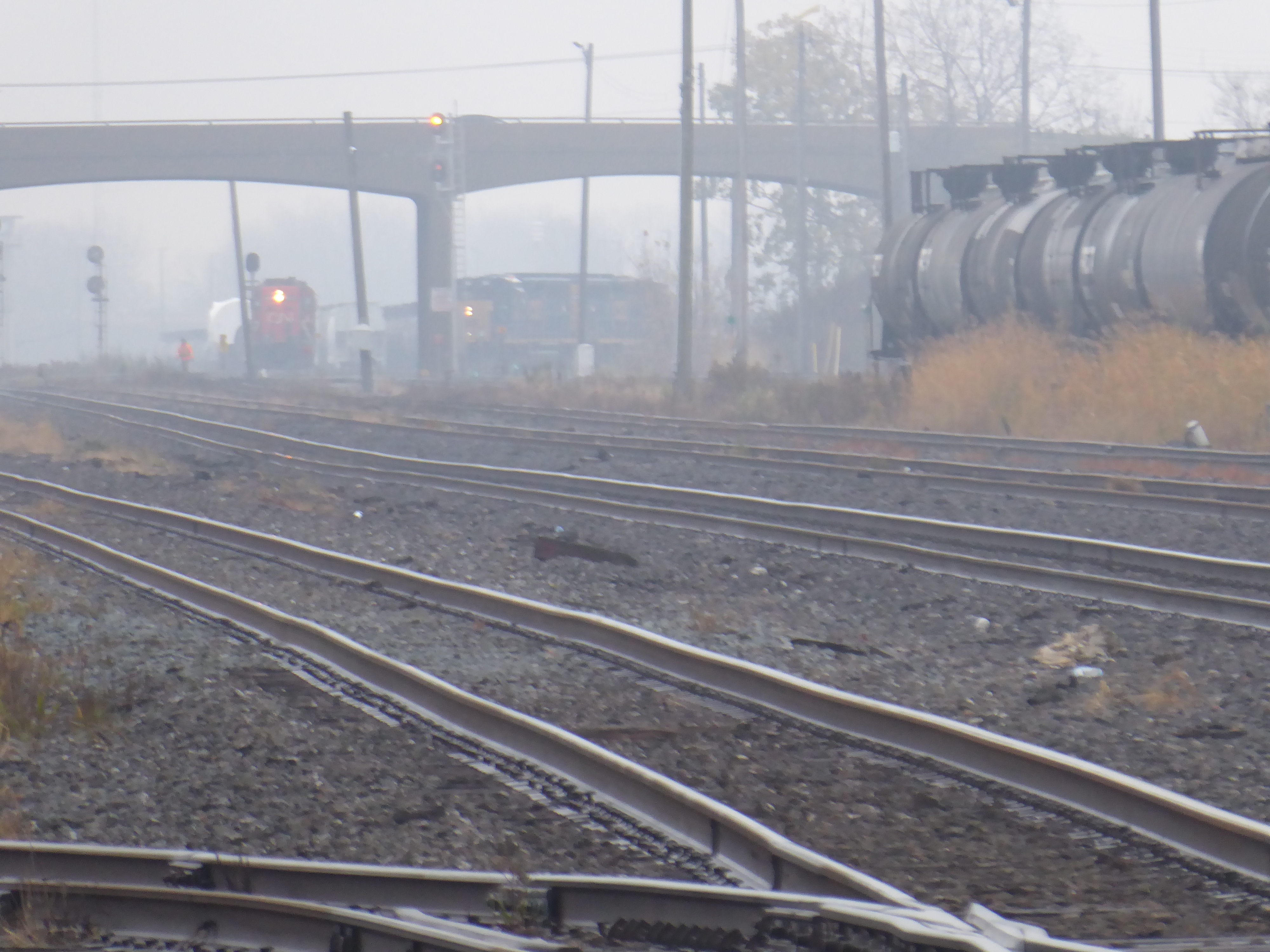
Deep in the yard however, east of the Indian Road overpass, I could see something happening in the yard through the fog.

A CN yard engine was idling there for a few minutes before I spotted an engine with a yellow nose emerging from the refineries and industrial operations east of Indian Road. I was a little surprised, as I have never seen a CSX train this deep in Sarnia Yard. I will admit that my time spent at this yard is quite sporadic, so it might be quite common. Still, every time I see CSX in Sarnia yard, its transfer or interchange jobs are usually situated closer to the Via station in the west end of the yard. So this train being this deep in the yard was unusual, at least to me.

As the train began to slowly make its way toward the station and toward its home rails, I noticed something interesting with the power, to say nothing of an oddity at the end of the train. First, the power.

You can see from the rebuilt cab that this is not the typical GP38-2 unit that has been the power of choice in this area for decades. This unit, with a boxier cab is actually a rebuilt GP40, from what I could find online. I see it referred to as GP40-3 6547, part of a series of old geep rebuilds that have been rolling out of CSX's Huntington shops for years. From what I could read, the new cabs are safer and more resistant to crashes.The units are also equipped with new heating and air conditioning, new control systems, new positive train control technology and refurbished starters. Both units pulling this train were rebuilds. The new cabs remind me a bit of the old GP30 cabs, which were a bit more boxy than their peers of the time. I think I might like these rebuilds better if the cabs had curved corners like the GP30s, but that's just aesthetics.

You can see from the photo above that I tried to capture the CN unit deep in the yard in my shots. I love capturing multiple railways in one shot. 

Here's a better shot, below, of the power from the side. You can see the noses and the cabs both look much boxier than the old geeps, with the headlines in the nose recessed and other features that have been modernized. Not sure what I think of this new look. It's something different for CSX in Canada for sure.

So let's focus on the back end of the train, with that impressively large cargo bringing up the rear. I was pretty stunned to see anything on a CSX train other than tank cars and covered hoppers. Its customer base is almost exclusively industrial operations in the Chemical Valley in Sarnia and related industry south of the city. The goods it carries are always in a tank car or hopper.


A giant tarp-covered piece of industrial equipment sat on a 12 axle centre-depressed flatcar, buffered by two empty gondolas.This is a serious piece of machinery. But what is it? For that answer, I turned to the Chesapeake & Ohio Canadian Division Facebook group, where people much more knowledgeable than me had an answer. There is writing on the tarp, which says Do Not Hump. That seems obvious, but a good reminder nonetheless.
 
 
I was told this car was carrying a gas turbine used in stationary power generation. It was produced by GE Energy in Greenville, South Carolina. From there, it was shipped via Norfolk Southern to East Point, South Carolina.
 
At that point, CSX took over the move as it moved it to Wixom, Michigan. 
 
From there, it was taken through to Flint, Michigan via Lake State Railway (LSRC). 
 
From Flint, CSX power took it to Port Huron on CN H710. 
 
In Port Huron,CN brought it through the tunnel under the St. Clair River into Sarnia. 
 
From there, CSX took it back to home rails where it was delivered to a customer in Courtright, a small town south of Sarnia with a number of industrial customers in the area, including the CF Industries plant (formerly Tera, C-I-L).
 
UPDATE: The one missing piece of information that I could not figure out was the identity of the customer that needed the turbine. That was, until the day I put this post online and a Sarnia local told me the turbine was delivered to Greenfields Energy, a cogeneration plant beside the CF plant. There are a number of power generation facilities in the Sarnia area that are producing vast amounts of electricity, some of this generation being fed by the output of refineries themselves.
 
So that is the story of how this piece of industrial equipment found its way to Sarnia and how I just so happened to be around when it made its final move onto the CSX Sarnia Subdivision. Here's a going away shot below of the train making its way around the tunnel gantry on the rails curving by the roundhouse.
 

 And one more shot around the gantry.
 
 
I didn't stick around much longer, as I didn't want to keep my family waiting. But it was nice to have a few quiet moments at the rail yard and be treated to a surprise.
 
I have shot mainly CN and Via Rail photographs in the past few years, so it was nice to be able to capture something different. In a way, the fog and cloudy skies also helped, as they cut down on the shadows that usually plague shots in this area on clear days. Some good railway karma for a change.

I'll take it.

Tuesday, December 17, 2024

Five reasons to be grateful in 2024

As the year winds down to its precious last few weeks, I find myself somewhat glad to be rid of 2024, although not for the reasons you might think. Yes, as many of you know, my family went through a terrible ordeal, having to move from our home due to the very serious threat posed by a former neighbour. Happily, that is behind us and we are safe. But I don't want to be rid of 2024 to be rid of this experience. In essence, a new year is simply a new number. I am happy to be heading into 2025 because I want to use my experiences from this year as a way of moving forward as a better, more grateful person.

I hope this is reflected in the tone of the posts I include on this blog. Just yesterday, someone sent me an email with an inspirational quote/graphic. I usually discard these emails out of hand, as they are a throwback to the days when people used the internet to perpetuate tired old jokes. But I read this message for some reason and I'm glad I did. It basically said, I have a roof over my head, my home is heated, and I have food on the table. I am grateful. Something like that. 

And I am. Grateful, that is. For all the discontent in the world and all the endless bickering, political grandstanding, political manipulation, tribalism, shaming, irrational hatred, old world grudges and general lack of courtesy, we are lucky. There is no other place I'd rather live than Ottawa, Canada. I have gone out of my way since we've moved into our new house to thank people more often, praise people for doing good work and letting people know they matter. I cannot believe what a difference it makes when you actively show gratitude and share it. I have been like this increasingly in the last few years of my life, but I have made sure to more actively show gratitude with others lately.

With that in mind, here are some reasons for me to be thankful.

1. I am grateful that I was able to share my writing with the Western Ontario Division of the National Model Railroaders Association's online magazine, Model Railroad Inspirations. For the sake of their intellectual property, I'm merely offering a screenshot of part of my article.

If you wanted to read about the Point Edward Spur, you can read my original post here. My thanks to Paul Hurly, editor of Model Railroad Inspirations, for reaching out. This is good lesson for bloggers out there. It pays to check out the comments on old posts. You never know.

2. I am grateful to be inspired by other writers. They should know that their writing matters and sometimes, their writings move people to action. 

Recently, I read this post on the Prince Street Terminal blog. I have to admit, when I read it, it felt like Chris, the blog's author, was reading my mind. He explored the beauty of an imperfect image and went on to muse on the people who operate trains, how they are masters of a very rare skill. They know how to balance the immense power of their diesel engine and the sometimes intimidating crush of the weight behind the engines. This dance between push and pull, slack, resistance, strain and raw physics is indeed an incredible skill. We should be thankful for these people, who help bring us the goods that make our lives more comfortable.

Chris is one of a number of great writers in the train blogosphere that inspire me to think harder, research more, write more clearly, and remember what my strengths are. 

I must admit, I have often thought about writing a blog post about the human element of each train. When Chris shared his thoughts in the blog post I linked to above, he managed to express some of the thoughts that have been rattling ahead in my head for years. He read my mind. And he managed to express those thoughts in a way I never could.

His post reminded me of this photo below, which is another reason I am grateful.

3. I am grateful for surprises. As someone who often relies on road trips to get the train photos that feed this blog, it's the surprises in my travels that make this blog sing.

This photo above was taken in late November as I was driving on the Rokeby Line back to my brother's house after visiting with my sister's family. This was a CN local picking up cars and doing its switching duties on the St. Clair River Industrial Spur, a long stretch of track that serves a number of industrial customers south of Sarnia's Chemical Valley.

And just like Chris mused in the Prince Street Terminal blog post above about imperfect shots, I'd like to take a moment to share how much I love this shot above, even thought it's far from perfect. I had to scramble to get anything as I was in my car and there was almost no light, save for the light of the engine's headlight. The signals, as well, did me no favours, as the red lights often washed through the images I was taking.

But this shot, which was the last one I took, worked out pretty well. It reminded me of that human aspect of railroading that we often forget, when we get caught up in talking about heritage paint schemes, locomotive numbers, axle counts and other technical aspects.

To me, there is a human story to be told here. Who was working this train late on a Sunday night, when he/she would rather be home with their family? What was the train picking up or dropping off? Why was it important that it be done at that time? How many other people relied on that engineer and conductor in the cab of that GP38 so their company could continue operations? Do the people who need these trains to operate even realize the work railway employees put in around the clock to keep their companies operating? These people are our unsung heroes in these blogs. They keep the wheels in motion (literally and figuratively) so that we can enjoy the lives we live.

Catching that train late on a cold November evening after spending time with family was a wonderful surprise.

4. I am grateful for the chance to learn from others. Since I relaunched my blog in 2022, I have been fortunate enough to pick up some new readers and reconnect with people who have been reading this blog since I launched it in 2013. To everyone who stops by the read my ramblings, I thank you. I have never considered myself anywhere near the calibre of other bloggers and I don't try to pretend I know more about railways than I do. That is why you will often find me making educated guesses and opening myself up to being corrected. It's the only way to go, if you want to survive online and learn.

But I am thankful for some of the new people I have met along the way since I relaunched, because it has allowed me to explore new territory. For example, I have been trading messages with a reader from Windsor, who has fed me all sorts of railway information from the city. I am slowly working on a few blog posts about Windsor, with his help. Thanks, Kevin!

Here's a shot from my brief time in Windsor in November, when I was lucky enough to catch a Venture set about to depart the city's Via terminal in the Walkerville part of the city. More on Windsor to come.

5. I am grateful to be published. I saved the best one for last. I don't want to go into great detail, as the details are yet to be finalized, but I can share with you that one of my photos will likely be published in a forthcoming book from a writer who is a well-known name in Trains and Classic Trains Magazine. 

A tip of the hat to Steve Boyko of Traingeek.ca for putting me in touch with this well-known writer. Not surprisingly, this writer reached out to Steve, who was able to relay the message to me. As I said higher up in this post, I don't consider myself anything other than what I am. I am an okay photographer and I know a bit about railways. But I am no expert. Everything I know I learned by reading or listening to people, especially those in my family who worked on the railways. I don't want to share the photo that will be published in the book on this particular post, but I can assure you that you can find it on one of the 400 plus posts I have already published on this blog. 

Instead, I will share this shot from 2015 of CN 589 making its ways to Arnprior, led by a GP38 in the CN North America scheme. The shot was taken along the Trans-Canada Trail crossing near Corkstown Road. No, the author was not looking for photographs of the Arnprior Turn. He was interested in another shot I have of a CN diesel in the short-lived North America scheme.

I hope to share more details about this new book of his soon. 

To conclude...

Would I do it again if I could redo my family's troubled time between September 2023 and 2024? I might have done a few small things differently at the outset, but even when things were at their worst earlier this year, I took time each day to remind myself to be grateful, even for the smallest things. Being a person of faith, I constantly remind myself that there is no guarantee in any sacred scripture from any faith that says a Higher Power promises us an easy life. Even if you're not a believer, I think we can all agree on the old adage, what doesn't kill us...

Let me expand on that for a moment. Whatever doesn't kill me will make me more thoughtful, more grateful, more sympathetic, more alert, more understanding, more aware of my mental health and more patient. All those things make me stronger.

So I wouldn't trade in the last year at all. Because if I did, I wouldn't be a better version of myself today. Even in hardship, I am grateful. 

This will likely be my last post before Christmas. Merry Christmas to everyone who has dropped by this year. I will see you all after Christmas.

Michael

hammond.michael77 AT gmail dot com


Sunday, November 17, 2024

Grand slam in Stratford (Part II)

In my first post about this strange lash-up I saw in Stratford, I shared some  photos of the CN crew bringing a short string of cars into Stratford's rail yard. The crew did a little switching, which was perfect for someone like me who never gets to see freight trains. My time in Stratford earlier this summer was quite prolific from a railfanning perspective. Not only did I get shots of a unique triple-header leading a CN freight, I also was able to catch an inbound Goderich Exeter Railway train returning from the Goderich Sub.

So you would think that would have been enough for one trip. And it was. However, I was surprised when I returned to the yard the following day for a quick peak to see this consist coming into the yard, with the same triple header I saw the day before.

CN had clearly kept the trio of geeps together for a return trip to the yard on July 19. This time, it was the BNSF geep in the lead, bring in a mixed load of mainly tank cars and a few covered hoppers. I tried to get a shot of the train emerging from behind the parked cars in the yard, as it made its way toward Romeo Street and the Masterfeeds elevator storage facility.

I also tried to frame the local with the entire elevator in the frame, just to give myself an idea of the scale of the Masterfeeds operations against the small consist. At least this way, I didn't have to fight the heat swivels coming up from the ground, which is always an issue in the summer when you are using the zoom on my camera. You can see the two searchlight signals showing the crew what it was allowed to do. The main line is red over red while the secondary track is red over green.

I don't take a lot of close-up shots of power anymore. I prefer shots where the train shares the frame with some other element of the landscape. In this case, the trio of geeps was too rare for me not to capture it in its own shot.

While I was in the yard, I made sure to try and find some unique rolling stock. I did spot these old Burlington Northern ribbed covered hoppers, which were in pretty decent shape considering how old they are.

That was the last really cool surprise before my family returned home from our trip. It was a really fun time for my kids and it was a very peaceful time for me at the rail yard at a time when I needed it. Great railway therapy.

Tuesday, October 29, 2024

Grand slam in Stratford (Part I)

I love being able to visit the rail yard in Stratford. Not only does it allow for a glimpse of a longstanding short line operation, the Goderich Exeter Railway, it also now gives you a chance to see a secondary operation in Canadian National's vast North American network. The trick here, as you would find on any secondary line, is to be there when the trains are operating, which is not terribly frequent. When you are along the main line in Kingston or in Toronto, you don't always have to wait long. In Stratford, there are long gaps you need to endure between trains sometimes. In my case, I did have some inside information from someone who is familiar with CN's operations.

But, as is often the case, when I arrived at the yard, it was quiet. Neither CN nor the GEXR was operating and the yard was only scattered with cars. As is often the case, there were a few strings of covered hoppers and some coil cars (unseen, but to the right of the hoppers).

Here's where being able to read railway signals helped me figure out that it was worth sticking around. The two signals to the left of the photo are what are commonly known as "searchlights." They are only activated when there is a train relatively close. On the Guelph Subdivision, even when these signals are activated, it doesn't mean you will see action imminently. The Guelph Subdivision often sees a more leisurely pace with its freight trains.

But a train did eventually appear on the main line, to the left. At first, it didn't seem like anything special. It was a string of covered hoppers pulled by the usual CN power on this line, which appeared to be a GP38-2 minus the wide safety hood. The train, which is usually 568, was pulling onto the secondary track leading to the yard. It was a sign that the consist was likely due to be switched, positioned in the yard, or added to cars already parked. Either way, it was great to know I'd be able to watch some freight action without any rush.

When it approached the Stratford Station platform, I was quite surprised to see that the leading geep was trailed by an old Grand Trunk Western and BNSF unit. Three liveries in one train. Talk about great luck.

The power, for the record, was CN GP38-2 4732, CN (GTW) GP40-2 6420 and BNSF GP38-2 2317. There were two tank cars immediately trailing, followed by a string of covered hoppers. I was surprised to see tank cars in tow directly behind the power, as they are usually separated by a buffer car. 

I waited for the train to move past the parked GEXR unit, so I could capture four liveries in one shot. This was a first for me. I would have to look through my photo archives to see if I have a shot with even three liveries. I know have a few shots with two liveries. But four? Well, this was a first.

I stuck around to watch the switching for a while, trying to get a few different shots as the crew did its switching duties.

And one last shot of the train in reverse.

I tried one last image with all four units and the Masterfeeds grain elevator in the same shot. When I was searching around a bit to get information on the units on CN 568, I saw that there were a few other railfans that caught this unique consist in Kitchener and elsewhere along the Guelph Subdivision. CN put on quite a show.

It was definitely the highlight of my time at the yard in Stratford.

Wednesday, September 9, 2020

Something a little different

As I mentioned in recent posts, I was lucky enough to spend some time in Stratford recently, which gave me the opportunity to take some shots of the Goderich Exeter Railway staging yard in the city, although it was quite empty for the most part.

You can read Part I of my series from Stratford here or Part II here

For the final portion of my Stratford pictures, I thought I would showcase one last shot I have attempted over the years, with varying degrees of success. I'm not sure what to call it, but it's kind of like a railway family photo where different railways get together in the same frame. But it's not quite a meet photo, as most have captured from time to time. This type of shot is a little different. The shot I have attempted a few times is a much more focused shot of the lead engines.

But before we get ahead of ourselves, I'd like to show off another few shots of a westbound Via corridor train bound for Sarnia. This train does one run to Toronto and back to Sarnia each day, so catching it is pretty simple. I was certainly not out to capture more Via Rail shots, but with no freight trains imminent, I figured I should capture what I could. 

Here's the first shot of the same consist I caught the previous day (see Part II link above). This time around, it was F40 6413 leading the way. Hard to believe these old warhorses will soon be gone when Via takes delivery of its new Siemens Chargers. I will miss the F40s. I've always liked them. 

The cut of hoppers in the GEXR yard was still there, possibly awaiting delivery the following day, which was a Monday. I hope the old Southern Ontario Railway geep tied up in the yard started okay. Two young railfans pointed out that someone had left the engine's trailing lights on. I had to strain to see the lights, but they were indeed left on. Oops.


 I figured I should also catch trailing P42 906 in the Via wrap design while I still can. It's not easy catching these engines in a single frame from the side, especially on a station platform. They are long units. I will say this. Via's wraps really do improve the look of these beasts, in my opinion. I know a lot of railfans don't like this scheme, but I like it. It's something different and it really does make the Via logo and the passenger train stand out. Both good things.

So with that business out of the way, this is the latest attempt at a family shot. I attempted to capture it as my one last frame before I packed it in for the evening. I have tried this type of shot before. This time around, I was reasonably pleased with the outcome. Unfortunately, my shot was a little off balance so I had to adjust the photo a bit, which trimmed a tiny bit off the top of the F40. Still, I love seeing two railways represented in the same shot. Both of these units are getting on in years and I'm sure one day this will be a shot I will appreciate more.

I will group together a few similar family shots in a future post, simply for the sake of exploring the idea of a different type of railfan photo. I hope this shot also explains that I am not anti-wedge or dramatic close-up, as some might have guessed, based on what I have written in this blog in the last little while.

As the light was fading fast, I didn't push my luck and headed back to the hotel where I was staying. It was a fun weekend in Stratford, which also included a quick trip to St. Marys to see the Canadian Baseball Hall of Fame and snag a few shots of the town's beautiful Via Rail station. Sadly, there were no trains coming through on the day I was there. Also, the pouring rain made it very difficult to get any shot at all, but here's a quick shot from the platform. You can see the town's water tower in the mist behind the station. You can also see the raindrops in the shot. Unavoidable, sadly.

That was the extent of my railfanning in Southern Ontario this summer. Now that my children are back at school, I do intend to try and catch up with the Wednesday Arnprior Turn here in Ottawa. Anyone who knows when it passes by in the morning these days, feel free to leave a message. I get the impression it has run later in recent weeks (around 10 a.m. or so). Any info is welcome.