Showing posts with label P42. Show all posts

Tuesday, April 21, 2026

Enjoy the drama

I've written a lot this year about how I have changed my approach to watching trains, writing about trains and photographing trains. Quite frankly, I'm doing this because I find myself bored with what's out there. Ottawa is essentially a dead zone for railfanning. I find most fans in this city dedicate themselves to the Arnprior Turn, a short train that services Nylene Canada and sometimes Kott Lumber on Wednesdays, via the Smiths Falls Sub, Beachburg Sub and Renfrew Spur.

Online, I often find railfanning photos are focused exclusively on the engines. That's fine if that is what keeps you motivated, but I just don't find these photos all that interesting anymore. There is more to a train than the power up front. Many photos, I find, are tightly focused on the engine with no thought given to the scenery around the train. Again, if this is what you prefer, I can respect that. It's just not my thing.

Here's an example above of a tight shot of an old F59PH commuter diesel passing by the Metro Toronto Convention Centre last November. I took a tight shot of this unit because they have become increasingly rare on Metrolinx rails in the Toronto area.  

Now contrast that with another shot I took from the same vantage point, but with more context. I won't say this is massive improvement over the top shot, but you can at least see some buildings in downtown Toronto, not to mention the Metro Toronto Convention Centre. Possibly the fact that there are two trains in the frame makes the biggest difference. Still, I like that I can see more of the trains in the frame. What comes after the engine matters as much as the engine itself.

This brings me to a point that I don't think I've made in all my ramblings about rail photography this year. In all my images, I feel that giving your photos context also gives your photos drama. I don't means to be dramatic (pun intended) but I will mention that there is an essential truth to what we all do.

That truth is this. When we stand trackside, we all have a sense of anticipation over what is to come or what may come. When we first see headlights on the horizon, we all feel some sort of excitement, wondering what we might be able to capture. Is there a heritage unit? An old piece of rolling stock? An old legacy piece of passenger equipment? A caboose? These are all possibilities.

Then there's this. As we stand trackside, there is always some sense of drama as these massive machines make their way over polished, smooth rail, on their way to deliver people to their loved ones, or to deliver essential goods to make life easier for us all. There is always drama in the movement of a train.

This shot above, taken last April at the Belfast Road overpass in Ottawa, is an example of drama. You can barely see the P42 in front, as it makes its way down the Alexandria Sub to Coteau, Quebec, where it will then make its way to Montreal via the Kingston Subdivision. Can you see the smoke from the engine? Can you sense the momentum building? Do you see the old LRC equipment with the original Via colours? Did you know the houses to the left of the frame belong to a neighbourhood in the city where all streets are named after letters of the alphabet (Avenue A, Avenue B, etc.)?

Here's one of my favourite images, taken last August in Stratford. I like that you see multiple lines of cars in the yard, the faded paint on the old CN engines, the Stratford Masterfeeds grain elevator, the grass in the foreground, the communications tower and some sky. The local was slowly making its way east through the yard on a hot day. I think you can get a sense of what it was like to be standing where I was near Niles Street and what it felt like to see this train.

In other words, I think we need to enjoy the everyday drama of watching these machines and capture some of that drama. 

Monday, February 23, 2026

Winter surprises in frozen Ottawa (Part II)

Recently, I was able to get out and capture some winter images in the city's east end on a bitterly cold day in early February. In my last post, I shared some images of the Bytown Railway Society's equipment parked outside the Canada Museum of Science and Technology. 

While I was in the area, I paid a visit to the Ottawa Via Rail station to see if there was anything interesting to capture. The first thing I saw when I arrived was Via Rail's all yellow consist that's called Lumi. It was idling with the power facing east. That train was Montreal-bound. In the spirit of making railways interesting again, I tried to get what I consider to be a different shot.

I deliberately framed the end cab car against the Ottawa station sign and Via Rail banner. I didn't zoom in much because I also wanted to capture the snow and the distinctive platforms at the station. The train is in shadow, partly because of the position of the afternoon sun and the overhead canopies. I basically left the image untouched. I like the end result. I find many railway images are overly focused on the engines leading a train and not on some of the interesting details. I like the story this photo tells.

Here's another image of Lumi leaving the platform, heading east on the Alexandria Sub toward Montreal. I was waiting to capture a shot of the consist on the east side of the Belfast Road overpass (pictured), but the biting wind and long wait meant I had to change plans. This shot worked out okay, despite the fact that I was on the shadow side of the train. 

The platforms were pretty quiet on that Sunday afternoon. I tried a few shots on the overpass, but the wires make is close to impossible to get a good clean image of anything. I don't have the patience to use photo editing to remove the wires, so I tried to frame Lumi between the wires as best I could. 

Here was the other surprise of the afternoon. When I arrived at the station, there was Lumi facing east and another Venture set on the track closest to Terminal Avenue (south track) which eventually made its way west on the Beachburg Sub toward Toronto. When it left, I saw a single P42, 910,  parked near the station idling on its own. This was a revealing site.

As most know, Via Rail has not had a successful rollout of its Venture fleet. Its continuing struggles with CN over speed restrictions on CN tracks is well known by now. That process continues to play itself out in the courts. But an operational wrinkle has also begun to plague Via's operations in the corridor. You might recall that, recently, Via informed passengers that it was reducing train frequency between Ottawa-Montreal-Toronto. The railway didn't provide terribly clear reasons as to why its fleet, consisting mostly of Venture sets, is experiencing problems. Most people in the know understand that the Ventures are not performing as well as expected in winter conditions.

Here's an interesting explanation shared with me by my friend Kevin from Windsor, who is a contributor to this blog. Here's what he shared, after taking the train for a return trip between Windsor and Toronto:

"One flaw with the Charger/Venture sets that I haven't read about yet is that they apparently have operational issues in the snow when the locomotive isn't on the front end. The attendant who collected our tickets told us this. I paid extra on both trips to choose forward-facing seats but, on the return trip, we were seated backwards. Not good for my wife; she gets motion sick. 
 
I was very particular about choosing the seats and knew that I didn't screw up, so we asked to be switched. The attendant asked if we bought the tickets more than a month ago, which we did. She said that, when the snow got heavy, Via decided to replace the push-pull operations with pull only and keep the locomotive up front. She didn't explain in detail, but said it was a snow issue. So now, they have to wye the trains at endpoints, at least until the spring. 
 
And if you booked forward-facing seats before they changed plans, you have to ask to be re-seated. I would have thought that Via might have a feature in their reservation system that would just reissue seats automatically based on a mirror image when this happens, but clearly RESERVIA isn't that sophisticated." 
 
Thanks to Kevin for sharing this explanation. Kevin also shared that, when Via was running on its own rails between Chatham and Windsor, the train was often travelling much faster than it does on CN rails. Kevin said his train reached 160 km/h and the crossings along the route all worked normally. This is very much consistent with my own experience on Via Rail in November, when my train reached speeds of 163 km/h between Brockville and Ottawa when Via was on its own rails. Like Kevin mentioned, I did not see any crossing malfunctions either.
 
It's tough to hear about Via Rail's struggles, especially at a time when it seems as though there might be political will from the government to better support its operations. It's not surprising, though, that the government is not getting involved in the CN-Via legal battles nor is it doing much to support the passenger carrier other than to press it to do better, given its string of operational woes in the last year.
 
I sometimes wonder how much of Via's problems is due to benign political neglect and how much is due to management challenges. Either way, there doesn't seem to be any daylight ahead for Via, which reminds me of one of my favourite song lyrics:
 
I see the light at the end of the tunnel now.
Someone please tell me it's not a train. 

Monday, October 20, 2025

Some random photos from summer and fall

This summer and early this fall, I have been able to collect a fair number of random railway photos that don't quite fit in with any particular theme or topic of a post. As I have done in the past, I usually give myself some time to store up a few and explore them in detail in a random post.

I suppose if there's a theme or topic that unites these photos, it's as follows. When you blog about railways and live in Ottawa, you need to be ready to take a railway photo anywhere and everywhere you can. To go one step further, you also need to constantly think of new places and new vantages points to take photos, so you can present some shots that aren't constantly covering the same ground. 

That's because Ottawa has very little to offer, obviously. 

I see this often online where railfans will take a shot of the same train at the same location at the same time of day. For them, it's fulfilling and worthwhile. That's not my thing anymore. I need to mix up the landscape and the background, not to mention the points of view, to keep things interesting. I think that's why a fair bit of my photography is now taken with landscape in mind.

I'll start with a shot that was shared with me by my sister. She and her husband were celebrating their 20th wedding anniversary in late September. They found their way to Alaska, where they took a ride on the White Pass and Yukon Route passenger excursion from Skagway, Alaska. 

 
Here's a shot of a few of the vintage 19th century vintage* coaches ready to welcome passengers for an excursion from Skagway to Carcross, Yukon, where the line currently ends. The railway, now owned by a company that includes Carnival Cruise Lines, operates in Alaska, northern British Columbia and Yukon. In recent years, there were talks about restoring service all the way to Whitehorse, Yukon's capital, but that has not materialized. Part of that discussion includes the line taking on freight service again, as mining interests still work along the route, although much of this traffic is handled via trucks. 
 
* - I neglected to mention in my original text that these vintage coaches are mainly newer builds made to look like 19th century equipment, although some are indeed very old and there are even some originals still in the railway's possession. Read the comments below for more.
 
It would be interesting to see this 3-foot-gauge operation back in action all the way to Whitehorse again, complete with freight operations, but this would require a fair bit of investment on the part of governments. I'm not sure there's a business case to be made right now.
 

A few days ago, I was on my way home from an appointment in Orleans, in Ottawa's east end, when I decided to avoid the westbound construction on the Queensway by taking some other city arterial routes back home. That path brought me by Ottawa's main train station on Tremblay Road. It was quiet when I arrived, save for this P42 and HEP consist pointed eastward, although the train was a double-ender. I am guessing this was a Montreal-bound train, as I have boarded eastbound trains on this track before. 
 
I didn't need to take another shot of a P42 and HEP consist, as I have hundreds of similar shots, but the thought occurred to me as I watched the train idle: How much longer will I see these trains? Even the engines with a face only a mother could love won't be around forever. The Venture sets are everywhere now and the legacy rolling stock is fasting becoming scarce. It's always worth a shot. 
 

In the summer, my family visited Sarnia and found our way to the Bluewater Bridge, which connects to Port Huron, Michigan over the St. Clair River. Beneath the bridge in Port Huron, near the Thomas Edison Inn, you will find this baggage/passenger car that once belonged to the Chicago, Detroit & Canada Grand Trunk Junction Rail Road. The railway connected Port Huron to Detroit beginning in the mid-1800s and became part of the Grand Trunk Western in 1928. 
 
Thomas Edison, a world-famous inventor born in Ohio, spent much of his earlier years in Port Huron, which is why the hotel is named in his honour. Edison also worked for the Grand Trunk, beginning as a young man when he told items, including newspapers and candy, to travellers bound for Detroit.  
 
Edison would later work as a telegraph operator for the Grand Trunk in Stratford, Ontario. You can read about his connection to railways in this earlier post. You can also see the historic Port Huron Railway Station behind the passenger car. 
 
 
This last image isn't exactly random as it's an image of Via Rail Train 84 headed eastbound toward Stratford Station en route to Toronto. I was lucky enough to catch this train while in Stratford this July, but I wanted to share this image, taken amid a sea of visial distractions. I liked the curvature of the tracks and the trees as a brackdrop. I will share my other photos of this meet later on, but I thought I would put this one out there to see what people thought. It was a bit of an experiment. I'm not sure about the concrete and metal poles framing the train. I like that there's a stop sign in there as well as some crossing signals. It shows you how the Guelph Subdivison snakes its way through the city in and around the station. In this image the consist is crossing Downie Street and making its way to Niles Street, which is the last street eastbound before it hits the station.
 
A bit of bric à brac from the last few months.  

Monday, August 26, 2024

That time in Toronto

It's nice to be able to live again, without a cloud hanging over every aspect of my family's life. I am happy to share that our family is safely in our new home and our nightmare is pretty much over. That said, let's talk about trains. 

In early June, my family made a quick trip to Toronto to a Blue Jays game, which was a first for my two daughters. You can read about what we saw on the way to Toronto in this post. After we arrived, we stayed at the hotel attached to the Rogers Centre, so it was conveniently located near the downtown Metrolinx/Via tracks, which made for some great railfanning for me. Never mind the quick visit I was able to make to the Toronto Railway Museum, right across from the baseball stadium. I will leave those images for another post. 

Obviously, on a game day, my family was around the baseball stadium, which meant we were able to see plenty of GO Trains. I did even see one still being pulled by an old F59, but I was not quick enough to get an image of that one. But I did like this shot taken in front of the city's convention centre. The mix of old and new Metrolinx green is quite common on GO Trains still.

This shot below was taken from a pedestrian walkway above the tracks right beside the Rogers Centre. I like that this image captures the length of the train, the shadows mid-train and the signals. The lighting was tricky to work with, but a bit of colour correction helped define the train a little more clearly.


I wasn't able to devote a lot of time to train watching, as our goal was to fulfill a Christmas promise to take the girls to a game and let them choose one piece of team memorabilia at the team shop. However, given the steady stream of commuters to and from downtown, there was lots to shoot in a short period of time.

In addition to the GO Trains making their way to and from Union Station, I also managed to get a few shots of the UP Express, short for Union-Pearson Express. This is the three-car consist making its way past the convention centre. The UP Express has both three- and two-car consists plying the rails to and from the airport. The frequency of these trains was pretty steady as I was trackside. I know a few people who have made use of this service. They tell me it is a great experience. You can just see my daughter's hand in the bottom of the photo.

I have to admit that I hung out at my hotel room window way too much when I returned from the game. I found the steady flow of trains and the gentle rumble of the diesel engines oddly captivating. Here's a shot of a P42 with a Love the Way wrap leading a LRC consist past my window. The final car in this train was a refurbished HEP silver streamliner. The architecture of the hotel room meant I could not entirely crop out the part of the building that jutted out and obstructed my view. The grey cityscape really makes the yellow Via logo on the P42 stick out. It was fun to get shots of trains from up high. It's not something I've been able to do often.

Speaking of wraps. Here's a GO coach with a Desjardins message for riders.


Call this next shot a milestone shot, even if it was taken through a window at an impossible angle with some issues with glare. It's a moral victory for me because this is the first time I have ever captured the Canadian. You can see the multiple F40 units on point, as the consist backs into Union Station as a GO Train heads in the opposite direction with the control cab leading the way. The Canadian was on the track closest to my hotel, which made it hard to capture. It took me a moment to realize what this train was. I'm glad I was taking photos of it all the same. You can see some of the gargoyles from the Rogers Centre obstructing the view. Nothing to be done. Beggars can't be choosers.

I thought I'd finish with this shot. If you've ever been in Union Station and find yourself descending the ramp from the main hall to the area where people line up for their trains, you might notice this old plaque off the to the side. I find it interesting that the railway thought enough of its employees that it felt it had to erect a small monument saluting their service to our country during wartime. The plaque doesn't specify any war. It's quite a contrast to the railways of today, spanning continents and more focused on shareholder value than their employees sacrificing their lives for the cause of freedom. I'm not mentioning this as a critique, per se. Times change. It's just interesting to have a glimpse of where the CPR's corporate mentality was, once upon a time.

Those are my images trackside in downtown Toronto. It was fun to get a brief look at big city railroading. It made the awful baseball game we watched all the more palatable.

Friday, June 7, 2024

The Overpass Debate

Note: Due to my ongoing efforts to move, my time online to pursue blogging is severely limited. I will be taking the siding for a few weeks, to focus on housing matters. The situation has improved, as we have bought a new home (near the Beachburg Sub!) and are in the process of selling our house. This is a stressful time for me, as I have mentioned in the past, so I appreciate your patience during this pause. In the meantime, here's a post that's been in the can for a while. I will continue with my Ottawa to Sarnia series when I return. - Michael

One of the things my family did in the early days of the pandemic was search for new exotic playgrounds for my children to play at throughout the city. In the summer of 2020, I took my daughters to a park next to the Smiths Falls Subdivision in Barrhaven. That was when I saw my first real glimpse of the overpass that now takes Strandherd Road over the Smiths Falls Sub. For those in the city, you know that Strandherd is an extremely busy road that is being widened and cannot handle its current capacity. The overpass really began to take shape over that summer. It also got me to thinking a bit about Ottawa and our railway etiquette in the city.

First things first, as we were leaving the park, I heard the familiar sound of a Via Rail corridor train heading east toward Fallowfield Station. I had my iPhone with me so I fired off a few shots of the train through the trees. I like this shot below the best.

I don't know that I've shared too many shots from my iPhone on this blog over the years, but I was glad to have it at that moment as the train went by at a fair clip. The sun was hiding behind clouds and making for some funny shadows, which explains some of the weird lighting in the shot. I decided to leave it untouched. 

Here's a shot of the tail end of the train, which was a double-ender with a P42 bringing up the rear.

This was pretty much the best I could do. I was trotting across a soccer field and trying not to use my phone's zoom function, which pretty much guarantees you a highly pixelated shot. As I have mentioned many times on this blog, I have really grown to like railway photos that place a train in its surroundings. I am as interested in the landscape around the train as I am in the train. I think there's so much more to the story than capturing an engine at the head of a train. This is why I like shots where the train isn't dominating the majority of the frame. I think the surroundings tell as much of the story as the train does.

But as I looked over at the Strandherd overpass, I couldn't help but think back to the years before 2020, when many of the signals and crossing guards were malfunctioning in Barrhaven, which had local residents suggesting all their level crossings should be switched over to overpasses or underpasses. 

I chuckled at those debates, as I have lived in cities with far more level crossings, many of which accommodate both long freight and passenger trains. Ottawa drivers don't know how good they have it. There is a high frequency of Via Rail traffic going through their neighbourhoods, but the inconvenience of a short, quick passenger train going by is quite minimal when you compare that to the time it takes for a giant freight train passes by. We're talking about the difference between a few seconds of waiting and a few minutes.

Having seen the delays these freight trains cause first hand when I lived in Kitchener, I know how these many crossings back traffic up, yet I don't recall much of a conversation about what needed to be done. Drivers accepted railways as being part of their landscape and learned to adjust their days according to the possibility of a delay. 

2016 shot of a flyover being constructed over Greenbank Road in Barrhaven. 
 
Greenbank flyover in 2023
 
I know I've made this point before, but Ottawa drivers really don't know how to live with railways anymore. The days of transcontinental freights going through the city are long gone, as are the days of more frequent short line traffic, like when the Ottawa Central Railway was at its busiest. 
 
While it is true that the residents of Barrhaven have more transportation headaches than many other parts of the city (they are also situated under the flight path approach to the Ottawa International Airport), the limited intrusions caused by Via Rail's corridor traffic are laughable when compared to what other cities have to live with. And never mind the once-a-week freight traffic, which usually consists of a freight train of no more than five cars.
 
I remember years ago when someone was complaining about the Arnprior Turn causing headaches for people in the Valleystream neighbourhood, when the once-a-week freight train rattled their homes with what the blogger described as "tar sands" oil tank cars. I was less than impressed with this blogger's ignorance, to say the least.  

Ottawa has become a spoiled city, where people think railways and crossings are a nuisance to be eliminated. Yet, they don't often think of the vital role Via plays in this city, or the role the rails could one day play in a future commuter transportation system.

Yes, overpasses are safer and better in the long run. I'm not suggesting they aren't the way to go from a safety perspective. However, I fear that people in this city have no concept of how to live with trains. A  collision between a Via Rail corridor train and pickup truck at the Barnsdale Road (country road, with clear views) level crossing is a good example. Anyone who thinks they can outrun a passenger train at this crossing is clearly not aware of the speed of these trains.

Sometimes, common sense is just as useful as improved infrastructure.

Thursday, April 11, 2024

Trackside ABCs in Ottawa

Last year, I declared 2023 to be the Year of Different. This year, I am declaring 2024 to be the Year of ABCs. No, I'm not talking about kindergarten stuff, I'm talking about our collective approach to rail photography. That is why I am challenging myself to:

Always Be Challenging (my approach) and;

Always Be Changing (my vantage points, framing, subjects or locations).

Last year, I decided that I would begin shooting the evening approach of Via Train 59 westbound around Hunt Club Road, since I am in the area for my daughter's dance class every week. But after a while, there are only so many times you can shoot the same train with a similar consist from the same spot, so I started challenging myself to try different approaches. The end result was that I was able to get some new photographs that tell a little more of the story of railways in Ottawa.

Let's face it. If you are going to be a railfan in Ottawa, or west Ottawa in my case, you need to be creative because you are going to shoot mostly Via Rail corridor trains. That's just life. Yes, there is CN's weekly Arnprior Turn that operates on Wednesdays. But if you work, as I do, this train will remain a ghost unless you get lucky enough to catch it occasionally.

So this year, this is how I began my pursuit of rail photos on my Wednesdays trackside. I am once again chasing Via Train 59, which makes its way west past Hunt Club Road around 6 p.m. This shot below I would only be able to get this time of year, since the foliage around this spot will soon obscure this train's approach to the Prince of Wales Drive flyover. I decided to try and get a shot of Via crossing the Rideau River, which runs parallel to Prince of Wales, just to its east.

Since I have already captured Train 59 on the Prince of Wales flyover, I wasn't terribly interested in doing it again, but I did fire off a quick few shots as it passed by. Not a terribly inspired shot (below), given some of my previous work at this location.

But the thought of getting a shot of Train 59 crossing over the Rideau River trestle began to intrigue me. The question was if I could find a spot along the river to get a shot of the bridge without encroaching onto private property. This is a tricky proposition in this part of Ottawa, as the Rideau River is largely hidden from view in a narrow valley and the vast majority of its banks are private property south of Mooney's Bay. So, I had my work cut out in looking for any city easements, trails or vantage points where I could get a shot of this bridge. Given the natural course the river takes, even trying to get a long distance shot from the sidewalk on the Hunt Club Road overpass is impossible, since the river curves and the dense foliage obscures any views of the trestle.

However, after some searches along the west bank of the river, I turned my attention to the east bank and did find a public easement with trails leading to the river. I followed one trail, which led me directly to the riverbank, right next to the trestle. And, happily, the trail is on the side of the bridge where the train is bathed in sunlight at 6 p.m.

So on March 27, I attempted my first shots of Train 59 crossing the Rideau River. This shot was taken quite a ways out into the riverbed, as the Rideau was running low and I was able to wade out into the sand and rocks to get an unobstructed view. Note the original Via livery on the P42, the updated livery on the first class car, a wrap on the second coach and an updated livery on the next coach. Catch Via's rainbow era while you can. It's going to disappear quickly.

I was reasonably happy with this first attempt. The daylight was a mixed bag, as the clouds prevented a washout of harsh evening sun, but the overall grey couldn't be helped.

This past Wednesday, I ventured out to the bridge again, thinking it might be better to get a shot with better lighting. As the sky was mainly sunny with a fair bit of clouds, I set up on the east riverbank again, although I had to change my spot as the river level had risen, which meant I had to live with the skeleton of a tree in the shot. 

I chose this shot, above, with the tree for a reason. You can make out the reflection of the train in the water, for one, and this was the last shot I took before the sun began to wash out the F40. You can see the usual mix of Via LRC cars that are used on this train, which had six cars. It usually runs between 4-6 cars. 

Here's another shot, below, where the tree is less of a factor but the train is a bit more obscured by the sun. I like this shot as well, since it gives you that golden hour glow that you can only get around sunrise or around sunset, although the sun was still pretty high in the sky when I took this shot.

The next time I come out to this spot, I think I'm going to work in front of that tree, although getting too close to the trestle means you are shooting at a more intense angle and that is not what I'm going for exactly. Still, it might be fun to experiment with this point of view.

I should point out that, closer to 7 p.m., another Via Rail corridor train makes its way east in the same area. This is Train 44, which is usually slated to arrive at around 6:43 p.m. at the downtown station, although it often comes in closer to 7 p.m. In late March, on the evening when I shot Train 59 near Prince of Wales, I decided to see if I could also capture Train 44 before my daughter's dance class ended. 

I got this shot of Train 44 near the now dismantled Bentley Avenue industrial spur. The former Ottawa Sun building is to the left. I was reasonably pleased with this shot, although as the train was late, I'm not sure I'm going to stick around each week to catch it, as it's cutting it close to pick up my daughters at their class.

A few observations I made as I was experimenting with this new spot near the Rideau River. The Beachburg Subdivision from Ottawa's Central Station and Federal Junction is maintained quite well, to my untrained eye. The tracks seem to be freshly ballasted and the signalling is all modern. Of course, this is hardly a keen observation, as this stretch of track is part of a very busy Via Rail corridor. 

However, having mainly taken in the stretch of Beachburg that CN maintains west of Federal Junction, it was a bit of a shock to see a stretch of a modern railway right of way in Ottawa. Via has a maintenance of way area along this subdivision just east of the Rideau River. It is observable from public property, although it is behind a fence. The area has a fair bit of rail, ballast and other supplies. I didn't know there was a maintenance spot in this location, but now that I do, I might take a photograph or two if there is anything of interest.

So, here is my challenge to you. Take the ABC challenge this year and think of new things to do to change your approach to rail photography. Don't settle for the same images from the same angle at the same spot.

Next post, I'll share another new spot I found to get a different railway image. Always be changing!

Friday, March 15, 2024

Wednesdays at the Overpass (Part II)

In the last post, I explored some different ways of shooting the same train at the same spot, since I often meet westbound Via Rail Train 59 around Hunt Club Road on Wednesday evenings. Let's be honest. If you are going to take up rail photography in Ottawa, you have to be prepared to catch lots of Via Rail corridor trains and think of creative ways to mix up your images. I often see photos taken at Fallowfield Station on various social media channels and I have to say, the shots all look pretty much the same. I am as guilty of this as anybody, which is why I don't go to Fallowfield much these days, unless it's in search of Via's new Siemens trains or something unique. 

The last post covered my shots taken from the spring through to the end of July. In August and into the fall, the elements around the tracks began to change, which at least gives you something else to play with other than your angle. 

August 9

In August, I returned to a spot just east of the tracks at the edge of a plaza on Antares Drive. This time, I tried to get a shot of the train before it proceeded under the overpass. This time around, P42 911 in the Love the Way wrap is leading the charge west toward Fallowfield. The sunlight on this evening was a little harsh, as the cloud cover was almost nonexistent. But I like the lines of the overpass. Also, note the switch stand in the left of the frame. That switch stand was soon to be removed.

August 23

Okay, so this is not the Hunt Club overpass, but this flyover over Prince of Wales Drive is very close to the overpass. I chose this spot on this evening, since it allowed to assume a perch in the shade. This flyover, made of stone, is just past the point where the Beachburg Sub crosses the Rideau River. I have considered trying to get a shot of the train crossing the river, but I haven't yet found a vantage point to capture this image. Something to work on for this year. Still, I love this spot. The only downside is there are a fair number of hydro wires to work around. You can see the tip of one in the top right corner.

Sept. 14

The following week, I decided that I would try to capture an image of the train beneath the overpass, as it made its way past the concrete pillars. This experiment almost didn't work because, as you are following the train past the stationary pillars in front of it, your camera will sometimes focus in the pillars and not the train. That obstacle, combined with the harsh sunlight at this spot in the evening, made for a few wasted frames. I did manage a few frames where the F40 came into view fairly well, so I think it was worth a try. I'm not sure I would try this shot again in this spot, without a better game plan.


Sept. 20

The following week, I decided to try a wider shot from a vantage point quite a bit west of the spots I had tried before. The problem on this evening was the sun was washing out the train in most shots, especially since the consist was made up of silver HEP cars. I stuck with it since I figured I could work with some shadows. Even this shot is somewhat unsatisfying. I left this shot unedited, just to show you how difficult the sun can be at times. The sky is washed out and the only thing really saving the shot is the shadows from the nearby brush. You will notice that the spur serving Bentley Avenue is in the process of being dismantled in the foreground.

Sept. 27

I've used this angle before but my goal on this evening was to capture some of the changing colours in the leaves trackside. You can even see the signals peaking out from beyond the turnout at Federal Junction. I always like it when I can capture those signals in a shot, which is not always possible. On this evening, I made sure to set up a fair bit west so I could capture the bend on the track. I tried to get a shot of the train coming around the bend, but my focus was distracted for a moment and I didn't get the train on the curve.

Oct. 11

October was a bit of a lost month for me, due to many factors, so I wasn't really thinking of anything creative when I took this shot, although I like the colours trackside. The evening light at this hour was beginning to dim significantly, which made for less glare, but the trackside colours hadn't really changed the way I wanted to them to change, since the warm summer seemed to delay the colours in the Ottawa region. The P42's headlights also didn't help.

Oct. 18

Note the difference in daylight from the last shot. This was my first attempt at getting a vertical shot at the overpass, although I was in a familiar spot, looking toward Federal Junction, on the north side of the overpass. This shot is blurred, as I was only armed with my iPhone on this evening. I don't think I was planning on getting any shots that evening, but I decided to do something at the last minute. I don't mind a blurred shot, as it conveys speed and drama when done right. I'm not sure I achieved that with this shot, but it's different than the shots I had captured earlier that summer, so there's at least that.

Nov. 1

This was the end of the line for my experiment with Train 59. This shot does not really convey how dark it was on this evening. There was a storm cloud making the daylight disappear rapidly, in addition to it being November. I didn't do much in the way of experimenting on this final meet. I figured a shot in the evening twilight would be enough to make this shot stand out. Sadly, many of the shots didn't come out as sharp as I would have liked, so I chose this one, which was reasonably crisp, even though it has the guy wire in the way.


Now that the time change has come and gone, I have more daylight to play with, which means I am starting to think of new areas in this part of the city to get some train shots. I'm not sure I will be able to get new shots, but I'm willing to give it a try. As I said, you have to take what you can get in Ottawa, since there are few options. At the very least, you can change the background, even if you can't change the trains.

Thursday, August 10, 2023

Happy 21st Birthday, Fallowfield Station (Part I)

Here's a quick trivia question. How many Canadian cities have more than one active passenger railway station? This is easy for many railfans. Montreal has its Central Station downtown as well as Dorval Station to the west. Toronto has Union Station as well as Guildwood Station in Scarborough. And, for the last 21 years, Ottawa has had its Central Station on Tremblay Road, which is east of the downtown, as well as Fallowfield Station in the southwest neighbourhood of Barrhaven.

The story of this suburban station is an interesting one, and it requires a little bit of local and national history to understand how it came to be. After all, it's a rare feat for any city to open a second railway station in the 21st century, never mind an urban centre like Ottawa, which had a population around 800,000 when Fallowfield was opened in 2002.

 
I began taking shots at Fallowfield Station in 2012. This is a shot of Fallowfield Station at dusk in 2013 as a P42 leads an eastbound corridor consist into the station before finishing its run at Via's main station on Tremblay Road.

So how does a station get built in an urban centre in what was then known as Ottawa-Carleton? Well, that is your first clue. Up until 2001, the City of Ottawa as we now know it was an urban centre that housed 11 separate municipalities, including the old City of Ottawa, Gloucester to its east, Nepean to its west, as well as Kanata, Vanier, Rockcliffe Park and some other townships and smaller municipalities. 

Nepean, for our purposes, is the most important of the former municipalities, since it encompassed a huge chunk of land to the west of the old City of Ottawa. Given its massive suburban neighbourhoods and communities, the issue of transit in this geographically large former city was critical. In the 1990s, the city council for Nepean put great emphasis on transit as one of its priorities. There were also strong voices for better regional transit at the Regional Municipality of Ottawa-Carleton, which was the senior level of local government that handled issues that transcended the boundaries of the old municipalities.

One area that required transit solutions was the burgeoning community of Barrhaven, which is now a city in and of itself, with a population north of 50,000 alone. Despite the efforts of Nepean city councillors and regional councillors, nothing was done with the idea for a west-end train station until a former Nepean city councillor and regional councillor broke into federal politics.

Former Nepean Councillor David Pratt, who would go on to become a minister in the Paul Martin government, was the champion who revived the idea of building the Fallowfield train station in 2000, when the government had set aside $400 million for Via Rail infrastructure improvements. It's important to note that, at this time, Via Rail had many friends in the federal government, including Transportation Minister David Collenette. Collenette would be Via's last true blue friend in government, as he was a big proponent of railways as a solution to many modern environmental and infrastructure challenges.

Surprisingly, from Mr. Pratt's proposal in 2000, the idea to build a suburban train station did not take long to become a reality. With the political will in place, the project gained traction and started quickly. The project was officially unveiled in June 2001.

Already, there were elements in place, such as an OC Transpo Park and Ride parking lot for commuters at the corner of Woodroffe Avenue and Fallowfield Road, on the northern edge of Barrhaven. At this point, the bus-specific Transitway system of bus lanes had not been completed to Barrhaven, but was on its way. 

In November of 2002, construction of the $1.2-million station was completed and regular service as a stop began. The train station is the first stop on all westbound Toronto trains and the last stop on all eastbound trains terminating at the Tremblay Road station. 

This is a scanned image from the Ottawa Citizen of former Transportation Minister David Collenette (left) and former Via Rail Canada Chairman Jean Pelletier (right) on the first day of operations at the Fallowfield train station in November 2002.

The opening of the station was imperfect, as Via Rail had a multibillion-dollar wish list of items it needed to modernize its fleet and operations at the time. However, the $400-million government funding did not go nearly far enough in addressing any of those operational goals, which tended to overshadow the opening of the suburban station.

There were plans leading up to the opening of the station for Via to establish overnight service to Toronto, which never happened. There were also plans to shorten the travel time between Ottawa and Toronto, but this never really happened, although it can hardly be expected that shortening time would be a guarantee when Via is a tenant of CN on much of the rails between Ottawa and Toronto. 

Via now controls its own rails on the Smiths Falls Subdivision to Smiths Falls and the Brockville Subdivison (ex-CP) to Brockville. From there, it is a tenant on CN rails all the way to Toronto and beyond. This means it is at the mercy of CN dispatchers, who often give priority to their own freight trains. There is also the matter of Metrolinx GO Trains in and around Union Station, as well.

The opening of the Fallowfield station happened not long after Via had discontinued service in Prescott, Trenton and Maxville in Eastern and Central Ontario. In many respects, it was a time of mixed messages and uncertain fortunes for Canada's national passenger railway. Even then, its fleet of F40PH-2 locomotives and HEP cars seemed old. Its LRC coaches had long since been imperfectly coupled onto the F40s, since the original Baombardier-built LRC locomotives had proven unreliable in the corridor. The railway's experiment with British renaissance cars was not yet on the horizon, although we all know how that turned out. 

Much like today, Via was an operation in flux, in search of a more secure future with better equipment. But, as a Crown corporation subject to political whims of the government of the day, planning is never easy for this railway. It certainly wasn't easy then either, despite the backers it had in its corner.

In the next post, I want to tackle some questions about the station. Why was it called Fallowfield Station? Why not Barrhaven? Why was it built where it now stands? Why not closer to the more populated parts of Barrhaven? Can you ride the train between the Tremblay Station and get off at Fallowfield? 

Indeed, there is more than meets the eye when you're talking about this station.

Saturday, April 1, 2023

Capture Via's rainbow era while you can

On Jan. 12, I found myself trackside at Via Rail's Tremblay Road station east of downtown Ottawa. I didn't really have a goal in mind, other than to see what was coming and going. I was hoping to maybe catch a glance at the new Siemens Charger trainsets, but none were in operation that day. 

As is the case in Ottawa, Via Rail is often the only railway to observe some days. My first stop was the Belfast Road overpass, which gives you a great view of the station yard to the west and the Alexandria Subdivision to the east. Of course, the view of the station is obscured by a number of hydro wires, but you can work around them with some creative camera positioning and zoom. If you are hoping to catch a westbound train coming from Montreal, the Belfast Road overpass is an ideal spot to shoot facing east, as long as the east sidewalk is cleared, which is not the case in the winter. On the day I was there, a corridor train from Montreal was making its way to the station, but I could only capture it from the west sidewalk, through the traffic. Not an easy task.

Led by P42 918 in a wrap, this train featured a full consist of silver streamliner cars, complete with the requisite buffer cars that sandwich the operational coaches, thanks to a mandate from federal safety officials. 

The buffer car behind the engine was 8103 long distance coach in the traditional Via blue and yellow colours. This was originally a CP coach, and is designated by Via as an HEP1 coach. 

The last buffer car in this train is Via Rail 8318 Manor-class sleeping car, which was also a Canadian Pacific car prior to Via. The nameplate on the side of the car did not carry a name, but research showed that 8318 is officially listed as Craig Manor. This car was also still carrying its original blue and yellow Via Rail colours dating back to the late 1970s. I mention these cars in particular because I really do think we are living in a rainbow era of Via, where many different paint schemes and wraps are vying for a railfan's attention. I wonder if a day will come when we look back fondly at this point in Via's history.

Once this train had tied up, I made my way to the station to take a peak at the schedule. Given the number of people in the station, I assumed more trains were coming or going. While there, the Ottawa Valley NTrak railway club was showing off its prowess in a combined display. I took a quick peak at this model train setup, in between all the fascinated kids. I took a shot at what I assumed was an approximation of CN's Super Continental. Love those old F units!

While I was there, I decided to get a shot of the main entrance to the station. This is kind of an iconic place for me, as it was how I arrived in Ottawa to return to university or the final place I saw before heading home to visit family in the Sarnia area. The Ottawa train station is a very difficult building to capture an image of, given there aren't many good vantage points in the area where you can get the entire building in a shot. But the entrance gives you an idea of the architectural design of the station, which has won awards. Once inside the building, you can certainly appreciate the floor-to-ceiling windows, as it is a very warm, welcoming place.

Before calling it a day, another westbound made its way to the station, this time being led by another P42 (902) in its original Via paint scheme. I tried to get the train as it rounded the curve, for the sake of getting a different shot. I like this one below the best.

Once again, you can see the two buffer HEP1 cars sandwiching the cars in revenue service. This at least adds a little bit of colour to the corridor, allowing those along the rails to see cars (like the Manor sleepers) that don't often grace the rails between Windsor and Quebec City. In this case, the first buffer was HEP1 Business Class car 4000 in the updated business class grey and yellow scheme.

The rear buffer car appears to be Via Rail 8307 Blair Manor sleeping car, once again in the original Via blue and yellow scheme from the late 1970s. It was fun to see some of these cars that very rarely made it through Ottawa before the mandated buffer car order came down from federal safety regulators. I wonder how long this policy will be in place, given the outcome of the tests being done on these cars. I suppose it's a reminder to capture some rail history trackside while you can.

While I was capturing the incoming consist from Montreal, I noticed an eastbound corridor train making its start for Montreal. This consist was a little more standard with an F40 leading a typical LRC consist.

My original goal with this post was to provide a little bit of trackside commentary on winter railroading in Ottawa but I realized that the photos I took tell the story of the many faces of Via Rail right now. There are many different colour schemes at play these days, including the newest scheme in the Siemens trainsets. This seems to be the direction that all of Via's equipment is heading in, or at least the equipment that will remain in use in the years to come. A look at the HEP1 4000 Business Class buffer seems to be a decent match for the newest Via equipment.

But it's interesting that you can see the original Via blue and yellow colours on both the HEP1 and LRC cars, not to mention the various updates and wraps from the Canada 150 and Via 40 years. Then there's the Love the Way wraps, which carried over in recent years. I'm not even mentioning the slightly iridescent scheme on the Renaissance equipment. Put it all together and you have a lot of interesting design elements worth capturing while you can. What seems mundane today might seem fascinating in the years to come. So go ahead and take that additional shot. You'll be happy you did.

Friday, February 10, 2023

A busy day on the mainline in Kingston: Part II

As I mentioned in Part I, I had the chance to spend the better part of a day trackside at Kingston's Via Rail station, as my family was in the Limestone City for a music conference downtown. After dropping off my children for their musical activities, I spent much of my time watching the steady flow of rail action at Kingston station, which resulted in five Via Rail trains in the morning, including the 60/50 J-Train eastbound along with the 62/52 J-Train eastbound, along with a westbound later on. So, for those keeping score, that's five trains in just a few hours. Still, I was waiting for a freight train, as that was what I was there to see. As many railfans south of Ottawa know, much of the CN freight movements happen earlier in the morning before the onslaught of passenger trains between Montreal, Ottawa and Toronto in the mid morning to afternoon.

My afternoon began with the arrival of another westbound Via Rail corridor train, being led by an F40 in the blue-ish scheme. Once again, staff was on the platform ready to greet the crew in the engine.

For much of the day, it was cloudy, which was actually a real plus for me, as the sun was making shots from my side of the platform tricky, given the sharp shadows, as you can see in this shot. I did take this shot of the corridor train boarding passengers with 6432 reflecting the brief moment of sun through the many clouds. As it was a windy day, the blue skies didn't last long. And for once, I was thankful for the return of the clouds.

That was because the next train through was an eastbound mixed freight, just minutes after the Via Rail westbound left. The train was led by ES44AC 2993. I mentioned that the sun was mostly gone by this point, but it was still wreaking havoc with shadows as the train came closer to the station.

Given that that train was being led by a single engine, I was pretty sure I was going to see a mid-train DPU. I was right. The DPU snuck up on me, so I wasn't able to get a great shot, but I did like this shot of the unit sandwiched between an ADM covered hopper and a RailBox boxcar. It was one of the former Citi units that CN has regularly used on this main line.

As always, I was on the hunt for interesting pieces of rolling stock to shoot, possibly with fallen flags on the side. Sadly, there wasn't much to shoot, so I at least got a going away shot of the DPU 3977 in better sunlight. This shot also reveals the size and length of the RailBox car. This type of boxcar reminds me of the auto parts boxcars I used to see regularly on the CSX trains that passed through my hometown, back when CSX shuttled oversized cars from Chatham to Sarnia.

I thought getting an overall shot of the train was a good idea. I took a few going away shots toward the station, but those shots weren't as interesting as this shot, given the colour and assortment of rolling stock.

After that afternoon mixed freight passed, I stuck around to see what else there was to see, as I still had time to kill before picking up my daughters and heading home to Ottawa. Not surprisingly, the afternoon was filled with more Via Rail corridor trains, including this westbnound, led by F40 6416 at 4:17 p.m. This as on my third trip to the station. The intermittent sun peaking through the clouds cast a glare on this train, which washed out most of my shots. This one I was able to touch up a bit. It was a tricky day at times for photos.

I was still holding out hope for another freight, but the Via Rail corridor train parade continued, with an eastbound about 10 minutes afterward, led by wrapped P42 913.

The LRC cars were pretty standard, but it was nice to see this outlier, a reminder of Via's branding efforts from a few years ago, which started with Canada 150 and then continued on during Via's 40th anniversary.

A lot has been written about the early days of Via's operations, when it wasn't uncommon to see Via cars mixed with old CN cars. Even more colourful were the early Amtrak years, when any number of its predecessor passenger carriers would find their way onto early Amtrak trains. I don't know if we'll look back on this era of Via as the rainbow years. There certainly is a wide variety of different paint schemes and wraps to shoot, if that is your thing.

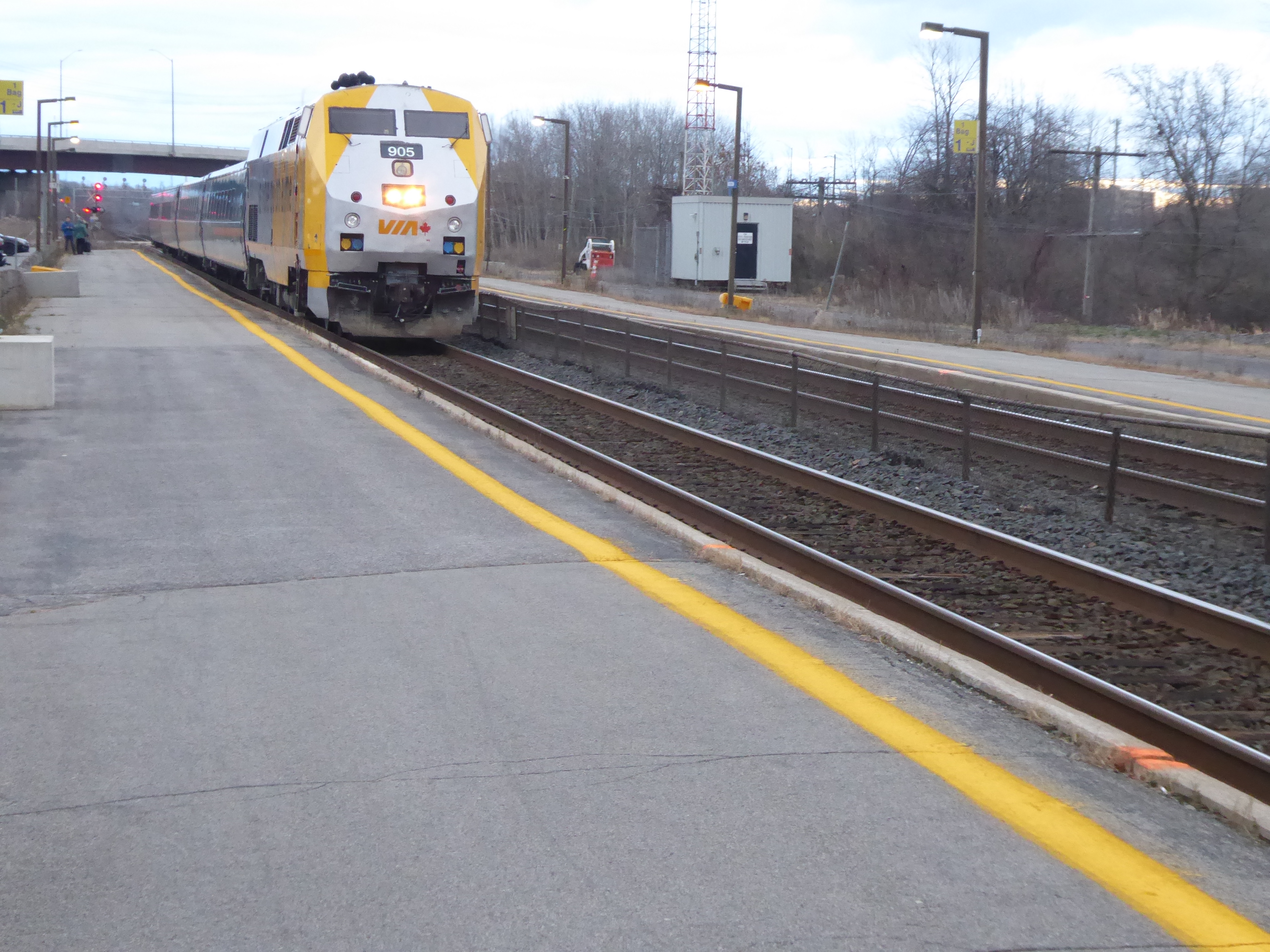
My day in Kingston ended with this westbound, led by P42 905 just after 5:30 p.m. I was a bit disappointed that the new Siemens train didn't make an appearance, as it has been in use periodically on a few Montreal-Toronto and Ottawa-Toronto trains (33 and 26 for example), but no such luck on this day.

But as I wrapped by day of railfanning, I was happy to see 10 trains, even if the ratio of Via to freight (9:1) was a bit slanted for my tastes. Overall, it was fun to watch a busy rail operation in action throughout the day. The frequency of trains, combined with the various scenes on the platform, made the day a good first effort in Kingston. I can't wait to go back.