Showing posts with label Kingston Ontario. Show all posts

Tuesday, September 30, 2025

Making (and breaking) the case for non-stop service

I found the coverage of Via Rail's recent announcement of non-stop service between Montreal and Toronto quite interesting, but not in the way you might think. In case you don't know, Via Rail was planning to make four trains between the two cities non-stop, which would mean no service for Dorval, Cornwall, Brockville, Kingston, Belleville and Cobourg, to name the more important stops in Eastern Ontario and west of Montreal in Quebec. The trains chosen for this pilot were Trains 60, 61, 68 and 69.

What went missing in the coverage was that Train 50 from Toronto to Ottawa would skip stops in Belleville and Kingston, as a near non-stop train. There was no word on what the status of this train was, from the coverage I read. 

As you can tell from my wording, Via Rail has decided to halt the pilot project, which was due to start on Sept. 29. The railway cited operational constraints from CN, its landlord on most of the rails between the two cities. This comes just days after Via made its announcement seemingly out of the blue.  


As always, there are two sides to this story. Via Rail claims that this new service would allow travellers to arrive 30 to 40 minutes sooner. The railway says it chose the trains for this pilot project based on the lowest ridership counts at the smaller stations between the cities. In other words, the trains with the lowest demand in Kingston, Cornwall and Brockville for example, were chosen for the non-stop service. 

I find it interesting that Via Rail was going to try this experiment now, as it has taken a beating publicly for its abysmal on-time performance in recent years, which is a function of the speed restrictions CN has placed on Via's Venture train sets. For more detailed information on this ongoing saga, head on over to Trackside Treasure. No one has done a better job of explaining this story than Eric Gagnon.

I guess my point is, Venture trains have been consistently late for years now, so I wonder what difference 30-40 minutes will make given the restrictions Via Rail faces on CN-owned tracks? Also, is 30-40 minutes enough of a time savings to justify this service? If the train arrives in 3 1/2 hours as opposed to 4, I can't say that would be enough to sway me if I was on the fence about taking the train. It still does not compare to a flight, which still gets you to your destination faster, even after you factor in the security, screening, pre-boarding, baggage claim etc. 


The mayor of Kingston Bryan Patterson raised some interesting points, to support the case for continued full service for his city. He said Via Rail didn't consult any of the communities along the line to give them a warning that these service cuts would be happening. And make no mistake, although Via Rail maintains that these communities would all still be well served by the remaining intercity trains that call on these stations, the coverage was overwhelmingly negative. Service cuts by any other name are cuts, in the eyes of civic leaders.
 
The local media was unequivocal in describing the move as cuts and you can't blame leaders in smaller communities and cities to say anything otherwise. Via Rail making a decision like this with no consultation to the cities it serves is poor communications. 
 
Patterson also pointed out that Via Rail is also turning its back on the 1 million people who live between Toronto and Montreal, many of whom count on these trains. I would think at the very least, Kingston's stops would be left untouched, as Kingston has a high student population at university or college. As we all know, students have always made up a large chunk of Via's fares in the corridor. I took the train many times in my university years.  
 
The mayor also pointed out that taking away more options from these towns and cities means Via Rail will attract fewer customers. It's a fair point. 
 

As someone who has worked in communications for 25 years, I don't agree with the hasty approach here. Had I been in the room, I would have suggested that Via Rail perhaps choose one train pair (60 and 61, for example) and give itself 6 months to a year to prepare a proper promotional campaign outlining this service. Also, it would give the railway time to speak to the leaders of the communities who would be missing out on future service.
 
The rollout of this announcement was hastily planned out; the response was not at all what the railway was likely expecting. In theory, non-stop service between major cities makes sense and provides Via with a compelling product for customers. But the way this was handled was unfortunate from a communications point of view. When customers already booked on these non-stop train pairs were being forced to transfer their spots onto the next available train, it's a bad look.
 
It also doesn't necessarily engender trust in this railway at a time when Via Rail's reputation is already in tatters thanks to the Venture set debacle with CN. The railway has already endured a lot of wounds since the Venture fleet was brought into service.
 
But its communications strategy is producing unnecessary self-inflicted wounds. It makes me wonder how a company comes back from what Via Rail has been through in the last several years.  
 
 
This leaves me with one last thought. Many of these smaller communities in the corridor are very quick to complain when the prospect of Via Rail service cuts are floated. However, just how strong is the customer demand in some of these communities? I'm sure Via Rail took a hard look at its numbers and reassured itself that losing a few extra customers on these non-stop trains would be balanced out by the increased demand from travellers in Montreal and Toronto who might be more keen to take a faster train.
 
That is the logic, although as an infrequent train traveller, I have my doubts that there would be a substantial benefit from such a small reduction in travel time. 
 
But just how soft are the numbers? If I was a politician in one of these affected towns, I'd be very careful about being too vociferous in my complaints. I'm sure Via's attitude is use it or lose it. We've already seen many smaller towns in the corridor who have lost Via service in past years due to lack of customer demand. 
 
Then there's the issue of the investments that have been made in the new train stations in Belleville and other towns in the corridor. When you strip away this much service, what becomes of these stations? I have already seen many examples of Via Rail stations that have essentially become white elephants in many towns across Ontario. They are far too big relative to their use. Many have been repurposed for other uses, like the stations in Stratford, St. Marys and Smiths Falls.
 
I suppose the point of all this is Via Rail, once it emerges from the Venture set fiasco with CN, needs to reflect on what kind of passenger railway it wants to be. This past week's circus leaves it unclear to me what that answer is. 

Sunday, September 15, 2024

Summer observations in Eastern Ontario

From time to time, I collect some random sightings into an observations post. Mostly, the posts centre around Ottawa, but I'm happy to have a few images from Kingston, so this post will be an Eastern Ontario post. However, I do want to start with a bit of news from Ottawa.

Farewell, 4977

You may have noticed, if you follow this organization on Facebook, that the Bytown Railway Society has found a new home for its old heavyweight Canadian National coach 4977. The BRS officially moved the old coach off the grounds of the Canada Museum of Science and Technology this week, where it began its long journey to the Railroad Museum of New England. It's noteworthy that it had to be trucked down to the States.

Those who do follow BRS on Facebook know that this group has worked diligently for 11 years to refurbish the old coach. They also chronicled their progress on Facebook regularly, so all of us history nerds could appreciate their painstaking progress. When the job was officially done, the group brought the old coach out of its storage area at the museum. I was lucky enough one day to be in the area in the spring, so I took a couple of photos of the old car.

This is what the old coach looked like on Feb 29, as it was resting on the BRS tracks near the museum on a frigid sunny afternoon. I walked along the car and marvelled at how great it looked. The BRS obviously did absolutely everything it could with the funds and manpower it had to bring this old antique car back to life. I would imagine that it will get further cosmetic treatment at its new home in Thomaston, Connecticut. 

The New England museum says 4977 will join some other pieces of CN passenger history on its grounds: heavyweights 5046, 5089, 5114, 4980. 

Of course, this is a somewhat bittersweet moment for the society and for railfans in Ottawa. The harsh reality for BRS is this group does not enjoy a connection to active rails like it once did. There was a time when the society chartered railfan trips on local and regional rails. Of course, times change and priorities change. 

The rails in and around Ottawa have been significantly pruned back by CN, which has shrunk the size of the old Ottawa Central footprint to the point where only the passenger links into and out of the city are the only rails left, with some exceptions. There's the trackage out to Orignal, the Walkley lead, Walkley Yard, a bit of the Beachburg Sub and the old Renfrew Sub. That's almost it. The rest of predominantly Via Rail territory.

Also, I can only speculate here, but I would imagine the prospect of granting BRS access to Via trackage in the area is likely fraught with difficulties, liability issues, timing challenges and likely resistance. That's just a guess. I can't see today's railways having the same attitude toward sharing its rails with charters like they once did. I can only imagine the potential liabilities that would need to be ironed out. Then there's the physical connection, which is nonexistent.

So the coach will go to a museum where it can be enjoyed. A reason to pay a visit to New England. Also, it makes me grateful that I had a chance to see this antique up close before it left Ottawa for good. 

A Bit of luck in Kingston

Earlier in July, my family took a break from the whirlwind of trying to sell our house, pack, and move to a new house. We visited family in Stratford, which meant a long drive on Highway 401. When we were driving through Kingston, we were lucky enough to catch an eastbound freight train right around the area where the CN Kingston Subdivision parallels the highway. My wife in the passenger seat was a good sport and tried to get a few quick glimpses of the mixed freight as it rumbled by in the opposite direction.

This is what you get when you are travelling at 100 km/h in the opposite direction of a freight train. The visual hazards are everywhere so you take a few shots and hope for the best. CN ES44DC 2299 leads the way with trailing unit C44-9W 2659 pulling a lumber car. 

She even managed to capture an image of an old BC Rail boxcar with its door open. 

Stretching the Eastern Ontario boundary definition

All right, this last image is most definitely not Eastern Ontario, by the classic definition, but I thought I'd add it in as it is east of Toronto. On the same trip west to Stratford, we saw a number of GO Trains as we headed west on the 401. As we were driving through the eastern suburb of Ajax, I snapped this quick shot of an eastbound commuter train from across the 401. I've made this point before but I will make it again. Taking photos of trains with no visual distractions in your image is fine, but I often find these images don't give you any context.

I've tried this year to take photos with the context attached, meaning to place the subject in your frame alongside something that gives you an idea of the five Ws. (who, what, where, when, how). That is an old lesson from my journalism school days. Approach everything with the 5 Ws in mind, even if one of the Ws is an H. I like that there are cars in the shot. It tells me this was taken on a busy highway near a city. Context!

I was actually going to finish this post with a few images of Via Rail's evening train that I usually come across each week when my daughters are at a nearby dance class. With my wife off Wednesday evenings this summer, many of my railfan excursions were curtailed by the more urgent needs of settling into our new house. This past week, I had a clear window to catch a few trains, hoping that one of them was a new Venture, but one of the trains was quite early and I missed it while the other I was unable to catch since I was busy at Costco. O for 2. 

In the coming weeks and months, I plan to share the prolific amount of railfanning images I was able to get on that trip to Stratford, including a very rare grand slam of a photo where I caught four different railway liveries on four different engines in a single shot.

Stay tuned.

Tuesday, May 14, 2024

Memories of Ottawa to Sarnia in the late 1990s (Part I)

I wasn't in the habit of taking rail photos in the late 1990s when I began my post-secondary education in Ottawa at Carleton University in September 1996. In retrospect, it would have been a fun time to take shots. That's because every one of my trips home to see family at that time meant spending the better part of a day on the train. It was a time when you could still buy your student-discounted ticket at a Travelcuts travel agency on campus and the ticket you got might still have the red carbon copy. That quickly changed to those thick cardstock paper, one-fold tickets with the perforated lines to separate each leg of your journey. For me, taking the train regularly over those four years (1996-2000) was an eye opener, as someone who had seen almost no part of Ontario beyond Toronto for the first 18 years of his life. So, let's take a journey down memory lane and across the province back in the glory days of the late 90s.

A quick note about the equipment. As far as I can recall, every one of the trains I took were pretty much the same consist. I don't recall ever riding behind a P42. It was always an F40PH-2. The cars were almost exclusively LRC coaches. I don't recall riding in an old silver HEP car once during my university years. I don't know if that's a coincidence, but I'm almost positive of these facts. 

Ottawa

It's important to mention this off the top. In all my time taking the train in university, there was no Fallowfield Station. The train would roar through Barrhaven in Ottawa's south end and throttle up for the short leg to Smiths Falls. That meant all trips started at Ottawa's train station on Tremblay Road. Despite the fact that Ottawa doesn't have an historic train station as in Toronto, the east end station in Ottawa is a fascinating building, which is an award-winning architectural work from the 1960s. Given what many buildings of a similar vintage look like in Ottawa, the central train station is downright beautiful. Its main hall, with an endless wall of windows facing the tracks, is a bright, welcoming space. The circular ticket office in the middle of the hall is a creative way to create separate areas. The underground tunnel from the outside platforms is quite beautiful as well, especially the circular ramp to take you back up to the main station. The Via Panorama Lounge is well appointed as well, although I have only been there once. That was when I accompanied my friend, a person with a disability, who was accommodated in the Business Class (formerly Via1) car. All in all, the building hasn't changed much since I frequented it in my university years. The biggest change might be that there is no Harvey's at the station anymore. The food options are not great. Also, the rail yard is much smaller and the old Governor General's cars are no longer there. A small complaint.


Smiths Falls

Heading southwest, the first stop was (and is) always Smiths Falls, which had a classic railway town feel the moment you eased into the old platform at the former Canadian Pacific station on the edge of the CP yard. Of course, in those days, that old building still functioned as the Via station, which has since changed. The new Via station is more of an enlarged kiosk on Union Street, on the edge of the town.

The old station is now a centre for the arts and seems to be well used. Depending on which way I was travelling, Smiths Falls was either the stop where I was getting restless or the stop where I would be settling in with a book, magazine or my walkman (yes, I still listened to cassette tapes then). It was a town I didn't know much about until I learned of its history. It was the longtime home of the Hershey's chocolate factory and was once a very busy division point on the CPR, the dividing point between the Brockville, Winchester and Belleville subdivisions. It still is, but the Brockville Sub is now exclusively Via controlled while the Winchester and Belleville subs continue on as the eastern leg of the CP system to Montreal (and now beyond, once again). But the activity here is not what it was in the 1990s.

Brockville

Brockville is another town that I must confess that I still don't know a lot about, other than it is still sees plenty of rail action each day, as the CN and CP eastern main lines converge here. There's plenty of history in Brockville, including its famous old railway tunnel, not to mention its name, which pays tribute to Sir Isaac Brock. Brock was a British military leader who many credit with preventing a successful American invasion of the Canadian colonies in the War of 1812. The red coat that he was shot and killed in on the Queenston Heights in the Niagara Region can be found at the Canadian War Museum in Ottawa. A gruesome relic, but a fascinating story.

Gananoque

This town was probably the most surprising stop in my early years taking the train to and from Ottawa. I didn't know the town existed, to be honest, and was absolutely shocked when I saw its railway station for the first time. I wondered what kind of one-horse town Gananoque was. I didn't understand at the time that the town's train station was actually not in the town at all, but in a rural area named Cheeseborough to the north. This station remains a vital link where Gananoque is connected to the main line. A short branch line south into the town itself served Gananoque as a passenger link until 1962 and as a freight spur until 1995, when the last freight service ended and the rails were pulled up. However, the first time my train stopped there and I looked around the station area through the window, it was hard to comprehend how a station could be placed in the middle of nowhere. That's what it appeared like to me, anyway. You can read about the town, its famous engine the Susan Push (below), and its heritage in this post, where I explored some of the town's railway history.


Kingston

Prior to my university years, I had only been to Kingston one time. Over the years, I have made some visits and I really do love the city. It's an eclectic mix of historic charm, academia, Upper Canada Loyalist, blue collar ethos and innovation. The city's history, of course, is what underpins much of Kingston and its beautiful downtown and waterfront.

From a rail traveller's perspective, there isn't much to be gleaned when you stop at Kingston station. The Via Rail schedule here is packed, as Kingston sits arguably about half way between Toronto and Montreal and also hosts a number of corridor trains to and from Ottawa. I suppose my memories of Kingston in the 1990s are closely tied to my high school friend Chris, who went to Queen's University to study engineering. Chris and I often found ourselves on the same train between Sarnia and Ottawa, although rarely on the return trip west. Chris was (likely still is) a real card back in high school and university. He had a gregarious personality and didn't mind making fun of himself in a crowd if it meant drawing laughter.

My clearest memory of our rides together on the train happened when we somehow got onto the topic of Stompin' Tom Connors and his famous ditty, The Hockey Song. I'm not sure how it came about, but I remember Chris singing the entire song word-for-word on the train, just loud enough that the people around us could hear him, but not too loud that he would annoy them. I think he left a few people befuddled, to be honest. 

Chris made many a train trip a little more bearable, although I should point out that I had no problem sitting by myself, reading, writing or listening to my cassette tapes. I do recall that, in the days before everything was available online, my brother would sometimes tape a cassette's worth of my favourite radio morning show from back home, which I used to listen to over and over. 

I should also mention that Kingston to me is closely tied to nearby Ernestown, a railway ghost town if ever there was one! The old stone station still stands trackside and it was on my rides between Ottawa and Sarnia that I first saw that old abandoned station. Back in the days before everything was online (man, I'm sounding old now), the story of that station remained a mystery to me, which I think was part of its appeal. Later on, I was filled in on the Ernestown story by Trackside Treasure's Eric Gagnon, but back in the 1990s that old station was the stuff of my imagination. 

These rides featured many other memories and lessons for me, but these are the ones that stick out as part of the Eastern Ontario portion of my journeys. I'm grateful for that education.

Friday, February 10, 2023

A busy day on the mainline in Kingston: Part II

As I mentioned in Part I, I had the chance to spend the better part of a day trackside at Kingston's Via Rail station, as my family was in the Limestone City for a music conference downtown. After dropping off my children for their musical activities, I spent much of my time watching the steady flow of rail action at Kingston station, which resulted in five Via Rail trains in the morning, including the 60/50 J-Train eastbound along with the 62/52 J-Train eastbound, along with a westbound later on. So, for those keeping score, that's five trains in just a few hours. Still, I was waiting for a freight train, as that was what I was there to see. As many railfans south of Ottawa know, much of the CN freight movements happen earlier in the morning before the onslaught of passenger trains between Montreal, Ottawa and Toronto in the mid morning to afternoon.

My afternoon began with the arrival of another westbound Via Rail corridor train, being led by an F40 in the blue-ish scheme. Once again, staff was on the platform ready to greet the crew in the engine.

For much of the day, it was cloudy, which was actually a real plus for me, as the sun was making shots from my side of the platform tricky, given the sharp shadows, as you can see in this shot. I did take this shot of the corridor train boarding passengers with 6432 reflecting the brief moment of sun through the many clouds. As it was a windy day, the blue skies didn't last long. And for once, I was thankful for the return of the clouds.

That was because the next train through was an eastbound mixed freight, just minutes after the Via Rail westbound left. The train was led by ES44AC 2993. I mentioned that the sun was mostly gone by this point, but it was still wreaking havoc with shadows as the train came closer to the station.

Given that that train was being led by a single engine, I was pretty sure I was going to see a mid-train DPU. I was right. The DPU snuck up on me, so I wasn't able to get a great shot, but I did like this shot of the unit sandwiched between an ADM covered hopper and a RailBox boxcar. It was one of the former Citi units that CN has regularly used on this main line.

As always, I was on the hunt for interesting pieces of rolling stock to shoot, possibly with fallen flags on the side. Sadly, there wasn't much to shoot, so I at least got a going away shot of the DPU 3977 in better sunlight. This shot also reveals the size and length of the RailBox car. This type of boxcar reminds me of the auto parts boxcars I used to see regularly on the CSX trains that passed through my hometown, back when CSX shuttled oversized cars from Chatham to Sarnia.

I thought getting an overall shot of the train was a good idea. I took a few going away shots toward the station, but those shots weren't as interesting as this shot, given the colour and assortment of rolling stock.

After that afternoon mixed freight passed, I stuck around to see what else there was to see, as I still had time to kill before picking up my daughters and heading home to Ottawa. Not surprisingly, the afternoon was filled with more Via Rail corridor trains, including this westbnound, led by F40 6416 at 4:17 p.m. This as on my third trip to the station. The intermittent sun peaking through the clouds cast a glare on this train, which washed out most of my shots. This one I was able to touch up a bit. It was a tricky day at times for photos.

I was still holding out hope for another freight, but the Via Rail corridor train parade continued, with an eastbound about 10 minutes afterward, led by wrapped P42 913.

The LRC cars were pretty standard, but it was nice to see this outlier, a reminder of Via's branding efforts from a few years ago, which started with Canada 150 and then continued on during Via's 40th anniversary.

A lot has been written about the early days of Via's operations, when it wasn't uncommon to see Via cars mixed with old CN cars. Even more colourful were the early Amtrak years, when any number of its predecessor passenger carriers would find their way onto early Amtrak trains. I don't know if we'll look back on this era of Via as the rainbow years. There certainly is a wide variety of different paint schemes and wraps to shoot, if that is your thing.

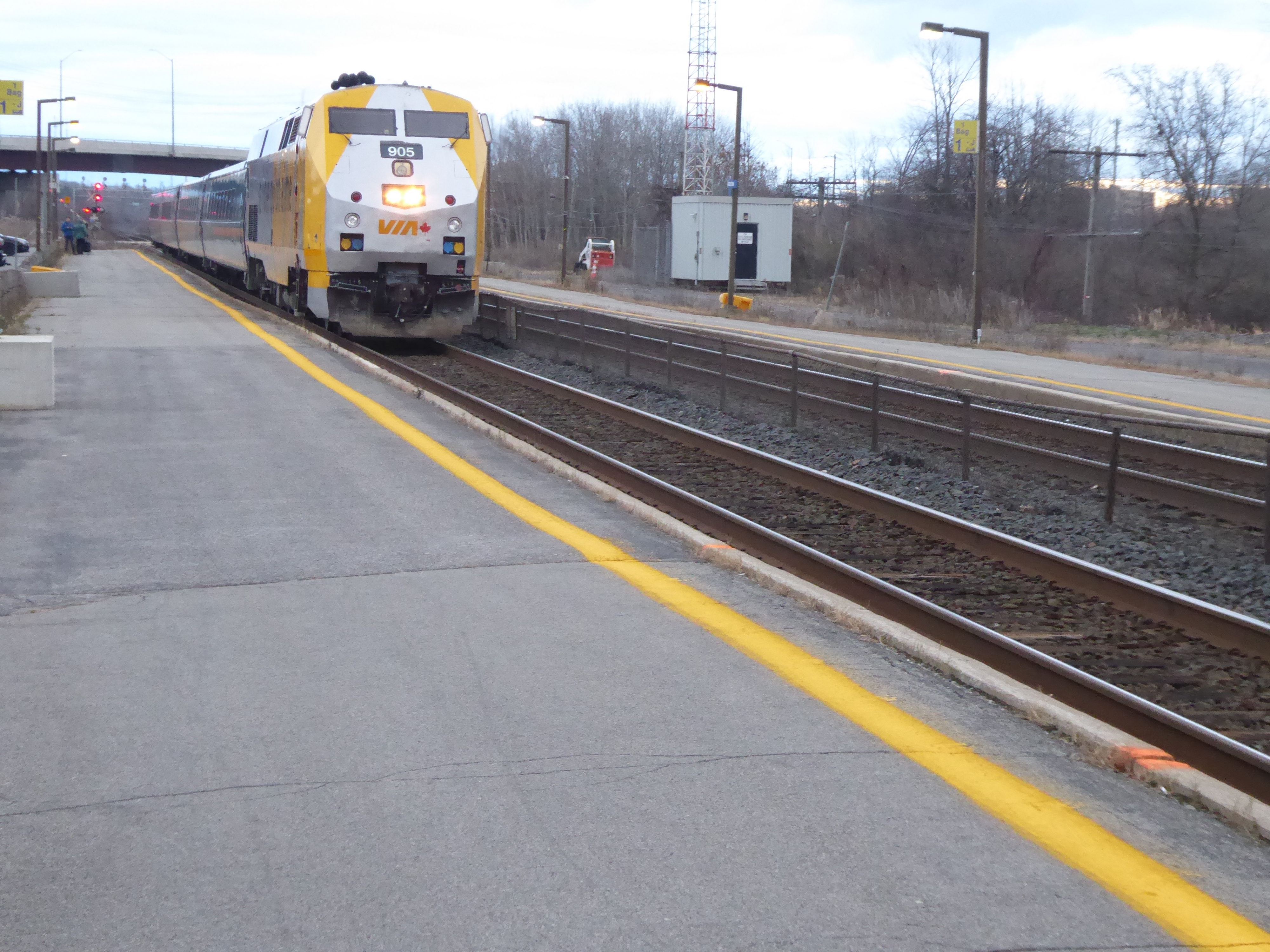
My day in Kingston ended with this westbound, led by P42 905 just after 5:30 p.m. I was a bit disappointed that the new Siemens train didn't make an appearance, as it has been in use periodically on a few Montreal-Toronto and Ottawa-Toronto trains (33 and 26 for example), but no such luck on this day.

But as I wrapped by day of railfanning, I was happy to see 10 trains, even if the ratio of Via to freight (9:1) was a bit slanted for my tastes. Overall, it was fun to watch a busy rail operation in action throughout the day. The frequency of trains, combined with the various scenes on the platform, made the day a good first effort in Kingston. I can't wait to go back.

Monday, January 30, 2023

A busy day on the mainline in Kingston: Part I

In November, my wife was attending a music conference and my daughters were participating in the music class portion, which gave me a free day to railfan in Kingston. This was worth the early morning wake-up and nearly two-hour drive from Ottawa. Having seen countless photos and historic commentary about the Kingston Subdivision from the Trackside Treasure blog, I was eager to get some of my own images from this rail hotspot. I have caught the occasional freight while driving through Kingston on Highway 401, but this opportunity was far different. This time, I didn't have to rely on lucky timing. I could sit at the Kingston Via Rail station and wait. Oh, the luxuries of living along a main line!

The day was punctuated with trips to downtown Kingston to drop off my daughters at various activities and then more time spent trackside at the station.Here are the first three trains I saw.

P42 917 leads an eastbound J-Train, with a F40 mid-consist for the moment. This was shortly before 11 a.m. The daily trains travelling east toward Brockville are Via Trains 60 and 50. Once they arrive at Brockville, they separate, with one proceeding east on the Kingston Sub toward Montreal while the other branches off onto the Via Rail Brockville Sub (ex-CP) toward Smiths Falls and from there, the Via Rail Smiths Falls Sub (ex-CN) into Ottawa. It's not often you get to see a Via Rail train this long, excluding the Canadian, which I have yet to encounter in person.

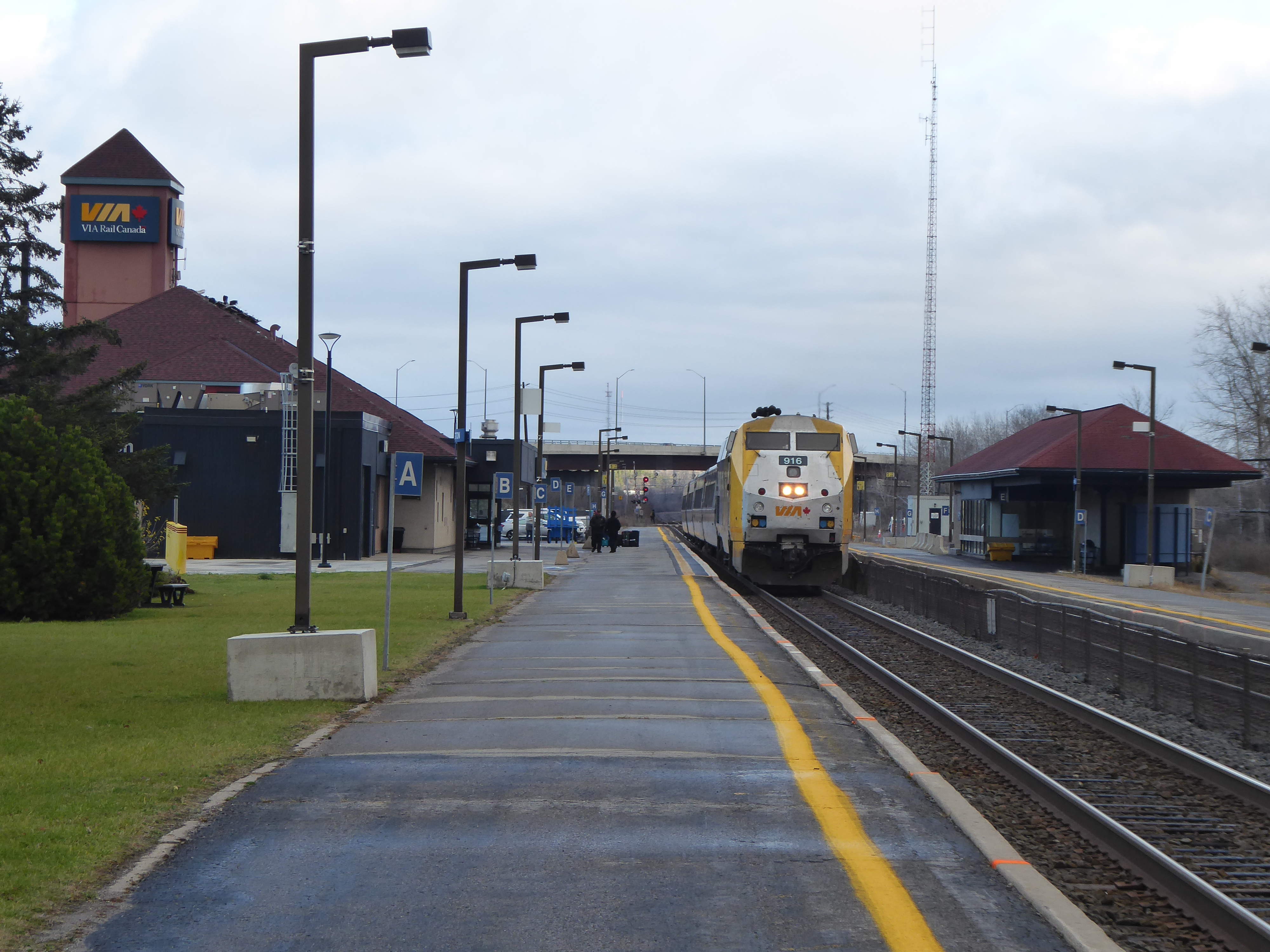
Not long after 60/50 arrived, it had company, as a westbound made its way to the platform, under the watch of the local Via staff on the platform. P42 916 was leading what I assume was Train 51 toward Toronto. If you're keeping count, that's three trains in one meet.

I made sure to get a shot of Train 51 with the entire Kingston station in a frame. It seemed silly to post about the station and not actually take a photograph of the structure itself. Kingston's station dates back to 1974, which predates the birth of Via Rail by a few years. It replaced the famous 1855 Outer Station on Montreal Street, which dated back to the Grand Trunk Railway. Of course, you likely know all this history if you visit Trackside Treasure. It's not my goal to get into an extensive history of this station other than to mention it. I found it funny that there is a line on the Wikipedia entry about this station that states: "The current 1974 mainline station has no notable historic or architectural value." Seems kinda harsh for Wikipedia, no?

Here's the next train I saw. which brought my total up to four. Actaully, it is five, as this was another J-Train, which was destined to separate at Brockville. This consist was led by F40 6436, with the French wrap showing on my side. The mid-train power was P42 911, also with the French slogan wrap showing on my side.

This is Train 62/52. As is the custom with these trains, one heads to Montreal from Brockville while the other heads northeast to Smiths Falls and Ottawa. Since I was on the platform, I decided to take some extra shots of this consist, as I have been trying of late to find images that show detail, rather than just the straight consist. As the P42 went by, I noticed a vestige of its original paint scheme still visible beneath the wrap. It's the old Government of Canada logo. I'm glad Via has done away with this bureaucratic government logo. I am assuming it was forced on them. 

I also took a quick shot of Via coach 8126 acting as a buffer car, is as the case with the old streamlined coaches these days. All the shades were down. It's interesting to see how many paint schemes Via has going on its entire rolling stock roster these days. The original silver and blue is my favourite scheme, but Via has for some time opted for different shades of blue and black on its silver fleet. It's also nice to see the Canada logo taken off the centre of the coaches. I found this to be visually distracting.

One final shot of the J-Train. I took a shot between two coaches to illustrate my point about how much the Via livery has changed over the years. The newer scheme is much more in the blue-green or teal hue. I still think that government logo is out of place on the grooved silver surface. From a business point-of-view, I don't think it's terribly appealing to remind your customers that you are subsidized by the federal government. 

Some have suggested the newer Via scheme is reminiscent of the old C&O passenger scheme, which is something I can appreciate, being a fan of Chessie System and its predecessors. However, I will always prefer the original Via blue and yellow. I'm sure there are marketing reasons to adopt newer schemes, but I maintain the right to be old (40+ anyway) and set in my ways in this case.

That covers my first few meets at the station with five different Via Rail corridor trains. In the next post, I will share images of the lone CN freight train I saw, along with more interesting Via corridor action. I will admit that I was hoping to see more than a single CN freight train, but the sheer volume of activity on my visit to Kingston station more than made up for the lack of freight trains.

Sunday, January 1, 2023

2022: The Year in Photos

Happy New Year, everyone.

I'd like to thank everyone for stopping by in 2022. I wasn't sure how long I could sustain this blog when I started it back up in August 2021. I did miss it, but the wear and tear of pandemic and my lack of time trackside made it a losing proposition. I couldn't do something half way. Luckily, in 2022, I was able to get out a fair bit to see some action along a number of rail lines. The results were surprising. I didn't see all that many mainline freights, but I did see some pretty cool things. Here is a brief summary of some of the highlights from 2022.

In March, I visited my family in Southwestern Ontario and was able to get some time along the rails, as my brother and nephew took me on a tour of their favourite haunts. I even was able to see some things on my own. While in Wyoming, I saw this fast moving freight roar through town. You can read about it here.

Those who are regular readers know that this catch in Wyoming was the second freight I caught in the span of half an hour on the Strathroy Subdivision. Just moments before this meet, I came across an eastbound train on a siding outside Watford. That train was clearly waiting for this one, which had the priority of movement. Here's a shot of the parked train, which was waiting in the howling wind in an area of barren farm fields. And, as an added bonus, this train had some guest power in the number two position, courtesy of BNSF.

But if there was a theme to this year, it was the year of the near miss. I did a lot of travelling this summer but somehow seemed to miss out when trackside along main lines. This has been a very unusual year for railfanning for me. I really had to strain my memory to think of the mainline freights I have witnessed from beginning to end. Notice I mention beginning to end. Every time I pass through Kingston on Highway 401, there is a stretch of road that parallels the CN Kingston Sub. I have had good luck on this stretch of road in the past, but this summer, not so much.

Whenever I catch a train mid-train like this, I always curse the fact that we didn't time our journey a little better! Granted the timing has to be perfect. But, when I at least had a chance to catch the mid-train DPU, this minivan's timing really hurt. Not going to lie.

So close.

I did get the chance to check out some areas of the province I haven't been to before, like Glencoe, a small town that had still hosts Via Toronto-Windsor trains. I always like to discover new stations, new stretches of track and new photo possibilities. The added bonus here was getting to spend time with my brother and nephew. The old Glencoe Grand Trunk station and caboose were also a cool site. Read the post in the link above, including the comments, to learn more about that old caboose.

As I mentioned, it was an unusual year for railfanning, as many of my highlights were not your usual train pictures. In the early summer, CN's Anrprior Turn briefly made use of an old Central Vermont caboose. While the caboose is still in Walkley Yard, as far as I can tell from the only publicly available view of the yard, its brief usage on the Renfrew Spur caused a flurry of excitement in Ottawa.

Here's another example of the unusual nature of my railfanning this year. As many locals know, Canadian Pacific sent a business train into Ottawa this year to coincide with the Women's Open golf championship at the Ottawa Hunt and Golf Club. I was not able to get any conventional shots of this train when it was moving around the city like many other local rail guys, but I did manage to get this shot of it on the evening before it left town. This is the first shot I have taken of an old F unit in all my years of railfanning. I wish I could have gotten something better, but it's a start.

In the summer, I spent some time with family and was able to visit the Oil Museum of Canada, a rural community museum celebrating the birth of the North American oil industry. That museum has an extensive amount of railway pieces, including the old Oil Springs train station, once served by the Canada Southern Railway. I will be sharing lots of pictures and tidbits about this in the coming year. It's one of the many posts that are backlogged and waiting to be edited and shared. Here's a glimpse of what I saw.

Also this summer, I spent some time in Kitchener-Waterloo, where I used to live. I was able to watch the region's Ion light rail system in action. Unlike the system in Ottawa, the Ion system seems to work fairly well, even though much of its system interacts with vehicle traffic. The region is also home to the Waterloo Central Railway in St. Jacobs, where many pieces of historic equipment can be seen from nearby streets. I will have more about my time in Waterloo next year as well. Here's another glimpse of what I saw this summer. It's hard to tell from this angle, but this old RDC unit is clad with CP-inspired maroon stripes, with Waterloo Central written on the side. Much of the equipment in this small yard has been maintained really well and painted in a handsome Waterloo Central script.

I would like to finish with another scene from Eastern Ontario, as that is where I had my last major rail adventure. In November, I spent the better part of a day at the Kingston Via Rail station, as my daughters were in the city for a music camp and I was free to do my own thing. I saw a number of interesting meets between Via's corridor trains connecting Toronto and Ottawa and Montreal. I even managed to see one CN mainline freight, which was what I really wanted to see. I will share all of this material early in the new year. There are probably two posts worth of images to go through, which is a great problem to have This shot below was one of my favourites, as a Via employee gives an westbound locomotive crew a friendly wave in the morning as an eastbound J-train awaits clearance to depart.

There were more moments and images, but these are the ones that stick out in my head. My thanks to everyone who helped contribute to this blog this year, either directly or indirectly, including Eric from Trackside Treasure, Steve from Traingeek.ca, Keith Boardman, my eyes and ears in east Ottawa, and everyone else who passed along tips and information. 

Moving forward, I'm hoping to share more posts next year, possibly in the form of occasional pop-up posts with more newsy, topical items. You will notice I shared a pop-up post about the unusually wrapped engines that have been sent to Ottawa recently, most likely to the NRC. There are many theories as to what these trains might be. For my part, I was just happy to have stumbled across something newsworthy to share.

It's hard to be first out of the gate with news these days, as more active rail watchers share their intel on Facebook almost immediately. That's great for all of us, but it tends to hurt my cause on this blog at times. Either way, I am going to try and step up the pace in the coming year. 

I enjoyed continuing to share my passion for railways with everyone this year. Thanks for your continued support. 

Happy New Year.

Thursday, March 17, 2022

Hide and Seek, Part I

When you don't see all that many trains, you have to make the most of the chances you do get. I have mentioned this many times on this blog. Aside from the very sporadic CN freight trains in Ottawa's west end, I am 40 minutes away from the nearest main line. That's why I always make sure to bring a camera along when my family travels to Southwestern Ontario. There are a number of spots along our route where you can technically get a quick shot, if you are ready. Last summer, my family made two trips to Southwestern Ontario.

There wasn't much on the first trip down. Usually, if we are passing through Kingston around 9:30 a.m., we will catch an eastbound or westbound CN mixed freight. On our first trip, there was nothing. Between Kingston and the Greater Toronto Area, there are a few spots where you can see rails, but nothing was happening. 

On the east side of Toronto, we did see a CN freight parked on the mainline, waiting for clearance to proceed west. We were in the westbound lanes, so visibility was tight, to say the least. I was sitting in the passenger seat and attempted a few shots at the head end of the train as it waited. 

Of course, the 401 being the 401, my first shot was foiled by a car. I tried again.

This time, there were no cars in the way, but I did managed to snag a decent shot of the head end power, although it was partially obscured by the highway divider. As I've mentioned before, I earn many of these shots through quick timing and lots of editing. The full frame of this shot was not nearly as orderly as this cropped version. But, all in all, not a total waste.

I titled this post Hide and Seek for a reason. When attempting shots from the highway in a moving car, anything on the tracks can disappear behind a car, tree, safety barrier, building or bridge in an instant. It's not an easy game to play, especially when you're shooting across your car and trying not distract the driver. Thankfully, my wife knows this game and is ice cold behind the wheel.

A few weeks after this first trip, my family headed west again on a separate trip to visit the other side of our family. The second time around, my highway railway karma was much better. We did run across a freight train headed east on the CN Kingston Subdivision, but the trees obscuring the main line foiled any attempt at a shot of the head end. This time, my wife was in the passenger seat and trying her hand at railfanning. 

She did snag a tiny piece of the mid-train DPU. This shot is the essence of hide and seek.

I did pick out a few shots of the middle of the train, since there wasn't much else to focus on. I like the single TTX RailBox car in the middle of a string of tank cars. When I was younger, I loved watching the old freight trains that didn't seem to have any order to their consists. I know there is an order to this train, but it's always fun to see a car that sticks out in a line.

Here's one more shot. Boxcars and a lumber car. Nothing special, but some contrasting colours and schemes. It's all part of the game when you're on the highway.

Further along on our journey, we came across something really interesting as we left the 401 and merged onto the Highway 8 in Kitchener. Having lived in this city and thinking back to past experiences in the area, I knew there was a slight chance of catching something. I did in fact get something at long range, but I am saving those shots for the next post in the Hide and Seek series.

Our final stop was Stratford, which meant some interesting shots in the town's CN rail yard, which is shared with the Goderich Exeter Railway. There were a few posts worth of material from my time in Stratford that I just shared.

Skipping ahead to the return trip to Ottawa, I did manage to get a few shots in the east end of Toronto from the eastbound lanes, which are much closer to the GO/CN tracks. Here's one shot that you can easily get when you exit off the eastbound 407/412 ETR back onto the 401. It puts you right next to GO's east end maintenance facility and yard. I like that you can get a shot along the curve.


I wasn't able to get a shot of the GO rail yard that was usable for this post. The glare of the sun off the car's windows obscured my shots. You can't win them all.

All in all, I think my train karma was pretty good. I also managed to see a CP container train passing beneath Highway 416 near Kemptville, but there were no shots of that meet. 

As always with these posts, I am a bit hesitant to share these shots, as there are not typical of what you would find on a railway blog and they are certainly not up to the usual standards of many other blogs with far better photo quality. 

I guess there are two reasons why I share these shots. One, I think the challenge of rail photography from the passenger seat of a car on the 401 is incredibly difficult, which is itself worth exploring. Second, trips on the 401 are always an opportunity for bonus rail photos. For someone living in a railway desert, I can't pass up the chance.

Wednesday, December 19, 2018

30 for 40 Bonus: A lifetime of Via Rail memories from Kingston platform

To cap off this series of Via memories, I reached out to one of the country's most prolific railway bloggers, Eric Gagnon of Trackside Treasure. He has graciously shared this excerpt from his fine collection of Via Rail books (four, count 'em, four in total). Please see the bottom of this post for more information on Eric's books and how you can get your hands on them. - Michael

To be trackside in the Corridor in VIA’s early era was a colourful cornucopia of sights and sounds. At the time, the continuation of operations from the CN into the VIA era provided many of the same sounds but some new sights. At Kingston, time spent on the platform revealed VIA blue & yellow making inroads into CN’s black & white scheme. Platform-filling consists prevailed, with baggage cars, meal service cars, coaches, club cars and even the occasional CN business car tagging along.

VIA Nos 1/55 smoked its way out of Kingston on May 7/84: 6775-6863-617-3229-108-5649-760-123-3228-Thompson Manor-Edgeley

Positioning oneself to see the approaching consists in review, inevitably ending up next to the locomotives, each consist could be viewed twice. Bell ringing, the train would be halted at the ‘pheeeep’ of the air whistle in the cab. Brakes squealed and running gear clunked and groaned. Locomotives would be brought to idle, coach Dutch doors opened, and stepboxes would be dropped onto the platform. Handrails wiped, suitcases and babies lifted from vestibule height to platform height by trainmen and conductors, baggage wrangled by the baggageman before returning to his wooden stool in the baggage car.

Rising and falling, MLW 251’s burbled continuously. GMDL 567’s had a drumming idle. Though serendipity sometimes prevailed providing solid MLW or GMDL locomotive consists, mixing together of both makers’ models was liberal. Some enginemen would roll down the window to converse with us ‘train buffs’ while other crews would busy themselves with various cab duties, or simply stare grimly ahead!

August 26/84: CN 4361-6632-602-5458-3217-5594-5487-5595-3202-Union Club

The highball from the conductor was soon followed by the ‘pheep pheep’ on the air whistle, often answered by a ‘barp barp’ of the air horn. A tug on the coupler. Bell ringing once more, smoke-belching MLW’s and the chant of transitioning GMDL’s rising to a crescendo, co-conspirators in a cacophony of sound and smoke sent skyward. Wheels banged on rail joints prior to the advent of continuous welded rail. Faces looking out - listless coach passengers, comfortable club car patrons, convivial comrades in the ‘bar car’. Prior to tinted glass, the panoply of passengers went past, continuing on their voyages. Soon it was just the last vestibule door, marker lamps and sometimes the hot breath of escaping steam as the train pulled away.

Thanks to Eric for sharing this almost poetic tribute to the early days of Via Rail. Most of you know that Eric has written four books about Via Rail, all of which are available through this blog, dubbed New Via Rail Book. To skip ahead to the order form, click here. When you get there, you have the option to pick among these four books:

Trackside with VIA: Research and Recollections
Trackside with VIA: Cross-Canada Compendium
Trackside with VIA: Cross-Canada Compendium Consist Companion
Trackside with VIA: The First 35 Years

I should also mention that Eric has also written Trains & Grain Volume I and II, which detail his time trackside with Canada's iconic grain trains. Those books are also available through the
Grains and Trains blog. I should also mention that shipping to anywhere in Canada is included in the prices. You can contact Eric directly at mile179kingston@yahoo.ca.