Showing posts with label Kitchener-Waterloo. Show all posts

Monday, February 2, 2026

Switching it up in Kitchener

It's been more than 15 years since I've lived in Kitchener, which seems crazy to me. When I moved there to take a job with the local newspaper, I never intended to move back to Ottawa, but things happen. I have fond memories of my years in KW, but I do regret never pursuing rail photography there, like I had in the past. Right before I was laid off at the newspaper and forced to return to Ottawa, I had begun to consider volunteering for the Waterloo Central Railway. 

Now when I return to KW on occasion, I make sure to make up for lost time. The city was served by the Goderich Exeter Railway when I lived there, but that service reverted back to Canadian National after I left the city. This past summer, I had a tip that the CN local for St. Marys was getting assembled in the Lancaster Street yard, which meant I had a chance to capture some local freight images. 

I started with a long shot of the crew crossing Lancaster for the first time. I've mentioned this before, but I am surprised that the city still allows this type of shunting to block city streets for as long as it does. I've seen this type of congestion in London as well. This type of arrangement where freight trains hold sway on a grade crossing in the middle of busy cities is fast becoming a memory. Here in Ottawa, Via Rail has removed its grade crossing on Greenbank Road in Barrhaven, and those inconveniences are minor, considering the passenger trains pass by in less than a minute. This shunting operation I watched blocked Lancaster for quite a while. I can imagine motorists are sick of this.

I took a quick shot of the local as it disappeared behind the metal recycling depot on Lancaster. The lead unit is a former GT geep. The cab lettering makes it clear. As I watched the crew assemble its train and cross Lancaster over and over, the thought occurred to me again that people in big cities are no longer used to living side-by-side with railways or, at the very least, have grown more impatient with them. Just down the line from Lancaster, the former grade crossings at Weber St. and King St. have both become flyover crossings. That has changed since I lived in Kitchener. I would imagine the housing, technology, research and academic developments in this area had a lot to do with King and Weber both being routed beneath the tracks. The Guelph Sub, in addition to hosting CN's local operations, also hosts daily Via Rail service, as well as GO Trains. 

 
From the Lancaster grade crossing, I was able to get a shot of the local backed well east of my vantage point, back in the yard. This shot gives you an idea of the topography that the Guelph Subdivision covers in the eastern end of Kitchener. As I was told by a few railfans who know Kitchener, the rails east of the yard are in excellent shape, as Metrolinx hosts its daily services on this line and has done much to ensure upgrades on the line into Toronto. 
 

Back and forth the train went, much to the chagrin of motorists on Lancaster. It should be noted for people not familiar with Kitchener that Lancaster Street is a busy road, as it connects much of Kitchener to the Conestoga Parkway, a busy highway that links most of Kitchener with Waterloo.  
 

Here's another example of my attempts to make railways interesting again. The lack of variety in today's freight trains means you need to get creative sometimes. In this shot, I framed a rust-stained hopper against the crossing guard, with the CN Guelph Sub plate visible. You can also see the trackside signals in the shot. 
 

One final shot of the train next to the recycling depot. I had to shot this image through links in a fence, but I think the effort was worth it. The morning sun and lack of cloud cover meant the sky was largely washed out, which was a common occurrence in my images from last summer, but such is life.
 
You can check out my other recent images from Kitchener in this post, when I caught the morning GO Train making its way east out of the station.  

Wednesday, November 26, 2025

How two railway photos helped spawn a book

The locomotive hissed and groaned as it inched its way forward. A small band of angry workers held its ground against the rumbling giant. A few of the workers shouted themselves hoarse, trying to get the engineer and the railway police to back off. Others hurled rocks at the train,which was attempting to push its way along the railway siding that led to the Nafziger Textiles plant. In the middle of the barricade stood a bewildered Eddie Daoust, a cigarette pinched between his thumb and index finger. He hadn't smoked in three years but couldn't resist a quick drag since he had a fierce headache from the diesel fumes and noise. 

So begins my short story, King Eddie, a tale that is included in my first volume of short stories, Sunshine at Night. The book was released in 2017 and updated just this fall to include another story (the original book had nine stories and I couldn't live with that).

The image I have included above is from a 1991 photo that was reprinted in my 2008 feature story in the Waterloo Region Record, the newspaper I worked with until 2009. The workers in the photo are striking employees of the Budd Canada plant, which was later known as Kitchener Frame. And yes, it is the same Budd company that also became famous for its rail car division. 

The Kitchener plant once employed as many as 3,300 workers by some estimates, as it was a key cog in the North American automotive parts network. The plant was opened as a direct result of the 1965 U.S.-Canada auto pact, which brought untold jobs to Canada. 

The plant had a colourful history, with years of unprecedented growth and profits, as well as years marked by wildcat strikes and layoffs. The plant closed for good in 2008.

When its owner, Martinrea International, closed the sprawling operation in late 2008, the head of the union local said something to me that was succinct and quite powerful. 

"This time, we won't get back up."

Indeed, it was an awful time in the region, as the automotive parts industry was decimated by the global recession and the freefall of the Detroit Three automakers. Kitchener Frame, in the end, made chassis for GM's line of SUVs, which was well on its way to oblivion.

That photo, to me, is a powerful image that fit the theme of the book Sunshine at Night. These were normal people doing something extraordinary, because they were fighting for what they believed. You don't have to agree with their point of view to admire their courage. The book is very much based on the premise that even the most ordinary life is extraordinary.

But it was the man in the middle, whom I later tracked down, that first inspired the character of Eddie Daoust, along with the man who was the union local president at Kitchener Frame. The man in the photo, John Coleman, had a look of determination in his eyes that made me think there was more to that image that needed to be told. You can even see his cigarette pinched between his fingers in the photo. It was a detail too good not to use in my story.

Truthfully, though, the story was mainly inspired by the head of the plant's union local, who told me, "This time, we won't get back up." He was a tough man, but fair. He often made things difficult for me as a reporter, but he earned my respect nonetheless. He didn't suffer fools gladly and was not afraid to be blunt when he thought the situation called for it. 

On the day I was laid off in 2009, I remember talking to him and he grudgingly said I was an okay reporter and did a decent job. It was high praise from him. I never forgot that brief exchange. 

I'm not mentioning his name, because he went on to other prominent community positions after his time in the CAW (Unifor now) and I honestly don't know what he'd think of my character, Eddie, and his resemblance to him.

But for our purposes, it was the railway image that sparked the initial seeds of the story, because it motivated me to wonder what it would feel like to be in a position where you had the fate of that many people in your hands with everything on the line. The drama was something that felt real and touching, to me.  

Here's the other image that also inspired much of the story.

This photo, above, is from the same story I wrote in 2008, when the old Budd plant closed for good. That story, which was a long feature that ran on the front page, is one of the articles I am most proud of from my time as a reporter. 

But it was this image of a train being held up on the tracks that also inspired my story King Eddie. I know from my dad's time as a unionized worker at a power plant that these types of stand-offs do happen, but this one just seemed too rich to not mine for a good story. That is why this image ended up inspiring the first scene in my story of workers holding off the charge of a train. I can't imagine what that scene was like in real life, but I enjoyed imagining it in my story.

In my time at the Record, I became more and more involved in labour reporting, which I found fascinating, given the high stakes at play in 2008 and 2009 when the manufacturing sector in the region was being pummelled by the recession. I remember once doing an interview with CBC Radio about one of these situations. It was a fascinating time to watch the human drama unfold and try to do it some justice through the written word. I miss that.

The other union stand-off that inspired my story happened at another plant in Kitchener, Ledco, which was owned by the same family that controlled Canadian Bank Note. Ledco was a small company by the time it came to my attention. The company, which once made components for the famed Canadian supersonic fighter jet, the Avro Arrow, was on life support when we received word that the company was essentially out of money.

Long story short, the owners had pressured the company's unionized workforce to take a 25-per-cent wage deduction and 20-per-cent benefits cut in exchange for keeping their jobs. Many of the unionized workers were already laid off, so it was already a tense situation.

What happened next made national news. The workers showed up to work and were locked out. A notice on the plant's doors said they were all terminated and that the business was closed. That began a tense stand-off where workers barricaded the plant and prevented the company's remaining products to be shipped. Ledco, like Kitchener Frame, was a parts supplier to the automotive industry.

Making matters more complicated, a few workers insisted to me that they had taken a vote of their peers and were prepared to accept the company's terms. That vote was not sanctioned by the union, which essentially meant the workforce was divided.

Then, some workers decided to break into the plant and occupy it. That lasted a few days until a court order declared the occupation illegal and cooler heads prevailed. 

One last footnote to the genesis of this story. There was one other plant that closed in my time in the region, which made felt products. I was shocked that such a business even existed in Canada in 2008-09, but it did. There were elements of that company's demise that made it into my story.

The whole point of this is to explain how much a muse the railways are to me in my writing. There is something about the railways and their impact on our country that makes them such a rich image and powerful inspiration to our art. 

It's not just me. How much art in Canada in inspired in some way by our railways?

He rolled down the window. He could hear the faint cries of the morning Via Rail train as it approached Louiston. He knew it would whiz through town just like it had done for years.  

The story, King Eddie, was the beginning of a prolonged period of inspiration that resulted in the book Sunshine at Night. And it was those two powerful railway photos that kickstarted the story, which ended up being one of the centrepieces of a book. 

If you ever wonder why I write about railways the way I do, maybe this will give you some insight into how my mind works. To me, there is an emotional response when I hear a train or see a train. There is something about them that resonates deeply within me. They have always inspired me and they will.  continue to do so. 

Wednesday, February 14, 2024

Running Back to St. Jacobs (Part I)

Back in November, I was in Kitchener-Waterloo for a conference, where I was giving a mental health presentation. I made sure to carve out some time trackside, as KW has some unique rail photo opportunities. You can read about my time trackside in Kitchener here. My first stop was St. Jacobs, a small community north of the City of Waterloo. St. Jacobs is known for its area old order Mennonite population (think horse and buggies) as well as its tourist industry, which is very much a mainstay of the local economy.

The Waterloo Central Railway has a yard located in the town, which serves as its maintenance facility and starting point for some tourist excursions. At one point, the WCR operated from the former Waterloo train station, but the rails south of St. Jacobs are now all occupied by the Ion light rail system. CN still operates local freight operations during off hours, which you can read about in this Traingeek.ca blog entry. But the area is off limits to the WCR.

You might recall I've been to this yard a few times, which you can read about here and here.

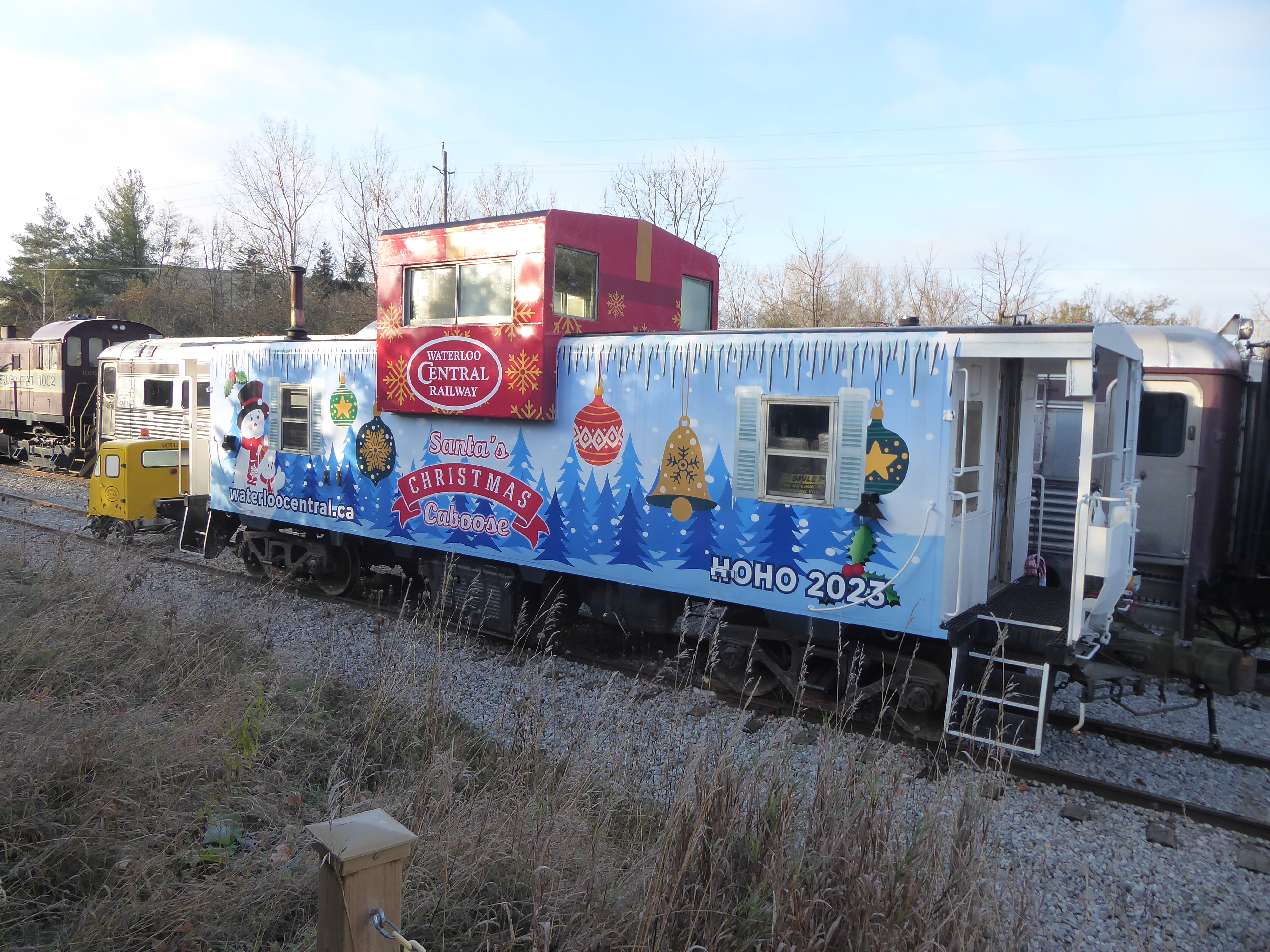
This time around, I arrived in the early morning, as this was the only time I had to take photos. I was quite happy to get a few shots of the WCR's former Essex Terminal Railway caboose, clad in a wrap that would be useful for its Christmas Train. The railway added some nice touches, like the HOHO 2023 operating mark. Also, as a communications professional, I always like it when a business includes its web address in a visible spot. I remember a marketing professional telling me she couldn't understand why a company would ever hesitate to share its website at every opportunity. 

You can even see the WCR speeder to the left of the caboose as well as a Budd-build RDC unit behind the caboose. I got all these shots from a small park next to the railyard, which offers you some great vantage points to get photographs. It's like visiting a rail museum for free. There is even a street just north of this park that ends at the tracks, where you can get some shots from a different vantage point, but stay on public property (the street). There are signs here that clearly show you where you can and cannot go, as there are homes and a small trackside business here.

There were some other interesting things to see in the yard, as the railway was clearly getting ready to assemble a Christmas train. If you look closely at this old passenger coach, you can see that the crews had already strung up lights around the windows and across the top and bottom of the car. The WCR is clearly influenced by a love of vintage Canadian Pacific colours, as many of its cars and locomotives sport CP's maroon (Tuscan red, technically) and grey scheme, which was officially ditched in 1968 for the action red multimark livery.

This coach, however, is actually a former CN coach, built in 1954 by Canadian Car and Foundry. It served well into the Via Rail era, where it took on the blue and yellow scheme, before finding its way into the BC Rail fleet, where it became known as Sunset Beach, and finally the Orangeville-Brampton Railway. Coach 1978 has been with WCR since 2018. 

In previous years, WCR kept some of its coaches in the blue and yellow Via Rail scheme. I was lucky to get a shot of one of the last coaches to sport this scheme. I was happy I did, as I have great memories of these old blue and yellow cars as a kid.

Here's a sun-drenched shot of two S13s 1001 (left) and 1002 in the yard. Each unit was built by the Montreal Locomotive Works in 1959. While each bears the colours of the pre-action mark CP, these units were actually Pacific Great Eastern (later BC Rail) units upon delivery. After serving out west, they spent time on the Greater Winnipeg Water District Railway as 501 and 502, before moving further east and operating for the Ontario Southland Railway with the same numbers. They have been with the WCR since 2018. It's incredible to think of how much revenue service these old units have seen.

A little deeper in the yard, another MLW unit, this one ex-CP S3 6593, was sitting with a mixed consist, including 1930s vintage ex-CN baggage car 8751, a tank car and a former Toronto, Hamilton & Buffalo boxcar. Unlike the other units, this one was originally a CP unit, built in 1957. For Ottawa railfans, they might be interested to know that CP sold it to the National Research Council, where it served as the NRC switcher at its ground transportation research centre along the old CP Prescott Sub, near the Ottawa International Airport. It was sold to the WCR in 2012. Here is a cool shot from its move from Walkley Yard back in 2012. This unit began its work in these maroon and grey colours before being switched to action red, so this is likely a fitting scheme for this old unit.

The railway explains on its website that its small collection of rolling stock is for the purposes of television and movie work, where productions might need to include a freight train in a scene. Since the WCR also has a steam engine on its roster, I would imagine have a tank car might come in handy as well for the purposes of feeding the engine water.

All in all, it was a fun visit to this area. I will share a few more images from this morning in another post, since there was quite a bit to see in a brief time.

Friday, December 1, 2023

Along the main line in Kitchener

I don't know what it is about Kitchener, but I have had some good luck in this city in the few times I have visited the area. You might remember that I caught some GEXR action in the grey and rain one time at the Lancaster Street crossing in 2018. In November, I was in Kitchener-Waterloo for a conference where I was giving a mental health presentation, which left me with some spare time to do little exploring and some railfanning in St. Jacobs and in Kitchener. 

Much has changed since I got those shots of the Goderich Exeter Railway in 2018. For one, the Guelph Subdivision in now back in CN's hands while the trackage east of the city into Toronto is essentially in the hands of Metrolinx. The last time I was in Kitchener last year, I didn't catch anything. But on the whole, it's been a spot where I've had a lot of success. It makes up for the years I lived in the city and didn't take any railway shots.

This time around, when I was approaching the Lancaster Street crossing near Victoria Street, I noticed that a CN conductor was flagging the crossing, which I found a bit curious, since the signals and gates were operating. It turned out, there was a crew in the Kitchener yard assembling a train. I managed to park my car in a nearby parking lot and walk down a sidewalk to get a few shots of the motive power shunting cars near the crossing. This was the first shot, which was taken from the west sidewalk on Lancaster. There were three four-axle geeps at work, two with the sergeant stripes. Interesting that the lead unit did not have its headlight on.

Here's a shot closer to the crossing. You can see that the crew had the power partially on the main line, as they hitched onto some hopper and tank cars in the yard. I waited around for a few minutes, to see what they were going to do, but my daughters were a little restless in my car, so I decided to move on. The early morning sun was not making it easy to get a shot, since many angles were a no-go due to the harsh light washing out images and casting unworkable shadows.

We were about to leave the area and make our way to the nearby Kitchener Via station near the corner of Victoria and Weber streets when the crew had the geeps moving again. They moved back into the yard in a position where the light was over my shoulder. it made for a decent shot, especially with the curved track. The zoom on the camera made it seem like I was in the yard, when I was still at the Lancaster crossing. Always stay on public property and be aware of the train's movement. Again, even with the engines moving, there was no light on the lead unit shining.

Within a few minutes, we were at the Via station just to see if there was anything to see, as I often say. See what there is to see. It's something railfans in Ottawa usually resort to, in the absence of a sure thing. The signals on the main line suggested there was nothing to see, which was fine. I like the Kitchener station. It's a nice old station, even if it's a little ragged around the edges. It's clearly seen better days, but it fits the character of Kitchener, which is as tough a town as I've ever seen. Also a town of good people, I should add. Great people, in fact. To be honest, it did appear as though some maintenance had been done to this old station in recent years.

I took a quick shot of the station and roamed the platform a bit. I've taken Via from Kitchener into Toronto a few times, since when I lived in the city, the GO Train service was not yet established. Speaking of the GO Train, as I looked east down the tracks from the eastern edge of the platform, I could see the trains parked on a spur just past the Weber Street flyover. In this shot below, I wanted to get as much of the cityscape in as I could. Here you can see the topography that the rail line traverses, a piece of the flyover and the GO Trains on the north side of the main line.

The last shot I took was an attempt to get the trains in the shot with fewer visual distractions.

I'm not sure it's all the much better, but the other shots where I zoomed in were not as sharp as this image. I made sure to keep the signals in the shot as well as the main line, as I think the topography is a visually interesting element. 

On the same trip, I took my girls up toe St. Jacobs to have a look at the Waterloo Central Railway yard on the Elmira Subdivision. That trip unearthed some surprises, which delighted not only me but my daughters as well, but I will save that for another post. 

All in all, it was a fun trip back to a city where I lived for a short while. It's interesting that I maintain such fondness for a place where I barely lived two years. I chalk it up to the people I met when I lived there. I will say this about Kitchener. Good people.

Saturday, June 10, 2023

Déjà vu in St. Jacobs

Last summer, my family was in Waterloo for a music camp at Wilfrid Laurier University (here's the post about KW rail sightings). It was in close proximity to St Jacobs, which is the home of the Waterloo Central Railway tourist line. Longtime readers might recall my first visit to this railway's yard, which is located along the CN Elmira Subdivision. The first time I shot this operation in 2018, it was a cold wet November day, when the rails were silent. My daughters and I took a few photos from public property and had to take shelter before a downpour spoiled our fun a bit (or, my fun, to be fair).

This past summer, in a break during our music camp activities, I managed to break away and head north to St. Jacobs to see if there were any other old antiques in the yard that I didn't catch on my previous visit. Luckily for me, there were some great old antiques on display, although their position in the yard made it difficult for me to get some decent shots. And despite the fact that we visited the area in the midst of a prolonged dry spell, we had to duck into our car again to avoid a sudden downpour. Eerie déjà vu.

A quick bit of history. The Waterloo Central is a tourist line that has operated on the CN Elmira Sub for a number of years and is the latest incarnation of a tourist operation that has operated on this line on and off over the years. Up until the Region of Waterloo repurposed much of CN's tracks in Waterloo for its Ion light rail operation, the WCR began its runs from Waterloo. Now, the short line starts its runs from a retail area just south of St. Jacobs, near the border with the City of Waterloo.

When my daughter and I arrived last August, there was a collection of old locomotives huddled next to the short line's engine house. My daughter and I both took some shots of this scene. I wish I could have gotten some clean shots of these engines, but I did like how this one turned out. It really fits with my new approach to rail photography, where I am trying to get creative with my images.

You can see former BC Rail MLW S13 locomotive 1002 clad in the old Canadian Pacific-inspired maroon, grey and yellow scheme. This unit was built in 1959 for BC Rail predecessor Pacific Great Eastern. After its life at BC Rail, it was sold to the Ontario Southland Railway in 1997. The Waterloo Central took ownership in 2018.

At the back is what I assume is former Canadian National SW switch engine 1012 in the old CN yellow and olive green scheme. In consulting the Southwestern Ontario Locomotive Restoration Society's (organization behind the Waterloo Central) fleet of engines, this one is not listed. The photo I took does not capture the full unit number, so its story remains a mystery for now.

In the foreground is a Waterloo Central heavyweight baggage car painted again in the CP maroon and grew scheme. The WCR has made great strides in recent years in painting much of its fleet or repainting it in a CP maroon and grey scheme. I recall during previous visits that some of its cars were still sporting the original Via Rail blue and yellow scheme, albeit with the WCR logo in place of the Via logo. Here's a better shot of the old baggage car.


If you are looking for old RDCs, the WCR has several of them in its St Jacobs yard, including this one, which was parked next to a heavyweight coach with a rear facing porch. Two different eras of passenger rail side by side. It was cool to get an image of these two together.

Here's another shot of more RDCs, a little to the south of the Via Rail painted unit. These ones have seen better days, as their faded blue and yellow liveries attests. You can just see a bit of a heavyweight coach in the foreground. These photos were taken from the edge of a nearby school yard. It was a challenge to shot through the brush at the edge of the tracks.

At this point, the rain had begun to fall. I took this shot from the end of a suburban street, which abuts the tracks. You can see a former Essex Terminal Rail caboose linked to a maroon-clad caboose and another WCR maroon and yellow baggage car. This society has an extensive collection of passenger equipment and cabooses, including a Toronto, Hamilton & Buffalo caboose. I was not able to get a clear shot of that car, as the rain turned into a downpour shortly after I took this shot.

This was the best I could do to get a shot of the TH&B caboose, which was tucked in behind another passenger coach near the engine house. The engine house, it should be noted, is where the group keeps its steam engine. I have never seen that machine out of the engine house. I find it interesting that the WCR paints its passenger cars with both the "Waterloo Central" and "Waterloo Central Railway" lettering, as you can see from this car. You can also see the Waterloo Central lettering on an RDC to the right. That RDC sports the CPR maroon and yellow scheme.

Here's one final image from my visit. It's strange how that clear blue sky turned into a downpour in a matter of 10 minutes. I wish I could have taken a better shot of this old coach, but railway employees were clearly somewhere on the property when we visited and their cars were parked right in my shot. Oh well.


I made sure to return to the yard the next day as well, to see if anything had moved or anything was operational. Sadly, all was quiet when I visited both days. Still, getting to see these antiques up close from public property was a real treat. It's like paying a visit to a railway museum for free.

Friday, March 10, 2023

The Past and Future of Rails in Kitchener-Waterloo

This past August, my family travelled to Waterloo, Ont. for a week-long music camp at Wilfrid Laurier University. The weather was ideal with sunny skies and muted summer temperatures. It was also a homecoming of sorts, as I used to live and work in Kitchener from 2007-2009.

While the music camp portion of our trip was exhausting, with parental participation a key component to the day, I did managed to sneak away a few times to explore the city's railway scene. There are a number of facets to this region's railway scene, if you are so inclined to railfan in the region.

For the uninitiated, Waterloo, the city, is situated in Waterloo Region, which consists of the conjoined cities of Waterloo (furthest north), Kitchener, and south of Highway 401, Cambridge. In the south end, CP's Galt Subdivision runs through Cambridge. CP is busy in this area, as it serves both Toyota automotive plants and numerous industrial customers. Sadly, I didn't have the time to explore these operations.

CN serves Kitchener, as its Guelph Subdivision runs through the city. This is the former Goderich Exeter Guelph Sub. The CN line also gives way to Metrolinx trackage, as GO Trains operate from the Kitchener Via Station into downtown Toronto. There is a Metrolinx spur in Kitchener, where trains are kept in off-hours, but it is not accessible to photograph. 

Waterloo does have rails, but they are mainly used by the region's Ion light rail trains. That's probably the best place to start, as I saw more of these trains than anything during the week. This shot below is of a northbound Ion train, having just crossed Seagram Avenue, near the Laurier campus.

Waterloo's light rail system is a highly reliable service, which uses Bombardier trains that ply the rails both off and along city streets. In many places, it's more like a streetcar, as it stops at red lights, makes turns onto streets like vehicles and observes fairly tame speeds. This is a real difference between Waterloo and Ottawa, where the O-Trains do not go anywhere near city streets and run at higher rates of speed, albeit not nearly as reliably.

Here's a shot of the Seagram level crossing. I was surprised by the frequency of trains crossing this street. The number of times the gates are activated makes it a frequent occurrence for drivers to consider when driving in the city. As far as I could see, the trains were seeing light ridership in early August, which is not a surprise, but they were far from empty. The uptake on this service seems to be pretty brisk to my eye, anyway.

Later in the week, my daughter and I had a break in her schedule, which allowed us to check out the rails near Kitchener's Via station along the Guelph Sub. I've had good luck with trains here in the past, as you can see from this post. On this day, however, the rails were quiet. There wasn't even a local in action. The Kitchener train station is quite nice, even if it is a bit dusty looking at times. You can just make out the GO Train ticket machine to the right of the image. This photo was taken from the platform looking back onto Victoria Street.

Here's another shot of the station's trademark outdoor waiting area, with its distinctive arches. Across the tracks is the old Krug industrial building, which is still in use.

One major change I noticed near the station is that the old King Street level crossing at Victoria has been eliminated, as the Ion trains that go north and south along King require a separation from the Guelph Sub. This is a major change since I lived in the city, when this track was a level crossing and often caused a fair bit of commuter distress when longer freight trains made their way slowly over King Street. When I was in Kitchener this past summer, I noticed a few level crossings had been eliminated by flyovers.

There wasn't much happening in the CN yard, which is visible from the sidewalk along Lancaster Road.

Here's another angle. The mainline is the track farthest to the right in the image.

Like I said, not even a local at work! It was a quiet day to say the least. Disappointing.

Later in the week, I took a few shots of the rails in Waterloo itself, as the city still has the remnants of the old CN Elmira Subdivision going through its downtown. Much of this trackage is now in use for light rail trains, but you can still see the remnants of traditional railways in the city. Waterloo's old train station still sits trackside, but is now a men's clothing store.

In the back of the men's clothing store along the rails, an old CN caboose still sits on a disconnected piece of track.

The store's name is Paul Puncher menswear, hence the branding on the caboose. But if you look closely, the old caboose's original number is still visible on the roof ledge. This is former CN caboose 79664. 

I also took this shot of a piece of trackage down an alleyway in Waterloo's core. These rails do still host CN trains, but those operations happen overnight and in the wee hours of the morning, when the Ion light rail operation is not operating.

This was one of my favourite pictures from the week, considering I had almost no luck capturing any live railway action. My schedule just didn't allow me to catch the early morning GO Train or go down to Cambridge to capture some CP action. I had to make do with what I had in Waterloo, which was light rail and any other assorted pieces of vintage railway scenes that crossed my path. 

At one point during the week, I was able to make my way up to St. Jacobs, a small tourist friendly town north of Waterloo, which is home to the Waterloo Central Railway tourist operation. I have blogged about this unique railway before, which you can read about here. I really wanted to go and take some photos of its unique roster of rolling stock and motive power, all of which is able to be photographed from public property. 

I will save these images for a later post.

Sunday, January 1, 2023

2022: The Year in Photos

Happy New Year, everyone.

I'd like to thank everyone for stopping by in 2022. I wasn't sure how long I could sustain this blog when I started it back up in August 2021. I did miss it, but the wear and tear of pandemic and my lack of time trackside made it a losing proposition. I couldn't do something half way. Luckily, in 2022, I was able to get out a fair bit to see some action along a number of rail lines. The results were surprising. I didn't see all that many mainline freights, but I did see some pretty cool things. Here is a brief summary of some of the highlights from 2022.

In March, I visited my family in Southwestern Ontario and was able to get some time along the rails, as my brother and nephew took me on a tour of their favourite haunts. I even was able to see some things on my own. While in Wyoming, I saw this fast moving freight roar through town. You can read about it here.

Those who are regular readers know that this catch in Wyoming was the second freight I caught in the span of half an hour on the Strathroy Subdivision. Just moments before this meet, I came across an eastbound train on a siding outside Watford. That train was clearly waiting for this one, which had the priority of movement. Here's a shot of the parked train, which was waiting in the howling wind in an area of barren farm fields. And, as an added bonus, this train had some guest power in the number two position, courtesy of BNSF.

But if there was a theme to this year, it was the year of the near miss. I did a lot of travelling this summer but somehow seemed to miss out when trackside along main lines. This has been a very unusual year for railfanning for me. I really had to strain my memory to think of the mainline freights I have witnessed from beginning to end. Notice I mention beginning to end. Every time I pass through Kingston on Highway 401, there is a stretch of road that parallels the CN Kingston Sub. I have had good luck on this stretch of road in the past, but this summer, not so much.

Whenever I catch a train mid-train like this, I always curse the fact that we didn't time our journey a little better! Granted the timing has to be perfect. But, when I at least had a chance to catch the mid-train DPU, this minivan's timing really hurt. Not going to lie.

So close.

I did get the chance to check out some areas of the province I haven't been to before, like Glencoe, a small town that had still hosts Via Toronto-Windsor trains. I always like to discover new stations, new stretches of track and new photo possibilities. The added bonus here was getting to spend time with my brother and nephew. The old Glencoe Grand Trunk station and caboose were also a cool site. Read the post in the link above, including the comments, to learn more about that old caboose.

As I mentioned, it was an unusual year for railfanning, as many of my highlights were not your usual train pictures. In the early summer, CN's Anrprior Turn briefly made use of an old Central Vermont caboose. While the caboose is still in Walkley Yard, as far as I can tell from the only publicly available view of the yard, its brief usage on the Renfrew Spur caused a flurry of excitement in Ottawa.

Here's another example of the unusual nature of my railfanning this year. As many locals know, Canadian Pacific sent a business train into Ottawa this year to coincide with the Women's Open golf championship at the Ottawa Hunt and Golf Club. I was not able to get any conventional shots of this train when it was moving around the city like many other local rail guys, but I did manage to get this shot of it on the evening before it left town. This is the first shot I have taken of an old F unit in all my years of railfanning. I wish I could have gotten something better, but it's a start.

In the summer, I spent some time with family and was able to visit the Oil Museum of Canada, a rural community museum celebrating the birth of the North American oil industry. That museum has an extensive amount of railway pieces, including the old Oil Springs train station, once served by the Canada Southern Railway. I will be sharing lots of pictures and tidbits about this in the coming year. It's one of the many posts that are backlogged and waiting to be edited and shared. Here's a glimpse of what I saw.

Also this summer, I spent some time in Kitchener-Waterloo, where I used to live. I was able to watch the region's Ion light rail system in action. Unlike the system in Ottawa, the Ion system seems to work fairly well, even though much of its system interacts with vehicle traffic. The region is also home to the Waterloo Central Railway in St. Jacobs, where many pieces of historic equipment can be seen from nearby streets. I will have more about my time in Waterloo next year as well. Here's another glimpse of what I saw this summer. It's hard to tell from this angle, but this old RDC unit is clad with CP-inspired maroon stripes, with Waterloo Central written on the side. Much of the equipment in this small yard has been maintained really well and painted in a handsome Waterloo Central script.

I would like to finish with another scene from Eastern Ontario, as that is where I had my last major rail adventure. In November, I spent the better part of a day at the Kingston Via Rail station, as my daughters were in the city for a music camp and I was free to do my own thing. I saw a number of interesting meets between Via's corridor trains connecting Toronto and Ottawa and Montreal. I even managed to see one CN mainline freight, which was what I really wanted to see. I will share all of this material early in the new year. There are probably two posts worth of images to go through, which is a great problem to have This shot below was one of my favourites, as a Via employee gives an westbound locomotive crew a friendly wave in the morning as an eastbound J-train awaits clearance to depart.

There were more moments and images, but these are the ones that stick out in my head. My thanks to everyone who helped contribute to this blog this year, either directly or indirectly, including Eric from Trackside Treasure, Steve from Traingeek.ca, Keith Boardman, my eyes and ears in east Ottawa, and everyone else who passed along tips and information. 

Moving forward, I'm hoping to share more posts next year, possibly in the form of occasional pop-up posts with more newsy, topical items. You will notice I shared a pop-up post about the unusually wrapped engines that have been sent to Ottawa recently, most likely to the NRC. There are many theories as to what these trains might be. For my part, I was just happy to have stumbled across something newsworthy to share.

It's hard to be first out of the gate with news these days, as more active rail watchers share their intel on Facebook almost immediately. That's great for all of us, but it tends to hurt my cause on this blog at times. Either way, I am going to try and step up the pace in the coming year. 

I enjoyed continuing to share my passion for railways with everyone this year. Thanks for your continued support. 

Happy New Year.

Friday, April 1, 2022

Hide and Seek, Part II

Ah, to go back in time and right past wrongs. I often think of my time in Kitchener and kick myself for not using that time to capture the then-Goderich Exeter Railway Guelph Subdivision action. I lived in KW from 2007-2009. The only train photograph I came away with was a shot of the trestle over Kolb Park on the city's eastern boundary. You can check that photo out in this post. Since living in the city, I have had very few opportunities to return. I did go back in 2018 and managed to catch a few really cool things, which are even more meaningful now that GEXR is but a memory on the Guelph Sub. You can check that post out here.

This is all a very long-winded way of introducing the second part of my Hide and Seek posts. Hide and seek is really just a fancy way of putting a name to my maddening pursuit of railway pictures from the passenger seat of my car when my family is driving on Highway 401. This summer, my family made two trips to Southwestern Ontario and saw a few things on the way. The second trip was much more fruitful, but I want to focus on one area where I never expected to see anything, but I did.

When you are travelling westbound on the 401 through Kitchener, you don't have to wait long once you exit the 401 and drive onto Highway 8 before you might see some trains. You have to look to the right of your car as you head into Kitchener (west). If you strain your eyes and you are lucky, you will see the Canadian Pacific switching, mainly autoracks.


You will notice that this is not much of a photo. I had to blow it up, sharpen the blurred lines and crop out the extraneous highway dividers. But it feels so good to earn a bonus shot, especially for me, since I so rarely see freight trains and CP freight trains especially. You can even see a hint of some golden farm fields in the background.

I almost came away with a brilliant shot, but then this happened. The shot is pretty sharp and there would have been nothing blocking my view of these distant engines, but then the dump truck ruined my shot. Taking shots from a moving car is the definition of crap shoot. You never know what you are going to end up getting or just narrowly missing. Hence, hide and seek. Sometimes, you get something and sometimes, it all disappears in a flash.


But I was happy to get anything, to be honest. When I lived in Kitchener, CP was a busy railway in and around Cambridge, which is on Kitchener's southern border. CP switches for Toyota in Cambridge, along with a number of smaller light industries in the area. But, the automotive production plants are its big business here. The railway built Wolverton Yard specifically for its flourishing autorack business at a time when it was not really in the habit of such capital expenditures. The yard handles Kia and Hyundai distribution, as well. I do remember when I was covering stories for the Record newspaper in Cambridge, I would sometimes happen across CP's switching moves and my eyes would linger for a moment. There are some great spots in Cambridge to watch local switching. Alas, I never took any photographs.

I knew I had to be aware when we pulled into Kitchener on Highway 8 this time around, since I first noticed the CP switching moves last year when we travelled the same stretch of road. This year, I was ready and I was lucky enough to see a train once again. Great train karma for once!

The shot above is not bad, all things considered. You can see that the head unit, GP38-2 3118, is in need of new paint. You can barely see the Canadian script or what's left of the golden rodent. I wasn't able to get a clear shot of the second unit, which looked like it had newer paint. Considering how few CN geeps I have seen (excluding the GP20ECO rebuilds), I was happy to see this old warhorse.

This shot below is the one image that was clear enough to allow me to identify the one unit. As you can see, much of the train is obscured, but that's how this game is played.

It's not much, but when you see as little as I do, every small victory counts.

Thursday, December 16, 2021

Opening up the Beachburg Sub Mailbag: How busy is Walkley Yard?

One of the things about taking an extended break from blogging is that I am now sifting through quite a number of comments from past posts, some of which are asking questions. I apologize to those that I did not respond to, as I usually try to respond to all comments. Those who have blogged for a long time will tell you, it's quite a challenge to stay on top of comments from posts from years past. I try to scroll through comments on the Blogger platform, but it's not always possible to get to them all in a timely fashion. That was part of the reason for this post. I am hoping to use this as an ongoing feature where I can answer questions from my fellow railfans and try to get an answer for them. 

As some readers have pointed out, I am not easy to reach. That is a deliberate decision on my part. I am trying not to draw attention to myself and I certainly don't want to share my information widely online, for privacy reasons. But, if you do have any questions, you can reach me via email at hammond.michael77 AT gmail dot com.

The first two questions I noticed are fairly recent questions concerning Walkley Yard. I have written many posts about this rail yard. To see them, simply type Walkley Yard and Beachburg Sub in google and you'll find them. There are too many of them to link here, so I will invite you to try the google method or DuckDuckGo, which is the anti-google I am now using. 

Question from Willow: I have to admit I am coming to this page as a potential homeowner rather than a railfan (though I did enjoy learning the history!)... How noisy is Walkley Yard for the homes nearby?

Answer:  Thanks for your question, Willow. I think you can rest easy. Walkley Yard is pretty quiet most of the time. Much of the time, half the yard is empty. CN has one local train it operates each day. In the morning, they may switch cars around a bit, but for much of the day, you will not see trains coming and going. There is a trucking business there (Rideau Bulk) which is busy at times, but it's nothing to be concerned about, since the setback from nearby homes is pretty wide. As a nearby homeowner, I'm not sure you will notice much of anything. The diesel O-Trains on the Trillium Line have a separate yard where they are maintained, but they too only use the yard to access the Trillium Line and to return back at the end of the evening.


Question from Unknown: I was checking out CN's Walkley Yard on Google maps before they sell it. I found a depressed flat car with an electrical transformer on it as well as an old RDC and a Russell snow plow. Could you do a drive through of Walkley yard showing those. Thank you.

2.  I can share with you this photo that was taken years ago. I do not go out to Walkley Yard anymore. There is a grey area there and I do not want to trespass on private property. Railways are very serious about this and I think it's only responsible that we understand the dangers involved with this industry. There is a gravel road along the yard, which seems to be an informal extension of Albion Road. Rideau Bulk is located on this gravel road and has a municipal address, so you could make a case that the road is fair game. However, I am not sure so I stay away. Here is a shot of that old RDC. It's privately owned and has been in this yard for many years.

At one point, it was hitched to any old CN caboose. I don't know where these cars are these days, as I have not been out to check out Walkley in several years.


Question from Graydon Johnston: Even though you were mentioning your regret for not seeing much GEXR during your two years here (in Kitchener), bet you're glad you caught at least some action this day as GEXR is a thing of the past in KW now. One quick question though regarding your shot of them pulling into the engine sidings with the single tank car. Do you remember what direction they came in from? From Stratford, the yard? Or did you just drive up by the time they were pulling in? I'm kind of wondering if they had a weekend extra that day to Elmira on the Waterloo Spur? Last known daylight run on the Waterloo Spur to Elmira was a weekend extra on a Sunday in Nov 2016 but that’s the last one we are aware of for the time being. 

For more context on this question, here is the post where the question came from.

Answer: All I can tell you is what I found in the information in my digital files. The shots of these engines at the Kitchener station was taken on Sunday, November 5, 2017 at 2:30 p.m. The engines seemed to be coming in from the west, so it's a good bet they were coming from Stratford. As I mentioned in my post, there was a westbound train that was preparing its consist just east of the station when I crossed the tracks again later that day. And I can confirm to you that on Monday, November 6, when my family was returning home, we did see a GEXR train overtop the Conestoga Expressway in Waterloo. I don't have any shots of that meet. Does this mean the train went up to Elmira? I can't say, but I'm guessing not.