Showing posts with label St. Jacobs. Show all posts

Monday, December 15, 2025

Thankful for everything, even the faceless grey hoppers

I once had a conversation with my former parish's priest when I was struggling mentally and he said something that changed my life. He asked me a few questions. Did you ever wonder what a miracle it was, he asked, that you walk into a room, flick a switch and light magically appears? Or when you go to the sink, you pull a faucet and clean water appears? He asked me a series of questions like these and it made me rethink my life entirely. His point was simple. He was telling me I was very fortunate to have all that I have in my life. Since that chat, I have come to recognize the blessings in my life at all times, which have made me much more successful in managing my mental wellness.

For our purposes here, I wanted to share a few photographs from my last few months, many of which I have yet to share on this blog. Many of these shots were taken in my journey to Sarnia by train and my journey home to Ottawa.

There's a saying that it's better to be lucky than be good. I'm lucky indeed. As we near Christmas, I'd like to share a few shots in the spirit of gratitude.

This first shot was taken around sunrise on a cold Nov. 24 morning in Sarnia before I left on Train 84 to head to Toronto and eventually back to Ottawa. This train was backing up in the yard when I arrived at the station, before heading west through the tunnel into Michigan. If you look closely, you can see Via Train 84 on the spur beside the station, before it backed onto the main track. The cloud bank over station made for a cooperative sky that cut down on the shadows. I decided to leave the photo as it was, with no correction. This is one of my favourite shots of the year.

 
Here's a quick shot I grabbed aboard my train home from Toronto. The sun was sinking fast and the light would soon vanish, making any further attempts at photographs moot, but I liked that I got two different GO Transit schemes in this shot, along with a bumper in the bottom of the frame. This looked like a layover yard, which was just a short distance east of Union Station in Toronto. I'm thankful that the train home was not heavily delayed anywhere, which as we all know from last week's fiasco in Brockville, is all too common.
 

Yes, I'm even thankful for the old P42s. This is the train that I took from Fallowfield to Toronto on my way to see family in Sarnia. The city was cover in a light film of ice from a messy evening of freezing rain and snow, so getting to escape that to spend the weekend in warmer climes was certainly a bonus. Also, the fact that I was on an older consist meant that there were no speed restrictions on this train. Granted, the delays from being held for freight trains is another story, but I'm trying to stick with my theme of gratitude.
 

This shot is from my July visit to Stratford, where I was lucky enough to catch a few Goderich Exeter Railway trains in the Stratford yard and on the GEXR Goderich Subdivision. I like this shot because I was able to capture a bit of smoke coming out of the old geeps, as the crew assembled its train in the yard before heading northwest down the Goderich Sub. I have many other photos to share from this trip, which I have yet to sort through for the purposes of a thematic post. 
 
 
Here's a shot from August when my family was in Waterloo for a music camp. I always try to make time to go up to St Jacobs to get some shots of the historic collection of locomotives and rolling stock in the Waterloo Central Railway yard. I like this shot because it captures the back end of an old heavyweight passenger car, a RDC Budd car as well as a repainted switcher. Then there are the axles in the foreground. This is the type of shot I am trying to capture more and more these days. I plan a post in the coming weeks to outline what I feel is the state of railfanning right now and how it has changed my perspectives on the hobby.
 
Looking for your thoughts
 
I'm thankful, as well, for blog reader Kevin from Windsor for alerting me to the fact that Firecrown Media has somehow decided to stop shipping its magazines to Canada, despite the fact that people have subscriptions. He told me he cancelled his subscription, as a result of this decision. I went online to see what was happening, as I have not received my latest issue of Classic Trains, which is a quarterly. It appears that the company that took over Kalmbach Media has indeed made this decision, although no one seems to have been notified. Needless to say, I have cancelled my subscription. Classic Trains was one of the few ties I retained to the United States after this spring's tariffs frenzy. Now, I have cut all ties.
 
I don't mean this as a slight against any blog readers from the States. I grew up on the U.S. border, have family in the U.S. and am an avid Detroit Tigers fan. Putting all politics aside, it's just a prudent measure for me to cut ties at this point. 
 
My question to my fellow railfans from Canada is which magazine should I subscribe to in this country to replace Classic Trains? I'm thinking Branchline, as I am a big fan of the Bytown Railway Society. Does anyone have any other suggestions? 

Sunday, February 25, 2024

Running Back to St. Jacobs (Part II)

As I mentioned in my last post, I had the chance to take some shots of the antique trains that are parked in St. Jacobs, a tourist town just north of Warterloo, Ont. I was in the area last November for a conference where I was giving a mental health presentation. In my first post, I focused my shots on the south end of the rail yard, which is situated behind a residential street, just a few blocks from the main street. Just a short block north on Isabella Street, there is another residential street that dead ends at the tracks. From this publicly available viewing point, you can get some shots of the north end of the yard, where there are a number of pieces of rolling stock near the maintenance facility. 

You have to be careful in this spot, because there are private residences and small businesses near the track. To be safe, I stayed on the road and used my camera's zoom, to respect private property.

I also took some shots from the edge of the railway's parking lot, so I could get a shot of this old Budd RDC car, numbered 6135, with a hasty WCRX operating mark stencilled in. The car appears to be used for storage at the moment. The car is still sporting its old Via colours, although I would assume at some point, the railway is going to change its colours to its crimson and grey scheme.  

The car, which is an RDC1 unit, was originally built in 1957 for Canadian Pacific and eventually made its way onto the Via Rail roster, where it served its final Via days on the railway's Vancouver Island operations, before that passenger service was shut down due to deteriorating track conditions. This car is not listed on the WCR website, so I'm assuming it's a fairly recent addition. Given its CP origins, a makeover in the maroon and grey scheme would seem fitting.

Before I get to the shots from the north end of the yard, I should add in one final shot I took from the south end. Although WCR is very much a CPR-styled tourist operation, it should be noted that it operates on the old CN Elmira Subdivision and it does roster one unit still in CN paint. In this case, the unit was already decked out in garland and lights for its Christmas runs. 

Sadly, every time I visit the WCR yard, this old GMD1 is hiding behind the MLW units. The engine, numbered 1012 (ex-CN 1437), is in the CN olive and yellow paint scheme, which predated the now ubiquitous wet noodle scheme. This railway appears to love heritage schemes. On its website, I noticed that the 1958-built unit was still in its CN safety scheme colours and numbered 1437 when it started pulling for WCR. At some point, it was renumbered and given the heritage CN look. I'd love to get a shot of this unit one day, as I do not have a single GMD1 shot in my collection. So close!

Moving on to the north vantage point, this unlettered six-axle heavyweight sat by itself, basking in the morning sun near to where I was standing. Upon close inspection of the photo, it appears this car was once lettered for WCR but seems to be undergoing some cosmetic work. It's still painted maroon, so I assume at some point it will once again sport some grey and yellow accents of the old Canadian Pacific scheme. I would imagine it will be relettered Waterloo Central Railway at some point. It's hard to track its history, as I couldn't identify it on the railway's website roster.

Toward to maintenance facility, I captured something under a tarp, which was partly shielded from my point of view by an old maroon passenger car. I'm not quite sure what they have under that tarp. I can see some safety rails at the end and some chains, but that's not a lot to go on.

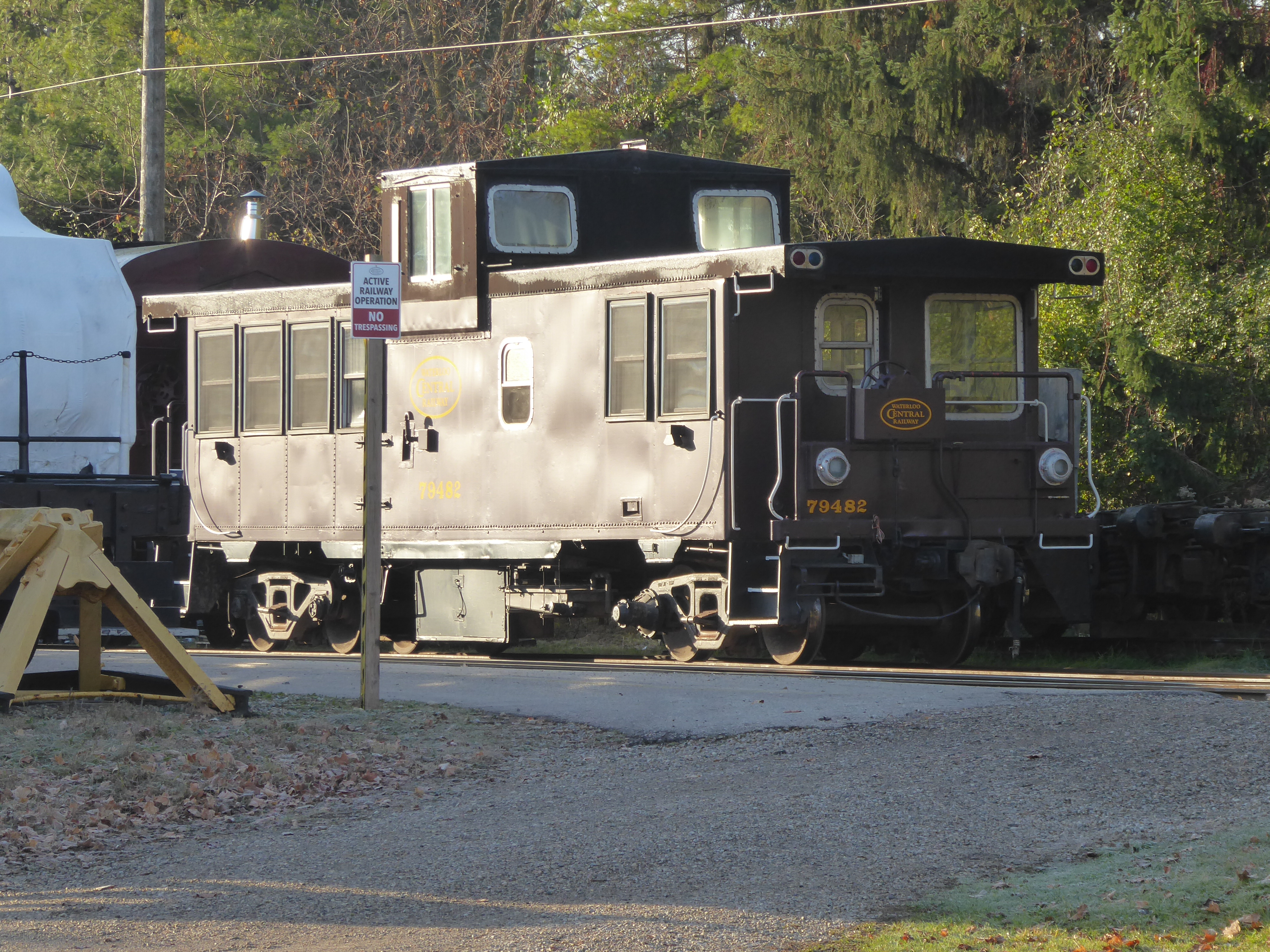
Right beside the tarped-off mystery car, I got a peak at WCRX 79482, a caboose clad in a maroon vintage CPR scheme. Again, the CPR scheme might make you think this is a vintage CPR van, but it's actually one of 548 CN cabooses from the Pointe St-Charles shops in Montreal. This one was built in 1971. The last CN van built in Quebec was in 1977, according to the WCR website. I find it incredible that there were once nearly 600 of these vans plying the rails across CN's system. How times have changed. This caboose came to the tourist railway in 2007 in a red CN scheme. It was returned to its original number and repainted after 2021.

I hope you enjoyed this post, as it really is like strolling through a museum. I still have yet to see this railway in action, at least at a time when I have a camera with me. I did see it in action years ago when I lived in Kitchener-Waterloo, although I wasn't in the habit of taking train photographs at that time. 

From its origins as the St. Thomas-based Southwestern Ontario Locomotive Restoration Society to its incarnation as the Waterloo Central, this organization is succeeding in an area where a tourist railway has failed in the past. Its ambitious plans, meticulous attention to detail and determination really do seem like a blueprint for other tourist operations.

Possibly the next time in am in the Waterloo Region, I can figure out a time to actually catch these old antiques in action. That would be a treat.

Wednesday, February 14, 2024

Running Back to St. Jacobs (Part I)

Back in November, I was in Kitchener-Waterloo for a conference, where I was giving a mental health presentation. I made sure to carve out some time trackside, as KW has some unique rail photo opportunities. You can read about my time trackside in Kitchener here. My first stop was St. Jacobs, a small community north of the City of Waterloo. St. Jacobs is known for its area old order Mennonite population (think horse and buggies) as well as its tourist industry, which is very much a mainstay of the local economy.

The Waterloo Central Railway has a yard located in the town, which serves as its maintenance facility and starting point for some tourist excursions. At one point, the WCR operated from the former Waterloo train station, but the rails south of St. Jacobs are now all occupied by the Ion light rail system. CN still operates local freight operations during off hours, which you can read about in this Traingeek.ca blog entry. But the area is off limits to the WCR.

You might recall I've been to this yard a few times, which you can read about here and here.

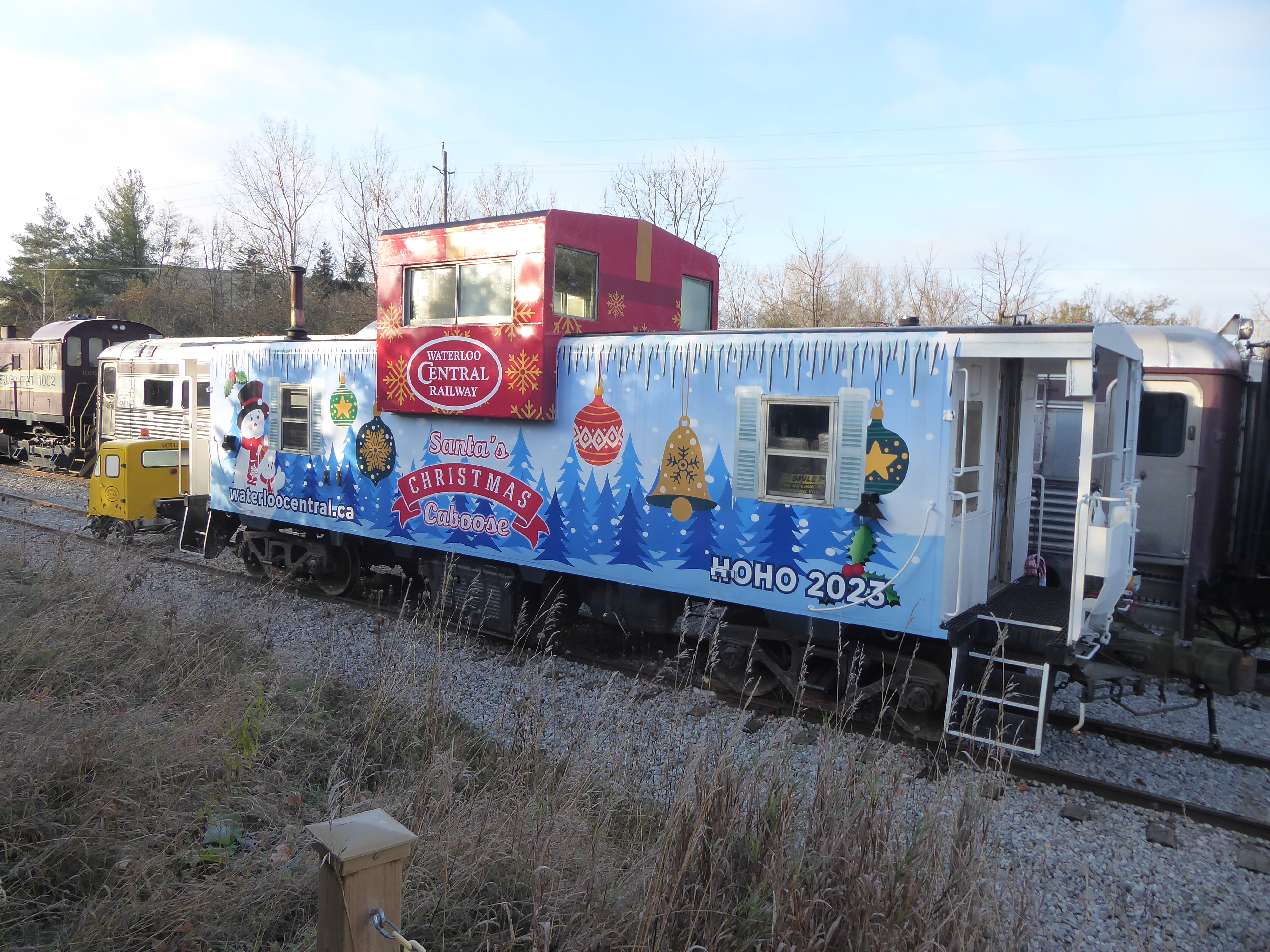
This time around, I arrived in the early morning, as this was the only time I had to take photos. I was quite happy to get a few shots of the WCR's former Essex Terminal Railway caboose, clad in a wrap that would be useful for its Christmas Train. The railway added some nice touches, like the HOHO 2023 operating mark. Also, as a communications professional, I always like it when a business includes its web address in a visible spot. I remember a marketing professional telling me she couldn't understand why a company would ever hesitate to share its website at every opportunity. 

You can even see the WCR speeder to the left of the caboose as well as a Budd-build RDC unit behind the caboose. I got all these shots from a small park next to the railyard, which offers you some great vantage points to get photographs. It's like visiting a rail museum for free. There is even a street just north of this park that ends at the tracks, where you can get some shots from a different vantage point, but stay on public property (the street). There are signs here that clearly show you where you can and cannot go, as there are homes and a small trackside business here.

There were some other interesting things to see in the yard, as the railway was clearly getting ready to assemble a Christmas train. If you look closely at this old passenger coach, you can see that the crews had already strung up lights around the windows and across the top and bottom of the car. The WCR is clearly influenced by a love of vintage Canadian Pacific colours, as many of its cars and locomotives sport CP's maroon (Tuscan red, technically) and grey scheme, which was officially ditched in 1968 for the action red multimark livery.

This coach, however, is actually a former CN coach, built in 1954 by Canadian Car and Foundry. It served well into the Via Rail era, where it took on the blue and yellow scheme, before finding its way into the BC Rail fleet, where it became known as Sunset Beach, and finally the Orangeville-Brampton Railway. Coach 1978 has been with WCR since 2018. 

In previous years, WCR kept some of its coaches in the blue and yellow Via Rail scheme. I was lucky to get a shot of one of the last coaches to sport this scheme. I was happy I did, as I have great memories of these old blue and yellow cars as a kid.

Here's a sun-drenched shot of two S13s 1001 (left) and 1002 in the yard. Each unit was built by the Montreal Locomotive Works in 1959. While each bears the colours of the pre-action mark CP, these units were actually Pacific Great Eastern (later BC Rail) units upon delivery. After serving out west, they spent time on the Greater Winnipeg Water District Railway as 501 and 502, before moving further east and operating for the Ontario Southland Railway with the same numbers. They have been with the WCR since 2018. It's incredible to think of how much revenue service these old units have seen.

A little deeper in the yard, another MLW unit, this one ex-CP S3 6593, was sitting with a mixed consist, including 1930s vintage ex-CN baggage car 8751, a tank car and a former Toronto, Hamilton & Buffalo boxcar. Unlike the other units, this one was originally a CP unit, built in 1957. For Ottawa railfans, they might be interested to know that CP sold it to the National Research Council, where it served as the NRC switcher at its ground transportation research centre along the old CP Prescott Sub, near the Ottawa International Airport. It was sold to the WCR in 2012. Here is a cool shot from its move from Walkley Yard back in 2012. This unit began its work in these maroon and grey colours before being switched to action red, so this is likely a fitting scheme for this old unit.

The railway explains on its website that its small collection of rolling stock is for the purposes of television and movie work, where productions might need to include a freight train in a scene. Since the WCR also has a steam engine on its roster, I would imagine have a tank car might come in handy as well for the purposes of feeding the engine water.

All in all, it was a fun visit to this area. I will share a few more images from this morning in another post, since there was quite a bit to see in a brief time.

Tuesday, December 12, 2023

Updated: The curious case of the coat hanger

This has been a weird year, to be sure. Without getting into details, I have faced a fair bit of adversity, which will culminate in a court hearing where I will attempt to secure a peace bond next week against someone harassing my family. There have been other fairly serious incidents I have found myself dealing with this year. I count about four major challenges, including this latest incident. So any and all pleasant surprises mean that much more to me.

Through all of the adversity, I am proud to say I have managed to maintain this blog at a rate of about three posts per month, which has been a great source of pride for me and a relief, to be honest. My passion for railways is almost a form of meditation. I find that I can sit trackside, or on a station platform, and just let the sound of the wind and the nearby buzz of life clear my mind. It's my happy place, no matter where the station is or what's happening around me.

Here's one small surprise that has capped off my year. I came across this hanger at a nearby church a few weeks ago, which was a cool surprise. It got me to thinking.

When was there ever a time when a railway made its own coat hangers? I thought of a few possibilities. I thought possibly CN had them at its stations, for first class travellers. Maybe they were in place at CN offices? Eric Gagnon of Trackside Treasure suggested as well that they could very well have been in place in sleeping compartments on long distance trains, which also makes sense. Here's a view below from a postcard, which shows both CN and CP westbounds in 1971 at the new Ottawa Union Station. Possibly some of these hangers were on this type of train, if it was a long distance train. If it was in corridor service, likely not. Note the Alco/MLW unit on point on the CN train.

Eric also recalled that Via Rail had its own hangers that were brown, with the yellow Via logo standing out in raised plastic. 

Ed. Note: Originally, I thought this hanger may have been from the Chateau Laurier, Ottawa's classiest hotel and a former CN Hotel property. In my distraction this week while putting together the post, I somehow forgot to add in this original theory of mine. Thanks to Kevin for reminding me!

It made me nostalgic for a time when railways were businesses that were all encompassing operations, from the station, to the rail yard, to the intermodal truck trailers, to the seats on a passenger coach to a ship, to an airplane. There was a time when railways did it all. Who remembers the old orange CP Air planes? I do. 

Needless to say, I took a hanger from home and swapped it out with the CN hanger so I could have a small piece of railway history in my house. I did wonder how these hangers managed to make it into this church. CN was once a thriving operation in Ottawa, but it has not had a major presence here in some time, especially on the passenger side. I am guessing that someone must have worked for this railway locally and taken the hangers to the church before they were thrown out. Just a guess. The hanger is mostly made of wood with a strong steel underframe. They were clearly built to last.

As we approach Christmas, I had one more image to share. Recently, I was in Waterloo with my family. During my time there, I was able to visit St. Jacobs and the Waterloo Central Railway yard in town. I will have lots of images to share of this yard next year, but there is one image I did want to share of WCR's Christmas caboose. 

Even the reporting marks (HOHO) are done with great care. Kudos to this railway for its attention to detail. My daughters were with me at the time and they really liked this caboose. They insisted that I take a few pictures of them in front of it. 

When we visited, the WCR had not yet started offering holiday trains for families, but they were clearly getting the consist ready. A few of the old maroon passenger cars in the yard had been equipped with Christmas lights. It made me think of the time I saw the CP Holiday Train, bedecked in lights, in Finch, Ont. in 2016.

The caboose was a nice scene on a chilly November morning. 

I bring up these things just to point out a few bright points and a few surprises from this last year, which has been a challenging one. Here's to a few more brights spots on the horizon.

Friday, February 1, 2019

Lament for the boxcar

I'm not one to endlessly talk about how things were better when I was young. After all, I grew up without cellphones, the Internet, digital cameras, millions of TV channels and many of the other modern conveniences that we now take for granted.

But I will say this. When it comes to railways, I miss boxcars. They used to be one of the more common types of rolling stock on any freight train. When I was younger, I recall seeing an endless assortment of boxcars pass through my hometown on the CSX freight trains. It wouldn't be uncommon to see CP Rail, CN, Central Vermont, Grand Trunk, Port Huron & Detroit, Chessie System, Louisville & Nashville, Seaboard Coast Line or Conrail boxcars on a train. Many of the cars were your standard boxcars (think of the once ubiquitous CN brown boxcars). But some would have ribbed exteriors and some would be impossibly huge, like this one below in the CN Sarnia Yard, used for auto parts. They almost always had interesting railways graphics and were very much the standard bearer for railways alongside the locomotives. Think of all the slogans Southern Railways used on its boxcars, as an example.


I think the best thing about boxcars is how they add such a graphic element to railfanning. They still fly the flags of railways, both past and present, in a way that is somewhat lost today with the proliferation of containers and homogenous leasing company rolling stock. Here's a great example of what we have lost from an aesthetic point of view.


This is an old St. Lawrence Railroad boxcar, in CP Rail's Windsor Yard in 1991. You can also see a Bangor & Aroostook boxcar in the background. Behind that boxcar is Detroit's Renaissance Center, home to General Motors' headquarters.

I'm not saying I don't enjoy watching today's long container trains. I think, when taken as a whole, they are quite interesting to shoot, given their symmetrical dimensions and their mix of colours. This shot from the London CN Yard is a good example of the interesting visuals containers sometimes offer.


But what I think we've lost as railfans is the ability to pick out individual cars in a freight train to shoot. There's always a cool boxcar worth grabbing in a photo, in my opinion. I have more boxcar photos than any other type of rolling stock. I don't have many individual wellcar photos, by comparison.

There isn't much to cheer about if you're a railfan in Ottawa, but I will at least say that at least we do have a fair amount of boxcars still plying the rails here. I have snapped a few interesting ones over the years. This one I spotted in Walkley Yard, which made me think of the trains I watched as kid in Corunna. I like that there's a little stencil next to the door that says "A CSX Quality Car."


Here's another cool shot of a string of boxcars early one morning at Walkley Yard. It's an image that could have been taking 20 or even 30 years ago. But, it's actually 2013.


I'm always thankful when I catch an old boxcar on a passing freight. It's like watching a bit of history pass by. This one looked like it was hand painted.


Have you noticed that most museums or tourist railways have lots of boxcars, like this one on the Waterloo Central?


Railways today are great at what they do. But they are not nearly as colourful as they once were. Even though I know why boxcars are on the wane, part of me wishes they weren't.


Friday, January 26, 2018

The little railway that could: Waterloo Central Railway

In last week’s post, I mentioned that my time in Kitchener was a bit of a missed opportunity since I didn’t take advantage of the opportunity to shoot the busy GEXR operations in the city. On my recent trip to Kitchener-Waterloo, I made up for that by taking some shots of GEXR operations near the Kitchener Via Rail station.

But there is another rail operation in KW that I similarly neglected to chronicle when I lived in the area. So, on a recent visit to the area last November, I made sure to search out the Waterloo Central Railway facilities in St. Jacobs and photograph what I could.

Even though the tourist line’s motive power, including ex-Essex Terminal Railway 0-6-0 steam locomotive, WCR GE 70-tonner 1556, former National Research Council MLW S3 switcher (originally CP 6593) and the other motive power were tucked away in the railway’s shed, I had a great view of the railway’s colourful rolling stock, which was easily accessible from adjacent streets and publicly accessible areas.

This old Via Rail heavyweight was closest to the WCR maintenance facility. A string of other passenger cars, of different vintages, was just down the line.

F
or those who may not be familiar with this railway, it has an interesting history goes back to Canada’s unofficial Railway Town, St. Thomas. That was where the Southern Ontario Locomotive Restoration Society originated. This group now operates the WCR and carries out its restoration work in St. Jacobs.

But the tourist railway’s origins go back to 1997, when the Waterloo-St. Jacobs Railway began operating between Waterloo’s old train station on Father David Bauer Drive and the village of St. Jacobs, with a stop at the St. Jacobs Farmers Market (between the city and village). That operation, which purchased CN’s Waterloo Spur, folded in 2000. Soon after it stopped running trains, the Region of Waterloo bought the trackage, which cleared the way for WCR years later.

After a short stint operating a tourist train in 2003, there was no tourist line on the old spur until 2007 when the SOLRS established the WCR and transferred all its rolling stock and motive power to Waterloo. The tourist line has been operating on the spur ever since, with the Goderich Exeter Railway providing freight service at night all the way to Elmira, where the spur ends.

At the end of the 2014 tourist season, WCR lost its running rights south of Northfield Drive, which effectively meant they would no longer use the old Waterloo passenger station as a starting point. That decision was made so that the region could use all trackage south of Northfield Drive for their Ion light rail operations, which will begin operations shortly.

The WCR now bases its trains out of the St. Jacobs Farmers Market area, just north of Waterloo and operates regularly from spring to fall. The railway takes tourists from the Farmers Market into the old village of St. Jacobs and even operates specials as far north as Elmira for that town’s Maple Syrup Festival. In December, WCR also operates Christmas specials for families.

Canadian Pacific six-axle heavyweight Midway, 1437, was built in 1923

Sadly, when I visited the region, the railway had just finished its fall operations and was weeks away from beginning its Christmas operations. Oh well.

Another interesting facet of this railway’s operations include railway training school for those looking to earn their engineer, conductor or safety crew certifications.

All was quiet when I visited the railway’s yard in St. Jacobs, but what a collection it was. I was thrilled to get some shots of old Via Rail heavyweights, still in their iconic blue and yellow. WCR also has various older passenger cars still in their classic Canadian Pacific and Canadian National colours. These cars are in various states of restoration.

Closer to the main shed, the railway has three cabooses. The two yellow cabooses are WCRX 1040 and 1042, formerly of the Essex Terminal Railway. 


Further down the line, the old wooden caboose sat by itself. This car was a former Toronto, Hamilton & Buffalo caboose, built in 1914. I couldn't get too close to this caboose since I didn't want to intrude on private property. This shot gives you an idea of how bad the weather was when I came to shoot these old relics.


Just north of this main collection of cars, there were a few gems, which are accessible from the end of a residential street and a pedestrian crossing over the tracks. I wasn’t sure if this trail was public, so I stayed on the street and to the side of the tracks, as I was not keen to trespass, especially in an area where I was unsure of the property lines.

This boxcar was the highlight, a former TH&B boxcar with a Canadian centennial logo to the right of the door.


I also thought this was a cool find. The railway appears to be in the process of rehabilitating this old Canadian National heavyweight baggage car. I love the old CN passenger colours before the railway adopted the black and white scheme with the wet noodle logo.


But, the expedition proved to be a real treat for me, even if I wasn’t able to see this fascinating railway in action. The next time I am in Kitchener-Waterloo, I will be sure to try and ride the WCR. I would suggest anyone who has an appreciation for railway history to check out this gem when they get a chance.

It’s well worth the trek up to St. Jacobs.