Showing posts with label Waterloo. Show all posts

Wednesday, February 14, 2024

Running Back to St. Jacobs (Part I)

Back in November, I was in Kitchener-Waterloo for a conference, where I was giving a mental health presentation. I made sure to carve out some time trackside, as KW has some unique rail photo opportunities. You can read about my time trackside in Kitchener here. My first stop was St. Jacobs, a small community north of the City of Waterloo. St. Jacobs is known for its area old order Mennonite population (think horse and buggies) as well as its tourist industry, which is very much a mainstay of the local economy.

The Waterloo Central Railway has a yard located in the town, which serves as its maintenance facility and starting point for some tourist excursions. At one point, the WCR operated from the former Waterloo train station, but the rails south of St. Jacobs are now all occupied by the Ion light rail system. CN still operates local freight operations during off hours, which you can read about in this Traingeek.ca blog entry. But the area is off limits to the WCR.

You might recall I've been to this yard a few times, which you can read about here and here.

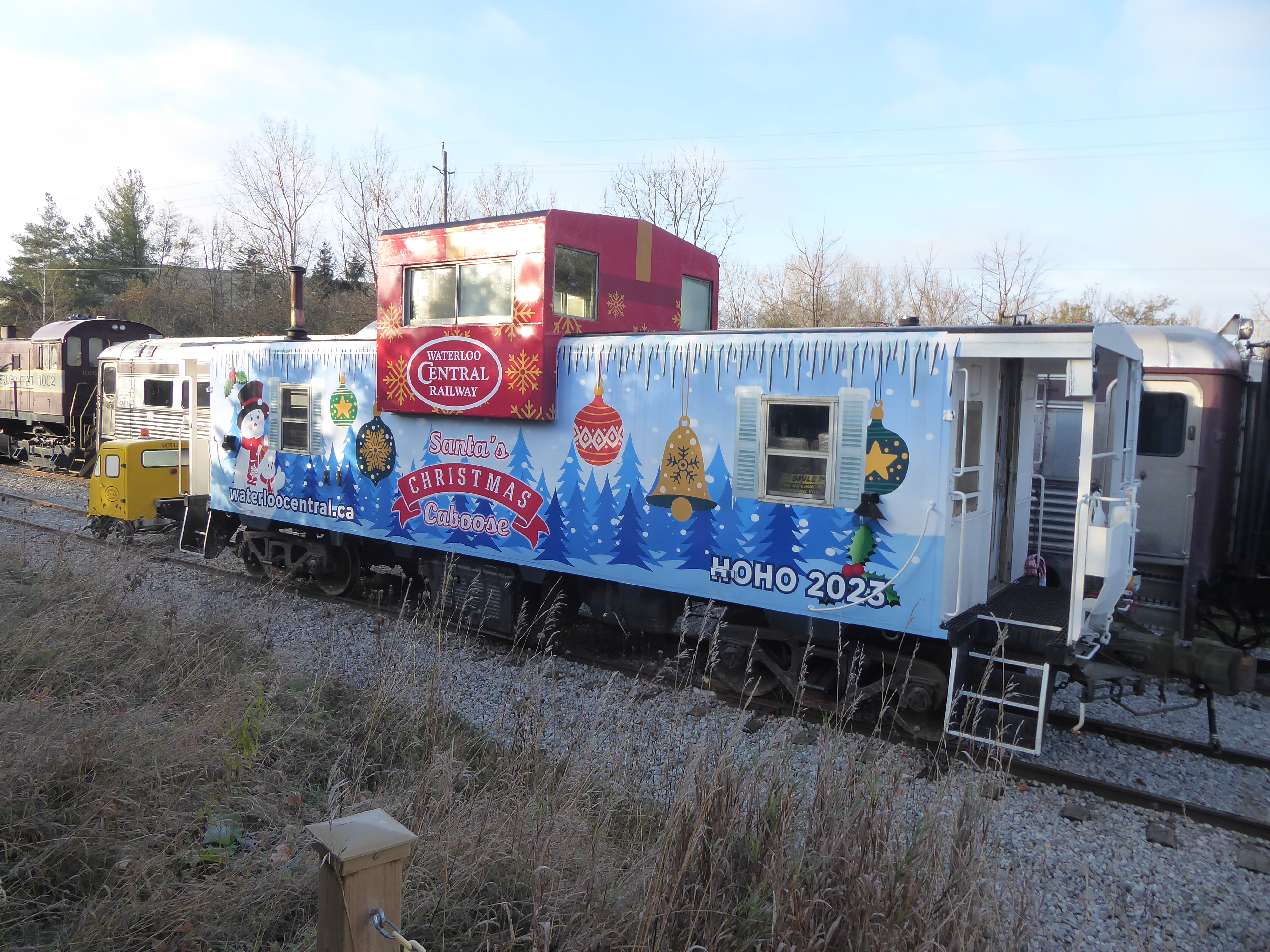
This time around, I arrived in the early morning, as this was the only time I had to take photos. I was quite happy to get a few shots of the WCR's former Essex Terminal Railway caboose, clad in a wrap that would be useful for its Christmas Train. The railway added some nice touches, like the HOHO 2023 operating mark. Also, as a communications professional, I always like it when a business includes its web address in a visible spot. I remember a marketing professional telling me she couldn't understand why a company would ever hesitate to share its website at every opportunity. 

You can even see the WCR speeder to the left of the caboose as well as a Budd-build RDC unit behind the caboose. I got all these shots from a small park next to the railyard, which offers you some great vantage points to get photographs. It's like visiting a rail museum for free. There is even a street just north of this park that ends at the tracks, where you can get some shots from a different vantage point, but stay on public property (the street). There are signs here that clearly show you where you can and cannot go, as there are homes and a small trackside business here.
There were some other interesting things to see in the yard, as the railway was clearly getting ready to assemble a Christmas train. If you look closely at this old passenger coach, you can see that the crews had already strung up lights around the windows and across the top and bottom of the car. The WCR is clearly influenced by a love of vintage Canadian Pacific colours, as many of its cars and locomotives sport CP's maroon (Tuscan red, technically) and grey scheme, which was officially ditched in 1968 for the action red multimark livery.

This coach, however, is actually a former CN coach, built in 1954 by Canadian Car and Foundry. It served well into the Via Rail era, where it took on the blue and yellow scheme, before finding its way into the BC Rail fleet, where it became known as Sunset Beach, and finally the Orangeville-Brampton Railway. Coach 1978 has been with WCR since 2018. 

In previous years, WCR kept some of its coaches in the blue and yellow Via Rail scheme. I was lucky to get a shot of one of the last coaches to sport this scheme. I was happy I did, as I have great memories of these old blue and yellow cars as a kid.

Here's a sun-drenched shot of two S13s 1001 (left) and 1002 in the yard. Each unit was built by the Montreal Locomotive Works in 1959. While each bears the colours of the pre-action mark CP, these units were actually Pacific Great Eastern (later BC Rail) units upon delivery. After serving out west, they spent time on the Greater Winnipeg Water District Railway as 501 and 502, before moving further east and operating for the Ontario Southland Railway with the same numbers. They have been with the WCR since 2018. It's incredible to think of how much revenue service these old units have seen.

A little deeper in the yard, another MLW unit, this one ex-CP S3 6593, was sitting with a mixed consist, including 1930s vintage ex-CN baggage car 8751, a tank car and a former Toronto, Hamilton & Buffalo boxcar. Unlike the other units, this one was originally a CP unit, built in 1957. For Ottawa railfans, they might be interested to know that CP sold it to the National Research Council, where it served as the NRC switcher at its ground transportation research centre along the old CP Prescott Sub, near the Ottawa International Airport. It was sold to the WCR in 2012. Here is a cool shot from its move from Walkley Yard back in 2012. This unit began its work in these maroon and grey colours before being switched to action red, so this is likely a fitting scheme for this old unit.

The railway explains on its website that its small collection of rolling stock is for the purposes of television and movie work, where productions might need to include a freight train in a scene. Since the WCR also has a steam engine on its roster, I would imagine have a tank car might come in handy as well for the purposes of feeding the engine water.

All in all, it was a fun visit to this area. I will share a few more images from this morning in another post, since there was quite a bit to see in a brief time.

Tuesday, December 12, 2023

Updated: The curious case of the coat hanger

This has been a weird year, to be sure. Without getting into details, I have faced a fair bit of adversity, which will culminate in a court hearing where I will attempt to secure a peace bond next week against someone harassing my family. There have been other fairly serious incidents I have found myself dealing with this year. I count about four major challenges, including this latest incident. So any and all pleasant surprises mean that much more to me.

Through all of the adversity, I am proud to say I have managed to maintain this blog at a rate of about three posts per month, which has been a great source of pride for me and a relief, to be honest. My passion for railways is almost a form of meditation. I find that I can sit trackside, or on a station platform, and just let the sound of the wind and the nearby buzz of life clear my mind. It's my happy place, no matter where the station is or what's happening around me.

Here's one small surprise that has capped off my year. I came across this hanger at a nearby church a few weeks ago, which was a cool surprise. It got me to thinking.

When was there ever a time when a railway made its own coat hangers? I thought of a few possibilities. I thought possibly CN had them at its stations, for first class travellers. Maybe they were in place at CN offices? Eric Gagnon of Trackside Treasure suggested as well that they could very well have been in place in sleeping compartments on long distance trains, which also makes sense. Here's a view below from a postcard, which shows both CN and CP westbounds in 1971 at the new Ottawa Union Station. Possibly some of these hangers were on this type of train, if it was a long distance train. If it was in corridor service, likely not. Note the Alco/MLW unit on point on the CN train.

Eric also recalled that Via Rail had its own hangers that were brown, with the yellow Via logo standing out in raised plastic. 

Ed. Note: Originally, I thought this hanger may have been from the Chateau Laurier, Ottawa's classiest hotel and a former CN Hotel property. In my distraction this week while putting together the post, I somehow forgot to add in this original theory of mine. Thanks to Kevin for reminding me!

It made me nostalgic for a time when railways were businesses that were all encompassing operations, from the station, to the rail yard, to the intermodal truck trailers, to the seats on a passenger coach to a ship, to an airplane. There was a time when railways did it all. Who remembers the old orange CP Air planes? I do. 

Needless to say, I took a hanger from home and swapped it out with the CN hanger so I could have a small piece of railway history in my house. I did wonder how these hangers managed to make it into this church. CN was once a thriving operation in Ottawa, but it has not had a major presence here in some time, especially on the passenger side. I am guessing that someone must have worked for this railway locally and taken the hangers to the church before they were thrown out. Just a guess. The hanger is mostly made of wood with a strong steel underframe. They were clearly built to last.

As we approach Christmas, I had one more image to share. Recently, I was in Waterloo with my family. During my time there, I was able to visit St. Jacobs and the Waterloo Central Railway yard in town. I will have lots of images to share of this yard next year, but there is one image I did want to share of WCR's Christmas caboose. 

Even the reporting marks (HOHO) are done with great care. Kudos to this railway for its attention to detail. My daughters were with me at the time and they really liked this caboose. They insisted that I take a few pictures of them in front of it. 

When we visited, the WCR had not yet started offering holiday trains for families, but they were clearly getting the consist ready. A few of the old maroon passenger cars in the yard had been equipped with Christmas lights. It made me think of the time I saw the CP Holiday Train, bedecked in lights, in Finch, Ont. in 2016.

The caboose was a nice scene on a chilly November morning. 

I bring up these things just to point out a few bright points and a few surprises from this last year, which has been a challenging one. Here's to a few more brights spots on the horizon.

Saturday, June 10, 2023

Déjà vu in St. Jacobs

Last summer, my family was in Waterloo for a music camp at Wilfrid Laurier University (here's the post about KW rail sightings). It was in close proximity to St Jacobs, which is the home of the Waterloo Central Railway tourist line. Longtime readers might recall my first visit to this railway's yard, which is located along the CN Elmira Subdivision. The first time I shot this operation in 2018, it was a cold wet November day, when the rails were silent. My daughters and I took a few photos from public property and had to take shelter before a downpour spoiled our fun a bit (or, my fun, to be fair).

This past summer, in a break during our music camp activities, I managed to break away and head north to St. Jacobs to see if there were any other old antiques in the yard that I didn't catch on my previous visit. Luckily for me, there were some great old antiques on display, although their position in the yard made it difficult for me to get some decent shots. And despite the fact that we visited the area in the midst of a prolonged dry spell, we had to duck into our car again to avoid a sudden downpour. Eerie déjà vu.

A quick bit of history. The Waterloo Central is a tourist line that has operated on the CN Elmira Sub for a number of years and is the latest incarnation of a tourist operation that has operated on this line on and off over the years. Up until the Region of Waterloo repurposed much of CN's tracks in Waterloo for its Ion light rail operation, the WCR began its runs from Waterloo. Now, the short line starts its runs from a retail area just south of St. Jacobs, near the border with the City of Waterloo.

When my daughter and I arrived last August, there was a collection of old locomotives huddled next to the short line's engine house. My daughter and I both took some shots of this scene. I wish I could have gotten some clean shots of these engines, but I did like how this one turned out. It really fits with my new approach to rail photography, where I am trying to get creative with my images.

You can see former BC Rail MLW S13 locomotive 1002 clad in the old Canadian Pacific-inspired maroon, grey and yellow scheme. This unit was built in 1959 for BC Rail predecessor Pacific Great Eastern. After its life at BC Rail, it was sold to the Ontario Southland Railway in 1997. The Waterloo Central took ownership in 2018.

At the back is what I assume is former Canadian National SW switch engine 1012 in the old CN yellow and olive green scheme. In consulting the Southwestern Ontario Locomotive Restoration Society's (organization behind the Waterloo Central) fleet of engines, this one is not listed. The photo I took does not capture the full unit number, so its story remains a mystery for now.

In the foreground is a Waterloo Central heavyweight baggage car painted again in the CP maroon and grew scheme. The WCR has made great strides in recent years in painting much of its fleet or repainting it in a CP maroon and grey scheme. I recall during previous visits that some of its cars were still sporting the original Via Rail blue and yellow scheme, albeit with the WCR logo in place of the Via logo. Here's a better shot of the old baggage car.


If you are looking for old RDCs, the WCR has several of them in its St Jacobs yard, including this one, which was parked next to a heavyweight coach with a rear facing porch. Two different eras of passenger rail side by side. It was cool to get an image of these two together.

Here's another shot of more RDCs, a little to the south of the Via Rail painted unit. These ones have seen better days, as their faded blue and yellow liveries attests. You can just see a bit of a heavyweight coach in the foreground. These photos were taken from the edge of a nearby school yard. It was a challenge to shot through the brush at the edge of the tracks.

At this point, the rain had begun to fall. I took this shot from the end of a suburban street, which abuts the tracks. You can see a former Essex Terminal Rail caboose linked to a maroon-clad caboose and another WCR maroon and yellow baggage car. This society has an extensive collection of passenger equipment and cabooses, including a Toronto, Hamilton & Buffalo caboose. I was not able to get a clear shot of that car, as the rain turned into a downpour shortly after I took this shot.

This was the best I could do to get a shot of the TH&B caboose, which was tucked in behind another passenger coach near the engine house. The engine house, it should be noted, is where the group keeps its steam engine. I have never seen that machine out of the engine house. I find it interesting that the WCR paints its passenger cars with both the "Waterloo Central" and "Waterloo Central Railway" lettering, as you can see from this car. You can also see the Waterloo Central lettering on an RDC to the right. That RDC sports the CPR maroon and yellow scheme.

Here's one final image from my visit. It's strange how that clear blue sky turned into a downpour in a matter of 10 minutes. I wish I could have taken a better shot of this old coach, but railway employees were clearly somewhere on the property when we visited and their cars were parked right in my shot. Oh well.


I made sure to return to the yard the next day as well, to see if anything had moved or anything was operational. Sadly, all was quiet when I visited both days. Still, getting to see these antiques up close from public property was a real treat. It's like paying a visit to a railway museum for free.

Friday, March 10, 2023

The Past and Future of Rails in Kitchener-Waterloo

This past August, my family travelled to Waterloo, Ont. for a week-long music camp at Wilfrid Laurier University. The weather was ideal with sunny skies and muted summer temperatures. It was also a homecoming of sorts, as I used to live and work in Kitchener from 2007-2009.

While the music camp portion of our trip was exhausting, with parental participation a key component to the day, I did managed to sneak away a few times to explore the city's railway scene. There are a number of facets to this region's railway scene, if you are so inclined to railfan in the region.

For the uninitiated, Waterloo, the city, is situated in Waterloo Region, which consists of the conjoined cities of Waterloo (furthest north), Kitchener, and south of Highway 401, Cambridge. In the south end, CP's Galt Subdivision runs through Cambridge. CP is busy in this area, as it serves both Toyota automotive plants and numerous industrial customers. Sadly, I didn't have the time to explore these operations.

CN serves Kitchener, as its Guelph Subdivision runs through the city. This is the former Goderich Exeter Guelph Sub. The CN line also gives way to Metrolinx trackage, as GO Trains operate from the Kitchener Via Station into downtown Toronto. There is a Metrolinx spur in Kitchener, where trains are kept in off-hours, but it is not accessible to photograph. 

Waterloo does have rails, but they are mainly used by the region's Ion light rail trains. That's probably the best place to start, as I saw more of these trains than anything during the week. This shot below is of a northbound Ion train, having just crossed Seagram Avenue, near the Laurier campus.

Waterloo's light rail system is a highly reliable service, which uses Bombardier trains that ply the rails both off and along city streets. In many places, it's more like a streetcar, as it stops at red lights, makes turns onto streets like vehicles and observes fairly tame speeds. This is a real difference between Waterloo and Ottawa, where the O-Trains do not go anywhere near city streets and run at higher rates of speed, albeit not nearly as reliably.

Here's a shot of the Seagram level crossing. I was surprised by the frequency of trains crossing this street. The number of times the gates are activated makes it a frequent occurrence for drivers to consider when driving in the city. As far as I could see, the trains were seeing light ridership in early August, which is not a surprise, but they were far from empty. The uptake on this service seems to be pretty brisk to my eye, anyway.

Later in the week, my daughter and I had a break in her schedule, which allowed us to check out the rails near Kitchener's Via station along the Guelph Sub. I've had good luck with trains here in the past, as you can see from this post. On this day, however, the rails were quiet. There wasn't even a local in action. The Kitchener train station is quite nice, even if it is a bit dusty looking at times. You can just make out the GO Train ticket machine to the right of the image. This photo was taken from the platform looking back onto Victoria Street.

Here's another shot of the station's trademark outdoor waiting area, with its distinctive arches. Across the tracks is the old Krug industrial building, which is still in use.

One major change I noticed near the station is that the old King Street level crossing at Victoria has been eliminated, as the Ion trains that go north and south along King require a separation from the Guelph Sub. This is a major change since I lived in the city, when this track was a level crossing and often caused a fair bit of commuter distress when longer freight trains made their way slowly over King Street. When I was in Kitchener this past summer, I noticed a few level crossings had been eliminated by flyovers.

There wasn't much happening in the CN yard, which is visible from the sidewalk along Lancaster Road.

Here's another angle. The mainline is the track farthest to the right in the image.

Like I said, not even a local at work! It was a quiet day to say the least. Disappointing.

Later in the week, I took a few shots of the rails in Waterloo itself, as the city still has the remnants of the old CN Elmira Subdivision going through its downtown. Much of this trackage is now in use for light rail trains, but you can still see the remnants of traditional railways in the city. Waterloo's old train station still sits trackside, but is now a men's clothing store.

In the back of the men's clothing store along the rails, an old CN caboose still sits on a disconnected piece of track.

The store's name is Paul Puncher menswear, hence the branding on the caboose. But if you look closely, the old caboose's original number is still visible on the roof ledge. This is former CN caboose 79664. 

I also took this shot of a piece of trackage down an alleyway in Waterloo's core. These rails do still host CN trains, but those operations happen overnight and in the wee hours of the morning, when the Ion light rail operation is not operating.

This was one of my favourite pictures from the week, considering I had almost no luck capturing any live railway action. My schedule just didn't allow me to catch the early morning GO Train or go down to Cambridge to capture some CP action. I had to make do with what I had in Waterloo, which was light rail and any other assorted pieces of vintage railway scenes that crossed my path. 

At one point during the week, I was able to make my way up to St. Jacobs, a small tourist friendly town north of Waterloo, which is home to the Waterloo Central Railway tourist operation. I have blogged about this unique railway before, which you can read about here. I really wanted to go and take some photos of its unique roster of rolling stock and motive power, all of which is able to be photographed from public property. 

I will save these images for a later post.

Thursday, January 18, 2018

Making up for lost time: Catching up with GEXR in Kitchener

My two years spent in Kitchener-Waterloo seem like a lost opportunity to me, in some ways. I worked in Kitchener for two years and, for the most part, enjoyed my time there immensely. But as I look back, I wonder how much railfanning I could have done, had I had a mind to do so when I lived there. At the time however, I was not into railfanning so the only photo I have from my time in KW is a shot from Kolb Park of the train trestle over the Grand River, which you can see inthis post.
However, I had the opportunity to turn my regret into something positive when I visited KW with my family in November. On a gloomy, misty Sunday, as my wife attended a conference, I took my girls with me to Kitchener so they could visit The Museum, a kids-focused museum on King Street in Kitchener. I made sure to plot a route that took me past the Kitchener Via Rail train station on Victoria Street.
When we reached the station, I finally saw some active Goderich Exeter Railway freight operations in action. This was the first time I have photographed this fascinating railway. You will remember from my numerous posts about Goderich, Ont. that I have tried to capture some active GEXR operations for years, but have always had to settle for some static images, like this shot of a pre-Genesee &Wyoming livery GP9 parked in the GEXR Goderich yard, just up the hill from the salt mine on Lake Huron.

I've finally seen some live GEXR operations.


Well, wasn’t my timing just perfect when I saw a duo of GEXR geeps and a tank car back into a spot in front of the GEXR offices, right next to the Via station. I have always told myself it would be cool to get some photos in this spot with those iconic vintage industrial buildings in the background.

I began from this angle, since the two units were still moving. I wasn’t sure how long my window would be to catch this tiny consist (which was about as long as the Arnprior Turn, incidentally). The two units then stopped and the crew began to shuffle around outside, which allowed to try some different shots and get a bit more detail.

The first unit, obviously of UP origin, is a leased unit from Locomotive Leasing Partners, still in the UP sergeant’s yellow. This is a fact of life for short lines. Very few seem to have their own fleet of colour-coordinated motive power now. I was pretty happy with this shot, which I framed between the Via station (left) and the GEXR building (right).


Upon closer inspection of the G&W painted unit, I was pleasantly surprised to see it was in fact a Quebec Gatineau Railway unit. This short line is just across the river from me in Ottawa, but I have yet to get some solid information as to when it would be best to shoot the QGRY’s operations near Buckingham. I still have it on my to-do list, but this contact might be the next best thing until then. 


I tried to get a close up of the “Kitchener” sign that was perched on this pipe next to the short consist. I’m not exactly sure if this pipe is connected to an underground fuel storage tank or serves some other purpose. Given that crews seem to change here and the railway has a small yard just to the east of this spot, I am speculating that this might be a servicing point. Someone who is more knowledgeable than me can let me know.


One last overall shot. I really like how the old industrial buildings provide the ideal background for these units. There is a timeless quality to this scene, which could be taken at any time. The crew on this consist must get the occasional railfan on the platform. They didn't seem fazed by my presence.


I thought I was done so I took my girls to the museum where they had a ball. On the way back to our hotel, I was happy to see another GEXR train doing some shunting near the station, although it was blocking a fair bit of traffic on Lancaster Avenue. Much of the train seemed to be comprised of covered hoppers, which made me wonder if it was carrying the products of the fall harvest.


I was in a left turn lane trying to get onto Lancaster. After waiting through too many light cycles, I pulled a U turn and made my way to St. Croix Street, since the train didn’t seem to be in a rush to clear the crossing. I was able to get this fleeting glimpse of the head end of the train, which finally backed into the yard and cleared the crossings. This was taken just off St. Croix Street, behind a plaza that was next to the Guelph Subdivision tracks.


The lead unit reminded me of the old Seaboard System/Family Lines System locomotives that sometimes made their way to CSX’s Canadian operations near Windsor and sometimes even Sarnia. Upon closer look, the unit turned out to be QGRY 6908. You can just make out the G&W style logo on the short hood. 


What’s interesting about this little bit of luck is that, just the day before, I had a chat with a friend from Kitchener and I was telling her that living with regret isn’t necessarily a bad thing. I told her that I really resent people telling me that’s it unhealthy to live with regret. I understand the sentiment, but I really do believe that resenting something in your past is never a bad thing, if you use that resentment as motivation to make things right.

This is one time when I was thankful for resenting missed opportunities.

If there was one downside to this railfanning experience, it was that the weather was pretty awful, as I had to contend with rain and mist, which made for some interesting touch-ups. If you want to see much better photography of GEXR operations, check out Steve Boyko's Kitchener Rainfanning post from his blog, Confessions of a Train Geek. I'm glad someone had decent weather in KW!