Showing posts with label Windsor-Quebec City corridor. Show all posts

Monday, February 23, 2026

Winter surprises in frozen Ottawa (Part II)

Recently, I was able to get out and capture some winter images in the city's east end on a bitterly cold day in early February. In my last post, I shared some images of the Bytown Railway Society's equipment parked outside the Canada Museum of Science and Technology. 

While I was in the area, I paid a visit to the Ottawa Via Rail station to see if there was anything interesting to capture. The first thing I saw when I arrived was Via Rail's all yellow consist that's called Lumi. It was idling with the power facing east. That train was Montreal-bound. In the spirit of making railways interesting again, I tried to get what I consider to be a different shot.

I deliberately framed the end cab car against the Ottawa station sign and Via Rail banner. I didn't zoom in much because I also wanted to capture the snow and the distinctive platforms at the station. The train is in shadow, partly because of the position of the afternoon sun and the overhead canopies. I basically left the image untouched. I like the end result. I find many railway images are overly focused on the engines leading a train and not on some of the interesting details. I like the story this photo tells.

Here's another image of Lumi leaving the platform, heading east on the Alexandria Sub toward Montreal. I was waiting to capture a shot of the consist on the east side of the Belfast Road overpass (pictured), but the biting wind and long wait meant I had to change plans. This shot worked out okay, despite the fact that I was on the shadow side of the train. 

The platforms were pretty quiet on that Sunday afternoon. I tried a few shots on the overpass, but the wires make is close to impossible to get a good clean image of anything. I don't have the patience to use photo editing to remove the wires, so I tried to frame Lumi between the wires as best I could. 

Here was the other surprise of the afternoon. When I arrived at the station, there was Lumi facing east and another Venture set on the track closest to Terminal Avenue (south track) which eventually made its way west on the Beachburg Sub toward Toronto. When it left, I saw a single P42, 910,  parked near the station idling on its own. This was a revealing site.

As most know, Via Rail has not had a successful rollout of its Venture fleet. Its continuing struggles with CN over speed restrictions on CN tracks is well known by now. That process continues to play itself out in the courts. But an operational wrinkle has also begun to plague Via's operations in the corridor. You might recall that, recently, Via informed passengers that it was reducing train frequency between Ottawa-Montreal-Toronto. The railway didn't provide terribly clear reasons as to why its fleet, consisting mostly of Venture sets, is experiencing problems. Most people in the know understand that the Ventures are not performing as well as expected in winter conditions.

Here's an interesting explanation shared with me by my friend Kevin from Windsor, who is a contributor to this blog. Here's what he shared, after taking the train for a return trip between Windsor and Toronto:

"One flaw with the Charger/Venture sets that I haven't read about yet is that they apparently have operational issues in the snow when the locomotive isn't on the front end. The attendant who collected our tickets told us this. I paid extra on both trips to choose forward-facing seats but, on the return trip, we were seated backwards. Not good for my wife; she gets motion sick. 
 
I was very particular about choosing the seats and knew that I didn't screw up, so we asked to be switched. The attendant asked if we bought the tickets more than a month ago, which we did. She said that, when the snow got heavy, Via decided to replace the push-pull operations with pull only and keep the locomotive up front. She didn't explain in detail, but said it was a snow issue. So now, they have to wye the trains at endpoints, at least until the spring. 
 
And if you booked forward-facing seats before they changed plans, you have to ask to be re-seated. I would have thought that Via might have a feature in their reservation system that would just reissue seats automatically based on a mirror image when this happens, but clearly RESERVIA isn't that sophisticated." 
 
Thanks to Kevin for sharing this explanation. Kevin also shared that, when Via was running on its own rails between Chatham and Windsor, the train was often travelling much faster than it does on CN rails. Kevin said his train reached 160 km/h and the crossings along the route all worked normally. This is very much consistent with my own experience on Via Rail in November, when my train reached speeds of 163 km/h between Brockville and Ottawa when Via was on its own rails. Like Kevin mentioned, I did not see any crossing malfunctions either.
 
It's tough to hear about Via Rail's struggles, especially at a time when it seems as though there might be political will from the government to better support its operations. It's not surprising, though, that the government is not getting involved in the CN-Via legal battles nor is it doing much to support the passenger carrier other than to press it to do better, given its string of operational woes in the last year.
 
I sometimes wonder how much of Via's problems is due to benign political neglect and how much is due to management challenges. Either way, there doesn't seem to be any daylight ahead for Via, which reminds me of one of my favourite song lyrics:
 
I see the light at the end of the tunnel now.
Someone please tell me it's not a train. 

Tuesday, September 30, 2025

Making (and breaking) the case for non-stop service

I found the coverage of Via Rail's recent announcement of non-stop service between Montreal and Toronto quite interesting, but not in the way you might think. In case you don't know, Via Rail was planning to make four trains between the two cities non-stop, which would mean no service for Dorval, Cornwall, Brockville, Kingston, Belleville and Cobourg, to name the more important stops in Eastern Ontario and west of Montreal in Quebec. The trains chosen for this pilot were Trains 60, 61, 68 and 69.

What went missing in the coverage was that Train 50 from Toronto to Ottawa would skip stops in Belleville and Kingston, as a near non-stop train. There was no word on what the status of this train was, from the coverage I read. 

As you can tell from my wording, Via Rail has decided to halt the pilot project, which was due to start on Sept. 29. The railway cited operational constraints from CN, its landlord on most of the rails between the two cities. This comes just days after Via made its announcement seemingly out of the blue.  


As always, there are two sides to this story. Via Rail claims that this new service would allow travellers to arrive 30 to 40 minutes sooner. The railway says it chose the trains for this pilot project based on the lowest ridership counts at the smaller stations between the cities. In other words, the trains with the lowest demand in Kingston, Cornwall and Brockville for example, were chosen for the non-stop service. 

I find it interesting that Via Rail was going to try this experiment now, as it has taken a beating publicly for its abysmal on-time performance in recent years, which is a function of the speed restrictions CN has placed on Via's Venture train sets. For more detailed information on this ongoing saga, head on over to Trackside Treasure. No one has done a better job of explaining this story than Eric Gagnon.

I guess my point is, Venture trains have been consistently late for years now, so I wonder what difference 30-40 minutes will make given the restrictions Via Rail faces on CN-owned tracks? Also, is 30-40 minutes enough of a time savings to justify this service? If the train arrives in 3 1/2 hours as opposed to 4, I can't say that would be enough to sway me if I was on the fence about taking the train. It still does not compare to a flight, which still gets you to your destination faster, even after you factor in the security, screening, pre-boarding, baggage claim etc. 


The mayor of Kingston Bryan Patterson raised some interesting points, to support the case for continued full service for his city. He said Via Rail didn't consult any of the communities along the line to give them a warning that these service cuts would be happening. And make no mistake, although Via Rail maintains that these communities would all still be well served by the remaining intercity trains that call on these stations, the coverage was overwhelmingly negative. Service cuts by any other name are cuts, in the eyes of civic leaders.
 
The local media was unequivocal in describing the move as cuts and you can't blame leaders in smaller communities and cities to say anything otherwise. Via Rail making a decision like this with no consultation to the cities it serves is poor communications. 
 
Patterson also pointed out that Via Rail is also turning its back on the 1 million people who live between Toronto and Montreal, many of whom count on these trains. I would think at the very least, Kingston's stops would be left untouched, as Kingston has a high student population at university or college. As we all know, students have always made up a large chunk of Via's fares in the corridor. I took the train many times in my university years.  
 
The mayor also pointed out that taking away more options from these towns and cities means Via Rail will attract fewer customers. It's a fair point. 
 

As someone who has worked in communications for 25 years, I don't agree with the hasty approach here. Had I been in the room, I would have suggested that Via Rail perhaps choose one train pair (60 and 61, for example) and give itself 6 months to a year to prepare a proper promotional campaign outlining this service. Also, it would give the railway time to speak to the leaders of the communities who would be missing out on future service.
 
The rollout of this announcement was hastily planned out; the response was not at all what the railway was likely expecting. In theory, non-stop service between major cities makes sense and provides Via with a compelling product for customers. But the way this was handled was unfortunate from a communications point of view. When customers already booked on these non-stop train pairs were being forced to transfer their spots onto the next available train, it's a bad look.
 
It also doesn't necessarily engender trust in this railway at a time when Via Rail's reputation is already in tatters thanks to the Venture set debacle with CN. The railway has already endured a lot of wounds since the Venture fleet was brought into service.
 
But its communications strategy is producing unnecessary self-inflicted wounds. It makes me wonder how a company comes back from what Via Rail has been through in the last several years.  
 
 
This leaves me with one last thought. Many of these smaller communities in the corridor are very quick to complain when the prospect of Via Rail service cuts are floated. However, just how strong is the customer demand in some of these communities? I'm sure Via Rail took a hard look at its numbers and reassured itself that losing a few extra customers on these non-stop trains would be balanced out by the increased demand from travellers in Montreal and Toronto who might be more keen to take a faster train.
 
That is the logic, although as an infrequent train traveller, I have my doubts that there would be a substantial benefit from such a small reduction in travel time. 
 
But just how soft are the numbers? If I was a politician in one of these affected towns, I'd be very careful about being too vociferous in my complaints. I'm sure Via's attitude is use it or lose it. We've already seen many smaller towns in the corridor who have lost Via service in past years due to lack of customer demand. 
 
Then there's the issue of the investments that have been made in the new train stations in Belleville and other towns in the corridor. When you strip away this much service, what becomes of these stations? I have already seen many examples of Via Rail stations that have essentially become white elephants in many towns across Ontario. They are far too big relative to their use. Many have been repurposed for other uses, like the stations in Stratford, St. Marys and Smiths Falls.
 
I suppose the point of all this is Via Rail, once it emerges from the Venture set fiasco with CN, needs to reflect on what kind of passenger railway it wants to be. This past week's circus leaves it unclear to me what that answer is. 

Saturday, February 1, 2025

Updated: New life for Windsor terminal?

This year, I'm trying to focus the blog on a little bit more rail history, and I wanted to research a few posts on the crossroads of Eastern Canada, Windsor, Ontario. Windsor is a town not unlike Winnipeg and Chicago. It has a long history of being a major junction for all kinds of railroads, much like Winnipeg and Chicago continue to be. 

It might surprise some people to know that the following railways once called on Windsor: Great Western, Wabash (through trackage rights), Norfolk and Western, Norfolk Southern, Pere Marquette, Chesapeake and Ohio, Chessie System, CSX, Canada Southern, Michigan Central, New York Central, Penn Central and Conrail. Some of these railways are, of course, one in the same (CASO, MCRR, NYC) and some are successor roads (Wabash, N&W, NS as well as NYC, PC and Conrail). Still, that's a lot of rail activity for a city with an urban population of 300,000, including suburbs. 

Today, the Canadian Pacific (CPKC for the less sentimental), Canadian National and Via Rail still serve the city, alongside one of Canada's oldest short lines, the Essex Terminal Railway. 

There are many reasons for Windsor's heavy rail presence throughout its history, not the least of which is Windsor's longstanding status as a major automaker. 

Car ferry on the Detroit River in the 1950s. Photo from Library and Archives Canada
 
But when you think of Windsor's rail history, you might be missing an important piece of the puzzle, which is Hiram Walker, the man who founded a distillery in what was then the independent town of Walkerville. The historic community, which was annexed amalgamated into Windsor in 1935, is in the northern* part of the city, the oldest area of which contains the Hiram Walker distillery, which dates back to Hiram Walker himself, who founded the business in 1858. The Canadian Club brand lives on, although it is owned by Suntory Global Spirits now.
 
(* - On a map, the tip of Walkerville is indeed in the northern part of the city next to the Detroit River, but as my friend from Windsor points out, locals do not use the term North Windsor, rather they describe the city more on an east-west axis. Walkerville, it should be noted, also extends quite far from the city's northern boundary with the Detroit River.)
 
Long story short, the distillery created a town, which eventually began to attract the automotive industry, and the railways were there to serve all industry, of course.
 
Photo from the Southwestern Ontario Digital Archives at the University of Windsor. Photo is meant for research purposes only and should not be copied or used in any other way.

Walkerville should be a familiar name to rail passengers, as the city's station was commonly known in Windsor as Walkerville. To the unwary traveller unfamiliar with Windsor, the dual names might have been confusing, much like Fallowfield in Ottawa might be today.

The first railway to have a major passenger station in Walkerville was the Pere Marquette, a Michigan road that was eventually folded into the Chesapeake and Ohio. Its station in Walkerville, like the city's other stations, was impressive.

Photo from the Southwestern Ontario Digital Archives at the University of Windsor
 
This shot above shows what the station looked like in 1957 before it was torn down. By this time, passenger service had long since vanished. C&O's predecessor Pere Marquette stopped most of its passenger service in Canada in the 1930s, including its operations from Sarnia to Chatham and its operations in Windsor.
 
I won't get into all the permutations that followed among Windsor's many railways, as that can be shared in subsequent posts. For our purposes, Walkerville once again hosted passenger service a little way down the line from this C&O station when CN ran its passenger operations out of its station, beginning in 1961. That station served CN and its successor, Via Rail for many years, until the city's new station was built in 2012.
 

This shot above, courtesy of blog reader Kevin O'Neil, shows what the old passenger station looked like in the early 1980s. Kevin helped me sort through the many bits of Windsor rail history, which was helpful in putting this first Windsor post together.

The new station for Via Rail was completed in 1012, at a cost of $5.3 million. It acts as the western terminus of Via Rail's operations in the Quebec City-Windsor eastern corridor. Here's a shot I took when I visited the station last November, as an eastbound Venture set was ready to begin its trip to Toronto. This shot is from the west end of the station.

In what might be a full-circle moment, the Via Rail Windsor station might once again host through trains, as Via Rail and Amtrak have discussed resuming cross-border passenger service between Chicago and Toronto. The initial plans called for a 2027 startup of service, pending the appropriate customs procedures are in place and track upgrades between the Michigan Central rail tunnel beneath the Detroit River and Walkerville Station. At one point, Via and Amtrak enjoyed popular demand for their service between Chicago and Toronto. I rode the Amtrak from Sarnia to Kitchener once, when I went to visit my sister at university. It was the only time I rode a Superliner.


It will be interesting to see if international passenger service could resume, as this service once enjoyed great success. Windsor Station still boats steady business. It is one of Via's busiest stations, given its multiple trains going to and from Toronto each day.

In a way, it would be a full circle moment for rail activity in the Walkerville neighbourhood. It's not as if things are necessarily quiet, but they are certainly not what they once were. Maybe some international rail service could spur additional rail investment in this historic part of Canada's rail network.

Sunday, October 20, 2024

Via Rail: All dressed up and nowhere to go

Does it seem strange (ironic? unlucky? typical?) that, within days of the federal government reaffirming its support for a Via Rail high-speed rail corridor in Ontario and Quebec, the passenger railway was hit with new regulations by CN? The new rules were brought in due to fears that its new Siemens Venture trains run the risk of not activating CN's grade crossing guards and signals. I won't get into the finer details of this new wrinkle for Via. Eric Gagnon of Trackside Treasure broke the story and did an excellent job of describing the problem. Check out his post on this issue here. 

As Eric points out, Via does not have a lot of great choices in the short term, as its Ventures alone run the risk of not activating signals at grade crossings (this is an oversimplification). The choices the railway faced were bad no matter what, so Via decided in the interim to slow its speed in the corridor to allow for these new trains to cross all grade crossings safely by properly activating the crossing guards and signals. 

It should be pointed out, and Eric did of course, that Via's legacy equipment, like its LRC and HEP cars, led by F40s and P42s, are not affected by this new rule. They have no operational issues with CN grade crossing equipment.

The reduction in Venture speed, however, means delays across the corridor, since Via Rail depends on its tenancy on CN rails for much of its routes. In the Ottawa area, Via enjoys much greater autonomy as it controls its schedule on the Smiths Falls and Brockville Subs between Ottawa and Brockville, via Smiths Falls. Also, Via largely runs unopposed most of the time on the Alexandria Sub from Ottawa into Quebec. In Southern Ontario, Via has more leeway between Chatham and Windsor as well as on the old Goderich Exeter Railway between London and Guelph, since CN does not use its Guelph Subdivision with the same regularity as it does its busier routes. 

For much of its operations in Quebec and Ontario, however, Via Rail depends on CN rails, many of which are its main routes.

Last week, I witnessed some of these challenges in real life as I was waiting to catch westbound Via Train 59, which usually passes through Nepean at 6 p.m. Instead, I saw an eastbound corridor train, Via Train 42, coming through the Merivale Road crossing nearly an hour late at a time when the westbound 59 usually has the all clear signal all the way to Fallowfield Station. The light was getting pretty dim, so I didn't stick around for Train 59, which might have been holding at the siding at Wass, closer to the Tremblay Road station in Riverside Park. 

Speaking of Wass, I noticed when I caught Train 59 in September on Hunt Club Road that Via has erected a sign on the right hand side of the track alerting crews that the Wass siding is ahead, although not before the train passes through Federal Junction, taking it onto the Beachburg Sub. 

Here's a shot from 2016 of a westbound Via Rail LRC consist overtaking a slower moving CN freight train on the Kingston Sub near Highway 401 through Kingston. Via Rail has always had to make do with its status among CN's freight traffic on this trackage. There was a time when a few of its long distance trains could make use of CN's Northern Transcontinental route through Algonquin Park and onto the Beachburg Sub through the Upper Ottawa Valley, but those days are long gone. With everything heavily concentrated on this right-of-way, Via Rail is at the mercy of CN, which has had an impact on its on-time performance since its very founding. 

So, in theory, re-establishing a route from Ottawa through Tweed, Marmora and Havelock sounds great, as this right-of-way still exists up to Havelock, and much of the path to the east would be salvageable, albeit at a cost. This line once connected Toronto and Ottawa via Peterborough, but has long since been severed and exists now as the more leisurely moving Kawartha Lakes Railway into Havelock and north into Nephton. This line has been the subject of political interest for more than a decade.

You might recall efforts to re-establish rail service between Peterborough and Toronto during the Stephen Harper years in power. First, there was talk of Via RDC service. At some point, the talk shifted to the possibility of a GO Train link, not unlike what you see in Kitchener today. But nothing has come of it. 

Given the complexity and cost of a high-speed rail line along the Kawartha Lakes Railway route and the former CP trackage to the east, I would put the chances of this happening as very low, especially given the fact that we are likely headed for a change in government in the coming year. The arguably profligate spenders at the wheel now will likely give way to a government of restraint, as is the normal case in this country. We tend to go back and forth and it seems the pendulum is swinging back toward fiscal conservatism.

So where does this week's headache leave Via? To me, it seems it leaves the railway pretty much where it's always been, which is in limbo. Try as its leadership might, it's an operation that just cannot seem to catch a break and it just can't seem to be able to realize its dreams. I'm trying to be fair here, but I would be remiss if I didn't mention some of the railway's missteps along the way, and there have been a few. But that is for another time.

 
It's a shame, really, since there seems to be a lot of factors that, in theory, are all aligning in Via Rail's favour. Canada is a geographically enormous country, so a fast, efficient railway network makes sense, especially at a time when fuel prices are high, airlines are anything but stable, and people are rethinking their travel habits. The addition of the new Siemens equipment should play a factor in making Via more reliable and less prone to mechanical failure. 

Finally, it seems as though much of the world is embracing rail as the greenest, most efficient mode of transportation. So, you would think we could make it work in a country like ours. But it seems as though Via is now at a point where it's all dressed up with new equipment, but the same problems it's always had continue to haunt it.

So you'll more than likely be late if you are taking the train in the corridor these days, but at least you'll look good getting there.

Thursday, April 24, 2014

Spring observations in Ottawa

Spring has finally, uh, sprung, in Ottawa for the most part. Some lilies and crocuses are beginning to poke out of the thawing ground. The last traces of snow are just about gone, although some of the last remnants of large snow banks are still visible.

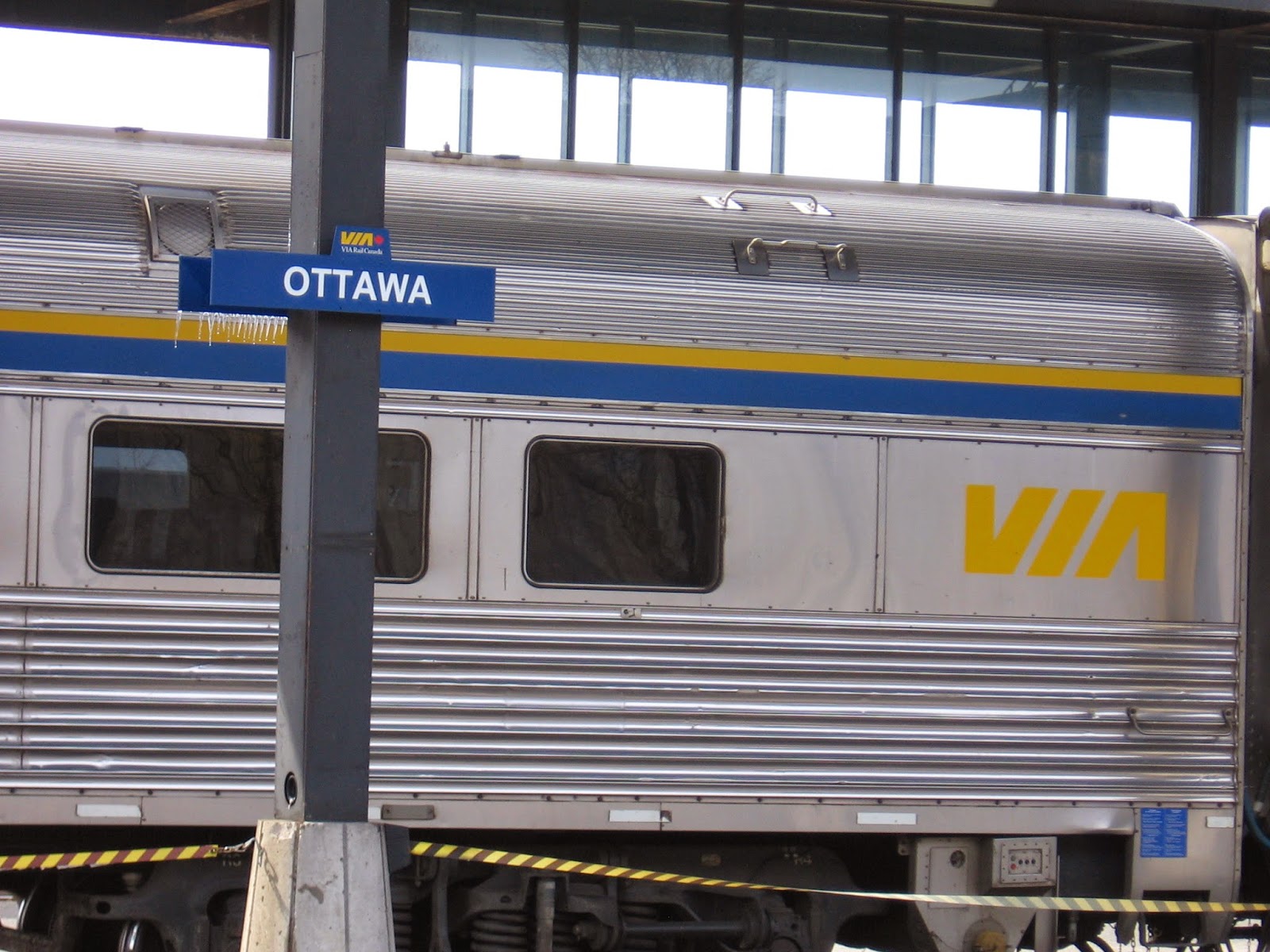
For train enthusiasts like me, spring is always fun because it means we can pursue our passion without any fear of frostbite. I stopped by the central Via station to see if there was anything interesting to see. This photo pretty much sums up this spring in Ottawa. Do you notice the last remnants of winter in the photo below? If not, look at the Ottawa sign.


This streamliner was part of a string that sat idle, awaiting its next journey to Montreal. This is the time of year to catch the silver and blue in the Windsor-Quebec City corridor, before many of these coaches get assigned to the Canadian or other long-haul routes.

I ventured over to the Belfast Road overpass, just east of the station, knowing that a train from Montreal was due to arrive in a few minutes. As mentioned before, this overpass is a great place to shoot Via trains in Ottawa, perhaps the best spot in the city.


This is Train 33, headed by P42 909, heading beneath the Belfast Road overpass. I swear, this looks better in the summer. Just for fun, look at a similar shot from this January, taken from the same overpass (below).


You'll notice that the switch heater is visible but the track diverging from the main line is covered over with snow. This shot, taken Jan. 27, was grabbed from the west sidewalk of the overpass while the spring shot was taken from the east sidewalk, which is covered with snow in the winter.

I mention this overpass because, by mid-May, it will be off limits, due to work being done on Ottawa's light rail line. A great deal of brush has already been cleared from the berms on either side of the overpass. This means I will have to find another spot to shoot these corridor trains this summer. This is a relatively minor problem caused by the LRT, as you can see from this story.

Here's a photo the city posted in the fall of the underground tunnel, where the light rail system will cross below Ottawa's downtown core. Right across from my building, a giant yellow transfer crane has been set up atop a massive hole that leads to the light rail tunnel. It's become a spot for materials to be delivered into the tunnel. But I digress. Let's get back to the Via station.


While Train 33 passed under the overpass, I got this overhead shot of these curious signs atop the coaches. Anyone want to guess what these are supposed to convey? I have a few ideas but leave it to you, my readers, to explain.


When I returned to the station, I waited for Train 50 to arrive from Toronto, but the train was delayed, so I had to make my way back to work, since my lunch break was nearly over. But I did snap a few shots of Train 33 beneath the long shelters.


And then one final shot as it cleared the main line to make way for Train 50. You can see the idled string of streamliners to the right.


Another big story in the spring here, besides the LRT issues, is the ongoing problems with the level crossings near Via Rail's Fallowfield station in Ottawa's southern Barrhaven subdivision. I will tackle this in a future post, but you may recall the terrible accident at one of these level crossings, which made national news last year.

SHAMELESS SELF PROMOTION: Next week (April 30) marks the first anniversary of the Beachburg Sub. I am hoping to put together a highlights package of the past year. If any readers had any favourite topics they might want me to revisit, feel free to leave a message.