Showing posts with label Ottawa Station. Show all posts

Monday, June 8, 2026

A moment of pause in the spring

I've had a few appointments in and around the city recently, which has given me opportunities to check out some railway spots that I don't always get to see that often. On one my jaunts into the city's east end, I was able to swing by the main Via Rail train station, as well as the Canada Science and Technology Museum. When I went to the museum, I saw this sight, as volunteers with the Bytown Railway Society were busy doing some refurbishments to their 1913 wooden Canadian Pacific caboose 436436. 

Note: My series on the history of the Renfrew Subdivision will continue with my next post. You can check out Part I here and Part II here. 

It was a neat scene, as a volunteer on the roof and one inside the cupola were busy working on the caboose's windows. Later on, that scene I had captured gave me a moment of pause. It occurred to me that my grandfather likely did work like this in Chapleau where he worked as a rolling stock mechanic at the CP facilities there. It made me smile thinking of my grandpa, who worked much of his adult life for the CP, in Chapleau and then in Windsor. 

While I was there, it was also nice to see the society's fully refurbished maintenance of way car, Central Vermont 4313.

The crew at BRS sure does heroic work in preserving railway history in Canada, which is all the more impressive given how little fanfare the organization gets in a city like Ottawa. While outside, I made sure to get a shot of the society's old 1946 GE switcher as well, which was coupled to the CP caboose. If you didn't know this was Ottawa in 2026, you might mistake this scene as being from the edge of a busy rail yard just about anywhere. I suppose the modern museum building in the background is a bit of a giveaway as well. I wonder if I could photoshop out the building and create a vintage image out of this.   

One final surprise was out on display, which you might have already caught a glimpse of in the second photo. The society's 1958 Pontiac hy-rail inspection car was also sitting in the spring sunshine, in its brilliant orange CN livery. This car is in operating condition and can sometimes be seen when the BRS crew goes to train shows. It's incredible how much thought and chrome went into the styling of cars in the 1950s. This would have been a comfortable way for railway crews to make it out to remote parts of the CN system back in the day.

You can see in the background that the doors to the BRS indoor rail shop were open. I was hoping that I might be able to see the Thurso & Nation Valley Official's private car 27. I could see a bit of it behind the half open door, but I couldn't get any short worthwhile. 

While I was in the east end, I was sure to swing by the city's Via Rail station, just to see what was going on in the yard. Unfortunately, there was not much to see from the Belfast Road overpass, which is where I chose to set up.

I wanted to get a shot of this train from a bit more of an angle so I could capture its profile, but there was construction happening at that area of the Belfast bridge, which prevented a more suitable image. This was also the only image I could get where the power wires weren't slicing through the train. Other than a baggage cart on the platform, that was about it. This is the lull in the day when most of the early westbound and eastbound trains to Toronto and Montreal respectively are gone. Closer to the evening, the pace picks up as trains originating from the big cities make their way to Ottawa and the evening runs from this city make their way east and west.

It's interesting to be able to contrast the lines of the Via Rail Ventures set at the Via station with the more angular lines of the heritage equipment at the museum. All in all, it was a fun bit of railfanning before my appointment. 

I had a few other small adventures recently, but I'll save those for another post. 


Wednesday, April 30, 2025

'Til the midnight hour

Last month, I had to go for a test at the General Campus of the Ottawa Hospital (nothing serious). The hospital runs many of its diagnostic equipment around the clock, which meant my appointment was at 12:30 a.m. Not exactly ideal, but it did provide a rare opportunity for me to get some nighttime rail photography. I will readily admit that I am not a photo expert, nor can I describe the technical aspects of what you do to maximize nighttime photos.

My two techniques are simple. The first was the mount my camera on a solid surface while ensuring my camera was on night mode. Then, when the shutter activates to get a shot, let the process play out as the camera takes the time needed to get the shot. That was the first technique. Check.

The second technique was to find a source of artificial light when available. In my case, I made sure to use the lighting at the Ottawa train station on Tremblay Road to my advantage, as it makes the camera's job easier. So that is what I did as a second step. Check.

The Ottawa train station is not all that far from the General so I made sure to head out for my appointment early, just in the off chance there might be something interesting to shoot at the station at night.


This first shot I got through the fence next to the station yard. In recent years, Via Rail has stepped up security at the station, with fencing installed around the entire platform area. This is likely a good thing, but it does tend to complicate photography. Luckily, there are square holes in the fence where you can get some shots. These holes are likely for fire fighting purposes, but I like to think it's also for us railfans. Likely not, but we'll go with that. This image is of F40PH-2 6446 idling close to a bumper while a Venture set idles further out from the station. Not the most exciting image, but it is something different.

Next, I ventured onto the Belfast Road overpass, where it was significantly darker, which would complicate photos, but I had to give it a try.

This shot isn't as crisp as I would have liked, but I did like how it turned out nonetheless. The wires next to the overpass are largely hidden. You can see the F40-led string of LRC cars that I had just shot, as well as the Venture set a few tracks over. What you can also see is a third Venture set on the edge of the yard. Three trains idling at midnight. They will all sit until morning, no doubt, for the first departures for Toronto or Montreal/Quebec City. The day is done for Via in Ottawa at this time.

There's also a very bright light on the platform in the middle of the image. That is a cart being used by Via crews who are servicing these trains. I also like how the station is lit up like a lantern at night. The Ottawa station is a decidedly modern-looking depot, but some of its style choices make it an appealing place to wait for your train. It has won architectural awards in the past. Normally, I prefer the classic train stations, but this train station is right up there with my favourites. I've always liked it.

That was my brief foray in March into some nighttime rail photography. The other images did not turn out. But I did like that these two images told a story of railways that we don't always see.The city was pretty quiet when I got these shots. The nearby Queensway was pretty empty and the sound of the idling diesels was pretty evident at that hour, when all else was pretty still.

It was a neat moment to capture. 

Saturday, July 6, 2024

Review: Riding the rails where the Ventures roam

This past week, I took my daughter to Montreal, as part of a late birthday gift. She is a big hockey fan so we went to have a tour of the Bell Centre, home of the Montreal Canadiens. We then followed that up with a trip to the team store, where she got her first Habs jersey. A fun day in a city that I love.

For the purposes of this blog, the trip was also a great opportunity to take the train. In this instance, it was my first chance to ride Via Rail's new Siemens Ventures train. 

This was the scene at Ottawa's main train station as our Venture was parked a few tracks over from a more traditional F40-LRC consist that was headed for Toronto. Our train was Via Train 24. My first impressions of the new Ventures coaches were that the centre aisle was wider than what you'd find on an LRC or silver HEP car. The interior is very white. The area for people with disabilities was spacious, much more so than the spaces you'd find on more traditional Via equipment. There was no shortage of space.

I've been reading some interesting commentary online about the new Via equipment being relatively scarce outside the Ottawa-Montreal-Quebec City route. There was also the Via "announcement" that its entire corridor now features the new Siemens trains, which is a bit of a stretch, to be sure. For my daughter and I, taking the train between Ottawa and Montreal meant we rode on a Siemens Venture set both ways. This seems to be the route where much of this equipment is being tested.

These digital signs were spread out along the car, which told you (roughly) where you were on your journey and how fast the train was moving. The Alexandria Subdivision is almost exclusively Via territory, save for the occasional CN freight train. On our way to Montreal, just east of Ottawa, our train managed to maintain a steady speed of 151 km/h for a long stretch, which was pretty impressive. As we got closer to Alexandria, the pace slackened a bit. Our train was given priority over a westbound train as well as a CN freight train closer to Coteau. As we neared Montreal, we yielded the main line for a westbound train, which caused us to pull in to Montreal's station a few minutes late, but nothing noticeable.


The train sheds at Montreal's Central Station were filled with new Siemens trains, but it's hard to get photos there, as it's so dark. The platforms at this station are as high as the coach doors, so there is no stepping down to the platform, as you have to do in Toronto. However, Toronto's train sheds are much brighter after the installation of much-needed windows there. It's a very different experience once you get off the train in Montreal.

The ride itself was incredibly quiet and smooth. Earlier this summer, I was on the last car of an all HEP consist on the way to Toronto. The difference in ride is not even close. The new Siemens coaches are a massive upgrade in terms of ride quality. I will say, however, the seats themselves felt a little stiff to me, although they weren't uncomfortable by any means. The leg room was more than enough and it was definitely a step up from the older coaches.

I mention the quiet. As someone with a hearing impairment, I have to wear hearing aids. I could hear all the announcements on the Ventures. I should clarify. It's not sound that is my problem, it's sound clarity. The acoustics of the Venture's sound systems are a massive improvement. Many details were well thought out in these new trains.

My daughter insisted on a platform shot, so I happily obliged. It's not easy getting anything decent on the Montreal platform, but I like this shot. My daughter and I had a wonderful day in Montreal. They locals treat you well when you're wearing the team colours!

The experience at Montreal station was pleasant as well. The Via personnel were very kind to us. We had to check one bag as we could not bring it on the Bell Centre tour. The gentleman at the baggage desk allowed us to check it for free, as he was enchanted with my daughter. I will have more to share about the Montreal station and my railway observations on this trip. Those will be for future posts.

Saturday, January 21, 2017

Winter observations in Ottawa: New mileage!

I found my way to the east end of the city this weekend, which gave me a chance to look at the progress being made on the O-Train Confederation Line and the renovations to Via Rail's Ottawa Station.

The most interesting site was at Belfast Yard. I don't know when railfans in Ottawa can claim to have seen new rails put it place in this city, other than the odd siding or such installed by Via Rail recently. What you're seeing below is a small section of the Confederation rail line as it enters Belfast Yard, the site where the new electric Alstom Citadis Spirit trains are being assembled and tested. If you look closely, you can see the catenary over the rails and the signals.

Those who are following the progress of this phase of the LRT project know that the city held a press conference recently around Cyrville Road, where they showed off an assembled trainset that was being tested on the tracks.


Here's another shot, below.


Both shots were taken from the Belfast Road overpass, facing east. Unfortunately, since the west sidewalk is the only vantage point that is walkable at this time of year, I was unable to get a shot from the east side, which would have minimized the impact of the fencing that was hindering my shots.

You may recall that I got a peripheral shot of the construction of this facility a few years back when I was shooting an incoming corridor train at Ottawa Station. The shot below gives you an idea of where Belfast Yard is relative to the station. Those cranes were assembling the Belfast facilities at the time. In some respects, the LRT yard is a next door neighbor to Via. The shot below shows a westbound train from Montreal coming in to the station in January 2015.


As you walk over the Belfact overpass, you can see where the Confederation Line dips below both the overpass and the Alexandria Sub trackage leading into the Via station. It's hard to photograph where the lines cross over, since no sidewalk access on the east side of the overpass prevents a good shot, so that will be for another day.

By all accounts, the O-Train project is progressing smoothly. This past year saw a few delays, one of which was caused by a massive sinkhole on Rideau Street in the downtown in late June, which flooded the O-Train tunnel and trapped a few workers for a short time. The sinkhole was fixed quickly, but the questions over how this hole formed are likely not going to be answered for some time. The last report I saw suggested that the tunnel was not a major factor.

The new line is slated to open next year. While the existing O-Train Trillium Line continues to operate normally with diesel Alstom Coradia LINT sets, the new Confederation Line construction is already having an impact. When the Confederation Line opens, the O-Train's existing Confederation Station, seen below, will likely have to be renamed to avoid confusion. This station , seen below, is named after the Confederation Park business park it serves, which includes a number of federal government buildings and Canada Post.


The debate over what to call the bus/train commuter stop at the Via Rail station was settled remarkably quickly, which surprised me. The stop, which went by the name Train, will now be called Tremblay Station, since the Via Rail station is on Tremblay Road.

Speaking of the Via Rail Station, I did manage to snap a few shots  of the action Saturday morning through the fog. The tracks were pretty full, judging by this shot I took from the Belfast overpass.


The fog really didn't help my cause from this vantage point. The wires are still a pain, too! But if you look, you'll two trains the south track (left) and two more on the right side of the picture. There is one on the centre track, hiding beneath the canopy. That's five trains at the station at once. That P42 is just about to leave for Montreal.

A little later, I drove down Belfast Road and was able to get up to the fence by the tracks to get this shot of two generations of Via diesels. The new diesel, P42 904, has the old blue and yellow paint while the older unit, F40 6446, has the new scheme. Those paying attention would notice that 6446 was the same train in the shot I shared above from January 2015. I was lucky that a huge snowbank allowed me to get a little elevation and get a shot over the chain link fence.


Just about a minute after I got the family shot, 6446 was on its way to Toronto, as seen below.


I didn't notice a whole lot of work being done on the platforms (read about the station renovations here), but there were some construction vehicles and some boarded off sections of the platform, which at least suggests that work has started in some spots to raise these platforms and enclose them from the elements.

I just hope the renovations don't ruin the vantage points from local rail enthusiasts.

Friday, November 25, 2016

Ottawa's Railway Station gets a little respect

Say what you want about Ottawa's Railway Station, but you can never accuse it of being boring. The station, which was opened in 1966, has always had a couple of factors working against it. But in the past few years, it has begun to gain a little respect.

Let's start with some surprising facts about this station. Did you know the Tremblay Road station has been open 50 years? That means it has been open for business just three fewer years than Ottawa's Union Station, which operated as the main railway hub in Ottawa's downtown from 1912 to 1966.

Did you know that the Tremblay Road station won a Governor General's Medal for architecture in 1967? Or that it was ranked as one of the 500 most significant buildings produced in the last century by the Royal Architectural Institute of Canada in 2000? Or that in 2007, it was presented the Ontario Association of Architects’ Landmark Award? Or that it was designated a heritage railway station in 1996, just 30 years after opening? Pretty impressive for a building that doesn't get a lot of love.

July 8, 2013 view of the platforms at Ottawa's Central Station as a Montreal-bound corridor consist eases out from the platforms. You can see the main building in the top right hand corner of this shot.

Many locals still bemoan the fact that the city's original Union Station was moved from the downtown to Tremblay Road, which is not exactly central like Via Rail's stations in Montreal, Toronto or Quebec City. The Tremblay Road station will also never measure up to the historic charm of the old Union Station, which is now the Government Conference Centre and soon to be the temporary home of Canada's Senate.

However, a few developments in the last few years promise to ensure that the Tremblay Road railway station gets a bit more respect in the years to come.

First, a pedestrian bridge has been built over Highway 417, which now connects the station to the neighbourhoods north of the highway, not to mention the city's baseball stadium, RCGT Park, home of the 2016 Cam-Am League champions, the Ottawa Champions (rather presumptuous name, but we backed it up with a championship).

Second, the city's Confederation Line light rail system is in the process of being built right through the station's property, which promises to directly link the Via Rail station to the downtown in a way that has been lacking since the station was built. Commuters will soon be able to board the LRT and get to the railway station without minimal fuss.

Finally, more than $21 million is being spent on ongoing renovations that will greatly enhance each traveler's experience at the station. Indeed, these are exciting times for the station.

June 26, 1971 view from the west side of the platforms when both CN and CP passengers trains used the Beachburg Subdivision.

The most obvious change that travelers will notice at the station will be the platforms. They will all be raised so that travelers will be able to board their coaches without walking up any steps. This will replicate the platforms that Via Rail has at its Montreal and Quebec City stations. The other major change is these platforms will be heated. If you have the misfortune of coming to Ottawa in the winter via train, this scene below is what you might face when you get off the train

Winter storm in early 2014.

The image below shows you what the platforms will look like when they are finished next fall.

Via Rail Canada publicity image

The station will also get new elevators that will improve access to the platforms. The station already has an aesthetically pleasing tunnel below the platforms, which ends with a massive and impressive circular ramp that you can take to the main concourse, if you decide to skip the escalators. I've done this a few times, just to prolong the experience a bit.

The station will also get roof repairs, electrical repairs, Business Class lounge renovations and washroom renovations.

Beginning in November, the railway also boosted the number of departures from Ottawa Station by two, meaning that there are now nine departures to Toronto and Montreal each day. This station accommodates 800,000 travelers each year, making it the third busiest railway station in the country.

Via Rail Canada publicity photo

When you think of how much has happened in the past 20 years around this station, it's hard to believe that there was so little surrounding this depot at one point. For example, most local take for granted that Trainyards retail development. Some might not remember that much of this land was railway property and some of it housed railway tracks.

Closer to the station, a few office buildings have been built in recent years on railway land that sat unused for quite a long time. Up until very recently, there were a few dilapidated railway structures on the other side of the chain link fence that surrounds the station's tracks.

Even on the other side of the highway, a fair bit of retail development on Coventry Road has really quickened the pace of the area around the station. When you think of the pedestrian bridge and light rail connection, the disrespected station in the middle of no man's land seems to be a little less lonely these days.

Happy 50th Birthday to Ottawa Station. I often rave about Ottawa's old Union Station, but I have to admit I truly do like this station. Here's hoping it remains a busy fixture in the city.

Via Rail Canada Facebook image

Thursday, December 10, 2015

Some railway questions

Going over old photos the other day, I was struck by some questions I had in mind that remain unresolved, so I thought I would open them up to my fellow rail enthusiasts.

Via Rail's Renaissance fleet

When I was in the habit of shooting Via Rail corridor trains at Ottawa's main station back in 2013, it was not uncommon to find a number of the railway's new Renaissance cars operating. Like this converted baggage car linked up behind a P42 in the fall of 2013.


Here's another shot of some of these sleek cars pulling into Ottawa's main station on a train from Montreal. This was shot in October of 2013.


These cars, as most know, were purchased in 2000 and put into service in 2002, according to the Via website. There were 139 of these cars purchased, of which 64 were operational. The remainder were assembled in Canada. Interestingly, Via states on its site that there are only 33 Renaissance coaches in its fleet.

These cars, which were purchased from British concerns, were originally intended to comprise a train between London, England and continental Europe via the Chunnel. The train, to have been  called the Nightstar, never happened, which meant that these cars were in storage in England for several years before Via Rail bought them after conducting tests.

The Canadian Public Transportation Discussion Board states that "the cars have been far from reliable. They have undergone numerous modification campaigns, the most recent ones being undertaken by Industrial Rail Services, Inc. in Moncton, N.B."  

So, here are my questions. After all the problems encountered with these cars, what has happened to them? Are there any in service? Where are they being stored? Are there plans to use them again?

Update: I did manage to catch a glimpse of some Renaissance cars in active service on a trip to Montreal recently. The shot below was taken as a P42 was backing this consist into Montreal's Central Station. I will have more on this in an upcoming post. These cars are in fact being used somewhere, although it's not in the Ottawa corridor, to the best of my knowledge.


The curious case of this little train

Back in 2013, I arrived at Via Rail's main station on a break and was treated to three trains. As you can see from this photo, though, one of them was a bit of a curiosity. I should point out that, usually, it's common to find one consist either idling or parked on one of the station's main tracks. But this one, consisting of F40 6435 and two stainless steel coaches, was backed up against the bumpers of a track that, until that day, I had not seen used.


Here's another shot of the little train. I wondered that day, and still do, what was that train doing there? Was it a special? Why only two cars? Perhaps a group a chartered the consist? Whatever the case, I was glad I caught it. I'm wondering if any readers has any thoughts as to what this little consist might have been doing there, backed up on a secondary track. By the way, can you see the Renaissance coaches in the background?


Mystery hook up

Final shot is from Sarnia's Via station in 2014. This was beside the spur that abutted the station (now removed, as per my brother's latest observations - Thanks, Marc). The track was used to park passenger cars in the past. I am guessing this mechanism has something to do with that. It looks to me like it was a hose hook up for water, possibly something to do with the old passenger cars and their steam generated heat? Does anyone know what it is and what it does? Or what it did?


As I have mentioned before, I am no expert so I am throwing these questions out to the readers, so I can learn something and we can have a little fun.

Monday, August 31, 2015

The late great passenger trains in the Ottawa Valley

Fellow blogger Eric Gagnon has written a post that should be of interest to Beachburg Sub readers. He has written about passenger trains he rode over Ottawa Valley rails, including the much lamented Carleton Place Sub. I highly recommend checking out this week's Trackside Treasure post. This blog, incidentally, is "the definitive source for Canadian Railway Enlightenment." I should know. I won Eric's slogan contest with that slogan.

Hard to believe passenger trains, including The Canadian, used to operate over this trackage. The CP Carleton Place Sub is seen, left, at Bells Junction, where it branched off from the CN Beachburg Subdivision.

You can read Eric's post by clicking here.

You can read this week's regular Beachburg Sub post here.

Wednesday, July 15, 2015

The rails they are a changin': Summer observations in Ottawa

Work on Ottawa's commuter rail network has kicked into high gear this summer, making this perhaps the busiest time for rail construction in Ottawa in many decades. You can't go anywhere near a bus shelter without seeing signs promiting the city's Confederation Line.

 
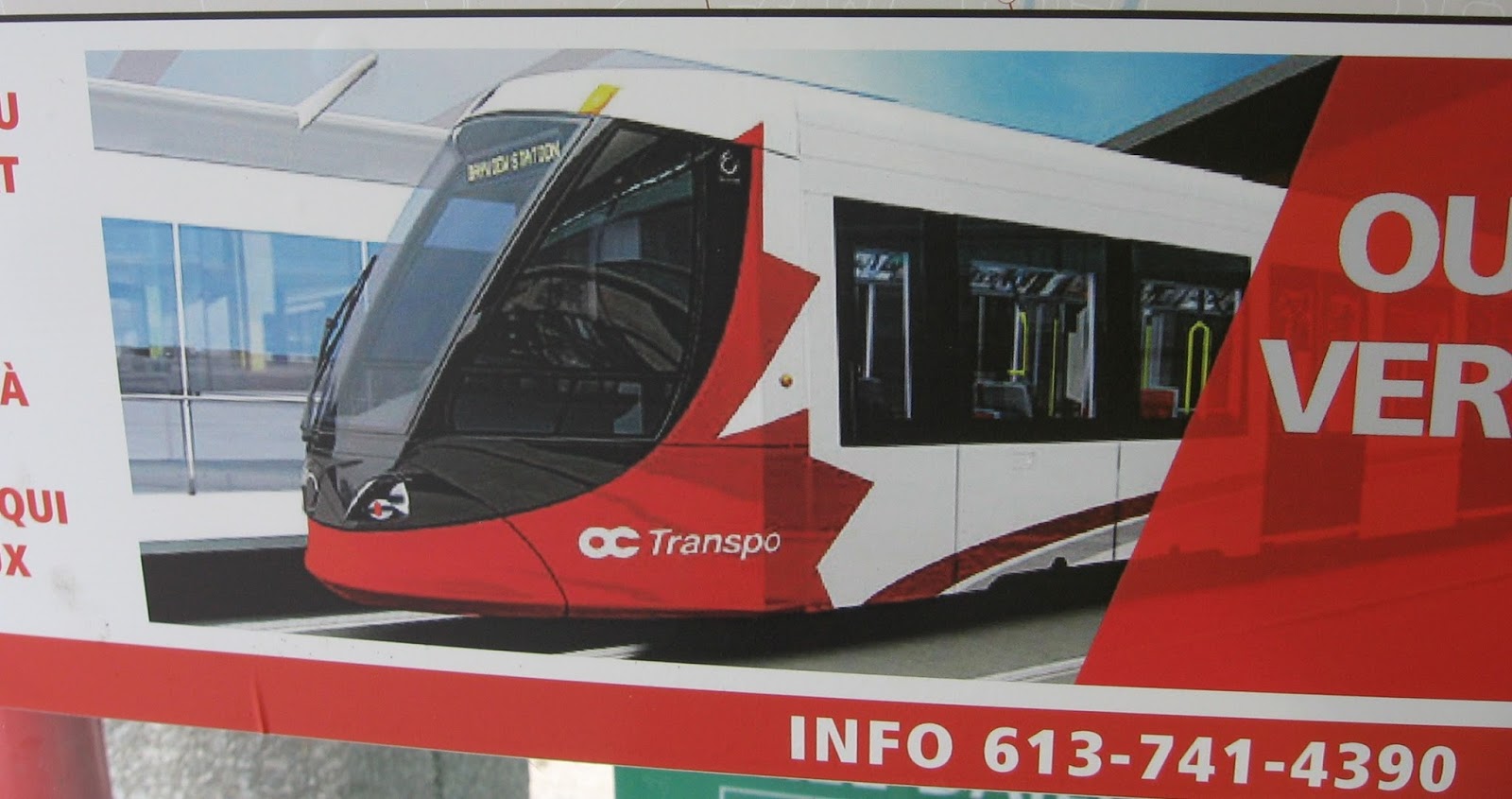
With the taglines "There's light rail at the end of this tunnel," and "Our transit future is on track," the signs of progress are hard to miss. This ad depicts what the new light rail trainsets will look like. I think they look like insects in the cab area, but that's just me. Work on the Confederation Line is really proceeding full steam ahead in many areas. In many spots, work on the rail stations is beginning. The first ties have even been laid, although this was done for the media so it was largely ceremonial.

Recently, city councillors discussed the state of the O-Train Trillium Line, an 8-kilometre rail line that currently accommodates four Alstom Coradia LINT diesel trainsets. The line has seen eight service interruptions since launching with the new power several months ago, but the complaints have been few and far between recently.

Alstom diesel trainset crosses Walkley Diamond recently, as seen from the Bank Street overpass.

There was talk at City Hall about whether the Trillium Line should be electrified early to make the transition to the all-electrified service smoother. As it stands, the Confederation Line is due to open for service in 2018.

Also this summer, city council's finance committee approved a $3-billion second phase of the LRT system, including an extension of the Trillium Line from its southern Greenboro terminus all the way south to the Riverside South neighbourhood. The Ottawa International Airport Authority's CEO said his organization is prepared to pay for an additional light rail station that would connect the Trillium Line to the airport. The issue of who would pay for a spur line off the Trillium Line to the airport is still a question that needs to be answered, since the existing rail line through airport lands does not pass terribly close to the terminal. Overall, the fact that the city has endorsed a southern expansion is a positive move, given previous reluctance to use the old CP Prescott Subdivision right-of-way for a southern commuter rail expansion.

The second phase of the light rail system will bring the western network from Tunney's Pasture to the Bayshore Shopping Centre with a stop at Baseline Station at Algonquin College. The college unveiled its own rail tunnel, which has been built for quite a while, but has been kept under wraps until recent weeks. The tunnel will travel beneath the college's Centre for Construction Excellence.

The eastern commuter rail extension will take trains past Blair Station (Phase I terminus) all the way to Place d'Orléans Shopping Centre. The plan still doesn't address the most urgent areas of commuter need, namely Kanata in the west and vast swaths of Orleans in the east, namely the Trim Road area. Can someone please mention the existing remnants of the Beachburg Sub in North Kanata please? Or is that too logical?

Meanwhile, nothing has been said about the fate of the Prince of Wales railway bridge, although it seems a foregone conclusion that the bridge will be lost as a potential commuter rail link to Gatineau. The last remaining efforts to save this rail link are fighting an uphill battle to say the least.

O-Train C9 makes its way south to Greenboro station on the Trillium Line.

Via Rail update:

One of the consequences of the O-Train Confederation Line construction is that the bus Transitway road past Via Rail's central train station has been closed. Bus service continues to serve the Tremblay Road station through other routes, although its circular access road has been partially closed to make way for the new rail right-of-way. Access out of the station has been rerouted via nearby Pickering Place.

I recently read about renovations that are planned for Ottawa's main railway station. The upgrades will include elevated and weather protected (yes!) passenger platforms and the replacement of the canopies above the platforms and tracks. Interior renovations will be included as well as a canopy to connect the station to the O-Train station.

Say goodbye to these old canopies!

An interesting side note to the light rail connection to the Via Rail station is that the bus stop at the station, which is now known simply as "Train Station" will be changed to "Tremblay Station" when the light rail line is completed through the area. I guess people thought it might be confusing and redundant to have a light rail station called "Train."

Programming note:

Beachburg Sub  and Confessions of  Train Geek contributor Dave M. has started his own railway blog, Ottawa 589. I invite you to check it out. Also, stay tuned for a contribution from Dave that is upcoming on this blog.

Thursday, April 9, 2015

Act Four for Ottawa's old Union Station

Ottawa's old Union Station is about to get a new lease on life. Again. The 103-year-old building, which served as the city's central passenger station until 1966, is about to undergo a $190-million rehabilitation to ensure the heritage structure is ready for its new task: housing the Senate of Canada.


In the fall, work began to clear what is known as the Government Conference Centre of all its employees so that the entire building could undergo much needed repairs. Anyone who has been inside this building for federal budget media locks-ups (like me) knows the building is tired. A number of ill-advised modifications made in the 1970s have hurt the building's aesthetics while a number of other much-needed modifications have been delayed.

Read about the interior of the station in this post.

The overdue renovations to the old Union Station were helped by the fact that Parliament Hill's Centre Block will soon undergo major renovations and rehabilitation, which will require the Senate Chamber to be vacated. That means the Senate will need a temporary home. That home will be in the old Union Station. The building's central Waiting Room has enough room to house the Senate and has played host to national political debates over the years.

This new function marks the third time this building has been selected for national duty following its use as a station. When tracks were removed from central Ottawa, the old station was in danger of being torn down, but was saved by heritage conscious citizens who fought for the structure's future.

The station was initially saved due to Canada's Centennial in 1967 when it was used as a home to a Canadian heritage display.

Amid questions over its future, the federal government converted the old station in a conference centre for all sorts of government uses. Unfortunately, that meant that the building was no longer open to the public. It is opened to the public for a couple of days a year as part of the Doors Open Ottawa event, although that will not be the case this year as the building is being fenced off.

I took a stroll around the old station on April 8 over my lunch hour to get some shots of the work being done. The shot below shows the east façade of the building. You can see the fencing is already up. This shot also shows the difference between the outer façade of the building the brick face of the inner parts of the building.


On the Rideau Canal side, I took a few shots of the old right-of-way. This is what engineers would have seen on their approach (although they would have been under the train sheds at this point). Of course, the trees, fencing, stone work and lamp posts were not there in the railway days. The tunnel beneath Wellington Street allowed trains to pass by the Chateau Laurier and over the Alexandria Bridge to Hull. That bridge is now used for cars and trucks.


Here's a shot from 1964 that shows what the approach to the station looked like in the waning days of the rail along the canal (Canada Science and Technology Museum collection). You can just make out the station through the haze.


Here's a shot of the west façade of the station today.


And another shot. As I mentioned, in the railway days, there were sheds for passengers disembarking from passenger trains, but they ended before trains emerged into daylight. Passengers would have seen these windows when their trains approached the Wellington Street bridge.


Here's a 1964 shot of a westbound CPR passenger train about to emerge from the sheds (Canada Science and Technology Museum archives). It is stationed right about the same spot where I took the photo above.


Now compare the top image in this post with a 1920s aerial, taken from Parliament Hill (Library and Archives Canada image). Note that the building itself is little changed except for the absence of the sheds. In the top image, you can just make out tiny glimpse of Ottawa's Shaw Centre, the city's major conference and events centre.


Before I finished my tour, I took a shot of the old station from the Mackenzie King Bridge. It's easy to imagine this is a functional station. You can also see the Chateau Laurier directly behind the old station.


Here's a shot, below, likely taken from Laurier Avenue, from an earlier vintage. A lot has changed since then, including the construction of the Mackenzie King bridge, which was the spot where I took the above shot. The freight sheds are gone along with the tracks. Also, the buildings to the right of the old station are mostly gone, replaced by Ottawa's Westin Hotel, the Rideau Centre mall and Shaw Centre. That rail yard has mostly been replaced by the Nicholas Street arterial road that feeds the Queensway and the University of Ottawa campus. Shot below is from the Canada Science and Technology Museum archives.


According to the government, the old station will begin housing the Senate in 2018, which means the renovation of this building will require years of work. The building needs new electrical and sprinkler systems, new plumbing fixture, new stone work and a host of other upgrades including removal of hazardous material (read into that what you will). Happily, some of the 1970s additions, including hideously ugly translations booths, will be removed, allowing the building's original features to be fully visible in the Waiting Room. Among the other curious items needing to be addressed will be the restoration of a skylight, which was painted over at some point in the building's past.

Special thanks to fellow blogger Eric Gagnon of Trackside Treasure for helping find the last photo in this post

Thursday, February 12, 2015

Details matter

Sometimes when I'm out looking for interesting railway photos, I tend to forget that the train itself doesn't always have to be the star attraction of a photo. Sometimes, it's the finer details that make photos interesting. I was reminded of this the recently when I read this post in Steve Boyko's blog, Confessions of a Train Geek.

With that in mind, I dug through my photos to find those unconventional shots where it's the finer details or the unconventional aspects that tell the story.

The first shot could best be described as disappointment. This shot was one of the first I took at an empty Walkley Yard in Ottawa on the Civic Holiday weekend in August 2013. I revisited this shot and realized it actually tells a great deal. It tells the story of Ottawa's railway business right now. Granted, the rail yard is rarely this empty, but it's often a ghost town. You can see the one engine assigned to Ottawa in the left side of the shot and a tiny piece of an O-Train trainset peaking from behind the hopper and lumber car.


This next shot is another that, at first glance, doesn't really show much, but it struck me the other day that it actually tells a fair bit. This is the CN bridge over Highway 416. I took this shot on New Year's Day this year, as part of an effort to get some file shots of local rail infrastructure, including bridges in Bells Corners. What struck me about this image isn't that this section of the Beachburg Sub was double tracked at one point, but that the track was removed and the ties left in place for some reason. I chalk it up to the fact that these ties are old and likely worthless, but it still makes me wonder. This is another image that tells the sobering story of Ottawa's rail infrastructure these days.


This shot below, taken May 13, 2013, was one of the first I took for this blog when I began taking shots of trains again. I love taking shots of Via's old silver and blues, but what I like about this shot is that the car's position allows you to see straight through to a station sign on the other side of the track. I do recall seeing the sign through the vestibule door and deliberately trying to capture it. The fact that the sign is hanging a little off kilter says something about Ottawa. But I'm a cynic, so maybe it's just me.

 
This shot below, taken October 6, 2013, is a shot of CN's hideous Millennium caboose in Walkley Yard. I've taken shots of this monstrosity before, but this time, I tried to focus in on some details, like the boarded up windows. But the real star of the show in this shot is the rain. It was a gloomy, lonely day in Walkley Yard.
 
  
This shot below really isn't special, which is why I haven't used it until now. But I thought it fit the theme of the post. I think the colours and the lines really tells the story of big time railroading today. This shot, taken August 10, 2013, was taken on the Woodbine Drive overpass in Markham, Ont. This container train stopped to allow another one to pass. You can also see the part of the GTA skyline in the distance.


The image below was one of many I shot when I happened across Sarnia's preserved steam locomotive in Centennial Park on December 23, 2013. No. 6069 has been undergoing an extensive refurbishment by dedicated local volunteers in the past few years and the progress shows through in the small details, like the old CNR maple leaf logo. I had a few detail photos of this locomotive that I wanted to share, but I thought the logo was the most vibrant.


One final shot. As I mentioned above, you don't need a giant train perfectly framed at an ideal spot to have a great railway photo. This shot below is another I like, but for reasons other than the train. I shot this photo on December 18, 2014, at Sarnia's rail yard. Looking at the shot, I think the train shot is fine, but I like prominence of the track and the turnout in the foreground. I also like that you can see pieces of the Chemical Valley peaking through the trees. It's an interesting mix of the environment and industry. You will also notice an old cement piling in front of the lead engine on this small consist. I'm not sure what it was, but it adds another interesting element.

 
I would never claim to be a good photographer. I am still learning the techniques and tricks of the trade from other more seasoned shooters. But I hope this small collection at least highlights the importance of occasionally mixing up your routine when trackside. The results might not be immediately obvious, but you'll thank yourself later.