Showing posts with label Renaissance coaches. Show all posts

Thursday, November 7, 2024

The two worst policy failures that plague Via Rail

Via Rail Canada's painfully public problems with its new Venture trainsets from Siemens are tough to watch, especially when it seems as though some of these problems could have been avoided. Having worked in the federal public service for 15 years now, I can say with some authority that I know how politics work. This experience is what made the recent federal government announcement that Canada will pursue high-speed rail laughable.

When you consider the Via-CN swipes over who's to blame for the Ventures speed restrictions and then consider the government's high-speed rail daydream, it all comes back to politics. That's unfortunate because we live in a time when passenger rail has become the norm in many parts of the world. It's the safest and most efficient means of moving people over short- to medium-length distances.

Yet, we here in Canada can only sit back and watch Via Rail push back its arrival times across the Windsor-Quebec City corridor, due to its Ventures being slapped with speed restrictions by CN. And all the while, the government is finally taking notice of high-speed rail as a possibility, but hardly in a serious way.

Via Rail has had plenty of turbulent moments in its history. What's happening now isn't all that different, but I think the stakes this time around are much, much higher. That is why we need to understand how the government has failed its own passenger rail system, if we are to prevent situations like this from happening again.

The beginnings: I asked Trackside Treasure blogger Eric Gagnon, my go-to expert on all matters Via Rail, to figure out if he could remember a time when the passenger railway was ever given better treatment by its host railways (CP and CN). The short answer is no. When Eric explained it to me, it made perfect sense. 

Passenger railway operations lose money and there's no reasonable way to fix that problem. When Via Rail was created, first as a rebranded passenger operation within CN, and then as a standalone operation, there was no incentive for CN to give Via Rail any preferential treatment on its tracks. After all, why should it? And there was even less incentive for CP to do the same, as it was not a Crown corporation at the time when Via was created, as CN was.

Here's where I wonder if the government could have done more. As CN was indeed a Crown corporation when Via Rail was created and spun off, doesn't it seem reasonable that the government of the day, led by Pierre Trudeau, would want to give Via every opportunity to succeed?

The answer, sadly, was no. The government of the day would have had more leverage in clearing a path for Via, as CN was a Crown corporation. But the creation of Via in some ways mirrored the creation of Amtrak in the United States. The goal was to get the freight railways back to profitability. I don't think the incentive was ever to create a successful passenger railway. It might have been a product of the times, when air travel and highways were generally seen as higher priorities by most governments. Those priorities have changes over the years, but rail is still very often an afterthought.

In hindsight, perhaps some government legislation arranging for better terms for a passenger railway might have given Via a better chance to establish itself with a good reputation. A recent article on CBC's website suggests Amtrak's better on-time record is a product of the U.S. government mandating more strict terms for its host freight railways. I don't know if that is necessarily true. I think the more meaningful point in the article is that Via claims is only owns 2 percent of the tracks it uses. I would think Amtrak's northeast corridor trackage, which it owns and where most of its trains run, would also account for its higher on-time percentage. However, I also think it is misleading for Via to say it only owns 2 percent of its trackage. Is it including the trackage it uses for the Canadian, Ocean and its Churchill trains? If so, that is a lot of trackage in its network that hosts essentially three trains.
 

Rail abandonment: Here's an area of government policy where I lean very heavily on people I know who are in the industry. As most know, Ottawa has seen its rail network shrink dramatically in the last 20 years, especially after CN took over the Ottawa Central Railway from the shortline operator that ran the operation. 

I have asked more than one person in the industry if Canada has strong policies in place that ensure rights-of-way can stay intact when a railway abandons operations on the line. Short answer is no, we don't. 

Ottawa witnessed a drawn-out struggle between CN and the municipalities of Renfrew County and the Pontiac region in Quebec when it announced plans to abandon the line from Pembroke all the way to Nepean Junction. 

The end result was fairly predictable as the local governments lost their fight to maintain the rail line, which they both sought to use as an economic driver in their regions. I recall the former head of the OCR telling me they already had a customer lined up with the promise of hundreds of car loads of freight each year. It was hardly enough to justify such a long stretch of track, but it was a beginning. 

Now consider what is today technically known as the Renfrew Subdivision or Spur, owned by Nylene Canada in Arnprior. CN has long wanted to abandon this line and sought more than once to discontinue service. The only measure to stop it was a government mandate to maintain service to Nylene under the terms of the arrangement where Nylene owns the line and the City of Ottawa owns the land where the line sits. It is possible to save rails. The government just doesn't seem to want to do it very often.

How does this relate to Via Rail?

Consider the fact that the government dreams of having a high speed rail line between Toronto and Quebec City, which sits largely on a former rail line that once connected Toronto and Ottawa. The process to reacquiring this right-of-way will be expensive and likely time consuming, as people who are affected will no doubt fight any attempts to re-establish rails. 

Consider as well that the Canadian once travelled through Ottawa and Carleton Place on the old Carleton Place Subdivision, before heading up the Chalk River Sub and onto the northern transcontinental route. This was back when this service had an eastern terminus in both Montreal and Toronto.

Both the Carleton Place and Chalk River Subs are gone, and with them, any chance to re-establish routes that Via Rail could use. I'm not saying that we need to keep every abandoned line for Via, but I think an argument can be made to strengthen government policy to prevent scenarios like the one the government now faces. Once a rail line is abandoned and sold off, there is no going back. Not easily anyway.

Now consider that Via Rail uses the old CN Smiths Falls Sub and the CP Brockville Sub for its service between Ottawa and Brockville. Both of these lines were deemed surplus by the railways and both were kept to maintain Via's busy operations between Toronto and Ottawa. The same is true of the Alexandria Sub, between Ottawa and Coteau, Quebec. Via controls and maintains all these lines.

What if the CP line through Peterborough had been kept and the connection to Ottawa via Smiths Falls was intact? Would we be talking about operational delays with the Ventures right now? Possibly not as many.

My point is government policy, from what I'm told, is not as strong as it is elsewhere, like in the United States. This is from what I read and from what I am told. I tend to agree with this point of view.

The obvious failures: I'm purposely leaving out obvious failures on the part of Via Rail, like the purchase of the notoriously unreliable Renaissance fleet from Europe, which proved to be a disaster that was quickly buried. These cars, which never operated properly in the corridor, were essentially demoted to the Ottawa-Montreal route, along with service on the Ocean between Montreal and Halifax. When I talk about government failures, I'm talking about the failures of the elected governments of the day and the public servants who inform those governments, in their jobs to support Via Rail. 

The obvious cuts: I'm also putting aside the decisions of governments past to chop Via Rail service. Yes, this is a failure in a way, although a counter argument can usually be made that some of the cuts were necessary. It depends how you look at them. Most people who follow the railway industry would argue the cuts were far too deep and caused lasting damage that Via was never able to recover from, but I can see the logic behind some of the cuts. I think the cuts Via Rails suffered can only qualify as a failure if they were made to routes where there was robust demand and good revenue margins. Cutting underserved routes is painful to the communities along that line, but sometimes they were necessary. And to be fair, passenger rail has seen cuts since the Second World War. This is nothing new.

My point is, if you want to have a successful passenger rail system in Canada, you need to give the railway sound policy for it to succeed. That starts with better prioritization of passenger trains when possible. This was a missed opportunity from Via's creation in the late 1970s. The other element is you need sound policy to ensure that rail lines are not torn up without a robust process in place to ensure their future use, if deemed necessary.

I could go on extensively about cuts or about the various minsters of transportation that didn't 'get' railways. To me, the easiest policy fixes for Via are federal mandates ensuring a higher priority on freight lines and a process that doesn't result in lost rail lines that might be of future use.

Those two elements, to me, should be on the mind of the government, not some high speed rail pipe dream that will never survive under the next government.

Friday, February 23, 2018

40 Shades of Via Grey

I recently caught up with a few Via Rail corridor trains. I have been meaning to get out and get some shots while there was still snow on the ground. It's been a busy winter with precious few chances to catch anything trackside with a little snow in the shot. Luckily, I was able to make the most of my chances.


One of my meets was lucky. I was driving home and made sure to check out a few trackside spots long the Smiths Falls Sub. When I was driving north along Moodie Drive, the crossing barriers came down. The road was empty so I slowed down and tried to set up a quick shot of an eastbound P42 makings its way to Fallowfield Station. P42 911 still had its Canada 150 wrap minus the Canada 150 logo. Not the best shot in the world, but it was the best I could do in a rush.

The next day, I dropped by Via's Central Station on Tremblay Road to check out if anything was worth shooting. This was the first thing I saw when I arrived.


A Via crew was inspecting another wrapped P42 on a stub-end spur. This was the first Via 40th anniversary wrap I have seen. It makes this unit look brand new. My plan when I arrived at the station was to get a shot of the departing Train 24, which was about to leave for Montreal. I also wanted to catch a glimpse of Train 45, which was scheduled to leave 11 minutes after Train 24. But, given the construction on the new platforms around the west end of the station, there was no space to stand trackside. So, I made my way to the Belfast Road overpass to set up for Train 24's departure.


Before the Montreal train left, I got a quick shot of two parked trains parked on the south track end to end. One train had an LRC Business Class car hooked up to three of the old streamliners. Nice mix of equipment. You might notice a bit of wire in the bottom of this shot. Getting clean shots of the Via station from the Belfast overpass is next to impossible. I tried to shoot between the wires a few times, but I never could seem to get them out of the frame.


Here's Train 24 with an F40PH-2 leading a consist of the Renaissance equipment. Those who know this stretch of track might wonder why there is such a long shadow on the south side of the track. That shadow is cast by a long sound barrier that was erected as part of the construction of the O-Train Confederation Line Belfast Yard. More on the O-Train next week. But, by way of comparison, here's a post that shows you what this stretch of track was like before that long sound barrier was put up.


I snagged a few shots of Train 24 as it gained speed and the F40 let out a bit of smoke. The long shadow of the sound barrier is really noticeable in this shot. I really like this shot, especially the smoke coming out of the F40.


Back to that newly wrapped P42. Right after Train 24 cleared the scene, the P42 backed out of the stub-end spur and backed up below the Belfast overpass, which allowed me a great opportunity to get this unit in full sunlight. This was Train 45. Soon after, a switch moved, this train took over the main track next to the station and began to board passengers for Toronto. I was happy to get a look at Train 45, which I had not expected. Nice little bonus.


I snapped a quick shot of the new raised platform. Work is still ongoing, but you can see that some of the newly raised platforms are done.


And here's one last shot of Train 45 before it gains the main track next to the station. All in all, it was a productive couple of meets for me. I did manage to see a bit of a 40th anniversary wrapped LRC coach but was not able to get any quality shots of it. Something to look for the next time I am trackside.

Sunday, July 23, 2017

Summer observations in Ottawa (Part I)

There's no shortage of rail news in Ottawa this summer as the city gears up for the launch of its Confederation Line light rail service next year. But it's not just the O-Train that is making the news. There are a number of other interesting items I have come across in recent weeks.

Let's start with something simple. In my years watching Via Rail at Ottawa's Central Station, I have not seen all that much of the maligned Renaissance equipment. Back in 2013, I caught some of this equipment a few times, but then noticed that it largely disappeared from the regular mix of corridor trains I watched. That isn't to say that it wasn't being used. I'm just saying that I didn't see it much. Of course, given the problems this equipment has experienced in recent years, it's not much of a stretch to say these coaches have seen light duty in the corridor compared to what Via originally intended.

Well, lo and behold, I did catch some of the Renaissance equipment recently, as it was being pulled by F40 6445. This was a surprising consist for me, as I have not seen the Renaissance equipment being pulled by an F40 before. I was under the impression that only the P42s were able to couple with the Renaissance cars, but I guess that is not the case. This was Train 24 headed to Quebec City. I've taken this train before (LRC coach, of course). It's a great ride.


Another interesting development at the station. Via is now using the northern spur at the edge of the station yard. This stub of a track has only seen use in recent years as a storage track for Via's snow clearing equipment. But, as you may have noticed in the top left of the photo, work to raise the platforms has put some of the trackage in the station yard off limits, which is likely what pressed this old track into service. Note the train in the hole. F40 6427, a Business Class LRC coach in renaissance colours and three old streamliners in the blue and yellow. Who says Via is boring?


I took some photos of Train 24 from the Belfast Road overpass. I made sure to cross over to the eastern side of the bridge to catch the train as it departed on the Alexandria Sub. The consist was led by Renaissance baggage car 7001, which is a refurbed shell of a sleeper. You can still see where the windows were covered over. Note, also, that the Business Class coach still reads "Via 1." Time for a new patch?


While I was at the station, I took a look at the ongoing work on the O-Train Confederation Line. The wiring is largely up from Blair Station in the east all the way to about Hurdman Station, just outside the downtown. Here, we see on of the many hi-rail trucks that roam the line. I even caught one of the makeshift maintenance of way cars, but that will have to wait for the next post.


Here's a shot of a worker doing some work on a crossover just in front of the Via station. You can see the station canopy in the top left. That shell you see top right will be the O-Train station that links commuters to the Via Station. As expected, the commuter station that serves the Via station will no longer go by the name "Train" since it seems a little redundant. It worked as a name when buses served the Via station on the Transitway, but as a LRT station, the name didn't work so the city has renamed the commuter station as Tremblay Station, to reflect the street where the Via station is located.


Much of the work on the west side of the Confederation Line does not appear to me to be as advanced as the work on the east side of the line. There is no catenary up between Tunney's Pasture and the downtown. There is some track laid, but there are gaps still between LeBreton and the western approach to the downtown rail tunnel. There is also no trackage in place at the end of the line at Tunney's.

I should mention that, while work on the Confederation Line is briskly progressing, another commuter rail development is beginning to make headlines. The Moose consortium, which is pushing to establish a GO Train style commuter service between Ottawa and various towns outside the city, is making its pitch to communities as we speak.

I'll speak to that in more detail in the next post because there is too much ground to cover. I have to admit, I am skeptical about Moose's plans but I am also intrigued by the group's ambition and its approach.

Thursday, December 10, 2015

Some railway questions

Going over old photos the other day, I was struck by some questions I had in mind that remain unresolved, so I thought I would open them up to my fellow rail enthusiasts.

Via Rail's Renaissance fleet

When I was in the habit of shooting Via Rail corridor trains at Ottawa's main station back in 2013, it was not uncommon to find a number of the railway's new Renaissance cars operating. Like this converted baggage car linked up behind a P42 in the fall of 2013.


Here's another shot of some of these sleek cars pulling into Ottawa's main station on a train from Montreal. This was shot in October of 2013.


These cars, as most know, were purchased in 2000 and put into service in 2002, according to the Via website. There were 139 of these cars purchased, of which 64 were operational. The remainder were assembled in Canada. Interestingly, Via states on its site that there are only 33 Renaissance coaches in its fleet.

These cars, which were purchased from British concerns, were originally intended to comprise a train between London, England and continental Europe via the Chunnel. The train, to have been  called the Nightstar, never happened, which meant that these cars were in storage in England for several years before Via Rail bought them after conducting tests.

The Canadian Public Transportation Discussion Board states that "the cars have been far from reliable. They have undergone numerous modification campaigns, the most recent ones being undertaken by Industrial Rail Services, Inc. in Moncton, N.B."  

So, here are my questions. After all the problems encountered with these cars, what has happened to them? Are there any in service? Where are they being stored? Are there plans to use them again?

Update: I did manage to catch a glimpse of some Renaissance cars in active service on a trip to Montreal recently. The shot below was taken as a P42 was backing this consist into Montreal's Central Station. I will have more on this in an upcoming post. These cars are in fact being used somewhere, although it's not in the Ottawa corridor, to the best of my knowledge.


The curious case of this little train

Back in 2013, I arrived at Via Rail's main station on a break and was treated to three trains. As you can see from this photo, though, one of them was a bit of a curiosity. I should point out that, usually, it's common to find one consist either idling or parked on one of the station's main tracks. But this one, consisting of F40 6435 and two stainless steel coaches, was backed up against the bumpers of a track that, until that day, I had not seen used.


Here's another shot of the little train. I wondered that day, and still do, what was that train doing there? Was it a special? Why only two cars? Perhaps a group a chartered the consist? Whatever the case, I was glad I caught it. I'm wondering if any readers has any thoughts as to what this little consist might have been doing there, backed up on a secondary track. By the way, can you see the Renaissance coaches in the background?


Mystery hook up

Final shot is from Sarnia's Via station in 2014. This was beside the spur that abutted the station (now removed, as per my brother's latest observations - Thanks, Marc). The track was used to park passenger cars in the past. I am guessing this mechanism has something to do with that. It looks to me like it was a hose hook up for water, possibly something to do with the old passenger cars and their steam generated heat? Does anyone know what it is and what it does? Or what it did?


As I have mentioned before, I am no expert so I am throwing these questions out to the readers, so I can learn something and we can have a little fun.

Wednesday, January 29, 2014

Whiteout!

It's at least -30C with the wind chill and I'm standing on a wind-blown stretch of overpass waiting for a train. I must be nuts.

The Beachburg Sub has been neglecting the railways in its own backyard lately so I set out this week to take some winter railroading photos in Ottawa, even if it meant risking my limbs to frostbite. With that, let us enjoy Ottawa's winter wrath and beauty along the rails.

I paid a visit to Ottawa's Central Station to catch some arrivals. I walked over to the Belfast Road overpass, just east of the station, since I wanted to catch Via Train 33 arriving from Montreal on the Alexandria Subdivision. When I arrived on the overpass, I was dismayed to see the east sidewalk covered in snow, which forced me to shoot Train 33 from the west sidewalk. I was lucky that traffic was sparse and no trucks blocked my vantage point. The train, pulled by P42DC 907 had six renaissance cars in tow as it approached the overpass. The wind had begun to pick up at this point, but the sky was relatively clear.


After capturing a few postcard images, I made sure to turn around, face west and get an overhead shot as Train 33  passed under Belfast Road and into the station.


You can see how much the wind had been whipping up against Train 33 on the way to Ottawa, judging by the roof of the first class coach and the rear of P42 907. I like this spot for taking photos, but it is rather restrictive facing west since so many hydro wires obscure the view of the station. Note how the tracks are all but hidden by blowing snow except for the section with the switch heater, directly ahead of the train.

After Train 33 arrived, the wind picked up quite a bit, which actually made me happy since I have so few true winter railway shots in my collection. I made it to the station in time to wait for Train 50 from Toronto, which usually arrives about 20 minutes after Train 33. While I was waiting, I saw an interesting consist on the far track. Several generations of Via in one train! P42 918 idled away with a consist of LRC coaches in tow, with the exception of streamliner 4002, which was the designated Business Class (Via 1) coach for the day.


Now, check out the same consist after the wind picked up (below). It appears as though Ottawa is in the midst of a blizzard, but by this point, it was far too cold for snowfall. However, given the overnight snow that had blanketed the city, there was more than enough of the white stuff to blow around, creating the illusion of a blizzard.


This happened in the span of about 10 minutes. I tried to stay warm as Train 50 approached. Usually, one can see eastbound trains coming into the station fairly easily from the platform. Unfortunately, I could not see Train 50 approaching, since the wind had created whiteout conditions. But, my keen hearing picked up the sound of a bell, so I fixed my camera west into the white abyss.


At this point, my fingers were frozen, so I tried to snap a few more images before I called it a day. Here's a closer shot below of Train 50, with F40PH-2 6457 and a string of three LRC coaches. Of course, I couldn't confirm the consist until the train actually emerged from the white wall of flying snow.


And with this shot below, it was time for me to head back indoors and let my hands thaw.


I am by no means done with this subject of winter railroading in Ottawa. My new goal is to shoot some freight trains that use the trackage near my house in Bells Corners, in the west end of Ottawa. There are several amazing vantage points for photographs, but the line is only used twice a week, so it will be incredibly tough to get the shots I want. But I shall persevere! Thanks to several Beachburg Sub readers who gave me a summary of Ottawa's local CN freight assignments. 

Beachburg Subdivision Update: I've been meaning to blog about the remnants of this subdivision recently. The news regarding the fate of this sub is not encouraging. In December, the Pontiac region in Quebec lost a provincial court battle to maintain the remnants of the CN rail line that still lies within its jurisdiction. Essentially, the region is arguing that, according to a bylaw it passed, the rail corridor has been designated for rail use only, making any attempt to pull up the rails illegal. That argument was struck down in court. The municipality has vowed to fight on, but it seems that the remainder of this rail line will likely be torn up in the spring, as CN seems anxious to tear up the rail line all the way to Nepean junction, where Beachburg branches off from the Renfrew spur (formerly CN's Renfrew subdivision). You can read about the latest developments in the Pembroke Daily Observer here.


Friday, December 13, 2013

Winter railroading in Ottawa

Winter has unquestionably arrived in Ottawa, which has allowed me to correct a longstanding gap in my railway photograph collection. Searching through my images the other day, I realized that I had but one winter railroading photograph. With that in mind, I lugged my camera into the arctic air to get some shots of the most Canadian of scenes: trains trudging through the snow.

The first shot, which I grabbed this past week, was Via Rail No. 33 arriving at Ottawa Station from Montreal, with P42 910 leading an all-Renaissance consist. The long shadows in the morning light, combined with the restricted vantage points around the station, made this shot tricky. I wasn't thrilled with it, but I do like seeing the exhaust from the locomotive in the crisp winter air. There wasn't much activity at the station at this point, so I didn't stick around.


On Dec. 7, I made one of my periodic visits to Walkley Yard to see if there was anything interesting to shoot. My daughter accompanied me for the first time, although she was busy watching Barney in the back seat. I did find several of these tank cars in the yard, which were a nice surprise. This tank car, Procor 50265, upon closer inspection, has a marking reading "Fluid Recycling Services" painted over on the left side. As to what fluids it carried, I'm not sure. I dug around a bit online but didn't find anything conclusive. Maybe a reader knows more than I do.


I also spotted CN's two local cabooses side by side near CN's local offices. I've shared photos of these two cabooses before, but never together. From what I've noticed, the former Devco Railway caboose never seems to move from this spot in the yard, which makes me wonder if it's operational at all. The old millennium caboose seems to be the unit of choice. The graffiti on the Devco caboose makes me shake my head. How bad is security in this rail yard?


I've shared photos of this old RDC unit before. I'm lucky that there is a service road running the length of the east end of the rail yard, which allows an excellent vantage point of this old gem. I noticed some interesting light and the cloud movement as I drove by, so I took a quick photo and was quite happy with the result. I wanted to capture a shot of this old unit, hooked to a former CN caboose, in a way that makes it look as though it's moving.

The best thing about shooting in the winter is the overgrown weeds in the yard are gone, which allows me to get a full shot of the RDC, complete with the old trucks and undercarriage. One of the small perks of this arctic weather.


Thursday, October 31, 2013

Autumn at Ottawa Station

Fall arrived in Ottawa in a hurry this year. Among with the changing colour of the leaves, it's easy to spot autumn in Ottawa by the changing consists at the central Via station. The most obvious change I spotted last week was the length of the trains. Throughout the summer, many of the trains were about three cars long and most were LRC consists. I even spotted one two-car consist. Last week, I saw some longer trains and was happy to see the return of the streamliners, albeit in an odd spot.

Above: P42 913 and F40PH-2 6435 idle at Ottawa's central railway station. Note the difference between the classic Via blue and yellow and the new Renaissance scheme.

I was a little surprised to see F40PH-2 6435 with two streamliners in tow, up against bumpers when I visited the station on my lunch break last week. The F40 was idling, so I was curious why it had been backed up on this track and where it was headed. But it was a stroke of good luck for me, since this track offers a great vantage point for photos, as it is close to the parking lot and platform.You can see streamliner coach 4122 below.


In the photo above, you can just make out some Renaissance cars to the right, which were part of Train 45 headed west for Toronto. That train was four cars in length, towed behind a P42. As I mentioned, the two-car streamliner consist was very close to the platform and the parking lot, allowing for some shots that you cannot usually get. Here's a shot from the rear of streamliner 4122, with a Montreal-bound consist of Renaissance cars idling a few tracks over. I'm backing into the real highlight of the afternoon. See below.


I very rarely see this in Ottawa. P42 913 and F40PH-2 6459 linked together. It's interesting to see the two of these locomotives together, because it allows you to see just how different they are. Compare the long, more streamlined GE in front with the more angular F40 behind. Also, you can see the contrasting paint schemes, as the GE still sports the traditional Via blue and yellow while the older rebuilt F40 sports the modern Renaissance green and school bus yellow. I am glad to see the maple leaf incorporated into the Via logo and the flag removed from the side of the rebuilt engines. I also like that the Government of Canada wordmark has been removed from the F40. It's also much less obvious on the Renaissance car behind. I always prefer simplicity to clutter. I still prefer Via's original blue and yellow paint scheme and its silver and blue streamliner look. I think the Canada wordmark on the old silver cars is downright gaudy. I digress.


Here's one final wide shot of the the Montreal-bound consist on the left, the streamliner consist on the right, partially hidden behind a shed, and the local snow plow on the far right. All in all, it was a nice break in my day to see the silver and blue back in Ottawa and to see the relatively uncommon pairing of new and old motive power. It must be fall in Ottawa.


Thursday, July 11, 2013

Ottawa's Train Hotspot: Belfast Road Overpass

Ottawa's central train station hosts a number of Via passenger trains each day, connecting to Toronto and Montreal. I've been by the station a few times in the past weeks on lunch breaks and weekends, to get some shots of new Renaissance coach consists as well as the familiar LRC consists. The other day, I ventured just east of the station to the Belfast Road overpass to get some long shots of the station's platforms and some elevated shots of outbound Montreal trains. The vantage point is tricky, as there are a number of hydro wires to contend with, along with a fair bit of overgrown brush. However, the overpass offers what might be the city's best best rail-watching vantage point.

The image below is a shot of Montreal-bound Train 54, led by rebuilt F40PH-2 6421 with four LRC coaches in tow. Another train, with P42 909 and Renaissance coaches, sits idle, awaiting its assignment on the next track. I was initially disappointed when I arrived at the station, thinking that the P42 consist would be the train I shot heading east. Thankfully, it wasn't (I'm a traditionalist, what can I say? I don't like the look of the P42s).
When the train approached the overpass, the wires were less of  an issue. I have rarely had the chance to see a train from this vantage point, other than in Toronto near Union Station. I was pretty happy with these shots below. As you can see, there are fewer wires in the shot below. If you look in the cab of the locomotive, you might see something. Do you see it?
Here's a closer look below.
Someone's enjoying a coffee on the right.

Before I headed up to the overpass, I was taking some shots of the idled train with the Renaissance coaches when the coach behind the locomotive caught my eye. I haven't seen this before.
This is Renaissance baggage car 7002, one of only nine in the Via fleet, according to its website. I had to look at it a few times before I realized what it was. It certainly doesn't fit with the image I have of Via baggage cars from its streamliner fleet or its old blue and yellow fleet inherited from CN. I expected to see a giant baggage door but it looks more like a retrofitted passenger car to me. The Via website says these cars were made from the shells of sleeping cars.

While I'm at it, here is a shot of another interesting coach worth noting. I caught this car a few weeks ago on Train 50. It's the new paint scheme for the LRC cars. This swoop indicates that the car is a Business Class car (formerly Via 1).

Beachburg Subdivision Update: I have been asked by a few readers what is happening with the old CN Beachburg subdivision, which is this blog's namesake. At this point, all I can share is that there have been no new reports of the CN rail removal teams coming to Ottawa. In my part of the city, the hopper cars that had been stored near my neighbourhood for months were recently taken away. I first blogged about this in May. I'm not sure if this means anything, since there have been no new reports of rail being removed from the portion of the Beachburg Sub that falls within the Ottawa city limits. I am trying to find out what is happening from a few sources. I will post an update soon.


Thursday, June 20, 2013

Meet me at the station

Ottawa is not a train-watcher's destination by any stretch. I have mentioned this a number of times since I started this blog. However, it doesn't mean there aren't trains to see, if you are motivated. This week, I have decided to lay off the history lessons and actually photograph some active railroading in Ottawa.

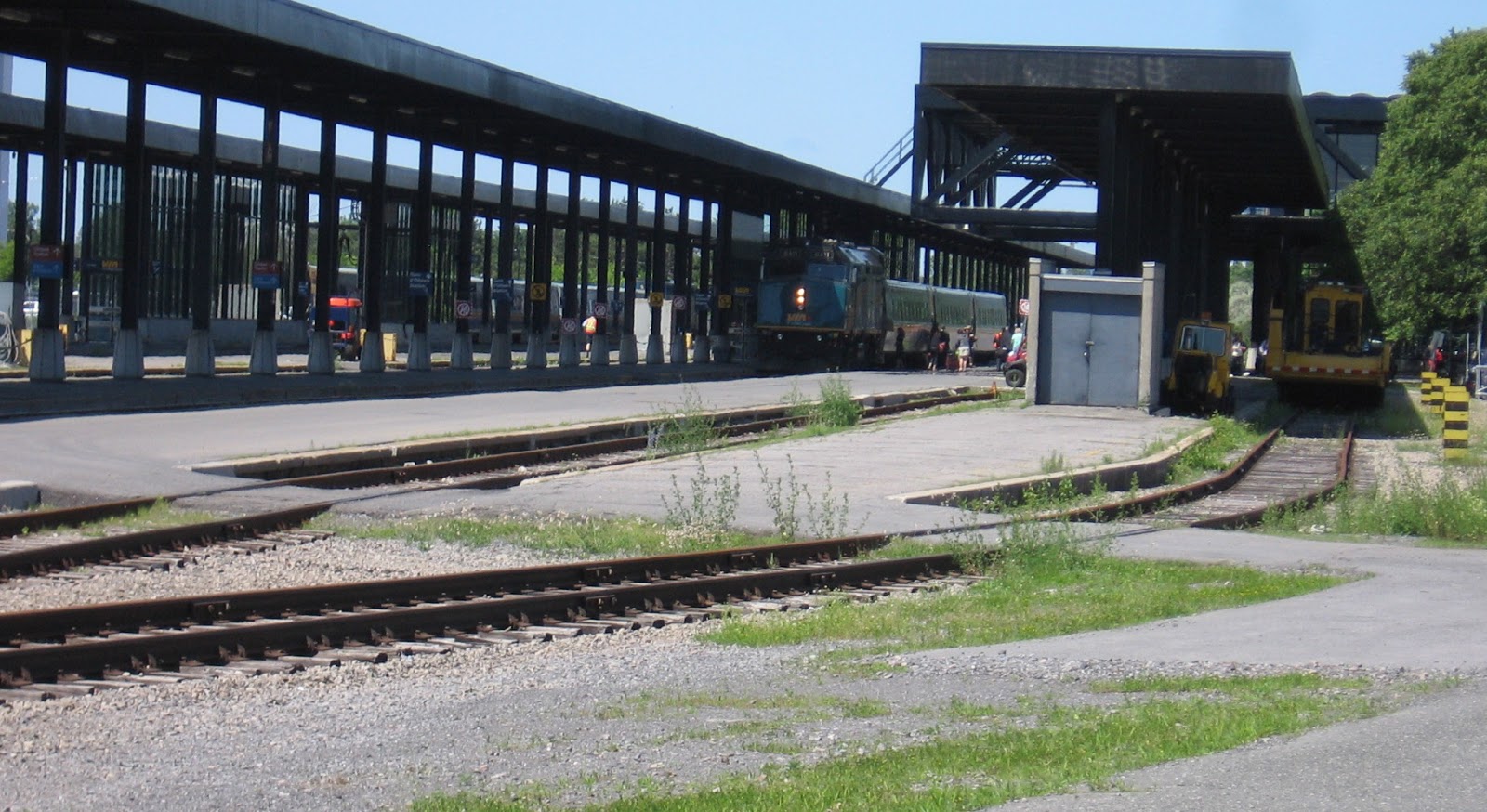
The most obvious train-watching spot is Ottawa's central train station. I headed there on my lunch break earlier this week, since it was dead at work and the station was a few minutes by bus from my workplace. This was the scene when I arrived.
Not much to look at, but it gives you an idea of how extensive the platforms are here. I made sure that I was standing in a spot just on the edge of the no-go zone, in a patch of grass that was once a part of the rail yard, judging by the ballast stones that were creeping up from the grass. I was waiting for what I hoped would be a meet between Train 50, bound for Montreal, and Train 33, arriving from Montreal. I arrived a few minutes past Train 33's arrival time and saw a consist led by a P42 on the far south track (you can just make it out in the top photo between the support posts of the platforms). I was hoping that was not Train 33, since it was not accessible to shoot.

Soon enough, Train 50 arrived with F40PH-2 6411 and a short string of LRC coaches. This was the locomotive once painted in the Kool-Aid and Operation Lifesaver colours, according to RR Picture Archives. The shot below was taken from the vantage point of a service road beside the tracks. I was pretty sure I was not allowed to be on the road, so I went back to the grass to avoid any trouble.
I waited while it boarded and kept an ear out for Train 33, assuming it was late. When Train 50 was fully boarded, it idled a few minutes, which suggested to me that it was waiting for Train 33 to arrive. You can see the other train on the south track more clearly (between the support posts) and also a yellow snowblower on the stub spur on the far right.
Train 33 arrived without much warning, which surprised me as I thought I would be able to hear it, but the noise from the nearby overpass drowned out the train until the last minute. I managed to get a couple of hasty shots of P42 917, albeit from the shadow side. I should mention that taking shots from the other side of the fence is very tough, as most of that land is private property and off limits. My next adventure to the station will include a couple of overhead shots from the Belfast Road overpass.
The real shot I wanted was a decent image of the two trains meeting. These were my attempts to get this shot from my vantage point, which was rather limited.
I was reasonably happy with the above shot, since I was going for a panorama-style shot with the two trains, the platforms, the spur and the switching mechanism all in a wide shot with some blue sky. I do like the look of the Renaissance coaches. At least the Government of Canada wordmark isn't as gaudy as it is on the streamliners and LRC cars. Still, I think the Canada flag, Via Rail maple leaf logo and government wordmark are overkill. The original blue and yellow VIA colours are still my favourite, but I digress.

I wasn't quite satisfied with that shot, so I hung around and waited for Train 50 to take off. This allowed me to get a shot more to my liking.
Train 33 pulled in a little further than I would have hoped, which prevented me from getting all of the rear of its last coach in the shot.

With my attempts at shooting the meet reasonably successful, I made sure to take a shot of Train 50 as it was bathed in the late morning sunlight.

Then, one last shot going away. Notice the old rail ties and the CN shed on the left.
With that, it was back to work.