Showing posts with label light rail. Show all posts

Tuesday, December 20, 2022

Pop-up Post: Here come the . . . new O-Trains?

This year, I have been pacing this blog so that a post is shared every other week, but the problem with that pace is that it doesn't leave much room for me to share items that a newsworthy. So I am speeding up the pace of the blog a little bit for the time being, as there is a lot to share and the backlog of posts is getting to the point where some information is becoming outdated by the time some things are ready for publication.

This post is a short one, but it does come with an interesting story. Long story short, my two children were down with the flu last week and our supply of childen's medication was quite low. As we needed to get them through about 5-7 days of fever maintenance, I made the decision to go down to Ogdensburg, New York to get some children's medication there. Alas, there was very little available, since many Canadians near the border are doing the same thing as me. I did manage to get some, but it was a tough pill to swallow, as the border is about an hour's drive from Ottawa. Hardly worth the gas, although a full tank only cost $30 in the U.S. Glass half full.

As I was driving south on Highway 416, I noticed a large flatbed truck making its way north toward Ottawa with a large plastic-wrapped railcar in tow. As I was driving in the opposite direction, I could only steel a quick glance and file the information away.

As I approached the bridge over the St. Lawrence River at Prescott, I noticed another flatbed truck with a similar railcar in tow, which was wrapped in plastic. As my car was stopped and it was safe to take a photo, I managed to get a quick shot of the mysterious rail cargo.

I was a little confused at first, since the trucks on this piece of rail equipment struck me as something that you'd see in a heavy rail vehicle, and not the typical trucks of a light rail car or power unit. So, to find something by way of comparison, I took a look at a shot I took from the end of Albion Road of a new O-Train sitting in Walkley Yard this past August. It's a Citadis Spirit trainset, which will be the train in use when the second phase of the O-Train Confederation Line is ready for use, supposedly next year between Corkstown Road in the west end and Trim Road in the east. The shot below doesn't show you the trucks, so I couldn't use that as a comparison but I thought the curvature of the end of the unit was similar to what I saw in the plastic-wrapped car. The reason I'm doubtful though, is that the O-Train below has a distinct hump on the end of the roof and the car under wraps does not. 

Also, as the O-Trains are designed to be accessible with seamless walk-on, walk-off capabilities, I'm not sure this piece of equipment fits the bill, although I realize that the platforms would rise above these trucks.

Since some have mentioned that Ottawa has had most of its light rail equipment delivered by truck, I figured it could be a piece of light rail equipment other than an end unit. But I'm not sure. Possibly a new piece of diesel equipment for the Trillium Line expansion? A piece of unrelated equipment destined for testing at the NRC facility near the airport? Can anyone else shed light on this mystery?

In this press release from Alstom, the company that makes the O-Train, it mentions that the trains are being "assembled" in Belfast Yard, where the current O-Train fleet is maintained. So, this further clouds the issue. In what state do the O-Trains arrive in Ottawa? Is this piece of rail equipment something else that is perhaps bound for the NRC facility for testing?

Can you help solve this mystery? There were two of these heading to Ottawa on December 13.

Thursday, September 26, 2019

Ten thoughts about the Confederation Line launch

I reluctantly took my first few trips aboard the new O-Trains on the city’s much-ballyhooed Confederation Line recently. To my surprise, I found the new system quite nice, with many small details well executed. There’s no doubt that people in the city are impressed with the new system. I think much of the excitement is centred around the fact that the line acts as a quasi subway through the downtown core, as it travels beneath the main parts of the core between the edge of the LeBreton Flats to the west and the University of Ottawa to the east.

Without getting into the politics behind the new line or the operational and bureaucratic miscues that have led us to this point, I thought I’d share a few observations on the trains themselves and the on-board experience.

1. My first impression of the train was that the ride was quite smooth and the trains remarkably spacious, considering how many people are hopping aboard at the end points of the line, which for me is Tunney’s Pasture. However, it is important to note that the old rapid bus transit system is still operating normally until Oct. 6, so these trains aren’t yet at full capacity just yet.


2. From a purely aesthetic point of view, I find these trains fairly ugly, especially the operator’s area at either end. I’ve seen other light rail sets in other citys that do not look like an insect’s head. Our trains look as though they have grotesque bug eyes on either end. I know they are probably designed this way to maximize safety and the sightlines for the train’s operators, but still. This is the light rail version of the P42. A small complaint.


3. The downtown underground stations are impressively laid out and quite functional. They are clean, although a bit sterile for my tastes. Most of the stations along the Confederation Line have a fair bit of artwork in them, but I found the actual platform areas at Rideau and Lyon Station to be a bit bland. Once you get into the areas with the stairs and pedestrian ramps that lead you away from the platforms, you begin to see more of the artistic flourishes. I suppose the platforms are no better worse than the subway station stops I can recall from my time taking transit in Montreal or Toronto.


4. The four-storey escalator that takes you from the deep underground Rideau Station to ground level is disorienting. It’s encased in a long, drab concrete tube. Unfortunately, there was no thought put into designing anything along the tube that is positioned at level. That means when you ride the escalator, you have a hard time judging whether you are standing at level. Think of the Crazy Kitchen at the Canada Science and Technology Museum and you will begin to understand. I have issues with vertigo and equilibrium and found the escalator a bit unsettling.


5. Pity the poor Trillium Line, the city’s first true light rail system. With all the hype and hoopla surrounding the launch of the Confederation Line, it’s somehow getting lost in the shuffle that this city has had a light rail system for more than a decade. The media coverage suggesting otherwise is just lazy.


6. The sound of the Citadis Spirit trainsets on the Confederation Line is more of a whirring rather than the sounds you typically associate with railways. I’ve been on subways in Toronto and Montreal and have to say that these LRT trainsets here sound much differently. There are no clanking sounds, just a high-pitched whirring.


7. The downtown rail tunnel is much louder than I thought it would be. As the trains makes their way through the core, the echoes of the train through the tunnel are quite noticeable inside the train cars. This is not a complaint. Just an observation.


8. The Tremblay Station that is right near the Via Rail central station has to be one of the more lightly used stations on the line. I am not an east-end commuter, so I can’t say this definitively. I took the train during off-peak hours but was still quite surprised at how empty this station was.

9. It’s interesting how the city links together two trainsets for the morning rush. The trains arrive every 3-5 minutes and are always in this configuration where two cabs are linked up together in the middle. I suppose this gives the operations people flexibility when they have reduced demand on the weekend and don’t need to use this two-trainset consist.


10. The new system has proven to get me to my workplace a few minutes quicker each morning, which was a pleasant surprise. Still, I’m not exactly thrilled that I have to make two connections just to get to work.

I guess I will reserve final judgment until this line operates in the winter. But, so far, so good.

We'll see.

Thursday, July 11, 2019

Sure, it looks cool, but...

On my lunch break a month ago, I made my way to the western portal for the new O-Train downtown tunnel. I did it for no particular reason other than to get some photos of the new Alstom Citadis Spirit trainsets making their way into and out of the tunnel. Given I went on a brilliantly sunny day, it was easy to get a few shots from the overpass over the tracks that also houses the upper level of the Pimisi O-Train station.

Eastbound O-Train makes its way to the downtown transit tunnel, as seen from Pimisi Station

I don't want to get into the messy history of this new line. The consortium building this new railway missed its completion deadline in the spring when the system was to be turned over the city so it could commence transit operations. That last delay meant it's been more than a year since this line was supposed to open to commuters. There are many, many different angles of this debacle that I could get into, but I'm growing really tired of blogging about it.

Now we're told that the city will officially take ownership of the line in mid-August and trains will roll in September. That's the last pledge, anyway.

Westbound O-Train makes its way toward Pimisi Station during a test run

Ottawa LRT is a notoriously tight-lipped consortium that has repeatedly failed to explain to the public why it is taking so long to finish this project. The city, for its part, has also been notoriously vague regarding a number of aspects of this project, often giving maddeningly bureaucratic answers to the simplest of questions. The company that built these trains, Alstom, is trying to ease fears that these European trainsets will be able to handle the Canadian climate, even though they have never before been in use in North America and have so far proved to be unreliable at times.

I could go on and on, but I won't.

As a communications guy, I will reserve my criticism for the mayor and councillors who have been trying their hardest to drum up any sort of excitement for this new line. The problem I have with their barrage of social media outreach about this rail line is that it is completely tone deaf. Every time I see a councillor's tweet with video of the new O-Train being tested, I roll my eyes. The tweets are usually accompanied by some sort of overly positive, hopeful comment about how we should all be very excited about commuting on these trains.

If I was in communications with the city, I would advise those around the council table to adjust their tone to acknowledge the fact that these delays are extending the grief for many people in the city. It hasn't made a huge difference to my commute, but for some, it's been a constant hassle. For the residents who live on roads where hundreds of buses have been rerouted each day, it's been a nightmare.

The constant barrage of positivity coming from the city is understandable, but misguided. When you have a project this far behind which is causing this many headaches, you can't fault the citizens of Ottawa for rolling their eyes and not getting on board with vapid cheerleading efforts. Instead of telling us all to don't worry, be happy, maybe a change is in order as we (possibly) approach the finish line.


Maybe change the message to say we're sorry for these problems, but it will be worth it. I would appreciate that approach much more than what I'm seeing right now.

Program note: I mentioned last week that I would share photos and commentary about the Perth Turn, which originates in CP's Smiths Falls yard. I will share that post next week, but wanted to bump up this post, given that it now appears the LRT project may actually, finally be close to being ready.

Tuesday, March 12, 2019

March Break tonic for a weary railfan

Those who are familiar with this city know that our light rail system has been delayed (yet again). For those keeping score, that's three delays now and more than a year past when we were supposed to "Get Ready for Rail" as our transit system continues to promote.

Meanwhile, the city has handed one of the principals responsible for Phase I, SNC Lavalin, the keys to Phase II at a price tag of $4.6 billion, or $1.2 billion more than expected. And, despite the legitimate concerns from city councillors about how the second phase become so much more costly, we are getting very little in the way of explanation from city officials. It's amazing to me that people that are public servants would do their best to avoid answering legitimate questions about something that is so critical to the future of our city. I should also mention that the extension of the Trillium Line (you know, the O-Train line that is actually operating) is also likely to come in over budget.

From the outset, I have wondered whether this city really thought through its options for relieving traffic congestion, especially when it had a pretty decent rapid bus system that, with a few tweaks, could have served the city well for decades to come. In other words, rail is great when it addresses a real need. In Ottawa's case, I have never seen a clear reason why its light rail plans were somehow better than a revamped Transitway bus system.

Did I mention that one of the reasons the first phase of the Confederation Line is being delayed, if you believe some people, is that testing has shown that the trainsets could not cope with severe winter conditions? I really do hope that was one of the first things considered when this massive project was first floated.

Okay, so the point is, it's not a good time to be a railfan or a rail booster in Ottawa. The city, by the way, is about to have its appeal heard in the case of the Prince of Wales bridge, which it neglected for more than a decade before someone took Ottawa to task for severing the bridge from the old Ellwood Subdivision.

Man, I keep meaning to share a few things I saw this week when I took my family to the Canada Science and Technology Museum, but the bad news keeps piling up. Well, let's lighten things up. Here's a scale model of the old CN/Via Rail turboliner that is hanging from the rafters in the museum. It's up so high, getting a decent shot is tough.


One thing I noticed when looking at this model is that there is a single axle between the middle passenger coach at the end power units. Was this part of the design of the actual Turboliner? Any experts out there who know?

Here's another interesting item that I saw in the steam engine exhibit. There are so many transportation related items in this exhibit, it's sometimes hard to see everything, but I saw this dramatic image of  Hudson type locomotive that is firing up before it heads out into the night. I suppose if I was a steam fan, I would be more enthralled with this photo. As it is, I think it's a cool shot.


I made sure to get a good shot of the golden rodent on the side of the CP steam locomotive.


Here's a little bonus for kids. They are giving away cardboard cutout steam locomotives for kids to take home. Remember those Via Rail LRC cardboard trains? Same concept. My older daughter asked for one. Brought a tear to my eye!


This reminds me of Bullet Nose Betty back in Sarnia.


Finally, the museum has a special exhibit right now, including an 1874 streetcar that once prowled the early commuter rail rights-of-way in Toronto. It was built in New Rochelle, New York.


The exhibit mentioned that the cars were pulled by horses, which had its limitations, obviously. The horses would often get tired, so the operators had to keep a rather large stable of horses at the ready to relieve the ones pulling the cars. You think your commute is slow now? Imagine what it must have been like in 1874!


Anyway, I really enjoyed my time at the museum this week. I hope to get out there and see some actual rail action this week, as it has been too long for me since I've been trackside. At the very least, the museum offered a little bit of comfort for me after months of shaking my head at what's been happening here in Ottawa.

Friday, September 14, 2018

Regional rail becomes an election issue in Ottawa

And here we go again. Most of my fellow Ottawa railfans know the city has once again pushed back the start date of the city’s Confederation Line O-Train service, although some of you out there who don’t live in this city might not know. I’ve tried to avoid too much commentary on this project, since I want to focus this blog on much more than LRT. It gets tiresome, to be honest.

Lots of construction, but no trains. Get used to this.

That being said, it would be crazy for me not to write about some of the recent developments in this city’s sad, sad history of rail bungling. And let’s be clear. Light rail transit has been bungled here many times. There was a plan under previous Mayor Bob Chiarelli, which once amazingly called for the removal of the existing Trillium Line (former CP Ellwood Subdivision, which is largely buried in a trench and hidden from view in the neighbourhoods it serves). Then there was the fixation with a downtown rail tunnel under Mayor Larry O’Brien, when a surface option was never seriously considered. Let’s not forget the giant sinkhole that collapsed near the O-Train tunnel on Rideau Street and the amazingly absurd insistence that this would not set the project back too far. More recently, we have seen the initial April deadline for the beginning of service missed. That was followed by the city letting the Rideau Transit Group off the hook by not insisting on a $1-million late penalty, which was written into the original contract. Now, the Rideau Transit Group is going to miss its own rescheduled deadline of November 2nd. When will service start? We’re being told the first quarter of 2019.

West end railway stations are still a long way from being able to host trains. This shot was taken in May, a month after service was to begin.

And I’m not even adding in the amazingly myopic decision that the Prince of Wales Bridge would be converted into a recreational pathway. This was very close to becoming reality until the city came under pressure from the Moose group and then the City of Gatineau, which wants to use the bridge as a commuter rail link as part of its own light rail system.

You can thank the City of Gatineau and the Moose Consortium for preventing this railway bridge from becoming an underutilized and overly expensive pedestrian bridge. In the coming years, it will host trains and yes, pedestrians. Everyone wins.

So, where does that leave us? Well, essentially in a holding pattern. I’m not bothered so much by the delays. This is a massive project and there were unforeseen delays, like the sinkhole. What bothers me is how little information has been shared, even when it is obvious to just about anyone that this project is nowhere near complete. Anyone that lives near the western stations on the Confederation Line knows they are still months away from even being close to ready for trains.

I will keep all this mind as the municipal elections approach. I don’t like the way the mayor has handled this file and I worry about Phase 2, as there are already some decisions in place that show an utter lack of understanding of how railways work.

So, all this to say, the light rail system has become an election issue, at least for those who know that there is more to the light rail story than the remarkably one-sided stream of “information” that has come from city hall.

Add to this drama an interesting twist. A former city councillor, Clive Doucet, is running for mayor. He has once again raised the prospect of using existing rails (what’s left anyway) for commuter rail. That would be a huge boon to my neighbourhood, which has rails running through it that are used twice a week.

Mr. Doucet, you may recall, once suggesting running rails down Carling Avenue and was harshly criticized for the idea. Honestly, I thought it had merit.

True to Ottawa’s recent history, Mr. Doucet is a day late and a dollar short (to be generous) with this proposal, although I happen to agree with the principle behind it. Mr. Doucet is proposing to run commuter trains to Smiths Falls, Fitzroy Harbour, Kinburn, Chelsea, Navan, Vars, Limoges and Lorrain Avenue in Gatineau, to name but a few proposed destinations. This includes using the Prince of Wales Bridge to connect the O-Train Trillium Line to Hull.


Next week, I intend to analyze just what it might take to realize the dream of regional commuter rail in Eastern Ontario. But, let me just say that part of Mr. Doucet’s plan involves commuter rail over scrapped railways including the old Beachburg Subdivision, the former Carleton Place Sub and the old Maniwaki Sub.

I would peg Mr. Doucet’s chances of winning the mayor’s chair as slim, but I hope he has at least generated some new enthusiasm for regional commuter rail. It’s at least worth discussing. Right? Anyone? Mr. Mayor? Is this thing on?


Tuesday, July 10, 2018

Forward thinking in Gatineau

As part of my railway wanderings in Hull recently, I came across the old Hull West station, which still stands on avenue Montcalm. The modest wooden station has seen better days. The roof definitely needs to be replaced, but a few businesses have made use of the building since it was last used for rail purposes. Right now, an arts store calls the station home. Before that store, a restaurant was located in the building.


The trip to see the station was an interesting little walk for me, because it revealed a couple of surprises.

As many people on this side of the river know, the City of Gatineau used the old Lachute Subdivision right-of-way through the city to construct its RapiBus express commuter service. This is the same approach that the City of Ottawa used to build part of the first phase of the Confederation Line LRT service (part of the new Confederation Line uses the bus Transitway, which was once part of the old CP Carleton Place Sub in the west end).

What I found to be really refreshing in Gatineau’s case was that, when the work on the bus road was done, the city reconstructed the old Lachute Sub. The line is now owned by the city, having most recently been used in 2007 by the Quebec Gatineau Railway, which used the sub to access the Eddy Spur and its last remaining customers in old downtown Hull.

Last used in 2007. This is what has happened to the Lachute Sub near the Ottawa River. The rest of the right-of-way has been rebuilt through Gatineau proper.

With this rail line in good shape, I would imagine the city would have a much easier time of realizing its light rail goals to connect downtown Hull with Aylmer in the west and the old City of Gatineau in the east. This is a forward-looking approach that has been in short supply in this region of late.

I don’t mean to harp on this again, but I can’t help but wonder what might have been possible had the City of Ottawa considered buying the portion of the old Beachburg Subdivision from Nepean Junction into North Kanata. As it stands now, the second phase of the Confederation Line will not reach Kanata, which is where the largest commuter demand is in Ottawa. North Kanata is an area that is bustling with technology businesses and has a sizeable amount of newer subdivisions. As it stands now, this area will continue to be served by buses for the foreseeable future. Had the city taken a forward-looking approach like Gatineau, who knows what might have been possible?

However, this is the same city that, until it was essentially forced into a corner, was prepared to convert the Prince of Wales Bridge into a pedestrian and cycling path over the bridge. This is also the same city that will not entertain working with CN to get light rail operating on the existing Beachburg Subdivision past Federal junction, a stretch of track that is essentially unused save for two trains on Wednesday. And let’s not forget that before the city, the old Regional Municipality sat on its hands as the old CP Carleton Place Sub was converted into a recreational path (albeit, a wonderful piece of the Trans-Canada Trail). Now, with the explosion of residential development in Stittsville, light rail would provide a welcome option for an area where the roads are at capacity, to say the least.

Where the Canadian used to roam. This is the old Carleton Place Sub in Stittsville, a suburb of the city that now numbers more than 30,000. How useful would this be for light rail now?


The plans for Gatineau’s light rail system are still very much in the early stages, as the environmental assessments and other early legwork need to be done. However, given that the Lachute Sub is in such good shape and the old remnants of the Waltham Sub right-of-way appear to be there for the taking, you have to think that Gatineau is in a much better position than Ottawa was, partly due to planning smarts and partly due to luck.

Either way, there’s a lesson to be learned here. Maybe old rail lines are worth keeping after all.

Side note: While checking out the old Hull West station, I noticed there was a nearby sign that said “CP parking only,” which was obviously overlooked when CP stopped using the Lachute Sub back in the late 1990s. Next to the tracks, there’s a no trespassing sign that asks people to report any untoward activity to CN Police. I wonder why. It’s my understanding that Gatineau owns these tracks. I can’t imagine why that sign would be there. As a contrast, if you go to the entrance to Walkley Yard in Ottawa, you’ll see a no trespassing sign that lists a private security firm’s name and number.


As far as I know, CN’s police has no presence here, which has me wondering about this sign.


Friday, June 8, 2018

Spring observations in Ottawa

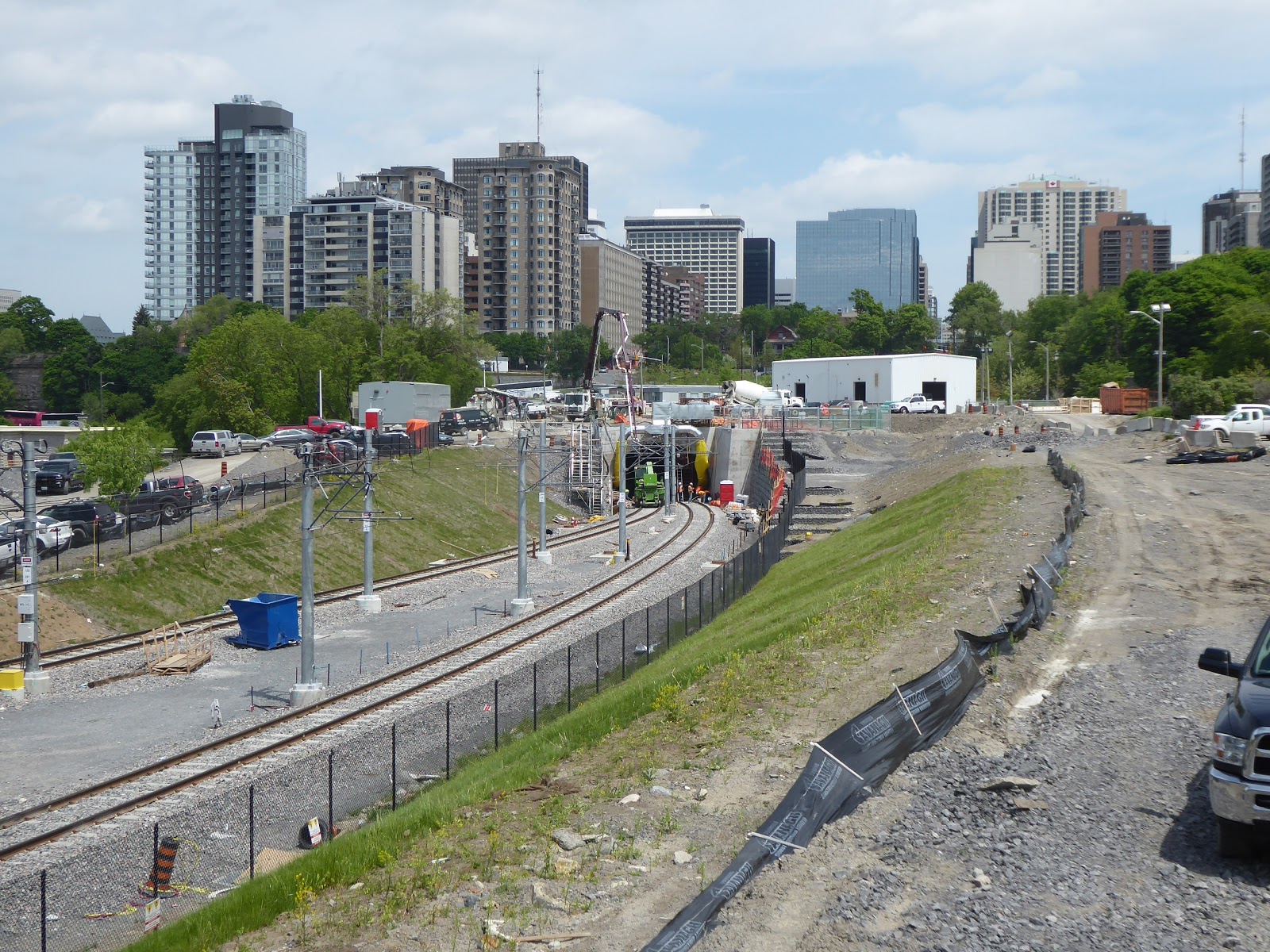
As the city’s Confederation Line light rail system lumbers toward completion, there remains a flurry of activity at a number of points along the line. I recently took a stroll along the tracks just west of the downtown, to see what was happening.

The first site I saw was the exposed western tunnel entrance. This is the first time I saw the tunnel entrance, which has been covered until very recently. Over the course of the early spring, the final tie clips were fastened into place, thus completing the Confederation Line from Blair Station in the east with Tunney’s Pasture Station in the west.
At Bayview Station, where the Confederation Line crosses over the existing Trillium Line, workers were busy with a number of tasks, including extending the Trillium Line beneath the Confederation Line flyover. This is an interesting job, since Bayview Station remains at the centre of a dispute between the City of Ottawa and the group calling itself the Moose Consortium.

As you have read here before, Moose has been battling the city over use of the Prince of Wales Bridge, which once connected the old Canadian Pacific Ellwood Subdivision with the CP trackage in Quebec, including the Maniwaki and Lachute Subs. The Trillium Line has been disconnected from the bridge for several years, as you saw in this photo I took in 2013.
More recently, when work began on Bayview Station, a portion of the trackage leading the the bridge was covered over by consruction. Moose, which has goals of establishing some sort of regional commuter rail service in Eastern Ontario and Western Quebec, challenged the city before federal authorities. Moose has long argued that the city cannot simply sever this trackage from the O-Train line without proceeding with discontinuance of service paperwork with the Canadian Transportation Agency. The city has argued that has long-term plans for the old rail bridge.

Whatever the outcome, the city cannot deny that, even recently, it had money set aside to convert the bridge into a recreational pathway. The city also cannot claim that has done much to maintain the bridge. The CTA recently sided with Moose, meaning it agreed with the group’s position that the city cannot sever the rail line over the Ottawa River from its Trillium Line without going through a discontuance process. The city is appealing that decision. At the very least, it appears that the tracks laid beneath the Confederation Line could very easily link back up with the trackage leading the bridge. I doubt that was the reason why the tracks were laid there, but it at least raises the possibility that the city might finally get serious about using the bridge for commuter rail.
Speaking of the Prince of Wales Bridge, the rusting old relic found itself as the centre of attention briefly during the early days of the Ontario provincial election. A group of local Liberals made an announcement that they would support any efforts to extend the city’s light rail system over the bridge. This announcement made me roll my eyes for several reasons. First, it seems strange to me pledge support for an extension of this system over the river at a time when this potential part of the light rail system is not an immediate priority. I also laugh whenever the city begins the trumpet the fact that the province is chipping in on the light rail system, as if the money is coming from some other taxpayer. Message to politicians: the city taxpayer, the provincial taxpayer and the federal taxpayer are all the same people.
For those who are following the progress of the Confederation Line, you may have noticed that a complete trainset has been sitting on the tracks near Tunney’s Pasture Station for weeks. The trainset is being guarded around the clock, even though the tracks at this point are in a deep cut. I suspect that those living near this end of the line will soon be seeing test runs. Most of the testing that has happened so far is happening near Belfast Yard on the east end of the line.
I did manage to take some time to get a few shots of the Trillium Line recently, including this meet between two diesel powered trainsets near Somerset Street. As anyone who takes the bus in Ottawa knows, the Trillium Line has been numbered “Line 2” while the Confederation has been numbered “Line 1.” I find this a bit odd, since the city went to great trouble to rebrand the original O-Train line as the Trillium Line. Now, if you are on a city bus nearing Bayview Station, you will hear the automated public address system announce “Bayview Station, O-Train Line 2.” I wonder if this will confuse anyone who have come to know the original O-Train line as the Trillium Line.

Oh well, at least all this activity has given us something to talk about.

Friday, March 2, 2018

As the flanged wheel turns

Was there ever a doubt that Ottawa's new light rail line would not open as scheduled? I for one, am not surprised. The media has been speculating about delays to the Confederation Line for a number of months. Despite assurances that the infamous sinkhole incident on Rideau Street would not delay the project, it appears that the giant hole and several other factors doomed the original completion date, which was supposed to happen in April.

That means that, for now, the new Alstom Citadis Spirit trainsets will mostly sit under the roof of this facility on Belfast Road, near the Via Rail station. I snapped this shot a few weeks ago.


The delay has raised a few important questions regarding who will be left on the hook for the costs associated with the delay. When the delay was first announced by our mayor, several indignant city counsellors stressed that the city had language in its contract with the Rideau Transit Group (RTG) that would allow the city to charge the group $1 million for missing its deadline. That suggestion was shot down by the mayor. A few days after that discussion, the city revealed that the delay to the Confederation Line opening will cost as much as $10 million a month, including the additional salaries that will have to be paid for bus drivers since the current bus transit system will have to continue operating. Many drivers will be laid off once the Confederation Line displaces countless express bus routes between the Confederation Line's endpoints, Tunney's Pasture and Blair. Nothing definite has been disclosed, but the RTG has been told it will be covering the costs in the coming months since the city signed a fixed-price contract for the entire system's construction.

Here's a shot of Tremblay Station, near the Via Rail station. The east end of this line is much further along in its development compared to the west end of the line, including Pimisi, Bayview and Tunney's Pasture stations.


Here's another shot, which gives you a glimpse of the right-of-way, which uses the old bus Transitway that once served the Via Rail station.


For now, the only action you will see on the Confederation Line is maintenance-of-way equipment, mostly in the form of hi-rail trucks and some pretty odd looking maintenance cars. This shot below shows you the types of grades that you don't see with heavy rail operations but are common with light rail operations.


I'm not a huge fan of railfanning light rail vehicles, but for those so inclined, this is about all you will see in Ottawa for the next few months. The Trillium Line continues to operate in the shadow of the Confederation Line.


A few final notes. A University of Ottawa professor has made the obvious suggestion (at least to me) that the city should look into using the Confederation Line for freight purposes as well. This system works in other cities, when freight trains make use of commuter rail line during off-peak hours. Ottawa is a city that is absolutely choked with trucks. You'd think politicians would embrace freight railways as a way of taking trucks off the highway and especially out of the downtown. Of course, those who read this blog know I've been advocating this all along, but I wonder how effective any freight operation would be with such dramatic grades on the Confederation Line.

Also, the city revealed the names of all the O-Trains, including those operating on the Trillium Line (Ellwood Sub). The city opened up the naming contest to students and received nearly 2000 submissions. The winning submissions were initially well received, although I did read today that some people aren't happy about the lack of diversity in the names. I would link to the story, but I really don't think it's a worthwhile read. I had a hard time getting through it without rolling my eyes.

Everyone's a critic and no one is ever happy. Pretty typical for Ottawa.

Thursday, November 30, 2017

Confederation Line is nearing completion

I won’t say I’ve come around to the city’s vision of the O-Train, but I have to say I understand some of the elements of Phase I better, having seen another city’s light rail system. Recently, my family visited Kitchener-Waterloo. As my wife attended a professional conference, I was able to spend some time in the city, where I lived for a few years.

My first impression of that region’s light rail system was that the north-south line was very much incorporated into the Kitchener and Waterloo city streets. I’ve long thought that we could avoid the costly construction of a downtown tunnel here in Ottawa by planning a smart rail corridor on Slater and Albert streets, two major one-way streets that bisect downtown Ottawa from east to west. These streets are cluttered with buses every day. It made sense to me that you could replace those buses with a surface rail line and still be able to retain a thoroughfare for vehicles. Of course, that vision died with former Mayor Larry O’Brien, who began to champion the idea of a tunnel.

When I saw the KW tracks running up and down King Street in parts of Kitchener and Waterloo, my first impression was that the region there is heading for massive traffic headaches. In some spots, these light rail tracks make sharp right turns and dominate busy intersections. In other places, drivers will be forced to make right turns off King Street by crossing the tracks, which are tucked away to the right of the street and separated by a small curb. I can foresee trouble with this system, based on my fleeting assessment. It looks much more like a streetcar line than a light rail line.

A friend of mine told me that the region has had troubles in recent months with delayed delivery of the Bombardier trainsets. So far, only a handful of trains have been delivered and have been tested on the new KW light rail system.

Ottawa, by comparison, looks to be in good shape. The fleet of Alstom light rail trains has largely been delivered and is being tested and readied for next year’s launch of commuter service, whenever that actually happens.

Recently, I was able to have a look at the progress of the Confederation Line on its west end. Most of my looks at the new system have been in the east end, particularly around the Via Rail station on Tremblay Road. The eastern half of the system is much further along in its development than the west end, but that is changing.

July view of the Confederation Line tracks near Belfast Road, near the Via Rail station

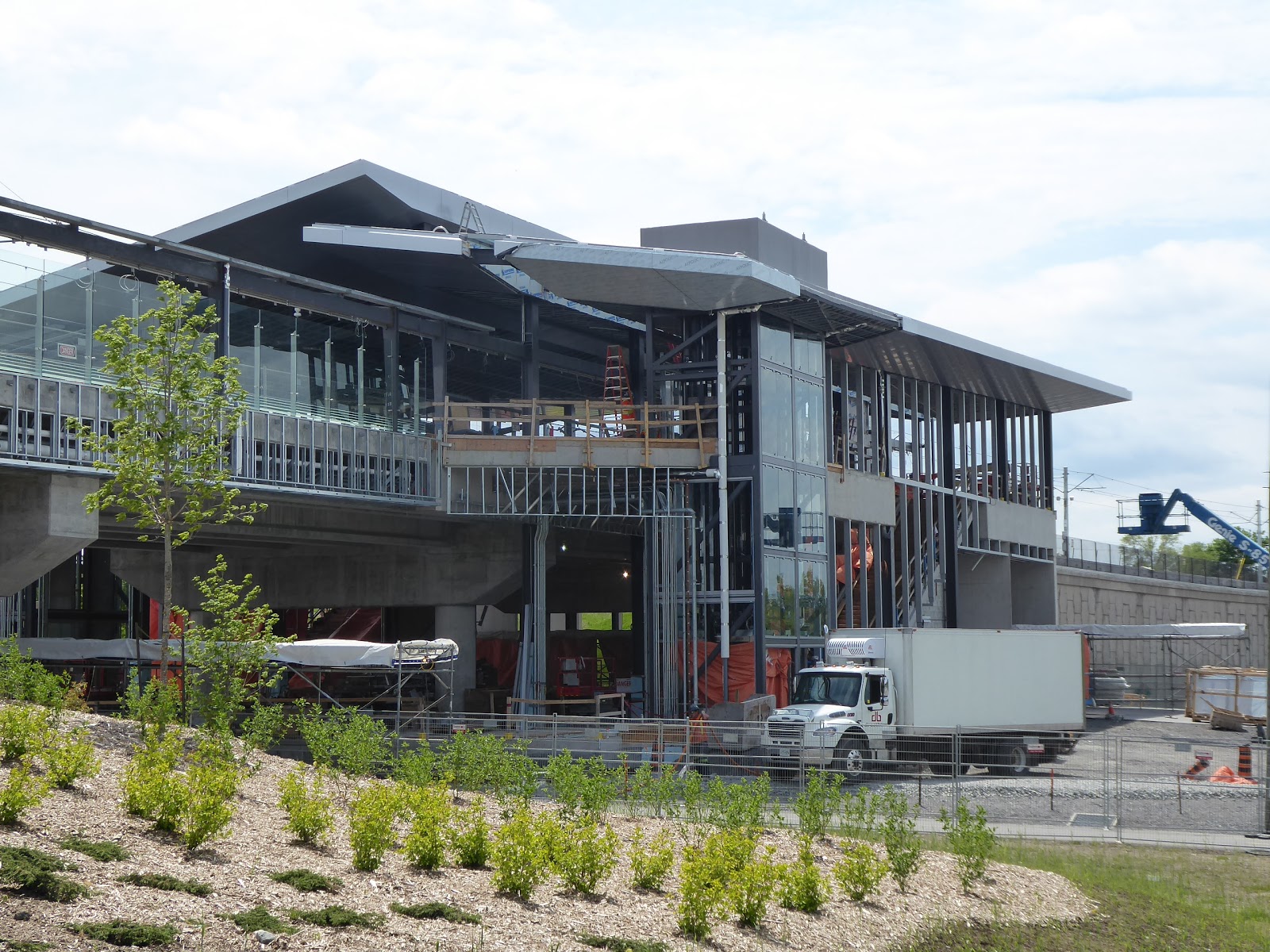
Catenary is going up on the LeBreton Flats. Rails have been laid in recent months. The Pimisi, Bayview and Tunney’s Pasture stations are all starting to take shape, including the roofs, stairs, walkways, platforms and other structural features. I know the Lyon and Parliament stations are also taking shape nicely, although that progress is not being seen, since both stations are underground.

I was walking in the area when I caught site of some maintenance of way equipment near Pimisi Station. It’s a good sign that testing might not be far off.

The poles are up, the MoW equipment is on the line and progress is being made. Those buildings you see in the distance are Tunney's Pasture, where the Confederation line will end next year.

Meanwhile, the Trillium Line continues to operate, as per usual, in the shadow of the Confederation Line hype. I was on the Trillium Line not too long ago and took this shot from the Carling station platform.


The city rolled out its Get Ready for Rail ad campaign in recent months to educate riders about how the new transit system is going to work. In many respects, the transit system we have now is a point to point system, but it will change to more of a hub and spoke system when the Confederation Line is operational.

The city has even asked residents to submit their ideas for train names, as each train will be named. I was told that “Trainy McTrainface” will not be accepted, but the appeal was made to children in particular, so who knows what direction that naming will take? I wonder if Thomas will make the cut.

As you get closer to the western terminus of the Confederation Line at Tunney’s Pasture, you can see the first signs of the catenary poles going up, as most of them have been erected. I am hoping in the coming months that I might be able to catch some images of testing happening on the LeBreton Flats section of the line.

Speaking of that end of the line, you can see the recently erected fencing that is preventing people from using the Prince of Wales Bridge as a makeshift pedestrian crossing. There were some fairly significant protests when the city finally came around to the fact that the bridge will be used for light rail, but those efforts did not go far. Common sense prevailed instead.


To be honest, I'm surprised it took the city this long to fence off this bridge, given the potential safety issues of people using it as a makeshift pedestrian bridge.


I would imagine that longtime residents of the city must be smiling to see the sight of train tracks back on the Lebreton Flats, after nearly 50 years absent. This section of the city has been dormant for so long and is now set to reclaim some of its rail heritage, which will in turn bring so much more life back to this longtime wasteland west of downtown. When you think of the new Senators arena, the new main branch of the public library and other projects taking shape in this area, you begin to understand how the ridership for the O-Train will develop.

Monday, February 20, 2017

Common sense prevails as LRT moves forward

It's always a good news/bad news situation when it comes to Ottawa's light rail plans. The city recently unveiled its latest update for the second phase of its light rail expansion. The bad news is the $3-billion price tag for the second phase now stands at $3.6 billion dollars, thanks to previously undisclosed infrastructure projects that will be part of the second phase.

Here's the best news, in my opinion. The first project to be complete under Phase II will be the southern extension of the Ellwood Sub (known publicly as the Trillium Line) to Bowesville Road in the city's south end. This means the communities of Riverside South, Findlay Creek and Leitrim will have a much faster route to downtown Ottawa when this phase is done in 2021. Remember that there is an existing right-of-way (the old CP Prescott Sub) in place. Included in this project will be a spur line to the Ottawa International Airport and a 3,500 spot park and ride at Bowesville where people can park and hop on the train. All in all, this is good news for the growing south end and great news for those frustrated with the congested Airport Parkway. This should have been a priority long ago, but better late than never.

Diesel O-Train C4 at Bayview Station earlier this month

So, the bad news? The Trillium Line will be shut down for a year and a half as the extension of this line is underway. Considering the city didn't seem at all interested in this common sense project until recently, I would gladly sacrifice this line for a year if it meant that it was extended to where it should be by 2021.

O-Train heads south near Young Street on Feb. 20

The next part of the second phase to be completed will be an extension of the eastern half of the Confederation Line from Blair Station to Trim Road, instead of Place d'Orleans. I'm glad that the city is moving quickly to further extend the train to Trim, since this is where it needs to be in the east end, and as soon as possible. This project will be finished in 2022 and will include a widening of the city's Highway 174 to accommodate light rail through the centre median. This will be a painful process for east end commuters, but having railways running in the centre median is smart and saves money, as there will be no costly land expropriations, neighbourhood fights and other hassles that go along with building rail lines through urban communities.

Two O-Trains meet near Somerset Street on Feb. 20

The good news for the western Confederation Line extension is that the western leg of the line will be extended from Tunney's Pasture to Moodie Drive by 2023, which will bring the train closer to Kanata much earlier than previously planned. The original plan was to have trains in Kanata by 2031. The extension to Moodie Drive is good news for Bells Corners and to Department of National Defence workers, who are in the process of moving into the old Nortel Networks Campus on Moodie. The original second phase plans called for the end of the line to be at the Bayshore Shopping Centre.
Still, I'm sure a few west end residents are wondering why they are the last ones to get light rail extended to their neighbourhoods as part of this plan.
I'm also still curious, given the city's change of heart on the southern extension and its plans to extend light rail over the Prince of Wales Bridge eventually, why nothing has been done to investigate light rail over the existing Beachburg Sub/Renfrew Spur in the west end. These lines are lightly used, to say the very least, and seem to be ripe for further use. And they just happen to cut through Kanata, which desperately needs better transit options.

Construction is proceeding at Bayview Station as O-Train C4 pulls into the station on Feb. 20

In total, 36 kilometres and 22 stations will be added, including the recently announced Moodie station.

In a related commuter transit vein, the city is now putting its old Bombardier Talent trainsets up for sale. At one point, the city was considering using them in some fashion, but those plans were never seriously considered. The Talent trainsets were the original train consists used for light rail in Ottawa until they were replaced by Alstom Coradia LINT units. I'll miss the old O-Trains. Happy Trails!


I won't get into the details of why the expanded service on the Trillium Line has not reached the frequency of a train every eight minutes at every station, as was promised. Ottawa's Mayor Jim Watson did mention this week that he was disappointed that the newly expanded service as not delivered as promised.

Wednesday, September 30, 2015

Who killed the train in the Ottawa Valley?

These past few weeks have been frustrating for me as an Ottawa rail fan. I was twice able to leave the house early to try and catch the one weekly freight train that travels over this blog's namesake subdivision. Only to be disappointed.

As I spent time waiting for the train that never came, I began to wonder, are railways in any way relevant in the Ottawa Valley anymore? And who or what killed the train in this region? As I pondered those questions this week, I surprised myself with some of the conclusions I reached.

This deer was the only thing I saw on the morning of Wednesday, Sept. 16, as I waited for the Arnprior local.

My first conclusion is that, despite everything that has happened since the 1950s, railways are still very much relevant in the Ottawa Valley, more specifically Ottawa, although the impact of the decisions in decades past are now being felt more than ever. What I mean is that trains, specifically passenger trains, could be relevant in the Valley, if the infrastructure was still in place. I won't wax on about the possibilities if the CN northern main line and CP Chalk River Sub were still in place. The reality is they are gone and for good reason. Rail lines need heavy industry trackside and other rail-friendly businesses in order to thrive. This, in turn, allows passenger lines to thrive by extension. The sad reality is globalization has killed many small-scale manufacturing businesses that were once common throughout Canada. Railways, specifically CN and CP, have become continental long-haul railways that do a good job moving imported goods from port to major centres, not to mention moving bulk commodities from their source to refineries and the market. These railways are not in business to provide local services on local spurs.

So, why do I think railways are still relevant in Ottawa? Well, it's clear that Via Rail is doing quite well in Ottawa, as evidenced by the opening of its second local passenger station, Fallowfield, in 2001. More recently, major track improvements have been made in the city, including a new passing siding at Wass. Via's local schedule of trains departing for and arriving from Toronto and Montreal is impressive. This is Via's third busiest hub. That says something.

Typical busy day at Ottawa's main railway station, April 2014.

The distance between Montreal and Ottawa is such that driving between these cities is no big deal. But the train still thrives between these cities because it is not all that convenient to drive to either city during rush hour and it's certainly not advisable to drive in either city's downtown core without a solid game plan.

This reminds me of European railways. They connect neighbouring cities where cars aren't always a feasible means of transportation. For this reason, Ottawa's passenger rail service will more than likely continue to be strong, government willing.

This leaves one question in my mind: What happened to the towns in the Valley that once had a reliable rail link? This is where I think you can make several arguments, but I think it's more easily explained by a chain of events. To be clear, the loss of passenger trains in the Valley isn't as cut and dried, or as romantic, as railfans would have you believe. It's simple economics. The rail lines in the Valley became less busy for freight railways, driven by the same economic factors that have hallowed out manufacturing towns in eastern North America for decades. In CN's case, a northern main line was overly expensive to maintain, particularly through stretches like Algonquin Park.

A CN freight train passes over a shoo-fly track near Moodie Drive in 1973. This rail line now hosts one round-trip per week (Canada Science and Technology Museum).

Once the freight railways lost business on lines like the Beachburg and Chalk River subs, passenger rail was in trouble. There were two reasons why these passenger trains have disappeared. The first reason is simple: passenger trains travel over CN and CP tracks at the whim of these freight railways. Once a line is redundant to a freight railway, Via's chances of keeping that route are slim. Ask those who fought to have that rail line in New Brunswick retained for Via's service there (happily, the line was retained, but not without lots of drama). More close to home, the Canadian travelled on CP's Carleton Place Sub only until CP decided it wasn't worth keeping that line around.

The second reason passenger trains have disappeared are closely tied to the first. When business dries up in these small towns, the very nature of these towns change. Unless these towns manage to reinvent themselves as tourist hotspots or in some other way, their economy suffers. The demand for rail travel diminishes as there are fewer reasons to go to these towns by train.

We can't overlook the obvious fact that passenger rail in small towns has also been affected by the development of bigger, better, safer highways, even in fairly remote areas in the upper Ottawa Valley. This was a continental trend, which has resulted in a number of problems in American cities where freeways have destroyed neighbourhoods and segmented cities. But for towns in the Valley, highway construction has become the main form of local transportation.

Finally, deregulation made it much easier for CN and CP to dispose of rail lines that were not profitable, including the Beachburg, Chalk River, Ellwood, Prescott and Lachute subdivisions, all lines that were once prominent in the region. Of course, this factor is not unique to Ottawa. Rail fans in every corner of the country can point to a line close to home that has since been abandoned. The complicating factor for rail fans is that the Canadian government does not have strong legislation that prevents railways from ripping up track when there is a compelling local case to be made for retaining those rails. For example, if the city wanted to save Beachburg for whatever reason but could not immediately afford the asking price, there would be little to stop CN from ripping up the track. The situation in the United States seems much easier for local groups who are interested in retaining rail lines.

All these factors have combined to make stops like Carleton Place, Almonte, Perth, Arnprior, Pembroke, Petawawa but a memory.

The question that I often have when I think of these old train stops is what do people do for a living in some of these more remote towns (Petawawa being the exception, everybody knows it's a military town)? The businesses close, the rails disappear but these towns persist. What keeps these towns alive? Some exist as bedroom communities for people who commute to Ottawa, but the others struggle. It's a question that I cannot answer.

CN Rapido service on the Beachburg Subdivision in 1972 (Canada Science and Technology Museum)

We cannot discount how much of an impact the Greber Plan has had in driving railways out of Ottawa. The plan, for those who might not know, was devised by what is now the National Capital Commission in the 1950s. The plan called for the removal of most railway lines from the central part of Ottawa. Most of those lines were removed in the late 1960s, including the main passenger line to Ottawa's former Union Station downtown. The beautification scheme mostly made sense, since there were too many rail lines in Ottawa, including a large rail yard where much of the University of Ottawa's more modern campus now sits. It makes no sense to have such a large railway presence and related industries so close to the Parliamentary precinct.

But, I truly believe anyone who is fair minded would agree that the plan went too far. Having a passenger rail link in Ottawa's downtown core makes more sense today than ever. Via still does quite well in this city. The value a railway brings to a city like Ottawa very much depends on its ability to deliver passengers to the downtown core. Railways understood this 100 years ago and Via understands this today. If you have to drive out to an airport on the edge of town, pay a king's ransom for parking or cab fare, arrive hours early to clear security and check your baggage and wait for your plane to take off after it taxis behind a string of other planes, you will begin to consider the train as a viable form of transportation.

Ottawa's main station is perched in no man's land, beside the Queensway, without an efficient link to the highway. On the station's back side is a massive big box store development (former railway land); on another side, a busy four lane divided arterial road; on another side a cluster of small-scale office buildings and shops. Just beyond that small industrial area is a small subdivision with streets named after the letters of the alphabet. You get the idea. Imagine if the city still had use of its Union Station downtown. Granted, it would infringe on parkland near the canal, but I have never understood how having a busy parkway on either side of the canal makes any more sense than having a single railway track.

As an example of a city where this arrangement works, allow me to submit for your consideration, Quebec City.

Quebec City's Via Rail Terminal in August 2010.

This station, much like Ottawa's old Union Station, is an architectural marvel very close to old Quebec. I would imagine if Ottawa had retained a rail connection along the lines of the one in Quebec, residents would come to appreciate having such a connection in the heart of their city. But the car-crazy 1960s beautification scheme that transformed Ottawa will never permit this to happen. And make no mistake, the Greber Plan was very much geared toward creating major car thoroughfares. Anyone who sees the truck traffic on Rideau Street or the patchwork quilt of roads and abandoned stores behind the Rideau Centre mall in the downtown can thank the Greber Plan in part for this mess.

Also, the existence of the Queensway and the Vanier Parkway are both largely thanks to the use of railway lands and tracks for roads. In many respects, these thoroughfares are a product of a time when highways were seen as a showpiece of a modern city. Just look at some of the original renderings of the Queensway and you will see the vision, however flawed, that planners had at the time.

The city did do one very smart thing with old railway tracks when it created the bus-only Transitway. This rapid bus road crosses much of the city with very minimal stoppages, allowing commuters a convenient option for getting to and from work. The system has flaws, of course, like the bottleneck of buses in the old city core, where the Transitway makes use of downtown arterial streets, but on the whole, it's an excellent system. When I heard that politicians wanted a light rail system and wanted to operate it through downtown with a tunnel, I scratched my head and wondered why the same consideration wasn't given to buses. After all, the city already has much of the Transitway infrastructure in place and buses offer more flexibility than trains for commuters. No matter what your view of the new light rail system, you can't deny that using old railway lines for a bus road was a silver lining to the worst elements of the Greber Plan.

So, for those keeping track, those are all the elements that I believe led us to where we're at today. Economic forces have caused a great deal of industry to leave the Ottawa Valley, which includes pulp and paper, manufacturing and other commodities that freight railways used to rely on for revenue. Once those businesses closed, the freight railways scaled back their operations and eventually abandoned their rights-of-way. That in turn has killed passenger rail along those rail lines. Those economic factors combined with an anti-rail development plan in Ottawa, which further reduced the rail network's prominence in the region. Deregulation further eroded the national railway presence in the Valley.

The more recent developments include CN taking over for former shortline Ottawa Central and subsequently tearing up much of the remaining Beachburg Subdivision between Pembroke and Nepean Junction.

That moves leaves several remaining industries along that former line and the shortened Renfrew Spur (wood pellet plant in Portage-du-Fort, aerospace manufacturing facility in Arnprior and other businesses without rail service) with no other option than to use trucks. Despite efforts to re-establish rail service on the old Beachburg line, the rails are gone and the last remaining rails in the Valley are now only a memory.

Switcher and two old cabooses in Pembroke, 1973. That rails in this Ottawa Valley community are now gone.

All this leaves the question in my mind, what's next for railways in Ottawa? I think there is reason for faint hope and here's why.

The first reason there could be hope is that Ottawa is busy re-establishing rails for a 2018 launch of its electrified commuter rail service. While this won't have any impact on the Valley's rail network on a larger basis, it will at least bring railways back into prominence in the city. There was some talk years ago of freight railways using the city's LRT line for freight operations outside the hours of O-Train operation. I don't see this happening anytime soon, but it at least raises the possibility that it could happen, if there was a willing partner.

I think it's highly probable that a shortline operator could return to Ottawa in the future, if there is a business case to be made. Currently, I don't think there's enough carloads or traffic to entice a shortline operator along the lines of the Ottawa Central. But I think that if the CN was given a chance to leave Ottawa, it would leave in an instant for the right price. It's fairly common knowledge that CN had very little interest in returning to this city when it was given control of the OCR as part of a package of railway operations it purchased in 2008. It seems to me that Ottawa would be a natural fit as an intermodal hub, since our city is the largest urban centre this far north and could potentially act as a gateway hub for cities further north. American railways have followed this model, but CP and CN seem content to funnel their container trains to the major centres exclusively. Perhaps Ottawa is too close to Montreal for any container train facilities. But it seems like a good spot for a regional container offloading spot where trains offload container trains and trucks take them to cities throughout the Valley and into Northern Ontario.

Finally, if there was ever the political will to do so, I think Ottawa would be an integral part of a high-speed rail corridor. We seem to have lost our interest in nation building exercises, which include high-speed rail links. Thinking of the last attempt at a project of this scale, one might be able to make a case for the Trans-Canada Highway as the most recent example. I am encouraged that other countries have pursued high-speed rail with some success. Heck, if the United States can do it in California (so far anyway), then surely it's not out of the question for Canada to pursue this. But that would require the political will, which is the tricky part.

A few backers have suggested that Ottawa and its surrounding municipalities could benefit from a GO Transit model that would deliver commuters to Ottawa via commuter trains, but the appetite for that type of system has not attracted any political backers, sadly.

Unfortunately, Ottawa has been spoiled by half a century of not really having to live alongside an active rail network. Most people in the city have very little idea of just how much potential Ottawa's rail network holds. The current LRT love-in among city politicians notwithstanding, there is very little understanding of railways in Ottawa.

So, that's my take on what's happened to the rails in the Valley and what might be ahead for this form of transportation. To answer the question I first posed in the title, no single factor or person killed rail in the Ottawa Valley, but I think a number of bad decisions need to be rectified if there is to be any realistic future for this mode of transportation here.

Beyond my self interest as a rail fan, the benefits of a healthy rail system to any major city are obvious, even beyond the benefits for inter-city passenger rail. Anyone who sees the truck traffic on Highway 401 or Highways 416 and 417 can attest to the stress this puts on the highways. I'm not saying that trains would ever overtake trucks for short-haul cargo traffic, but I do think a healthy rail corridor could have prevented the flood of trucks we now see on highways here.

And to close the loop on my anecdote, I decided to head back out in the afternoon to catch the Arnprior local returning from Nylene Canada and finally had some success. This picture below, in  the context of this post, represents what is left in the western Ottawa Valley. This train is all that is left of railways in an area that was once very much defined by railways.

More on this meet in a future post.