Showing posts with label Port Huron. Show all posts

Monday, October 20, 2025

Some random photos from summer and fall

This summer and early this fall, I have been able to collect a fair number of random railway photos that don't quite fit in with any particular theme or topic of a post. As I have done in the past, I usually give myself some time to store up a few and explore them in detail in a random post.

I suppose if there's a theme or topic that unites these photos, it's as follows. When you blog about railways and live in Ottawa, you need to be ready to take a railway photo anywhere and everywhere you can. To go one step further, you also need to constantly think of new places and new vantages points to take photos, so you can present some shots that aren't constantly covering the same ground. 

That's because Ottawa has very little to offer, obviously. 

I see this often online where railfans will take a shot of the same train at the same location at the same time of day. For them, it's fulfilling and worthwhile. That's not my thing anymore. I need to mix up the landscape and the background, not to mention the points of view, to keep things interesting. I think that's why a fair bit of my photography is now taken with landscape in mind.

I'll start with a shot that was shared with me by my sister. She and her husband were celebrating their 20th wedding anniversary in late September. They found their way to Alaska, where they took a ride on the White Pass and Yukon Route passenger excursion from Skagway, Alaska. 

 
Here's a shot of a few of the vintage 19th century vintage* coaches ready to welcome passengers for an excursion from Skagway to Carcross, Yukon, where the line currently ends. The railway, now owned by a company that includes Carnival Cruise Lines, operates in Alaska, northern British Columbia and Yukon. In recent years, there were talks about restoring service all the way to Whitehorse, Yukon's capital, but that has not materialized. Part of that discussion includes the line taking on freight service again, as mining interests still work along the route, although much of this traffic is handled via trucks. 
 
* - I neglected to mention in my original text that these vintage coaches are mainly newer builds made to look like 19th century equipment, although some are indeed very old and there are even some originals still in the railway's possession. Read the comments below for more.
 
It would be interesting to see this 3-foot-gauge operation back in action all the way to Whitehorse again, complete with freight operations, but this would require a fair bit of investment on the part of governments. I'm not sure there's a business case to be made right now.
 

A few days ago, I was on my way home from an appointment in Orleans, in Ottawa's east end, when I decided to avoid the westbound construction on the Queensway by taking some other city arterial routes back home. That path brought me by Ottawa's main train station on Tremblay Road. It was quiet when I arrived, save for this P42 and HEP consist pointed eastward, although the train was a double-ender. I am guessing this was a Montreal-bound train, as I have boarded eastbound trains on this track before. 
 
I didn't need to take another shot of a P42 and HEP consist, as I have hundreds of similar shots, but the thought occurred to me as I watched the train idle: How much longer will I see these trains? Even the engines with a face only a mother could love won't be around forever. The Venture sets are everywhere now and the legacy rolling stock is fasting becoming scarce. It's always worth a shot. 
 

In the summer, my family visited Sarnia and found our way to the Bluewater Bridge, which connects to Port Huron, Michigan over the St. Clair River. Beneath the bridge in Port Huron, near the Thomas Edison Inn, you will find this baggage/passenger car that once belonged to the Chicago, Detroit & Canada Grand Trunk Junction Rail Road. The railway connected Port Huron to Detroit beginning in the mid-1800s and became part of the Grand Trunk Western in 1928. 
 
Thomas Edison, a world-famous inventor born in Ohio, spent much of his earlier years in Port Huron, which is why the hotel is named in his honour. Edison also worked for the Grand Trunk, beginning as a young man when he told items, including newspapers and candy, to travellers bound for Detroit.  
 
Edison would later work as a telegraph operator for the Grand Trunk in Stratford, Ontario. You can read about his connection to railways in this earlier post. You can also see the historic Port Huron Railway Station behind the passenger car. 
 
 
This last image isn't exactly random as it's an image of Via Rail Train 84 headed eastbound toward Stratford Station en route to Toronto. I was lucky enough to catch this train while in Stratford this July, but I wanted to share this image, taken amid a sea of visial distractions. I liked the curvature of the tracks and the trees as a brackdrop. I will share my other photos of this meet later on, but I thought I would put this one out there to see what people thought. It was a bit of an experiment. I'm not sure about the concrete and metal poles framing the train. I like that there's a stop sign in there as well as some crossing signals. It shows you how the Guelph Subdivison snakes its way through the city in and around the station. In this image the consist is crossing Downie Street and making its way to Niles Street, which is the last street eastbound before it hits the station.
 
A bit of bric à brac from the last few months.  

Friday, December 6, 2019

Images of the tunnel accident aftermath

This really hasn't been a great year for Canadian National, has it? The railway that just recently had to lease dozens of locomotives just to keep up with an unexpectedly large uptick in demand found itself in the doldrums, somewhat. Of course, everyone knows about the eight-day strike that really clogged up yards and left customers in a lurch in late November. Then there were the layoffs when business began to falter.

But, for my money, the truly compelling story is the messy late June crash of a train in the middle of the St. Clair Tunnel between Sarnia and Port Huron, Michigan. A reader reached out to me anonymously with information about that crash. This reader allowed me to share what they had gleaned, on the condition that I not reveal anything about where this information came from.

So, for what it's worth, the messy derailment was, according to this source, likely caused by an unbalanced load in a gondola car, which derailed on a descent into the tunnel. I have no reason to doubt the veracity of this information, but I will caution that it is by no means an official explanation. So take it for what it is worth.

The crash caused a considerable amount of damage to one of CN's busier transnational routes that connects Eastern Canada to Chicago (via Michigan). The track into and in the tunnel had to be ripped up and the entire right-of-way regraded and relaid. Readers who follow this blog from Sarnia managed to share some photographs with me (taken from public vantage points). I was told the pedestrian bridge that links Sarnia's Chemical Valley with South Sarnia was barricaded to prevent people from watching the construction efforts. Considering this walkway is surrounded by chain link fencing, I have to wonder why the local police and the railway would go to such lengths to hide these activities. Yes, this was an embarrassing accident, but preventing access on a public walking path is unfortunate, if it was guided by anything other than safety concerns.

After round-the-clock efforts for the better part of a week, the tunnel was reopened to traffic, which allowed the refineries in the valley to clear the backlog of cars on their spurs.

So, with the help of some folks in Sarnia, includng my brother, here are a few shots of what happened after the derailment. Some of these pictures were taken from the pedestrian walkway before it was closed off by local police.


The above image is of a road unit with two damaged couplers. I'm told this might have been one of the units in the accident, although I don't know what the head end of this train sustained any damaged or derailments. Take this image for what's it worth. It was indeed taken right after the derailment.


 Another shot of the unit with damaged couplers.


Shot from the Donahue Bridge walkway, this is the main line looking east toward the rail yard. You can see the debris on the side of the tracks.


 That looks like shredded pieces of an autorack, shot directly overhead from the pedestrian walkway.


A fleet of maintenance-of-way equipment ready for action.


This is a shot of the rebuilding efforts from the edge of the pedestrian walkway after it was closed. As you can tell, getting a clear shot of the repair efforts was tough at this point.


You can clearly see from this image that the tracks are long gone, with construction equipment busily working to fix the grading.


This might be my favourite shot. On the evening of the crash, a reader went out around sunset to catch some efforts to pull cars out of the tunnel, including these autoracks. You can also see shredded debris on the lower left.

My thanks to everyone who ended up getting these unique shots. Thankfully, no one was hurt in this accident and everything returned to normal in short order.

Friday, November 15, 2019

Postcard from Port Huron

This is the latest installment in an occasional series where I share my thoughts about a single photo. You can read the other postcard posts by clicking the links below.

Postcard from Chemical Valley (2015)
Postcard from Saint Laurent Boulevard (2015)
Postcard from Twin Elm (2016)
Postcards from Alberta (2016)
Postcard from Vaughan (2019)

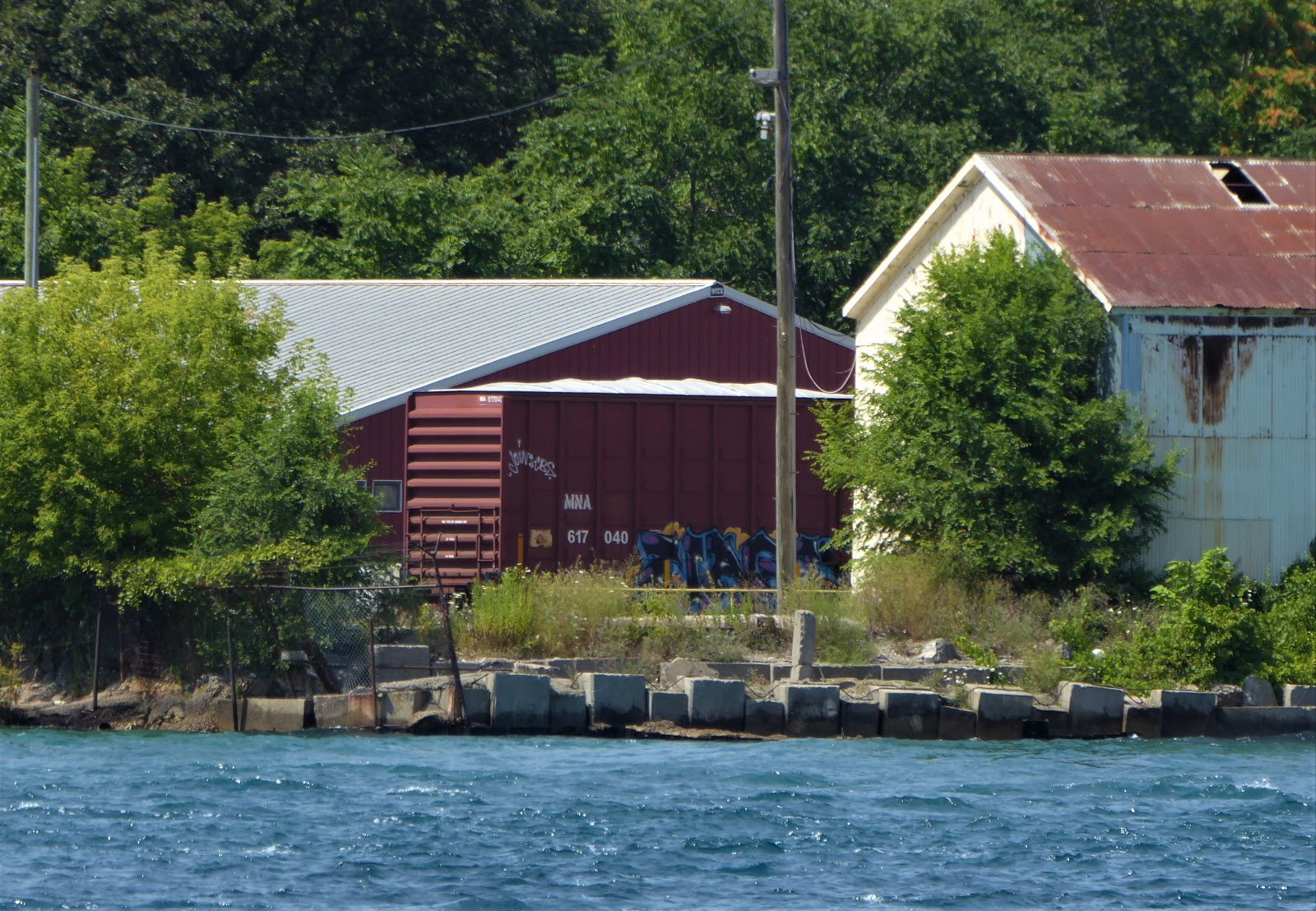
This photo makes me nostalgic for a few reasons. At first glance, it's not much. A large boxcar spotted at the end of a weedy spur. But upon closer look, you might see glimpses of railway history.


I saw this boxcar from across the water in Point Edward, Ontario, beneath of Bluewater Bridge. I brought my daughters and nephew there in the summer so they could run around at the playground and have some famous bridge french fries. As we were walking along the water's edge, I saw the boxcar and it made me smile for a few reasons.

The first reason is that there are still some active rail lines along waterfronts, even though many have disappeared from the urban landscape. This line, in particular, is a former Grand Trunk line, now part of the Canadian National system. I've seen some compelling photos over the years of old blue and red GT geeps crawling along this old right-of-way to serve the industry along the line.

Every time I visit the area, I almost expect this rail line to be removed. There is no place in today's modern world for tiny little spurs along the waterfront to be serviced by massive Class I railways.

Well, I guess there is still room for this type of operation.

I don't know what I like more, the weeds along the tracks, the fact that this car reminds of of the old high-cube boxcars that once carried auto parts or the fact that this photo also incorporates the stunning blue water of the St. Clair River.

For those interested in the operational details, this car carries paper, as it has been spotted at the Dunn Paper mill on Riverview Street in Port Huron. Someone with more knowledge of CN's local operations might be able to tell you about the frequency of this service.

For me though, I prefer just to marvel at the image itself. A boxcar on an old spur, sitting amid the weeds along the waterfront. This shot could have been taken in the 1970s or possibly 1960s and the scene would be nearly identical today.

In other words, timeless.

Thursday, May 21, 2015

The other side: Port Huron, Michigan

Port Huron, Michigan is a transportation hub at the southern tip of Lake Huron, across the St. Clair River from Sarnia, Ontario. Like Sarnia, Port Huron is a great place to watch Great Lakes freighters ply the waters of Lake Huron. For our purposes here, it's also located at a critical point in the Canadian National Railways system. The Paul M. Tellier tunnel beneath the St. Clair River allows CN to quickly transport a number of goods between Toronto and Chicago with minimal delay.

This wasn't always the case. Read about this rail hub's history in my first post about the tunnel. You can also read about the more recent history in the Part II.

Without getting into the history here, I will simply say that the tunnel is a favourite spot for railfanning in Port Huron and Sarnia, although I have to say that I have yet to photograph a train actually going into the tunnel or heading out of the tunnel in my visits to the area. I was talking about this with my brother a while back. Then, a few days later, he was on his way back from the Detroit Airport when he made a small detour to see if there was anything to shoot on the Port Huron side of the tunnel.

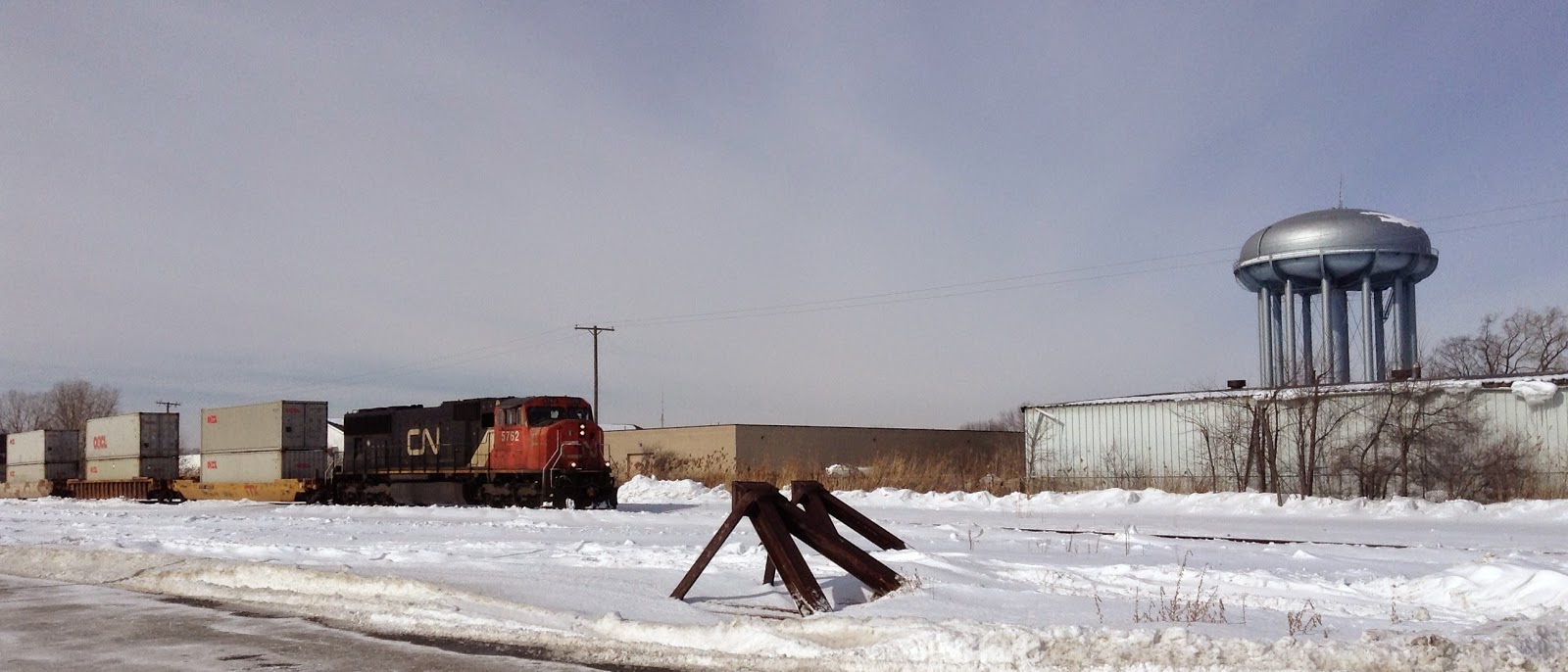
His email to me read, "Ask and ye shall receive." Here are some shots he took of an eastbound CN container train headed for the tunnel and Canada.


The Port Huron side of the tunnel is nowhere near as dramatic as the Canadian side, but my brother did manage to capture a few rail bumpers and the Port Huron water tower in this shot. As a comparison, here's a shot I took last December of the Canadian side. You can see the old tunnel beside the new one, which opened for business in 1994. You can also see a CN police cruiser parked on the old right-of-way, which is now an access road to the old tunnel.


Back to Port Huron. My brother parked in the Amtrak station parking lot and tried to get some shots of the tunnel train going into the tunnel. As you can see (below), the station is not all that far from the tunnel (to the left of the Amtrak sign).


The Amtrak station is used as an endpoint for Amtrak trains to and from Chicago. This train is called the Bluewater. The station sees one arrival from Chicago daily and serves as the departure point for one other train, to Chicago, each day. At one point, Amtrak and Via Rail Canada jointly operated a train, the International Ltd., which connected Chicago and Toronto. That was the last passenger train to use the tunnel. Service was discontinued in 2004, due to declining ridership. Here's a shot of a Chicago-bound International Ltd. at Sarnia station in the early 1990s.


Here's a better shot of the container train descending into the tunnel. Some of the container cars only have one container. This was once a much more common site in Sarnia, since the old tunnel could not accommodate double stacks.


Here's an old shot of a Via F40PH-2 6441 with a single stack container car next to it, circa 1991.


Here's the going away shot of the train, as a few cars wait at the 16th Street level crossing.


Speaking of the Amtrak station, here it is, in all its uninspired glory. You will also notice that the Port Huron side of the tunnel does not have the bustling rail yard like the Sarnia side. Still, I'd imagine this would be a good vista to capture trains. You can see a long way off in the distance from here.


Special thanks to my brother for stopping off and capturing this train. I still have to cross a tunnel train off my to-do list, but I guess this will have to do for now. If you want to see my meet with a tunnel train as it left Sarnia yard, check out this post from January.


Friday, November 7, 2014

Thomas Edison on the rails

Thomas Edison was a railway man. Really. After a chance encounter with an old rail car this summer, I searched out the legend of the famous inventor and his connection to railways. This is what I discovered.

Across the St. Clair River in Port Huron, Michigan, Thomas Edison remains an immense source of civic pride. Although born in Ohio, Edison spent a great deal of his childhood in Port Huron, where his journey toward world fame began on the rails.

Let's back up a bit. The photo you see below is a restored 1800s baggage and passenger car, once belonging to a railroad with quite possibly the longest name in rail history. Care to guess what the C.D. & C.G.T. Jct. R.R. stands for? No googling, please. The initials stand for the Chicago, Detroit & Canada Grand Trunk Junction Rail Road. The line was built in 1858-9 to link Port Huron to Detroit and the rest of the outside world. As the GT suggests, this line was part of the Grand Trunk Western system, although the line was technically independent until 1928 when it officially became a subsidiary of the Grand Trunk. The Grand Trunk continues to operate in Port Huron, including on waterfront trackage that goes past this old rail car and its old rail station (you can the station and the crossing signal in the photo).

August 2014 photo of restored baggage and passenger car at Thomas Edison Depot Museum in Port Huron, Michigan. The museum is located along the St. Clair River waterfront, right next to the Bluewater Bridge (seen behind the station).
 
Back to Edison. The young inventor was a restless young man, even as far back as his pre-teen years. He was twelve years old when he convinced his parents to allow him to ride the train to and from Detroit each day in order to sell newspapers and candy to passengers. He was soon successful enough that he hired other boys to work as newsboys on the same line. One of the results of this venture was that Edison obtained the exclusive rights to sell his own newspaper, the Grand Trunk Herald, along the line.
 
The profits Edison reaped from his railway sales helped fund his early experiments. A few versions of a local legend suggest that Edison's hearing problems stemmed from a failed science experiment on a train. He once suggested a conductor hit him over his ears and threw him off the train after one of his experiments went awry. That story changed over the years.
 
There is even a Canadian connection to Edison's railway adventures. After his time selling papers and candy on the rails, Edison would go on to become a telegraph operator for the Grand Trunk in Stratford, Ontario. The story about this job holds that Edison saved a young boy from being struck by a train. The boy's father, a Grand Trunk employee, was so grateful to Edison that he trained him to be a telegraph operator. 
 
Photo from Port Huron Museum
 
Of course, there is so much more to the Edison story, but for our purposes here, I will stop there. Port Huron continues to pay tribute to the man. The restored 1800s rail car and train station comprise what is known as the Thomas Edison Depot Museum, which is perched beneath the Bluewater Bridge, linking Port Huron to Point Edward and Sarnia Ontario. The rail car has been restored, but many of its original furnishings inside the car have been replaced by what you see above. Look online and you will notice many complaints about this. The city also has a waterfront hotel, The Thomas Edison Inn, not far from the museum.
 
Information on the car was very hard to come by. Most references to it suggest it was an 1800s vintage car, but little else is out there, from what I can see.
 
ANOTHER CLOSE CALL IN BARRHAVEN
 
Via Rail Canada was busy reassuring residents in the Barrhaven neighbourhood that there are no public safety issues after the warning signals at two level crossings at Jockvale Road and Greenbank Road both malfunctioned earlier this week, resulting in the signals going into fail-safe mode. Via Rail said the problem was due to a mechanical malfunction, which has been fixed.
 
 
On Thursday morning, an OC Transpo double decker bus stopped beneath the crossing guards at the Fallowfield Road level crossing, in the midst of the morning rush hour. Although commuters on the bus told local news they were frightened by the fact that the bus was about five metres away from the train, the city transit authority insisted that the bus driver did the proper thing by stopping for a yellow light, even though the bus was sitting in the path of the crossing guards. The incident, of course, will likely raise new questions over the safety of these crossings, especially after the fatal bus-train collision at the Woodroffe Avenue crossing last fall.


Thursday, October 17, 2013

CN's St. Clair Tunnel (Part II)

In 1993, CN began work on a second tunnel beneath the St. Clair River to accommodate double-stack container trains, autoracks and other oversized rail cars that were being shipped via ferry. Unlike the original 1891 St. Clair Tunnel, which was dug from two sides, the second tunnel was to be excavated from the Canadian side of the river toward the Michigan side (see CN's St. Clair Tunnel Part I). The boring machine used, named Excalibore in a  newspaper contest, was installed and began work in the summer of 1993. The original tunnel continued to be used as the boring machine made its way west to Michigan.

Above: The preparations for the new tunnel take shape next to the original tunnel in Summer 1993. Note the small building, called the pumping house, next to the old tunnel.

It was not a smooth process for the boring machine, by any means. Several times during its initial forays under the river, the machine broke down and had to be fixed and cleaned of sentiment that had ground the machine's engine to a halt. At certain points, local media outlets were charting Excalibore's progress versus the men who dug the original tunnel by hand. At one point, the progress achieved by modern machinery was barely ahead of the record set by the men in the 1890s. This was a major embarrassment to the project's contractor and to CN.

Above: Excalibore being assembled in Summer 1993, as seen from a viewing platform set up by CN to accommodate curious locals and rail fans like me.

Despite the initial hiccups, the construction of the new tunnel generated a lot of excitement locally and beyond. Rail fans in London and other points along the CN system snapped photos of special trains that were used to deliver parts of the huge boring machine to the work site in Sarnia. This photo below, courtesy of Eric Gagnon of the Trackside Treasure blog, shows one such special heading through London, bound for the tunnel site in Sarnia. Eric mentioned that the two Via Rail business cars in the consist were likely Coureur des Bois and Sandford Fleming. He also mentioned that he saw a freight in Kingston in 1993 with "white circular 'containers' marked LOVAT." The consist of that June 1993 special through Kingston contained the following (according to Eric's notes):

CN 9665 / EMD(ex-Conrail, blue) 795 / CN, BCR boxcars / CN covered hoppers / CN 670103 / CN 677002 (one of a kind, four trucks, built by CN) / CN 670102.


Eric was also kind enough to pass long this shot below, which shows a more detailed close up of the pieces of the boring machine in gondola cars, again in London. Special thanks to Eric for sharing these images from his collection for this post.


Once the mechanical difficulties were ironed out, Excalibore began to easily chew threw the earth beneath the river and it finished its mission with a sizeable lead over the men who dug the original tunnel. The late surge of boring saved CN and the project's contractors from embarrassment. The new tunnel had the following specs:

Length: 1,898 metres (6,129 feet)

Diametre: 8.4 metres (27 feet, 6 inches)

Compare that to the specs of the original tunnel in my previous post about the tunnel.

More importantly for CN, the new tunnel once again gave the railway an enormous advantage over the Canadian Pacific Railway, which operated a rail tunnel between Windsor and Detroit beneath the Detroit River. When the new St. Clair Tunnel opened in 1994, double stack container trains could move through to Chicago with little delay. Soon after the new tunnel opened, CN's ferry service over the St. Clair River ended.

Meanwhile, the Windsor tunnel, known as the Michigan Central Railway Tunnel, could only handle rolling stock as big as autoracks. Considering the fact that 1994 marked the beginning of the North American Free Trade Agreement, the ability to seamlessly move container trains through an international crossing offered CN a huge early advantage that CP has yet to match. Plans to replace the Windsor tunnel have still not materialized, meaning double stack traffic cannot be routed through Windsor-Detroit, which is otherwise the busiest trade crossing in North America.


It's interesting to note that the new tunnel gave CN the same advantage that the original tunnel gave the Grand Trunk Railway in 1891. When the original tunnel was built, the Grand Trunk essentially gave itself the edge over the Canada Southern Railway, which was still using ferries in Windsor and in Courtright, Ont. (to be mentioned in a future post). The St. Clair Tunnel had officials with the CSR scrambling to match the Grand Trunk, but the Windsor tunnel would not be opened for traffic until 1910.

Above: A view of the old and new St. Clair Tunnel in Sarnia, Ont. on Oct. 13, 2013. Note the absence of the old pumping house.

Today, the new tunnel bears the name Paul Tellier in honour of the former CN president who oversaw its creation. It has seen its share of fanfare over the years, including a GO Train special, which made its way to Sarnia in 1994 and offered locals a free ride under the river to Port Huron, Michigan in the new tunnel. Sadly, passenger trains no longer use the tunnel, as the Canadian leg of Amtrak's route from Chicago through Port Huron to Toronto was eliminated in 2004. I used to ride on this train in my teens, which often included the Superliners. Back then, it was known as the International, and was jointly operated by Amtrak and Via Rail.

This above shot is of the new and old tunnels, taken over the Thanksgiving weekend on a brief trip to Sarnia. The old building that used to stand at the entrance to the old tunnel (see top photos) is now gone and the original tunnel has been sealed off, although the old right-of-way still acts as a service road. The new tunnel continues to be a source of pride for Sarnia and a vital link in Canadian National's network.


Thursday, October 3, 2013

CN's St. Clair Tunnel (Part I)

Sarnia has always been a railway town, thanks to its petrochemical industry and its location along a key rail corridor between Toronto and Chicago. The Great Western and the Grand Trunk railways were the first major railways to establish operations in Sarnia. By the end of the 1800s, the Grand Trunk's main line through the city was an extremely busy link between Toronto and Chicago. However, ferrying cars across the St. Clair River into Michigan was hurting the railway's business, which led to the construction of the St. Clair Tunnel, North America's first underwater rail tunnel. The tunnel was constructed at a cost of $2.7 million and opened in 1891.

Some quick statistics about this tunnel:
  • It is 1838 metres long (6028 feet). 
  • At its lowest point, it is 40 feet below the surface of the river. 
  • It was dug by hand by crews in Sarnia and Port Huron, Michigan, at a rate of 10 feet a day.
  • The width of the river where the tunnel is located is 698 metres (2290 feet). 
  • The tunnel's diameter is 6 meters (19 feet, 10 inches). 
Amazingly, when crews met and completed the digging process, they were off only by a fraction of an inch, which many consider to be an incredible feat of engineering for 1891.

The tunnel, seen in this undated Pesha Studio photo below, reliably served the Grand Trunk and its successor, Canadian National, for decades. Trains were originally pulled through the tunnel by Baldwin-built locomotives, which gave way to electric units and catenary wires in 1907 when concerns arose over engineers and crewmen suffocating in the tunnel amid the exhaust from the Baldwins.


Sarnia was proud of its tunnel, which was once regarded as the longest underwater rail tunnel in the world. The city was sometimes known as "Sarnia Tunnel" as you can see from this postcard below. Notice the two types of horsepower in the 1920s onward. The Baldwin locomotives were replaced by the Westinghouse electrics for the tunnel trips, but they were still used around the Sarnia rail yard.


In the late 1960s and 1970s, railway cars grew, mainly due to the advent of large boxcars (hi-cubes) and tri-level auto racks. These cars were essential pieces of rolling stock in southwestern Ontario, since so many auto parts and vehicles had to be shuttled between automotive production facilities throughout Ontario and Michigan. This presented a problem to CN, since the tunnel could not accommodate these cars. By the 1980s, the old tunnel became more of a liability, with the advent of double-stack container trains. CN ferried many of these oversized cars over the river, creating the same problem the Grand Trunk faced in 1890s. The flow of goods was simply too slow between Toronto and Chicago.

This created scenes like this one below from 1992, with CN workhorse SW1200s shuttling long lines of auto racks onto its Point Edward spur, which led to the CN ferry along Front Street in Sarnia's downtown waterfront area.


This also created the problem of lag time in the Sarnia yard (below photo from 1992), with hi-cubes like this Conrail boxcar (coupled to a Burlington Northern autorack) languishing in the rail yard for long periods. In an era of just-in-time delivery demands, CN knew it had to serve its automotive customers in a more timely manner.


Autorack traffic continued to expand on the CN Strathroy Subdivision, which ends at CN's Sarnia yard, and along CSX's Sarnia Subdivision, which interchanges with CN near the yard. This created a backlog of oversized freightcars at the ferry staging yard in downtown Sarnia. The photo below is from Summer 1993. I'm not sure what the cargo on that flatcar is, but my guess at the time was that it had something to do with what was going on in the photo at the bottom of this post.


In 1993, a boring machine called Excalibore started clearing the way for a new St. Clair Tunnel that would accommodate the oversized rail cars (below photo is from Summer 1993). This would usher in a new era of railroading in Sarnia.