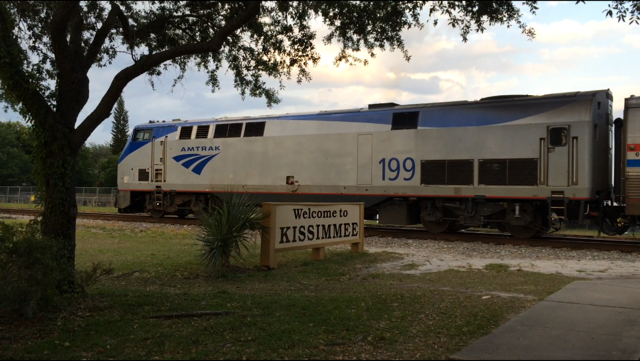
After Christmas, my family made its way to Florida for a family vacation. I made sure to carve out some time to sit trackside and capture some images of railway action outside my customary haunts in Ottawa. On Dec. 29, when my family was relaxing poolside, I made my way to the Lakeland Amtrak station to get some shots of Amtrak's long distance train, the Silver Star. This train connects Miami with New York alongside its sister train, the Silver Meteor. The Star serves Lakeland twice daily, once on its way northbound and once on its way south to Miami.
I arrived a little early because I was curious about the Lakeland Amtrak station, which has an unconventional design, but is still quite pleasing to the eye. It's not a terribly old station, but it has some nice classic touches, like the arched windows. Here's a shot from Lakeland's Main Street. For those interested in Lakeland's geography, it is located roughly halfway between Orlando (to its east) and Tampa (to its west).
I couldn't help but think of some comparisons between Amtrak and Via Rail Canada, while I stood on the platform, waiting for the northbound Star to make its way to the platform. My first observation was how impossibly long the platform was (look carefully at the image below and you will see just how far into the distance those arches recede).
My first thought was how many more long distance trains Amtrak has in its schedule compared to Via Rail. It's not an apples-to-apples comparison by any means, since Amtrak relies much more heavily on regional subsidies for many of its longer distance regional trains, but the fact remains that its long-distance trains that fall under the Amtrak National umbrella outnumber Via's Canadian and Ocean by a wide margin.
Here's a shot of the Star crossing Massachusetts Avenue in Lakeland's downtown. The consist of this train might appear odd to some, but it does make sense. The train was led by two P42s, as all Amtraks seem to be. The P42s are arranged elephant style. I have read in a few places (including Trains Magazine) that this arrangement is used when a train breaks up into two pieces, like the Empire Builder does on its western fringes. In this case, the Star doesn't do this, but I have also read that the engines are often arranged this way, rather than back-to-back, as a redundancy in case one of the units breaks down. The other will then be able to take over without having to wye somewhere.
I was not able to get a great angle, since I was so close to the tracks, but I did manage to get a shot of some of the Amfleet equipment. This design seems to be timeless. I don't know if there was ever a time when Amtrak didn't have some generation of this type of coach in its fleet. I was reading not too long ago that this design was a carryover from the old Penn Central Metroliners, which Amtrak inherited when it took over much of the American passenger railway services in the 1970s. Apparently, despite the initial problems with the rough ride, Amtrak liked the fuselage style design of the cars and stuck with it.
The end of these trains are always lined with newer equipment, with wider windows. You can even see the baggage car, which is at the end of the train. If you look closely, you can faintly see the light from the Amtrak station agent's scooter, which is used to carry bags to the back of the train.
Here's a new baggage car, much newer than the baggage car I saw the last time I caught this train in Kissimmee, Florida a few years back. I am told that Amtrak leaves the baggage car at the back of the train on the northbound Star because it means one less car to turn when the train is readied to head back south to Florida. I'm not sure if that's the reason, but it does make for an interesting consist when this car is on the end. Notice, too, how the traditional Amtrak striping has been applied to this car. I'm often baffled by Amtrak's various paint liveries. There's always some form of red, white and blue but look at the difference between this car and the coaches.
Now look at the blue and grey livery of its P42s. It doesn't make a lot of sense to me, but neither does the various shades of green, turquoise and yellow that Via Rail uses. I was actually hoping to catch one of Amtrak's heritage painted units, but this was all that was on display that day.
One last going-away shot and that was a wrap for this brief trackside meet with a long-distance passenger train. If you click the link above to the post where I met this train in Kissimmee, you'll notice quite a difference in its length.
I tried to catch this train one more time, but there must have been some serious congestion on CSX's Florida lines because the train was ridiculously late the next time I was at the station and I ended up giving up. The A Line, which this train uses for the stretch through Lakeland, is lightly used by most indications, but the lines further south, which include CSX's S line (former Seaboard) has heavier traffic. In any case, this was my only meet with the Star. I did manage to make it out to a railway museum at Plant City and saw some interesting stuff. I will share that soon.
Showing posts with label Amtrak. Show all posts
Friday, January 24, 2020
Friday, August 3, 2018
Where the trains meet: San Luis Obispo
For a community that was never supposed to have a railway, San Luis Obispo has certainly managed to keep itself relevant as a key railway point. The city, located roughly half way between San Francisco and Los Angeles, is a crew change point where Amtrak’s Coast Starlight trains meet. The Coast Starlight and the Pacific Surfliner both serve this city, which is located on the old Southern Pacific Sunset Route (now Union Pacific).
Although freight traffic on the line is sparse in this area, there is a key time each afternoon where you can catch the Coast Starlight Amtrak trains meeting up and the arrival of the Surfliner from San Diego, all in a span of a few hours. Luckily for me, my brother was there on business in the spring and had time to wander around the station area.
While there, he snapped some photos of two Union Pacific diesel tied up next to a bumper, not to mention the two Coast Starlight trains meeting (see above). He also visited the San Luis Obispo Railroad Museum, which features a few pieces of interesting rolling stock, including an old SP bay window caboose and an old heavyweight passenger car (below). The volunteer there told my brother that the city sees only about one freight a week. Sounds familiar to me.
One of the benefits that this station has for railfans is that it has a cool pedestrian bridge where you can get some interesting shots of the trains meeting. My brother took advantage of this viewpoint to get some overhead shots. This shot below was his favourite and it's hard to argue. You can really appreciate the size of some of Amtrak's intercity trains, especially with their bilevel coaches. This shot also gives you a glimpse of the city's old train station (top centre of image above the tracks), which is where the railroad museum now operates.
Here's another overhead shot. You can also see the UP local units pretty clearly in this shot.
I like that many of Amtrak's west coast trains have a unique paint scheme from the rest of the railway's national fleet. You might have noticed that Amtrak's intercity trains in California are branded "Amtrak California." This has to do, of course, with the fact that many of Amtrak's intercity reoutes outside the Northeast Corridor are state-sponsored, which is the case in California, hence the unique livery. Another example is the Amtrak Cascades service in Washington State and Vancouver. In the case of the Surfliner, the cars are clearly branded as such.
My brother also told me that the station is nestled into an active, vibrant part of the city, with shops and cafes nearby. That made me think of how many railway stations at street level that I’ve been to that can make this same claim. Not many.
Thanks to my brother for taking a few moments to capture these dramatic shots from a beautiful spot along the Sunset Route.
Oh, and in case you're wondering about what I said off the top, San Luis Obispo was not supposed to have the old SP Sunset Route built through the city, but local businessmen greased the wheels with the SP's backers and the rest is history. It's a pretty typical story.
Thursday, June 21, 2018
Patriotism on the rails
I’ve just finished nearly two years in a marketing role for a government agency and it’s provided me with some interesting insight on branding. Of course, this experience motivated some thoughts about how railways brand themselves. At work, I was put in charge of marketing a certain project, but soon found myself at odds with the decision makers. The reason was they didn’t want to use the actual name of the project we were asked to promote. Instead, they insisted we use a more general word “Modernization” in all of the documents and ads we produced. It made little sense to me that the actual name of what we were promoting took a back seat to the word “modernization,” which seemed overly long and a little bland as a brand name.
Oh well. On to more interesting topics. Here are a few branding insights I have gained in my time in communications and marketing that I think railways should consider.
1. A country is not your brand. I have seen this trend in the last decade or more, where railways wrap themselves in a flag, as a way of promoting themselves to be patriotic companies in it for the good of their country. While I do not have a problem with a company expressing its pride in country, I think several railways have begun to lose brand power because their own name often plays second fiddle to their country.
Whose railway is it anyway? Well, to the casual observer, you wouldn't know the yellow engine is a UP engine. Thanks to my brother for grabbing this shot in San Luis Obispo, Calif. recently.
The best example I can find is Union Pacific. My brother recently found himself in San Luis Obispo, where two UP engines were tied up at the station. When he shared his photo with me, I was immediately struck by the prominence of the American flag on the side of the power. I don’t have any problem with UP using patriotism as part of its corporate image, since its roots stretch back into the very founding of the modern west of the United States. The critique I have is that the flag is so prominent, it drowns out the actual company’s identity. That’s a shame because UP has a great, patriotic logo that has stood the test of time. The railway also has an outstanding slogan “Building America” which really does sum up what a railway should be doing on a daily basis. On some locomotives, you see a small UP logo near the rear of the long hood with the company slogan, but it’s the flag that is the dominant image. Given my experience in government in the last years, I think UP’s branding needs more balance.
I’ve noticed Amtrak is beginning to use this flag approach on the sides of its new electric locomotives in the Northeast Corridor. The stakes are much higher for Amtrak than they are for Union Pacific and here’s why.
2. Patriotism has a dark side, too. I don’t want to get into the political divisions in the United States. That’s not my point at all. From a marketing point of view, I think Amtrak, and Via Rail Canada, have a very fine line they need to walk. Why? Well, in Amtrak’s case, it is forever fighting an uphill battle to maintain a good reputation and many of the factors that are working against it are out of the railway’s control. We all know about the battles it faces to maintain proper operating and capital budgets in order to provide service that passengers want to use. This is not always easy when you must go cap in hand to the government for funds each year. That is why wrapping yourself in the flag is dangerous. Passengers often associate Amtrak, and Via Rail Canada, as wards of the state, for better or for worse. And most people do not relate the government with quick, efficient service. I don’t know why Amtrak or Via Rail would want to invite those comparisons.
3. Government branding should be avoided at all costs. This is, in my opinion, a branding challenge Via Rail needs to address. At one point, Via Rail consists did not have any maple leaf flags or Government of Canada wordmark on any of their locomotives or rolling stock. I’m not sure when the flags first began to appear, or the Canada wordmark, but I’ve always found these additions to be visual distractions to what was once a very clean, modern and effective look.
When Via Rail began wrapping its cars for Canada 150 and for the railway’s 4oth anniversary, the Canada wordmark and the by now faded Canada flags were removed. I thought this was a good move. Again, I want to stress that I don’t have a problem with a company expressing its patriotism, but I do think there needs to be a balance. In the case of Via, I found the fluttering Canada flags to be a tad too large and also at odds with the more two-dimensional Via Rail logo. I also found the Canada wordmark to be far too large. The brand is Via Rail, not the Government of Canada. The company’s logo should always be the biggest, most prominent feature. This is why I think Via Rail can learn from its years of wrapping cars. While you might not like this scheme, it at least makes one thing clear: the brand is Via Rail.
Just like I don’t think Amtrak wants to associate itself with the U.S. federal government, I don’t think Via Rail has done itself any favours by associating itself so closely with the Canadian government, especially given the ever-changing political whims of those in power. I don’t know how much of the Canada wordmark placement and size was mandated, but if there was no directive, I think at the very least the wordmark should be minimized and placed elsewhere in the future. Same with the flag. If the flag is bigger than the Via logo, then there’s a branding problem.
Does anyone remember when Via replaced its logo at the bottom of the F40PH-2 hoods and replaced with the wordmark? The railway was then forced to jam their company’s logo above the headlights on the hood. That was a marketing disaster.
[PHOTO]
One railway operation that has it right is Metrolinx. The GO Train operator does have an Ontario flag on the hoods of its locomotives, but it’s subtle. If you were to plaster a large Ontario flag on the side of the green and white commuter trains, it would create an inconsistent look at the very least. At worst, it could create an unnecessarily visceral reaction. After all, I’m not sure that many in the province are terribly enamored with the provincial government, no matter who is in charge.
I guess my message is simplicity is always the best solution. I’ve read a lot on marketing recently and that message seems to be the central theme to any successful branding exercise or marketing campaign. Railways need to be railways first and foremost. Being patriotic is a good way to create goodwill, but it can’t replace your central message. And that message should always be: We are a darn good railway.
Thursday, May 26, 2016
Have iPhone, will travel
My brother often has to travel around the United States for business. Since his son has shown an interest in trains, Marc has made sure to take shots of trains when he comes across them. We here at the Beachburg Sub are the beneficiaries, as my brother always passes along the shots to me. Recently, he was in Tuscon, Arizona on his way from Davis-Monthan Air Force Base when he stopped for gas. Luckily, he came across a Union Pacific autorack train headed north from the auto plants in Mexico. You can see one of the units is a newer unit with the American flag sheme while the other is an older unit with the old paint scheme. I prefer the older scheme. I think the flag confuses the railway's identity, just like the Canada wordmark and old flag logos did on older Via LRC coaches. I always prefer a cleaner look.
Also recently, my brother was in Kissimmee, Florida, for business when he had a meeting close to the old Kissimmee Amtrak station. You will recall that I caught the northbound Amtrak silver service train en route to New York in this post. My brother also caught the same northbound train, although the consist was significantly different than the one I saw. As you will see from the video he shot (below the image of the P42), the consist featured quite a few newly repainted Amfleet coaches and bilevels.
Here's the video from my brother's iPhone. I like the baggage car scheme. Old school! One thing you will find with Amtrak is that the railway still rosters a fairly wide variety of rolling stock with different paint schemes, when you compare it to Via Rail.
Also recently, my brother found himself watching some trains with his son at the Sarnia Via Rail station. He passed this one along to me. I have to give him credit. He has a sharp eye for interesting rolling stock.
In this case, he caught a former Southern Pacific/CottonBelt/Denver and Rio Grande Golden West Service branded boxcar. The cars were in need of repair at a point in the 1990s, when SP and its subsidiaries were in financial trouble. A deal was struck for Greenbrier to buy the cars and have them repaired. The fleet would then be leased back to SP. Since Greenbrier had to use railway reporting marks, the company secured a number of other railway marks, which meant most of these cars lost their original SP reporting marks over time.
On a trip to Seattle, my brother came across a number of streetcars, some of which sported some interesting advertising wraps. This one, sponsored by Amazon, was my nephew's favourite. He told my brother that this was the smiling train. I like to see the seamless integration of street cars with regular traffic in big cities. Also, the design of this car makes its wheels invisible. It's almost as if the streetcar is floating.
Speaking of street cars, here's a shot I snagged of some new and old streetcars on Spadina Avenue in Toronto in March.
Final shot is a Sound Transit light rail train that my brother hopped aboard to get out to the SEATAC airport. My brother told me he was impressed with the service, which only cost $2.50 to get from the city centre out to the airport. The light rail line enters the downtown through a 1.5 mile tunnel, which has several stops underground. My brother also mentioned that the suburban buses fed into the tunnel as well. You can see from this shot that you can take your bike onto the train.
Marc mentioned that the Sound Transit line parallels freight railway lines, which is great for a rail fan. Sadly, the train was a little too packed for my brother to take shots.
Thanks for my brother for keeping his eyes peeled wherever he goes and sharing some great shots.
Also recently, my brother was in Kissimmee, Florida, for business when he had a meeting close to the old Kissimmee Amtrak station. You will recall that I caught the northbound Amtrak silver service train en route to New York in this post. My brother also caught the same northbound train, although the consist was significantly different than the one I saw. As you will see from the video he shot (below the image of the P42), the consist featured quite a few newly repainted Amfleet coaches and bilevels.
Here's the video from my brother's iPhone. I like the baggage car scheme. Old school! One thing you will find with Amtrak is that the railway still rosters a fairly wide variety of rolling stock with different paint schemes, when you compare it to Via Rail.
Also recently, my brother found himself watching some trains with his son at the Sarnia Via Rail station. He passed this one along to me. I have to give him credit. He has a sharp eye for interesting rolling stock.
In this case, he caught a former Southern Pacific/CottonBelt/Denver and Rio Grande Golden West Service branded boxcar. The cars were in need of repair at a point in the 1990s, when SP and its subsidiaries were in financial trouble. A deal was struck for Greenbrier to buy the cars and have them repaired. The fleet would then be leased back to SP. Since Greenbrier had to use railway reporting marks, the company secured a number of other railway marks, which meant most of these cars lost their original SP reporting marks over time.
On a trip to Seattle, my brother came across a number of streetcars, some of which sported some interesting advertising wraps. This one, sponsored by Amazon, was my nephew's favourite. He told my brother that this was the smiling train. I like to see the seamless integration of street cars with regular traffic in big cities. Also, the design of this car makes its wheels invisible. It's almost as if the streetcar is floating.
Speaking of street cars, here's a shot I snagged of some new and old streetcars on Spadina Avenue in Toronto in March.
Final shot is a Sound Transit light rail train that my brother hopped aboard to get out to the SEATAC airport. My brother told me he was impressed with the service, which only cost $2.50 to get from the city centre out to the airport. The light rail line enters the downtown through a 1.5 mile tunnel, which has several stops underground. My brother also mentioned that the suburban buses fed into the tunnel as well. You can see from this shot that you can take your bike onto the train.
Marc mentioned that the Sound Transit line parallels freight railway lines, which is great for a rail fan. Sadly, the train was a little too packed for my brother to take shots.
Thanks for my brother for keeping his eyes peeled wherever he goes and sharing some great shots.
Friday, November 6, 2015
Via Rail about to expand service in Southern Ontario
I was down in the Sarnia area for a visit over Thanksgiving and had some time to sit trackside at the Sarnia Via Rail station. I knew that the station was going to be torn up since Via Rail recently announced its intention to rehabilitate the old station, which was built in 1891. The station sees only two trains a day and is unstaffed. However, these renovations are part of a plan to expand service.
As you can read in the link above, Via Rail has already told local officials that it plans to expand its Toronto-Sarnia service to four trains a day, which means two trains in and two trains out. Not only is this good news for Sarnia, this is also good news for trains along the line who will also benefit from increased service.
The renovations will mainly take the form of structural repairs and roofing repairs. Already, the foundations around the building have been dug up and the masonry has been treated. The repairs are expected to be complete by the spring, in time for the new train schedule, the starting date of which has not been confirmed yet.
Here's a shot, below, that I took in 1992, which essentially reveals a very similar look, except that the roof was shingled by darker shingles then. The station last saw major renovations in the 1980s when the City of Sarnia undertook improvements to the building, which is a designated heritage property.
I know I've shared this photo (below) before but I always like to share this because of the three types of equipment in the shot, which shows Amtrak at its varied best. The shot below is the International Ltd. that once ran between Toronto and Chicago and was jointly operated between Amtrak and Via Rail. That train was cancelled in the mid-1990s due to ridership decline. I'm surprised there isn't more of a demand for such a train. However, even if there was demand, I would imagine that security protocol at the border would likely rule out any future train like this. So, Sarnia and much of Southern Ontario will benefit from a link to Toronto, but that appears to be the extent of the new service that Via Rail is bringing to the region.
As you can read in the link above, Via Rail has already told local officials that it plans to expand its Toronto-Sarnia service to four trains a day, which means two trains in and two trains out. Not only is this good news for Sarnia, this is also good news for trains along the line who will also benefit from increased service.
The renovations will mainly take the form of structural repairs and roofing repairs. Already, the foundations around the building have been dug up and the masonry has been treated. The repairs are expected to be complete by the spring, in time for the new train schedule, the starting date of which has not been confirmed yet.
Here's a shot, below, that I took in 1992, which essentially reveals a very similar look, except that the roof was shingled by darker shingles then. The station last saw major renovations in the 1980s when the City of Sarnia undertook improvements to the building, which is a designated heritage property.
I know I've shared this photo (below) before but I always like to share this because of the three types of equipment in the shot, which shows Amtrak at its varied best. The shot below is the International Ltd. that once ran between Toronto and Chicago and was jointly operated between Amtrak and Via Rail. That train was cancelled in the mid-1990s due to ridership decline. I'm surprised there isn't more of a demand for such a train. However, even if there was demand, I would imagine that security protocol at the border would likely rule out any future train like this. So, Sarnia and much of Southern Ontario will benefit from a link to Toronto, but that appears to be the extent of the new service that Via Rail is bringing to the region.
Here's a more recent shot of the station taken in 2013. The track you see at the bottom of the image is where Via Rail's consists would be stored overnight when the last train of the day arrived from Toronto. Imagine a time when there were so few security concerns. I would draw your attention to the two doors at the end of the station.
In this photo below, taken in 1952, you can see that there once was an extension on this side of the station. You can also notice on the right side of the image where passenger cars were stored next to the station (the same track as the one in the image above).
So, more service to the Sarnia station will mean this beautiful old building will become more of a hub in the years to come, much as it has been throughout its history. It's always encouraging when Via Rail adds service. Let's hope this move will be accompanied by service additions elsewhere in Canada, especially if our new government is supportive of passenger rail.
Thursday, May 21, 2015
The other side: Port Huron, Michigan
Port Huron, Michigan is a transportation hub at the southern tip of Lake Huron, across the St. Clair River from Sarnia, Ontario. Like Sarnia, Port Huron is a great place to watch Great Lakes freighters ply the waters of Lake Huron. For our purposes here, it's also located at a critical point in the Canadian National Railways system. The Paul M. Tellier tunnel beneath the St. Clair River allows CN to quickly transport a number of goods between Toronto and Chicago with minimal delay.
This wasn't always the case. Read about this rail hub's history in my first post about the tunnel. You can also read about the more recent history in the Part II.
Without getting into the history here, I will simply say that the tunnel is a favourite spot for railfanning in Port Huron and Sarnia, although I have to say that I have yet to photograph a train actually going into the tunnel or heading out of the tunnel in my visits to the area. I was talking about this with my brother a while back. Then, a few days later, he was on his way back from the Detroit Airport when he made a small detour to see if there was anything to shoot on the Port Huron side of the tunnel.
His email to me read, "Ask and ye shall receive." Here are some shots he took of an eastbound CN container train headed for the tunnel and Canada.
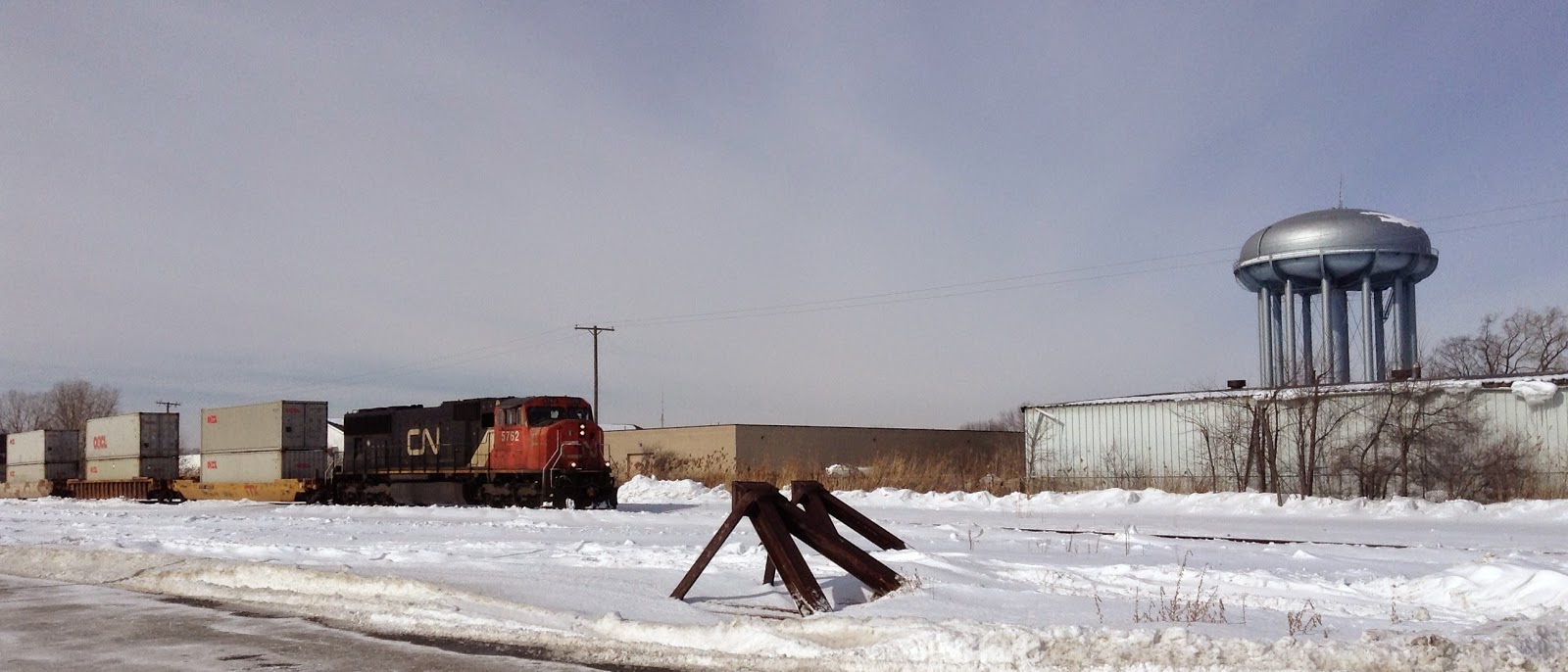
The Port Huron side of the tunnel is nowhere near as dramatic as the Canadian side, but my brother did manage to capture a few rail bumpers and the Port Huron water tower in this shot. As a comparison, here's a shot I took last December of the Canadian side. You can see the old tunnel beside the new one, which opened for business in 1994. You can also see a CN police cruiser parked on the old right-of-way, which is now an access road to the old tunnel.
Back to Port Huron. My brother parked in the Amtrak station parking lot and tried to get some shots of the tunnel train going into the tunnel. As you can see (below), the station is not all that far from the tunnel (to the left of the Amtrak sign).
The Amtrak station is used as an endpoint for Amtrak trains to and from Chicago. This train is called the Bluewater. The station sees one arrival from Chicago daily and serves as the departure point for one other train, to Chicago, each day. At one point, Amtrak and Via Rail Canada jointly operated a train, the International Ltd., which connected Chicago and Toronto. That was the last passenger train to use the tunnel. Service was discontinued in 2004, due to declining ridership. Here's a shot of a Chicago-bound International Ltd. at Sarnia station in the early 1990s.
Here's a better shot of the container train descending into the tunnel. Some of the container cars only have one container. This was once a much more common site in Sarnia, since the old tunnel could not accommodate double stacks.
Here's an old shot of a Via F40PH-2 6441 with a single stack container car next to it, circa 1991.
Here's the going away shot of the train, as a few cars wait at the 16th Street level crossing.
Speaking of the Amtrak station, here it is, in all its uninspired glory. You will also notice that the Port Huron side of the tunnel does not have the bustling rail yard like the Sarnia side. Still, I'd imagine this would be a good vista to capture trains. You can see a long way off in the distance from here.
This wasn't always the case. Read about this rail hub's history in my first post about the tunnel. You can also read about the more recent history in the Part II.
Without getting into the history here, I will simply say that the tunnel is a favourite spot for railfanning in Port Huron and Sarnia, although I have to say that I have yet to photograph a train actually going into the tunnel or heading out of the tunnel in my visits to the area. I was talking about this with my brother a while back. Then, a few days later, he was on his way back from the Detroit Airport when he made a small detour to see if there was anything to shoot on the Port Huron side of the tunnel.
His email to me read, "Ask and ye shall receive." Here are some shots he took of an eastbound CN container train headed for the tunnel and Canada.
The Port Huron side of the tunnel is nowhere near as dramatic as the Canadian side, but my brother did manage to capture a few rail bumpers and the Port Huron water tower in this shot. As a comparison, here's a shot I took last December of the Canadian side. You can see the old tunnel beside the new one, which opened for business in 1994. You can also see a CN police cruiser parked on the old right-of-way, which is now an access road to the old tunnel.
Back to Port Huron. My brother parked in the Amtrak station parking lot and tried to get some shots of the tunnel train going into the tunnel. As you can see (below), the station is not all that far from the tunnel (to the left of the Amtrak sign).
The Amtrak station is used as an endpoint for Amtrak trains to and from Chicago. This train is called the Bluewater. The station sees one arrival from Chicago daily and serves as the departure point for one other train, to Chicago, each day. At one point, Amtrak and Via Rail Canada jointly operated a train, the International Ltd., which connected Chicago and Toronto. That was the last passenger train to use the tunnel. Service was discontinued in 2004, due to declining ridership. Here's a shot of a Chicago-bound International Ltd. at Sarnia station in the early 1990s.
Here's a better shot of the container train descending into the tunnel. Some of the container cars only have one container. This was once a much more common site in Sarnia, since the old tunnel could not accommodate double stacks.
Here's an old shot of a Via F40PH-2 6441 with a single stack container car next to it, circa 1991.
Here's the going away shot of the train, as a few cars wait at the 16th Street level crossing.
Speaking of the Amtrak station, here it is, in all its uninspired glory. You will also notice that the Port Huron side of the tunnel does not have the bustling rail yard like the Sarnia side. Still, I'd imagine this would be a good vista to capture trains. You can see a long way off in the distance from here.
Special thanks to my brother for stopping off and capturing this train. I still have to cross a tunnel train off my to-do list, but I guess this will have to do for now. If you want to see my meet with a tunnel train as it left Sarnia yard, check out this post from January.
Thursday, April 2, 2015
Don't stop believing
This past winter has really been a test of endurance, hasn't it? When you live in a northern city like Ottawa, long, cold winters are the norm. This one has been brutal, even by our hardy standards. We broke our record for consecutive days with weather below freezing (O C or 32 F), although most of those days were at least -10 to -15 C. Today, as I write this, we are experiencing freezing rain after some overnight snow. I decided drastic action was needed, so I gathered up some warm weather photos I have not shared before (along with one I have shared).
This first shot was actually taken Sept 28 of last year, which doesn't quite make it a summer shot (check out the changing colour of the leaves trackside). But I decided to include this shot of CN 589 because of the heat lines in the photo. The one-car consist is passing beneath Highway 416 in this shot on the Via Rail Smiths Falls Sub. You can see the Via speed limit to the right.
I've shared some similar photos of this meet in the past, but I don't think I've shared this one. This is CN 589 assembling in Walkley Yard on Sept. 1, 2013. I took this shot on a very sunny Sunday morning. I like the effect the morning sun made on the boxcars as well as CN 589. The cars all seem to exemplify the term sun-bleached. Ah, I can just feel that heat now.
This is one of my favourite shots. I took this one sometime in the summer of 1991 in Corunna, Ontario, in what was then a relatively new subdivision across the city's main street from my own neighbourhood. This is my only shot of a Chessie System cupola caboose in action. I remember hearing the train whistle in the distance and rushing on my bike down Murray Drive to a spot where I could grab a shot of the train. I had other shots of the meet at one time that have gone missing sadly. Still, I like this shot because it showcases two things that don't exist on this line anymore, one being cabooses in revenue service and the other being interchange autorack traffic. Looks like we needed some rain.
This one is from February 2014 in Kissimmee, Florida. I made sure to take an afternoon and shoot Amtrak's Silver Meteor, as it made its way north through Kissimmee on its way to New York City. The train is rounding a bend before making its way to the city's historic train station. The track bundles along the old Atlantic Coast Line's famous A Line were part of the work being done to ready to the old line for commuter rail. Oh, and word of advice to Via. Bring back train names.
Okay, how about this for summer? Here's Lake Louise's famous chalet-style train station in the summer of 1992. Check out that vintage car in the parking lot bottom right. I took this shot when my sister and I were wandering around this area on a vacation that summer. This shot was taken from the higher track, as you can tell from the ballast in the bottom left.
So, don't stop believing, as Steve Parry once famously crooned for Journey. The warm weather is coming. It has to, right? Right?
This first shot was actually taken Sept 28 of last year, which doesn't quite make it a summer shot (check out the changing colour of the leaves trackside). But I decided to include this shot of CN 589 because of the heat lines in the photo. The one-car consist is passing beneath Highway 416 in this shot on the Via Rail Smiths Falls Sub. You can see the Via speed limit to the right.
I've shared some similar photos of this meet in the past, but I don't think I've shared this one. This is CN 589 assembling in Walkley Yard on Sept. 1, 2013. I took this shot on a very sunny Sunday morning. I like the effect the morning sun made on the boxcars as well as CN 589. The cars all seem to exemplify the term sun-bleached. Ah, I can just feel that heat now.
This is one of my favourite shots. I took this one sometime in the summer of 1991 in Corunna, Ontario, in what was then a relatively new subdivision across the city's main street from my own neighbourhood. This is my only shot of a Chessie System cupola caboose in action. I remember hearing the train whistle in the distance and rushing on my bike down Murray Drive to a spot where I could grab a shot of the train. I had other shots of the meet at one time that have gone missing sadly. Still, I like this shot because it showcases two things that don't exist on this line anymore, one being cabooses in revenue service and the other being interchange autorack traffic. Looks like we needed some rain.
This one is from February 2014 in Kissimmee, Florida. I made sure to take an afternoon and shoot Amtrak's Silver Meteor, as it made its way north through Kissimmee on its way to New York City. The train is rounding a bend before making its way to the city's historic train station. The track bundles along the old Atlantic Coast Line's famous A Line were part of the work being done to ready to the old line for commuter rail. Oh, and word of advice to Via. Bring back train names.
So, don't stop believing, as Steve Parry once famously crooned for Journey. The warm weather is coming. It has to, right? Right?
Wednesday, March 26, 2014
Lessons learned in Kissimmee
A little breath of fresh air in Kissimmee, Florida really did me good. I made sure to take time away from the typical family outings to break away for a few moments of photographs at the Kissimmee Amtrak Station.
I had targeted this as my spot for photos before my family even went to Florida for a few reasons. The first was the station was photogenic, having been built in 1910. Second was that the trackage through the city is somewhat famous and is still known as the A Line, which was formerly a very busy and important route for the Atlantic Coast Line, Seaboard Coast Line and Seaboard System railways. It is currently under CSX control, although the line sees light traffic. But, true to its name, it is poised to be an important line once again.
In the above photo, you will notice batches of new rail ties ready for placement on the A Line, as Amtrak Train 98, the northbound Silver Meteor approaches the Monument Street crossing (Check out the old Amfeet coaches!). The reason for the upgrade is that this section of the subdivision is slated to house the state's Sunrail commuter operations, which will link the city of DeLand, via Orlando, with the Poinciana region in Osceola County. Kissimmee will be the second last westbound stop on this route, or the first eastbound stop, depending on the train. This commuter link will serve an incredibly congested part of the state where the roads are at capacity, to say the least.
When I arrived at the station last Thursday, I made sure to keep my distance, since I was warned that security is tight at this station. I loved the look of the old building, which still sports old signal equipment on its roof (right of photo) and a steam engine weather vane. The inside of the station had beautiful, creaky old floors and a number of other period flourishes. I decided not to take photos, just to be safe.
While waiting for the predictably late Train 98, I decided to take some shots at a number of pieces of maintenance-of-way and track-laying equipment that were parked on a spur next to the main line. Clearly, this track is just about ready for its makeover.
Shortly after hearing an announcement warning passengers that the Silver Meteor would be "15 or 20 minutes late," P42DC 75 roared into the station about 25 minutes late, much to the relief of the passengers who were baking in the mid-afternoon sun. I brought some heat rashes back to the Great White North as a souvenir.
The train didn't stay long and geared up pretty fast as it crossed East Drury Avenue, which was where I was perched at this point. I haven't seen an Amtrak train since my teenage years in Sarnia, so the site of these old Amfleet coaches was a treat. In fact, it was nice to see a passenger train with a few different coaches in its consist. I was pleased with the shot below, as it captures the acceleration of the locomotive, which is spewing out smoke as it picks up speed.
This (below) was the true gem of the lot, an old heavyweight baggage car at the end of Train 98, coupled behind a few Viewliner sleepers. It's been a while since I've seen Amtrak rolling stock, so correct me if I'm wrong about the Viewliners.
I came away from this encounter with a few thoughts.
1. Commuter rail in the U.S. is faring somewhat better than it is in Canada. The co-operation between municipalities, states and the federal government is getting a number of commuter lines going, which should serve as a reminder to us here in Canada that intercity rail travel isn't just important in the busiest eastern corridors.
2. Amtrak has a much more extensive roster of long-haul trains, which is a product of a system in the U.S. where states subsidize trains that they feel serve an important purpose. This train, for example, was bound for New York City. It runs daily in both directions between the Big Apple and Miami. I wonder how different Via Rail would be if provinces were allowed more leeway in deciding where passenger services would be useful. I would think Western Canada might be better served, at the very least.
3. Despite these positive points, Amtrak is still at the mercy of government whims, not to mention the timetables of its railway hosts like CSX. You can't help but wonder how passenger rail manages to survive in North America in spite of these two massive obstacles.
4. I really miss the old Amtrak logo and red, white and blue scheme. The latest one is boring.
I had targeted this as my spot for photos before my family even went to Florida for a few reasons. The first was the station was photogenic, having been built in 1910. Second was that the trackage through the city is somewhat famous and is still known as the A Line, which was formerly a very busy and important route for the Atlantic Coast Line, Seaboard Coast Line and Seaboard System railways. It is currently under CSX control, although the line sees light traffic. But, true to its name, it is poised to be an important line once again.
In the above photo, you will notice batches of new rail ties ready for placement on the A Line, as Amtrak Train 98, the northbound Silver Meteor approaches the Monument Street crossing (Check out the old Amfeet coaches!). The reason for the upgrade is that this section of the subdivision is slated to house the state's Sunrail commuter operations, which will link the city of DeLand, via Orlando, with the Poinciana region in Osceola County. Kissimmee will be the second last westbound stop on this route, or the first eastbound stop, depending on the train. This commuter link will serve an incredibly congested part of the state where the roads are at capacity, to say the least.
When I arrived at the station last Thursday, I made sure to keep my distance, since I was warned that security is tight at this station. I loved the look of the old building, which still sports old signal equipment on its roof (right of photo) and a steam engine weather vane. The inside of the station had beautiful, creaky old floors and a number of other period flourishes. I decided not to take photos, just to be safe.
While waiting for the predictably late Train 98, I decided to take some shots at a number of pieces of maintenance-of-way and track-laying equipment that were parked on a spur next to the main line. Clearly, this track is just about ready for its makeover.
Shortly after hearing an announcement warning passengers that the Silver Meteor would be "15 or 20 minutes late," P42DC 75 roared into the station about 25 minutes late, much to the relief of the passengers who were baking in the mid-afternoon sun. I brought some heat rashes back to the Great White North as a souvenir.
The train didn't stay long and geared up pretty fast as it crossed East Drury Avenue, which was where I was perched at this point. I haven't seen an Amtrak train since my teenage years in Sarnia, so the site of these old Amfleet coaches was a treat. In fact, it was nice to see a passenger train with a few different coaches in its consist. I was pleased with the shot below, as it captures the acceleration of the locomotive, which is spewing out smoke as it picks up speed.
This (below) was the true gem of the lot, an old heavyweight baggage car at the end of Train 98, coupled behind a few Viewliner sleepers. It's been a while since I've seen Amtrak rolling stock, so correct me if I'm wrong about the Viewliners.
I came away from this encounter with a few thoughts.
1. Commuter rail in the U.S. is faring somewhat better than it is in Canada. The co-operation between municipalities, states and the federal government is getting a number of commuter lines going, which should serve as a reminder to us here in Canada that intercity rail travel isn't just important in the busiest eastern corridors.
2. Amtrak has a much more extensive roster of long-haul trains, which is a product of a system in the U.S. where states subsidize trains that they feel serve an important purpose. This train, for example, was bound for New York City. It runs daily in both directions between the Big Apple and Miami. I wonder how different Via Rail would be if provinces were allowed more leeway in deciding where passenger services would be useful. I would think Western Canada might be better served, at the very least.
3. Despite these positive points, Amtrak is still at the mercy of government whims, not to mention the timetables of its railway hosts like CSX. You can't help but wonder how passenger rail manages to survive in North America in spite of these two massive obstacles.
4. I really miss the old Amtrak logo and red, white and blue scheme. The latest one is boring.
Thursday, October 17, 2013
CN's St. Clair Tunnel (Part II)
In 1993, CN began work on a second tunnel beneath the St. Clair River to accommodate double-stack container trains, autoracks and other oversized rail cars that were being shipped via ferry. Unlike the original 1891 St. Clair Tunnel, which was dug from two sides, the second tunnel was to be excavated from the Canadian side of the river toward the Michigan side (see CN's St. Clair Tunnel Part I). The boring machine used, named Excalibore in a newspaper contest, was installed and began work in the summer of 1993. The original tunnel continued to be used as the boring machine made its way west to Michigan.
Above: The preparations for the new tunnel take shape next to the original tunnel in Summer 1993. Note the small building, called the pumping house, next to the old tunnel.
It was not a smooth process for the boring machine, by any means. Several times during its initial forays under the river, the machine broke down and had to be fixed and cleaned of sentiment that had ground the machine's engine to a halt. At certain points, local media outlets were charting Excalibore's progress versus the men who dug the original tunnel by hand. At one point, the progress achieved by modern machinery was barely ahead of the record set by the men in the 1890s. This was a major embarrassment to the project's contractor and to CN.
Above: Excalibore being assembled in Summer 1993, as seen from a viewing platform set up by CN to accommodate curious locals and rail fans like me.
Despite the initial hiccups, the construction of the new tunnel generated a lot of excitement locally and beyond. Rail fans in London and other points along the CN system snapped photos of special trains that were used to deliver parts of the huge boring machine to the work site in Sarnia. This photo below, courtesy of Eric Gagnon of the Trackside Treasure blog, shows one such special heading through London, bound for the tunnel site in Sarnia. Eric mentioned that the two Via Rail business cars in the consist were likely Coureur des Bois and Sandford Fleming. He also mentioned that he saw a freight in Kingston in 1993 with "white circular 'containers' marked LOVAT." The consist of that June 1993 special through Kingston contained the following (according to Eric's notes):
Eric was also kind enough to pass long this shot below, which shows a more detailed close up of the pieces of the boring machine in gondola cars, again in London. Special thanks to Eric for sharing these images from his collection for this post.
Once the mechanical difficulties were ironed out, Excalibore began to easily chew threw the earth beneath the river and it finished its mission with a sizeable lead over the men who dug the original tunnel. The late surge of boring saved CN and the project's contractors from embarrassment. The new tunnel had the following specs:
Length: 1,898 metres (6,129 feet)
Diametre: 8.4 metres (27 feet, 6 inches)
Compare that to the specs of the original tunnel in my previous post about the tunnel.
More importantly for CN, the new tunnel once again gave the railway an enormous advantage over the Canadian Pacific Railway, which operated a rail tunnel between Windsor and Detroit beneath the Detroit River. When the new St. Clair Tunnel opened in 1994, double stack container trains could move through to Chicago with little delay. Soon after the new tunnel opened, CN's ferry service over the St. Clair River ended.
Meanwhile, the Windsor tunnel, known as the Michigan Central Railway Tunnel, could only handle rolling stock as big as autoracks. Considering the fact that 1994 marked the beginning of the North American Free Trade Agreement, the ability to seamlessly move container trains through an international crossing offered CN a huge early advantage that CP has yet to match. Plans to replace the Windsor tunnel have still not materialized, meaning double stack traffic cannot be routed through Windsor-Detroit, which is otherwise the busiest trade crossing in North America.
It's interesting to note that the new tunnel gave CN the same advantage that the original tunnel gave the Grand Trunk Railway in 1891. When the original tunnel was built, the Grand Trunk essentially gave itself the edge over the Canada Southern Railway, which was still using ferries in Windsor and in Courtright, Ont. (to be mentioned in a future post). The St. Clair Tunnel had officials with the CSR scrambling to match the Grand Trunk, but the Windsor tunnel would not be opened for traffic until 1910.
Above: A view of the old and new St. Clair Tunnel in Sarnia, Ont. on Oct. 13, 2013. Note the absence of the old pumping house.
Today, the new tunnel bears the name Paul Tellier in honour of the former CN president who oversaw its creation. It has seen its share of fanfare over the years, including a GO Train special, which made its way to Sarnia in 1994 and offered locals a free ride under the river to Port Huron, Michigan in the new tunnel. Sadly, passenger trains no longer use the tunnel, as the Canadian leg of Amtrak's route from Chicago through Port Huron to Toronto was eliminated in 2004. I used to ride on this train in my teens, which often included the Superliners. Back then, it was known as the International, and was jointly operated by Amtrak and Via Rail.
This above shot is of the new and old tunnels, taken over the Thanksgiving weekend on a brief trip to Sarnia. The old building that used to stand at the entrance to the old tunnel (see top photos) is now gone and the original tunnel has been sealed off, although the old right-of-way still acts as a service road. The new tunnel continues to be a source of pride for Sarnia and a vital link in Canadian National's network.
Above: The preparations for the new tunnel take shape next to the original tunnel in Summer 1993. Note the small building, called the pumping house, next to the old tunnel.
It was not a smooth process for the boring machine, by any means. Several times during its initial forays under the river, the machine broke down and had to be fixed and cleaned of sentiment that had ground the machine's engine to a halt. At certain points, local media outlets were charting Excalibore's progress versus the men who dug the original tunnel by hand. At one point, the progress achieved by modern machinery was barely ahead of the record set by the men in the 1890s. This was a major embarrassment to the project's contractor and to CN.
Above: Excalibore being assembled in Summer 1993, as seen from a viewing platform set up by CN to accommodate curious locals and rail fans like me.
Despite the initial hiccups, the construction of the new tunnel generated a lot of excitement locally and beyond. Rail fans in London and other points along the CN system snapped photos of special trains that were used to deliver parts of the huge boring machine to the work site in Sarnia. This photo below, courtesy of Eric Gagnon of the Trackside Treasure blog, shows one such special heading through London, bound for the tunnel site in Sarnia. Eric mentioned that the two Via Rail business cars in the consist were likely Coureur des Bois and Sandford Fleming. He also mentioned that he saw a freight in Kingston in 1993 with "white circular 'containers' marked LOVAT." The consist of that June 1993 special through Kingston contained the following (according to Eric's notes):
CN 9665 / EMD(ex-Conrail, blue) 795 / CN, BCR boxcars / CN covered hoppers / CN 670103 / CN 677002 (one of a kind, four trucks, built by
CN) / CN 670102.
Eric was also kind enough to pass long this shot below, which shows a more detailed close up of the pieces of the boring machine in gondola cars, again in London. Special thanks to Eric for sharing these images from his collection for this post.
Once the mechanical difficulties were ironed out, Excalibore began to easily chew threw the earth beneath the river and it finished its mission with a sizeable lead over the men who dug the original tunnel. The late surge of boring saved CN and the project's contractors from embarrassment. The new tunnel had the following specs:
Length: 1,898 metres (6,129 feet)
Diametre: 8.4 metres (27 feet, 6 inches)
Compare that to the specs of the original tunnel in my previous post about the tunnel.
More importantly for CN, the new tunnel once again gave the railway an enormous advantage over the Canadian Pacific Railway, which operated a rail tunnel between Windsor and Detroit beneath the Detroit River. When the new St. Clair Tunnel opened in 1994, double stack container trains could move through to Chicago with little delay. Soon after the new tunnel opened, CN's ferry service over the St. Clair River ended.
Meanwhile, the Windsor tunnel, known as the Michigan Central Railway Tunnel, could only handle rolling stock as big as autoracks. Considering the fact that 1994 marked the beginning of the North American Free Trade Agreement, the ability to seamlessly move container trains through an international crossing offered CN a huge early advantage that CP has yet to match. Plans to replace the Windsor tunnel have still not materialized, meaning double stack traffic cannot be routed through Windsor-Detroit, which is otherwise the busiest trade crossing in North America.
It's interesting to note that the new tunnel gave CN the same advantage that the original tunnel gave the Grand Trunk Railway in 1891. When the original tunnel was built, the Grand Trunk essentially gave itself the edge over the Canada Southern Railway, which was still using ferries in Windsor and in Courtright, Ont. (to be mentioned in a future post). The St. Clair Tunnel had officials with the CSR scrambling to match the Grand Trunk, but the Windsor tunnel would not be opened for traffic until 1910.
Above: A view of the old and new St. Clair Tunnel in Sarnia, Ont. on Oct. 13, 2013. Note the absence of the old pumping house.
Today, the new tunnel bears the name Paul Tellier in honour of the former CN president who oversaw its creation. It has seen its share of fanfare over the years, including a GO Train special, which made its way to Sarnia in 1994 and offered locals a free ride under the river to Port Huron, Michigan in the new tunnel. Sadly, passenger trains no longer use the tunnel, as the Canadian leg of Amtrak's route from Chicago through Port Huron to Toronto was eliminated in 2004. I used to ride on this train in my teens, which often included the Superliners. Back then, it was known as the International, and was jointly operated by Amtrak and Via Rail.
This above shot is of the new and old tunnels, taken over the Thanksgiving weekend on a brief trip to Sarnia. The old building that used to stand at the entrance to the old tunnel (see top photos) is now gone and the original tunnel has been sealed off, although the old right-of-way still acts as a service road. The new tunnel continues to be a source of pride for Sarnia and a vital link in Canadian National's network.
Subscribe to:
Posts (Atom)