The good news for my model railway in my basement is that the main line works and three spurs are essentially operational. There are rough spots causing derailments and the wiring is about 90 per cent complete. I have a rough idea of a piece of my town and a plan for a railyard and interchange track.
The bad news is I need a tonne of supplies and time (which I don't really have) to complete some of the important next steps. I'm trying to decide what next steps I can take with what I have. But I will share a few details of things I have done so far and give you an idea of where I found the inspiration in the actual railway operations I have photographed over the years.
A bit of context. I am not modelling any actual part of the CSX Sarnia Subdivision. Instead, I am taking elements from both the north and south ends of the line (Chatham had a number of rural agricultural customers while Sarnia had the industrial and petrochemical customers). There were points on the old Sarnia Subdivision that had both the agricultural and industrial customers. I am modelling what I would imagine to be a branch off the main sub that would include many of the elements one would have seen along this operation in the early to late 1980s.
One thing I am proud of is my maintenance-of-way spur that sits next to the mainline near the station.
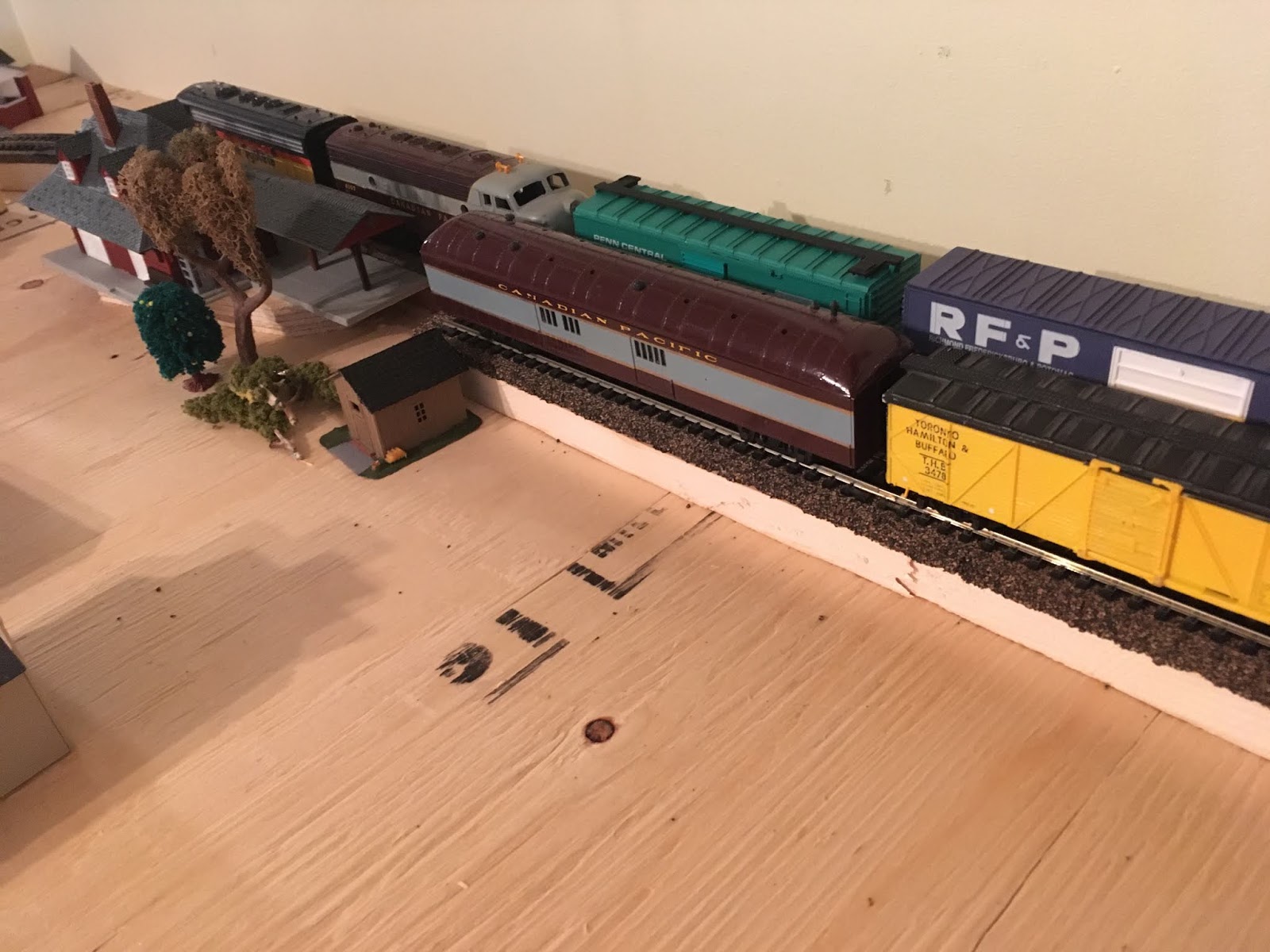
One half of the MoW consist has an old Canadian Pacific baggage car, which was not an uncommon thing for railways to use during this time. Since the Sarnia Sub intersects with the CP in Chatham, I took the liberty of blending both railways. You will also notice an old wooden TH&B boxcar. Some of these old wooden boxcars lived well into the 1990s as MoW cars. The photo below from the Sarnia end of the the CSX operations gives you an idea of my inspiration. I would love to one day put together a detailed C&O MoW boxcar like the one below, but the TH&B boxcar will have to do for now. It was once part of the CP empire, so it's a stretch, but I am not one for strict adherence to prototypical operations. I like to freelance a bit.
Here's the other end of the MoW consist. It features an old Cotton Belt gondola and a CP flatcar, which I built from an old Ulrich kit. I had to look up this company to see what it was. When I bought this car, I had never heard of this model train maker before. You can see the rooftop of an industrial building in the shot as well. I'm not sure what it is going to be yet. You can also see a short train on the mainline with AT&SF, Bangor & Aroostook, RF&P and a green PC boxcar trailing a set of F units. All of these boxcars, except the PC, were given to me last year by a friend who had them in his basement collecting dust. What a gift!
Here's a closer shot of the CP flatcar. It took a lot of work to put this 60-year-old car together and get it operational. The couplers that it came with I had never seen before. I had to put in a conventional coupler and modify the car a bit to get it to fit properly.
Here's a shot of a MoW gondola I saw once in Sarnia, which gave me the idea that I needed one on my own maintenance track.
Here's a final shot of the mainline train and the station spur, below. You can get an idea of the developing town from this angle. There are a couple of things to note in this shot.
One is I bought an extended platform kit for my train station but found that it wasn't needed for what I was modelling, which is essentially a small town. So I used the extra platform for a railway themed park across the street from the station.
The next thing is the Chessie System F unit. You will see that it is mated to an old vintage Canadian Pacific unit, which needs a lot of work to make it look a little more realistic. Again, the old CSX Subdivision from my youth did not include shared power, but there were instances in Southern Ontario, particularly in the case of the CASO Sub near Windsor, where shared power did happen. So, it's another liberty I am taking. To be honest, I was just testing the old CP dummy to see how it handled the tracks. It has a temperamental coupler in the back, but it's working really well so far.
Try as you might, you will not find any real world example of a Chessie-painted F unit. I looked into it and discovered that the Chessie System did not retain any F units for revenue service, so this F unit is someone's idea of what it would have looked like if the railway had saved any of the covered wagons from its predecessors' long gone passenger service. The closest thing I found was that the old Seaboard System retained a set of F units long after it gave up its passenger operations.
You will also notice that the station is sitting on a block of wood. It will, of course, be elevated from the town, much like the Guelph Via Rail station is situated well above that city's downtown. The station is a common kit from Atlas. I like the look of it, since it reminds me of the old C&O station at the foot of Clifford Street in Sarnia, nestled behind the Esso refinery. The station looks different these days. Back in the early 1990s, it looked pretty rough. My station is a bit more tidy, for sure.
So that's one part of my set that could be close to getting some scenery in the near future, since it is pretty much set from a functional point of view. There is another part of that spur, which will serve a small farming operation. The building itself (you can see a piece of its power in the second last shot) is an old lumber mill, but it's generic enough that it can double for just about any old industrial building. I'm hoping to convert it into a feed mill, so I can use my hoppers and cylindrical hoppers there. That's a topic for another post.
Showing posts with label Chessie System. Show all posts
Tuesday, May 12, 2020
Tuesday, May 5, 2020
Takin' it to the basement
The trackside time has pretty much dried up for me, since there is so little happening in Ottawa to begin with, but with the stay-at-home orders, it's even tougher. I've been thinking of things to share in this strange time. I have a model railway in my basement, which doesn't receive a lot of attention in busy times. But it's seen a little bit of love in the last few weeks.
I have been trying to figure out how to take a decent shot of the set, which is far from finished. The walls of my den are also adorned with pictures and framed copies of some of my old newspaper stories from my journalism days. It makes photos pretty tough. There's also a lot of bare wood still showing and a lot of unfinished track work, particularly in my rail yard.
So, I decided I would content myself with a few shots of a few test trains that I have been operating, just to ensure my main line is somewhat operational. So far, my operations have gone quite smoothly, with almost no derailments. That's a real step up from my days of model railroading back in my teens, when persistent operational problems were enough to make me quit the hobby for long spells.
Here's a shot of my test train, led by Chessie System SD40-2 7614. It is passing by a spur that will serve some sort of plastic or petrochemical customer in the near future. I have a storage tank, tankcare unloading platform and a general purpose industrial building.
Right now, I have some intermodal cars parked there for no reason at all. Possibly my railway is relying on car storage fees before its official start-up. Those container wells were actually given to me. They don't really fit in with what I'm doing, but they look okay parked.
The covered hopper I picked up used a few months ago. Someone tried to apply their own West Virginian livery on the car alongside the Chessie cat, but I was able to get rid of the hand-drawn logo for the most part. What's left looks like old graffiti, which is okay by me. I used to see these hoppers an awful lot on the Sarnia Sub when I was a kid.
I should mention that the SD40 was an engine which did not prowl the Sarnia Subdivision, but I like to use it anyway, as it was a Christmas gift from my parents many years ago. I am not one to strictly follow prototype rules. I'm not sure what part of the old CSX Canadian operations I am modelling, but I am trying to blend a few of its operations in and around Southwestern Ontario.
My diesel roster also features a B&O GP35-2 and a Seaboard GP38-2. There was sometimes a blend of pre-CSX power on the Sarnia Sub before the CSX units began to take over. The Seaboard units were exceptionally rare, but they were not unseen, in my experience.
I also recently finished a secondary spur that ends at my station. The spur now houses an old Canadian Pacific baggage car, a wood box car, a flat car and a gondola, which will act as a MoW consist, if I ever feel the urge to operate one of these trains.
It reminds me of this MoW consist I once captured in Sarnia. In fact, this photo below was my inspiration.
I would be happy to share some thoughts about my model railway endeavors, but rest assured that I intend to continue my focus on real world railways when the world opens back up.
Take care. Stay healthy.
I have been trying to figure out how to take a decent shot of the set, which is far from finished. The walls of my den are also adorned with pictures and framed copies of some of my old newspaper stories from my journalism days. It makes photos pretty tough. There's also a lot of bare wood still showing and a lot of unfinished track work, particularly in my rail yard.
So, I decided I would content myself with a few shots of a few test trains that I have been operating, just to ensure my main line is somewhat operational. So far, my operations have gone quite smoothly, with almost no derailments. That's a real step up from my days of model railroading back in my teens, when persistent operational problems were enough to make me quit the hobby for long spells.
Here's a shot of my test train, led by Chessie System SD40-2 7614. It is passing by a spur that will serve some sort of plastic or petrochemical customer in the near future. I have a storage tank, tankcare unloading platform and a general purpose industrial building.
Right now, I have some intermodal cars parked there for no reason at all. Possibly my railway is relying on car storage fees before its official start-up. Those container wells were actually given to me. They don't really fit in with what I'm doing, but they look okay parked.
The covered hopper I picked up used a few months ago. Someone tried to apply their own West Virginian livery on the car alongside the Chessie cat, but I was able to get rid of the hand-drawn logo for the most part. What's left looks like old graffiti, which is okay by me. I used to see these hoppers an awful lot on the Sarnia Sub when I was a kid.
I should mention that the SD40 was an engine which did not prowl the Sarnia Subdivision, but I like to use it anyway, as it was a Christmas gift from my parents many years ago. I am not one to strictly follow prototype rules. I'm not sure what part of the old CSX Canadian operations I am modelling, but I am trying to blend a few of its operations in and around Southwestern Ontario.
My diesel roster also features a B&O GP35-2 and a Seaboard GP38-2. There was sometimes a blend of pre-CSX power on the Sarnia Sub before the CSX units began to take over. The Seaboard units were exceptionally rare, but they were not unseen, in my experience.
I also recently finished a secondary spur that ends at my station. The spur now houses an old Canadian Pacific baggage car, a wood box car, a flat car and a gondola, which will act as a MoW consist, if I ever feel the urge to operate one of these trains.
It reminds me of this MoW consist I once captured in Sarnia. In fact, this photo below was my inspiration.
I would be happy to share some thoughts about my model railway endeavors, but rest assured that I intend to continue my focus on real world railways when the world opens back up.
Take care. Stay healthy.
Friday, May 17, 2019
My railway happy place
I’m tired. Tired from renovating my basement after a flood and tired of rehabilitating my property after we had a new pipe connected to our house, which destroyed our front yard and landscaping. So yeah, I’m tired from that. I’m also tired of this wet spring and cool temperatures. This spring has not been great and much of my time has been spent as a cut-rate Mike Holmes wannabe.
So the blog has suffered a bit. I was thinking of new things to talk about and there is no shortage of newsworthy items from Ottawa. Our new LRT is still not ready and doesn’t appear to be, even though it is more than a year behind schedule. Did I mention that one of the new electric trainsets derailed just outside of Belfast Yard recently? Okay, maybe this topic is not your cup of tea. How about the uncertainty over CN’s desire to pull out of Ottawa? How about CN’s recent (and vague) advertisements alluding to some sort of celebration they are organizing for Ottawa next year? I’m wondering if they’re even going to be here still.
I am not going to write about any of this. I’m bored with reality, tired of light rail and full up with day-to-day headaches. I want to think back to when I was young and just liked watching trains go by; a time when I simply admired them for the mechanical marvels that they are.
With that in mind, here are a few small anecdotes and observations from the railway of my youth, CSX’s Sarnia Subdivision. In many ways, this rail line is an anomaly that you don’t often find anymore. I was looking through some photographs of this line the other day when I noticed some interesting things that I hadn’t seen before.
1. In this shot, can you see the old telegraph pole? I never noticed it before and with good reason. They are pretty small, compared to the old poles I’ve noticed along other rights-of-way. Just a single pole and two measly wires leaning away from the roadbed.
As readers of this blog know, this line is actually quite old. It has changed hands a number of times and reads like a who’s who of CSX predecessors. It was the Erie and Huron Railway when it opened for business in 1886. It changed hands once and was renamed before becoming part of the Pere Marquette Railway in 1902. From there, it became part of the Chesapeake and Ohio in 1947, and then the inevitable mergers brought in the Chessie System group of companies before finally becoming CSX Transportation.
Unlike many other railways, this line shed its passenger service in 1933, much earlier than other lines. It’s a shame that none of the passenger stations have survived, other than the old Mooretown Station, which is located on the grounds of the Moore Museum.
But that little telegraph pole, barely noticeable as it is at the back of my sister’s property, which extends to the tracks, is a witness to the history of this line and its importance in connecting a very large and scattered group of settlements in Lambton County.
2. This is something I’ve noticed before but it was particularly noticeable behind my sister’s house. Usually, a railway’s roadbed is elevated a fair bit above the surrounding landscape for many reasons, not the least of which is to prevent washouts from floods. In many areas along this line, the roadbed is actually not elevated all that much higher than the surrounding area. I really noticed it in these images. It made me wonder if this was a factor of neglect in that the railway has not bothered to bolster its ballast in a while or if it was a factor of the line’s design. Did the elevation in this area suggest to the line's builders that it did not require that much of an elevation? I wonder.
3. I’ve shared this shot before, but I like the fact that this line still has concrete mileposts, like this one near Emily Street in Mooretown. I’m not sure how many are actually left but I like the fact that some of them are still around. I recall as a kid seeing concrete W signs as well, but as you can tell from this shot below, some of them have been replaced over the years.
4. I didn’t realize this until I was older, but this rail line has no speed or occupancy signals, and for good reason. The line, even in its heyday, connected with CN in Sarnia and CP in Chatham. The trackage through Chatham-Kent is now finished, of course, and the Sarnia connection is used only for once-a-day interchanges between CSX and CN at CN’s Sarnia Yard. CSX also connects with CN’s St. Clair River Industrial Spur at Terra Industries, south of Courtright, but this connection seems to be lightly used or unused at the moment. The point is, neither of these current connections require signals. The Chatham connection did have signals but I think that was it for this line. Up until the 1950s, the line also connected with the former Canada Southern St. Clair Branch in Courtright, but I have not seen any images of whether it was governed by any signals. A real throwback. I imagine the line was (and still is?) governed by OCS.
5. One more way this line was really different. I remember watching a competitive baseball tournament one summer when I was young and then hearing the rumbling of a GP38 (like this one pictured) on the adjacent rail line (this line in my day was the exclusive domain of this geep). Well, didn’t the engineer stop the engine next to the ball field so he could watch some of the action? How many rail lines have this type of casual attitude these days? It reminds me that numerous blog readers have told me that they see CN 589 stop at the March Road railway crossing in Kanata so the crew can pick up a Tim Hortons coffee on their way to Arnprior.
You know, I feel better now. It’s been a tough couple of weeks of hard work for me. And my commute to work has been changed by bridge closures, due to flooding. So, not a lot to cheer about, but I have plans to have a trackside day in the coming weeks. This was the same trackside day I planned a year ago. So, things are looking up.
What about you, fair reader? Where is your railway happy place? Or where was it?
So the blog has suffered a bit. I was thinking of new things to talk about and there is no shortage of newsworthy items from Ottawa. Our new LRT is still not ready and doesn’t appear to be, even though it is more than a year behind schedule. Did I mention that one of the new electric trainsets derailed just outside of Belfast Yard recently? Okay, maybe this topic is not your cup of tea. How about the uncertainty over CN’s desire to pull out of Ottawa? How about CN’s recent (and vague) advertisements alluding to some sort of celebration they are organizing for Ottawa next year? I’m wondering if they’re even going to be here still.
I am not going to write about any of this. I’m bored with reality, tired of light rail and full up with day-to-day headaches. I want to think back to when I was young and just liked watching trains go by; a time when I simply admired them for the mechanical marvels that they are.
With that in mind, here are a few small anecdotes and observations from the railway of my youth, CSX’s Sarnia Subdivision. In many ways, this rail line is an anomaly that you don’t often find anymore. I was looking through some photographs of this line the other day when I noticed some interesting things that I hadn’t seen before.
1. In this shot, can you see the old telegraph pole? I never noticed it before and with good reason. They are pretty small, compared to the old poles I’ve noticed along other rights-of-way. Just a single pole and two measly wires leaning away from the roadbed.
As readers of this blog know, this line is actually quite old. It has changed hands a number of times and reads like a who’s who of CSX predecessors. It was the Erie and Huron Railway when it opened for business in 1886. It changed hands once and was renamed before becoming part of the Pere Marquette Railway in 1902. From there, it became part of the Chesapeake and Ohio in 1947, and then the inevitable mergers brought in the Chessie System group of companies before finally becoming CSX Transportation.
Unlike many other railways, this line shed its passenger service in 1933, much earlier than other lines. It’s a shame that none of the passenger stations have survived, other than the old Mooretown Station, which is located on the grounds of the Moore Museum.
But that little telegraph pole, barely noticeable as it is at the back of my sister’s property, which extends to the tracks, is a witness to the history of this line and its importance in connecting a very large and scattered group of settlements in Lambton County.
2. This is something I’ve noticed before but it was particularly noticeable behind my sister’s house. Usually, a railway’s roadbed is elevated a fair bit above the surrounding landscape for many reasons, not the least of which is to prevent washouts from floods. In many areas along this line, the roadbed is actually not elevated all that much higher than the surrounding area. I really noticed it in these images. It made me wonder if this was a factor of neglect in that the railway has not bothered to bolster its ballast in a while or if it was a factor of the line’s design. Did the elevation in this area suggest to the line's builders that it did not require that much of an elevation? I wonder.
3. I’ve shared this shot before, but I like the fact that this line still has concrete mileposts, like this one near Emily Street in Mooretown. I’m not sure how many are actually left but I like the fact that some of them are still around. I recall as a kid seeing concrete W signs as well, but as you can tell from this shot below, some of them have been replaced over the years.
4. I didn’t realize this until I was older, but this rail line has no speed or occupancy signals, and for good reason. The line, even in its heyday, connected with CN in Sarnia and CP in Chatham. The trackage through Chatham-Kent is now finished, of course, and the Sarnia connection is used only for once-a-day interchanges between CSX and CN at CN’s Sarnia Yard. CSX also connects with CN’s St. Clair River Industrial Spur at Terra Industries, south of Courtright, but this connection seems to be lightly used or unused at the moment. The point is, neither of these current connections require signals. The Chatham connection did have signals but I think that was it for this line. Up until the 1950s, the line also connected with the former Canada Southern St. Clair Branch in Courtright, but I have not seen any images of whether it was governed by any signals. A real throwback. I imagine the line was (and still is?) governed by OCS.
5. One more way this line was really different. I remember watching a competitive baseball tournament one summer when I was young and then hearing the rumbling of a GP38 (like this one pictured) on the adjacent rail line (this line in my day was the exclusive domain of this geep). Well, didn’t the engineer stop the engine next to the ball field so he could watch some of the action? How many rail lines have this type of casual attitude these days? It reminds me that numerous blog readers have told me that they see CN 589 stop at the March Road railway crossing in Kanata so the crew can pick up a Tim Hortons coffee on their way to Arnprior.
You know, I feel better now. It’s been a tough couple of weeks of hard work for me. And my commute to work has been changed by bridge closures, due to flooding. So, not a lot to cheer about, but I have plans to have a trackside day in the coming weeks. This was the same trackside day I planned a year ago. So, things are looking up.
What about you, fair reader? Where is your railway happy place? Or where was it?
Saturday, February 10, 2018
What's to become of CSX in Canada?
The CSX I knew seems to be disappearing right before
my eyes. First there was the upheaval when Hunter Harrison took over and then
there was his untimely death. Say what you want about the man, he got results.
For my part, I’m not about seriously question his methods, other than to say
that I think there is an extreme lack of long-term thinking among publicly
traded companies, especially railways. There has been a lot of debate over the
fixation over quarterly number. As a former business reporter, I understand how
the game is played, but I have to wonder how much is enough? How long can you
slash, burn and defer for the sake of making a quarterly target, even if you’re
sacrificing your long-term profitability? I’m not necessarily saying this is
the case with CSX, but you look at the scale of the cutbacks the company is
considering and you wonder what will be left when the hedge funds are finished
with this company.
April 1991 - A northbound CSX mixed freight waits on the Sarnia Subdivision, just south of the St. Clair Boulevard crossing. That empty field behind the train is now a subdivision.
For me, CSX has been a lifelong fascination. The
railway’s Sarnia Subdivision passes through my hometown. For how much longer is
anyone’s guess. When I was younger, CSX operated from Sarnia all the way to
Chatham, where it interchanged with CP. At one point, the rail line went all
the way to Lake Erie, terminating in Erieau, but that was before my time. Now,
the railway switches a few refineries in Sarnia and maintains a scant presence
between the Chemical Valley and its remaining customers south. CSX only goes as
far as Sombra. South of that, the line’s service has been discontinued through
Port Lambton, Wallaceburg, rural Kent County and Chatham.
This past summer, I caught a short local returning to
Sarnia from Sombra. At the time, I wondered if that meet might be the last time
I saw the CSX passing through my hometown. I’m thinking it was.
August 2017 - Perhaps my last meet with a CSX freight near my hometown
I can remember back when the railway was much busier,
often shuttling long trains of interchange traffic between Sarnia and Chatham,
with countless autoracks, auto parts high-cube boxcars among its usual tank
cars and hoppers. In the 1980s, nearly all the GP38s were painted in the
Chessie scheme, a scheme I didn’t like at the time but have grown to
appreciate. There were even a fair number of B&O and even C&O painted
geeps plying the rails. At some point in the late 1980s, the drab silver and
grey CSX scheme popped up. By then, the writing was already on the wall. The
trains were getting shorter and less frequent. By the time I moved away for
school, the interchange traffic from Chatham was largely gone and the railway’s
customer base in the Valley was shrinking (Dow Chemical left in the mid-1990s,
Ethyl closed and a few other operations left the area afterward).
Summer 1991 - Autoracks and cabooses? This was back when CSX linked the CP in Chatham with CN in Sarnia.
Although there is optimism that small-scale industry
is on its way back to some of these old refinery sites, I don’t think the CSX
will want to wait around for an economic rebound. Its Sarnia Sub is already
disconnected from the rest of its network.
As some continue to speculate, the Ontario Southland
Railway might be a prime candidate to pick up the trackage from CSX and assume
operations. The one wild card I’ve heard is that the City of Chatham-Kent owns
the south end of the line and has been searching for an operator to resume rail
service for the mainly agricultural customer base on the south end of the line.
That process has dragged on for years with no success.
One has to wonder whether the addition of the
lucrative switching business in Sarnia would make such an acquisition more palatable
to the colourful shortline. I would love to see those old OSR F units and
vintage locomotives in my hometown.
But I think I might raise a glass to the railway of my
youth – the old Chessie System. It’s the railway that often woke me in the
middle of the night when its freight trains would announce their presence by
the two long, two short, one long horn blasts all the way through town. Even
when I was young, I always found the sound reassuring and comfortable.
The CSX was the railway that used to distract me from
my soccer games in the summer in Parkdale Park.
The CSX was the railway that produced countless summer
chases as I raced to the tracks with my bike in the hopes of snapping a few
shots.
The CSX is the railway whose old MoW cars were used
for climbing on a tiny spur Port Lambton, where I went to school. Despite the
open access to the old cars, they were never vandalized or damaged. How times
change.
Fall 1992 - These MoW cars were often parked in Port Lambton, where I attended school. I recall climbing these cars on occasion, back when a railway could leave cars parked on an unprotected spur in the middle of a town and nothing would happen to them.
You get the idea. I’m not so much mourning the
disappearance of the railway that I know as I am mourning the loss of its legacy
in parts of Canada, especially around my hometown, but also in Windsor, Essex
County, Niagara, St. Thomas and parts of Quebec. Hard to believe that this
railway once served so many areas in Eastern Canada. But there is no room for sentimental nostalgia for a publicly traded railway in 2018.
CSX brings in an interchange load into CN's Sarnia Yard in October 2016
I look at what’s become of CSX in the last year and it
seems like there’s almost no room for nostalgia with this railway. It’s a shame
because a railway with such a colourful history deserves better.
Saturday, July 8, 2017
Reasons to appreciate rolling stock (Part I)
In light of some of the great discussion I have seen lately about rolling stock, I decided to approach the subject of the humble freight car in a series of posts. With that in mind, I'd like to call to order the first session of the Rolling Stock Appreciation Society (RSAS for short).
I can't underestimate how important it is to document every piece of a train that passes by our lenses. I know there are many out there, including me, that sometimes halfheartedly take shots of rolling stock as part of our trackside experience. However, when you consider how quickly things change in this industry, it is sometimes to our detriment when we don't chronicle rolling stock like we do the front end of trains. Yes, the dramatic shot of the locomotive is always what we strive for, but should we be satisfied with the head end only?
Why is rolling stock so important? Well, here's the first reason.
1. What is common today may not be all that common tomorrow.
Case in point. When I was a teenager, intermodal container trains were just starting to really take hold as the dominant form of rail freight. I remember when the double stacks began to show up in Sarnia in the mid-1990s when the new St. Clair Tunnel was build to accommodate them. The site of these stacked containers on an endless string of well cars was jarring.
This shot above, captures the site of two container trains, one headed to Macmillan Yard in Vaughan with the other making its way out. A few decades ago, this shot would likely inspire a much different reaction than it does today.
I doubt very much that container traffic is going to go the way of the boxcar anytime soon, but it's no reason for us to ignore the site. This shot above aptly captures the essence of modern railroading in 2017 (well, this shot is 2013, but you get the idea). It also gives you an idea of what a railway carries and who it serves, based on the stamps on the trailers (JB Hunt, Canadian Tire, MSC, etc.). This allows to more easily understand how railways work.
Now compare the all-too-common intermodal stack trains with something like an old high-cube boxcar. I took this shot in the Spring of 1991 in my hometown of Corunna. This boxcar, which still retained its Louisville and Nashville lettering (although patched for CSXT), was once a very common site where I lived. These massive boxcars carried auto parts and were abundant on the rail lines in Southern Ontario, since the big three (CN, CP and CSX) all served the auto plants and parts suppliers in the region.
Well, lo and behold, these boxcars are now a distant memory and it really hasn't been all that long (less than 30 years). I have a few shots of these old cars and am glad that I do. Not only do they seem more compelling now, but they also help to explain what it was like to be trackside 30 years ago.
So take that boring shot of a freight car. You might be glad you did one day.
I can't underestimate how important it is to document every piece of a train that passes by our lenses. I know there are many out there, including me, that sometimes halfheartedly take shots of rolling stock as part of our trackside experience. However, when you consider how quickly things change in this industry, it is sometimes to our detriment when we don't chronicle rolling stock like we do the front end of trains. Yes, the dramatic shot of the locomotive is always what we strive for, but should we be satisfied with the head end only?
Why is rolling stock so important? Well, here's the first reason.
1. What is common today may not be all that common tomorrow.
Case in point. When I was a teenager, intermodal container trains were just starting to really take hold as the dominant form of rail freight. I remember when the double stacks began to show up in Sarnia in the mid-1990s when the new St. Clair Tunnel was build to accommodate them. The site of these stacked containers on an endless string of well cars was jarring.
This shot above, captures the site of two container trains, one headed to Macmillan Yard in Vaughan with the other making its way out. A few decades ago, this shot would likely inspire a much different reaction than it does today.
I doubt very much that container traffic is going to go the way of the boxcar anytime soon, but it's no reason for us to ignore the site. This shot above aptly captures the essence of modern railroading in 2017 (well, this shot is 2013, but you get the idea). It also gives you an idea of what a railway carries and who it serves, based on the stamps on the trailers (JB Hunt, Canadian Tire, MSC, etc.). This allows to more easily understand how railways work.
Now compare the all-too-common intermodal stack trains with something like an old high-cube boxcar. I took this shot in the Spring of 1991 in my hometown of Corunna. This boxcar, which still retained its Louisville and Nashville lettering (although patched for CSXT), was once a very common site where I lived. These massive boxcars carried auto parts and were abundant on the rail lines in Southern Ontario, since the big three (CN, CP and CSX) all served the auto plants and parts suppliers in the region.
Well, lo and behold, these boxcars are now a distant memory and it really hasn't been all that long (less than 30 years). I have a few shots of these old cars and am glad that I do. Not only do they seem more compelling now, but they also help to explain what it was like to be trackside 30 years ago.
So take that boring shot of a freight car. You might be glad you did one day.
Thursday, June 9, 2016
Ontario Hydro and CSX: The railway deal that wasn't
I stumbled across a photo the other day of a CSX train passing by the Lambton Generating Station near Courtright, Ont. The photo reminded me of a rail story about this old coal-fired generating station, where I spent a summer working. The photo caption suggested that two rail spurs into the generating station property were used for coal deliveries and fly ash removal. Though the photo was top notch, the information about the rail spur was wrong. I know this because my Dad worked at this power station and I know the story behind the rails into that plant.
So, here is the story behind these long disconnected rail spurs and how they nearly led to a deal between Ontario Hydro and CSX Transportation in the 1990s, a deal that would have changed the fortunes of the rail line.
Could a deal with Ontario Hydro have changed the fortunes of the CSX Sarnia Subdivision in the 1990s? We'll never know. (Stalled northbound freight near Corunna in 1991)
I spoke with my Dad about the rail lines recently and he told me the two rail spurs into the powerhouse (the main building, left of photo) and behind the powerhouse were put in place to deliver the materials needed to build the power plant in the mid-1960s. At the time, the railway delivering those materials was the Chesapeake and Ohio.
Here's a closer shot, below, of the rails without the mark-ups. You will notice to the right of the photograph that part of the turnout from the Sarnia Subdivision was preserved but a section of track was torn out. This remained the case for decades after the rail deliveries stopped when the plant was built. I find it interesting that these rails remained in place. Was there a thought that these rails would someday be useful again?
In the late 1990s, I was fortunate enough to land a summer job at the Lambton Generating Station, which was perhaps the best summer job I have ever had. I recall walking through the powerhouse and seeing those old rails in place. I wondered then why they were there. It wasn't until recently that my Dad told me about the rails being in place for the construction. The scale of the construction must have been impressive, if the rails were put in place simply to deliver materials for the power plant. Sadly, no publicly available photographs exist of the railway delivering any of these pieces necessary to build the plant.
That brings me back to the early 1990s when the Lambton Generating Station was being retrofitted with scrubbing technology that used lime to remove harmful sulphur dioxide emissions from the generating process. The thought at the time was that the best way to deliver the lime needed was to have it brought in by train. The resulting fly ash that was produced by the scrubbing process would have been shipped out by rail as well. This would have been a pretty big contract for CSX Transportation, which was struggling at this point with the loss of industry on its Sarnia Subdivision.
From a railfanning perspective, I don't think this deal would have changed the look of trains on the Sarnia Subdivision. I would imagine you would have seen more of these covered hoppers in the Courtright area, not that these cars were uncommon along that line at the time.
Alas, it was not to be. At one point, it was decided that rail service was too expensive and that all the lime would be brought in by truck and all the fly ash removed the same way. I have to wonder just how expensive it would have been for a Crown corporation to back away from rail service. After all, Ontario Hydro (later Ontario Power Generation) wasn't exactly the model of cost efficiency.
That leaves me with one shot from my summer at the plant. This is a shot my Dad took of me standing atop one of the power generation units at the top of the powerhouse. You can see a Canada Steamship Lines coal ship making its way south along the St. Clair River to the left of me. The power plant received its coal from these lake freighters. You can see the coal funnel just to my left in the photo.
I climbed up to the roof of the plant with my Dad on one of my last days of work.

So, here is the story behind these long disconnected rail spurs and how they nearly led to a deal between Ontario Hydro and CSX Transportation in the 1990s, a deal that would have changed the fortunes of the rail line.
Could a deal with Ontario Hydro have changed the fortunes of the CSX Sarnia Subdivision in the 1990s? We'll never know. (Stalled northbound freight near Corunna in 1991)
I spoke with my Dad about the rail lines recently and he told me the two rail spurs into the powerhouse (the main building, left of photo) and behind the powerhouse were put in place to deliver the materials needed to build the power plant in the mid-1960s. At the time, the railway delivering those materials was the Chesapeake and Ohio.
Here's a closer shot, below, of the rails without the mark-ups. You will notice to the right of the photograph that part of the turnout from the Sarnia Subdivision was preserved but a section of track was torn out. This remained the case for decades after the rail deliveries stopped when the plant was built. I find it interesting that these rails remained in place. Was there a thought that these rails would someday be useful again?
In the late 1990s, I was fortunate enough to land a summer job at the Lambton Generating Station, which was perhaps the best summer job I have ever had. I recall walking through the powerhouse and seeing those old rails in place. I wondered then why they were there. It wasn't until recently that my Dad told me about the rails being in place for the construction. The scale of the construction must have been impressive, if the rails were put in place simply to deliver materials for the power plant. Sadly, no publicly available photographs exist of the railway delivering any of these pieces necessary to build the plant.
That brings me back to the early 1990s when the Lambton Generating Station was being retrofitted with scrubbing technology that used lime to remove harmful sulphur dioxide emissions from the generating process. The thought at the time was that the best way to deliver the lime needed was to have it brought in by train. The resulting fly ash that was produced by the scrubbing process would have been shipped out by rail as well. This would have been a pretty big contract for CSX Transportation, which was struggling at this point with the loss of industry on its Sarnia Subdivision.
From a railfanning perspective, I don't think this deal would have changed the look of trains on the Sarnia Subdivision. I would imagine you would have seen more of these covered hoppers in the Courtright area, not that these cars were uncommon along that line at the time.
Alas, it was not to be. At one point, it was decided that rail service was too expensive and that all the lime would be brought in by truck and all the fly ash removed the same way. I have to wonder just how expensive it would have been for a Crown corporation to back away from rail service. After all, Ontario Hydro (later Ontario Power Generation) wasn't exactly the model of cost efficiency.
That leaves me with one shot from my summer at the plant. This is a shot my Dad took of me standing atop one of the power generation units at the top of the powerhouse. You can see a Canada Steamship Lines coal ship making its way south along the St. Clair River to the left of me. The power plant received its coal from these lake freighters. You can see the coal funnel just to my left in the photo.
I climbed up to the roof of the plant with my Dad on one of my last days of work.

My most vivid memory of that climb to the top of the power station was walking up this long set of metal stairs. The higher we went, the deeper the dark void was beneath us in the unit we were climbing. My dad breezed up the stairs like it was nothing, but I was hanging on to the rails and taking each step gingerly. Man, what bad time to discover a fear of heights.
Anyway, the rail deal never happened and thus started an endless convoy of trucks in and out of the Lambton Generating Station to feed its scrubbers. It would have been fun to see rail service in that facility, but CSX never had the chance to use those rails again. Looking at the overhead shots of the rails in that area, I wonder if they might be of use again when a new gas-fired power plant is built on the property to replace the controversial Mississauga gas plant that was shuttered before it was completed. I doubt those rails would be of use, since the new plant will not be built near the old powerhouse. However, it is worth noting that two of the units in the old powerhouse have been kept in a condition such that they can be started again if there is a retrofit considered for the old plant.
I guess keeping those rails in place all these decades might not have been such a bad idea.
Thursday, March 10, 2016
All American Diesel in Canada
In Spring 1991, I sometimes would hop on my bike and race to the nearby CSX tracks when I heard a train approaching my hometown. One morning, I caught a huge four-diesel mixed freight, which was one of the better catches I have ever had.
Fast forward a few decades.
A great surprise awaited me the other day when I visited the Chesapeake & Ohio Canadian Division Facebook group. It turns out, one of the photos I took that spring day had much more historic significance than I had imagined.
This is a shot of GP38-2 2002, repatched for CSX but previously bearing the B&O markings on the side of its hood. This unit, which was originally B&O 3802, was like any other GP38 that were used almost exclusively on this rail line between Sarnia and Chatham in the 1990s.
But this unit, it turns out, has been preserved at the Baltimore & Ohio museum in Baltimore, Maryland because it is historically significant. There was a reminder stenciled onto the side of this unit, which read "Do Not Dismantle. On release from service, hold for shipment to B&O Museum via Locust Point, Baltimore."
The stencil was applied in 1992, which meant my photo was taken the year before the locomotive was officially tabbed for the museum. But the question is, why was this unit designated to be saved?
Upon reading about this unit's story on the museum's website, I was surprised to read that this locomotive was dubbed the All American Diesel by Trains Magazine in 1982. At the time it was chosen, this locomotive was already in Chessie paint. It turns out, despite the patch being applied to this unit in 1992, this locomotive wasn't retired from service until 2000. Not a bad return for a diesel manufactured in 1967.
You can see lots of photos of this unit and the patch at the C&O Canadian Facebook group (see link above), which I have found to be a fascinating treasure trove of photos and information about a largely forgotten rail network in Southwestern Ontario. You can also see what this unit looks like fully restored today on the B&O Museum's 3802 Flikr page.
What makes this even better for me was I caught this unit on a train with four diesels. This was the one and only time I ever saw four units leading a train on this line. Usually, CSX ran two geeps together, with the long hoods connected together.
This has always been one of my favourite railway photos. Now that I know the story behind this unit, it makes this image all the more special. It also makes me feel old to know that an engine I caught is now a museum piece.
OTHER NEWS
Over at Trackside Treasure, blogger Eric Gagnon has posted about the fascinating Sclair covered hoppers that were once common around Sarnia and elsewhere. Eric was nice enough to include a link to an older Beachburg Sub post that included a shot I took of the Sclair hoppers in Corunna. I found one other shot of a Sclair hopper, taken in 1992 that I thought I would share. This car is parked on a spur serving a plastics plant near Corunna. That maroon car to the left is a Dupont hopper. The former Dupont plant, now owned by Nova Chemicals, is located in Corunna on the CSX Sarnia Sub.
Fast forward a few decades.
A great surprise awaited me the other day when I visited the Chesapeake & Ohio Canadian Division Facebook group. It turns out, one of the photos I took that spring day had much more historic significance than I had imagined.
This is a shot of GP38-2 2002, repatched for CSX but previously bearing the B&O markings on the side of its hood. This unit, which was originally B&O 3802, was like any other GP38 that were used almost exclusively on this rail line between Sarnia and Chatham in the 1990s.
But this unit, it turns out, has been preserved at the Baltimore & Ohio museum in Baltimore, Maryland because it is historically significant. There was a reminder stenciled onto the side of this unit, which read "Do Not Dismantle. On release from service, hold for shipment to B&O Museum via Locust Point, Baltimore."
The stencil was applied in 1992, which meant my photo was taken the year before the locomotive was officially tabbed for the museum. But the question is, why was this unit designated to be saved?
Upon reading about this unit's story on the museum's website, I was surprised to read that this locomotive was dubbed the All American Diesel by Trains Magazine in 1982. At the time it was chosen, this locomotive was already in Chessie paint. It turns out, despite the patch being applied to this unit in 1992, this locomotive wasn't retired from service until 2000. Not a bad return for a diesel manufactured in 1967.
You can see lots of photos of this unit and the patch at the C&O Canadian Facebook group (see link above), which I have found to be a fascinating treasure trove of photos and information about a largely forgotten rail network in Southwestern Ontario. You can also see what this unit looks like fully restored today on the B&O Museum's 3802 Flikr page.
What makes this even better for me was I caught this unit on a train with four diesels. This was the one and only time I ever saw four units leading a train on this line. Usually, CSX ran two geeps together, with the long hoods connected together.
This has always been one of my favourite railway photos. Now that I know the story behind this unit, it makes this image all the more special. It also makes me feel old to know that an engine I caught is now a museum piece.
OTHER NEWS
Over at Trackside Treasure, blogger Eric Gagnon has posted about the fascinating Sclair covered hoppers that were once common around Sarnia and elsewhere. Eric was nice enough to include a link to an older Beachburg Sub post that included a shot I took of the Sclair hoppers in Corunna. I found one other shot of a Sclair hopper, taken in 1992 that I thought I would share. This car is parked on a spur serving a plastics plant near Corunna. That maroon car to the left is a Dupont hopper. The former Dupont plant, now owned by Nova Chemicals, is located in Corunna on the CSX Sarnia Sub.
Wednesday, June 24, 2015
Postcard from Chemical Valley
This week, I am starting a new and likely occasional feature on The Beachburg Sub. I plan to offer a single photograph and tell the stories attached with that single image. I am doing this for a few reasons. One, I have a number of photos that don't really fit in with any particular theme. Second, I feel like this format allows me to roam a little bit and tell some stories that I am not always able to explore in more regularly structured postcards.
So, with that, here is my first postcard, from beneath a bridge in Sarnia's Chemical Valley.
This shot, taken last Dec. 22, was shot beneath a bridge that carries Vidal Street above the CSX Sarnia Subdivision. You can see the shadow cast by the overpass in the shot. The road you see, partially in shadow, is the former stretch of Vidal Street, which once crossed three CSX tracks via a level crossing. That crossing would often produce traffic headaches as CSX trains would often block the crossing as they shunted cars in and out of the Dow Chemical refinery.
The overpass was built in the early 1980s to ease traffic flow and deal with safety concerns. The map below shows where I took the photo and gives you an idea of the track alignment. The old road just above the one labelled 33 is the former stretch of Vidal Street which once passed over the CSX tracks at a level crossing.
Fast forward to today and the old stretch of Vidal Street is part of a ghost town. The Dow Chemical refinery is long gone, having been closed in the early 1990s. In its place, all that is left is a vast expanse of concrete, old settling ponds, a few rail spurs and a small cogeneration plant. There has been talk of a business park on the old Dow site, but very little has happened here since most of the old refinery was dismantled.
That means this stretch of the valley remains pretty quiet, especially along the rails. CSX still uses some of the tracks here to park tank cars or queue them up before delivering them to other chemical plants further down the line. The image I took makes it look like the tank cars are parked on the main line, which is what I thought when I took the photograph. But the map shows you that this is not the case.
I vividly remember crossing these tracks when I was a child and often having to wait for the Chessie System painted geeps to clear the crossing long enough for my frustrated parents to drive by. Of course, as a kid, I was happy to sit in the back seat and watch the trains ply the rails. Sometimes, we would catch a glimpse of Dow Chemical's orange SW locomotive, which performed switching duties on the refinery's tracks.
Last December, when I visited this spot, I hoped I could catch something happening, but this was all I was able to capture. I'm not a fan of photographing stationary cars, but in this case, the image sparked a flood of memories of busier times.
So, with that, here is my first postcard, from beneath a bridge in Sarnia's Chemical Valley.
This shot, taken last Dec. 22, was shot beneath a bridge that carries Vidal Street above the CSX Sarnia Subdivision. You can see the shadow cast by the overpass in the shot. The road you see, partially in shadow, is the former stretch of Vidal Street, which once crossed three CSX tracks via a level crossing. That crossing would often produce traffic headaches as CSX trains would often block the crossing as they shunted cars in and out of the Dow Chemical refinery.
The overpass was built in the early 1980s to ease traffic flow and deal with safety concerns. The map below shows where I took the photo and gives you an idea of the track alignment. The old road just above the one labelled 33 is the former stretch of Vidal Street which once passed over the CSX tracks at a level crossing.
Fast forward to today and the old stretch of Vidal Street is part of a ghost town. The Dow Chemical refinery is long gone, having been closed in the early 1990s. In its place, all that is left is a vast expanse of concrete, old settling ponds, a few rail spurs and a small cogeneration plant. There has been talk of a business park on the old Dow site, but very little has happened here since most of the old refinery was dismantled.
That means this stretch of the valley remains pretty quiet, especially along the rails. CSX still uses some of the tracks here to park tank cars or queue them up before delivering them to other chemical plants further down the line. The image I took makes it look like the tank cars are parked on the main line, which is what I thought when I took the photograph. But the map shows you that this is not the case.
I vividly remember crossing these tracks when I was a child and often having to wait for the Chessie System painted geeps to clear the crossing long enough for my frustrated parents to drive by. Of course, as a kid, I was happy to sit in the back seat and watch the trains ply the rails. Sometimes, we would catch a glimpse of Dow Chemical's orange SW locomotive, which performed switching duties on the refinery's tracks.
Last December, when I visited this spot, I hoped I could catch something happening, but this was all I was able to capture. I'm not a fan of photographing stationary cars, but in this case, the image sparked a flood of memories of busier times.
Thursday, April 2, 2015
Don't stop believing
This past winter has really been a test of endurance, hasn't it? When you live in a northern city like Ottawa, long, cold winters are the norm. This one has been brutal, even by our hardy standards. We broke our record for consecutive days with weather below freezing (O C or 32 F), although most of those days were at least -10 to -15 C. Today, as I write this, we are experiencing freezing rain after some overnight snow. I decided drastic action was needed, so I gathered up some warm weather photos I have not shared before (along with one I have shared).
This first shot was actually taken Sept 28 of last year, which doesn't quite make it a summer shot (check out the changing colour of the leaves trackside). But I decided to include this shot of CN 589 because of the heat lines in the photo. The one-car consist is passing beneath Highway 416 in this shot on the Via Rail Smiths Falls Sub. You can see the Via speed limit to the right.
I've shared some similar photos of this meet in the past, but I don't think I've shared this one. This is CN 589 assembling in Walkley Yard on Sept. 1, 2013. I took this shot on a very sunny Sunday morning. I like the effect the morning sun made on the boxcars as well as CN 589. The cars all seem to exemplify the term sun-bleached. Ah, I can just feel that heat now.
This is one of my favourite shots. I took this one sometime in the summer of 1991 in Corunna, Ontario, in what was then a relatively new subdivision across the city's main street from my own neighbourhood. This is my only shot of a Chessie System cupola caboose in action. I remember hearing the train whistle in the distance and rushing on my bike down Murray Drive to a spot where I could grab a shot of the train. I had other shots of the meet at one time that have gone missing sadly. Still, I like this shot because it showcases two things that don't exist on this line anymore, one being cabooses in revenue service and the other being interchange autorack traffic. Looks like we needed some rain.
This one is from February 2014 in Kissimmee, Florida. I made sure to take an afternoon and shoot Amtrak's Silver Meteor, as it made its way north through Kissimmee on its way to New York City. The train is rounding a bend before making its way to the city's historic train station. The track bundles along the old Atlantic Coast Line's famous A Line were part of the work being done to ready to the old line for commuter rail. Oh, and word of advice to Via. Bring back train names.
Okay, how about this for summer? Here's Lake Louise's famous chalet-style train station in the summer of 1992. Check out that vintage car in the parking lot bottom right. I took this shot when my sister and I were wandering around this area on a vacation that summer. This shot was taken from the higher track, as you can tell from the ballast in the bottom left.
So, don't stop believing, as Steve Parry once famously crooned for Journey. The warm weather is coming. It has to, right? Right?
This first shot was actually taken Sept 28 of last year, which doesn't quite make it a summer shot (check out the changing colour of the leaves trackside). But I decided to include this shot of CN 589 because of the heat lines in the photo. The one-car consist is passing beneath Highway 416 in this shot on the Via Rail Smiths Falls Sub. You can see the Via speed limit to the right.
I've shared some similar photos of this meet in the past, but I don't think I've shared this one. This is CN 589 assembling in Walkley Yard on Sept. 1, 2013. I took this shot on a very sunny Sunday morning. I like the effect the morning sun made on the boxcars as well as CN 589. The cars all seem to exemplify the term sun-bleached. Ah, I can just feel that heat now.
This is one of my favourite shots. I took this one sometime in the summer of 1991 in Corunna, Ontario, in what was then a relatively new subdivision across the city's main street from my own neighbourhood. This is my only shot of a Chessie System cupola caboose in action. I remember hearing the train whistle in the distance and rushing on my bike down Murray Drive to a spot where I could grab a shot of the train. I had other shots of the meet at one time that have gone missing sadly. Still, I like this shot because it showcases two things that don't exist on this line anymore, one being cabooses in revenue service and the other being interchange autorack traffic. Looks like we needed some rain.
This one is from February 2014 in Kissimmee, Florida. I made sure to take an afternoon and shoot Amtrak's Silver Meteor, as it made its way north through Kissimmee on its way to New York City. The train is rounding a bend before making its way to the city's historic train station. The track bundles along the old Atlantic Coast Line's famous A Line were part of the work being done to ready to the old line for commuter rail. Oh, and word of advice to Via. Bring back train names.
So, don't stop believing, as Steve Parry once famously crooned for Journey. The warm weather is coming. It has to, right? Right?
Monday, October 20, 2014
Trackside Treasure's Railfan Five Challenge
Eric Gagnon of the Trackside Treasure rail blog has been a great influence on the Beachburg Sub. His blog, as most of you know, is one of the most interesting railway forums you will find online. Many of my own readers have drifted over from Trackside Treasure, which really helped establish this blog early on. Eric recently issued a Railfan Five challenge that asked his readers (of which I am a regular) to post five photos they feel tell their story as a railfan. You can read his own Railfan Five post here. Another blogger, Steve Boyko of the equally excellent blog, Confessions of a Train Geek, posted his Railfan Five. Steve asked me to take up the challenge, so here are my five.
I should mention that there are a few prints of early train photos that I do not have at the moment, which would tell my railfan story more a little more clearly, but those prints are my sister's house. Until I find those prints and scan them, my story will remain partly incomplete for now.
Photo One
This photo is (to my knowledge) the earliest family train photo that features me in it, likely taken about 1981. I am about 4 years old in this photo, I think. I am the little guy bottom left. The guy beside me is my brother Marc. My big sister Jennifer is behind Marc. The girl behind me is a friend of the family, also named Jen. This photo was taken in Windsor, Ontario in front of Canadian National steam locomotive, the Spirit of Windsor. My journey as a railfan began in Windsor, since my grandfather Paul-Émile worked there as a rolling stock mechanic for the Canadian Pacific. He worked for years at the Chapleau, Ont. servicing yard before transferring to Windsor in the 1960s. He took me aboard my first locomotive and often saved his back issues of CP Rail News. He was a big influence on my love of trains. As I mentioned previously, all my uncles worked on the railway at one point, as did my dad. I grew up with a fascination with trains, which was further fuelled by a gift of an old HO scale train set, given to me by my uncle. I still have many of the pieces of that set.
Photo 2
This next photo, which I have shown on this blog before, was taken in the spring of 1991 at the St. Clair Boulevard crossing in Corunna. I was 14 years old when I decided that I would start taking photos of trains. I had this pocket-sized instant camera with no flash that I used to take with me on my bike as I rode around Corunna, Ontario, my hometown. I was lucky that my house was located a short two-minute bike ride from the tracks. Many of my photos didn't turn out, due to the limitations of that camera, but I still sometimes ended up with some decent shots, although the camera almost always washed out the sky! Through my early teen years, I quietly pursued this hobby until I abandoned it, due to the other teenage concerns, like fitting in. This has been a common thread in my life. I've always been fascinated by trains but I haven't always pursued the hobby.
Photo 3
After stints living in Peterborough, Ont. and Kitchener, Ont., I returned to Ottawa in 2009 and married the love of my life. We moved into our first home and began our life together. It was at this time that I took out my old HO scale trains and began thinking about railways again. I scanned my old railway photo prints from the early 1990s. I purchased the odd issue of Trains Magazine and found myself reading blogs like Trackside Treasure and Confessions of Train Geek. In 2012, I began taking my digital camera to Via Rail's Fallowfield Station to take photos of trains for the first time in years. This is how I reignited my passions for trains. This shot above was taken in April 2012 and it's Toronto-bound Train 55 pulling in to pick up passengers. There's nothing really special about this shot, but it's symbolic of my entry back into the fray, so to speak.
Photo 4
This shot was taken earlier this year, in the spring. It's Train 589, switching Kott Lumber near the Jock River on the Via Rail Smiths Falls Subdivision. This shot is special because it marks the first time I caught this train. I also think it marks a transition in my photographs. I have become more serious about capturing compelling images of local railways, which has brought me to new places trackside. Despite the dearth of railway activity in Ottawa, I have found more than enough to keep me interested and keep me writing about trains. I have been really lucky to have learned from other bloggers and benefited from a supportive railfan community out there. In the last few months, I have discovered an entire community of local railfans, which has only strengthened my resolve to keep blogging. This blog has exceeded all my expectations.
Photo 5
At the end of the day, I'm just a railfan. I'm sure some would call me a foamer, which is fine with me. No longer worried about what people think of my hobby, I have allowed myself to pursue the hobby trackside whenever I find time. Railways have a long history in my family and it's truly in my blood. This shot is me at the Canada Science and Technology Museum in Ottawa on the back of an old CN wooden caboose. This brings me to my final point. To be a train geek, you need a supportive family. My wife humoured me and took this shot. She continues to humour me and allow me to indulge in my hobby. And it's paying huge dividends. My little girl, not three years old yet, recently asked to see my "choo-choo" pictures on my computer. She then informed me that "I love choo-choos." And so, the tradition continues.
I now open up this railfan five challenge to my readers. I encourage you to read Eric Gagnon's original Railfan Five post (see link above). If you want to share your story in five photos, feel free to contact me and I will be glad to post your story and photos or link to your Flikr site. I will also be donating to the Bytown Railway Society, as part of my participation in this initiative. Thanks to Eric for coming up with this idea and thanks to Steve for issuing the challenge.
For those looking for my regular post, please scroll below this post on the main page, or click here.
I should mention that there are a few prints of early train photos that I do not have at the moment, which would tell my railfan story more a little more clearly, but those prints are my sister's house. Until I find those prints and scan them, my story will remain partly incomplete for now.
Photo One
This photo is (to my knowledge) the earliest family train photo that features me in it, likely taken about 1981. I am about 4 years old in this photo, I think. I am the little guy bottom left. The guy beside me is my brother Marc. My big sister Jennifer is behind Marc. The girl behind me is a friend of the family, also named Jen. This photo was taken in Windsor, Ontario in front of Canadian National steam locomotive, the Spirit of Windsor. My journey as a railfan began in Windsor, since my grandfather Paul-Émile worked there as a rolling stock mechanic for the Canadian Pacific. He worked for years at the Chapleau, Ont. servicing yard before transferring to Windsor in the 1960s. He took me aboard my first locomotive and often saved his back issues of CP Rail News. He was a big influence on my love of trains. As I mentioned previously, all my uncles worked on the railway at one point, as did my dad. I grew up with a fascination with trains, which was further fuelled by a gift of an old HO scale train set, given to me by my uncle. I still have many of the pieces of that set.
Photo 2
This next photo, which I have shown on this blog before, was taken in the spring of 1991 at the St. Clair Boulevard crossing in Corunna. I was 14 years old when I decided that I would start taking photos of trains. I had this pocket-sized instant camera with no flash that I used to take with me on my bike as I rode around Corunna, Ontario, my hometown. I was lucky that my house was located a short two-minute bike ride from the tracks. Many of my photos didn't turn out, due to the limitations of that camera, but I still sometimes ended up with some decent shots, although the camera almost always washed out the sky! Through my early teen years, I quietly pursued this hobby until I abandoned it, due to the other teenage concerns, like fitting in. This has been a common thread in my life. I've always been fascinated by trains but I haven't always pursued the hobby.
Photo 3
After stints living in Peterborough, Ont. and Kitchener, Ont., I returned to Ottawa in 2009 and married the love of my life. We moved into our first home and began our life together. It was at this time that I took out my old HO scale trains and began thinking about railways again. I scanned my old railway photo prints from the early 1990s. I purchased the odd issue of Trains Magazine and found myself reading blogs like Trackside Treasure and Confessions of Train Geek. In 2012, I began taking my digital camera to Via Rail's Fallowfield Station to take photos of trains for the first time in years. This is how I reignited my passions for trains. This shot above was taken in April 2012 and it's Toronto-bound Train 55 pulling in to pick up passengers. There's nothing really special about this shot, but it's symbolic of my entry back into the fray, so to speak.
Photo 4
This shot was taken earlier this year, in the spring. It's Train 589, switching Kott Lumber near the Jock River on the Via Rail Smiths Falls Subdivision. This shot is special because it marks the first time I caught this train. I also think it marks a transition in my photographs. I have become more serious about capturing compelling images of local railways, which has brought me to new places trackside. Despite the dearth of railway activity in Ottawa, I have found more than enough to keep me interested and keep me writing about trains. I have been really lucky to have learned from other bloggers and benefited from a supportive railfan community out there. In the last few months, I have discovered an entire community of local railfans, which has only strengthened my resolve to keep blogging. This blog has exceeded all my expectations.
Photo 5
At the end of the day, I'm just a railfan. I'm sure some would call me a foamer, which is fine with me. No longer worried about what people think of my hobby, I have allowed myself to pursue the hobby trackside whenever I find time. Railways have a long history in my family and it's truly in my blood. This shot is me at the Canada Science and Technology Museum in Ottawa on the back of an old CN wooden caboose. This brings me to my final point. To be a train geek, you need a supportive family. My wife humoured me and took this shot. She continues to humour me and allow me to indulge in my hobby. And it's paying huge dividends. My little girl, not three years old yet, recently asked to see my "choo-choo" pictures on my computer. She then informed me that "I love choo-choos." And so, the tradition continues.
I now open up this railfan five challenge to my readers. I encourage you to read Eric Gagnon's original Railfan Five post (see link above). If you want to share your story in five photos, feel free to contact me and I will be glad to post your story and photos or link to your Flikr site. I will also be donating to the Bytown Railway Society, as part of my participation in this initiative. Thanks to Eric for coming up with this idea and thanks to Steve for issuing the challenge.
For those looking for my regular post, please scroll below this post on the main page, or click here.
Thursday, August 14, 2014
Caboose survivors
It's an increasingly rare sight to see cabooses in regular service on today's freight railways. I've been lucky since starting this blog to see a few in service here in Ottawa. You might remember my earlier posts, which featured images of CN's former Devco caboose. Then there is the ever popular so-ugly-it's-interesting Millennium caboose. Both of these can be found in Walkley Yard most mornings, before the CN local leaves for the day.
Last fall, I caught up with two CSX bay-window cabooses on the end of the CSX Sarnia Subdivision and mentioned them fleetingly in a post. Going through my work from last year, I realized that I hadn't really delved into the story of these two bay window survivors much.
It was hard to make out the car's numbers, since the numbering had faded and I didn't want to venture off the access road. Both of these units are obviously used for shoving moves when the caboose leads the train. This requires a crew member to be posted on the caboose platform to keep an eye on the route ahead. You will notice in the above photos how the doors to each caboose are blocked, with No Trespassing signs posted. I've seen some railfan photos from this yard with people inside these old cabooses, posing for photos out the windows. That would explain the windows now being welded shut, although it's hard to tell from this image of the Chessie caboose whether the bay window is indeed boarded up, welded, or simply dirty.
Here's a shot, below, of a bay window in its prime, travelling through Corunna in 1991. It is hitched to an ex-Louisville & Nashville high-cube boxcar.
The CSX caboose in the yard was no doubt a former Chessie caboose, but finding earlier photos of it were tough. Here's a shot of another CSX caboose with the same livery, in regular revenue service. I searched through a few sites, but found only a few shots of this particular caboose. This shot shows this unit in service as the last CSX train out of Wallaceburg makes its way north toward Sombra.
The CSX Sarnia Subdivision has hosted both cupola-style and bay window cabooses over the years. They were used in revenue service into the early 1990s, well after CN stopped using its cabooses in the area. Up to the end of the caboose era, the Sarnia Sub featured Chessie System-painted cabooses, which makes the appearance of a CSX-caboose on the line a bit of a rarity. For more on these cars, check out my post, Cabooses on the CSX Sarnia Sub.
Just for fun, I thought I'd add in a shot of two CSX GP38-2s making their way into the yard, with a crew man watching from the end of the long hood. I caught these two at the end of my short visit to this yard in October. These two units came hustling into the yard at quite a clip before screeching to a stop amid a collection of other geeps.
The Bedell Saga: As I mentioned last week, I am delaying the final post in my Bedell, Ontario series, due to computer issues, which are being resolved as we speak. I have all the photos from my Bedell adventure on my ailing computer. Unfortunately, I was unable to transfer copies the images to my back-up drive in time. I am told that it's a video card issue, and have been told my files should be safe.
Attention Ottawa train watchers: I have noticed that several Ottawa train watchers have been curious about when they could possibly catch elusive CN freight action in and around Ottawa. There's particular interest in the Arnpior local, which passes through Bells Corners. Thanks to some observant readers and other contacts, I have pieced together a schedule of CN freight assignments around Ottawa, which I will share in an upcoming post. Stay tuned.
Passing siding: I will be parking this blog on a passing siding next week, as I will be visiting family in southern Ontario. I hope to return to Ottawa with lots of new photos to share in the coming months. I plan on shooting CN, CSX and Goderich-Exeter action.
Last fall, I caught up with two CSX bay-window cabooses on the end of the CSX Sarnia Subdivision and mentioned them fleetingly in a post. Going through my work from last year, I realized that I hadn't really delved into the story of these two bay window survivors much.
This was the site Oct. 13 of last year when I was taking photos at the end of the Sarnia Subdivision. At the end of a string of tank cars and covered hoppers, two CSX bay window cabooses were hitched together. One of them, CSXT 900027, I had never seen. It was painted in a safety scheme. The other caboose, which still wears its Chessie colours, was a little more interesting, since its side windows were still largely visible, even though they had been welded shut. Here's a closer look at the Chessie caboose. These crew cars have been a fixture on this subdivision for decades.
It was hard to make out the car's numbers, since the numbering had faded and I didn't want to venture off the access road. Both of these units are obviously used for shoving moves when the caboose leads the train. This requires a crew member to be posted on the caboose platform to keep an eye on the route ahead. You will notice in the above photos how the doors to each caboose are blocked, with No Trespassing signs posted. I've seen some railfan photos from this yard with people inside these old cabooses, posing for photos out the windows. That would explain the windows now being welded shut, although it's hard to tell from this image of the Chessie caboose whether the bay window is indeed boarded up, welded, or simply dirty.
Here's a shot, below, of a bay window in its prime, travelling through Corunna in 1991. It is hitched to an ex-Louisville & Nashville high-cube boxcar.
The CSX caboose in the yard was no doubt a former Chessie caboose, but finding earlier photos of it were tough. Here's a shot of another CSX caboose with the same livery, in regular revenue service. I searched through a few sites, but found only a few shots of this particular caboose. This shot shows this unit in service as the last CSX train out of Wallaceburg makes its way north toward Sombra.
The CSX Sarnia Subdivision has hosted both cupola-style and bay window cabooses over the years. They were used in revenue service into the early 1990s, well after CN stopped using its cabooses in the area. Up to the end of the caboose era, the Sarnia Sub featured Chessie System-painted cabooses, which makes the appearance of a CSX-caboose on the line a bit of a rarity. For more on these cars, check out my post, Cabooses on the CSX Sarnia Sub.
Just for fun, I thought I'd add in a shot of two CSX GP38-2s making their way into the yard, with a crew man watching from the end of the long hood. I caught these two at the end of my short visit to this yard in October. These two units came hustling into the yard at quite a clip before screeching to a stop amid a collection of other geeps.
Attention Ottawa train watchers: I have noticed that several Ottawa train watchers have been curious about when they could possibly catch elusive CN freight action in and around Ottawa. There's particular interest in the Arnpior local, which passes through Bells Corners. Thanks to some observant readers and other contacts, I have pieced together a schedule of CN freight assignments around Ottawa, which I will share in an upcoming post. Stay tuned.
Passing siding: I will be parking this blog on a passing siding next week, as I will be visiting family in southern Ontario. I hope to return to Ottawa with lots of new photos to share in the coming months. I plan on shooting CN, CSX and Goderich-Exeter action.
Friday, February 21, 2014
Favourite railway photos #2
This is the second installment of my favourite train photos series. In this post, I chose photos from the first year of this blog that I particularly like but wasn't able to use in my posts. I used the word "railway" in the title, since one of the photos isn't of a train, but of an old station. You can check out the first installment of this series here.
Okay, let's get started. The first shot is of the ceiling of Ottawa's old Union Station in downtown Ottawa,. The ceilings in this station were inspired by the Roman baths in Caracalla. I loved this shot because it shows three of the arched windows in the station's old waiting room. You can't help but stare at this magnificent ceiling when you enter this room. My family paid a visit to this magnificent old building during Doors Open Ottawa last summer. I like this shot because it shows quite a few of the architectural features of the old station. To read about this old station, check out my post from last year.
This shot below was from last September. This is long shot of a northbound O-Train crossing beneath the Young Street pedestrian overpass on Ottawa's Capital Railway. I like this photo because it was one of the first times I realized that you don't need to fill your entire frame with a train in order to achieve a dramatic railway photo. This was something I didn't realize when I was younger. I really like the light in this image as well as the colour of the foliage that lines either side of this line. You can also just barely see a red signal beneath the overpass. Lots going on in this photo. It's similar to a shot I used in my post from last fall, but I like the framing of this one much better. It makes me wonder why I didn't chose this shot in the first place. To read about the latest on this line, check out my post about the Capital Railway from last fall.

The story behind the next shot is interesting. I meant to use it as a basis for a post, but for whatever reason, I never did. This is a shot taken Aug. 10, 2013 in Markham of one intermodal train passing by a parked train, which is waiting for a clear signal to proceed. The shot itself isn't all that special, but I like the fact that I had to really hustle to get this shot. I had to park along Woodbine Avenue and wait on the sidewalk of an overpass to catch a train. Fortunately, I didn't have to wait long as an intermodal train came roaring eastward toward the overpass. After grabbing a few shots, the train stopped as I heard another one making its way on the opposite track. Two for one! It was a lucky moment for me.
I liked my shots from the overpass, but I wanted something else. So, when I heard the other train coming, I ran the length of a parking lot that was next to the railway right of way. When I reached the end of that parking lot, I made my way through a hole in a fence into another parking lot, which lead to a frayed fence. I stepped through the fence and proceeded down a weed-choked embankment so I could get a close-up shot of the trains. The problem I encountered when I walked down to track level was that the weeds were so thick, I couldn't actually see the approaching train. You can see some of the weeds and trees in this shot, which were unavoidable. This was all I could catch of the lead unit, CN 5622, as it hustled by.
But, I was pleased with the shot because it had two trains in it, some beautiful blue sky, a few clouds and some movement. For a train-starved Ottawa resident, this is about as good as it gets.
The last shot was snagged last October in Sarnia along CSX's Sarnia Subdivision. Catching this Chessie System bay window caboose, which was hitched to a CSX-painted bay window caboose, was a great catch, since these cabooses were rare 15 years ago when I used to regularly photograph trains on the sub. They are still in use on this sub for shoving movements, making them pretty rare survivors. Seeing this old relic still in use and in relatively good shape brought back great memories for me. Read about my adventures chasing cabooses here.
Once again, I find it's not usually the photos that I value as much as the stories attached to them.
Okay, let's get started. The first shot is of the ceiling of Ottawa's old Union Station in downtown Ottawa,. The ceilings in this station were inspired by the Roman baths in Caracalla. I loved this shot because it shows three of the arched windows in the station's old waiting room. You can't help but stare at this magnificent ceiling when you enter this room. My family paid a visit to this magnificent old building during Doors Open Ottawa last summer. I like this shot because it shows quite a few of the architectural features of the old station. To read about this old station, check out my post from last year.
This shot below was from last September. This is long shot of a northbound O-Train crossing beneath the Young Street pedestrian overpass on Ottawa's Capital Railway. I like this photo because it was one of the first times I realized that you don't need to fill your entire frame with a train in order to achieve a dramatic railway photo. This was something I didn't realize when I was younger. I really like the light in this image as well as the colour of the foliage that lines either side of this line. You can also just barely see a red signal beneath the overpass. Lots going on in this photo. It's similar to a shot I used in my post from last fall, but I like the framing of this one much better. It makes me wonder why I didn't chose this shot in the first place. To read about the latest on this line, check out my post about the Capital Railway from last fall.
The story behind the next shot is interesting. I meant to use it as a basis for a post, but for whatever reason, I never did. This is a shot taken Aug. 10, 2013 in Markham of one intermodal train passing by a parked train, which is waiting for a clear signal to proceed. The shot itself isn't all that special, but I like the fact that I had to really hustle to get this shot. I had to park along Woodbine Avenue and wait on the sidewalk of an overpass to catch a train. Fortunately, I didn't have to wait long as an intermodal train came roaring eastward toward the overpass. After grabbing a few shots, the train stopped as I heard another one making its way on the opposite track. Two for one! It was a lucky moment for me.
I liked my shots from the overpass, but I wanted something else. So, when I heard the other train coming, I ran the length of a parking lot that was next to the railway right of way. When I reached the end of that parking lot, I made my way through a hole in a fence into another parking lot, which lead to a frayed fence. I stepped through the fence and proceeded down a weed-choked embankment so I could get a close-up shot of the trains. The problem I encountered when I walked down to track level was that the weeds were so thick, I couldn't actually see the approaching train. You can see some of the weeds and trees in this shot, which were unavoidable. This was all I could catch of the lead unit, CN 5622, as it hustled by.
But, I was pleased with the shot because it had two trains in it, some beautiful blue sky, a few clouds and some movement. For a train-starved Ottawa resident, this is about as good as it gets.
The last shot was snagged last October in Sarnia along CSX's Sarnia Subdivision. Catching this Chessie System bay window caboose, which was hitched to a CSX-painted bay window caboose, was a great catch, since these cabooses were rare 15 years ago when I used to regularly photograph trains on the sub. They are still in use on this sub for shoving movements, making them pretty rare survivors. Seeing this old relic still in use and in relatively good shape brought back great memories for me. Read about my adventures chasing cabooses here.
Once again, I find it's not usually the photos that I value as much as the stories attached to them.
Tuesday, January 7, 2014
The changing colours on the Sarnia Sub
Railways don't change their image all that often. Union Pacific, Norfolk Southern and CN are good examples of railways whose diesels have looked remarkably consistent over the last twenty years. CN's last major change occurred when it ditched its safety scheme for the CN North America scheme, which quickly gave way to the current CN look, complete with web address beneath the wet noodle. One railway that has bucked this trend is CSX. This railway, which was a creation of a number of diverse railways, has always been colourful, particularly on its oftentimes orphan Sarnia Subdivision.
Above: Chessie System quadruple header makes it way through Corunna en route to Sarnia in Spring 1991. The railway ran the vast majority of its manifest freights with two GP38-2s at this time.
For years following the merger between the Seaboard System and Chessie System (which were in turn the result of the merging of a number of smaller railways), the GP38s on the CSX Sarnia Subdivision wore mainly Chessie System colours, with the yellow, orange and vermillion blue, although it often looked more like black to me. This was likely the result of the fact that the Sarnia Sub was formerly a C&O line. The above photo shows the rare combination of four Chessie diesels, some still bearing the markings of their original railway on the side of the hoods. You can see the B&O marking on the final GP38 in the above shot. In 1992 onward, those cab markings were removed in favour of a smaller "CSXT" marking, which was likely the precursor to being repainted in CSX's original grey and blue scheme.
One exception in the 1980s and the early 1990s was a scattering of units still painted in the B&O and C&O blue scheme. You can read the story of the below B&O unit here. A reader noted in that post that GP38-2 2100 was also a frequent presence on Chessie's Windsor operations around the same time. How this unit escaped repainting is an interesting question. One explanation is that CSX's Canadian operations were at the edge of the railway's network and often lagged behind the rest of the network in appearance.
Above: B&O GP38-2 2100 crosses Hill St. in Corunna in the early 1990s
The early 1990s brought changes to the sub as the first of the GP38s began to appear in CSX colours. They were often paired with Chessie units. Notice how the fuel tank and trucks were repainted along with the rest of the unit in the shot below.
There's no question that CSX is a strange name for a railway, although it seemed less odd after Burlington Northern Santa Fe morphed into BNSF. I read about the origin of the CSX name. The C in CSX stands for Chessie System while the S stands for the Seaboard System. The X is the symbol of the merger and the fact that the combined entity was obviously much larger and more dynamic than its predecessors. That was the rationale at the time, anyway.
Above: CSX GP38-2 2013 sits on an idle freight train near St. Clair Blvd. in Corunna in Spring 1991
In about 1993, a single unit appeared on the subdivision with a yellow stripe added (GP38 2006). This unit was a tough one to capture in a photo. I recall chasing this unit for months before I finally caught up with it around sunset near the CSX Clifford Street rail yard in Sarnia. There was a span of three to four years where the old Chessie units continued to work the sub alongside the newly painted CSX units, making for colourful consists.
Above: CSX GP38-2 2006 near the Clifford St. station in Sarnia in July 1993. This was the first diesel on the Sarnia Sub to wear the newer CSX scheme.
Following this change of paint scheme, most units on the sub looked very much like GP38 2006 until CSX decided to make a wholesale change, going from grey units with blue and yellow trim to blue units with yellow trim. I'm not sure when this change happened, since I have not lived in this area for years and have only been in the habit of photographing trains on this sub very recently. When CSX began to adopt a new colour scheme, the essential design of the scheme remained the same, as did the logo. Last year, on a visit to the Sarnia area in October, I caught a glimpse of a few geeps in the blue and yellow colour livery.
Above: October 2013 on the Sarnia Sub near Clifford St. in Sarnia as two GP38-2s in the blue paint scheme grind to a stop. Note the difference in the background from the 1993 photo above. Gone are the storage tanks, replaced by a gravel dock on the river.
The latest version of the CSX logo has been rolled out since last year, with a boxcar design being added around the CSX script. I have read some negative comments about the new boxcar logo, since boxcars aren't exactly the most popular freight cars on North American railways anymore. Some have suggested the new logo symbolizes container traffic. Either way, it's changed. I caught a unit on the Sarnia Sub with the new logo on Dec. 23rd. The engineer was kind enough to give me a wave as he brought his unit to a stop. Notice some of the modifications on the unit including ditch lights, the removal of lights next to the top number boards and what I am assuming are air conditioning units on top of the cab.
Above: GP38-2 2697 pulls into the Clifford St. yard in Sarnia on Dec. 23, 2013. The "boxcar" CSX logo is the latest livery for the railway.
Despite the changes that the diesels have undergone on the sub in the last 25 years, the one thing that has remained the same is the type of engine used. Ever since I can remember watching trains on this sub, the unit of choice has been the GP38-2. It's been the one constant on a railway line that has sported many colours over the years.
Above: Chessie System quadruple header makes it way through Corunna en route to Sarnia in Spring 1991. The railway ran the vast majority of its manifest freights with two GP38-2s at this time.
For years following the merger between the Seaboard System and Chessie System (which were in turn the result of the merging of a number of smaller railways), the GP38s on the CSX Sarnia Subdivision wore mainly Chessie System colours, with the yellow, orange and vermillion blue, although it often looked more like black to me. This was likely the result of the fact that the Sarnia Sub was formerly a C&O line. The above photo shows the rare combination of four Chessie diesels, some still bearing the markings of their original railway on the side of the hoods. You can see the B&O marking on the final GP38 in the above shot. In 1992 onward, those cab markings were removed in favour of a smaller "CSXT" marking, which was likely the precursor to being repainted in CSX's original grey and blue scheme.
One exception in the 1980s and the early 1990s was a scattering of units still painted in the B&O and C&O blue scheme. You can read the story of the below B&O unit here. A reader noted in that post that GP38-2 2100 was also a frequent presence on Chessie's Windsor operations around the same time. How this unit escaped repainting is an interesting question. One explanation is that CSX's Canadian operations were at the edge of the railway's network and often lagged behind the rest of the network in appearance.
Above: B&O GP38-2 2100 crosses Hill St. in Corunna in the early 1990s
The early 1990s brought changes to the sub as the first of the GP38s began to appear in CSX colours. They were often paired with Chessie units. Notice how the fuel tank and trucks were repainted along with the rest of the unit in the shot below.
There's no question that CSX is a strange name for a railway, although it seemed less odd after Burlington Northern Santa Fe morphed into BNSF. I read about the origin of the CSX name. The C in CSX stands for Chessie System while the S stands for the Seaboard System. The X is the symbol of the merger and the fact that the combined entity was obviously much larger and more dynamic than its predecessors. That was the rationale at the time, anyway.
Above: CSX GP38-2 2013 sits on an idle freight train near St. Clair Blvd. in Corunna in Spring 1991
In about 1993, a single unit appeared on the subdivision with a yellow stripe added (GP38 2006). This unit was a tough one to capture in a photo. I recall chasing this unit for months before I finally caught up with it around sunset near the CSX Clifford Street rail yard in Sarnia. There was a span of three to four years where the old Chessie units continued to work the sub alongside the newly painted CSX units, making for colourful consists.
Above: CSX GP38-2 2006 near the Clifford St. station in Sarnia in July 1993. This was the first diesel on the Sarnia Sub to wear the newer CSX scheme.
Following this change of paint scheme, most units on the sub looked very much like GP38 2006 until CSX decided to make a wholesale change, going from grey units with blue and yellow trim to blue units with yellow trim. I'm not sure when this change happened, since I have not lived in this area for years and have only been in the habit of photographing trains on this sub very recently. When CSX began to adopt a new colour scheme, the essential design of the scheme remained the same, as did the logo. Last year, on a visit to the Sarnia area in October, I caught a glimpse of a few geeps in the blue and yellow colour livery.
Above: October 2013 on the Sarnia Sub near Clifford St. in Sarnia as two GP38-2s in the blue paint scheme grind to a stop. Note the difference in the background from the 1993 photo above. Gone are the storage tanks, replaced by a gravel dock on the river.
The latest version of the CSX logo has been rolled out since last year, with a boxcar design being added around the CSX script. I have read some negative comments about the new boxcar logo, since boxcars aren't exactly the most popular freight cars on North American railways anymore. Some have suggested the new logo symbolizes container traffic. Either way, it's changed. I caught a unit on the Sarnia Sub with the new logo on Dec. 23rd. The engineer was kind enough to give me a wave as he brought his unit to a stop. Notice some of the modifications on the unit including ditch lights, the removal of lights next to the top number boards and what I am assuming are air conditioning units on top of the cab.
Despite the changes that the diesels have undergone on the sub in the last 25 years, the one thing that has remained the same is the type of engine used. Ever since I can remember watching trains on this sub, the unit of choice has been the GP38-2. It's been the one constant on a railway line that has sported many colours over the years.
Subscribe to:
Posts (Atom)


