Showing posts with label Markham. Show all posts

Thursday, March 19, 2026

Part of the landscape

Railways are as much a part of Canada's landscape as they are of the country's history. The same can be said for a number of countries. This week, I am busy working on my house, which needs some TLC, but I had a moment Wednesday afternoon when I took my children out for a drive. We encountered a Via Rail corridor train making its final last few kilometres east from Fallowfield Station toward Ottawa Station.

This is the quick photo I took while we waited for the train to slowly pass the Woodroffe Avenue crossing on the outskirts of Barrhaven. This was the shot that was taken while we were stopped.

I've mentioned several times this year how much I am emphasizing railway photography that includes the landscape. I like this shot because you get a lot of landscape elements. You can see the traffic waiting, the trackside signals governing westbound trains approaching Fallowfield Station and a nice profile of the clear winter sky over Ottawa.

Yes, there is a Venture set in profile, which is supposed to be the purpose of the shot, but I don't mind that it isn't necessarily the dominant element in the photo. I would be lying if I said I set up this shot intentionally. The shot was taken with what there was available in that moment. Using the zoom on a smartphone might have given me a shot with more of the train in the frame, but it would likely also have turned out pixelated, as the camera function on older phones doesn't give you the same crisp shot that an actual camera offers.

The other element I like in this image is that you get to see a fair bit of the train in profile, which I find can be much more interesting at times than a train taken from a very sharp angle. At some point, we need to get away from the 3/4 wedge shot. There has to be more to this hobby than that fall-back option.

Here's another technique I love to see in the other railway blogs I visit regularly. I love it when we are able to get shots of trains from overhead. This shot of a Venture set, which I took last Nov. 24 in Toronto, is one of my favourite recent shots. There isn't all that much to it. You can see a bit of Rogers Centre and the Blue Jays logo in the upper left. There is also a fair bit of the cityscape all around the corridor of railway tracks just west of Union Station. You can also see the signals in the distance. I'm not sure why I like this photo so much, but I do. I like that it looks different than my more standard railway shots. There's elevation, cityscape and a logo. In short, there's a little bit of a story that you wouldn't get if you had zoomed in and focused exclusively on the train.


Here's one final example of what I mean. I will state again that this shot was not taken intentionally. I was in Markham and was near a set of double tracks. There was a parked intermodal train that was waiting another container train heading in the opposite direction. I did get some shots from an overpass, but I was looking for something a little more dramatic, which I was able to get after climbing down a small gully. I found an area where I was safely behind a fence. I took this shot of one train heading one way while another facing the opposite direction waits for the line to clear to it can continue on in its journey. I kept the brush in the shot, as it meant I could also keep more of the containers in the shot. It's not my best shot by any means, but I like that it was a departure from my early railway photography attempts (this was taken in 2013, which was barely a year after I started taking railway photos again).

I know I have made this point a number of times this year, but I can't stress enough how important it is for me to be pursuing my railway photos this way now. We are railfans at at a time of increasing standardization. Much of the rolling stock looks exactly the same. Long lines of grey hoppers and black tank cars with no visual identifiers or logos are now the norm. Most Via Rail consists are essentially carbon copy Venture sets. Motive power on most major railways is essentially the same, in that it all looks very similar. 

For me, I am trying to keep it interesting by changing the one thing that can always be changed, which is the background. By getting new elements in my images to surround the trains featured, I am keeping this hobby interesting. I'd be interested to know what you are doing to keep the hobby interesting.

Tuesday, August 15, 2017

Reasons to appreciate rolling stock (Part III)

Sometimes, a single photo of a single railcar is just not worth it to a railfan. However, even if something like a blank sided hopper car or similarly drab tank car doesn't excite you, maybe it's time to think outside the box. Yes, one railcar might not be worth a shot, but what about a shot of a bunch of railcars?

Read Part I and  Part II of the Rolling Stock Appreciation Society posts.

As railfans, we often chase diesel units and focus almost exclusively on the head of the train, but I think there's merit in shooting the middle of the train and the end of the train. Why? Because when taken together, railcars can sometimes tell a story of their own.


The best example I can think of is a container train. Intermodal trains are commonplace to say the very least and for the most part, aren't terribly exciting to shoot. Well, not so fast. I think when you take the container trains as a whole, they are actually fairly compelling to the eye. This photo above is one of a number of examples of containers trains I have shot. This train was one of my favourite meets. It also tells a story about railroading today. And check out the CN Mandaumin sign. The containers really form a great backdrop for the sign.

You'll never see just one container car on a train like you might with a boxcar, hopper car, flatcar or tank car. Intermodal cars are always part of a unit. These units are huge. They tell you a lot about how railroads operate today.


This shot, above, is one of my favourites. It doesn't contain a great deal of detail, but it tells a story. This is what railroading looks like today. This is how goods are shipped on the rails today. This is what intermodal is all about. This is what railways do best these days. Check out my post about this meet here.


You'll notice in each of these shots that the container cars are framed by an interesting looking sky. This is where I think many railfans could benefit from paying a little more attention to rolling stock. This shot, above, may not have an engine in it, but it gives you an idea of the scale of unit intermodal trains today and it is framed by an interesting backdrop. Sometimes, even a throwaway rolling stock snap can be worthwhile.


Another example of this is the humble autorack. This car hardly inspires excitement among many of us, I would imagine, but when you take a shot of group, you are telling the story of how cars are moved via rail today. You never see just one autorack on a train. They are always grouped together in large units. This tells you the scale of this source of revenue for railways. I like this shot above for that reason, but also because these autoracks are framed by some cool wildflowers trackside.


Here's another example of the whole being more than the sum of its parts. I like the lines that this image captures. On the surface, a unit ethanol train isn't terribly exciting, but when I reviewed this shot and looked at the lines this long string of tank cars created, I really liked the shot. The other thing I tried to capture was the anomaly. In this case, there is one white tank car in a sea of black ethanol cars.


Full disclosure. I don't see a lot of trains, so many of these revelations I have come across about rolling stock are really the product of a dearth of meets. I don't see many trains so I am always taking as many photos as possible when I do see one. I also can admit that I threw many of my old shots of rolling stock away in the 1990s, which in hindsight was a dumb move. I can only imagine if I had those photos today how much more compelling my image collection would be.

Learn from my mistakes. Take a shot of everything. You'll be glad you did.

Saturday, July 8, 2017

Reasons to appreciate rolling stock (Part I)

In light of some of the great discussion I have seen lately about rolling stock, I decided to approach the subject of the humble freight car in a series of posts. With that in mind, I'd like to call to order the first session of the Rolling Stock Appreciation Society (RSAS for short).

I can't underestimate how important it is to document every piece of a train that passes by our lenses. I know there are many out there, including me, that sometimes halfheartedly take shots of rolling stock as part of our trackside experience. However, when you consider how quickly things change in this industry, it is sometimes to our detriment when we don't chronicle rolling stock like we do the front end of trains. Yes, the dramatic shot of the locomotive is always what we strive for, but should we be satisfied with the head end only?

Why is rolling stock so important? Well, here's the first reason.

1. What is common today may not be all that common tomorrow.


Case in point. When I was a teenager, intermodal container trains were just starting to really take hold as the dominant form of rail freight. I remember when the double stacks began to show up in Sarnia in the mid-1990s when the new St. Clair Tunnel was build to accommodate them. The site of these stacked containers on an endless string of well cars was jarring.

This shot above, captures the site of two container trains, one headed to Macmillan Yard in Vaughan with the other making its way out. A few decades ago, this shot would likely inspire a much different reaction than it does today.

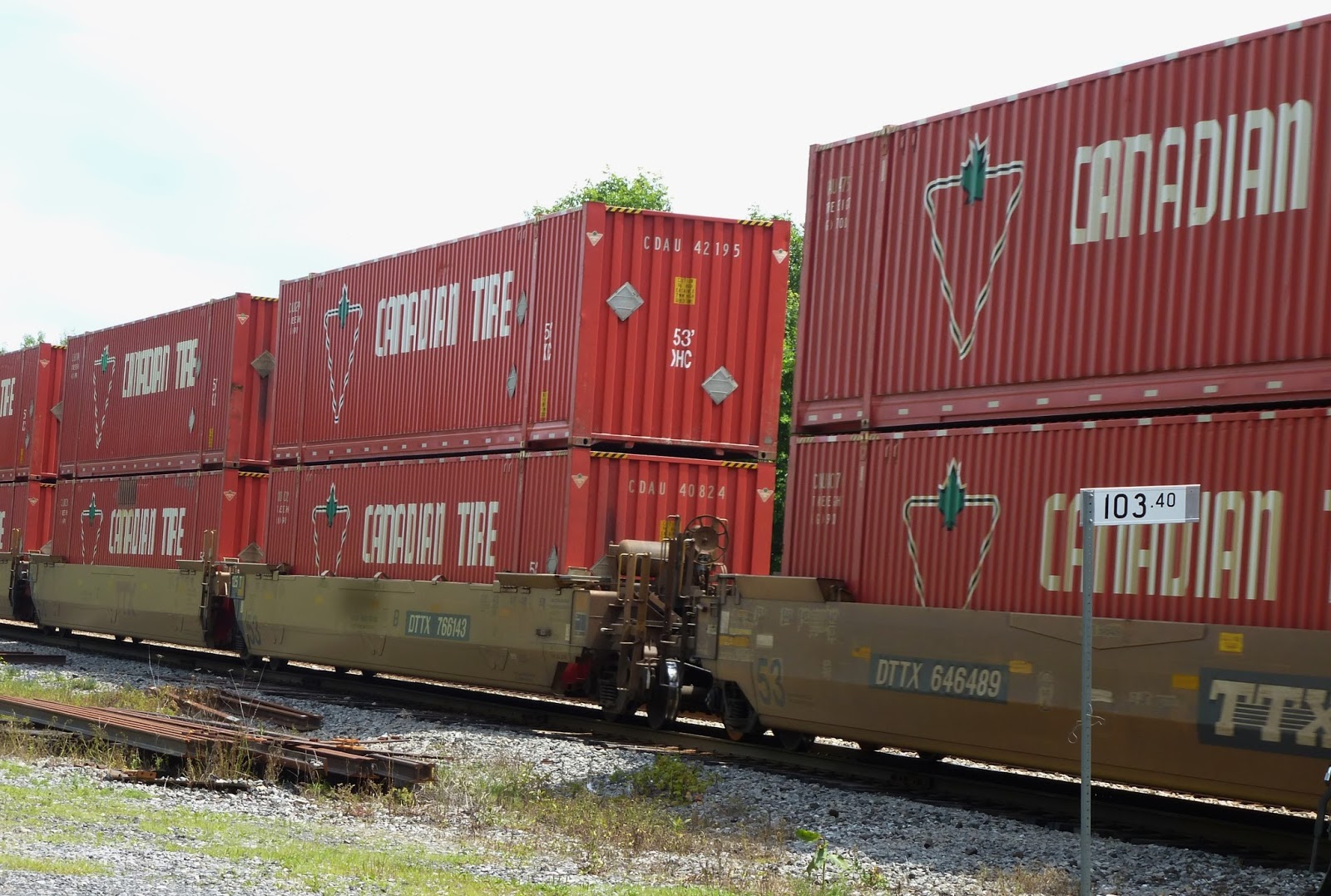
I doubt very much that container traffic is going to go the way of the boxcar anytime soon, but it's no reason for us to ignore the site. This shot above aptly captures the essence of modern railroading in 2017 (well, this shot is 2013, but you get the idea). It also gives you an idea of what a railway carries and who it serves, based on the stamps on the trailers (JB Hunt, Canadian Tire, MSC, etc.). This allows to more easily understand how railways work.


Now compare the all-too-common intermodal stack trains with something like an old high-cube boxcar. I took this shot in the Spring of 1991 in my hometown of Corunna. This boxcar, which still retained its Louisville and Nashville lettering (although patched for CSXT), was once a very common site where I lived. These massive boxcars carried auto parts and were abundant on the rail lines in Southern Ontario, since the big three (CN, CP and CSX) all served the auto plants and parts suppliers in the region.

Well, lo and behold, these boxcars are now a distant memory and it really hasn't been all that long (less than 30 years). I have a few shots of these old cars and am glad that I do. Not only do they seem more compelling now, but they also help to explain what it was like to be trackside 30 years ago.

So take that boring shot of a freight car. You might be glad you did one day.

Thursday, February 25, 2016

Rolling stock madness

The top photo is a bit of a tease, even though it's not much at first glace. This is my initial shot when I caught up with CN's Arnpror Local, otherwise known as 589, recently. I call your attention to the lone tank car in tow. Do you see the yellow badge on it? I was surprised when I grabbed a few shots of the unique tank car, which I had never seen before. Seeing this tank car reminded me that I have amassed a collection of rolling stock photos over the last few years. This week, I decided to share a few photos of the standout shots I have spied trackside along with a number of shots my brother took trackside in Sarnia. I will share better photos of the tank car in the photo below soon.


The first image is a beautiful shot my brother grabbed of an old Boston & Maine covered hopper, which was repatched for ATEL Leasing Corp. As common as it is to see generic railcars with marks belonging to leasing companies, it's always interesting to see the old markings of a fallen flag remain on a car. In this case, the car looks very much like it did when it plied the rails of the Boston & Maine, which became part of Pan-Am Railways Guildford Rail System (later Pan Am Railways) in 1983.


Here's another from my brother in Sarnia Yard. This hopper is one of many CSX predecessor cars still bearing the markings of its former railway. I am fascinated by CSX's history, since it includes such colourful railways including the Baltimore & Ohio, Chesapeake & Ohio, Seaboard Coast Line, Louisville & Nashville, Western Maryland and many others. In this case, Seaboard System was the combination of the component railways that made up the Family Lines System. Since it was such a short-lived railway, I find any of its relics to be great finds.


Here's another shot from my brother in Sarnia Yard. These boxcars, which are patched for a leasing company, still carry faint markings for the Maine Central railway, another of my favourite fallen flags. These cars don't have the prominent original markings like the two cars photographed above, but they are still great reminders of railroading's past.


This shot, below, was taken when I caught up with a Canadian Pacific freight train in Bedell, Ontario, in July 2014. Like most railfans today, double stacks don't really excite me much, but there was something about the symmetry of the Canadian Tire containers that I liked, so I snapped a few shots. I like this image for some reason, but I'm not sure why.


This car I found in Walkley Yard in August 2013. It was perched on a spur near the Rideau Bulk facility. So, what's the big deal with this car? Well, it's incredibly rare to see a coal/aggregate car in Ottawa for starters. Even though the city has a number of stone quarries  on Moodie Drive near the Smiths Falls Subdivision, none has rail service. I sometimes see a modified orange CN hopper in the local yard, but this was the only time I saw this UP car. I'm not sure what it was doing in the yard, but I'm glad I caught it.


This tank car below is very much like any other Procor tank car. These cars are everywhere throughout the North American rail network, but what I found interesting was the little logo next to the Procor logo. I figured it had something to do with what the tank car holds. I checked the hazardous materials placard and found that this car holds sulfuric acid. I don't see many of these cars up here, so I thought I would add in this seemingly mundane shot.


This shot, taken August 2013, shows a Wisconsin Central boxcar resting on the same spur at the Rideau Bulk facility. There are always a few boxcars at this facility, which makes any visits to Walkley Yard worthwhile for railfans. These cars have been tagged repeatedly and repatched. I took the shot because I have not seen many WC cars up here.


This shot, taken, March 2013, is probably a fairly common site elsewhere but I've only seen these hoppers in Ottawa a few times. The car belongs to American Railcar Industries and is your basic four bay covered hopper. I've seen this paint scheme on these cars before but am not sure who the previous owner was. It was a nice splash of colour on a day when the rail yard was full of tank cars.
 
 
I was particularly pleased with this image, taken August 2014 in Goderich. Sadly, I've yet to see any live action in Goderich in my visits to the town, but this string of hoppers in the Goderich yard was a nice consolation. I used this image in a previous post about Goderich but I figured it was worth another look. I call this shot the manmade rainbow. The position of the sun and the composition of the sky made this a near perfect shot for me.
 
 
This last shot I included for two reasons. One is this car is patched for Cabot Carbon, a Chemical Valley company that once had a full fleet of its own black hopper cars that CN spotted and hauled away. Those cars even had the Cabot logo on the side. So, this car brought back memories for me. The second reason I chose this shot is because this car is so odd looking. The car doesn't have the Cabot logo and seems to be a hybrid between two cars (in appearance anyway). It's not quite a box car, but has the dimensions of a boxcar. It's not quite a hopper car in appearance although it clearly has the trappings of a hopper car. This car was spotted by itself in Sarnia Yard one cold morning a few years ago.
 
 
This final shot was taken in Markham through a hole in a fence trackside. Again, there isn't anything that stands out in this shot, but I liked it because of the diversity of the containers. You can see the Hapag-Lloyd, JB Hunt and CN trailers, but also the Stolt tanks. It's a fairly representative shot of modern railroading.
 
 
So that is my brief recap of some of the best rolling stock shots I have amassed in the last few years. Hopefully, it at least illustrates that it's not just the head end of a train that is worth a look.


Friday, February 21, 2014

Favourite railway photos #2

This is the second installment of my favourite train photos series. In this post, I chose photos from the first year of this blog that I particularly like but wasn't able to use in my posts. I used the word "railway" in the title, since one of the photos isn't of a train, but of an old station. You can check out the first installment of this series here.

Okay, let's get started. The first shot is of the ceiling of Ottawa's old Union Station in downtown Ottawa,. The ceilings in this station were inspired by the Roman baths in Caracalla. I loved this shot because it shows three of the arched windows in the station's old waiting room. You can't help but stare at this magnificent ceiling when you enter this room. My family paid a visit to this magnificent old building during Doors Open Ottawa last summer. I like this shot because it shows quite a few of the architectural features of the old station. To read about this old station, check out my post from last year.


This shot below was from last September. This is long shot of a northbound O-Train crossing beneath the Young Street pedestrian overpass on Ottawa's Capital Railway. I like this photo because it was one of the first times I realized that you don't need to fill your entire frame with a train in order to achieve a dramatic railway photo. This was something I didn't realize when I was younger. I really like the light in this image as well as the colour of the foliage that lines either side of this line. You can also just barely see a red signal beneath the overpass. Lots going on in this photo. It's similar to a shot I used in my post from last fall, but I like the framing of this one much better. It makes me wonder why I didn't chose this shot in the first place. To read about the latest on this line, check out my post about the Capital Railway from last fall.


The story behind the next shot is interesting. I meant to use it as a basis for a post, but for whatever reason, I never did. This is a shot taken Aug. 10, 2013 in Markham of one intermodal train passing by a parked train, which is waiting for a clear signal to proceed. The shot itself isn't all that special, but I like the fact that I had to really hustle to get this shot. I had to park along Woodbine Avenue and wait on the sidewalk of an overpass to catch a train. Fortunately, I didn't have to wait long as an intermodal train came roaring eastward toward the overpass. After grabbing a few shots, the train stopped as I heard another one making its way on the opposite track. Two for one! It was a lucky moment for me.

I liked my shots from the overpass, but I wanted something else. So, when I heard the other train coming, I ran the length of a parking lot that was next to the railway right of way. When I reached the end of that parking lot, I made my way through a hole in a fence into another parking lot, which lead to a frayed fence. I stepped through the fence and proceeded down a weed-choked embankment so I could get a close-up shot of the trains. The problem I encountered when I walked down to track level was that the weeds were so thick, I couldn't actually see the approaching train. You can see some of the weeds and trees in this shot, which were unavoidable. This was all I could catch of the lead unit, CN 5622, as it hustled by.

But, I was pleased with the shot because it had two trains in it, some beautiful blue sky, a few clouds and some movement. For a train-starved Ottawa resident, this is about as good as it gets.


The last shot was snagged last October in Sarnia along CSX's Sarnia Subdivision. Catching this Chessie System bay window caboose, which was hitched to a CSX-painted bay window caboose, was a great catch, since these cabooses were rare 15 years ago when I used to regularly photograph trains on the sub. They are still in use on this sub for shoving movements, making them pretty rare survivors. Seeing this old relic still in use and in relatively good shape brought back great memories for me. Read about my adventures chasing cabooses here. 


Once again, I find it's not usually the photos that I value as much as the stories attached to them.

Thursday, September 26, 2013

Why Railways Matter (And Why I Blog About Them)

It all started with a few photos at Fallowfield Station.

My wife was on her way to London, to be an adjudicator in music festival in April 2012. I took her to the station where we waited for Train 55 to take her to Toronto and beyond. We watched from the platform as a P42 and streamliner consist made its way past the Woodroffe Avenue crossing to the station in Ottawa's suburban southwest end. I had been thumbing through prints of old train photos for months at home and had been considering what to do with them.

As the train pulled in, I snapped a number of photos, including this one below, not really knowing why. I liked what I saw, but I thought I could do something more with the photos other than add them to my computer.


Earlier that year, I had written a story about plans to start a shortline railway along the inactive CN Beachburg Subdivision for a now shuttered news site, OpenFile.ca. The initial story spawned a follow-up, although it didn't generate much of a response. As I stood at the Corkstown Road crossing along the Beachburg Sub, snapping photos for the story, I found myself lingering around the crossing, wondering what it would be like to have an active rail line so close to my home. At that point, I hadn't yet thought about taking photos, but the seeds had been planted.


Before I knew it, I was bringing my camera to Fallowfield Station whenever someone was coming to town to visit us or when we sent them home. I justified bringing the camera by telling myself that I hadn't landed a shot of an F40PH-2 yet, or I handed landed a shot of LRCs (like 6446 with Train 55 below) yet or I hadn't landed a shot of Renaissance cars yet. On and on it went. I kept telling my wife that it was a just a little harmless diversion. So she thought.


She should have known better. As you may know, the railways have a long history in my family.

Soon after those trips to Fallowfield, I talked to a few bloggers about ideas for a blog, because I knew I had a fair number of old train photos from the 1990s and had some thoughts to share. After some thought, I just started blogging. Before I knew it, I found myself taking photos of trains whenever I could find time. It's been tough to find time since I have a young daughter and a wife who works evenings, but I have managed to get a bunch of new photos and great story ideas.

Case in point: I took this photo (below) along Highway 401 when my family was travelling to Toronto on August 9th. I tried to catch a westbound Via just east Kingston, but this was all I managed to capture. The point is, I knew then I was hooked. I loved sharing my passion with railways in the few spare moments I can find.


I am now getting comfortable in my little corner of the internet, doing what I can to preserve the memory of railroading past and trying to get people thinking about the importance railways can still play in our country. I mention this because Ottawa is the city where railroading went to die. Much of what's left of our rail system here has been banished to the margins of the city. We have done little to preserve the railway tracks left in our city, but now find ourselves spending billions of dollars to build new railway lines and tunnels for a problematic light rail system. I am hoping that my blog can at least get people thinking about preserving what we have left here and investing in the future of this mode transportation in Ottawa and beyond. 

CN SD70 5622 speeds westward as an eastbound intermodal waits on the opposite track, near Woodbine Avenue in Markham, Ont. on August 10.

This is all a long-winded way of reflecting on my first few months of blogging. I also wanted to share some positive thoughts on railroading in Ottawa following the horrific bus-train collision last week in the city.

I was disappointed that many commentators and pundits here have suggested that the level crossing where the accident occurred is inherently unsafe. I find this statement highly speculative and unfortunate since so little is known about the crash. Those who follow this industry know that level crossings with working signals and safety barriers are perfectly safe, provided that everyone follows the rules, which means both train operators and motorists. I think part of the reason why there was so much speculation about this crossing has to do with the fact that Ottawans just aren't that knowledgeable about how railways work since so little of the rail system in this city remains.

Last week's accident only reinforces my conviction that train bloggers, no matter where they are, play an important role in ensuring that this crucial mode of transportation remains a vital part of this country.