Friday, December 13, 2013

Winter railroading in Ottawa

Winter has unquestionably arrived in Ottawa, which has allowed me to correct a longstanding gap in my railway photograph collection. Searching through my images the other day, I realized that I had but one winter railroading photograph. With that in mind, I lugged my camera into the arctic air to get some shots of the most Canadian of scenes: trains trudging through the snow.

The first shot, which I grabbed this past week, was Via Rail No. 33 arriving at Ottawa Station from Montreal, with P42 910 leading an all-Renaissance consist. The long shadows in the morning light, combined with the restricted vantage points around the station, made this shot tricky. I wasn't thrilled with it, but I do like seeing the exhaust from the locomotive in the crisp winter air. There wasn't much activity at the station at this point, so I didn't stick around.


On Dec. 7, I made one of my periodic visits to Walkley Yard to see if there was anything interesting to shoot. My daughter accompanied me for the first time, although she was busy watching Barney in the back seat. I did find several of these tank cars in the yard, which were a nice surprise. This tank car, Procor 50265, upon closer inspection, has a marking reading "Fluid Recycling Services" painted over on the left side. As to what fluids it carried, I'm not sure. I dug around a bit online but didn't find anything conclusive. Maybe a reader knows more than I do.


I also spotted CN's two local cabooses side by side near CN's local offices. I've shared photos of these two cabooses before, but never together. From what I've noticed, the former Devco Railway caboose never seems to move from this spot in the yard, which makes me wonder if it's operational at all. The old millennium caboose seems to be the unit of choice. The graffiti on the Devco caboose makes me shake my head. How bad is security in this rail yard?


I've shared photos of this old RDC unit before. I'm lucky that there is a service road running the length of the east end of the rail yard, which allows an excellent vantage point of this old gem. I noticed some interesting light and the cloud movement as I drove by, so I took a quick photo and was quite happy with the result. I wanted to capture a shot of this old unit, hooked to a former CN caboose, in a way that makes it look as though it's moving.

The best thing about shooting in the winter is the overgrown weeds in the yard are gone, which allows me to get a full shot of the RDC, complete with the old trucks and undercarriage. One of the small perks of this arctic weather.


Thursday, December 5, 2013

Goderich's Railways: Then and Now

I love Goderich. It's a beautiful town on the shores of Lake Huron, which was once described as one of the country's "prettiest towns" by Queen Elizabeth. It has a rich history, much of which is preserved in the town's older quarter. Most importantly for our purposes, Goderich has long been a railway town. I recently visited family near Goderich for the Thanksgiving weekend and was able to get a few up-to-date photos of the town's wonderful train stations.

That's right! This town has actually preserved both of its stations.

Luckily, my parents visited Goderich a few times in the early 1990s and took some great photos of the railway operations then. The shot below is the Canadian National railway station in the early 90s. By this time, the railway operations had been sold off to the Goderich Exeter Railway, which would mean the photo is post 1992. You can see the old green and cream coloured GEXR GP9 locomotive on the right of the photo. These engines once sported Shakespeare inspired names, since the railway is based in Stratford. More on this in a later post.


As mentioned, Goderich has a long and proud railway history. The GEXR rails have an interesting lineage themselves. Before the short line operator took over (GEXR itself has been a RailTex, RailAmerica and Genesee & Wyoming concern), the line was CN. The CN operation was inherited from the Grand Trunk, which took over a railway by the name of Buffalo & Lake Huron Railway. That means parts of the rails in Goderich date back to 1859.

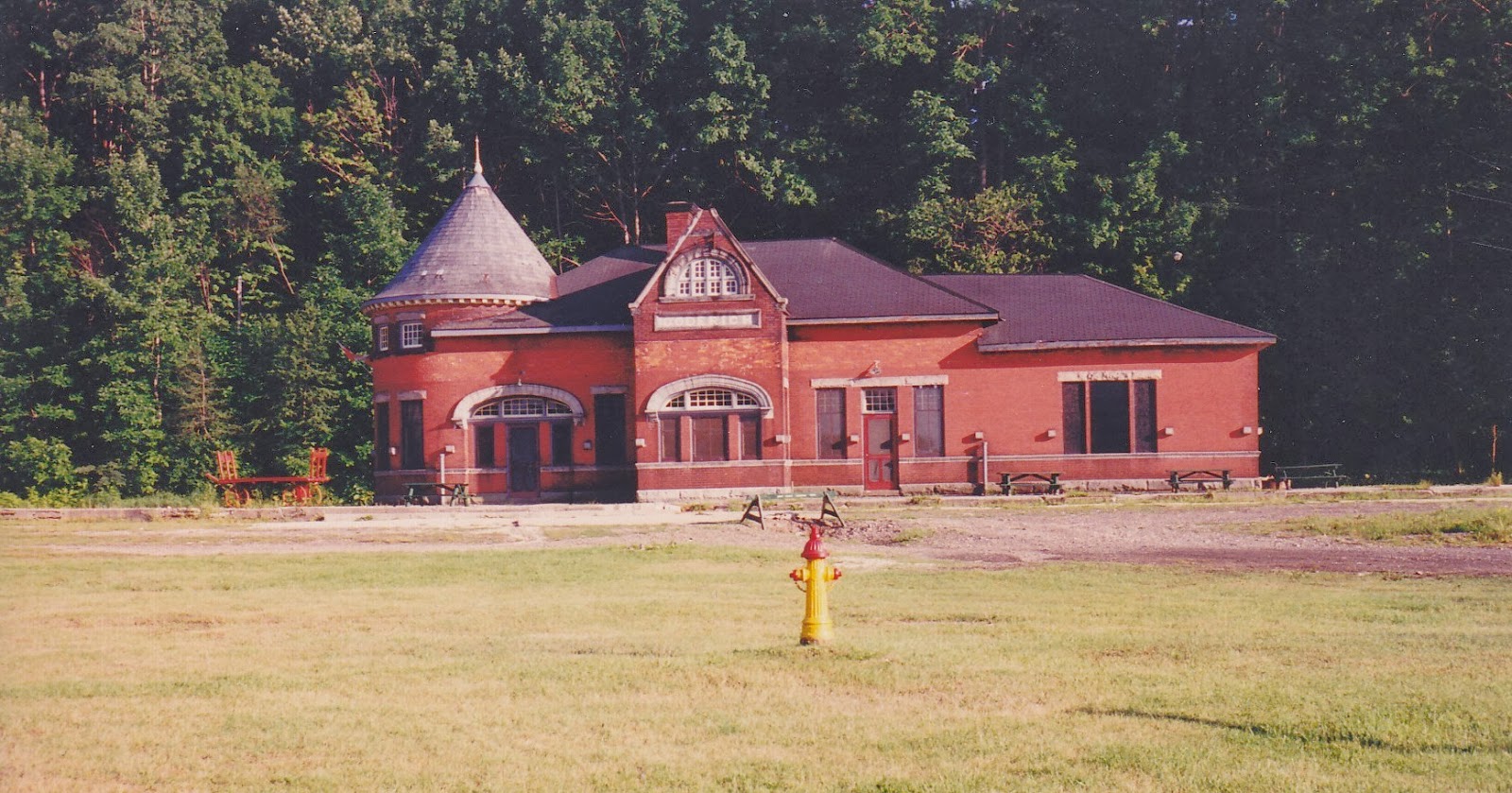
The Canadian Pacific also laid rails to Goderich in 1907, seeing as how the town was a key cargo port on the Great Lakes and had long prospered, thanks to the enormous salt deposits in the area. The CPR built this beautiful rail station (below) near the Goderich harbour. The passenger service was axed in the 1960s and the entire CPR line was pulled up sometime afterward, but the building was preserved by the town. For decades, it sat at the bottom of a bluff, existing as a town storage facility. I remember once looking into the station and seeing Christmas decorations and pieces of parade floats. In the shot below, you can see the old luggage cart still sitting on the old platform. A beautiful old trestle nearby over the Maitland River has also been preserved as a public trail.


In the last two years, the town has been busy rebuilding after a devastating F3 tornado ripped apart much of the town's octagonal town square and surrounding neighbourhood in August 2011. One of the initiatives included moving the old CPR station from its lonely spot near the bluffs to a spot facing the lake and the town's public beach. An entrepreneur is opening a restaurant in the old station and adding an adjacent convention facility, which will be physically attached to the old station. You can see the Goderich lighthouse at the top of the bluff to the right.


The station looks to be in decent shape, despite being jarred from its home and moved a few hundred metres to its new spot via a giant flatbed truck. As you can see below, a fair bit of work needs to be done to the exterior facade, which has not been given much attention in the past few decades. Still, it's good to see this beautiful old station being put to good use.


I managed to venture across the downtown to the old CN station to see what was happening there. My father-in-law told me that the town has also renovated this old station and used it as a performing arts venue. You can see some subtle changes between the top photo and this one, including the lattice in the front windows. Also, to the right of the photo, you will see a lonely hopper car and a few industrial buildings. Those structures are part of the GEXR's operations, which serve a nearby Sifto Salt processing facility, which was once part of a Volvo heavy machinery plant that was recently closed and moved south to the U.S.


As you can imagine, there was nothing happening on the rails over the Thanksgiving weekend, but I did get a quick snap of a few covered hoppers awaiting loads at a loading dock near the old CN train station. Those tracks beyond the crossbucks lead to the Sifto salt mine on the lake.


Taking a close look at both stations, you will notice some architectural flourishes, including the witch's hat turrets and archways, that were not all that common for small-town railway stations at the time. It is also worth noting that a third railway once attempted to reach Goderich, but ultimately failed. When you examine the town's rail history and take a close look at both of its stations, you can understand just how important railways once were to small-town Canada. 

Thursday, November 28, 2013

Bullet Nose Betty and other family shots

Although I am by far the biggest railway fan in my family, we all have a certain fascination with trains to some degree. With that in mind, I thought I'd share some railway photos taken by family members that have been left in my care.

As I have previously mentioned, my Dad worked for the Candian Pacific Railway in his teens in Windsor, Ont. He had been offered a job with the railway, but was lured away by a better offer from what was then known as Ontario Hydro. However, in our family photo archives, there are some scattered railway photos that my Dad took with his excellent Canon 35-mm camera.

My Dad took this shot below in 1987, I believe. The locomotive is a Canadian National U-1-f class steam engine, more commonly known as a 4-8-2 mountain-type. The engine was one of 20 such workhorses built for the CNR in 1944 by Montreal Locomotive Works. 6069 was converted from coal to oil at some point, although some of the 20 4-8-2s were originally constructed as oil-burners. Nicknamed "Bullet Nose Betty" for its cone-shaped smoke box door cover at the front of the engine, this beast has been on display in Sarnia's Centennial Park for about 40 years, with its original dark green trim. The weather has been tough on the locomotive, which has prompted local rail enthusiasts to restore the engine. Two other 4-8-2s like this one remain on display, one in Alberta and one in Capreol, Ont.

You can see a piece of CN's old Point Edward spur in the extreme left of the photo. This track leads to the grain elevators on Sarnia's waterfront. This line is still operational, as CN continues to service the elevators on this tiny branch through the park. Those wishing to see Betty these days are out of luck. Due to its industrial past, Centennial Park has been quarantined due to asbestos in the soil. It is not known when the park will be cleaned up and re-opened for public use.


This second photo was taken by my sister, in August of 1992. As I mentioned in my two previous posts (Banff 1992 Part I and Part II), my sister lived in Banff during this summer and took me to Banff Station to let me get some of the best train photos I have ever taken. After I visited her in Banff, my sister and a friend went to Jasper National Park one weekend on a hiking adventure. It was during this weekend that she went out of her way to visit the local rail yard to capture a few photos for me. I like this one because it features two SD-40-2Ws, 5289 and 5331. What I also like about the shot is that it captures part of an old CN caboose (far right).


This final shot is the image that inspired this post. My brother, like me, has always been fascinated by trains. In my teens, he often helped me with my train set and often drove me around to rail yards, when I was too young to drive. While at work a few weeks back, I received an email from him while he was on the road for business in San Diego. The shot was taken from his hotel room in the city. He took a quick shot of a BNSF autorack train making its way through the city. He isn't as up to date on railways as me, but he correctly identified that BNSF stood for Burlington Northern Santa Fe, although BNSF technically stands for nothing these days. What strikes me about this photo is one of the locomotives leading the train has been defaced with graffiti. I don't see that often.


My family has always been understanding of my passion and has contributed over the years. I'm thankful that they did.