To honour Via Rail Canada’s 40th anniversary, I am sharing some of my favourite Via Rail memories from my numerous adventures along the Quebec City-Windsor corridor. Last week, I shared my first 10 memories. Here are ten more.
11. It’s been three years since I last took the train. The last time I was on a Via Rail train was in 2015 when I had to go to Montreal for an appointment. The reason this memory sticks out is that it was the first time I had been away from my young family (my oldest daughter was three at the time when my youngest was nine months). As much as I missed my family, it was such a peaceful day! That day afforded me many rail memories, which you can read about here and here.
12. This is not really my memory, per se, but a story that was related to me by someone who used to work as part of Via Rail’s staff at Union Station in Toronto. I won’t get into too many details, to protect the innocent, but this was the story that was told to me. My contact was part of a crew whose duties included loading baggage cars and helping people on the platform in the train shed. One day, a few employees were bringing a casket to a baggage car so it could be transported somewhere for a funeral or memorial service. For whatever reason, something went horribly wrong and the casket tumbled from the platform onto the tracks, body included, obviously. I can’t imagine how this would be explained to a supervisor. I also can’t imagine the process of fixing this situation.
13. In 2010, a few days after I married the love of my life, my wife and I boarded a train from Ottawa to Quebec City for our honeymoon. For years, I had been saving Air Miles with no particular end goal in mind. One of my main responsibilities in the lead-up to my wedding was the plan the honeymoon. In a stroke of genius, I redeemed all my Air Miles and brought Via Rail gift cards, which I then used to purchase two round-trip first class tickets to Quebec City.
14. Arriving at the Quebec City train station, both as a child and then as an adult on my honeymoon. This station is one of the best railway stations, period. You don’t forget your initial experiences in this place. It is a jewel.
15. One of my favourite stretches of track to travel is the (now) Goderich Exeter Railway line through St. Mary’s, Ontario. The first few times riding this stretch of railway still evoke fond memories. This town is still served by Via Rail. When you come into town on the Sarnia Bridge over the Thames River, you feel as though you have been transported back in time. The pastoral view evokes memories of a bygone era, when idyllic small towns owed their existence to the railway. Four daily trains still serve this town.
16. That time when I wanted to capture some dramatic winter railroading shots at Ottawa Station and I came away with these dramatic images, thanks to a wind storm.
17. When my second daughter came into the world, she didn’t like me all that much, which was not surprising. However, when my wife went to work and baby had to spend time with me, I decided that a car ride would calm her down. I was right. That began a few months of wonderful jaunts through the countryside in west Ottawa looking for photo opportunities along the Smiths Falls subdivision. This might be my favourite shot from that time.
18. When I started getting a little more adventurous with my railway photos, I came across this stretch of McKenna Casey Drive in Ottawa’s west end. I captured this shot of a Via Rail corridor train while a summer storm barrelled into town from the south.
19. My sister spent a summer working in Banff and I was lucky enough to be able to go visit her. She was nice enough to take me to Banff station, where I did some ridiculously cool railfanning, which you can read about here and here. Also, over the course of our adventures, we were able to check out the old Lake Louise passenger station, when it was still in service. We didn’t see any trains when we were there, but that station might be one of the best in Western Canada. It’s too bad the Canadian doesn’t call there anymore.
20. The first time I took my oldest daughter with me to the train station, in this case Fallowfield, her lasting memory of the experience was not at all what I expected. I sat her down trackside and tried to teach her a few things about rail safety. I took a short video and the engineer was nice enough to wave at Sarah and her foamer dad. But, my daughter was much more fascinated with a crow that was craning its neck sideways to drink out of a meager puddle in the parking lot. She still talks about it. Sigh. I guess the railfan gene might have skipped a generation.
Showing posts with label Banff. Show all posts
Monday, December 3, 2018
Friday, November 18, 2016
This is why I bleed action red
Let's forget about Hunter Harrison, Bill Ackman, Pershing Square Capital Management, operating ratios, profit per share and the rest of the soap opera that has typified the Canadian Pacific Railway's recent history. Let's forget about blind trusts, Norfolk Southern, hostile takeovers and everything else. Let's forget for a moment the argument that rail systems need to span the entire continent. All of these items are worthy of discussion, but there's something more important about the CPR that is worth considering.
Canadian Pacific's Rideau at Ottawa's Central Station in 1967. I had this postcard for years before losing it. I had it so long I didn't even know who gave it to me. I was lucky that I got another copy from Trackside Treasure blogger Eric Gagnon. Thanks Eric!
The Canadian Pacific Railway is quite far removed from that iconic entity that brought Canada together from sea to sea in the late 1800s. I'm not naïve enough to think that this railway is anything other than a for-profit company that is beholden to its bottom line and shareholders. We live in a capitalist country and I don't have a problem with a company doing all it can to earn as much as it can. That's how it works.
But I'm disappointed with this railway because it means so much more to me. The Canadian Pacific's history runs deep in my family. At one time or another, just about all my uncles, my father and both my grandfathers worked for this company. I'm immensely proud of that fact because the CPR is more than just a company in Canada's history.
So, why am I disappointed with all the shenanigans that have typified the railway's recent history? Well, from a personal point of view, I think the company can do more to honour its rich history. I think it's better than this.
But to truly explain just how deep this company runs in my family, I'd like to share a few stories.
Let's start with my grandfather, Egidio. My grandfather (I called him Nonno) was born in northern Italy and came to Canada after World War II to build a new life for his family. My Nonno was pressed into enlisting for Mussolini's army and was forced to fend for himself in what was then Yugoslavia after the Italian army disbanded when Il Duce was overthrown.
My Nonno, Uncle John and me at Heritage Park in Calgary in the summer of 1992. You can see a piece of the park's passenger train in the background.
I'd imagine that he likely had seen enough by war's end and welcomed the opportunity to come to Canada. When he did, he found work as a general labourer for the Canadian Pacific in the Crowsnest Pass area. I only know this from my Uncle John. My Nonno spoke very little English, even though he lived in Canada for fifty years. He knew I liked trains and once gave me a book Canadian Railway Scenes Vol. I by Adolph Hungry Wolf. He would sometimes mimic the motions of a steam engine to me to try and explain what he did. As I grew older and learned more about railways, I knew that what he did wasn't glamorous. He fixed tracks, tamped down ballast and did a lot of the grunt work that often goes unnoticed. It was hard work. For my Nonno, it helped build a future for his family, including my Mom.
My other grandfather, Paul-Émile, worked for the Canadian Pacific in Chapleau, a town in Northern Ontario that owes its existence to the CPR, since it served as a servicing point along the transcontinental main line. My grandfather worked as a rolling stock mechanic in Chapleau and then Windsor. Again, since he didn't speak a great deal of English, I mainly know about his work through stories he told my Dad and uncles.
My grandfather and me in Mirabel, Quebec, 2005
And the stories are amazing. My Dad told me this summer about some of the more colourful duties that fell to my grandpa. Whenever there was a wreck, my grandpa was dispatched to the crash site to help repair the cars and get them back on the rails so they could be towed back to Chapleau to be fixed properly. My grandpa also was dispatched to crashes when he was transferred to Windsor. You can see a photo of one of these wrecks in this post.
My Dad told me that my grandpa was often away from home for weeks, which makes sense considering how much territory there is west of Chapleau where the railway crosses nothing but wilderness. One of the fringe benefits of going to these crash sites would be that the crews were able to take home the damaged merchandise that fell out of the boxcars. My Dad said my grandpa would often return home loaded with all sorts of things that had fallen out of the boxcars and couldn't be salvaged otherwise.
My grandfather worked for the railways for decades and brought me aboard my first locomotive in Windsor when I was very, very young. I still remember him sitting me in the engineer's seat and showing me how the engine worked. Years later, when I was a teen, he brought me back to the Windsor yard, where I was able to take photos from a vantage point I wouldn't otherwise have access to. His former co-workers greeted him warmly when he showed up and told him how much they could use his expertise at the yard.
Canadian Pacific yard in Windsor in 1991
This summer, my Dad told me about another chapter in our family's railway history. When my Dad was in grade nine or ten, he landed a job with the Canadian Pacific in Chapleau. On Sunday nights, he would board a train westbound toward Manitoba. He would ride a caboose in the back of a freight train. He carried a box of food for himself for a week. At a given point, the train would stop and let off my Dad and a few others. Over the course of a week, my Dad would bunk in a trackside bunkhouse and spend his days repairing tracks "in the middle of the bush" (his words). He said that his supervisor would keep in touch with dispatchers via a trackside phone so the crew would know when to keep clear of the tracks when a train was coming through. This work would continue through the week until my Dad boarded an eastbound freight and returned to Chapleau.
My Dad said he spent a summer doing this work. His older brother, my Uncle Claude, did the same thing, although my Dad said my uncle worked further west on the line. Both my uncle and my Dad told me it was incredibly hard work. They also spoke of working with local First Nations youth on these track gangs. The First Nations part of the crew would work half days, since they were expected to spend their afternoons hunting and fishing.
Later, when my Dad's family moved to Windsor, he worked with my Grandpa in the Windsor yard, doing things like trackside inspections and greasing the bearings on the old freight cars. Again, he said the work was incredibly hard, which made his decision to work for Ontario Hydro much easier. At one point, the railway offered my Dad a job, but the railway dynasty wasn't to be.
My Dad's little brother, my Uncle Michel, did work for the railways for a while, working for Via Rail at Toronto's Union Station, but that was it. My cousin worked for CP for several years in dispatch before he moved on to another career in the railway industry.
Me on board an old Canadian Pacific switcher at the Railway Museum of Eastern Ontario in Smiths Falls, Summer 2015
And then there's me. My connection with this railway has been peripheral at times, but it seems as though the CPR has always been there.
Going to Windsor to visit my grandparents as a kid was always a highlight, since it pretty much was a guarantee that I would see a CP train. There was one crossing at Howard Avenue that was the best bet, since it wasn't far from the CP Yard and the old Michigan Central Railway tunnel. I remember how excited I was when a long freight train would slowly pass by, as motorists on the busy thoroughfare would patiently wait. That crossing was replaced by a flyover a while ago.
When we visited my Nonno's house, also in Windsor, I used to stand at the end of his driveway, since his street, Wellesley, provided a direct view to the CP tracks. For a young railfan, it didn't get any better than this. Seeing the old multimark go by was a thrill for me, since I mainly saw Chessie System trains in my hometown of Corunna.
Then there was the summer of 1992 when I went to Alberta by myself to visit family, including my Nonno and Uncle John. That trip included a few days in Banff where I visited my sister, who was working there for the summer. One of my best memories of that trip was railfanning at Banff station where I saw this unit grain train. (You can read about my railfanning in Alberta in this post and this post.)
When I worked for the newspaper in Peterborough, I remember watching the Kawartha Lakes Railway trains rush by our newspaper offices at night, en route to the Nephton mines. There were a few times when I would have to stop my evening jogs after work when a train was passing through town. It was always nice to feel that draft of wind when the train passed by.
I often travelled the Highway 7 between Peterborough and Ottawa during that time of my life. The highlight of the drive was very often going through Havelock, where the Kawartha Lakes Railway still maintains a small rail yard that parallels the highway before the line branches off to the Nephton mines. I often considered pulling over on my trips to and from Ottawa to take pictures, but I never did since I wasn't in the habit of taking rail photos then like I am now.
More recently, since I began this blog, I have had a few occasions to see some CP action in Bedell (You can read about my most recent time there in this post).
Empty CP ethanol train westbound at Bedell, Summer 2016
The whole point of these stories is that this railway has always been a part of my family's story and a part of my story as a railfan.
That is why all this drama surrounding the railway makes me sad. I won't argue the economics of mergers or the improved performance that the railway has shown under its current management. Like I said, it's a public company and it is doing a good job of making money for its shareholders.
But I also know from a number of sources that the morale in the company is low. I know that its CEO is not terribly respected by the rank and file, although it's no mystery why he is loved by investors. I won't get into the particulars because it's not my place.
I will only say this. I think this company can do better to live up to its legacy. There are no doubt many other families with similar stories to that of my family. And there are many other stories of how this railway has helped shaped Canada.
I don't begrudge the company for wanting to do the best it can.
But I think the Canadian Pacific is better than what we've seen in the last few years. Be profitable, sure. But never forget your roots because there are countless Canadians that contributed so that company could endure.
I'm not sure today's CP truly appreciates that.
Canadian Pacific's Rideau at Ottawa's Central Station in 1967. I had this postcard for years before losing it. I had it so long I didn't even know who gave it to me. I was lucky that I got another copy from Trackside Treasure blogger Eric Gagnon. Thanks Eric!
The Canadian Pacific Railway is quite far removed from that iconic entity that brought Canada together from sea to sea in the late 1800s. I'm not naïve enough to think that this railway is anything other than a for-profit company that is beholden to its bottom line and shareholders. We live in a capitalist country and I don't have a problem with a company doing all it can to earn as much as it can. That's how it works.
But I'm disappointed with this railway because it means so much more to me. The Canadian Pacific's history runs deep in my family. At one time or another, just about all my uncles, my father and both my grandfathers worked for this company. I'm immensely proud of that fact because the CPR is more than just a company in Canada's history.
So, why am I disappointed with all the shenanigans that have typified the railway's recent history? Well, from a personal point of view, I think the company can do more to honour its rich history. I think it's better than this.
But to truly explain just how deep this company runs in my family, I'd like to share a few stories.
Let's start with my grandfather, Egidio. My grandfather (I called him Nonno) was born in northern Italy and came to Canada after World War II to build a new life for his family. My Nonno was pressed into enlisting for Mussolini's army and was forced to fend for himself in what was then Yugoslavia after the Italian army disbanded when Il Duce was overthrown.
I'd imagine that he likely had seen enough by war's end and welcomed the opportunity to come to Canada. When he did, he found work as a general labourer for the Canadian Pacific in the Crowsnest Pass area. I only know this from my Uncle John. My Nonno spoke very little English, even though he lived in Canada for fifty years. He knew I liked trains and once gave me a book Canadian Railway Scenes Vol. I by Adolph Hungry Wolf. He would sometimes mimic the motions of a steam engine to me to try and explain what he did. As I grew older and learned more about railways, I knew that what he did wasn't glamorous. He fixed tracks, tamped down ballast and did a lot of the grunt work that often goes unnoticed. It was hard work. For my Nonno, it helped build a future for his family, including my Mom.
My other grandfather, Paul-Émile, worked for the Canadian Pacific in Chapleau, a town in Northern Ontario that owes its existence to the CPR, since it served as a servicing point along the transcontinental main line. My grandfather worked as a rolling stock mechanic in Chapleau and then Windsor. Again, since he didn't speak a great deal of English, I mainly know about his work through stories he told my Dad and uncles.
My grandfather and me in Mirabel, Quebec, 2005
And the stories are amazing. My Dad told me this summer about some of the more colourful duties that fell to my grandpa. Whenever there was a wreck, my grandpa was dispatched to the crash site to help repair the cars and get them back on the rails so they could be towed back to Chapleau to be fixed properly. My grandpa also was dispatched to crashes when he was transferred to Windsor. You can see a photo of one of these wrecks in this post.
My Dad told me that my grandpa was often away from home for weeks, which makes sense considering how much territory there is west of Chapleau where the railway crosses nothing but wilderness. One of the fringe benefits of going to these crash sites would be that the crews were able to take home the damaged merchandise that fell out of the boxcars. My Dad said my grandpa would often return home loaded with all sorts of things that had fallen out of the boxcars and couldn't be salvaged otherwise.
My grandfather worked for the railways for decades and brought me aboard my first locomotive in Windsor when I was very, very young. I still remember him sitting me in the engineer's seat and showing me how the engine worked. Years later, when I was a teen, he brought me back to the Windsor yard, where I was able to take photos from a vantage point I wouldn't otherwise have access to. His former co-workers greeted him warmly when he showed up and told him how much they could use his expertise at the yard.
Canadian Pacific yard in Windsor in 1991
This summer, my Dad told me about another chapter in our family's railway history. When my Dad was in grade nine or ten, he landed a job with the Canadian Pacific in Chapleau. On Sunday nights, he would board a train westbound toward Manitoba. He would ride a caboose in the back of a freight train. He carried a box of food for himself for a week. At a given point, the train would stop and let off my Dad and a few others. Over the course of a week, my Dad would bunk in a trackside bunkhouse and spend his days repairing tracks "in the middle of the bush" (his words). He said that his supervisor would keep in touch with dispatchers via a trackside phone so the crew would know when to keep clear of the tracks when a train was coming through. This work would continue through the week until my Dad boarded an eastbound freight and returned to Chapleau.
My Dad said he spent a summer doing this work. His older brother, my Uncle Claude, did the same thing, although my Dad said my uncle worked further west on the line. Both my uncle and my Dad told me it was incredibly hard work. They also spoke of working with local First Nations youth on these track gangs. The First Nations part of the crew would work half days, since they were expected to spend their afternoons hunting and fishing.
Later, when my Dad's family moved to Windsor, he worked with my Grandpa in the Windsor yard, doing things like trackside inspections and greasing the bearings on the old freight cars. Again, he said the work was incredibly hard, which made his decision to work for Ontario Hydro much easier. At one point, the railway offered my Dad a job, but the railway dynasty wasn't to be.
My Dad's little brother, my Uncle Michel, did work for the railways for a while, working for Via Rail at Toronto's Union Station, but that was it. My cousin worked for CP for several years in dispatch before he moved on to another career in the railway industry.
Me on board an old Canadian Pacific switcher at the Railway Museum of Eastern Ontario in Smiths Falls, Summer 2015
And then there's me. My connection with this railway has been peripheral at times, but it seems as though the CPR has always been there.
Going to Windsor to visit my grandparents as a kid was always a highlight, since it pretty much was a guarantee that I would see a CP train. There was one crossing at Howard Avenue that was the best bet, since it wasn't far from the CP Yard and the old Michigan Central Railway tunnel. I remember how excited I was when a long freight train would slowly pass by, as motorists on the busy thoroughfare would patiently wait. That crossing was replaced by a flyover a while ago.
When we visited my Nonno's house, also in Windsor, I used to stand at the end of his driveway, since his street, Wellesley, provided a direct view to the CP tracks. For a young railfan, it didn't get any better than this. Seeing the old multimark go by was a thrill for me, since I mainly saw Chessie System trains in my hometown of Corunna.
Then there was the summer of 1992 when I went to Alberta by myself to visit family, including my Nonno and Uncle John. That trip included a few days in Banff where I visited my sister, who was working there for the summer. One of my best memories of that trip was railfanning at Banff station where I saw this unit grain train. (You can read about my railfanning in Alberta in this post and this post.)
When I worked for the newspaper in Peterborough, I remember watching the Kawartha Lakes Railway trains rush by our newspaper offices at night, en route to the Nephton mines. There were a few times when I would have to stop my evening jogs after work when a train was passing through town. It was always nice to feel that draft of wind when the train passed by.
I often travelled the Highway 7 between Peterborough and Ottawa during that time of my life. The highlight of the drive was very often going through Havelock, where the Kawartha Lakes Railway still maintains a small rail yard that parallels the highway before the line branches off to the Nephton mines. I often considered pulling over on my trips to and from Ottawa to take pictures, but I never did since I wasn't in the habit of taking rail photos then like I am now.
More recently, since I began this blog, I have had a few occasions to see some CP action in Bedell (You can read about my most recent time there in this post).
Empty CP ethanol train westbound at Bedell, Summer 2016
The whole point of these stories is that this railway has always been a part of my family's story and a part of my story as a railfan.
That is why all this drama surrounding the railway makes me sad. I won't argue the economics of mergers or the improved performance that the railway has shown under its current management. Like I said, it's a public company and it is doing a good job of making money for its shareholders.
But I also know from a number of sources that the morale in the company is low. I know that its CEO is not terribly respected by the rank and file, although it's no mystery why he is loved by investors. I won't get into the particulars because it's not my place.
I will only say this. I think this company can do better to live up to its legacy. There are no doubt many other families with similar stories to that of my family. And there are many other stories of how this railway has helped shaped Canada.
I don't begrudge the company for wanting to do the best it can.
But I think the Canadian Pacific is better than what we've seen in the last few years. Be profitable, sure. But never forget your roots because there are countless Canadians that contributed so that company could endure.
I'm not sure today's CP truly appreciates that.
Thursday, November 28, 2013
Bullet Nose Betty and other family shots
Although I am by far the biggest railway fan in my family, we all have a certain fascination with trains to some degree. With that in mind, I thought I'd share some railway photos taken by family members that have been left in my care.
As I have previously mentioned, my Dad worked for the Candian Pacific Railway in his teens in Windsor, Ont. He had been offered a job with the railway, but was lured away by a better offer from what was then known as Ontario Hydro. However, in our family photo archives, there are some scattered railway photos that my Dad took with his excellent Canon 35-mm camera.
My Dad took this shot below in 1987, I believe. The locomotive is a Canadian National U-1-f class steam engine, more commonly known as a 4-8-2 mountain-type. The engine was one of 20 such workhorses built for the CNR in 1944 by Montreal Locomotive Works. 6069 was converted from coal to oil at some point, although some of the 20 4-8-2s were originally constructed as oil-burners. Nicknamed "Bullet Nose Betty" for its cone-shaped smoke box door cover at the front of the engine, this beast has been on display in Sarnia's Centennial Park for about 40 years, with its original dark green trim. The weather has been tough on the locomotive, which has prompted local rail enthusiasts to restore the engine. Two other 4-8-2s like this one remain on display, one in Alberta and one in Capreol, Ont.
You can see a piece of CN's old Point Edward spur in the extreme left of the photo. This track leads to the grain elevators on Sarnia's waterfront. This line is still operational, as CN continues to service the elevators on this tiny branch through the park. Those wishing to see Betty these days are out of luck. Due to its industrial past, Centennial Park has been quarantined due to asbestos in the soil. It is not known when the park will be cleaned up and re-opened for public use.
This second photo was taken by my sister, in August of 1992. As I mentioned in my two previous posts (Banff 1992 Part I and Part II), my sister lived in Banff during this summer and took me to Banff Station to let me get some of the best train photos I have ever taken. After I visited her in Banff, my sister and a friend went to Jasper National Park one weekend on a hiking adventure. It was during this weekend that she went out of her way to visit the local rail yard to capture a few photos for me. I like this one because it features two SD-40-2Ws, 5289 and 5331. What I also like about the shot is that it captures part of an old CN caboose (far right).
This final shot is the image that inspired this post. My brother, like me, has always been fascinated by trains. In my teens, he often helped me with my train set and often drove me around to rail yards, when I was too young to drive. While at work a few weeks back, I received an email from him while he was on the road for business in San Diego. The shot was taken from his hotel room in the city. He took a quick shot of a BNSF autorack train making its way through the city. He isn't as up to date on railways as me, but he correctly identified that BNSF stood for Burlington Northern Santa Fe, although BNSF technically stands for nothing these days. What strikes me about this photo is one of the locomotives leading the train has been defaced with graffiti. I don't see that often.
My family has always been understanding of my passion and has contributed over the years. I'm thankful that they did.
As I have previously mentioned, my Dad worked for the Candian Pacific Railway in his teens in Windsor, Ont. He had been offered a job with the railway, but was lured away by a better offer from what was then known as Ontario Hydro. However, in our family photo archives, there are some scattered railway photos that my Dad took with his excellent Canon 35-mm camera.
My Dad took this shot below in 1987, I believe. The locomotive is a Canadian National U-1-f class steam engine, more commonly known as a 4-8-2 mountain-type. The engine was one of 20 such workhorses built for the CNR in 1944 by Montreal Locomotive Works. 6069 was converted from coal to oil at some point, although some of the 20 4-8-2s were originally constructed as oil-burners. Nicknamed "Bullet Nose Betty" for its cone-shaped smoke box door cover at the front of the engine, this beast has been on display in Sarnia's Centennial Park for about 40 years, with its original dark green trim. The weather has been tough on the locomotive, which has prompted local rail enthusiasts to restore the engine. Two other 4-8-2s like this one remain on display, one in Alberta and one in Capreol, Ont.
You can see a piece of CN's old Point Edward spur in the extreme left of the photo. This track leads to the grain elevators on Sarnia's waterfront. This line is still operational, as CN continues to service the elevators on this tiny branch through the park. Those wishing to see Betty these days are out of luck. Due to its industrial past, Centennial Park has been quarantined due to asbestos in the soil. It is not known when the park will be cleaned up and re-opened for public use.
This second photo was taken by my sister, in August of 1992. As I mentioned in my two previous posts (Banff 1992 Part I and Part II), my sister lived in Banff during this summer and took me to Banff Station to let me get some of the best train photos I have ever taken. After I visited her in Banff, my sister and a friend went to Jasper National Park one weekend on a hiking adventure. It was during this weekend that she went out of her way to visit the local rail yard to capture a few photos for me. I like this one because it features two SD-40-2Ws, 5289 and 5331. What I also like about the shot is that it captures part of an old CN caboose (far right).
This final shot is the image that inspired this post. My brother, like me, has always been fascinated by trains. In my teens, he often helped me with my train set and often drove me around to rail yards, when I was too young to drive. While at work a few weeks back, I received an email from him while he was on the road for business in San Diego. The shot was taken from his hotel room in the city. He took a quick shot of a BNSF autorack train making its way through the city. He isn't as up to date on railways as me, but he correctly identified that BNSF stood for Burlington Northern Santa Fe, although BNSF technically stands for nothing these days. What strikes me about this photo is one of the locomotives leading the train has been defaced with graffiti. I don't see that often.
My family has always been understanding of my passion and has contributed over the years. I'm thankful that they did.
Thursday, November 21, 2013
Banff 1992 (Part II)
As mentioned in Banff 1992 (Part I), I was lucky to catch a parked grain train on a summer evening at Banff Station. I was able to get shots of all three units at the head of the train from both sides, including this shot of the lead unit, SD40-2 5865 perched in front of Tunnel Mountain. Compared to the previous evening when I visited the station, this evening proved to be a success.
I was busy shooting everything I could, including this shot of the front of the train. I've said it many times in this blog, but I would not recommend ever doing this. I was blissfully ignorant of the dos and don'ts of rail photography etiquette as a teen. I love the shot below, but I shake my head at how I captured the shot. You can see Banff Station, with its handsome fieldstone trim, on the right and a freight shed on the left.
As I mentioned in the previous post, I was in for a great surprise that evening when the Rocky Mountaineer pulled into Banff Station, giving me the opportunity to capture shots of the famous tourist train. This shot, which I have shown in a previous post, is one of my favourite shots. It shows the train pulling into the station with an impressive backdrop and interesting evening light. You can see the fellow rainfans to the right. Read about my run-in with these folks in the link above.
The evening sun was tricky to work with that night, which explains the curious whiteout effect near the front of B36-7 7488. I remember having to manually block sunlight from ruining this shot by using my baseball hat. During this trip, I saw a bear in the wild for the first time, hiked up Sulphur Mountain, I went to a Calgary Cannons double header and hiked the Paradise Valley. Still, this was one of the highlights of my trip out west.
I was busy shooting everything I could, including this shot of the front of the train. I've said it many times in this blog, but I would not recommend ever doing this. I was blissfully ignorant of the dos and don'ts of rail photography etiquette as a teen. I love the shot below, but I shake my head at how I captured the shot. You can see Banff Station, with its handsome fieldstone trim, on the right and a freight shed on the left.
As I mentioned in the previous post, I was in for a great surprise that evening when the Rocky Mountaineer pulled into Banff Station, giving me the opportunity to capture shots of the famous tourist train. This shot, which I have shown in a previous post, is one of my favourite shots. It shows the train pulling into the station with an impressive backdrop and interesting evening light. You can see the fellow rainfans to the right. Read about my run-in with these folks in the link above.
The evening sun was tricky to work with that night, which explains the curious whiteout effect near the front of B36-7 7488. I remember having to manually block sunlight from ruining this shot by using my baseball hat. During this trip, I saw a bear in the wild for the first time, hiked up Sulphur Mountain, I went to a Calgary Cannons double header and hiked the Paradise Valley. Still, this was one of the highlights of my trip out west.
Thursday, November 14, 2013
Banff 1992 (Part I)
Banff was a train watcher's dream for me in 1992. That summer, my parents allowed me to travel to Alberta on my own to visit my aunt and uncle in Calgary. I had just finished grade nine and was eager to have an adventure on my own.
While in Alberta, I was also able to spend a few days in Banff to visit my sister, who was spending the summer there working at a Smitty's restaurant before heading back to university in Ontario in the fall. One evening, my sister was nice enough to take me to Banff Station to see if there was anything for me to shoot along the rails. Unfortunately, there was nothing except a few old gondolas on a side track. All in all, a disappointing first attempt at getting some shots of trains in the Rockies. But the next evening proved to be a gold mine.
As you can tell from the top photo, the next evening proved to be much better. As my sister and I approached Banff station, we saw a CP grain train parked, awaiting a fresh crew. I don't know enough about CP's western operations to know if Banff was a crew change point at the time or if it still is. Once again, I will rely on my readers to let me know. Either way, the train was sitting there, complete with three units. The lead SD40-2 had the multimark, which was a bonus, since many of the shots I had been taking of CP units in Windsor in the 1990s were missing the multimark.
Case in point. The second unit on the train, SD40-2 5801 was missing the multimark. I was smart enough to cross the tracks and find a spot on the sunny side of the train to get some proper shots of the locomotives. At this point in my rail pursuits, I often failed to get the sun behind me when shooting trains. This time, I was fortunate to get it right. You can see Tunnel Mountain behind this unit and a small piece of Banff's beautiful station.
I was also smart enough to get a few shots of the Government of Canada cylindrical grain hopper cars, including this one. At the time, I always regarded shots of typical rolling stock as throwaway shots, but I am grateful that I was able to recover this shot from my archives. I have two of these hoppers in my HO scale collection, which is boxed away at the moment (no room for a layout right now).
Banff Station has been the site of some of my most prized rail photos. Years before, when my family visited Alberta, I was lucky enough to get a tour of a CP Rail SD40-2 from an engineer named Rick. The SD40 was towing a lame Via F unit and a string of streamliners. I know photos of this encounter exist somewhere in our family archives. I intend to track down these shots over Christmas and share them here in the new year. I know my Dad also took shots of grain trains in the Rockies, which are also in the family archives somewhere. Again, when I have them, I will share them.
But, for the sake of this post, I will just mention that, on this evening in Banff, there was one more surprise awaiting me and my camera. Come back next week for part two.
While in Alberta, I was also able to spend a few days in Banff to visit my sister, who was spending the summer there working at a Smitty's restaurant before heading back to university in Ontario in the fall. One evening, my sister was nice enough to take me to Banff Station to see if there was anything for me to shoot along the rails. Unfortunately, there was nothing except a few old gondolas on a side track. All in all, a disappointing first attempt at getting some shots of trains in the Rockies. But the next evening proved to be a gold mine.
Above: CP SD40-2 5865 is parked and awaiting a new crew in Banff, with a load of grain hoppers behind. This was my first attempt at creating an artistic photo.
In fact, all that remains of that first evening of photos is this shot of a local employee returning on his speeder. He made sure to give me a wave as I took a quick shot in the fading sunlight.
Case in point. The second unit on the train, SD40-2 5801 was missing the multimark. I was smart enough to cross the tracks and find a spot on the sunny side of the train to get some proper shots of the locomotives. At this point in my rail pursuits, I often failed to get the sun behind me when shooting trains. This time, I was fortunate to get it right. You can see Tunnel Mountain behind this unit and a small piece of Banff's beautiful station.
I was also smart enough to get a few shots of the Government of Canada cylindrical grain hopper cars, including this one. At the time, I always regarded shots of typical rolling stock as throwaway shots, but I am grateful that I was able to recover this shot from my archives. I have two of these hoppers in my HO scale collection, which is boxed away at the moment (no room for a layout right now).
Banff Station has been the site of some of my most prized rail photos. Years before, when my family visited Alberta, I was lucky enough to get a tour of a CP Rail SD40-2 from an engineer named Rick. The SD40 was towing a lame Via F unit and a string of streamliners. I know photos of this encounter exist somewhere in our family archives. I intend to track down these shots over Christmas and share them here in the new year. I know my Dad also took shots of grain trains in the Rockies, which are also in the family archives somewhere. Again, when I have them, I will share them.
But, for the sake of this post, I will just mention that, on this evening in Banff, there was one more surprise awaiting me and my camera. Come back next week for part two.
Wednesday, August 21, 2013
Railfanning 101
I don't like the term railfanning, but for the purposes of this post, I'm using it to illustrate a few points. In my teens, I loved taking photos of trains, but was woefully ignorant of the rules by which most rail fans abide. I present to you three photos and three stories from my experiences that hopefully serve as reminders of what to do and what not to do.
Lesson One: Pick your spot carefully
Above: Rocky Mountaineer pulls into Banff Station in the summer of 1991
I learned this lesson the hard way. I was visiting my sister in Banff in the summer of 1991 and had ventured down to the station to get some photos of passing trains. I was lucky enough to catch this tourist train as it pulled in to town. The mistake I made was venturing too close to the train and blocking the view of other rail fans to the right in the photo. They were quite indignant and yelled that I needed to move out of their shot. I had never encountered other enthusiasts in my pursuit of trains around Sarnia before, so I had to plead ignorance. However, it worked out fine as I was able to capture this shot of the tourist train, led by B36-7 7488, with a beautiful backdrop of mountains and twilight sky. Lucky for me, rail fans in Ottawa are even rarer than trains, so I don't have to worry about ruining someone's shot here.
Lesson Two: Respect Private Property
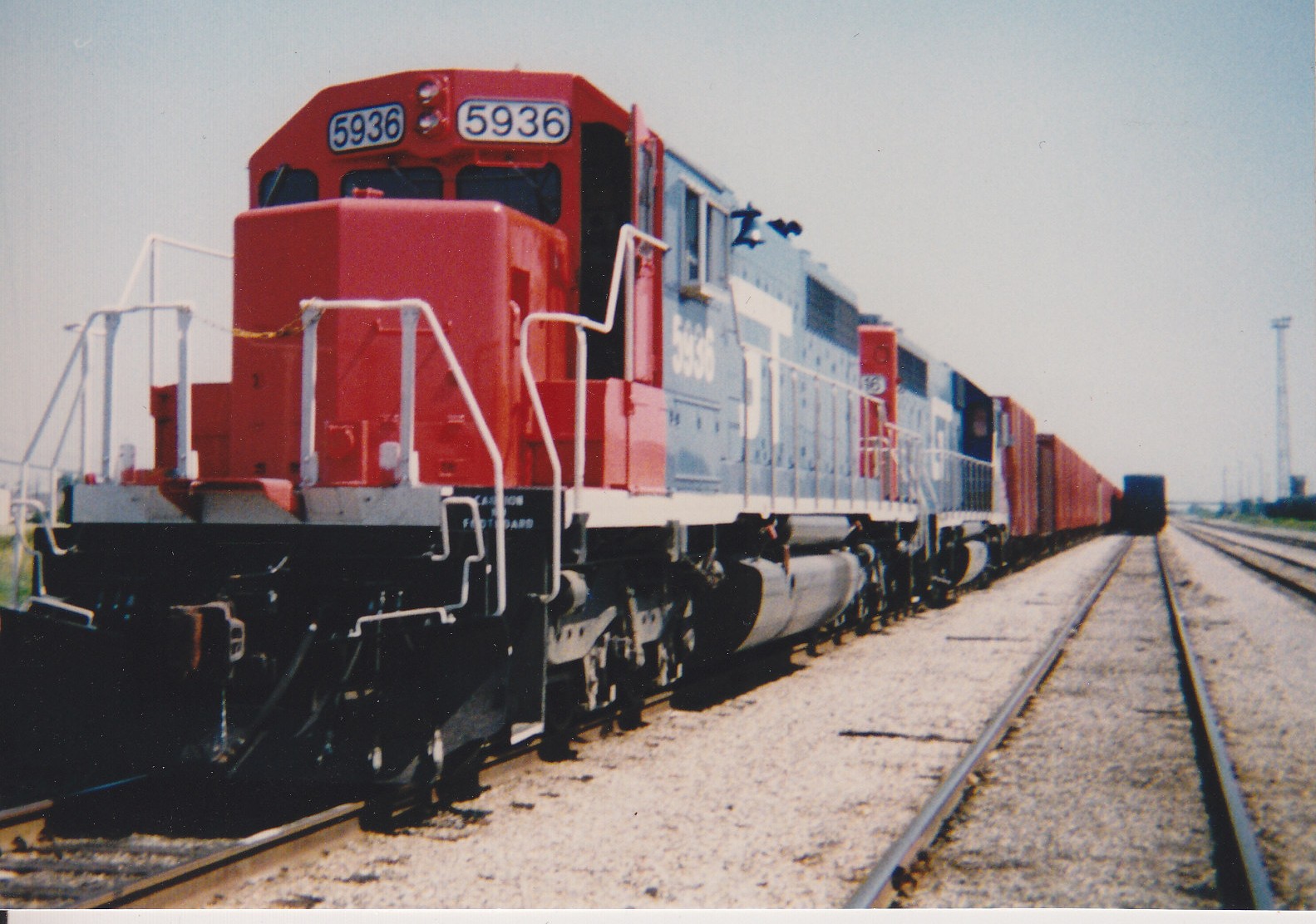
Above: Grand Trunk SD40-2 5936 leads a train destined for the old St. Clair Tunnel to Michigan at the Sarnia rail yard, 1992
I am happy to say that this story does not involve me getting into trouble for trespassing, but that is exactly how I got this shot. The Sarnia rail yard is massive, which made it very easy to sneak around the yard and get the photos I wanted in the 1990s. This doesn't mean you should do it, though. I should have known better, even in my teens, that rail yards are incredibly dangerous places for the average citizen. I do recall being in this area of the train yard, in between tracks, when an engineer yelled for me to throw a switch for him, since I was standing near it and he didn't want to get out of his engine to do it himself. I remember going back to the car, where my brother was waiting and he told me he thought I was in big trouble when he saw the engineer yelling to me. That was the first time I ever realized that maybe I should be more careful. I was very lucky that I was never was caught or hurt in my teens. Lesson learned.
Lesson Three: Take Shots of Everything
Above: St. Lawrence Railroadwaffle-side boxcar in CP's Windsor rail yard, 1991
This lesson is especially easy to apply today with digital cameras allowing rail fans to take as many shots as they want. When I was a teen, I chose my shots judiciously since I only had limited funds to buy film and develop prints. Still, I think of all the shots I took of rolling stock and subsequently discarded, and I could just kick myself. Readers will know that I accidentally threw out all my old film and subsequently lost dozens and dozens of rail photos.
This shot is a good example of why it is important to take shots of everything. At the time, taking a shot of a boxcar had no real value to me. In this case, I had never seen a boxcar with this railway logo, so I took a quick shot. Looking back, I'm glad I did since these boxcars have mostly disappeared. You can make out the Renaissance Center in downtown Detroit to the left of the boxcar. This car was parked near the locomotive and rolling stock repair facility, hence the axles. You can also make out a boxcar and flatcar in the background. Lots to look at in this shot. A typical scene in 1991 but a far more interesting shot in 2013.
Lesson One: Pick your spot carefully
Above: Rocky Mountaineer pulls into Banff Station in the summer of 1991
I learned this lesson the hard way. I was visiting my sister in Banff in the summer of 1991 and had ventured down to the station to get some photos of passing trains. I was lucky enough to catch this tourist train as it pulled in to town. The mistake I made was venturing too close to the train and blocking the view of other rail fans to the right in the photo. They were quite indignant and yelled that I needed to move out of their shot. I had never encountered other enthusiasts in my pursuit of trains around Sarnia before, so I had to plead ignorance. However, it worked out fine as I was able to capture this shot of the tourist train, led by B36-7 7488, with a beautiful backdrop of mountains and twilight sky. Lucky for me, rail fans in Ottawa are even rarer than trains, so I don't have to worry about ruining someone's shot here.
Lesson Two: Respect Private Property
Above: Grand Trunk SD40-2 5936 leads a train destined for the old St. Clair Tunnel to Michigan at the Sarnia rail yard, 1992
I am happy to say that this story does not involve me getting into trouble for trespassing, but that is exactly how I got this shot. The Sarnia rail yard is massive, which made it very easy to sneak around the yard and get the photos I wanted in the 1990s. This doesn't mean you should do it, though. I should have known better, even in my teens, that rail yards are incredibly dangerous places for the average citizen. I do recall being in this area of the train yard, in between tracks, when an engineer yelled for me to throw a switch for him, since I was standing near it and he didn't want to get out of his engine to do it himself. I remember going back to the car, where my brother was waiting and he told me he thought I was in big trouble when he saw the engineer yelling to me. That was the first time I ever realized that maybe I should be more careful. I was very lucky that I was never was caught or hurt in my teens. Lesson learned.
Lesson Three: Take Shots of Everything
Above: St. Lawrence Railroad
This lesson is especially easy to apply today with digital cameras allowing rail fans to take as many shots as they want. When I was a teen, I chose my shots judiciously since I only had limited funds to buy film and develop prints. Still, I think of all the shots I took of rolling stock and subsequently discarded, and I could just kick myself. Readers will know that I accidentally threw out all my old film and subsequently lost dozens and dozens of rail photos.
This shot is a good example of why it is important to take shots of everything. At the time, taking a shot of a boxcar had no real value to me. In this case, I had never seen a boxcar with this railway logo, so I took a quick shot. Looking back, I'm glad I did since these boxcars have mostly disappeared. You can make out the Renaissance Center in downtown Detroit to the left of the boxcar. This car was parked near the locomotive and rolling stock repair facility, hence the axles. You can also make out a boxcar and flatcar in the background. Lots to look at in this shot. A typical scene in 1991 but a far more interesting shot in 2013.
Subscribe to:
Posts (Atom)