Showing posts with label Kanata. Show all posts

Monday, May 18, 2026

From Main Street to the Back Forty: The Renfrew Subdivision (Part I)

To most railway enthusiasts in Ottawa and Eastern Ontario, what was once the CN Renfrew Subdivision is now technically Nylene Canada's Renfrew Spur. The track hosts one train a week, delivering tank cars of caprolactum to Nylene Canada's plant in Arnprior.

CN 589 crosses March Road in 2021 en route to Arnprior. The weekly train is the last vestige of a long history of operations on the former Renfrew Subdivision. Just to the right of the track is Station Street, where the old South March railway station once stood.

But what many people often forget is this lonely right-of-way was once one of the busiest railways in Canada. Yes, that's right. In all of Canada. 

Today, you'd hardly even be able to imagine it. Let's start briefly at the beginning. John Rudolphus Booth built a rail line from Depot Harbour*, on Georgian Bay, all the way to Ottawa, where it connected to Booth's other railway, the Canadian Atlantic. The two railways were soon joined under the CAR banner. The Ottawa, Arnprior & Parry Sound Railway began operations in 1897. 

(*- if Depot Harbour sounds unfamiliar, it's because Booth made the decision to establish his own port, away from Parry Sound, to foil the schemes of railway speculators in the town) 

Why was it the busiest rail line in Canada? Two reasons. Booth gained timber rights in Algonquin Park, which provided a great deal of traffic to his saw mill in Ottawa, not to mention to eastern U.S. markets via the CAR's terminus in Vermont. 

Secondly, Booth's OA&PS also shipped as much as 40 percent of the grain from the Canadian west to the St. Lawrence, as the fourth Welland Canal had yet to be completed. This meant that shipping grain via modern freighters on the Great Lakes was not yet possible due to the limitations of the smaller canals in the Welland area. The final Welland Canal was completed in 1932, which essentially replaced the Renfrew Subdivision's source of through grain from the Prairies.  

Booth's line was incredibly busy before this development, which is why it isn't surprising that the operations were acquired by the Grand Trunk in 1905. Of course, the boom years inevitably came to an end.

A Canadian National passenger train makes its way along the Renfrew Subdivision in the 1940s at an unknown location. Photo from the Canada Science and Technology collection.

The sharp downfall of the old Booth line happened mainly because of the grain movements shifting south to Welland, not to mention the fact that Booth had exhausted the useful timber in Algonquin Park, meaning the two main sources of through freight were gone. That meant that, by the 1930s, the Booth line had very much shifted to a secondary railway line under what was then the Canadian National Railways company, which bought the Grand Trunk in 1923.

It was a swift decline for a line that opened up vast stretches of Algonquin Park to tourists, considering it led to the creation of the Highland Inn and Cache Lake Station in the park. Many people forget that the Renfrew Subdivision was one of two major rail lines that crossed through the park, the other being the CN Northern Transcontinental Line. That line, the Beachburg Subdivision, went through what is now northwest Ottawa into the Pontiac Region in Quebec before crossing back into Renfrew County and all the way up to Pembroke, Petawawa and beyond.

The writing was on the wall for the Renfrew line as far back as 1933, when a trestle over Cache Lake/Lake of Two Rivers in Algonquin Park was closed due to safety concerns. That meant the line was cut in two and never reconnected. The western section between Depot Harbour/Parry Sound and Cache Lake was operated until 1952, when it was closed for good. The eastern section, terminating at Whitney, on the eastern edge of Algonquin Park, soldiered on as a local branch line for some time.

Fast forward to more recent times when most of the car load business dried up. For many years, CN tried to rid itself of the trackage, even when it was severed west of Arnprior. The line's final customer,  Nylene Canada (formerly BASF), still requires train service, as it cannot easily receive its needed product, caprolactum, by truck.

In the 1990s, there was talk of BASF being serviced by CP Rail's Chalk River Sub, which also reached up through Arnprior at one point. That connection was never made and the Chalk River Sub is history. In the end, a compromise was reached, which meant that the former Region of Ottawa-Carleton bought the land on which the tracks sit, while Nylene Canada bought the rails. That relieved CN of the obligation to maintain the line. 

When the Ottawa Central Railway took over CN's local operations in 1998, there was no longer any real threat to the Renfrew Sub. But when OCR sold back to CN in 2008, the same threat that has faced this line for decades resurfaced.

CN now serves Nylene on contract each week, essentially with running rights on an otherwise dormant line. This system seems to work, although CN has tried in recent years to remove itself entirely from Ottawa once again. Right now, its focus is mainly on customers east of the city. 

I'm skipping over decades of freight train history on this line, but it's not altogether that different from what you see on other marginal train lines. Without major freight customers, a branch line is not going to survive in today's highly centralized world of transcontinental railways. 

I figured we could relive some history and go on a trip from Ottawa to Whitney on the Renfrew Subdivision. 

Luckily for us, rail photographer Aubrey Mattingly was busy taking photographs of railways in the Ottawa area for decades. His collection passed into the hands of the Canada Science and Technology Museum. Many of his photos include everyday, somewhat mundane scenes that are now invaluable to us as we piece together the past. 

Let's start at the obvious place: Union Station in downtown Ottawa. This is what the old station looks like today, as the home of the Senate of Canada, which has been displaced from Parliament Hill due to construction of the Centre Block.

Thanks to some information supplied by Steve Boyko of traingeek.ca and Eric Gagnon of Trackside Treasure, I can pinpoint the final days of passenger rail service on the Renfrew Subdivision. CN ran its final trains on the line in 1961, but let's take the train in 1959, which is a significant year. It was the last year that many of the vestiges of the line's heyday remained.

UNION STATION: 4:30 p.m. departure 

Taking a Railiner (RDC or Budd Car in other words), you will leave Ottawa at 4:30 p.m.

This leads you to the first stop, which is the Bells Corners flag stop. It's important to note that, prior to the building of the Queensway, much of the land where the highway sits was the Renfrew Subdivision. After the National Capital Commission began lifting rail lines in the city under an expansive beautification effort in the 19502, the Renfrew Subdivision was largely scrapped from where it began all the way to Nepean Junction, where it branched off the Beachburg Subdivision.  

Sadly, there are no existing photographs of the Bells Corners station, but I imagine it would have been near Bells Junction, where the CN line met the CP Carleton Place Subdivision, which is also where there was once a flyover crossing. There is also a chance that the station was located west of here, near where Highway 416 is now. It's important to note that the 416 cut was obviously level ground in earlier days. 

Twenty minutes to get from downtown to Bells Corners? That seems slow by rail. There must have been serious speed restrictions. 

BELLS CORNERS flag stop: 4:50 p.m. 

SOUTH MARCH flag stop: 4:58 p.m.

This is the station that got me on the case of looking up the story of this rail line again. You might recall that I took a first crack at the history of this line in this post from 2019. I have often wondered what became of the Kanata train station, which was located on Station Street, just off of March Road, in the eastern part of the former city. My mistake was looking up Kanata Station in online searches. Needless to say, Kanata did not exist as a city until 1978, which I should have known.

Before Kanata was developed in earnest from farm land in the 1960s, it was mainly a rural township called March Township, hence the station's name, South March. The photo below is from the Canada Science and Technology Museum collection, as are all the remaining black and white images in this post.


This image was taken in 1958, shortly before CN demolished this building in 1959. That is why our 1959 trip west is so significant. It would have been the last time you could see all of these historic relics of the Renfrew Subdivision's past.

CARP STATION: 5:08 p.m.

This image, from 1944, is evidence of how important the railway was to small towns on this line. The Carp station seems quite large for a community so small. It's important to remember that, in the 1950s, the road network in this part of Ottawa was not nearly as developed as it is now. Same goes for many parts of Canada. Post-WWII, cars took over and the road network largely replaced short-distance passenger rail. Even in 1959, taking the train on this line would likely not have been a popular choice, as the operation was just a few years away from being discontinued.

This is where the history becomes fascinating to me. Many place names that are familiar to Ottawa residents but show no sign of their rail history, come alive, thanks to these images. Which brings us to our next stop.

KINBURN STATION: 5:19 p.m.

Note the similarity of the architecture of the stations on this line. It seems to me they were designed to provide accommodation to station agents and their families. It's hard for us now to understand the need for so many stations so close together.


This photo above was taken in 1959, again right before the station was demolished by CN. It's amazing that someone would think to capture images of so many stations in the 1950s. That brings us to our next stop, still in the western reaches of what is now Ottawa.

GALETTA STATION: 5:27 p.m.


You must be thinking that you're seeing double. The stations along this line were very much carbon copies of each other in many places, particularly in the smaller communities. You can see an old luggage cart on the platform of this station and the freight shed, for people who shipped goods via the railway express service.

At this point in the trip, you will be leaving what was then known as Carleton County, later the Region of Ottawa-Carleton (now Ottawa), so we will pick up our trip further east in the next post. You are by now an hour into your trip and you're not even out of Carleton County. This train is the definition of milk run!

This is an image from my map of the CN Rail system, back when the Renfrew Subdivision was still in place to the town of Renfrew in Renfrew County. After the train leaves what is now Ottawa, there are a few more surprise in store on the line. That will wait for the next post. 

Monday, November 28, 2022

Two trains, two very different images, one day

Two trains in one day in Ottawa? It’s not as tough as you might think, as this city continues to be a busy hub in Via Rail’s Windsor-Quebec City corridor. But in early October, I managed to catch two trains in one day and one of them was CN’s weekly west end freight train, the Arnprior Turn, as they call it. It took a little bit of luck, as it usually does.

I was in Kanata checking out a federal government office building, where I am now working once a week, as part of the government’s mandate that all public servants return to the office. I won’t get into the absurdity that I can telework from a generic government office and fulfill my back-to-work commitment, but I can’t telework from home on that day. Either way, I don’t have to return to my employer’s actual main office in Hull.

Anyway, as I was returning home after checking out the office building, I saw the telltale light from an old geep winding its way slowly down the Renfrew Spur. At the moment, I was on Carling Avenue, which follows the tracks for a short distance east of Kanata. I was able to turn off Carling and found my way to Bayfield Avenue, a tiny residential lane that has an unprotected crossing with the tracks, with only a set of crossbucks and a stop sign.

I have to say that I was excited to get a shot on this seldom used street. It affords you a chance to get a shot of trains from an interesting angle up close. I started by taking a shot of the signage. Notice how the Renfrew Spur is not listed as a CN property. It is listed as the Renfrew Subdivision, which is a legacy of its former status. It’s technically a spur now. The official name of this rail line is the Arnprior-Ottawa Railway, which is owned by Nylene Canada, its only customer in Arnprior. The rails are owned by the company while the land is owned by the city, which inherited ownership from the former Regional Municipality of Ottawa-Carleton.

The crossing gives you the opportunity to get a shot down the tracks, since Bayfield has almost no local traffic except for people from the handful of households on the street. After framing the train alongside the signs. I tried one shot without the signs. Given the low speed limit on this line, you have lots of time to set up these shots before moving back to safety when the train gets back.

This is not the type of shot I take all the much anymore. I don’t really like close wedge shots as much as I once did. However, I was happy with this shot because the angle of the tracks gave me this dramatic shot. You can even see old GP9 4140 behind the lead unit, CN GP38-2 4700. I was surprised to see the old geep in the consist. It’s been years since I saw one of these old geeps in Ottawa. You can check outmy tribute to the GP9 in this post.


I was also happy to catch a lumber car in the consist. This is the first time I have seen one of these cars on the weekly west end train.

Later in the day, I was waiting for my daughters to finish their weekly dance class in the Colonnade Road area, close to the Federal Junction where the Beachburg and Smiths Falls subdivisions meet. Since I am there at the same time each week, I was able to see Via Rail Train 59, westbound for Toronto at the same time. My first attempt to get this train was atop the Hunt Club Road overpass, which I snapped on Sept. 28.


But on the same day I was able to catch CN 589, I decided to try catching Via Rail Train from beneath the overpass. There was a spot near the fence, where I stood on a small cement block to get the shot. I liked this shot the best of the train coming out from beneath the overpass.

As the daylight was getting shorter, I figured there wouldn't be many more chances to capture this train with decent lighting, but I managed to squeeze in a few more shots in subsequent weeks. I am not in the habit of taking shots of Via Rail trains at Fallowfield Station or the Central Station, since I have so many shots from both places. I am really trying to find new places with different photographic elements, so this area is a new challenge for me. I like that this train is using the old silver streamlined cars. It makes up for the P42 in front, as this engine my least favourite locomotive to shoot.

All in all, it was a fun day trackside. Given that it happened in Ottawa, that makes it all the more special. You always feel like to earn everything you get in this city.

Wednesday, June 15, 2022

Let's begin at the end

I'm old enough to remember when freight trains had cabooses at the end. I remember, in fact, the union campaign, Trains are safer with a caboose. Of course, the march of progress was unstoppable and the caboose went the way of the dodo on many railways in the 1980s. CSX maintained them on the Sarnia Subdivision until the early 1990s, which was cool for me when I watched trains when younger.

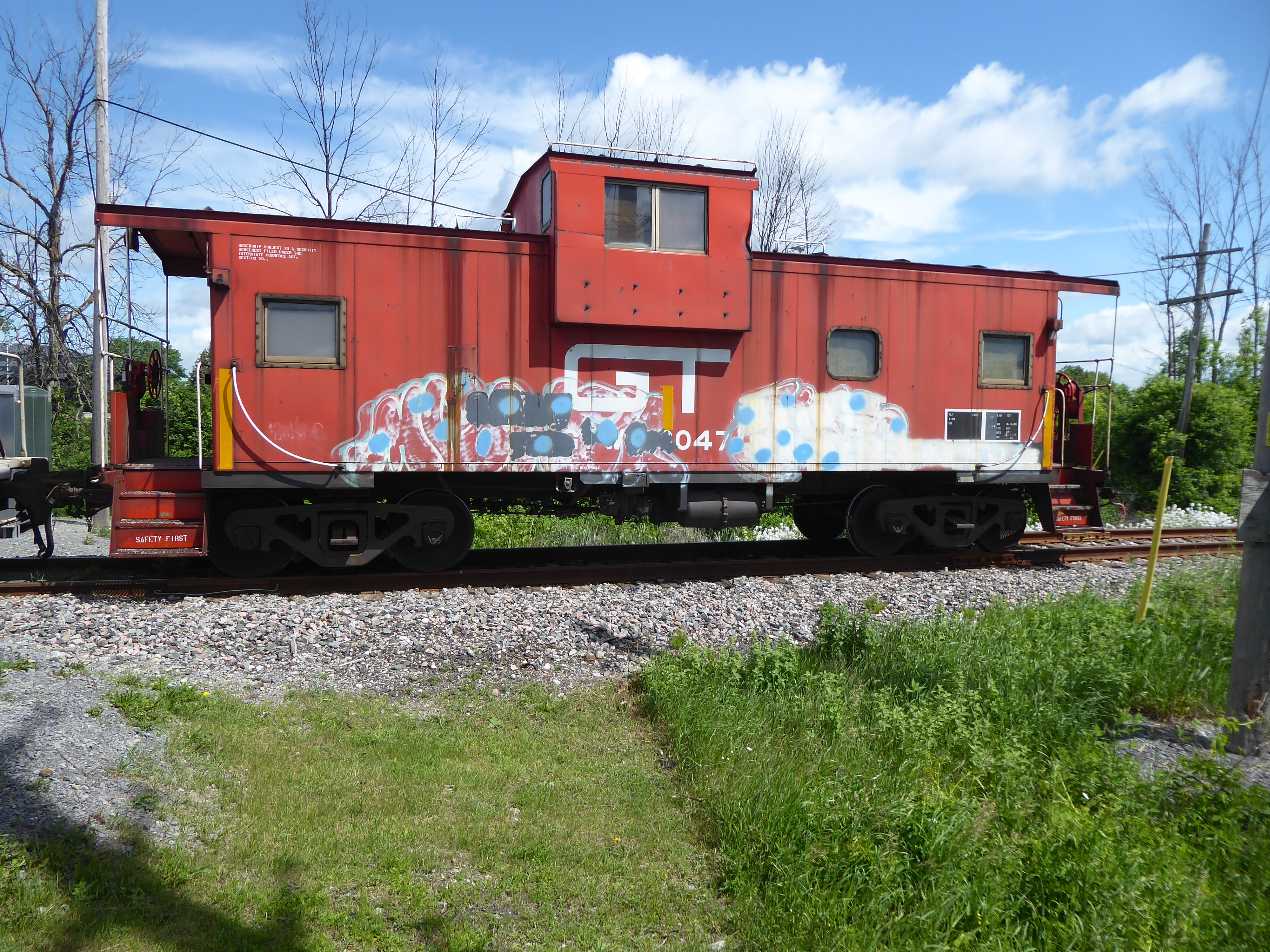
So imagine my surprise on June 8 when I heard the Arnprior Turn (CN 589) making its way through my neighbourhood and I decided to follow it, only to see this at the end. It was a GTW 79047 caboose still in its original scheme. Of course, there was no crew in the cupola, or even in the caboose. The car is clearly being used for shoving moves, giving the conductor a safe platform to watch the tracks ahead.

Of course, this isn't the first time CN has made use of an old caboose in its Ottawa operations. CN has made use of an former Devco caboose and the famous Millennium caboose in past years. Walkley Yard even hosted an old CN caboose hitched to an old RDC unit, both of which were owned by a company in Toronto and patched DAWX.

Over the course of my wanderings trackside, I did see CN using the infamous Millennium caboose once when it was shunting cars in Walkley Yard. I just managed to get this shot from the end of Albion Road on public property.

I will get into the history of CN's cabooses in its Ottawa operations in my next post, but for now, let's just admire the fact that the railway has used more than one caboose locally over the course of the last 10 years. It's an anomoly for sure, but not unexpected, given that there is a significant amount of shoving operations that the railway needs to perform in this area.

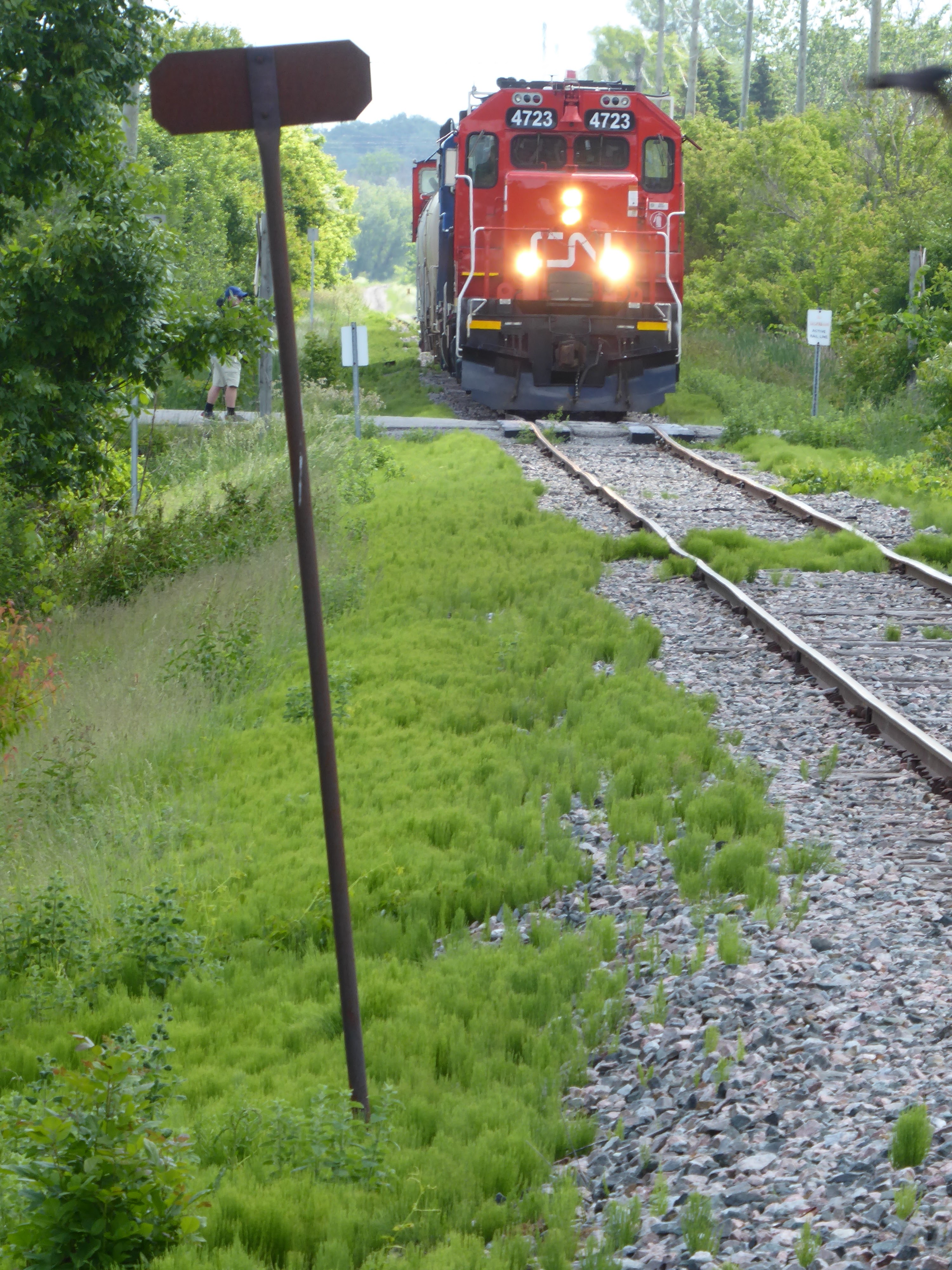
On June 8, I would not have caught up to the train if not for the fact that the crew stopped at a private crossing before March Road to grab a coffee at Tim Hortons, which sits trackside along the Renfrew Spur. That allowed me to park near the Tims and get some shots from March Road, like this head-on shot, which is not possible usually. The skies washed out on this shot, given the angle of the sun but I did manage to frame the trackside sign. You can just make out a railfan to the left of the shot. He had a camera set up on a tripod on the private crossing, which is blocked to vehicles.

Right when the train was easing to a stop, I took a quick photo of the two units from across Carling Avenue. I noticed the GATX unit doesn't seem to be a leased unit anymore. It's patched CN 4905, which suggests to me that the unit is now CN property.


As the train slowly made its way toward March Road, I tried to get some shots of the overall consist, which featured four tank cars loaded with caprolactum and the GT caboose bringing up the rear.

CN continues to use two GP38s on its run to Arnprior, including the GATX unit, which has been a common site in Eastern Ontario for the last several years. The March Road crossing offers a fairly unobstructed view of the Renfrew Spur right-of-way, although you do have to position your shots around a few guy wires and trackside poles. But at least the crossing gives you clearance against the trackside shrubbery, which can ruin your shots.

This is a shot of the March Road crossing, which gives you a better shot of the GATX unit. This is the first time I have captured anything at this crossing. Now that I know what I'm facing here, I will definitely come back, if the chance presents itself.

Even though I was on the sunny side of the train, this side of the caboose was not nearly as photogenic as the other side, which sat in the shadows. There was no graffiti on the other side, while this side was pretty marked up. 

Not knowing if I would ever see this old relic again, I tried to get it from as many angles as I could, including this profile shot, which gives you a view of the entire train as it makes its way slowly east toward the Huntmar crossing and eventually, Arnprior.

One final shot as the train made its way west. I don't take a lot of vertical shots but I took quite a few this past week, which made for some interesting shots. All in all, it was a lucky meet, as I decided at the last minute to chase this train on my break from work and caught it only because of its unscheduled stop near March Road.

It was quite a week for the Arnprior Turn, as it was featured in a story on CTV Ottawa's local newscast. The message that Nylene Canada was delivering was nothing new. There's 40 kilometres of track that the company owns that is being used by one customer. The company would obviously like to see more customers use rail service. It's a great idea in theory, but as readers of this blog know, Nylene has made this pitch before to the Ottawa Sun. I mentioned that story, which was behind a paywall, in this blog entry from 2014.  

I guess I'm skeptical that this latest pitch will get anywhere, since CN is a reluctant service provider in this case, as it is mandated to provide this service to Nylene. If CN does indeed pull out of Ottawa, as it has publicly stated that it wants to do, who steps in? All of the publicity in the world won't help if there is no railway company to provide the service.

Wednesday, December 1, 2021

Greed is Good (Sometimes)

As I mentioned in my last post, I managed to accomplish a number of firsts on October 20 when I heard CN's Arnprior Turn approaching my neighbourhood and decided to chase it. In the last post, I detailed how I just managed to get to Corkstown Road in time to catch the train, although the sunlight was essentially there to ruin my shots. There was much photoshopping that needed to be done to get some of the images into presentable shape. 

But then I figured, given the slow speed of the train, that I could easily beat it to March Road in Kanata to get a better shot of it on the sunny side of the train. In other words, I decided to get greedy and try to capture the same train twice. In all my time trackside, I have never been able to chase a train and properly capture it multiple times. So this was a first for me. 

Many locals who like to catch this train on its weekly run mention that the crew often stops the train short of March Road to grab a coffee at the Tim Hortons next to the Renfrew Spur. I decided to set up shop in the back parking lot of a commercial plaza, where there were a few gaps in the trackside brush, which would allow me to get some decent shots of the train. I did have to lift my camera pretty high to get these shots, so the brush was not dominating the images.

 
This shot above works pretty well, although I was a little disappointed that the gap I chose didn't allow me to see the entire train, which included seven tank cars. It was the longest freight train I have ever seen making its way to Arnprior. I shared that fact with a few friends of mine outside Ottawa and they thought that was quite funny. The GMTX unit is trailed my CN GP38-2 9411. I have seen this unit plying the rails in Ottawa before. Quite recently, in fact.
 
As far as a standard shot goes, this image below probably fits the bill the best. I liked how this image turned out as you can see both units and a few tank cars. The trackside brush prevented me from getting any more. I should also mention that there was a large ditch on the other side of the brush, which prevented me from getting to the other side of the bushes to get a clearer shot. My reasoning to stay at this spot seemed pretty sound at that moment. Since many have said the train stopped before reaching March Road, I figured I could get more shots when it was parked. However, it was not to be. As soon as the train passed me by, I could hear the engineer give the typical two long, one short, one long blasts of the horn, which told me the consist was heading straight through without stopping. Oh well.

I did get a shot of 9411 on its own as the trailing unit. I should also mention that this was the first time I have seen this train using two units. This seems to be a recent development. In my years pursuing 589, the Arnprior consist has always been pulled by a single engine. I'm not sure why CN has made the change now. Without knowing any context, two units seems excessive for this train to me, unless the primary reason for the extra unit was dual-direction visibility. In other words, not pulling the entire train home long hood forward, as happens when there is only one unit.

I did try one shot with a little more of the foliage around the edges of the frame, just to see if it made for a more compelling shot. I'm not sure it did in this case. Doing this also allowed me to try and get more of the tankcars in the shot, but I'm not sure there is anything more compelling to see.

So here is a final summary of what happened on Oct. 20. I will list it by the number of firsts I crossed off my list.

  • First time seeing 589 with two units
  • First time catching 589 in two different spots (Corkstown Road and March Road)
  • First time catching 589 on the Renfrew Spur
  • First time catching 589 with seven cars in the consist

If I catch 589 once more this year, I think I might break my own record. I have only ever caught it as many as two times in a year. Granted, I haven't worked from home like I do now with a flexible lunch schedule, so I'm not sure if this record is anything to shout about, but I'll take anything I can get.

I see that there has been a lot of chatter as to why this train has been shifting around its schedule of late, with the crew sometimes making its way on a Thursday and then on a Wednesday the following week. I have no idea why it hasn't been as consistent. My only thoughts are perhaps it has something to do with Kott Lumber's needs, since this customer on the Smiths Falls Sub, is now part of this weekly run. Some rail watchers have simply guessed that it has to do with crew availability, since CN's presence here in Ottawa is paper thin, to put it mildly. 

Whatever the reasons may be, it seems like this train has become more visible on its weekly run through western Ottawa. Hopefully, there are more meets and surprises to come.

Sunday, November 14, 2021

Use The Force

Railfans in Ottawa are an impressive bunch, I have to say. We don't have much to see, but it doesn't stop many of us from capturing what little there is. Many also are not afraid to go far afield to capture something in Eastern Ontario. Just go the Eastern Ontario Rails Facebook group (you need to ask the administrator to join formally). I would say that, of late, an outsized amount of photos and chatter is focused on CN's weekly Arnprior Turn. The crew for that train must wonder how they have managed to attract so many fans of late. 

All of this is a lead-in to my story of using the force. By the force, I mean being ready at a moment's notice to identify 589 approaching my neighbourhood and heading out to catch it. Recently in October, I was working in my back yard, listening to a podcast with headphones when I thought I heard the distant sound of a freight engine's horn. Did I mention I am hearing impaired? Yes, my sixth sense for this train is quite impressive sometimes, if I do say so myself. 

An aside: when we had a visitor a few years ago and one of my children heard a distant train horn, I quickly identified it as a Via train, since I knew which direction it was coming from and knew the difference between a P42 horn and a geep horn. Our visitor looked me funny and asked how I knew the train was a Via. I guess my railfan was showing. I quickly pointed to the direction of the sound and said those were the Via tracks over yonder. The other way was where the freight tracks were.

So, back to my story. I rushed into my car with my iPhone as there was no time to grab my camera inside. This was going to be a tight timeline to get to Corkstown Road to get a shot. I saw 589 passing in front of me on the Moodie flyover, so I knew it would be tough to catch it at Corkstown Road. But I did get there with a few seconds to spare, although I couldn't get to my vantage point of choice on the sunny side of the tracks. 

I just barely made it to this spot in time to get some initial shots. Luckily, the lights on the Corkstown Road crossing were not working, which forced the train to stop short of the road as the conductor had to get out to guard the crossing. After one pickup went through, the train proceeded ahead across the road, slowing a bit to allow the conductor back on before the consist picked up speed. The sun flare on the train was some of the worst I've ever encountered, but I told myself I would fix it up with some photoshop later on. Note the conductor ahead of the blue geep.

Below, you will see the conductor looking west on Corkstown Road as the train approaches the level crossing. You can see the effects of the sun on the side of the engine. That was the best I could do with my photoshopping skills. Anything more would not have been true to the original image, so I avoided the temptation to alter things too far. I do have to mention that this is the first time I have seen this type of old school railroading where a conductor is guarding a level crossing like this.

As many local railfans know, work was recently done to shore up the Beachburg Sub ballast, ties and tracks between Federal and Nepean, which seems to be the last remnants of CN controlled trackage in the area, save for a few other scraps here and there. I'm not sure who is in charge of signalling repairs, but my guess is it's RailTerm, which is the company that does similar work for Via Rail in the city on its trackage. I guess they haven't gotten to this repair yet.

Notice the absence of crossing signals below. Now that I am moving away from the sun, the two-engine head end of the train begins to become a little more vibrant and less shadowy. Here's the lead unit, GMTX 2252. This leased unit has been making the rounds in Eastern Ontario as of late. I'd be curious to know why CN is still leasing units and why they might be short of motive power.

CN 9411 trails the lead unit as the relatively long consist approaches the curve in the track toward the old Nepean Junction. This is the first time that I have seen a two-engine lead on this train, which seemed to be a late summer/early fall change to CN 589. The shadows are still pretty brutal at this point, but I was able to touch up the image a fair bit to include a little more detail.

Here's one final shot of the consist, which includes seven (yes, seven!) tankcars all headed for Nylene Canada in Arnprior. Compare this to the one-car consist I have seen headed to Arnprior in the past. I'm not sure if this is a one-off or whether Nylene Canada's business is picking up, which is requiring more caprolactum.

At this point, I hustled back to my car and decided to test my luck at catching this train a second time. Given its relatively slow speed and my close proximity to March Road, I figured I would be able to beat 589 to the March Road crossing. Local railfans in Kanata say the train often stops at the Tim Hortons right next to the tracks, which would give me another opportunity to take some shots.

I'll save the second part of the story for the next post.

Thursday, October 30, 2014

Guest post: A 5 mph chase of CN 589 to Arnprior

I'd like to introduce Beachburg Sub readers to a fellow Ottawa railfan, David M, who has generously volunteered to share some of his experiences along the rails with us. I hope this post provides you with a different perspective from my own. Please take the time to post a comment and let David know what you think! - Michael

By David M

I’ve always wanted to get a picture of a train on the Renfrew Spur going over the Mississippi River. Recently, I had a Wednesday morning off and decided that I would chase CN 589 to get that picture. 

Early on Wednesday morning, I started scanning these frequencies [Stand By: 160.545, RTC Call-In: 160.860, RTC Call-In: 160.290] on my radio scanner. Around 8:30am, I overheard the clearances. I then hopped in the car and drove to Carling Ave. and March Rd., in Kanata, to meet 589 at 9:00am (where I’ve seen it there many times at 9:00). When I arrived there, it was nowhere to be seen. I thought that perhaps it was earlier than usual, so I then proceeded to the crossing at Terry Fox  Drive and then the crossing at Huntmar and Old Carp Road where I didn’t see it. By now, it was 9:30 and I still hadn’t made contact with it. I then proceeded to Carp to see if it was there, which it wasn’t. I decided to park on the side of the road near the Diefenbunker (picture below) and decided to wait for it.


Since 9:00, the scanner had been quiet. At 10:00, the scanner became active again with additional notifications for the crew. Two minutes later, I heard a distant whistle coming from Carp. Finally at 10:11, first contact was made. Once you have found 589, it is very easy to chase since it only travels 5 mph. I was then able to catch it easily at five other locations. 


I decided to leave the close chase and get ahead of it to ensure I had sufficient time to set up for the shot of it crossing over the Mississippi River bridge. I chose to set up on the bridge on Mohrs Road. The shoot turned out to be difficult since, in my rush out the door, I only took an 11-16mm wide-angle lens and a 55-200mm zoom lens. When shooting from the bridge, a 35mm would have perfect as the 55 was challenging to get it properly framed, and the wide angle gave a bit too much.

 
Rail fanning on this line is challenging because there are no signals that you can sneak a peak of, or any hotbox detectors that give you a heads up when a train crosses over it. The main advantage of rail fanning on this line is that once you’ve found the train, you have many opportunities to see it because it travels so slowly.

 
All in all, it was a good chase. The next time, I will try to chase it in the other direction. If anyone has a favorite place to shot along the line, or any pictures of the train on the Renfrew Sub, please post a comment with a link to the pictures, because I’m interested in seeing them. (So am I! - Michael)
 
Many thanks to David for his story and photos. Stay tuned for more from David in the next little while. - Michael