Wednesday, August 21, 2013

Railfanning 101

I don't like the term railfanning, but for the purposes of this post, I'm using it to illustrate a few points. In my teens, I loved taking photos of trains, but was woefully ignorant of the rules by which most rail fans abide. I present to you three photos and three stories from my experiences that hopefully serve as reminders of what to do and what not to do.

Lesson One: Pick your spot carefully

Above: Rocky Mountaineer pulls into Banff Station in the summer of 1991

I learned this lesson the hard way. I was visiting my sister in Banff in the summer of 1991 and had ventured down to the station to get some photos of passing trains. I was lucky enough to catch this tourist train as it pulled in to town. The mistake I made was venturing too close to the train and blocking the view of other rail fans to the right in the photo. They were quite indignant and yelled that I needed to move out of their shot. I had never encountered other enthusiasts in my pursuit of trains around Sarnia before, so I had to plead ignorance. However, it worked out fine as I was able to capture this shot of the tourist train, led by B36-7 7488, with a beautiful backdrop of mountains and twilight sky. Lucky for me, rail fans in Ottawa are even rarer than trains, so I don't have to worry about ruining someone's shot here.

Lesson Two: Respect Private Property
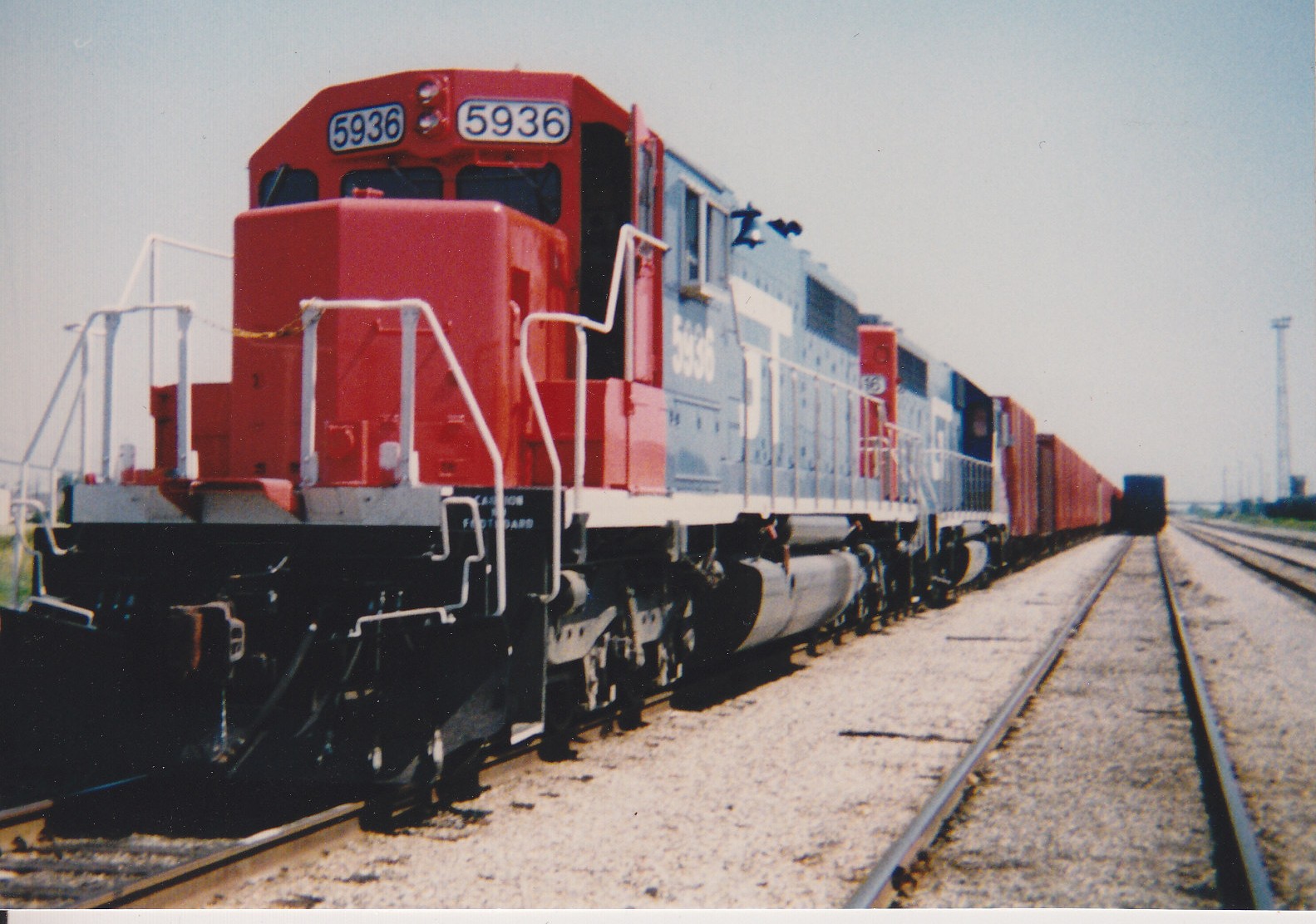
Above: Grand Trunk SD40-2 5936 leads a train destined for the old St. Clair Tunnel to Michigan at the Sarnia rail yard, 1992

I am happy to say that this story does not involve me getting into trouble for trespassing, but that is exactly how I got this shot. The Sarnia rail yard is massive, which made it very easy to sneak around the yard and get the photos I wanted in the 1990s. This doesn't mean you should do it, though. I should have known better, even in my teens, that rail yards are incredibly dangerous places for the average citizen. I do recall being in this area of the train yard, in between tracks, when an engineer yelled for me to throw a switch for him, since I was standing near it and he didn't want to get out of his engine to do it himself. I remember going back to the car, where my brother was waiting and he told me he thought I was in big trouble when he saw the engineer yelling to me. That was the first time I ever realized that maybe I should be more careful. I was very lucky that I was never was caught or hurt in my teens. Lesson learned.

Lesson Three: Take Shots of Everything 

Above: St. Lawrence Railroad waffle-side boxcar in CP's Windsor rail yard, 1991

This lesson is especially easy to apply today with digital cameras allowing rail fans to take as many shots as they want. When I was a teen, I chose my shots judiciously since I only had limited funds to buy film and develop prints. Still, I think of all the shots I took of rolling stock and subsequently discarded, and I could just kick myself. Readers will know that I accidentally threw out all my old film and subsequently lost dozens and dozens of rail photos.

This shot is a good example of why it is important to take shots of everything. At the time, taking a shot of a boxcar had no real value to me. In this case, I had never seen a boxcar with this railway logo, so I took a quick shot. Looking back, I'm glad I did since these boxcars have mostly disappeared. You can make out the Renaissance Center in downtown Detroit to the left of the boxcar. This car was parked near the locomotive and rolling stock repair facility, hence the axles. You can also make out a boxcar and flatcar in the background. Lots to look at in this shot. A typical scene in 1991 but a far more interesting shot in 2013.


Thursday, August 15, 2013

Relics on the rails

Once in a while, you come across scenes along a railway that defy explanation. For whatever reason, a railway sometimes keeps a particular locomotive or car operational (and I use that term loosely here) long past its best before date.

The following are a few photos of some oddities I encountered in the Sarnia area in the 1990s. The shot immediately below represents perhaps the biggest mystery. The first question that came to mind when I saw this car is how it was still standing. The car, which looked to be an old piece of maintenance-of-way equipment, was parked at the dead end of an old siding at the edge of CN's rail yard in Sarnia along Campbell Street. The track was tucked behind an old truck loading depot and transload facility that had long since been converted into a storage building for the railway.

I took the shot in the early 1990s (the original print is undated). I can only hazard a guess as to the vintage of this car, but it's definitely from the era when railcars were still made of wood, so that gives you a good idea when it was built. I tried to find any information about this car online, but as far as I know, this may be the only photo of this old car. You can see a wooden platform on the left, which suggests that car had been parked there and used as some sort of office or storage facility for some time.


These two maintenance-of-way cars and an old wooden boxcar, below, lingered on the CSX Sarnia Subdivision for more than a decade. They found their way to the end of the CSX sub, at its Clifford Street office, in the early 1990s. The shot below of C&O 911043 was taken in the fall. It looked like it was in better shape than the CN car above. I managed to find one photo of this car in better days when it was in use in Saginaw, Michigan. It's listed as a crew car, which is the term I generally use for these cars. The amazing thing about these cars, besides the fact that they were still in use in the 1990s, was the fact that they still carried C&O markings, which means they survived both the Chessie System and CSX years with their original identity.


This was the wooden boxcar that was hitched to the two MoW cars. You can just make out the "MW" markings next to its car number. I did manage to find one other shot of a MoW boxcar that was similar to this one. Again, the shot is an earlier photo taken in Michigan when the equipment was in (slightly) better shape. You can see in my grainy image that the CSX sub in Sarnia ends in the Chemical Valley. The yard is nestled between the St. Clair River and the Esso petroleum refinery.


These cars hold great memories for me. The last time I saw those MoW cars before that evening, was when they were parked on a siding along the CSX main line in Port Lambton, where I went to grade school. I remember walking up to the cars when I was a kid and climbing on the handrails. It really speaks to a different time since those cars were parked in the middle of that town for quite some time with no security whatsoever and none of them were vandalized.

This final shot isn't as much of an oddity as the cars above, but I thought I'd include it since I've always loved this shot. This car is an unusual tank car, with a vent stack on the right. I found a photo of a similar car, which was used as a water transporter in maintenance-of-way consists. I know these cars had other uses and I recall blogger Eric Gagnon talking about this type of car in his blog, Trackside Treasure. This shot was taken in 1993 around the old CN roundhouse in Sarnia.


New to the blog? Welcome to all new readers. I am a railway enthusiast living in Ottawa, but my blog covers railway topics from all over Ontario, both old and new. I mainly blog about railroading in the Sarnia area, which is where I grew up, and Ottawa. The blog is named after a CN subdivision that could soon be completely scrapped in the Ottawa area. To learn more, I invite you to read my introductory post.

Thursday, August 8, 2013

Ottawa's Walkley Rail Yard

Ottawa's Walkley Yard is a strange place these days, with only a bare minimum of activity happening. Since CN's acquisition of the Ottawa Central Railway in 2008, there has been a noticeable drop off in freight traffic in the region. With the O-Train service suspended for the summer, due to the $59-million renewal of the existing 8-kilometre Capital Railway, the commuter trains also sit silent in the mostly empty yard. I dropped by on the civic holiday Monday (Colonel By Day in Ottawa) just to see what was there, and the trip did not disappoint. When I drove to the end of Albion Road, where the CN office sits, I saw this former Devco Railway caboose, sitting near the locomotive shop, badly in need of a paint job. As you can see, security in the yard is minimal at best, which explains the graffiti on the caboose, including its windows. The caboose has been around since the Ottawa Central days. It is still used by CN for the same purpose, mainly shoving moves.


Just east of the caboose, I saw the lone CN locomotive currently assigned to Ottawa, GP38-2W 4807, still clad in the CN safety scheme, albeit just barely. Getting photos from a service road was tough since the weeds in the yard have not been trimmed this summer, which tended to obscure the locomotive's trucks. Seeing the old geep in the safety scheme was cool. I have always liked that scheme.


The Walkley Yard was constructed in 1955 by the National Capital Commission to replace the Canadian National's rail operations in central Ottawa. This was part of a plan to rid the centre of the city of its rail lines as part of a Paris-inspired urban redevelopment plan. The yard eventually housed Canadian Pacific's freight operations, which were moved in the 1960s from its old Ottawa West Yard, near the Prince of Wales rail bridge on the Ottawa River. In the past decade and a half, CP sold off its local trackage to the City of Ottawa while the Ottawa Central was sold to CN as part of a larger package of short lines. When you factor in the loss of heavy industry in Eastern Ontario, the end result is a mostly empty rail yard, which describes Walkley these days. These cars below were the sum total of rolling stock in the main yard on the holiday.

But as I drove down the service road, I saw something on the margins of the empty east end of the yard. I drove toward the odd site, but not before I took a few snaps of interesting rolling stock on a spur, which included a transload facility called Rideau Bulk. You can see a Wisconsin Central boxcar to the right of the TTX (Railbox to me) waffle-side boxcar.


A little further east of that spur, I saw these interesting relics at the edge of the yard. Sitting on a dead-end wreck track was former CN caboose 79872 and former Budd RDC numbered 6002. Doing a little research, I learned that both have been left at Walkley since 2007. The cars are lettered DAWX, which means they are owned by David A. Wamsley & Co., a private company that owns and sells rail equipment. I was only able to find a few scant mentions of the company online and a few photos, so I invite readers to share what they can find about this company and these cars. At one point, there was another RDC on the same track, but that unit has since been refurbished by Via. From what I can gather, this remaining RDC is a former piece of Via equipment (numbered 6002) and is a RDC9. Notice that the caboose's door has been left open.


Another view of the RDC, below.


And a view of the end.


Here's another shot of the caboose and its markings. There are photos of other CN cabooses out there, but I was unable to find a shot of this one in its prime. 


As I left the yard, I saw one lonely ballast car (filled). It looks as if the car has been modified. Behind it, one of the city's water towers.


And one last shot of CN 4807 before I headed back home.


This visit proved to be the highlight of my holiday Monday. Now that I know how to get around the yard a little better, I am going to make a habit of checking it out every once in a while, even if there is only a handful of things to shoot. In Ottawa, you have to take what you can get!