Wednesday, October 16, 2019

Camlachie Road: One of my new favourite spots to catch a train

The older I get, the more I tend to shy away from railyards. When I was younger, I loved having the chance of visiting a yard, because it usually guaranteed that I would see something. These days, I am constantly in search of more rural or interesting urban settings when I do find myself with time trackside.

Case in point. This summer, I visited family in the Sarnia area and really wanted to catch some action trackside, but I was also looking after my two daughters and my nephew for the week, so I knew I would have to get creative. My nephew was game, but I know my daughters would not likely have the patience to sit trackside for long. So I made sure to plot my routes for the week around as many rural crossings as possible along the Strathroy Subdivision, in the hopes of catching something.

One advantage you have in this area is topography. When crossing the tracks in the countryside, you can slow down and see clearly what is (or what isn’t) coming. Twice during the week, I saw the familiar headlights far down the tracks, which gave me time to set up and get some shots.

The first time I caught something was when I was on my way home with my daughters, after we had spent the day with my sister’s family in Corunna and were heading back to my brother’s house, where we were staying. When we crossed the tracks, my older daughter was quick to point out a train was coming. In this case, it was an eastbound freight coming out of Sarnia heading toward Toronto. I had to find another road to set up, since the road we were on had no gravel shoulders and was a bit too busy to take pictures safely. So, after some scrambling, I found a spot along Camlachie Road, a spot I have used in the past (which you can read about here), which has a great vantage point for westbound freights.


The train was travelling a lot faster than I had expected, which required some quick decisions and set up before I could fire off some shots. Sadly, I had to settle for the shady side of the train, which necessitated a fair bit of colour correction.


The first unit, ES44AC 3202 sported the Indigenous Peoples logo on its nose, meant to honour Canada's Inuit, Metis and First Nations. I've come across this logo a few times this summer. The trailing unit was ET44AC 3073. In other words, there was some serious power on this train.


Given that the sun was not making things easy for me, I tried a few going away shots and was happy with the way the sunlight was reflecting the front of the trailing unit. You can see that the growth trackside certainly makes it a little tougher to shoot a passing train with much detail. To me though, I thank the landscape is just as important as the train. I don't mind images like this where the train blends into its surroundings.


So, once the front end of the train was properly documented, I turned my attention to some interesting rolling stock. It seems like most cars these days are owned by leasing companies, which makes finding an old gem from a fallen flag harder than ever. However, I did like this gondola, graffiti aside.


I also liked the way these empty lumber cars allowed me to see through to the other side of the tracks. This was a mixed freight in every sense of the word. Some cars were empty...


And some were obviously headed for unloading. These chassis appear to be headed to one of the automotive plants that still makes trucks in Ontario. My brother and I were trying to figure out where. I speculated that they might have been going to the Oakville Ford plant while my brother thought they might also be going to Oshawa, as that facility is still in production for now.


The train ended with a long string of empty autoracks, including a few that were lettered for Mexican railways. I thought I would share this end of train shot, since it captures the countryside just beyond the train fairly well. As you can see from the way the shadows are reaching across the road, it was difficult for me to tell when I arrived at the crossing which side would be best. I think I could have done better on the other side. Oh well.

It was still fun to catch a train in the countryside and it wasn't the only time in my week in Southwestern Ontario when I caught a train.


Thursday, October 3, 2019

Some fascinating details at the Railway Museum of Eastern Ontario

Earlier this summer, I brought my girls to the Railway Museum of Eastern Ontario. Much to my surprise, they loved the place and are eagerly awaiting a return trip. I spent a great day with them, looking at some of the old relics in the Smiths Falls collection and explaining some basics of railways to them. We were even treated to a demonstration in railroad telegraphy from a volunteer, who was fluent in Morse code. He also explained to the girls what a railway agent was and what they did in the station.

The last time I went to this museum, I spent much of the time photographing the pieces of rolling stock and the two locomotives. This time around, since I already knew what was on display, I looked for some hidden details I missed the first time around.

I am a history nerd, so I was thrilled with all the artifacts that I didn't notice the first time around.

Here are a few shots of the railroadiana you will encounter at this gem of a museum. What really fascinated me were the signs in the old Canadian Northern station. This one below was by far my favorite.


Arrested for spitting! Imagine. I suppose that this rule was likely aimed at those spitting tobacco. I laughed when I saw it because it made me think of an actual bylaw that the old City of Kanata had, before the western suburb was amalgamated into the City of Ottawa. It was a long-running joke in this area that you could not spit in Kanata. The old city had a bylaw that prohibited the habit. I remember playing soccer there and my teammates always joked about not spitting during a game without first taking a good look around.

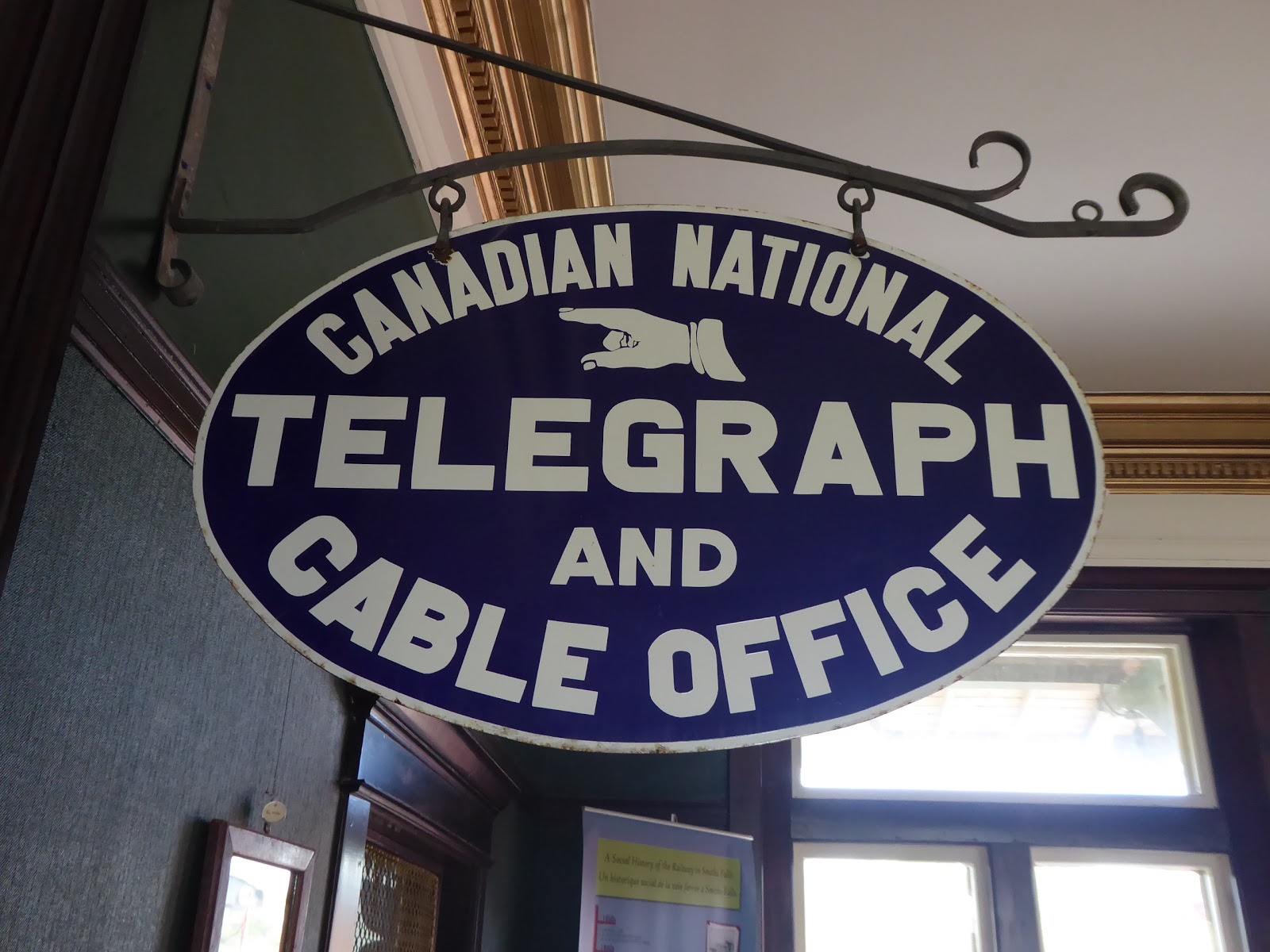
The second sign that I really loved was this old telegraph sign, perched outside the old telegraph office. Today, we still see parts of the old telegraph system still in place along railway lines, but I would imagine many younger railfans not really understanding just how important these lines were at one point.


I thought this slate timetable (below) on the outside of the station was a nice touch. Although it was quite out-of-date by the time we visited in July, it gave you a good idea of what train travel was like in the days before the technology that we take for granted today. Surprisingly, the frequency of passenger trains then is comparable to what you see today in Eastern Ontario, although Smiths Falls passengers no longer have their grand old CP passenger station to begin their trips. Instead, Via now uses a modern kiosk on Union Street. I say kiosk, but it is quite a bit larger than a bus shelter. However, whenever I see that ultramodern station, I can't help but think that it looks like an overgrown bus shelter. Functional, for sure, but lacking any style.


Before I saw this sign, I had no idea this place even existed. Forthton is a hamlet northwest of Brockville. It once had its own railway station on the Brockville, Westport & Northwestern (later Canadian Northern and Canadian National) Railway. The sign looks like it's seen its share of bad weather over the years but it now hangs in the old CNor station waiting room. I love old station signs and wish more of them had been saved. I always thought it would be a cool feature to have in my house (not sure if my wife would agree).


This old flag station for Nolans saw use for many years just north of Smiths Falls. I didn't know that this station was actually originally used as a flag station for Dwyer Hill, on the edge of Ottawa, before it was moved to Nolans to replace the original Nolans flag station after it burned down. This little station served CNor passengers between Smiths Falls and Ottawa in the early 1900s. The museum notes that in its final years, only two trains passed this station at 9:45 p.m and 2:15 a.m. Not terribly convenient!


I didn't get a shot of this caboose the last time I was at this museum, as it was parked in the museum's yard in a spot that was not accessible to visitors. As you can see, it is used for storage now and requires a fair bit of work to be fully restored, particularly on each end. I like the fact that they note that the caboose was originally CP 436757. You can also see another old CP caboose hitched to the other side. This caboose also seems to be suffering from the elements. It was in a prominent position the last time I was at this museum, but has been boarded up and shuffled off to a much less prominent spot. The yellow caboose is an older wooden van that had its slatted sides covered over with plywood sheets. It was a practical thing for railways to do at the time, but has since proven to be a headache for those who seek to restore the cars for preservation purposes.


My daughters couldn't get enough of riding in the cupolas, so I decided to follow them up one time and get this cupola's view of the station and the trailing CN caboose. This museum really does allow you to get a feel for what it was like to ride a train back in the golden era of railroading. As a parent, it means you have to watch your little ones closely, but I like that the museum trusts its visitors enough to hop aboard these fascinating relics.


Here's another shot I took from the end of the caboose lash-up in front of the station. You can see the old passenger equipment to the right, including the CN dental car, which is the best preserved piece of passenger equipment at the museum. The interiors of the other passenger cars are not open to visitors.


This is an old section house built by the Canadian Northern, that now houses some of the museum's archives. It is not open to visitors, but it is in the process of being restored after being saved from demolition in 1995. These structures were used as homes for the families of railway section hands. The museum says this is one of the last remaining such structures in all of Canada. The house was built in 1912.


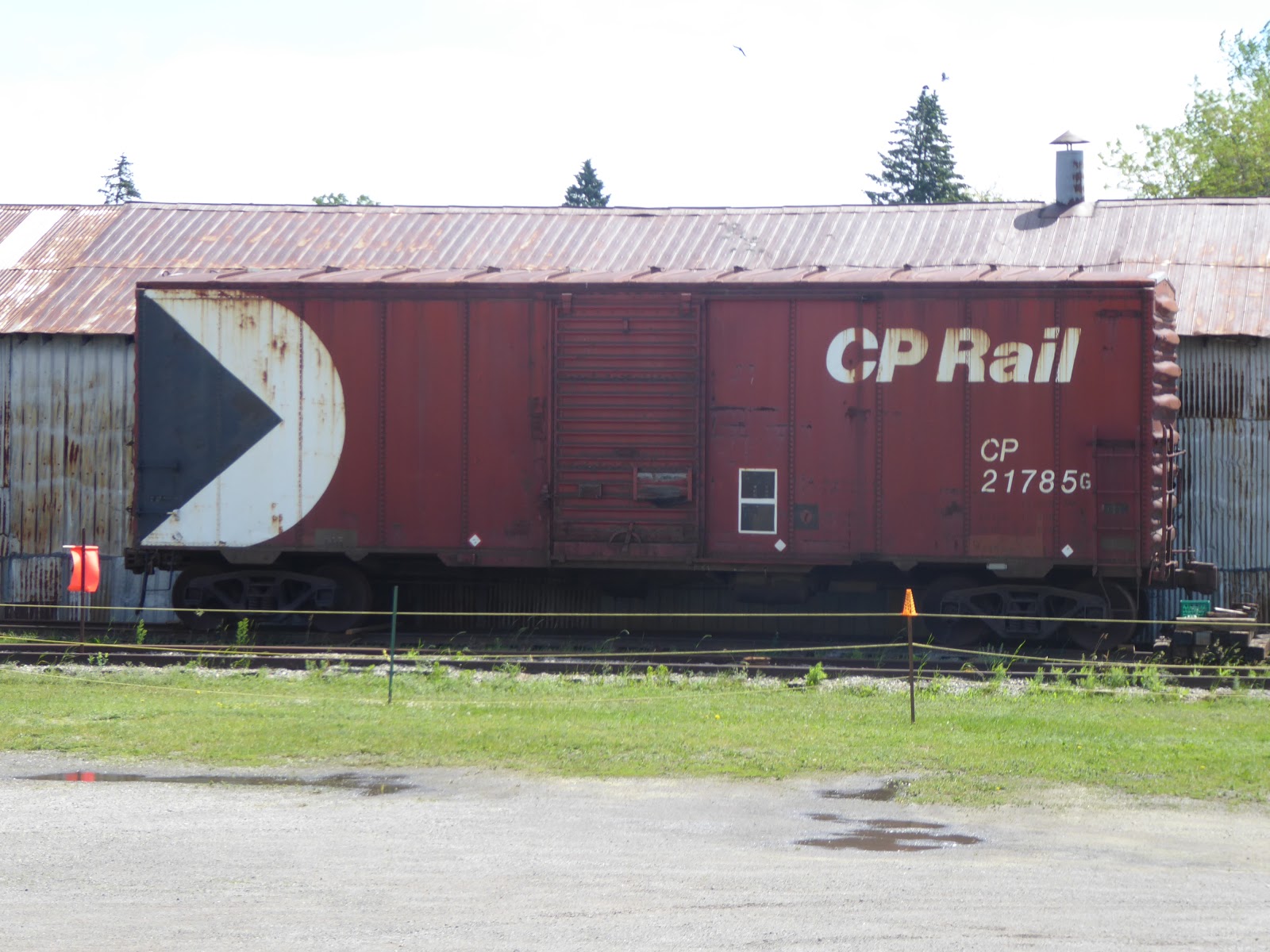
I didn't get a shot of this boxcar the last time I was at the museum. I took a quick photo because it reminded me of railfanning when I was a kid. The CP multimark was a common site for me and it remains a source of great nostalgia. Plus, I have two examples of this boxcar on my layout in my basement (although both are in boxes at the moment).


I couldn't publish a post about the museum without getting a shot of my favourite piece in the collection, its old Alco switcher. This engine still operates on occasion, when the museum offers visitors train rides on its operations days.


I couldn't get a shot of this old bench without my girls sitting on it. This bench is a new addition to the museum's collection and it is of particular significance to railfans from Ottawa. Why? Because this bench was just recently found in storage in Ottawa. It was originally one of the benches used by passengers at Ottawa's former Union Station downtown. The craftsmanship on this bench is amazing. The two lamps are part of the overall structure and were purposely crafted into the framework of this two-sided structure. It was recently donated to the museum, as it had no uses in Ottawa. I think this was the best possible outcome for this relic. Here, it will be appreciated by those who want to learn more about rail history. My girls loved it, as you can see.


For those who haven't been to the Railway Museum of Eastern Ontario lately, there are some exciting developments happening here. A volunteer told me about plans to move an 1890s-vintage passenger car to the museum grounds where staff will clean it for use in the spring. It will be on the museum's grounds in November and will spend the winter indoors. The car will be put into "revenue service" (museum's words) in the spring and possibly be used for events or as a cafe down the road. Whatever the case, there are hopes this car will provide the museum with a much-needed new source of revenue, which can then be used to further preservation efforts. For more on this, go to the museum's Facebook page.

The museum's next operations day will take place over the Thanksgiving weekend.

Thursday, September 26, 2019

Ten thoughts about the Confederation Line launch

I reluctantly took my first few trips aboard the new O-Trains on the city’s much-ballyhooed Confederation Line recently. To my surprise, I found the new system quite nice, with many small details well executed. There’s no doubt that people in the city are impressed with the new system. I think much of the excitement is centred around the fact that the line acts as a quasi subway through the downtown core, as it travels beneath the main parts of the core between the edge of the LeBreton Flats to the west and the University of Ottawa to the east.

Without getting into the politics behind the new line or the operational and bureaucratic miscues that have led us to this point, I thought I’d share a few observations on the trains themselves and the on-board experience.

1. My first impression of the train was that the ride was quite smooth and the trains remarkably spacious, considering how many people are hopping aboard at the end points of the line, which for me is Tunney’s Pasture. However, it is important to note that the old rapid bus transit system is still operating normally until Oct. 6, so these trains aren’t yet at full capacity just yet.


2. From a purely aesthetic point of view, I find these trains fairly ugly, especially the operator’s area at either end. I’ve seen other light rail sets in other citys that do not look like an insect’s head. Our trains look as though they have grotesque bug eyes on either end. I know they are probably designed this way to maximize safety and the sightlines for the train’s operators, but still. This is the light rail version of the P42. A small complaint.


3. The downtown underground stations are impressively laid out and quite functional. They are clean, although a bit sterile for my tastes. Most of the stations along the Confederation Line have a fair bit of artwork in them, but I found the actual platform areas at Rideau and Lyon Station to be a bit bland. Once you get into the areas with the stairs and pedestrian ramps that lead you away from the platforms, you begin to see more of the artistic flourishes. I suppose the platforms are no better worse than the subway station stops I can recall from my time taking transit in Montreal or Toronto.


4. The four-storey escalator that takes you from the deep underground Rideau Station to ground level is disorienting. It’s encased in a long, drab concrete tube. Unfortunately, there was no thought put into designing anything along the tube that is positioned at level. That means when you ride the escalator, you have a hard time judging whether you are standing at level. Think of the Crazy Kitchen at the Canada Science and Technology Museum and you will begin to understand. I have issues with vertigo and equilibrium and found the escalator a bit unsettling.


5. Pity the poor Trillium Line, the city’s first true light rail system. With all the hype and hoopla surrounding the launch of the Confederation Line, it’s somehow getting lost in the shuffle that this city has had a light rail system for more than a decade. The media coverage suggesting otherwise is just lazy.


6. The sound of the Citadis Spirit trainsets on the Confederation Line is more of a whirring rather than the sounds you typically associate with railways. I’ve been on subways in Toronto and Montreal and have to say that these LRT trainsets here sound much differently. There are no clanking sounds, just a high-pitched whirring.


7. The downtown rail tunnel is much louder than I thought it would be. As the trains makes their way through the core, the echoes of the train through the tunnel are quite noticeable inside the train cars. This is not a complaint. Just an observation.


8. The Tremblay Station that is right near the Via Rail central station has to be one of the more lightly used stations on the line. I am not an east-end commuter, so I can’t say this definitively. I took the train during off-peak hours but was still quite surprised at how empty this station was.

9. It’s interesting how the city links together two trainsets for the morning rush. The trains arrive every 3-5 minutes and are always in this configuration where two cabs are linked up together in the middle. I suppose this gives the operations people flexibility when they have reduced demand on the weekend and don’t need to use this two-trainset consist.


10. The new system has proven to get me to my workplace a few minutes quicker each morning, which was a pleasant surprise. Still, I’m not exactly thrilled that I have to make two connections just to get to work.

I guess I will reserve final judgment until this line operates in the winter. But, so far, so good.

We'll see.