Showing posts with label Railway Museum of Eastern Ontario. Show all posts

Tuesday, March 4, 2025

The long, slow, strange journey of an antique passenger coach to Smiths Falls

The pandemic was cruel to so many people and many organizations, needless to say. I don't mean to minimize the impact it had on those who were sick or lost loved ones. But from a business standpoint, it was especially cruel to organizations like the Railway Museum of Eastern Ontario in Smiths Falls. This museum is a tenacious operation that is the product of the success of its volunteer efforts. I love this place. The people who work here or lend their time are second to none. They are dedicated and passionate. This place does not exist as it is now without its volunteers.

That was why it was cruel that the pandemic put a huge dent in the museum's plans to showcase its new piece of rolling stock in 2020, a turn-of-the-century dining car once belonging to the Intercolonial Railway and later the Canadian National.

The car is so long, it's almost impossible to get a good shot of it from up close. To get a proper shot of it in profile, I had to take a less-than-ideal shot from across the parking lot. And yes, that is my family's RAV4 blocking some of the shot. I should have thought ahead when parking!

This old dining car could be one of the oldest pieces in a railway museum in Canada. It was built in 1899 by the Wagner Palace Car Company of Buffalo. If that company name doesn't ring a bell, perhaps its purchaser is more familiar: Pullman Standard. Pullman bought Wagner just a year after this dining car was built.

The car was used on the Intercolonial Railway between Halifax and Riviere-du-Loup, Quebec, where the ICR connected to the old Grand Trunk Railway. Even though the car now bears the Canadian National script, it clearly did not belong to the railway when it was first used, as CN didn't exist until June 6, 1919, when it was founded and was given control over several failing railways (GTR, Canadian Northern for example).

The car itself was beautifully cared for by the Bytown Railway Society for years before it was transferred to the Smiths Falls museum before the pandemic. The car, according to the museum website, has five tables on either side of the aisle in the dining area. 

Interestingly, the builder plate for the car can be seen in the dining area on the floor. Beneath that brass plate, there is a kingpin, which is part of the wheel (truck) assembly. It's interesting that the builder's plate is found on the floor above the kingpin. I can't say I have seen that before.

Many of these details I picked up from researching the car. The last time I was at the museum, this old dining car's interior was off limits, due to pandemic restrictions.

As you would expect, the car also had a kitchen and storage area for staff. Cooking was done with the aid of charcoal. To load the food and supplies, the car had a hatch where crews could slide the food and supplies directly into the kitchen and preparation area. 

Originally, the car was lit by hanging kerosene lanterns, as you might expect from a car built at the turn of the century. There was also an emergency cord strung up on the ceiling, for emergency stopping purposes.

There are a few bits to this car's recent story that you might not know. First, the car was brought to the museum with the goal of using it as a cafe of sorts to generate extra revenue for the operation. Sadly, that was not able to happen due to the lousy timing of the pandemic and the strict health measures that prevented the dining car's use for food service.

Second, as you might imagine, the process of getting this car to Smiths Falls was also a chore. You might think it would be easy enough to ship the car on a special move down the old CN Smiths Falls Subdivision, but this was not possible.

Why? Well, the Bytown Railway Society no longer has access to the rail system, as its rails at the Canada Science and Technology Museum are no longer connected to local tracks. This has been a topic of conversation among railfans in Ottawa for years. Ask the BRS officially and they will tell you that this is not in their plans, nor is it a priority for the museum, I would imagine.

I say this without any malice. But I know many people are frustrated that a group like the BRS has no way to host excursions as it once did. I have spoken quietly to a few members of the society in the past and they told me that they wished there was a way this connection could be re-established.

Also factor in the times we live in, where the liability and the changing priorities of railways make it much more difficult to facilitate third-party excursions. I can't imagine this would be an easy proposition, given how busy local rail lines are with Via Rail trains. It's true that CN doesn't own much trackage in Ottawa anymore, but I can't imagine the company would be thrilled with a third party making use of what little of the Beachburg Sub is left. And when you factor in the 10 mp/h speed restriction on the Nylene Canada-owned Renfrew Spur, you can see the potential legal and operating issues that would get in the way of excursion runs.

All that to say, the old dining car had to be brought to Smiths Falls in two pieces on special trucks that are sometimes used to move houses. It's a sad commentary on what has happened to the rail system in Ottawa that a rail car cannot be moved by rail to Smiths Falls, even though a rail connection is very much in place.


This brings me to a final, somewhat sombre, point. The Bytown Railway Society can only do so much with the limited trackage it has in place at the museum. Still, the group has done some great events and continues to be a beacon of preservation. It still has some great pieces that are safely stored in the new museum collections building. It's a much better setup for the group than what it had previously. But the reality is, without any way of being able to do excursions or generate revenue through events, its options are limited. That is my opinion, anyway. BRS still publishes Branchline Magazine and the annual Canadian Trackside Guide. It also hosts history presentations.

If you follow BRS on Facebook, you will have noticed that it was putting out feelers on this wrecker (above). I was lucky enough to see this car out on the tracks last year. It's a wonderful old relic of the days when railways had full-fledged work trains. I'd hate to see this piece of history go, but it appears as though there's only so much room for what the society has.

You might also recall that the society's old CN passenger car is now residing in a New England rail museum, where is is paired with coaches just like it. I remember following the BRS's Facebook updates on the restoration of this coach. Again, I was lucky to catch it out on the tracks behind the museum last year. I'm glad I got this image, because it was the only time I was able to see this car in person. I'm sure it will be put to good use in New England, but it's still sad that it had to go at all.

The next time I go to the Smiths Falls museum, I'm hoping to get a better look at the inside of the old dining car.

It makes me wonder if we can't do more for rail preservation and history in Ottawa. We do a great job honouring history in this city in so many other ways. Why not honour our rail transportation legacy, like we do our aviation history? Also, given the collection of cars the science and tech museum has in storage, possibly there's an opportunity here to look at a transportation museum connected to the aviation museum?

We've spent money on worse ideas!

Monday, January 31, 2022

The Tangled History and New Life of Car 23

I was surprised when I visited the Railway Museum of Eastern Ontario in Smiths Falls last summer to see that the organization has a big new project in the works. An old Canadian Pacific Railway observation car, which is simply called Car 23, is slated for full restoration. The museum says it has many of the car's original parts, carpets and furniture in storage. The car is now located in a corner of the property, behind the museum's CN snowplow.

You can see from this photo that much works needs to be done, as the sides of the car are currently being protected by plywood sheeting, although I give the volunteers credit for painting the sheeting to match the car's maroon scheme.

I had no idea that the museum had this old railcar on its premises. I have visited this museum several times over the years and didn't even know it had a single piece of Canadian Pacific passenger equipment. Those who have been here know that the majority of the museum's passenger equipment is from the Canadian National, mostly from its pre-wet noodle black and white days. Here's a shot below of its passenger roster, as seen from the side of the museum's S3 Alco switcher. The car at the end of the consist is the former Canadian National dental car, which was once used to serve the needs of those in remote towns who did not have a dentist.

These days, you are not allowed to climb on the equipment or even touch it, which is understandable given the health precautions that are in place due to the pandemic. That meant that we were given a guided tour of the grounds by a tour guide. He was a great guide and very knowledgeable about the overall history of the equipment and the companies that supplied it. When he arrived at Car 23, as he called it, he mentioned that it is the museum's next big project. 

He even mentioned that the car was used for Sir John A. Macdonald's purposes. That piece of information made my ears perk up. I knew that Canada's first prime minister was a huge fan of the Canadian Pacific and made use of the railway, but I wondered if he did in fact use this car.

So I tried to find what I could online about Car 23.

First things first. This car was built five years after Sir John passed away, so we can effectively squash that bit of the myth. While Canada's first prime minister was a fierce supporter of the transcontinental railway and rode the rails many times, he never stepped foot in this car.

The car was built by Crossen Car Manufacturing Co.in 1896 as Quebec Central Megantic. The Quebec Central was a railway that was headquartered in Sherbrooke. The railway served the province's Eastern Townships and eventually connected to CP's transcontinental line at Lac Megantic. The railway was leased by CP in 1912 for 99 years, so it eventually fell into CP's operations, although it continued to be operated as a separate entity, with passenger service as far as Quebec City and Vermont. 

So, strictly speaking, this car didn't begin life as a Canadian Pacific car. It's important to note that the car's frame and undercarriage were both originally made of wood, which reflects what was common at the time. The car's underframe was rebuilt in 1912, the same year CP leased the Quebec Central. The car's name changed to Beauce in 1935.

It wasn't until 1939 that is acquired the Car 23 moniker. The rear observation porch makes you think that it might have been a car used on the rear of passenger trains, but the car was strictly speaking a business car or superintendent's car. It was retired in 1968 and assumed a second life as a museum piece under the ownership of the Canada Museum of Science & Technology. The car was leased to the Canadian Railroad Historical Association for its Harbourfront Attraction in Toronto until the museum was disbanded and the collection scattered.

The history of the car gets a little murky here. I'm not sure when the Toronto museum was closed and where the car resided in the ensuring years before it came to the Smiths Falls Museum. You can read a bit about the car, and CP's other business cars, on this Old Time Trains page. You will have to scroll down the page a bit to get to the Car 23 information.

As for its provenance, there is a fair amount of information about Crossen Car Manufacturing, which built many cars for the Canadian Pacific, Canadian Northern, Intercolonial Railway and other Canadian lines around the turn of the century and shortly afterward. You can read about that company by checking out this fascinating history page. 

So, in all this sleuthing, I wasn't able to find any extensive information on Car 23. The museum's plans for the car will likely involve years of restoration, which means it will likely not look any different than it does in the top photo for some time. I'm not sure how extensive the museum's volunteer base is, when it comes to restoration efforts. I know the Bytown Rail Society has its regular dirty hands club, which has been working on an old CN coach for years, so I would assume that Car 23's timeline would be something similar. 

Still, it's a fascinating piece of history. Hopefully, it will have its moment to shine once again.

Thursday, October 3, 2019

Some fascinating details at the Railway Museum of Eastern Ontario

Earlier this summer, I brought my girls to the Railway Museum of Eastern Ontario. Much to my surprise, they loved the place and are eagerly awaiting a return trip. I spent a great day with them, looking at some of the old relics in the Smiths Falls collection and explaining some basics of railways to them. We were even treated to a demonstration in railroad telegraphy from a volunteer, who was fluent in Morse code. He also explained to the girls what a railway agent was and what they did in the station.

The last time I went to this museum, I spent much of the time photographing the pieces of rolling stock and the two locomotives. This time around, since I already knew what was on display, I looked for some hidden details I missed the first time around.

I am a history nerd, so I was thrilled with all the artifacts that I didn't notice the first time around.

Here are a few shots of the railroadiana you will encounter at this gem of a museum. What really fascinated me were the signs in the old Canadian Northern station. This one below was by far my favorite.


Arrested for spitting! Imagine. I suppose that this rule was likely aimed at those spitting tobacco. I laughed when I saw it because it made me think of an actual bylaw that the old City of Kanata had, before the western suburb was amalgamated into the City of Ottawa. It was a long-running joke in this area that you could not spit in Kanata. The old city had a bylaw that prohibited the habit. I remember playing soccer there and my teammates always joked about not spitting during a game without first taking a good look around.

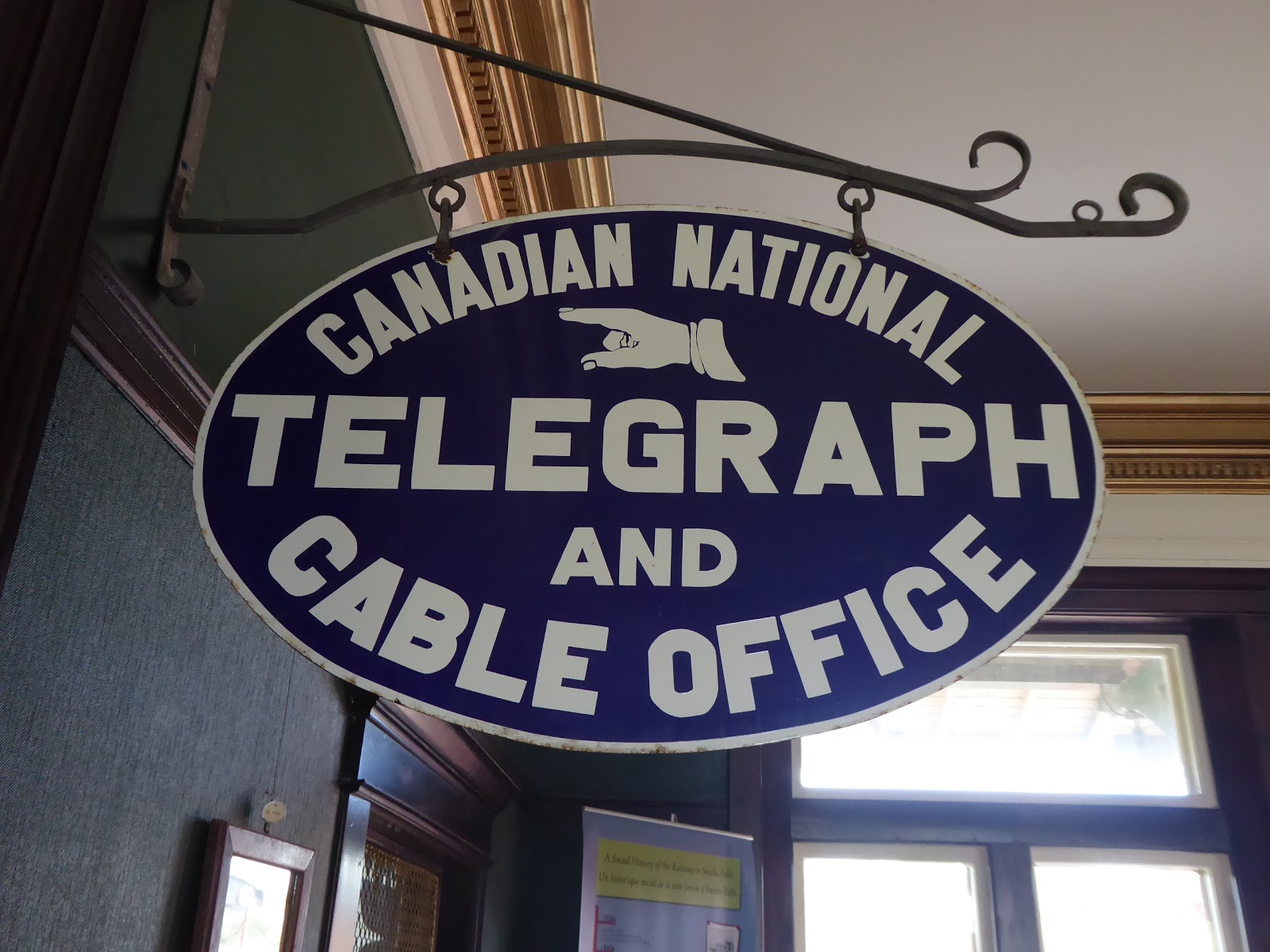
The second sign that I really loved was this old telegraph sign, perched outside the old telegraph office. Today, we still see parts of the old telegraph system still in place along railway lines, but I would imagine many younger railfans not really understanding just how important these lines were at one point.


I thought this slate timetable (below) on the outside of the station was a nice touch. Although it was quite out-of-date by the time we visited in July, it gave you a good idea of what train travel was like in the days before the technology that we take for granted today. Surprisingly, the frequency of passenger trains then is comparable to what you see today in Eastern Ontario, although Smiths Falls passengers no longer have their grand old CP passenger station to begin their trips. Instead, Via now uses a modern kiosk on Union Street. I say kiosk, but it is quite a bit larger than a bus shelter. However, whenever I see that ultramodern station, I can't help but think that it looks like an overgrown bus shelter. Functional, for sure, but lacking any style.


Before I saw this sign, I had no idea this place even existed. Forthton is a hamlet northwest of Brockville. It once had its own railway station on the Brockville, Westport & Northwestern (later Canadian Northern and Canadian National) Railway. The sign looks like it's seen its share of bad weather over the years but it now hangs in the old CNor station waiting room. I love old station signs and wish more of them had been saved. I always thought it would be a cool feature to have in my house (not sure if my wife would agree).


This old flag station for Nolans saw use for many years just north of Smiths Falls. I didn't know that this station was actually originally used as a flag station for Dwyer Hill, on the edge of Ottawa, before it was moved to Nolans to replace the original Nolans flag station after it burned down. This little station served CNor passengers between Smiths Falls and Ottawa in the early 1900s. The museum notes that in its final years, only two trains passed this station at 9:45 p.m and 2:15 a.m. Not terribly convenient!


I didn't get a shot of this caboose the last time I was at this museum, as it was parked in the museum's yard in a spot that was not accessible to visitors. As you can see, it is used for storage now and requires a fair bit of work to be fully restored, particularly on each end. I like the fact that they note that the caboose was originally CP 436757. You can also see another old CP caboose hitched to the other side. This caboose also seems to be suffering from the elements. It was in a prominent position the last time I was at this museum, but has been boarded up and shuffled off to a much less prominent spot. The yellow caboose is an older wooden van that had its slatted sides covered over with plywood sheets. It was a practical thing for railways to do at the time, but has since proven to be a headache for those who seek to restore the cars for preservation purposes.


My daughters couldn't get enough of riding in the cupolas, so I decided to follow them up one time and get this cupola's view of the station and the trailing CN caboose. This museum really does allow you to get a feel for what it was like to ride a train back in the golden era of railroading. As a parent, it means you have to watch your little ones closely, but I like that the museum trusts its visitors enough to hop aboard these fascinating relics.


Here's another shot I took from the end of the caboose lash-up in front of the station. You can see the old passenger equipment to the right, including the CN dental car, which is the best preserved piece of passenger equipment at the museum. The interiors of the other passenger cars are not open to visitors.


This is an old section house built by the Canadian Northern, that now houses some of the museum's archives. It is not open to visitors, but it is in the process of being restored after being saved from demolition in 1995. These structures were used as homes for the families of railway section hands. The museum says this is one of the last remaining such structures in all of Canada. The house was built in 1912.


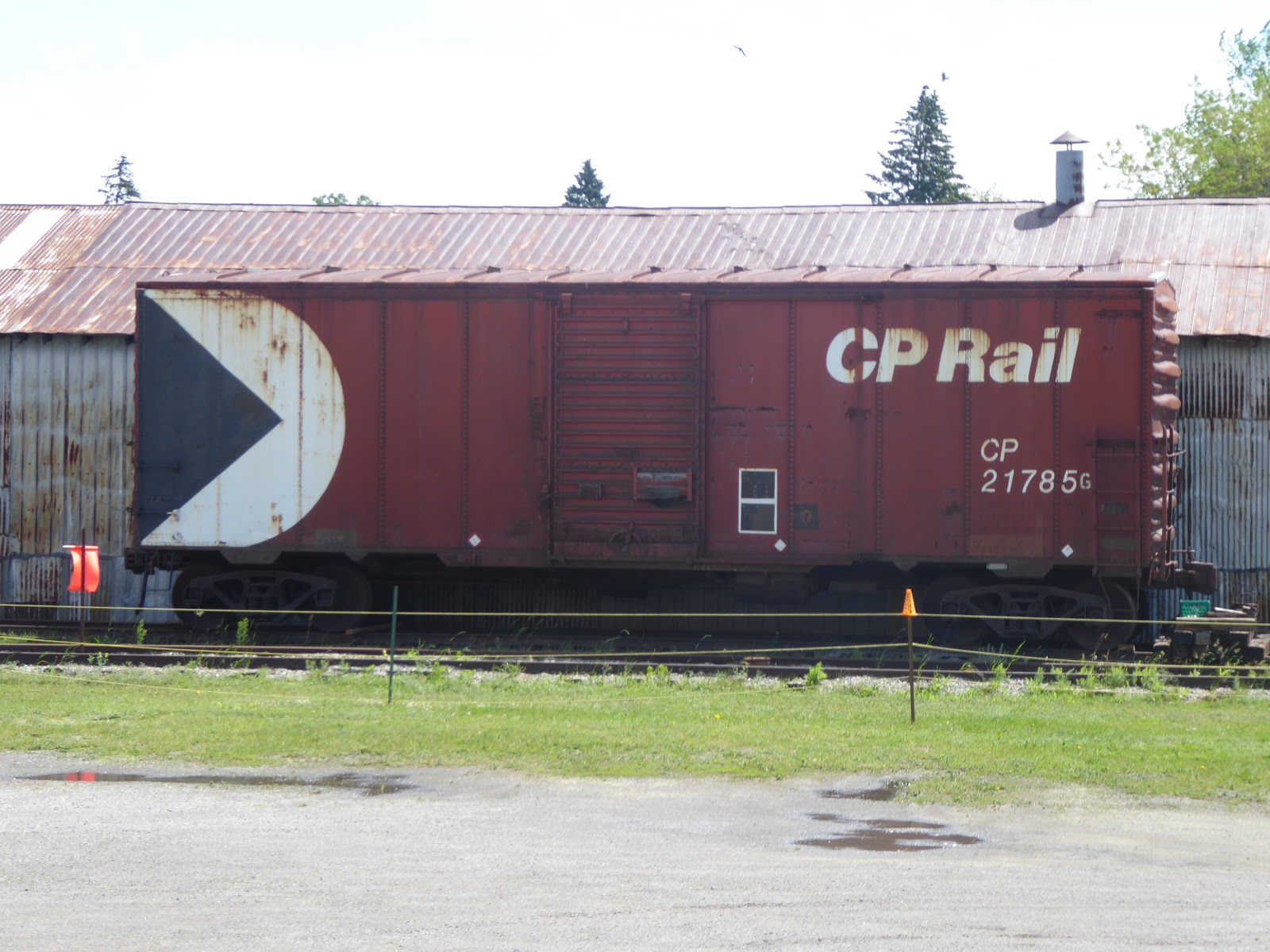
I didn't get a shot of this boxcar the last time I was at the museum. I took a quick photo because it reminded me of railfanning when I was a kid. The CP multimark was a common site for me and it remains a source of great nostalgia. Plus, I have two examples of this boxcar on my layout in my basement (although both are in boxes at the moment).


I couldn't publish a post about the museum without getting a shot of my favourite piece in the collection, its old Alco switcher. This engine still operates on occasion, when the museum offers visitors train rides on its operations days.


I couldn't get a shot of this old bench without my girls sitting on it. This bench is a new addition to the museum's collection and it is of particular significance to railfans from Ottawa. Why? Because this bench was just recently found in storage in Ottawa. It was originally one of the benches used by passengers at Ottawa's former Union Station downtown. The craftsmanship on this bench is amazing. The two lamps are part of the overall structure and were purposely crafted into the framework of this two-sided structure. It was recently donated to the museum, as it had no uses in Ottawa. I think this was the best possible outcome for this relic. Here, it will be appreciated by those who want to learn more about rail history. My girls loved it, as you can see.


For those who haven't been to the Railway Museum of Eastern Ontario lately, there are some exciting developments happening here. A volunteer told me about plans to move an 1890s-vintage passenger car to the museum grounds where staff will clean it for use in the spring. It will be on the museum's grounds in November and will spend the winter indoors. The car will be put into "revenue service" (museum's words) in the spring and possibly be used for events or as a cafe down the road. Whatever the case, there are hopes this car will provide the museum with a much-needed new source of revenue, which can then be used to further preservation efforts. For more on this, go to the museum's Facebook page.

The museum's next operations day will take place over the Thanksgiving weekend.

Thursday, March 17, 2016

RMEO Part IV: The best of the rest

Last summer, my family visited the Railway Museum of Eastern Ontario in Smiths Falls. I made sure to take photos of just about everything. In this post, I thought I'd share some photos of a number of pieces of the museum's collection that didn't merit their own post.

You can read about the museum's S3 locomotive here.
You can read about the museum's two Canadian Pacific cabooses here.
You can read about the museum's dental car here.

The car below is an oddity for sure, at least by today's railway standards. This 1947 Cadillac sedan was originally owned by a Toronto doctor. The doctor donated the car to his friend "Buck" Crump, president of the Canadian Pacific Railway. Crump promptly sent the luxury car to Montreal where the railway converted it into possibly the most comfortable inspection vehicle the CP had ever seen.

The car, numbered M-260, was assigned to the president and used for division inspections. There are some interesting modifications on this car. One is that the steering wheel was used for air brakes while the car itself was placed on a rotating turntable, which allowed the car to avoid needing wyes or diamonds in order to turn around. An air horn and bell were also added to this eight-cylinder, seven-tonne car, which has 32,000 miles on the odometer. I also love the CPR beaver logo on the driver side door.


Canadian Pacific spanned the world at the time.


My nephew loved this locomotive, which I took him to see. This steam engine, built in 1912 for the Canadian Northern, was a 4-6-2 coal-burning locomotive later converted to oil. The locomotive was used for both freight and passenger service. It served in these two capacities for the CNoR and CNR until it was sold to the resource line Quebec, North Shore and Labrador, where it worked in revenue service until 1961. The locomotive was then donated to railway museum Exporail. In 1992, it was leased to the Smiths Falls museum, where it has been ever since. The museum had the engine laid out with a consist of two boxcars and a caboose.


This wooden caboose below was one of 15 built by the Canadian National in London, Ontario in 1947. This caboose belonged to the last roster of wooden cabooses built by the railway. It was retired from revenue service in 1983 and was donated to a museum in Cornwall. In 2001, it was donated to this museum, where it was restored. It looked like it needed a fresh coat of paint, but the interior was immaculate. Despite the fact that it is a wooden caboose, this car has some modern touches, like an oil stove, rather than a coal stove. It also was equipped with air brakes.


Inscription on this yellow boxcar (see shot above, in front of the CNR caboose) reads: "Insulated and Heated Car. For Cleaning Lading Only. Accept Bulk Commodity."


This plow was one of my favourites. One of the reasons is that it's such an odd looking car. The Goderich Exeter Railway still uses a plow just like this one to keep its lines clear, especially in the Huronia region. This car, 55400, was built in 1935 by National Steel Car in Hamilton. This plow worked by harnessing the power of the compressed air in the train's braking system.


This shot gives you an idea of what it was like to sit in the cockpit of one of these cars. The three gauges you see read main reservoir, signal line and train line. I was surprised how simplistic the setup was when I climbed into this car.


This old wooden boxcar was something of an anomaly. There wasn't much to read about it in the brochure the museum gives visitors. There was nothing on the outside to indicate the origin of this car. By digging a little, I found that this car was built in 1923 for the Canadian Pacific. There is little more out there about the story of this car.


I did find it interesting that there was this door at the end of the boxcar, which suggested to me that this car may have been modified at some point for maintenance of way duties, although that is just a guess.


I spotted this tank car at the edge of the museum's property near a maintenance shop. It reads Casco on the side. It looked like it needed a fair amount of work before it was added to the permanent collection.

 
That concludes my four-part recap of one of Eastern Ontario's more fascinating museums. My family and I had a great time wandering the grounds and the restored CNoR station. Smiths Falls should be very proud of this museum. I know I will be back.

Thursday, October 22, 2015

RMEO Part III: The dental car

This is the third part of a series detailing the artifacts found at the Railway Museum of Eastern Ontario in Smiths Falls. You can read the first part here and the second part here.

One of the more curious artifacts in the museum is Canadian National heavyweight sleeper car 15095, built in 1913. What makes this car curious is that is was converted in 1951 into a dental car. The bedrooms in the car were remade into living quarters for a travelling dentist, a dental office and a nurse's room.


The car, which was converted in 1951, owed its new lease on life to the Ontario government, which introduced a program in the 1930s to provide free dental care to children in remote communities in Northern Ontario, many of which were connected to the outside world by the Canadian National, Canadian Pacific, Ontario Northland main lines or other northern subdvisions (think of towns like Sioux Lookout, Capreol, Kapuskasing or Cochrane).

Children would enter one end, be treated in the dental office halfway down the length of the car before exiting the other end. The dental car travelled with an accompanying car that stored the dental supplies. This car had three options for its power supply. It could receive power from a train consist, a generator or directly from the hydro grid. The dental car would also serve adults, for a fee.

The car served as a travelling dental car before being retired in 1977. Shortly after, it was preserved in Toronto and was on display there before it was acquired in 1990 by the Railway Museum of Eastern Ontario. This is what the car looked like when it was stored in Toronto (below).

Photo courtesy of the Canada Science and Technology Museum online archives

The museum's volunteer in the dental car told me that each end of the car retained much of its original mahogany interior décor. I took this photo of what the hallway near the entrance looked like. This is what a passenger would have seen as they boarded this car in 1913. That head you see in the bottom of the photo is my daughter practicing her photobomb skills.


This room, below, was once the men's smoking lounge. It was converted to a kitchen as part of the dentist's living quarters.


Some beds were removed from a bedroom to make up the dentist office. My daughter thought the stuffed animals on the dentist's chair were a nice touch.


This shot below shows you what the exterior of the car looks like right now. The car is perched at the end of a long wooden boardwalk. I've read some conflicting points of view online regarding this Canadian National paint scheme. Some seem to like it while others hate it. I, for one, like it.


This final shot gives you an idea of the collection at the museum. When I took a handcart ride on the track between these cars, I was able to see the seven or so passengers cars in various states of repair. Given the museum relies on volunteers, I'm guessing it will be a long road ahead for some of these old beasts.

 
The volunteer in the dental car told me that the car, which was known as Camrose, was also used on Canadian Pacific trackage in Northern Ontario, making it likely that it might have made its way to Chapleau, where my Grandfather worked as a rolling stock mechanic.
 
The dental car is one of seven at the museum (see above). CP and CN both contributed three old passenger coaches to the museum as part of its creation in 1985. Some bear no outward identifying marks, which makes it tough to trace their history. 

Thursday, August 27, 2015

RMEO Part II: Two cabooses, two stories

This is the second in a series of posts profiling some of the more interesting pieces of rolling stock on display at the Railway Museum of Eastern Ontario in Smiths Falls. Read the first post in this series here.

At first glance, this CP caboose resembled the centre-mounted cupola cabooses I remembered from my childhood. Of course, most railfans would recognize this car as being quite a bit older, since the cupola is mounted off centre and is clearly clad in tongue-in-groove wood. But as I neared this old caboose, I noticed something was not as it should be.


And this closer look confirms it. Expecting to see the slated wood finish, I discovered this old caboose was actually clad in plywood. It made me wonder why. So I did a little digging.


It turns out this caboose, CP 437169, was built in 1945 at Canadian Pacific's Angus shops in Montreal. The museum's website mentions that the car was actually constructed with plywood, instead of tongue-and-groove slats, due to ongoing materials rationing that was a result of Canada's war effort. Let's put this aside for a moment. We'll come back to it.

The museum's site also stated that the car, over the course of its career, went through 3-4 paint schemes before finally undergoing its final transformation in the CP multimark livery. The car served in Eastern Ontario before being retired by the railway in 1990. Upon its retirement, it was donated to the museum.

Below is the view you get when you walk into the car. You can see the interior is made of slated wood with a bench, desk, bed, stove, kitchenette and the cupola off toward the other end of the car. All in all, not a bad setup. The museum has done an excellent job of maintaining the interior of this old van.


Below is a sister caboose to the one above. Numbered 437169, this car was also made in Montreal at the Angus shops and was retired in 1990 after serving in the Eastern Ontario region. If you compare this side profile with the side profile of the caboose above, you will see they are identical, but for the paint. The museum's website states that this car was originally built with slated wood and then sheeted over with plywood sheets at some point in its history.


If you look closely, you can see the nailing edge on the end of the car.


So the question remains, which story is correct? I can't imagine that one car would have been built with plywood while the other was made with slats. The interior of the yellow caboose shows that its interior was clearly made of slated wood, which leads me to believe that it too was re-sheeted at one point.

The next question is, why were these cars re-sheeted? Scanning a few websites, the best answer I found was that the railway found it was easier to maintain these cars with a plywood veneer rather than maintaining the slats. The one unintended consequence of this cost-saving measure, however, was that the exterior sheeting actually contributed to the slats underneath rotting, which compromised the structural integrity of the cars.

Penny wise, pound foolish? Maybe.

 
This last shot was my attempt at framing the above caboose next to a backdrop of the station. I shot this image in the area between the passenger waiting rooms and the railway express office, which was in a separate structure, although both were connected by the same roof.
 
I have to say that I have always been fascinated with old rolling stock being dressed up in contemporary railway liveries. I found this car in the Sarnia rail yard and was amazed that a car so old was repainted in the wet noodle paint scheme. The wood CP caboose in the multimark scheme appeals to me for the same reason. I was drawn to it immediately. I think it's the mixture of railways past and present that makes these cars unique.