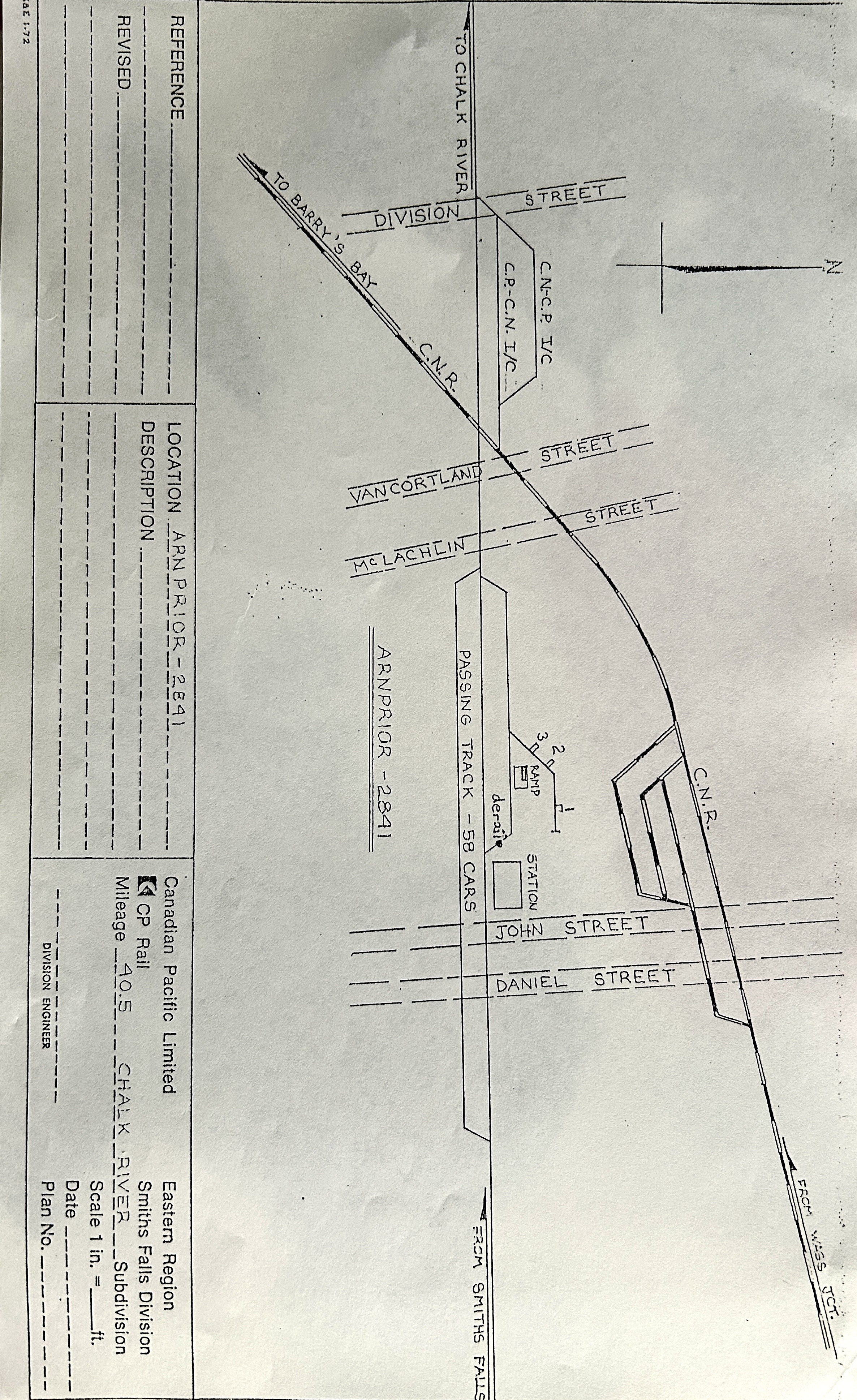
There is no shortage of lamentations online about the state of railways in the Ottawa Valley and loss of much-loved rail lines. The other day, I found myself in Bells Corners with a few minutes to spare, so I sat trackside, hoping to catch CN 589 on its way back from Arnprior. The train never showed, but I began to think of some documents I read years ago from the Canadian Transportation Agency about the Renfrew Spur, a long stretch of track, between the former Nepean Junction and Arnprior, that would be long gone by now if CN had its way. Strangely enough, you can thank the Canadian Pacific Railway (okay, CPKC if you want to get technical) for the survival of the former Renfrew Subdivision.
Long story short, in 1987, CN applied to discontinue service on what was then known as the Renfrew Subdivision because the railway claimed it lost more than $328,000 per year on the line. The reasons were pretty obvious. Its one main customer was Nylene Canada (formerly BASF), which required weekly service, mostly one to three tank cars of caprolactum from Texas. CN, in its filings to the CTA, said there weren't enough customers on the line to justify continued service. In 1987, there were less than 100 car movements on the line. Hardly worth the price of maintaining the tracks for a large railway.
Read the specific details of this line's status from my earlier post.
At the time, the Teamsters Union claimed that Sullivan's Lumber in Carp (later Rona) and a flour mill both wanted rail service, but nothing seemed to come of the union's claims.
Instead, there were discussions with both CN and CP over how Nylene Canada would continue to get rail service in a way that didn't cost a railway money. When you consider that the Renfrew trackage now runs roughly 50 kilometres from what was once Nepean Junction (where the Beachburg Sub once veered northwest toward Fitzroy Harbour and beyond) out to the Nylene plant, you understand that this is a lot of infrastructure to maintain for one eastern and western movement a week.
At some point in these proceedings, it was decided that Nylene must have rail service, as the cost of shipping caprolactum by truck wasn't worth it for the company, which remains a major employer in Arnprior to this day. So the issue was how would the plant get served and which railway would provide the service in a way that was workable for everyone involved?
In 1987, Arnprior had both the Renfrew Subdivision and CP's Chalk River Subdivision running through the town. At the time, neither line could be described as a critical stretch of track, but CP did still use its Chalk River Sub for through freight, even if there was little to no trackside business. Also, Via Rail used the Chalk River Sub, as well as the CP Carleton Place Sub, for the Canadian, which once ran through Ottawa all the way to Montreal.
We all know how the story ends. We don't know what happened during this time between the government and the two railways, but we know the discussions over rail service to the Arnprior plant ended with the decision that CN would continue to serve the plant, instead of CP. But here's the question that I find intriguing. What if it was decided that CP would serve Nylene Canada?
If the Canadian Transportation Agency's discussions about rail service to Nylene Canada resulted in CP being the railway to provide the service, would there have been an Arnpior Turn originating in Smiths Falls? It might have happened. Here are the possible scenarios that could have resulted from this decision, including my take on how likely they would be in a parallel universe.
1. CP would have retained part of the Chalk River Subdivision. (LIKELY) I think this could have been a likely scenario. Would the track have been owned by CP or would the land have been sold to local governments and the rails sold to Nylene? Possibly over time. But what makes this scenario less likely is the fact that, at the time the decision was made in 1987, the Chalk River Subdivision still hosted daily through freights as well as the Canadian. That's a far different situation than what CN was facing with the Renfrew Subdivision, which essentially hosted nothing but a weekly freight out to Arnprior and back. Possibly the Chalk River track would have remained a CP concern.
2. CP would have retained the entire Chalk River Subdivision. (FAIRLY UNLIKELY) The other fascinating question would be if this weekly service, as mandated by the CTA, have caused CP to rethink its plans to abandon the Chalk River Sub in 2010-11? I ask this because possibly the weekly Arnprior service would have ensured that the subdivision between Smiths Falls and Arnprior remained in place. If that was the case, possibly Via Rail could have come in to maintain the remainder of the track to ensure the Canadian had its connection to Ottawa and beyond. And if that scenario seems possible, would it be a stretch for CP to keep running through freights on this line as a guest on a Via line? Or would the Ottawa Valley Railway still be involved on the sub? There are a lot of factors to consider here, but I think it might have happened.
The issue working against this possibility is that Via Rail did not have multiple trains using this line. Think about Via Rail's ownership of the old CN Smiths Falls Sub and the old CP Brockville Sub. These two lines see many movements a day, which makes sense for Via Rail to own and maintain them. The Chalk River Sub is not in the same league as these other lines. I think the entire track would likely not have made it.
3. CP would have retained the Carleton Place Subdivision. (UNLIKELY) This is where the alternate history gets a little murkier. Remember that Via Rail used the Carleton Place Sub and the Chalk River Sub as its route for the Canadian up until 1990. If CP had been forced to provide service to Arnprior, which would have necessitated a major stretch of the Chalk River Sub to be saved, would it mean that the Carleton Place Sub would have been saved? I don't think it would have saved this piece of track, which is but a memory now.

The reason I think this line was doomed no matter what was because it was essentially in the same situation as CN's Renfrew Subdivision, with no freight activity. In its final days, it was hosting Via Rail and nothing else. The discontinuance documents show the line had two car loads in and out in 1986 and nothing else afterward. This document from 1988 shows that CP was essentially losing anywhere from $250,000 to nearly $500,000 a year on this stretch of track, even though Via and officials from Carleton Place wanted the line kept in place. Notice from the document that the former Region of Ottawa-Carleton did not take a position on the rail line, but asked for the right of first refusal to buy the land.
My guess is that the Canadian, if it still had access to the Chalk River Sub and was running through to Montreal, would have gone to Smiths Falls and switched onto the old CN Smiths Falls Sub, where it could then continue on its way to Ottawa and then Montreal. It's fascinating to consider that train stopping at Fallowfield Station.
 Is the platform at Fallowfield long enough for the Canadian? It's interesting to consider.
4. CN would have torn up the Renfrew Subdivision (SURE THING) There's no doubt at all that the Renfrew Sub would have been a goner had the CTA decision on rail service to Arnprior been different. Most likely, the land would have either been converted to a trail or sold off in parts of the city where it could be developed, like in Kanata. As it stands today, the line is still in place, with a 10 mph speed limit, giving you an idea of the condition of the rails.
The final factor to consider in this alternate history is the fact that CPKC now has a transcontinental link across Canada re-established. Given that CP can run trains all the way out to port in New Brunswick, possibly there could have been consideration to keeping the Chalk River Sub in place or at least re-establishing a connection between Chalk River and Arnprior, if that part of the line saw a discontinuance even with the CP service to Nylene.
Of course, in the early 1990s, no one could have foreseen CP relinquishing its cross-Canada network only to reacquire it years later, but it's fascinating to think what might be possible if CP had been mandated to serving Nylene in Arnprior.


.JPG)