Thursday, August 20, 2015

Another railway mystery

So, here's another mystery to present to the experts out there. I've come across this locomotive several times at the Lambton Diesel roundhouse in Sarnia, Ont. I was looking at it more closely the other day when I realized I didn't know much about it. It has an odd paint job.

Here's a shot of the switcher, hiding behind a collection of spare axles and parts, taken October 2013. The unit is obviously near the end of the line. At first glance, you can see that it is a General Motors SW model. You can make out the GM logo and the Electro-Motive logo on the cab, not to mention the Canadian Auto Workers logo to the side. The locomotive carries the No. 1. And then there's the inscription on the bottom of the hood.

The mystery engine parked near the roundhouse in Sarnia. Check out the shark fins!

Here's a more recent shot of the switcher, sandwiched in between the old Nova Chemicals 2003 genset locomotive and CN 7516, which is being used for parts. Not much to learn from this photo, which was taken by my brother this past November.


Last December 22, I made my annual visit to the Sarnia area and took some time to snap a few shots around Sarnia Yard. I was lucky enough to have a clear vantage of the engine from an access road near the old CN roundhouse. You can clearly make out the inscription on the hood, which reads "Quality Built Locomotives for the 21st Century." That suggests to me that this was the old switcher that was used at the old GM Diesel plan in London, Ont. That plant, as most rail enthusiasts know, was closed in 2013. Another curious feature on this engine is the style of trucks. They look much older than the trucks I've seen on SW1200s.


Compare the trucks on the engine above with the trucks on this SW1200, which was crossing Front Street in Sarnia in 1993.

 
The trucks on the GM Diesel switcher remind me of the trucks on this old MLW unit, from CP's Windsor Yard in 1991.
 
 
On Aug. 18 last year, I noticed that the trucks resemble some of these trucks that were lying around in front of Lambton Diesel switcher 0176. Does this mean that the old GM Diesel unit has modified trucks or were the trucks replaced? Are they simply just an older model used on early GM diesels? My guess is they are simpler an older model of trucks.
 
 
In many ways, the unit looks very similar to an SW1200, but a few of the features, including its trucks, modified smoke stack, hood vents, fuel tank, and sharp slant between the hood and the cab make me think it's an earlier model. Anyone have an idea what model this engine is and where it's from? I'm sure someone with an old Trackside guide can help.


Thursday, August 13, 2015

RMEO Part I: The not-so-little engine that could, CP's S3

This is the first in a series of posts detailing the artifacts on display at the Railway Museum of Eastern Ontario in Smiths Falls.

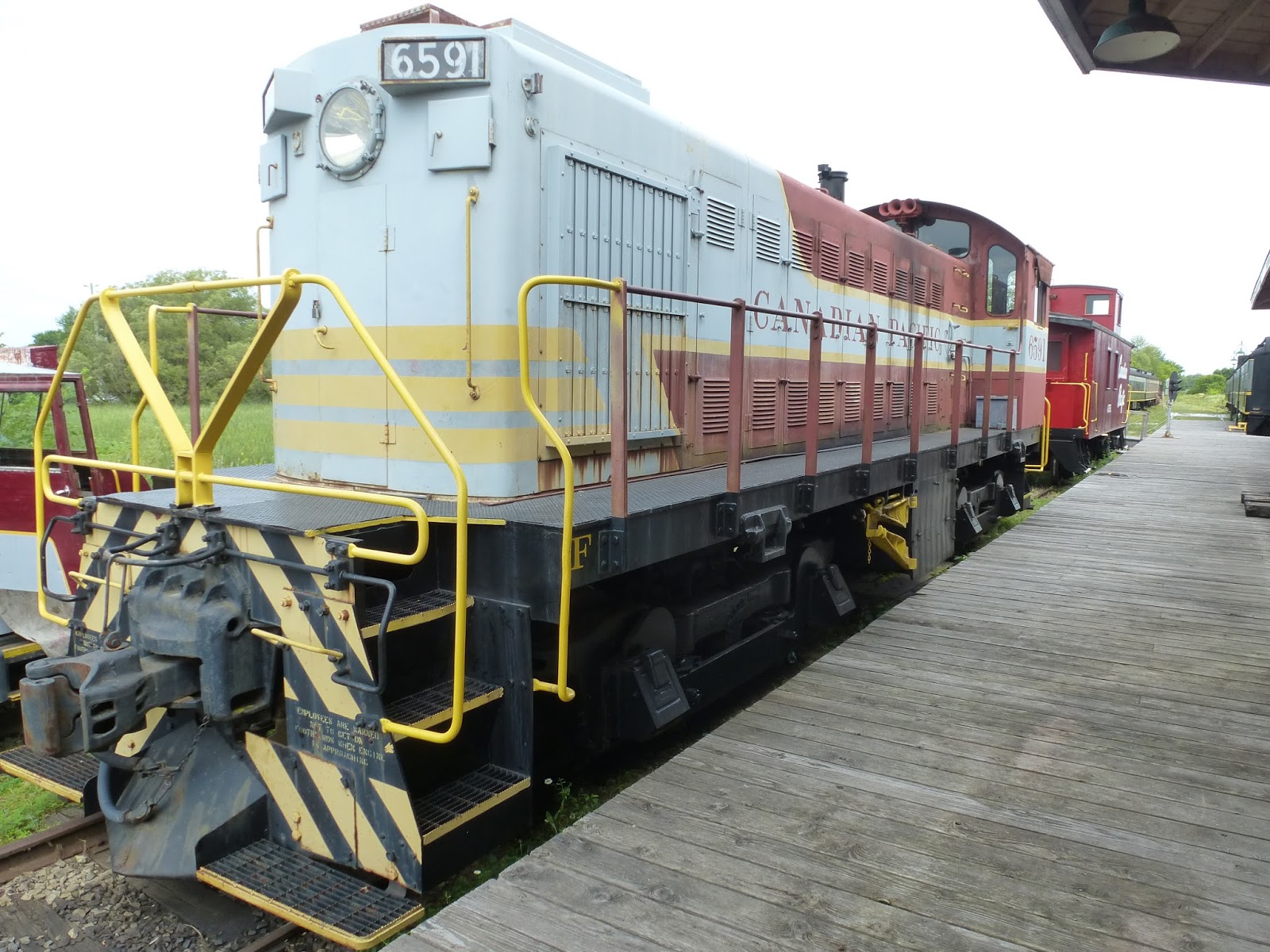
As I recently mentioned in my first Smiths Falls post, I visited the Railway Museum of Eastern Ontario in late July. The museum has a surprisingly large and diverse collection of rolling stock from various eras of railroading. The museum also has two locomotives on display, a CN steam engine and a Montreal Locomotive Works S3 switcher 6591 (ex-CP).

This diesel locomotive, which the museum lists as weighing 99 tons, often roamed the Smiths Falls freight yard and other parts of Eastern Ontario as a switcher until it was retired in 1982. The unit was then donated to the museum three years later. The engine has been restored and operated since that time. In fact, a volunteer at the museum told me they recently operated the S3 for some switching duties on the museum's tracks.

The shot below was taken from the platform of the museum's restored Canadian Northern (later Canadian National) station. So, had you been waiting for a train at this station in the past, this is the view you would get when an engine passed by, although it would be an unlikely site to see this CP unit on CN tracks.


This locomotive absolutely exudes first generation diesel. This model was built starting in 1957 in Montreal (earlier models were built by Alco in the United States). It's bulky compared to the more common switcher of choice in recent decades, the SW1200.

One might think that a switcher this big would have horsepower to burn, but the S3 only had 660 horses under its hood, compared to 1200 for the SW1200. For this reason and others, this locomotive and its sibling, the S1 were not the runaway success that Alco had hoped they would be.

Only 292 of these switchers were built by Alco and only 163 built by MLW. But, despite its shortcomings, 101 were purchased by CP while CN rostered 49.


This unit, as you can see above, is a centrepiece of the rail museum's collection, which is why it's the first thing you see after you emerge from the reception area onto the grounds.


I was able to walk around the unit and get a shot from the other side. As you can see, a number of Eastern Ontario winters have been less than kind to the locomotive's maroon, grey and gold livery. (here's a shot of the locomotive in action red in 1977 in Brockville) But its undercarriage and its trucks seem to be in great operating shape. You can just make out a piece of the station's original semaphore signal above the hood.

  
This shot shows you (again) the condition of the paint and the trucks. I took this shot from inside the doors of the station. You can see a small piece of an antique luggage cart to the left. Getting a wide shot of this unit was impossible, given the sightlines.
 
It should be noted that this locomotive is one of three that are either preserved or operating in Canada. Another S3 (with the Canadian Pacific cursive logo) is on display at the Saskatchewan Railway Museum while another has been refurbished by the Waterloo Central Railway, where it is now pulling excursion trains on the tourist line to St. Jacobs. The switcher in Waterloo has an Ottawa connection as it was housed at the National Research Council's railway facilities near the Ottawa International Airport. In 2012, the NRC sold the unit to the WCR, which has retained the old CP action red scheme for the most part (see Waterloo Central link above).


Thursday, August 6, 2015

Smiths Falls: Glimpses of Eastern Ontario's railway hub

I was recently in Smiths Falls with family and managed to fit in a great deal of train watching, which I will share in the months to come. Our trip to the town was specifically for the purposes of visiting the Railway Museum of Eastern Ontario accompanied by my brother's family. Before we proceeded to the museum, I suggested we visit the Canadian Pacific rail yard in the centre of town so I could show my nephew, a huge train fan, some Canadian Pacific action. He has only seen the Canadian National yard in Sarnia, so I figured this would be a treat for him. Not surprisingly, he very quickly identified three large red locomotives as CP when we arrived at the yard.

Our first glimpses of the yard were actually rather disappointing, since this train, led by ES44AC 8723, was blocking pretty much the entire view. The early morning sun was also not casting this train in a terribly flattering light.

 
But it wasn't long before a few CP GP38-2s peeked out from behind the tank train, as they shuttled cars into position in the yard.


We walked the platform and took photos of the kids against the backdrop of the old CP/Via Rail passenger station. As we wandered and took shots, I kept my eye on the two geeps that were switching the yard behind the tank train. My patience paid off as I got a good shot of this blue gondola. Granted, I wasn't at the ideal point for shots, but the long platform still afforded us a unique vantage point. (There are a number of side streets around this yard that would allow you to get great shots of freight trains on the curve you see. I made a mental note to scout out these spots for future visits.)


Just before we set off for our outing to the railway museum, we heard the two geeps gearing up once more, but this time, they weren't shunting. They were pulling out of the yard with a tank car consist. And it wasn't just any consist.


These tank cars are familiar to most of us, no doubt. These are Omya-branded tank cars that are used to transport limestone slurry for the Omya plant, which is located at milepost 15.5 (Glen Tay) on the Belleville Subdivision in Perth Ont. This plant, just west of Smiths Falls, is a major customer on this line. The plant's recent expansion ensures we will see these trains riding the rails in Eastern Ontario for some time.

This train was more than likely returning empty tank cars to the plant, judging by a number of different posts I found online. Most people who have caught this westward-bound train leaving Smiths Falls mentioned that these movements are for returning empty cars.

The limestone slurry in these cars is a mixture of 20 per cent calcium carbonate and 80 per cent water.

The Omya plant creates its calcium carbonate products by mixing water out of the Tay River with marble that is mined near Perth. Calcium carbonate is a key component in products such as toothpaste, paper products, paint, plastics and mortar and mortar board. It is also used in coal generating stations, where it reacts with sulphur dioxide emissions and essentially renders these emissions far less toxic.

The Omya cars were too far away for me to see their reporting marks with the naked eye, but my camera images, when blown up, revealed that they were patched UTLX (Union Tank Car Co.) and SHPX (ACF Industries).

There are three other possibilities as these leased cars are also patched for GATX (General American Marks Co.), NATX (General Electric Rail Services) and TILX (Trinity Industries Leasing Corp.). These cars are fairly common throughout the North American rail system, since Omya has a number of facilities throughout North America, including Mexico.


For those who don't know, Smiths Falls is your best bet for railfanning in Eastern Ontario, given its location at the junction of the CP Winchester, Belleville and Brockville subdivisions as well as the Via Rail Smiths Falls subdivision (Via uses the CP Brockville Sub as well). Up until 2011, CP's Chalk River subdivision also ended in Smiths Falls until it was abandoned and dismantled.


This map gives you an idea of layout of trackage in the city. In the coming months, I will be profiling a number of the historic artifacts that I saw at the Railway Museum of Eastern Ontario. A number of the cars here are worthy of their own examinations, so I will be sharing shots and thoughts from this museum for a while, rather than dumping everything into one or two posts.

Smiths Falls is about 45 minutes southeast of Ottawa. I wasn't sure what I would find when I arrived here with my family recently, but was pleasantly surprised with the abundance of activity. I was told that most activity in the Smiths Falls yard happens in the morning, which turned out to be true when we arrived there.

For a train-starved Ottawan, it was as good as it gets.