Showing posts with label Stratford. Show all posts

Monday, March 30, 2026

It's time to change the approach to . . . everything

I've been trying to put into words what it is that I have been trying to do with my rail photography recently, but I think I've fallen short. That was until I read the comments to my last post when a few fellow railfans commented and the words came to mind. So thanks to Steve and J.D.

And here is how I came to clarify my new approach to rail photography. It started with a memory of what my counsellor told me many years ago when I was struggling with my mental health. His name was Woody and what he told me I never forgot. He said, "No one makes you feel anything. People act and you choose how you REact." It was a revelation to me at the time.

That made me think of how I am approaching my photography right now. I thought back to what my counsellor said and I applied it to my hobby. I have no control over what railways do, which is in line with another thing my counsellor told me. He said, "You have no control over anything but yourself." I am applying those lessons in my photography. Since I have no control over how the rail industry has changed, I can at least control how I approach my photos.

So here is my new approach, boiled down to something more pithy, thanks to recent comments from readers and old lessons from my counsellor.

Railways might be more standardized, boring and faceless these days. I don't know if anyone can argue this. I cannot change this.

If you can't change the trains, change everything else in your camera's frame. That means change your angles, your spot, your height, your lighting, your choice of background, your location, your time of day, your approach to the sky, your . . . well, everything. 

This photo above is perhaps not the ideal image to prove my point, but bear with me. In this frame, you can see the interior lights of my Venture coach and the reflection of the laptop screen of the young lady sitting in front of me. I tried to get images that would avoid the interior glare but this is the best I could do. In the image, you can see a string of GO coaches in the background and part of an old Via F40PH-2 in the foreground. The Via engine looks like it has just completed a run from Montreal or possibly Ottawa. It needs to go through the washing station, for sure. The buildings in the background tell you this is Toronto and the platforms tell you this is near Union Station. Put all those elements together, and you have some context about where this photo was taken. 

As for the computer screen in front of me, I do have a funny story to share about that. I couldn't help but notice via the reflection in the glass that the young lady in front of me was attempting to study for an exam or possibly upcoming test. However, she was also clearly messaging friends, which meant her attempts at studying were distracted at best, and I say that nicely. She was mostly messaging. At times on the ride, I wondered when she would give up the ghost with her studies. Whatever it was she was trading messages about was clearly her main focus.


Here's another image that I have come to enjoy. I took this shot at Via Rail's Windsor Station when I paid a very brief visit to the city in 2024. Here you don't see the front end power or much of the train, but you get to see a timeless scene of people boarding an eastbound train for Toronto at the station. I like that you can see the people in silhouette (sort of), a beautiful fall sky, the coaches and the station. It's a scene that could have been captured 20, 30, 40 or even 100 years ago. The trains and stations might look different but the scene is the same. Timeless. 

How many times do we stop to capture a bit of humanity in our images? After all, trains are still a very human endeavor.


Here's an example of angles. I have more photos of Via Rail corridor trains than anything else, so I have given a lot of thought in past years as to how I can capture images of them in different contexts. This is a shot of incoming Sarnia-Toronto Train 84 making its way into Stratford across Niles Street. I deliberately stepped back and made sure I got the people waiting at the crossing (on the left) as well as the cars waiting on the other side. You can also see the railway stop sign. There are many elements in this image, which made the task of framing the train a bit of a challenge, but I like the end result. So often, I find we obsess over getting the train or locomotive itself but lose sight of getting its surroundings. 

I would have liked to attempt this shot from the other side, but the harsh summer sun meant the shadow side of the train would have ruined the image of that train on the curve.

Here's one final image that I captured in February 2021 on the Canadian Pacific Winchester Sub at Bedell, Ontario. There was a maintenance of way crew working on the South Prescott Spur to Oxford Station, with a genuine CP caboose sitting on the spur, offering a warm place for crews to get out of the biting cold. I took a few shots of the caboose but I made sure to back up and get a shot of all the surroundings, so I could have a complete picture. The fencing in the foreground and the enormous pile of ties gives you can idea of the scale of the work being done here. I only wish I could have done a better job with the morning sky, as it did not turn out nearly as crisply as I would have liked. 

With these images, I hope I have made my new approach clear. It's time to change my approach to everything in my rail photography outside of the trains themselves. I've done this in fits and starts over the years, but I'm really trying to make it a major focus going forward. It doesn't mean I'm not taking standard photos anymore. I am. But at a time when everything tends to look the same, the one major thing about rail photography that provides endless variety is your background. And that is what I am trying to change in my images.

Friday, January 2, 2026

Make Railways Interesting Again

Being a railway enthusiast sure is different these days. I am not going to go down the road of saying everything was better when I was young. It wasn't. Some things I found were better while other things were not. But I will say this. Railways have taken on a sameness, for lack of a better term, and it's really affected my enjoyment of rail photography.

Again, I won't say that things aren't what they used to be, across the board, because there are some aspects of railways today I find fascinating. But I cannot get excited by endless container trains, at least in that, once you get your initial photographs of the power up front, there really isn't much left to photograph. The same can be said for most rolling stock. Most covered hoppers are endless strings of grey, with only their alphabet soup of lease company reporting marks to offer any variety. The same has always been true for most tank cars, as this continental fleet has been under the control of leasing companies for far longer than other cars.

The question is what can we do to keep this hobby fresh when there is so much blank space on cars and so little diversity? With most railways not investing much in new rolling stock, there's not much variety in the average freight train. Also, with much of the fleet of fallen flag cars on its way to the scrapper's torch, there's a scarcity of history to capture.

Over the last few years, I have found that I have begun to refine my approach to railfanning quite a bit, without even realizing it. These small changes I have made to my approach have really allowed me to make the most of what there is to capture out there these days. I'm not saying it's for everyone. I understand that there are people younger than me who don't have the same experiences I have in my arsenal, so they don't know what they're missing, so to speak.

For that matter, there are people older than me who could say the same thing about my outlook. I will never know the luxury of their past experiences, so I cannot say whether their time spent trackside while young was better than my time spent trackside when I was young.


So here is my refined approach to railfanning, developed with modern railways in mind. 

1. Don't begin and end your time trackside documenting power only This might be my biggest disappointment when I look at the work of others. It's also a critique I have of my own work at times. So many videos today essentially follow the power to the detriment of actually cataloging the entire train. I try to look for shots of the train from different angles. This means finding interesting trackside infrastructure to frame the entire train against. I find shots of engines with no context are not terribly interesting anymore. Unless I know where the shot is being taken and the context of the train's movements, I am not all that excited.

Look at the shot above from Smiths Falls in 2017 and look at the shot below, taken with details in mind. I know which one I prefer.


2. Try and get the big picture This is one of the hardest challenges of rail photography and it often goes against our natural desire to get as close to the action as possible. I think we spend so much time shooting the power that we forget how powerful an image can be when it incorporates an entire train. There is certainly a trade off here. Your shot will not be as close and the train will not be as prominent, but I think it's a good compromise sometimes, when it works out.

 
This shot shows the limitation of my former camera, as I took this shot outside of Sarnia in 2013. I shared similar photos of this train in a past post, but this one at least captures the majority of the train. It also gives you an idea of the train's length as well as the topography outside Sarnia and the time of year. There are many details to consider. 
 
3. Change your perspective This is where I find I am having the most success and fun. I am always on the lookout for a new perspective, whether is be down low, on a bridge, shooting a train on a bridge, or just finding a creative way to capture a train in a way that doesn't mimic a standard rail shot. I think the best recent example of this was when I shot some GO Trains in Toronto in November, when I was travelling between Ottawa and Sarnia. I will have a few posts from Toronto later on.
 

This shot, taken in November, is an example of all the different techniques I have been trying recently. I am on a bridge over the downtown tracks, which means I have a different perspective. I also deliberately framed the cityscape in the shot, and placed the train to the far right of the image. Finally, I didn't zoom in on the train, which would have meant I couldn't capture the entire consist. I deliberately kept the train small in the image, so I could capture the big picture. I also like the look of the many tracks in the photo. I am far more satisfied with this type of image than I would have been with a shot where I zoomed in on the train.
 
4. Look for history This might be the hardest technique as so much rail history has disappeared. When I write about rail history, I'm not talking about steam engines or something that you can only see in a museum, I'm talking about fallen flag cars. I used to shoot images of shortline railway cars and the incentive-per-diem cars that tiny railways built and were still in wide usage when I was younger. I also made sure to get photos of railway fleet cars, which seem to be quite rare now that many railways basically use cars that are part of lease fleets. But, since this is such a challenge, it makes a good catch all the more rewarding!
 

I know that these old Burlington Northern covered hoppers are still fairly common trackside, but for how long? I have photos of old Soo Line covered hoppers that I shot just a few years ago and I haven't seen any since. I like this shot above because I made sure to wait until the yard job in Stratford was passing between the cars so I could grab this shot of the old BN hopper in a unique image.
 
My first thought for this post was to do an exhaustive comparison of how the rail photography hobby has changed since I was younger, but I felt that this approach would come across too much like an angry man shaking his fist at young whippersnappers so I decided to try and take a more even-handed approach.
 
I will say that, unlike when I was younger, today's epically long trains with power on both ends, and often with distributed power in the middle, are something that I never saw when I was younger. And it's a definite improvement for those who are trackside these days. I also like how container trains look from a distance, with so much colour and variety, when taken together as a whole. 
 
See? It wasn't all better back in the day. I'm grateful for what I have now, just I am grateful for what I saw when I was younger. It's all what you make of it. My goal is to make the railways of today, with their lack of diversity, interesting again. Make Railways Interesting Again. MRIA is this year's theme. Let's get to it!
 
Happy New Year everyone. 

Monday, October 20, 2025

Some random photos from summer and fall

This summer and early this fall, I have been able to collect a fair number of random railway photos that don't quite fit in with any particular theme or topic of a post. As I have done in the past, I usually give myself some time to store up a few and explore them in detail in a random post.

I suppose if there's a theme or topic that unites these photos, it's as follows. When you blog about railways and live in Ottawa, you need to be ready to take a railway photo anywhere and everywhere you can. To go one step further, you also need to constantly think of new places and new vantages points to take photos, so you can present some shots that aren't constantly covering the same ground. 

That's because Ottawa has very little to offer, obviously. 

I see this often online where railfans will take a shot of the same train at the same location at the same time of day. For them, it's fulfilling and worthwhile. That's not my thing anymore. I need to mix up the landscape and the background, not to mention the points of view, to keep things interesting. I think that's why a fair bit of my photography is now taken with landscape in mind.

I'll start with a shot that was shared with me by my sister. She and her husband were celebrating their 20th wedding anniversary in late September. They found their way to Alaska, where they took a ride on the White Pass and Yukon Route passenger excursion from Skagway, Alaska. 

 
Here's a shot of a few of the vintage 19th century vintage* coaches ready to welcome passengers for an excursion from Skagway to Carcross, Yukon, where the line currently ends. The railway, now owned by a company that includes Carnival Cruise Lines, operates in Alaska, northern British Columbia and Yukon. In recent years, there were talks about restoring service all the way to Whitehorse, Yukon's capital, but that has not materialized. Part of that discussion includes the line taking on freight service again, as mining interests still work along the route, although much of this traffic is handled via trucks. 
 
* - I neglected to mention in my original text that these vintage coaches are mainly newer builds made to look like 19th century equipment, although some are indeed very old and there are even some originals still in the railway's possession. Read the comments below for more.
 
It would be interesting to see this 3-foot-gauge operation back in action all the way to Whitehorse again, complete with freight operations, but this would require a fair bit of investment on the part of governments. I'm not sure there's a business case to be made right now.
 

A few days ago, I was on my way home from an appointment in Orleans, in Ottawa's east end, when I decided to avoid the westbound construction on the Queensway by taking some other city arterial routes back home. That path brought me by Ottawa's main train station on Tremblay Road. It was quiet when I arrived, save for this P42 and HEP consist pointed eastward, although the train was a double-ender. I am guessing this was a Montreal-bound train, as I have boarded eastbound trains on this track before. 
 
I didn't need to take another shot of a P42 and HEP consist, as I have hundreds of similar shots, but the thought occurred to me as I watched the train idle: How much longer will I see these trains? Even the engines with a face only a mother could love won't be around forever. The Venture sets are everywhere now and the legacy rolling stock is fasting becoming scarce. It's always worth a shot. 
 

In the summer, my family visited Sarnia and found our way to the Bluewater Bridge, which connects to Port Huron, Michigan over the St. Clair River. Beneath the bridge in Port Huron, near the Thomas Edison Inn, you will find this baggage/passenger car that once belonged to the Chicago, Detroit & Canada Grand Trunk Junction Rail Road. The railway connected Port Huron to Detroit beginning in the mid-1800s and became part of the Grand Trunk Western in 1928. 
 
Thomas Edison, a world-famous inventor born in Ohio, spent much of his earlier years in Port Huron, which is why the hotel is named in his honour. Edison also worked for the Grand Trunk, beginning as a young man when he told items, including newspapers and candy, to travellers bound for Detroit.  
 
Edison would later work as a telegraph operator for the Grand Trunk in Stratford, Ontario. You can read about his connection to railways in this earlier post. You can also see the historic Port Huron Railway Station behind the passenger car. 
 
 
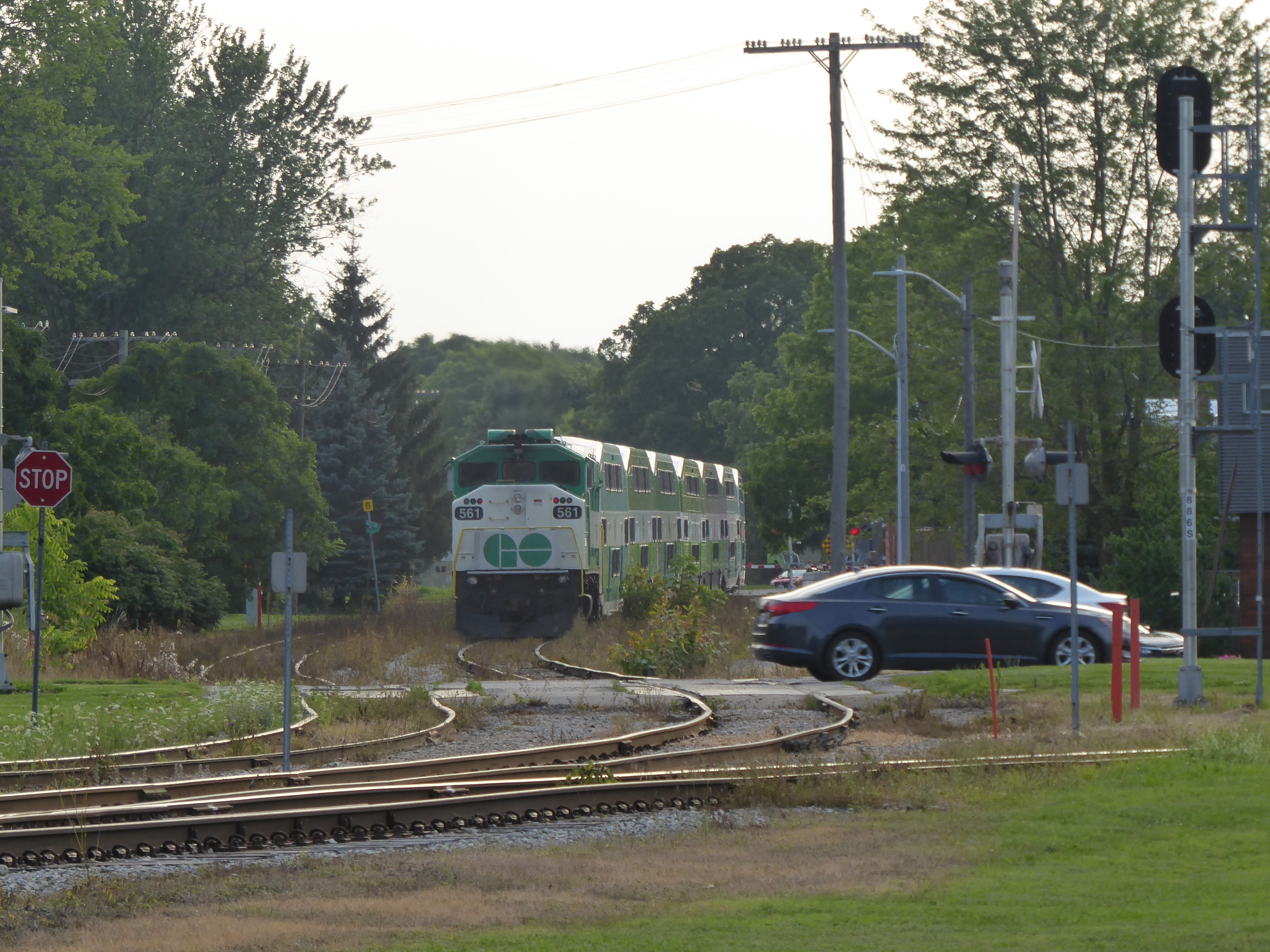
This last image isn't exactly random as it's an image of Via Rail Train 84 headed eastbound toward Stratford Station en route to Toronto. I was lucky enough to catch this train while in Stratford this July, but I wanted to share this image, taken amid a sea of visial distractions. I liked the curvature of the tracks and the trees as a brackdrop. I will share my other photos of this meet later on, but I thought I would put this one out there to see what people thought. It was a bit of an experiment. I'm not sure about the concrete and metal poles framing the train. I like that there's a stop sign in there as well as some crossing signals. It shows you how the Guelph Subdivison snakes its way through the city in and around the station. In this image the consist is crossing Downie Street and making its way to Niles Street, which is the last street eastbound before it hits the station.
 
A bit of bric à brac from the last few months.  

Wednesday, October 8, 2025

Say hello to Belton

Over the course of my travels this summer, I was able to take photographs at many of my favourite spots, including the Sarnia rail yard and the Stratford rail yard. What's rare is when I come across a new railway find and am able to properly capture it for the sake of discussion on this blog. After all, my trips to see family are usually quite busy and they don't leave a lot of time for wandering. 

In July, as my family made its way to London to visit our family there, we drove through a wide swath of countryside, which is when we came across a small farming hamlet called Belton. North of London, Belton is a tiny community that is home to the Agromart Group fertilizer storage and distribution site. It's a large facility with various storage domes. The site is used as the company's administrative centre as well as a storage and distribution hub for farming customers throughout southern Ontario. In total, 25-acre site can house 80,00 metric tonnes of "urea, potash, SOP, MAP, DAP, ammonium sulphate, MESZ and NitroK." 

If you know what some of those abbreviations mean, let me know. I took it directly from the company website. Most importantly for our purposes, this facility is served by an interesting loop track near milepost 106, off CN's Guelph Subdivision.

 
This was a shot I took from the passenger seat of our car as we made our way back to Stratford from London. As you can see, the track serving the facility is a long loop. I would think this would be the domain of GP9s, GP38s or other more nimble engines. The tight radius would not accommodate larger motive power. I can imagine the squeal of the trucks and axles on this track!
 

Here's a closer look at some covered hoppers parked beside one of the storage domes, behind which stands a very large feeder. I don't know that I have ever seen an industrial rail siding with this type of radius in real life. I've seen a few on model railways, but that's it. This would be a neat facility to model.
 
Belton is just a short jaunt south of St. Marys, which is also on the CN Guelph Sub. I can't imagine that Belton is served by CN's Kitchener operations, which serve St. Marys. I would assume this facility is served out of London's CN yard, on the Dundas Subdivision. But I stand to be corrected, as I am not familiar with CN's operations in this area.
 
I had to do a little searching to figure out what railway served Belton, as I had no idea where it was relative to nearby CN and CP lines when I passed through in the car. I assumed it was CN served, and was proven right when I consulted the geography of the area using the Railway Association of Canada's online Canadian Rail Atlas. It's a handy resource if you are unsure about railway geography. I was surprised how much I was able to drill down on the interactive map to see the loop track in Belton. It's a really handy resource.
 
Speaking of surprises, here's a shot below that I was able to take that I would not have thought possible without a little luck and some great information from people who know about the movements of trains in Stratford. As I mentioned in this previous post, I was able to stay at an AirBnB in the city that was close to the GEXR Goderich Sub. Since I had already visited the Stratford rail yard and took photos of GEXR assembling its train, I was able to drive back to my place and wait by the tracks to get a shot of the westbound freight train making its way over two overpasses as it headed out of town.
 

You can see the train snaking its way around a building as it heads over the first of two overpasses that take the GEXR northwest out of the city en route to its rural customers. I was surprised to get an image like this, as my timing was perfect and there was just enough shade to allow me to get a decent shot, even through the morning sun was unforgiving. If you don't believe me, look at the small patch of sky behind the train. The sky was blue that morning, but the angle of the sun in this shot meant that the sky was washed out, no matter what I did. I stayed off the tracks and found the best spot to take a shot legally and safely.  
 
Those were among the bigger surprises from my adventures this summer. I have a fair bit of material from this summer to share still, so I won't get ahead of myself and drop it all into one post. As I have not really been trackside in Ottawa of late, it's good to have a backlog from this summer.  

Saturday, July 19, 2025

Odds and ends on my summer travels

My family has done a fair bit of travelling so far this summer, as our life is more stable. After a wonderful visit to my hometown around Canada Day, we were able to visit my wife's family in London and Stratford in recent days. 

This being vacation, I was able to make my way trackside quite a bit and was fortunately, saw lots of mainline action in both Sarnia and Stratford. I have not even begun to process some of my better shots and figure out how to present them thematically. So, as these are the lazy days of summer and I am not thinking too hard, here are a few random photos that I captured in my travels that I thought would be interesting to share.

This shot made me laugh a bit. This was taken in the eastbound lanes of the 407 as we approached MacMillan Yard. There is an overpass in this area where container trains are often passing over the highway. On the other track, a trio of engines sat, awaiting their next assignment. The unit in the middle was clearly an ex-BNSF unit that was hastily patched over by CN. I shared this with a couple of my friends, and they had the same reaction. Nice patch job!

Over the course of any year spent railfanning in Ottawa, it is inevitable that there will be a large amount of Via Rail pictures. A friend jokingly told me as we were preparing to head home to Ottawa, "It's back to Via Rail purgatory." Don't get me wrong. I will take photos of any trains, but Via Rail photos can become monotonous after a while, which is why I wasn't all that keen to capture passenger rail photos in my travels. This shot is an exception, though. I thought it was cool to catch Train 84 backing into Sarnia Station from its overnight parking spur.

Via operates one train out of Sarnia each morning and one train into Sarnia each evening. The new Venture sets mean that Via no longer has to wye its trains in the yard, as they are bi-directional. All they have to do is tuck in to the spur beside the station each evening and back in to the station the following morning. Easy. 

Via Rail used to have early morning service from Sarnia when I was a university student, but the train now leaves mid-morning, which is better for those who aren't earlybirds. I wasn't specifically seeking out Via trains on this morning, but I was happy to catch this move. 

When we first arrived in Stratford, I headed for the CN/GEXR yard to see if anything was moving. This isn't like Sarnia, of course. You need to know when things are moving on the CN Guelph Subdivision or you will be waiting quite a long time. Luckily, I had some good information to work from, which allowed me to catch both CN and GEXR action. However, when I first arrived, there was nothing happening in the yard and the familiar GEXR units were nowhere to be seen from the station platform, which I found odd.

So I took a walk across Nile Street crossing to Guelph Street, which gives you a different perspective of the yard. Deep in the yard, tucked away behind long strings of steel coil cars, were the two GEXR units, parked at an odd angle. I was told that these tracks are situated like this because they once led to the old Stratford roundhouse. I didn't know that until I shared this photo with a friend who knows the local operations.

So it was cool to catch these units framed against the massive Masterfeeds complex. Those elevators helped frame many of my shots over the course of my visit. 

It was a ridiculously profitable vacation for me for future blog content, but as mentioned, I need to get some themes together to properly share some of my photos. I look forward to the challenge. 


Thursday, January 4, 2024

Dive right into 2024 (Stratford Part IV)

Happy New Year, fellow friends of the iron horse. I was considering how to start the new year and what to write about when it hit me. Just start with some cool train photos. That was what I decided. There is lots of material left over from last year's adventures, which will be shared over the weeks and months to come. Sadly, I wasn't able to make it trackside over the Christmas holidays, but that's okay. There was very little snow after Dec. 25 and I was still working my regular hours at home, so the opportunities for something seasonal didn't materialize.

So let's start with some shortline summer action shots, shall we? On July 30 while in Stratford for a family reunion, I had a chance to stop by the Stratford station to see if there was anything going on in the yard. Luckily, there was. The GEXR crew had two geeps idling in the yard and ready for some work. Later on, CN 568 came passing through, which you can check out in this post. In the harsh early morning sunlight, I wandered around the yard from publicly accessible vantage points, as the crew assembled a string of hoppers that seemed to be destined for Goderich or other points along the GEXR Goderich Subdivision. Here's a shot from the crossing. The morning sun was washing out the sky, but I still like this shot.

I have a friend who takes shots from this vantage point, so I decided to follow his lead and get an overall shot of the yard action. This is in keeping with what I started last year, in the Year of Different. the goal is to get some railway images that aren't dominated only by the train. In this case, I wanted to get the grain elevator and the overall yard in the image. I didn't get all that I wanted, but I think this shot conveys the overall size of this railway operation.

Here's another example of a shot that is different. I wouldn't have taken this shot even a few years ago. The crew in this shot is getting ready to couple its two hoppers with a few more cars, some that are hidden behind the boxcar. It's the human element that I like in this shot, even though the morning sun did not do me any favours.

The engines went back and forth getting the cars the crew needed to take up the Goderich Sub, which allowed me to think about different shots and elements to capture. There's nothing like a good smoke shot! In fact, I dedicated a previous post to smoke.

As everyone knows, GEXR is a shortline owned by the Genesee & Wyoming Inc. shortline company, so it's not uncommon to see orange units in the yard that aren't technically GEXR units. In this case, the power was supplied by a Southern Ontario Railway GP38-2 2111 and Huron Eastern GP38-2 3510. Here's a closer look at the Huron Eastern logo, which is a small departure from the G&W logo.

While SOR has been absorbed back into the CN empire, HESR continues to operate close to 400 miles of track in Michigan's thumb area and into Flint and Saginaw in the lower peninsula of the state. Here's something that I thought was odd, though. Since I have been taking shots in this yard in Stratford, I have spotted more G&W units that are not GEXR than I have actual GEXR units. I would imagine the reason for this is that things are likely quite fluid between the various operations that G&W oversees across North America.

One more observation from this shot. The aftermarket horn on the SOR unit, as it was moving across the crossing, was more like a car horn than a train horn. It was quite pathetic, to be honest! I often see people on train forums that can rhyme off the actual make of horns on engines. In all honesty, that is a level of detail I just don't have room for in my brain.

Here's shot that required some editing, as the morning sun was playing havoc with my shots. I decided I would accept some form of distortion and shadow for the chance of getting a shot of the engines in action against the backdrop of the grain elevator. I liked how this turned out, despite the obvious imperfections. It screams early morning or late evening. 

Here's one final shot with a blue sky in it, as the sun was throwing me a bone. The shadows were harsh still, but the colours came through pretty well in this shot as the crew stretched out its consist before backing it up again to pick up more cars. I didn't stick around for it to depart, as my daughters were getting a little impatient, so I decided to wrap up my wanderings shortly after taking this shot and a few more.

Looking through my photos from Stratford this summer, I can see I have a lot more to share. This early morning bit of shunting was fun to see but there were a few more surprises the yard still had to offer me. However, it wasn't until I returned to Stratford in November that these surprises were fully revealed. All in all, it was a fun bit of railfanning on a pleasant July morning. And that wasn't counting the mainline freight that came through later on.

I hope everyone had a wonderful Christmas break. Here's to more rail musings and conversation in the year to come.

Sunday, September 10, 2023

Mainline freight action near the station (Stratford, Part II)

In a recent post, I shared a few images of evening GO Train 3775 returning west and stopping in Stratford, en route to London. This is part of a pilot project where Metrolinx is providing weekday commuter service between London and Toronto's Union Station. For commuters along the Guelph Subdivision, the imminent discontinuation of this service will likely come as a disappointment. For me, I was grateful to catch the evening GO Train, complete with an old F59 trailing, in a rare setting. 

The bonus was that, as I waited for the GO Train, a eastbound CN mainline freight train was waiting for the GO Train to pass. This train, CN 581, was led by three idling engines, which were parked east of the Via Rail station, close to CN's yard office on Regent Street.

The parked freight was carrying mainly covered hoppers, making it quite possibly a grain or agriculture-related movement, as the Guelph Subdivision passes through some of Ontario's richest and most productive farmland. I was quite pleased to capture an image of an old Burlington Northern three-bay covered hopper, still visually intact sans graffiti. 

This car has 4,750 cu. ft. of storage space, made in 1992 by Trinity Industries for BN, all numbered in the 467XXX series. Given its fairly recent build date, that makes it positively new, in terms of the railway-branded fleets that are becoming less and less common these days. I know a lot of railway vets dislike BN's cascade green and white scheme and its ultra modern symbol, but I always liked it. It must have something to do with not growing up with BN's more well-loved predecessors, the Burlington Route, Great Northern and the Northern Pacific. I'm too young for them.


The train had quite a few of these old BN hoppers, still lettered BN, although this lettering is, of course, one of many combinations belonging to BN successor, BNSF Railway. In the late summer, this is the type of train that is quite common in this area, not to mention on the Goderich Exeter Railway, which originates in Stratford. I did catch a GEXR yard job preparing to embark for Goderich earlier in my stay in Stratford, but I'll save that series of photos for another time. That train was also very heavily weighted with covered hoppers.

Once the GO Train made its way west, I made my way east down Regent Street, which parallels the Stratford Yard. From a public vantage point, I managed to capture a shot of the head end of Train 581. There were some visual hazards, but I think they add to the scene quite nicely, as they put the image of this train in context. The head end was led by GP40-2 9449, which was given the new CN.ca scheme in recent years. The second unit, also a recent convert to the CN.ca scheme, is GP38-2 7501, although it does not have a wide safety cab hood, as 9449 does. The final unit is GP38-2 4725, still in its original sergeant stripes. 

You can also see the first car is an Ontario Northland ribbed boxcar, with the chevrons logo. Behind the parked freight were a large string of covered hoppers that were parked closer to the Masterfeeds agricultural products concrete elevator complex, which is on the east end of the yard, near the Romeo Street flyover.

Here's a closer shot of the two lead units, taken from Regent Street.


In both shots, you can see what appears to be a moveable wooden ramp, no doubt used to unload boxcars for use in carload service deliveries to local customers. I'm not sure how much business CN does like this, but it seems to me that this would be why they would keep this ramp around. Also, I'm guessing it might be used if they need to move heavy construction equipment onto a train for MoW service. These are just guesses on my part.

There was also one other cool sighting in the yard, as I explored it from all angles from the surrounding streets. On the side of the yard opposite the station, there was this electrical unit that was parked on a heavy-duty flatcar. I could only get so close on public property to get a proper shot of it. As we were leaving Stratford to head home, I saw a large contingent of local public utility vehicles carting this unit onto a truck for use somewhere in the local electrical grid.

The other rolling stock sightings were part of the GEXR move, so I will save those images for another post.

This meet between the freight train and the GO Train was one of many such sightings that dotted my weekend in Stratford. I was quite happy to catch so much action in Stratford, which can be a hit-or-miss place to railfan these days, unless you're there to catch the regularly scheduled Via service. And yes, I did get a few shots of a Via passenger train making its way to the station, since it was carrying members of my extended family into town for a family reunion. 

More material for another post. Stratford proved to be a gold mine this summer!

Monday, August 21, 2023

Get on the GO, while you can (Stratford, Part I)

My family recently returned from a trip to Stratford for a family reunion. It's been two years since we've been here. Stratford is best known for its annual summer theatre festival, which has a decidedly Shakespearean flair. For my purposes, it serves as the headquarters of the Goderich Exeter shortline railway. Stratford also serves as the regional hub for Canadian National, which assumed operations on the Guelph Subdivision after leasing out the line to GEXR until 2018. 

On my recent travels to Stratford, I was lucky to be able to spend a fair bit of time at the town's railway station. On the whole, I was able to see two mainline CN freights (CN 568) as well as one GEXR yard job as the crew prepared to head north on GEXR 581. Part of the weekend required a short stay to pick up family on the platform, as they were arriving from London. So that was another one to add to my list. 

Perhaps the rarest catch was the evening eastbound GO Train 3775 from London, as it stopped in Stratford en route to Union Station in Toronto. It's this train I wanted to focus on first, as it is the rarest of birds one would expect to find in a small town like Stratford. Metrolinx launched a pilot project in 2021 to connect a number of southwestern Ontario cities to Toronto via a GO Train. That project will conclude this autumn, without a permanent link being established. All the same, I was able to find myself at the station just after 7 p.m. on Aug. 1 as 3775 made its way past a stopped CN westbound 581. A meet! Two for one! I tried to capture a shot of the control cab making its way to the platform with the Masterfeeds elevator complex in the shot.

This was a surprisingly difficult shot to capture, as Metrolinx has a wooden platform on the edge of the station platform that was obstructing my view. There was also a CN employee in a car parked right next to the tracks. I managed to adjust my zoom and aim my shot in between these visual hazards to get this shot. You can see the searchlight signals appearing double red to the left of the GO Train. CN 581, which was on the second track in the yard, was stopped with three units in the lead. The train was all covered hoppers.

This shot shows you a bit of the visual hazards that could not be eliminated entirely as the GO Train made its way to the station platform. This pilot project by Metrolinx is one that had me scratching my head, to be sure. I'm not sure a two-hour-plus milk run is what qualifies as commuter rail. I did notice when my family arrived on Via Train 87 that the train seemed to be quite full, so I would imagine there was some understanding between Metrolinx and Via about this GO service, which to me is otherwise encroaching on intercity passenger rail service, which is not in its mandate.

Of course, given the size of the Greater Toronto Area, GO already extends quite far on either side of Toronto, making a run out to London not entirely out of character, although to me it's too far. The train leaves London at the crack of dawn and arrives back in London fairly late into the evening. I suppose it's a cheaper option than taking Via, but it begs the question in my mind, which company should be providing this service? It seems to me to be Via, given its mandate to provide intercity service. 

All of this is a moot point, as the GO service will be ending soon, which made me quite happy to catch this train in Stratford. My wife and I also made a quick trip to St. Mary's, near Stratford, where we took photos of the town's beautiful train station as well as its towering train bridge. There is also a GO platform in that city (watch for my St. Mary's post in the near future). 

Seeing this commuter service so far outside the GTA made me wonder why something like this hasn't even entered the local discussion in Ottawa in recent years, as Ottawa tries to sort out its light rail nightmare called the Confederation Line. In an upcoming post, I will share some recent history from Ottawa where leaders were in fact calling for commuter rail on existing rail lines in the city. Alas, I think more people were entranced by the thought of a more European electrified light rail system on a brand new right-of-way, which leads in part to the mess we've inherited today. 

The slight curve on the Guelph Subdivision just past the station does make for some great pictures, although the evening sun was washing out the sky a fair bit. I was not expecting to see an old F59PH unit at the tail end, as these old beasts have mostly been replaced by newer, sleeker MPI MPXpress units, but there it was, rounding the curve as I snapped away.

One final shot of the westbound as it makes its way past the Downie Street crossing. I was happy to capture a few shots without local traffic obstructing my view of the train as it made its way back to London.

I was happy that I could capture a few shots that I will file under different, as this year is the Year of Different. However, it got me to thinking about how much of an opportunity Ottawa missed in not using the rails it has (and recently had) to try some sort of GO Train experiment in the city. In a future post, I will examine what GO service could have looked like in the city, if it had not been for the differing views of our local leadership.

All in all, it was a good catch and it was even better since there was a waiting freight in the hole as well. I will share shots of that train in the next Stratford post.

Saturday, March 5, 2022

Twilight on the Guelph Sub in Stratford

In my most recent post about Stratford, I shared some shots of Canadian National's Stratford Yard, which was once the main Goderich Exeter Railway yard, when the Guelph Sub was GEXR territory. That, of course, is no longer the case, as CN assumed control of the line once again when the GEXR lease expired. The end result, at least to my eye, is a quiet yard and not all that many CN freight trains on the Guelph Sub. I'm told that the line is now used as a relief line for when the busier Dundas Sub is at capacity.

In the time when I was in Stratford in August, I had multiple opportunities to visit the Stratford yard and the Via Rail station. Since there were no switching operations or locals being prepared on any mornings I was at the yard, all I could photograph were the GEXR units in the yard and the rolling stock. I did see one CN local rolling through town, crossing Romeo Street in the city's east end, but I was not able to get a shot, since I was too far away and was driving at the time. 

Nearing the end of my time in the city, I figured it would be worthwhile to get a shot of the westbound Via Rail corridor train en route to Sarnia. There is a nearby grain elevator and other landmarks to use to frame passenger trains, so I thought I would try to get a few shots of live rail action.

Here is the first shot of the westbound as it approached the platform.

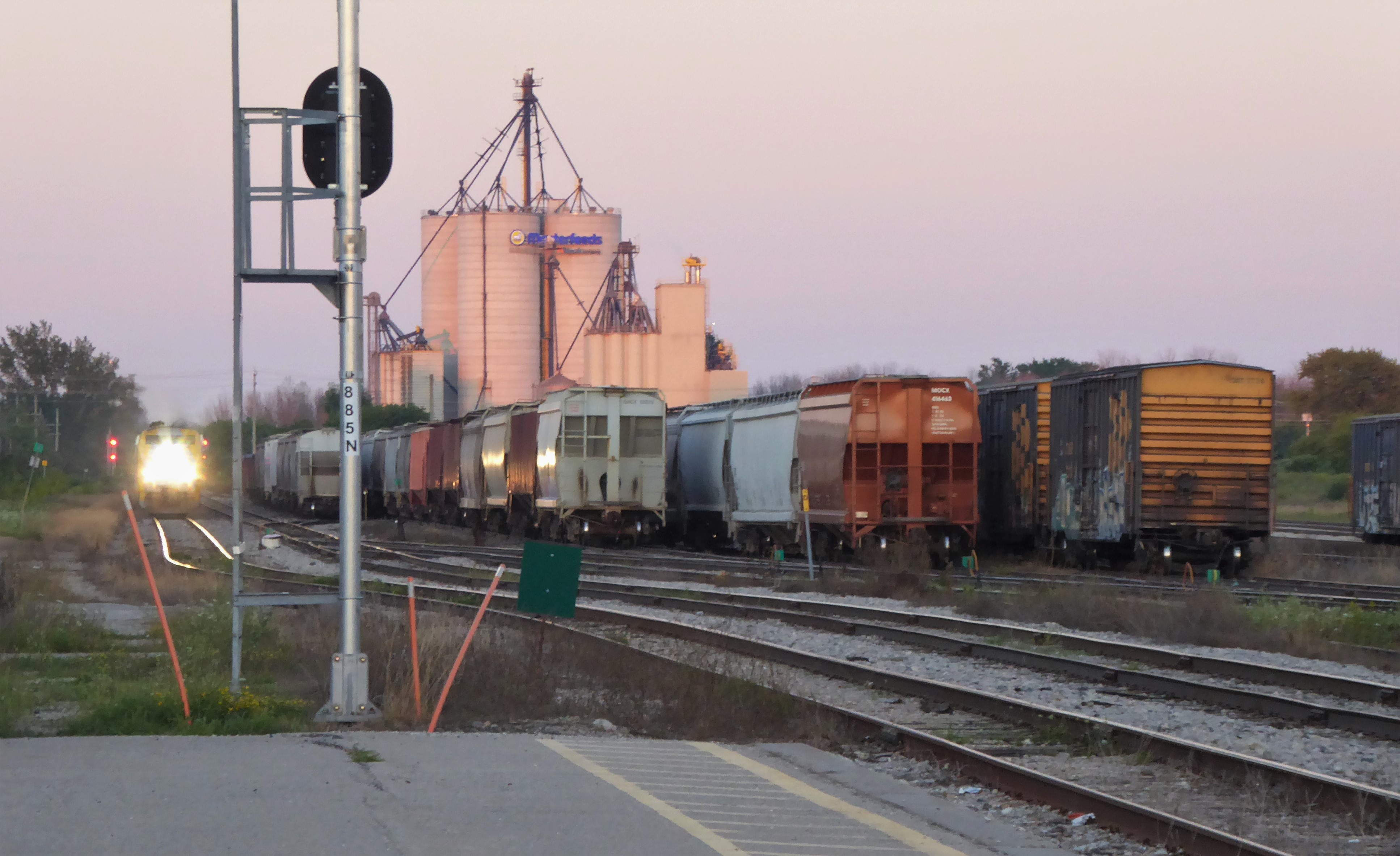
I picked this shot among a few others because I managed to fit in most of the cars in the yard that had been dropped off by a westbound local freight earlier in the day (the one I could not photograph). You can see the old searchlight signals to the left of the Via Rail corridor train. You can also see the prominent grain elevator in the centre of the frame, not to mention the new signals on the edge of the passenger platform. The Via is led by a P42. 

The next shot I wanted to capture was the passenger train next to the GEXR units. I love railway family shots, as I call them, where you can capture different railways in the same shot. It's not quite as rewarding as capturing different railways in a meet, but it's close. This shot below was my favourite shot of the evening.


 Here's a shot with the westbound Via closer to the GEXR units, below. 

And how about a shot of the train at the platform. A timeless image in a small town. If not for the P42, you could date this photo anytime in the past few decades.

I should include a shot of the streamliners as well. I love that these old cars are still being used in corridor service. I suppose now is the time to get shots of them before they are replaced, perhaps by the Siemens equipment.

So that was my one and only meet with a live train in Stratford that I was able to photograph. As always, you have to make the best of what you're given. I like that one of the streamliners is still sporting the original Via Rail blue and yellow scheme. I will never get tired of that. The final coach is a modern take on the the blue and yellow. I've seen a few cars in this new scheme in the past few years. I don't like it as much as the straight blue and yellow, but it's not too bad. 

Shortly after the last platform shot, I was on my way back to my hotel, as the sunlight was fading fast and the air was getting crisp. All in all, it was a bit of a disappointment to not get any live freight movements captured, but I was happy with these shots as a consolation prize.

Monday, February 21, 2022

The Rise and Fall and Rise of a Railway Town

At the end of the summer in 2020, I visited family in Stratford and caught my first glimpse of the Stratford rail yard under CN control. It was underwhelming to say the least. In 2019, I was much luckier when I caught a GEXR train heading out of the yard and onto the Goderich Sub. In my two visits since, including last year's time in the city, the rail yard is really different.

I'm not going to say it's better or worse. To be honest, I noticed that the yard looked to be much more full this year than it was last year. I missed the CN local, which dropped off a long string of cars at one point over my stay, which appeared to be the only major freight activity on the Guelph Sub in my time there. I was disappointed, because most railfans in the area spoke of the healthy GEXR operations on the sub. That's not to say that CN has flushed all this progress down the toilet. The number of cars and activity in the yard suggested otherwise. There was a lot of work being done on the rails and the volume of cars was definitely high compared to 2020.

On my first morning at the station, I saw some CN maintenance of way workers welding a joint near the gain elevators. It was hard to get a decent shot, since they were quite fair away, but it was cool to catch some of the smoke coming off the welder in the early morning light. This type of work is always a good sign. All around the station, the railway properties that CN now controls seem to be much busier than they were when I visited here in past years. Several buildings beside the yard appear to have been refurbished and are hives of activity. Does this mean CN has plans for the Guelph Sub? Or it is catching up on deferred maintenance? I don't have an answer, but the signs of CN's increased presence were everywhere.

I also spotted this ballast car hidden behind a graphics and printing business on the edge of the yard. Again, these loaded cars, combined with the stacks of other railway maintenance materials next to the station had me wondering what CN's long-term plans are for this rail line. I had to take this photo on the shadow side of the ballast cars, so this was the best I could do to clean up the shot with a little retouching.

I mention all these observations because Stratford is a fascinating railway town. It was once a very busy division point in the days of steam when it serviced Grand Trunk's and eventually Canadian National's steam engines. The local Stratford museum has lots of information about the railway's influence in this city's development. At one point, it is estimated that 40 percent of the city's workforce was employed by the railway. That's a staggering number by any stretch. Even in the streets close to the rail yard, you can see the remnants of many industrial operations that owe their existence either directly or indirectly to the railway.

Of course, it would be unwise to suggest CN's takeover of the Guelph Sub after decades of GEXR operation is a sign of a railway resurgence. Many rail observers suggested that the Guelph Sub is now being used mainly as a relief route for the Dundas Sub, which allows CN to spread out its traffic during times when one line isn't enough. Via Rail continues to use the Guelph Sub, just as it has for decades. Via's Sarnia-Toronto service makes its way through this city in the morning and evening each day, as part of a milk run service that also serves other small towns including St. Marys. 

While I was trackside, I did snap a few shots of the GEXR units on a stub end track. They didn't move in the four days I was there. That, to me, was a sad site. I did see one GEXR work crew at the yard briefly one day, but otherwise, the shortline railway appeared to be quiet.

The GEXR unit was listed as a GP38-3, which means it has been refurbished and updated. It was pretty shiny. It was linked to a comparatively beat-up RLK (Rail Link) 4095. This unit has turned up online a number of times. It's an old GP40 that was once an Ottawa Valley Railway unit. It was originally CN 4004 in 1966. A bit of a relic. I don't know that I've seen many GP40s lately. I only have a handful of photos of these units, although they look quite similar to the ubiquitous GP38s.
 

 I noticed 4095 appeared to have some engine issues at one point. Looks like a small blow-out or fire. 

Since nothing else was happening at the yard, I took some time to frame some shots with the station in mind. Stratford's station has been beautifully preserved. You can see more shots of it in this previous post. 

I also managed to take some shots of the rolling stock I found interesting, including the Ontario Northland boxcars. 

Here's a better vantage point.

I did manage to catch some live railway action eventually, which was a relief as I was getting a bit bored of looking at this still life. You can only take so many roster shots.

I will definitely be back in Stratford to visit family in the years to come. That means I will likely get a better idea of what is happening in this area with CN and GEXR. For a town that has risen to great heights and seen its railway industry virtually disappear, the re-emergence of CN is a curiosity at best right now. I doubt very much that it will change much of anything. Personally, I am sad to see GEXR diminished to what it is now, but maybe all the activity I noticed over my time in Stratford means there might be better days ahead for the railway in this historic railway town.

Stranger things have happened.