Showing posts with label Smiths Falls. Show all posts

Friday, January 2, 2026

Make Railways Interesting Again

Being a railway enthusiast sure is different these days. I am not going to go down the road of saying everything was better when I was young. It wasn't. Some things I found were better while other things were not. But I will say this. Railways have taken on a sameness, for lack of a better term, and it's really affected my enjoyment of rail photography.

Again, I won't say that things aren't what they used to be, across the board, because there are some aspects of railways today I find fascinating. But I cannot get excited by endless container trains, at least in that, once you get your initial photographs of the power up front, there really isn't much left to photograph. The same can be said for most rolling stock. Most covered hoppers are endless strings of grey, with only their alphabet soup of lease company reporting marks to offer any variety. The same has always been true for most tank cars, as this continental fleet has been under the control of leasing companies for far longer than other cars.

The question is what can we do to keep this hobby fresh when there is so much blank space on cars and so little diversity? With most railways not investing much in new rolling stock, there's not much variety in the average freight train. Also, with much of the fleet of fallen flag cars on its way to the scrapper's torch, there's a scarcity of history to capture.

Over the last few years, I have found that I have begun to refine my approach to railfanning quite a bit, without even realizing it. These small changes I have made to my approach have really allowed me to make the most of what there is to capture out there these days. I'm not saying it's for everyone. I understand that there are people younger than me who don't have the same experiences I have in my arsenal, so they don't know what they're missing, so to speak.

For that matter, there are people older than me who could say the same thing about my outlook. I will never know the luxury of their past experiences, so I cannot say whether their time spent trackside while young was better than my time spent trackside when I was young.


So here is my refined approach to railfanning, developed with modern railways in mind. 

1. Don't begin and end your time trackside documenting power only This might be my biggest disappointment when I look at the work of others. It's also a critique I have of my own work at times. So many videos today essentially follow the power to the detriment of actually cataloging the entire train. I try to look for shots of the train from different angles. This means finding interesting trackside infrastructure to frame the entire train against. I find shots of engines with no context are not terribly interesting anymore. Unless I know where the shot is being taken and the context of the train's movements, I am not all that excited.

Look at the shot above from Smiths Falls in 2017 and look at the shot below, taken with details in mind. I know which one I prefer.


2. Try and get the big picture This is one of the hardest challenges of rail photography and it often goes against our natural desire to get as close to the action as possible. I think we spend so much time shooting the power that we forget how powerful an image can be when it incorporates an entire train. There is certainly a trade off here. Your shot will not be as close and the train will not be as prominent, but I think it's a good compromise sometimes, when it works out.

 
This shot shows the limitation of my former camera, as I took this shot outside of Sarnia in 2013. I shared similar photos of this train in a past post, but this one at least captures the majority of the train. It also gives you an idea of the train's length as well as the topography outside Sarnia and the time of year. There are many details to consider. 
 
3. Change your perspective This is where I find I am having the most success and fun. I am always on the lookout for a new perspective, whether is be down low, on a bridge, shooting a train on a bridge, or just finding a creative way to capture a train in a way that doesn't mimic a standard rail shot. I think the best recent example of this was when I shot some GO Trains in Toronto in November, when I was travelling between Ottawa and Sarnia. I will have a few posts from Toronto later on.
 

This shot, taken in November, is an example of all the different techniques I have been trying recently. I am on a bridge over the downtown tracks, which means I have a different perspective. I also deliberately framed the cityscape in the shot, and placed the train to the far right of the image. Finally, I didn't zoom in on the train, which would have meant I couldn't capture the entire consist. I deliberately kept the train small in the image, so I could capture the big picture. I also like the look of the many tracks in the photo. I am far more satisfied with this type of image than I would have been with a shot where I zoomed in on the train.
 
4. Look for history This might be the hardest technique as so much rail history has disappeared. When I write about rail history, I'm not talking about steam engines or something that you can only see in a museum, I'm talking about fallen flag cars. I used to shoot images of shortline railway cars and the incentive-per-diem cars that tiny railways built and were still in wide usage when I was younger. I also made sure to get photos of railway fleet cars, which seem to be quite rare now that many railways basically use cars that are part of lease fleets. But, since this is such a challenge, it makes a good catch all the more rewarding!
 

I know that these old Burlington Northern covered hoppers are still fairly common trackside, but for how long? I have photos of old Soo Line covered hoppers that I shot just a few years ago and I haven't seen any since. I like this shot above because I made sure to wait until the yard job in Stratford was passing between the cars so I could grab this shot of the old BN hopper in a unique image.
 
My first thought for this post was to do an exhaustive comparison of how the rail photography hobby has changed since I was younger, but I felt that this approach would come across too much like an angry man shaking his fist at young whippersnappers so I decided to try and take a more even-handed approach.
 
I will say that, unlike when I was younger, today's epically long trains with power on both ends, and often with distributed power in the middle, are something that I never saw when I was younger. And it's a definite improvement for those who are trackside these days. I also like how container trains look from a distance, with so much colour and variety, when taken together as a whole. 
 
See? It wasn't all better back in the day. I'm grateful for what I have now, just I am grateful for what I saw when I was younger. It's all what you make of it. My goal is to make the railways of today, with their lack of diversity, interesting again. Make Railways Interesting Again. MRIA is this year's theme. Let's get to it!
 
Happy New Year everyone. 

Tuesday, March 4, 2025

The long, slow, strange journey of an antique passenger coach to Smiths Falls

The pandemic was cruel to so many people and many organizations, needless to say. I don't mean to minimize the impact it had on those who were sick or lost loved ones. But from a business standpoint, it was especially cruel to organizations like the Railway Museum of Eastern Ontario in Smiths Falls. This museum is a tenacious operation that is the product of the success of its volunteer efforts. I love this place. The people who work here or lend their time are second to none. They are dedicated and passionate. This place does not exist as it is now without its volunteers.

That was why it was cruel that the pandemic put a huge dent in the museum's plans to showcase its new piece of rolling stock in 2020, a turn-of-the-century dining car once belonging to the Intercolonial Railway and later the Canadian National.

The car is so long, it's almost impossible to get a good shot of it from up close. To get a proper shot of it in profile, I had to take a less-than-ideal shot from across the parking lot. And yes, that is my family's RAV4 blocking some of the shot. I should have thought ahead when parking!

This old dining car could be one of the oldest pieces in a railway museum in Canada. It was built in 1899 by the Wagner Palace Car Company of Buffalo. If that company name doesn't ring a bell, perhaps its purchaser is more familiar: Pullman Standard. Pullman bought Wagner just a year after this dining car was built.

The car was used on the Intercolonial Railway between Halifax and Riviere-du-Loup, Quebec, where the ICR connected to the old Grand Trunk Railway. Even though the car now bears the Canadian National script, it clearly did not belong to the railway when it was first used, as CN didn't exist until June 6, 1919, when it was founded and was given control over several failing railways (GTR, Canadian Northern for example).

The car itself was beautifully cared for by the Bytown Railway Society for years before it was transferred to the Smiths Falls museum before the pandemic. The car, according to the museum website, has five tables on either side of the aisle in the dining area. 

Interestingly, the builder plate for the car can be seen in the dining area on the floor. Beneath that brass plate, there is a kingpin, which is part of the wheel (truck) assembly. It's interesting that the builder's plate is found on the floor above the kingpin. I can't say I have seen that before.

Many of these details I picked up from researching the car. The last time I was at the museum, this old dining car's interior was off limits, due to pandemic restrictions.

As you would expect, the car also had a kitchen and storage area for staff. Cooking was done with the aid of charcoal. To load the food and supplies, the car had a hatch where crews could slide the food and supplies directly into the kitchen and preparation area. 

Originally, the car was lit by hanging kerosene lanterns, as you might expect from a car built at the turn of the century. There was also an emergency cord strung up on the ceiling, for emergency stopping purposes.

There are a few bits to this car's recent story that you might not know. First, the car was brought to the museum with the goal of using it as a cafe of sorts to generate extra revenue for the operation. Sadly, that was not able to happen due to the lousy timing of the pandemic and the strict health measures that prevented the dining car's use for food service.

Second, as you might imagine, the process of getting this car to Smiths Falls was also a chore. You might think it would be easy enough to ship the car on a special move down the old CN Smiths Falls Subdivision, but this was not possible.

Why? Well, the Bytown Railway Society no longer has access to the rail system, as its rails at the Canada Science and Technology Museum are no longer connected to local tracks. This has been a topic of conversation among railfans in Ottawa for years. Ask the BRS officially and they will tell you that this is not in their plans, nor is it a priority for the museum, I would imagine.

I say this without any malice. But I know many people are frustrated that a group like the BRS has no way to host excursions as it once did. I have spoken quietly to a few members of the society in the past and they told me that they wished there was a way this connection could be re-established.

Also factor in the times we live in, where the liability and the changing priorities of railways make it much more difficult to facilitate third-party excursions. I can't imagine this would be an easy proposition, given how busy local rail lines are with Via Rail trains. It's true that CN doesn't own much trackage in Ottawa anymore, but I can't imagine the company would be thrilled with a third party making use of what little of the Beachburg Sub is left. And when you factor in the 10 mp/h speed restriction on the Nylene Canada-owned Renfrew Spur, you can see the potential legal and operating issues that would get in the way of excursion runs.

All that to say, the old dining car had to be brought to Smiths Falls in two pieces on special trucks that are sometimes used to move houses. It's a sad commentary on what has happened to the rail system in Ottawa that a rail car cannot be moved by rail to Smiths Falls, even though a rail connection is very much in place.


This brings me to a final, somewhat sombre, point. The Bytown Railway Society can only do so much with the limited trackage it has in place at the museum. Still, the group has done some great events and continues to be a beacon of preservation. It still has some great pieces that are safely stored in the new museum collections building. It's a much better setup for the group than what it had previously. But the reality is, without any way of being able to do excursions or generate revenue through events, its options are limited. That is my opinion, anyway. BRS still publishes Branchline Magazine and the annual Canadian Trackside Guide. It also hosts history presentations.

If you follow BRS on Facebook, you will have noticed that it was putting out feelers on this wrecker (above). I was lucky enough to see this car out on the tracks last year. It's a wonderful old relic of the days when railways had full-fledged work trains. I'd hate to see this piece of history go, but it appears as though there's only so much room for what the society has.

You might also recall that the society's old CN passenger car is now residing in a New England rail museum, where is is paired with coaches just like it. I remember following the BRS's Facebook updates on the restoration of this coach. Again, I was lucky to catch it out on the tracks behind the museum last year. I'm glad I got this image, because it was the only time I was able to see this car in person. I'm sure it will be put to good use in New England, but it's still sad that it had to go at all.

The next time I go to the Smiths Falls museum, I'm hoping to get a better look at the inside of the old dining car.

It makes me wonder if we can't do more for rail preservation and history in Ottawa. We do a great job honouring history in this city in so many other ways. Why not honour our rail transportation legacy, like we do our aviation history? Also, given the collection of cars the science and tech museum has in storage, possibly there's an opportunity here to look at a transportation museum connected to the aviation museum?

We've spent money on worse ideas!

Friday, June 28, 2024

Summer Observations in Eastern Ontario

These last few weeks have epitomized the line from a Tom Petty song: "The waiting is the hardest part." My family is trying to sell our home, which is a difficult task. Until we do sell it, we can't move on to next steps that will prepare us for a new life in our new home. Even though I was unsure that I would have much time for blogging, I am making an effort to do the things I love, which helps me deal with the stress of this time of transition.

I decided it would be fun to share some odds and ends that I have collected over the last little while and put together an observations piece. 

I'll start with a recent observation of Via Rail Train 59 in a new place. As you might have read in this blog recently, I am trying to find new places around Ottawa to capture some railway photos. I captured some nice shots of Train 59 on the Rideau River bridge, just north of Hunt Club Road. A few weeks ago, I decided to get a shot of the same train crossing on the Riverside Drive flyover. I have never attempted a shot from this spot before, so I figured it was worth a shot. Here P42 916 leads the train west toward the Rideau River bridge and Federal Junction.

A few weeks later, I was at the Hunt Club Road overpass, as my time was limited while waiting for my daughter's dance class to wrap up. I waited for Via Rail Train 43 making its way east to Ottawa Station. I haven't been to this spot in a while. While there, I noticed that the remnants of the old industrial spur to Bentley Avenue were still not cleaned up trackside. The tracks beyond the fencing are still in place, but the rails removed from the Smiths Falls Sub are still lying to the west of the tracks, along with the old switch stand. You can see the remnants of the rails in the weeds as Train 43 passes by.

My family recently spent the weekend in Toronto, which allowed me to get months worth of railfanning in, which I will share in a series of future posts. I will share a few shots, however, closer to Ottawa. On our way home from Toronto as part of a J-train, I took a quick shot of the CP offices in Smiths Falls, or should I say CPKC. As someone whose family has a long history with the Canadian Pacific, I had mixed feelings seeing this new logo. I understand the nature of modern railways. There's no room for sentimentality. Still, I can't help but think we lose a little bit of our heritage when an iconic name becomes part of some corporate alphabet soup. I have similar issues with BNSF.

On our way to Toronto, I noticed that there was a long line of empty intermodal cars parked on a track near where the Smiths Falls Sub gives way to CP territory. Possibly someone with more knowledge can tell me if this might be the last remnant of the old CP Chalk River Sub? I know that railways often keep short stretches of old subdivisions for car storage purposes. I don't know if this is the case here. It seemed odd that these cars would be here rather than the CP yard, unless they were here so they could be kept out of the way.

While we're on the subject of the Smiths Falls Sub, there was chatter online about the spur at SynAgri in Twin Elm being disconnected. I can confirm from my trip to Toronto that this spur has indeed been lifted. There isn't much freight trackage still connected to the Smiths Falls Sub, save for the Kott Lumber facility on Moodie Drive. Here's a shot of some hoppers at SynAgri from 2015. I'm glad I have these shots now.

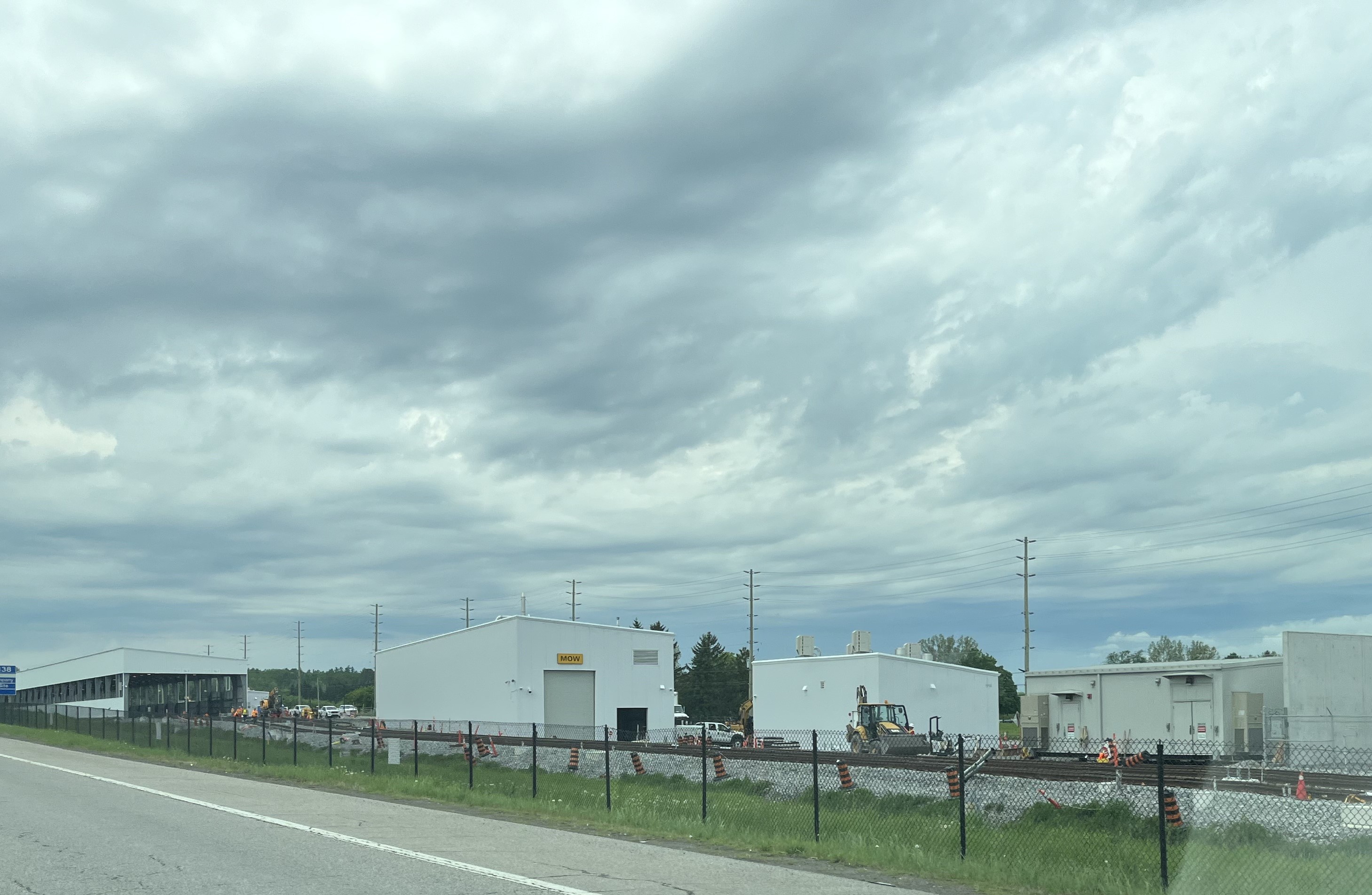
In the west end of Ottawa, rails have begun to appear alongside the Queensway, where the end of the second phase of the Confederation Line is taking shape. The project is behind schedule, which is no surprise, given that the pandemic pushed most projects back quite a ways. I have seen some MoW equipment on the rails lately near the Corkstown Road station, but haven't been able to get any shots.

This shot was taken from the passenger seat of our car, as my wife drove toward the Tanger Outlets further west. The next part of the O-Train system that will come online will be the long-delayed north-south Trillium Line (former CP Ellwood/Prescott Sub right-of-way). When it is complete, it will operate from Bayview Station, near the Ottawa River, all the way south to the Riverside South community. The spur to the Ottawa International Airport is also nearing a point where it will come online as well, which will give travellers another option for getting to the airport. 

One final bit to share. My girls are on a break from their evening dance classes, which means my Wednesday evenings trackside have taken a hiatus. Here is a recent shot of Via Train 59 at the Merivale Road level crossing. I didn't have any plan in mind. I just happened to be there so I took a few shots as the train sped by. You can see the symmetry of the Via wraps on the P42 and the first three cars.


 The end of the train was a bit different, as this was a double-ender.

So those were a few observations from Ottawa and Smiths Falls from the last few months. I have quite a bit to share from my trip to Toronto recently, but that will have to wait until life settles down a little. I am also going on a day trip to Montreal on the train, so I am hoping to have more to share. It's always nice to have too much material. A rare challenge for me.

Tuesday, May 14, 2024

Memories of Ottawa to Sarnia in the late 1990s (Part I)

I wasn't in the habit of taking rail photos in the late 1990s when I began my post-secondary education in Ottawa at Carleton University in September 1996. In retrospect, it would have been a fun time to take shots. That's because every one of my trips home to see family at that time meant spending the better part of a day on the train. It was a time when you could still buy your student-discounted ticket at a Travelcuts travel agency on campus and the ticket you got might still have the red carbon copy. That quickly changed to those thick cardstock paper, one-fold tickets with the perforated lines to separate each leg of your journey. For me, taking the train regularly over those four years (1996-2000) was an eye opener, as someone who had seen almost no part of Ontario beyond Toronto for the first 18 years of his life. So, let's take a journey down memory lane and across the province back in the glory days of the late 90s.

A quick note about the equipment. As far as I can recall, every one of the trains I took were pretty much the same consist. I don't recall ever riding behind a P42. It was always an F40PH-2. The cars were almost exclusively LRC coaches. I don't recall riding in an old silver HEP car once during my university years. I don't know if that's a coincidence, but I'm almost positive of these facts. 

Ottawa

It's important to mention this off the top. In all my time taking the train in university, there was no Fallowfield Station. The train would roar through Barrhaven in Ottawa's south end and throttle up for the short leg to Smiths Falls. That meant all trips started at Ottawa's train station on Tremblay Road. Despite the fact that Ottawa doesn't have an historic train station as in Toronto, the east end station in Ottawa is a fascinating building, which is an award-winning architectural work from the 1960s. Given what many buildings of a similar vintage look like in Ottawa, the central train station is downright beautiful. Its main hall, with an endless wall of windows facing the tracks, is a bright, welcoming space. The circular ticket office in the middle of the hall is a creative way to create separate areas. The underground tunnel from the outside platforms is quite beautiful as well, especially the circular ramp to take you back up to the main station. The Via Panorama Lounge is well appointed as well, although I have only been there once. That was when I accompanied my friend, a person with a disability, who was accommodated in the Business Class (formerly Via1) car. All in all, the building hasn't changed much since I frequented it in my university years. The biggest change might be that there is no Harvey's at the station anymore. The food options are not great. Also, the rail yard is much smaller and the old Governor General's cars are no longer there. A small complaint.


Smiths Falls

Heading southwest, the first stop was (and is) always Smiths Falls, which had a classic railway town feel the moment you eased into the old platform at the former Canadian Pacific station on the edge of the CP yard. Of course, in those days, that old building still functioned as the Via station, which has since changed. The new Via station is more of an enlarged kiosk on Union Street, on the edge of the town.

The old station is now a centre for the arts and seems to be well used. Depending on which way I was travelling, Smiths Falls was either the stop where I was getting restless or the stop where I would be settling in with a book, magazine or my walkman (yes, I still listened to cassette tapes then). It was a town I didn't know much about until I learned of its history. It was the longtime home of the Hershey's chocolate factory and was once a very busy division point on the CPR, the dividing point between the Brockville, Winchester and Belleville subdivisions. It still is, but the Brockville Sub is now exclusively Via controlled while the Winchester and Belleville subs continue on as the eastern leg of the CP system to Montreal (and now beyond, once again). But the activity here is not what it was in the 1990s.

Brockville

Brockville is another town that I must confess that I still don't know a lot about, other than it is still sees plenty of rail action each day, as the CN and CP eastern main lines converge here. There's plenty of history in Brockville, including its famous old railway tunnel, not to mention its name, which pays tribute to Sir Isaac Brock. Brock was a British military leader who many credit with preventing a successful American invasion of the Canadian colonies in the War of 1812. The red coat that he was shot and killed in on the Queenston Heights in the Niagara Region can be found at the Canadian War Museum in Ottawa. A gruesome relic, but a fascinating story.

Gananoque

This town was probably the most surprising stop in my early years taking the train to and from Ottawa. I didn't know the town existed, to be honest, and was absolutely shocked when I saw its railway station for the first time. I wondered what kind of one-horse town Gananoque was. I didn't understand at the time that the town's train station was actually not in the town at all, but in a rural area named Cheeseborough to the north. This station remains a vital link where Gananoque is connected to the main line. A short branch line south into the town itself served Gananoque as a passenger link until 1962 and as a freight spur until 1995, when the last freight service ended and the rails were pulled up. However, the first time my train stopped there and I looked around the station area through the window, it was hard to comprehend how a station could be placed in the middle of nowhere. That's what it appeared like to me, anyway. You can read about the town, its famous engine the Susan Push (below), and its heritage in this post, where I explored some of the town's railway history.


Kingston

Prior to my university years, I had only been to Kingston one time. Over the years, I have made some visits and I really do love the city. It's an eclectic mix of historic charm, academia, Upper Canada Loyalist, blue collar ethos and innovation. The city's history, of course, is what underpins much of Kingston and its beautiful downtown and waterfront.

From a rail traveller's perspective, there isn't much to be gleaned when you stop at Kingston station. The Via Rail schedule here is packed, as Kingston sits arguably about half way between Toronto and Montreal and also hosts a number of corridor trains to and from Ottawa. I suppose my memories of Kingston in the 1990s are closely tied to my high school friend Chris, who went to Queen's University to study engineering. Chris and I often found ourselves on the same train between Sarnia and Ottawa, although rarely on the return trip west. Chris was (likely still is) a real card back in high school and university. He had a gregarious personality and didn't mind making fun of himself in a crowd if it meant drawing laughter.

My clearest memory of our rides together on the train happened when we somehow got onto the topic of Stompin' Tom Connors and his famous ditty, The Hockey Song. I'm not sure how it came about, but I remember Chris singing the entire song word-for-word on the train, just loud enough that the people around us could hear him, but not too loud that he would annoy them. I think he left a few people befuddled, to be honest. 

Chris made many a train trip a little more bearable, although I should point out that I had no problem sitting by myself, reading, writing or listening to my cassette tapes. I do recall that, in the days before everything was available online, my brother would sometimes tape a cassette's worth of my favourite radio morning show from back home, which I used to listen to over and over. 

I should also mention that Kingston to me is closely tied to nearby Ernestown, a railway ghost town if ever there was one! The old stone station still stands trackside and it was on my rides between Ottawa and Sarnia that I first saw that old abandoned station. Back in the days before everything was online (man, I'm sounding old now), the story of that station remained a mystery to me, which I think was part of its appeal. Later on, I was filled in on the Ernestown story by Trackside Treasure's Eric Gagnon, but back in the 1990s that old station was the stuff of my imagination. 

These rides featured many other memories and lessons for me, but these are the ones that stick out as part of the Eastern Ontario portion of my journeys. I'm grateful for that education.

Monday, January 31, 2022

The Tangled History and New Life of Car 23

I was surprised when I visited the Railway Museum of Eastern Ontario in Smiths Falls last summer to see that the organization has a big new project in the works. An old Canadian Pacific Railway observation car, which is simply called Car 23, is slated for full restoration. The museum says it has many of the car's original parts, carpets and furniture in storage. The car is now located in a corner of the property, behind the museum's CN snowplow.

You can see from this photo that much works needs to be done, as the sides of the car are currently being protected by plywood sheeting, although I give the volunteers credit for painting the sheeting to match the car's maroon scheme.

I had no idea that the museum had this old railcar on its premises. I have visited this museum several times over the years and didn't even know it had a single piece of Canadian Pacific passenger equipment. Those who have been here know that the majority of the museum's passenger equipment is from the Canadian National, mostly from its pre-wet noodle black and white days. Here's a shot below of its passenger roster, as seen from the side of the museum's S3 Alco switcher. The car at the end of the consist is the former Canadian National dental car, which was once used to serve the needs of those in remote towns who did not have a dentist.

These days, you are not allowed to climb on the equipment or even touch it, which is understandable given the health precautions that are in place due to the pandemic. That meant that we were given a guided tour of the grounds by a tour guide. He was a great guide and very knowledgeable about the overall history of the equipment and the companies that supplied it. When he arrived at Car 23, as he called it, he mentioned that it is the museum's next big project. 

He even mentioned that the car was used for Sir John A. Macdonald's purposes. That piece of information made my ears perk up. I knew that Canada's first prime minister was a huge fan of the Canadian Pacific and made use of the railway, but I wondered if he did in fact use this car.

So I tried to find what I could online about Car 23.

First things first. This car was built five years after Sir John passed away, so we can effectively squash that bit of the myth. While Canada's first prime minister was a fierce supporter of the transcontinental railway and rode the rails many times, he never stepped foot in this car.

The car was built by Crossen Car Manufacturing Co.in 1896 as Quebec Central Megantic. The Quebec Central was a railway that was headquartered in Sherbrooke. The railway served the province's Eastern Townships and eventually connected to CP's transcontinental line at Lac Megantic. The railway was leased by CP in 1912 for 99 years, so it eventually fell into CP's operations, although it continued to be operated as a separate entity, with passenger service as far as Quebec City and Vermont. 

So, strictly speaking, this car didn't begin life as a Canadian Pacific car. It's important to note that the car's frame and undercarriage were both originally made of wood, which reflects what was common at the time. The car's underframe was rebuilt in 1912, the same year CP leased the Quebec Central. The car's name changed to Beauce in 1935.

It wasn't until 1939 that is acquired the Car 23 moniker. The rear observation porch makes you think that it might have been a car used on the rear of passenger trains, but the car was strictly speaking a business car or superintendent's car. It was retired in 1968 and assumed a second life as a museum piece under the ownership of the Canada Museum of Science & Technology. The car was leased to the Canadian Railroad Historical Association for its Harbourfront Attraction in Toronto until the museum was disbanded and the collection scattered.

The history of the car gets a little murky here. I'm not sure when the Toronto museum was closed and where the car resided in the ensuring years before it came to the Smiths Falls Museum. You can read a bit about the car, and CP's other business cars, on this Old Time Trains page. You will have to scroll down the page a bit to get to the Car 23 information.

As for its provenance, there is a fair amount of information about Crossen Car Manufacturing, which built many cars for the Canadian Pacific, Canadian Northern, Intercolonial Railway and other Canadian lines around the turn of the century and shortly afterward. You can read about that company by checking out this fascinating history page

So, in all this sleuthing, I wasn't able to find any extensive information on Car 23. The museum's plans for the car will likely involve years of restoration, which means it will likely not look any different than it does in the top photo for some time. I'm not sure how extensive the museum's volunteer base is, when it comes to restoration efforts. I know the Bytown Rail Society has its regular dirty hands club, which has been working on an old CN coach for years, so I would assume that Car 23's timeline would be something similar. 

Still, it's a fascinating piece of history. Hopefully, it will have its moment to shine once again.

Thursday, September 30, 2021

Something Old, Something New in Smiths Falls

You better believe that when I took my family to the Railway Museum of Eastern Ontario in Smiths Falls in August, a trip to the Canadian Pacific rail yard was on the agenda as well. I told my wife that this would be a stopover before we hit the local Tim Hortons. She seemed fine with this and stayed in the car. My oldest daughter decided to come with me and walk along the old platform in front of the original Canadian Pacific (later Via Rail) passenger station. 

As is the case in Smiths Falls these days, timing is everything. This is not a terribly busy rail yard at times. It's such a different place compared to the CN rail yard in Sarnia, which is one of only a few other points of reference for me. However, there is one thing you can almost always count on seeing in the Falls. CP always has two units assigned to the yard and they are usually idling a few tracks out from the main line. And by this, I mean the middle of the yard.

I checked the old searchlight signals and it was clear there was nothing coming on the main line, which was no surprise, so I decided to see if there was any interesting rolling stock in the yard. I did find this tank car, still painted in the Omya scheme. Of course, these cars are quite common in these parts, as CP serves the Omya plant in Perth, delivering what it needs to make its calcium carbonate-derived products (think of toothpaste and many other consumer and building products).

This may not be all that exciting to some, but I was happy to find one of these cars that still had the Omya logo on it. I have a lot of shots of these cars from years past, but almost all of them now have no logo on them. I've mentioned it many times on this blog, but I'll mention it again. What seems mundane today might just be a gem a few years from now. 

I also love taking overall shots of this yard, which is one of the few I have seen that was designed on such a pronounced curve on the main line. It allows you to see lines of cars stretching quite far into the distance. Again, for someone who never sees trains these days, any shot is worth taking.

If you study shot carefully, you'll notice three different styles of tank car (grey, black and white), some more of the white tank cars bound for Perth and a long string of autoracks, including one painted for the Grand Trunk at the end. 

But all of this is secondary to the idling engines in the yard, which is about all there is to see in Smiths Falls for much of the day. Some mornings, you might get to see crews get a consist together for a run to Perth (I've caught this type of action two times. You can read about it here and here.). This time around, nothing was happening. The two units in the yard were idling and the air brakes were making some serious hissing noises. My daughter found it unsettling.

Here was the shot I took. Here are a few things I found odd about the lash-up. First, I don't know that I've seen units lashed up like this. They are usually connected on the long hood ends. The next thing I noticed was that there were two very different units together. Unit 2304 is obviously a rebuilt GP20ECO unit that are the go-to choice for yards and local runs on the CP, judging by my past experiences in this yard and at a few other CP spots I've visited. But engine 3037 is a GP38-2, obviously in need of some new paint, judging by the look of the red on the long hood.

Okay, so it's maybe not as surprising as a regular to this yard would expect, but it was the first time I've seen this type of old and new together in this yard. For someone who so rarely gets to the rail yard these days, anything out of the ordinary is worth mentioning.