Showing posts with label Renfrew Spur. Show all posts

Monday, May 18, 2026

From Main Street to the Back Forty: The Renfrew Subdivision (Part I)

To most railway enthusiasts in Ottawa and Eastern Ontario, what was once the CN Renfrew Subdivision is now technically Nylene Canada's Renfrew Spur. The track hosts one train a week, delivering tank cars of caprolactum to Nylene Canada's plant in Arnprior.

CN 589 crosses March Road in 2021 en route to Arnprior. The weekly train is the last vestige of a long history of operations on the former Renfrew Subdivision. Just to the right of the track is Station Street, where the old South March railway station once stood.

But what many people often forget is this lonely right-of-way was once one of the busiest railways in Canada. Yes, that's right. In all of Canada. 

Today, you'd hardly even be able to imagine it. Let's start briefly at the beginning. John Rudolphus Booth built a rail line from Depot Harbour*, on Georgian Bay, all the way to Ottawa, where it connected to Booth's other railway, the Canadian Atlantic. The two railways were soon joined under the CAR banner. The Ottawa, Arnprior & Parry Sound Railway began operations in 1897. 

(*- if Depot Harbour sounds unfamiliar, it's because Booth made the decision to establish his own port, away from Parry Sound, to foil the schemes of railway speculators in the town) 

Why was it the busiest rail line in Canada? Two reasons. Booth gained timber rights in Algonquin Park, which provided a great deal of traffic to his saw mill in Ottawa, not to mention to eastern U.S. markets via the CAR's terminus in Vermont. 

Secondly, Booth's OA&PS also shipped as much as 40 percent of the grain from the Canadian west to the St. Lawrence, as the fourth Welland Canal had yet to be completed. This meant that shipping grain via modern freighters on the Great Lakes was not yet possible due to the limitations of the smaller canals in the Welland area. The final Welland Canal was completed in 1932, which essentially replaced the Renfrew Subdivision's source of through grain from the Prairies.  

Booth's line was incredibly busy before this development, which is why it isn't surprising that the operations were acquired by the Grand Trunk in 1905. Of course, the boom years inevitably came to an end.

A Canadian National passenger train makes its way along the Renfrew Subdivision in the 1940s at an unknown location. Photo from the Canada Science and Technology collection.

The sharp downfall of the old Booth line happened mainly because of the grain movements shifting south to Welland, not to mention the fact that Booth had exhausted the useful timber in Algonquin Park, meaning the two main sources of through freight were gone. That meant that, by the 1930s, the Booth line had very much shifted to a secondary railway line under what was then the Canadian National Railways company, which bought the Grand Trunk in 1923.

It was a swift decline for a line that opened up vast stretches of Algonquin Park to tourists, considering it led to the creation of the Highland Inn and Cache Lake Station in the park. Many people forget that the Renfrew Subdivision was one of two major rail lines that crossed through the park, the other being the CN Northern Transcontinental Line. That line, the Beachburg Subdivision, went through what is now northwest Ottawa into the Pontiac Region in Quebec before crossing back into Renfrew County and all the way up to Pembroke, Petawawa and beyond.

The writing was on the wall for the Renfrew line as far back as 1933, when a trestle over Cache Lake/Lake of Two Rivers in Algonquin Park was closed due to safety concerns. That meant the line was cut in two and never reconnected. The western section between Depot Harbour/Parry Sound and Cache Lake was operated until 1952, when it was closed for good. The eastern section, terminating at Whitney, on the eastern edge of Algonquin Park, soldiered on as a local branch line for some time.

Fast forward to more recent times when most of the car load business dried up. For many years, CN tried to rid itself of the trackage, even when it was severed west of Arnprior. The line's final customer,  Nylene Canada (formerly BASF), still requires train service, as it cannot easily receive its needed product, caprolactum, by truck.

In the 1990s, there was talk of BASF being serviced by CP Rail's Chalk River Sub, which also reached up through Arnprior at one point. That connection was never made and the Chalk River Sub is history. In the end, a compromise was reached, which meant that the former Region of Ottawa-Carleton bought the land on which the tracks sit, while Nylene Canada bought the rails. That relieved CN of the obligation to maintain the line. 

When the Ottawa Central Railway took over CN's local operations in 1998, there was no longer any real threat to the Renfrew Sub. But when OCR sold back to CN in 2008, the same threat that has faced this line for decades resurfaced.

CN now serves Nylene on contract each week, essentially with running rights on an otherwise dormant line. This system seems to work, although CN has tried in recent years to remove itself entirely from Ottawa once again. Right now, its focus is mainly on customers east of the city. 

I'm skipping over decades of freight train history on this line, but it's not altogether that different from what you see on other marginal train lines. Without major freight customers, a branch line is not going to survive in today's highly centralized world of transcontinental railways. 

I figured we could relive some history and go on a trip from Ottawa to Whitney on the Renfrew Subdivision. 

Luckily for us, rail photographer Aubrey Mattingly was busy taking photographs of railways in the Ottawa area for decades. His collection passed into the hands of the Canada Science and Technology Museum. Many of his photos include everyday, somewhat mundane scenes that are now invaluable to us as we piece together the past. 

Let's start at the obvious place: Union Station in downtown Ottawa. This is what the old station looks like today, as the home of the Senate of Canada, which has been displaced from Parliament Hill due to construction of the Centre Block.

Thanks to some information supplied by Steve Boyko of traingeek.ca and Eric Gagnon of Trackside Treasure, I can pinpoint the final days of passenger rail service on the Renfrew Subdivision. CN ran its final trains on the line in 1961, but let's take the train in 1959, which is a significant year. It was the last year that many of the vestiges of the line's heyday remained.

UNION STATION: 4:30 p.m. departure 

Taking a Railiner (RDC or Budd Car in other words), you will leave Ottawa at 4:30 p.m.

This leads you to the first stop, which is the Bells Corners flag stop. It's important to note that, prior to the building of the Queensway, much of the land where the highway sits was the Renfrew Subdivision. After the National Capital Commission began lifting rail lines in the city under an expansive beautification effort in the 19502, the Renfrew Subdivision was largely scrapped from where it began all the way to Nepean Junction, where it branched off the Beachburg Subdivision.  

Sadly, there are no existing photographs of the Bells Corners station, but I imagine it would have been near Bells Junction, where the CN line met the CP Carleton Place Subdivision, which is also where there was once a flyover crossing. There is also a chance that the station was located west of here, near where Highway 416 is now. It's important to note that the 416 cut was obviously level ground in earlier days. 

Twenty minutes to get from downtown to Bells Corners? That seems slow by rail. There must have been serious speed restrictions. 

BELLS CORNERS flag stop: 4:50 p.m. 

SOUTH MARCH flag stop: 4:58 p.m.

This is the station that got me on the case of looking up the story of this rail line again. You might recall that I took a first crack at the history of this line in this post from 2019. I have often wondered what became of the Kanata train station, which was located on Station Street, just off of March Road, in the eastern part of the former city. My mistake was looking up Kanata Station in online searches. Needless to say, Kanata did not exist as a city until 1978, which I should have known.

Before Kanata was developed in earnest from farm land in the 1960s, it was mainly a rural township called March Township, hence the station's name, South March. The photo below is from the Canada Science and Technology Museum collection, as are all the remaining black and white images in this post.


This image was taken in 1958, shortly before CN demolished this building in 1959. That is why our 1959 trip west is so significant. It would have been the last time you could see all of these historic relics of the Renfrew Subdivision's past.

CARP STATION: 5:08 p.m.

This image, from 1944, is evidence of how important the railway was to small towns on this line. The Carp station seems quite large for a community so small. It's important to remember that, in the 1950s, the road network in this part of Ottawa was not nearly as developed as it is now. Same goes for many parts of Canada. Post-WWII, cars took over and the road network largely replaced short-distance passenger rail. Even in 1959, taking the train on this line would likely not have been a popular choice, as the operation was just a few years away from being discontinued.

This is where the history becomes fascinating to me. Many place names that are familiar to Ottawa residents but show no sign of their rail history, come alive, thanks to these images. Which brings us to our next stop.

KINBURN STATION: 5:19 p.m.

Note the similarity of the architecture of the stations on this line. It seems to me they were designed to provide accommodation to station agents and their families. It's hard for us now to understand the need for so many stations so close together.


This photo above was taken in 1959, again right before the station was demolished by CN. It's amazing that someone would think to capture images of so many stations in the 1950s. That brings us to our next stop, still in the western reaches of what is now Ottawa.

GALETTA STATION: 5:27 p.m.


You must be thinking that you're seeing double. The stations along this line were very much carbon copies of each other in many places, particularly in the smaller communities. You can see an old luggage cart on the platform of this station and the freight shed, for people who shipped goods via the railway express service.

At this point in the trip, you will be leaving what was then known as Carleton County, later the Region of Ottawa-Carleton (now Ottawa), so we will pick up our trip further east in the next post. You are by now an hour into your trip and you're not even out of Carleton County. This train is the definition of milk run!

This is an image from my map of the CN Rail system, back when the Renfrew Subdivision was still in place to the town of Renfrew in Renfrew County. After the train leaves what is now Ottawa, there are a few more surprise in store on the line. That will wait for the next post. 

Thursday, April 30, 2026

GO Trains return to Stratford, but what about Ottawa?

The recent news that Metrolinx is once again extending its GO Train service to Stratford, Ont., well west of Kitchener-Waterloo, got me to thinking about Ottawa's beleaguered rail transit service. My thought was, if GO Trains can regularly operate between Toronto as far west as Stratford, what's preventing Metrolinx from applying the same logic to Ottawa? 

A shot of an evening GO Train making its way through Stratford in summer 2023. That pilot service was cancelled soon after this photo was taken.

For those who might not know, the province agreed to work with Ottawa so that Metrolinx would take over operation of the O-Train. That arrangement has led Metrolinx to send new axles for Line 1 O-Train sets that had been damaged due to spalling issues. We need not get into the many, many issues that have plagued Ottawa's east-west Line 1, formerly known as the Confederation Line. Rails not properly installed, axle issues, catenary failures, door jamming problems and weather delays are just a few problems that have reduced the line's schedule many times since it launched. 

The end result is the city's electrified rail transit line is notoriously unreliable and the winters make the problem worse. The state of the line is such that, trains now have to slow at various curves to avoid derailing and causing further damage. The trainsets, which were once coupled end to end, are now single sets, due to the same track issues.

The eastern extension of Line 1, all the way into Orleans, is set to open this year. The western extension, which will reach as far as Crystal Beach at Corkstown Road, will take more time. 

 
A commuter waits for the next eastbound trainset on Line 1 in March.

So, here's my thought. How about some sort of GO Train service here in Ottawa?

The city has already committed to seeing the second phase of the Line 1 extension through to completion, essentially linking Orleans with Crystal Beach. Fine. The missing piece here is how to serve the booming west end of the city, namely Kanata and Stittsville? Also, how to properly serve Barrhaven, which is a city in and of itself?  

I suggest that, instead of extending the problematic electrified Line 1 operations, make use of existing track and serve Barrhaven and western Ottawa with diesel trains. 

Metrolinx knows how to do this. I'm not saying that we should see massively long double-decker GO Train consists like we do in the GTA, but who's to say we couldn't extend a slightly modified diesel service throughout the city along our lightly-used tracks?

Possibly the answer would be to use the existing diesel trainsets that are currently in use on Line 2, or the Trillium Line, which now runs from Bayview all the way out to Riverside South. 

A northbound diesel O-Train makes its way past the Walkley Diamond en route to Bayview Station in early spring 2025

This is why I think it could work, if there was a will. Consider the trackage we have in the city that is greatly underutilized, to say the least. Using the city's Via Station on Tremblay Road as a possible starting point, consider the possibilities of heavy rail going west. The one challenge would be to time all diesel O-Train runs between Ottawa's westbound corridor train departures in the morning and its eastbound arrivals in the evening. This is possible, as Via has installed a passing siding at Wass, and there is also a possibility of holding trains at Federal Junction, where the Beachburg Sub connects to the Smiths Falls Sub.

Using the Beachburg Sub from Tremblay through to North Kanata*, Ottawa has the potential to connect vast neighbourhoods with hundreds of thousands of people.

Beachburg could easily host stations where the tracks pass over Merivale Road, Woodroffe Avenue and possibly Greenbank Road. After Greenbank, there would be a possibility at multiple points to connect Bells Corners, after which the train could make its way to March Road in Kanata via the Renfrew Spur (* Then, if there was a will to reconnect the Beachburg line from the old Nepean Junction, the Beachburg Sub could link North Kanata, where many people work in the North Kanata Business Park). 

And we all know CN would desperately like to be rid of the burden of maintaining what little trackage it still owns in Ottawa. 

Easy, right?

No. 

The bridge over Carling Avenue that once took the Beachburg Sub into Kanata and beyond is gone. The rails from Nepean Junction running northwest are long gone. That part of the plan would require time, money and planning.

I haven't even mentioned the Smiths Falls Sub so far, but I don't think it's unreasonable at all to assume that diesel service couldn't be extended to Fallowfield Station, as there is already a Park and Ride facility there. Fallowfield Station was originally designed to be a commuter rail stop anyway. Why not use it for its intended purpose? The passing siding is already there.

What about laying tracks on the former Carleton Place Sub, which would link Bells Corners to Stittsville, where tens of thousands of people could make use of a link to the downtown? That old trackage was initially acquired by the former Ottawa-Carleton region as a possible commuter option. 

A meet between two Via corridor trains in May 2023 shows that this station was originally designed to be a frequent stop for commuter rail. Its name was meant to connect it to the Fallowfield Park and Ride facility, where people can park and take the bus.
 
The Barrhaven part of any diesel extension would be far easier to accommodate, as the rails are in place and the station is well established, with perhaps only some small changes to be made on the platform. You can see how Via stations operate side-by-side with commuter trains throughout the GTA and even at Dorval in Montreal.
 
I guess my point is, before the city doubles down on its electrified O-Train service, which most agree has been a failure, why not extend a proven technology? Diesel O-Trains work well and are almost never out of service. GO Trains or some form of heavy commuter trains (nor LRT, in other words) can withstand the Ottawa winters. There is no catenary to maintain.
 
Better yet, Metrolinx knows how to operate diesel commuter service in the GTA. Why not let this organization do what it can do, but here in Ottawa?
 
How could it possibly be worse than what we have in place now? 

Sunday, January 1, 2023

2022: The Year in Photos

Happy New Year, everyone.

I'd like to thank everyone for stopping by in 2022. I wasn't sure how long I could sustain this blog when I started it back up in August 2021. I did miss it, but the wear and tear of pandemic and my lack of time trackside made it a losing proposition. I couldn't do something half way. Luckily, in 2022, I was able to get out a fair bit to see some action along a number of rail lines. The results were surprising. I didn't see all that many mainline freights, but I did see some pretty cool things. Here is a brief summary of some of the highlights from 2022.

In March, I visited my family in Southwestern Ontario and was able to get some time along the rails, as my brother and nephew took me on a tour of their favourite haunts. I even was able to see some things on my own. While in Wyoming, I saw this fast moving freight roar through town. You can read about it here.

Those who are regular readers know that this catch in Wyoming was the second freight I caught in the span of half an hour on the Strathroy Subdivision. Just moments before this meet, I came across an eastbound train on a siding outside Watford. That train was clearly waiting for this one, which had the priority of movement. Here's a shot of the parked train, which was waiting in the howling wind in an area of barren farm fields. And, as an added bonus, this train had some guest power in the number two position, courtesy of BNSF.

But if there was a theme to this year, it was the year of the near miss. I did a lot of travelling this summer but somehow seemed to miss out when trackside along main lines. This has been a very unusual year for railfanning for me. I really had to strain my memory to think of the mainline freights I have witnessed from beginning to end. Notice I mention beginning to end. Every time I pass through Kingston on Highway 401, there is a stretch of road that parallels the CN Kingston Sub. I have had good luck on this stretch of road in the past, but this summer, not so much.

Whenever I catch a train mid-train like this, I always curse the fact that we didn't time our journey a little better! Granted the timing has to be perfect. But, when I at least had a chance to catch the mid-train DPU, this minivan's timing really hurt. Not going to lie.

So close.

I did get the chance to check out some areas of the province I haven't been to before, like Glencoe, a small town that had still hosts Via Toronto-Windsor trains. I always like to discover new stations, new stretches of track and new photo possibilities. The added bonus here was getting to spend time with my brother and nephew. The old Glencoe Grand Trunk station and caboose were also a cool site. Read the post in the link above, including the comments, to learn more about that old caboose.

As I mentioned, it was an unusual year for railfanning, as many of my highlights were not your usual train pictures. In the early summer, CN's Anrprior Turn briefly made use of an old Central Vermont caboose. While the caboose is still in Walkley Yard, as far as I can tell from the only publicly available view of the yard, its brief usage on the Renfrew Spur caused a flurry of excitement in Ottawa.

Here's another example of the unusual nature of my railfanning this year. As many locals know, Canadian Pacific sent a business train into Ottawa this year to coincide with the Women's Open golf championship at the Ottawa Hunt and Golf Club. I was not able to get any conventional shots of this train when it was moving around the city like many other local rail guys, but I did manage to get this shot of it on the evening before it left town. This is the first shot I have taken of an old F unit in all my years of railfanning. I wish I could have gotten something better, but it's a start.

In the summer, I spent some time with family and was able to visit the Oil Museum of Canada, a rural community museum celebrating the birth of the North American oil industry. That museum has an extensive amount of railway pieces, including the old Oil Springs train station, once served by the Canada Southern Railway. I will be sharing lots of pictures and tidbits about this in the coming year. It's one of the many posts that are backlogged and waiting to be edited and shared. Here's a glimpse of what I saw.

Also this summer, I spent some time in Kitchener-Waterloo, where I used to live. I was able to watch the region's Ion light rail system in action. Unlike the system in Ottawa, the Ion system seems to work fairly well, even though much of its system interacts with vehicle traffic. The region is also home to the Waterloo Central Railway in St. Jacobs, where many pieces of historic equipment can be seen from nearby streets. I will have more about my time in Waterloo next year as well. Here's another glimpse of what I saw this summer. It's hard to tell from this angle, but this old RDC unit is clad with CP-inspired maroon stripes, with Waterloo Central written on the side. Much of the equipment in this small yard has been maintained really well and painted in a handsome Waterloo Central script.

I would like to finish with another scene from Eastern Ontario, as that is where I had my last major rail adventure. In November, I spent the better part of a day at the Kingston Via Rail station, as my daughters were in the city for a music camp and I was free to do my own thing. I saw a number of interesting meets between Via's corridor trains connecting Toronto and Ottawa and Montreal. I even managed to see one CN mainline freight, which was what I really wanted to see. I will share all of this material early in the new year. There are probably two posts worth of images to go through, which is a great problem to have This shot below was one of my favourites, as a Via employee gives an westbound locomotive crew a friendly wave in the morning as an eastbound J-train awaits clearance to depart.

There were more moments and images, but these are the ones that stick out in my head. My thanks to everyone who helped contribute to this blog this year, either directly or indirectly, including Eric from Trackside Treasure, Steve from Traingeek.ca, Keith Boardman, my eyes and ears in east Ottawa, and everyone else who passed along tips and information. 

Moving forward, I'm hoping to share more posts next year, possibly in the form of occasional pop-up posts with more newsy, topical items. You will notice I shared a pop-up post about the unusually wrapped engines that have been sent to Ottawa recently, most likely to the NRC. There are many theories as to what these trains might be. For my part, I was just happy to have stumbled across something newsworthy to share.

It's hard to be first out of the gate with news these days, as more active rail watchers share their intel on Facebook almost immediately. That's great for all of us, but it tends to hurt my cause on this blog at times. Either way, I am going to try and step up the pace in the coming year. 

I enjoyed continuing to share my passion for railways with everyone this year. Thanks for your continued support. 

Happy New Year.

Monday, November 28, 2022

Two trains, two very different images, one day

Two trains in one day in Ottawa? It’s not as tough as you might think, as this city continues to be a busy hub in Via Rail’s Windsor-Quebec City corridor. But in early October, I managed to catch two trains in one day and one of them was CN’s weekly west end freight train, the Arnprior Turn, as they call it. It took a little bit of luck, as it usually does.

I was in Kanata checking out a federal government office building, where I am now working once a week, as part of the government’s mandate that all public servants return to the office. I won’t get into the absurdity that I can telework from a generic government office and fulfill my back-to-work commitment, but I can’t telework from home on that day. Either way, I don’t have to return to my employer’s actual main office in Hull.

Anyway, as I was returning home after checking out the office building, I saw the telltale light from an old geep winding its way slowly down the Renfrew Spur. At the moment, I was on Carling Avenue, which follows the tracks for a short distance east of Kanata. I was able to turn off Carling and found my way to Bayfield Avenue, a tiny residential lane that has an unprotected crossing with the tracks, with only a set of crossbucks and a stop sign.

I have to say that I was excited to get a shot on this seldom used street. It affords you a chance to get a shot of trains from an interesting angle up close. I started by taking a shot of the signage. Notice how the Renfrew Spur is not listed as a CN property. It is listed as the Renfrew Subdivision, which is a legacy of its former status. It’s technically a spur now. The official name of this rail line is the Arnprior-Ottawa Railway, which is owned by Nylene Canada, its only customer in Arnprior. The rails are owned by the company while the land is owned by the city, which inherited ownership from the former Regional Municipality of Ottawa-Carleton.

The crossing gives you the opportunity to get a shot down the tracks, since Bayfield has almost no local traffic except for people from the handful of households on the street. After framing the train alongside the signs. I tried one shot without the signs. Given the low speed limit on this line, you have lots of time to set up these shots before moving back to safety when the train gets back.

This is not the type of shot I take all the much anymore. I don’t really like close wedge shots as much as I once did. However, I was happy with this shot because the angle of the tracks gave me this dramatic shot. You can even see old GP9 4140 behind the lead unit, CN GP38-2 4700. I was surprised to see the old geep in the consist. It’s been years since I saw one of these old geeps in Ottawa. You can check outmy tribute to the GP9 in this post.


I was also happy to catch a lumber car in the consist. This is the first time I have seen one of these cars on the weekly west end train.

Later in the day, I was waiting for my daughters to finish their weekly dance class in the Colonnade Road area, close to the Federal Junction where the Beachburg and Smiths Falls subdivisions meet. Since I am there at the same time each week, I was able to see Via Rail Train 59, westbound for Toronto at the same time. My first attempt to get this train was atop the Hunt Club Road overpass, which I snapped on Sept. 28.


But on the same day I was able to catch CN 589, I decided to try catching Via Rail Train from beneath the overpass. There was a spot near the fence, where I stood on a small cement block to get the shot. I liked this shot the best of the train coming out from beneath the overpass.

As the daylight was getting shorter, I figured there wouldn't be many more chances to capture this train with decent lighting, but I managed to squeeze in a few more shots in subsequent weeks. I am not in the habit of taking shots of Via Rail trains at Fallowfield Station or the Central Station, since I have so many shots from both places. I am really trying to find new places with different photographic elements, so this area is a new challenge for me. I like that this train is using the old silver streamlined cars. It makes up for the P42 in front, as this engine my least favourite locomotive to shoot.

All in all, it was a fun day trackside. Given that it happened in Ottawa, that makes it all the more special. You always feel like to earn everything you get in this city.

Monday, August 29, 2022

Summer Observations in Ottawa

I will admit that I have mixed feelings about CN's weekly train out to Arnprior, CN 589. While it's fun to catch this train, as you almost always have to earn it, it seems like it's sometimes the only thing us rail enthusiasts in Ottawa want to talk about.

Recently, I was taking my daughter to soccer and heading down Carling Avenue around the intersection with Herzberg Road in Kanata, when I saw CN 589 heading east back toward Walkley Yard after making its weekly run to Nylene Canada. My daughter in the passenger seat was able to capture a few images from our vantage point with an iPhone. Granted, these are not ideal shots by any means, but any sighting of this train is always a plus in my book.

You can tell my windshield has seen its share of bugs. The image is a bit grainy and blurred, but you can see the usual two-engine consist of a CN GP38-2 and the former GATX GP38-2 leading the way home. That cyclist nearly ruined the shot, but we just managed to squeeze the train in. There are five tank cars in tow, although the much-talked-about GT caboose is nowhere to be seen. I've noticed on Facebook in recent weeks that the caboose has yet to make another appearance in the west end, which makes my recent meet with it all the more special.

This (above) might be the second best shot, but it's all relative when you're shooting through a bug-stained windshield with an iPhone. Here's a tip I've learned about iPhones. They are perfectly acceptable to use if you are fairly close to a train but the shots pixelate in a hurry any time you zoom in, especially with the older models. I use them in a pinch when I don't have my proper camera, but I always resist the temptation to use the zoom for this reason. 

In recent weeks, people that follow the weekly Arnprior Turn have been wondering why they haven't been using the Grand Trunk caboose. I was in the area of Walkley Yard and managed to capture a fleeting glimpse of the caboose in the yard in late August. 

This image was taken at the end of Albion Road on public property. I know some people still make their way into the yard on the service road that is an extension of Albion Road. I can's stress it enough that this is not a great idea. That road is more than likely on private property and is not a public road. Don't risk it.

While I was at the end of Albion, I had a fairly clear view of the new O-Train diesels that will soon be plying the Trillium Line all the way from Bayview to the southern extension past the airport. From an aesthetic point-of-view, these new units are much better looking than the electric trainsets that make their way east and west on the Confederation Line. I won't get into the recent mechanical failures and technology failures that took the O-Train out of service yet again. The best thing going for the O-Train right now is not that many people take it, as most public servants continue to work from home. The uproar over this malfunctioning line would be a lot louder if more people actually used it. But, for now, here's one of the new diesels.

 
I should mention that, with the ongoing construction happening on the Trillium Line, which is behind schedule, one of the developments that will affect railfans is happening in Walkley Yard. The city is building a maintenance facility in Walkley Yard that blocks much of the view railfans once had from the Bank Street overpass. This is unfortunate from our perspective, as this overpass did once offer a reasonable view of Walkley Yard from a safe, publicly accessible vantage point. This means you will not be able to get a view like this anymore.

This shot, from 2017, can no longer be duplicated, as there is a large maintenance facility on the left track, which blocks much of the view of the yard. Thankfully, the vantage looking west toward Walkley diamond is still unobstructed, so that area is still in play for photographers. 

Recently, I spent some time in Waterloo, Ontario and saw its own light rail system, dubbed Ion, in action. My friends in that area say the system runs very well and has rarely had any operational problems since it began operating on a full-time basis. I will explore this system in a future post.

Finally, the big stir this summer in Ottawa was caused by the Canadian Pacific bringing some business train equipment to town, behind its F-series units. Some have called this the Royal Canadian Pacific train, which I'm not sure is entirely accurate. I did managed to snap some shots of it from Conroy Road from quite a distance, thanks to the zoom on my camera. The CP police officer, who told me he was from Regina, said the train was in town so the railway could entertain VIPs as part of its sponsorship of the CP Women's Open golf tournament at the nearby Ottawa Hunt and Golf Club. 

The next day, August 29, the train was scheduled to head back west and leave Walkley Yard in the morning. A group of railfans waited at Fallowfield Station, but the train had not shown up yet, as it had obviously not been given clearance between Via's many corridor trains to and from Toronto on the Smiths Falls Sub. I stayed as long as I could, sacrificing my lunch hour, but I only saw Via Train 52. I did like that it was being led by a wrapped F40PH-2. I don't have that many shots of these old warhorses in the wrap design. It was better than nothing, but I was quite disappointed to have missed the CP heritage equipment. Oh well.

One last shot of the train beside the station as the passengers boarded.

Those are a few observations from my limited railside adventures this summer in Ottawa. Much of my material for further posts came from outside Ottawa in recent months. Stay tuned for some material from Waterloo, the GTA, Kingston and even a few items from the Sarnia area. And with an imminent trip to the United States looming, I hope to add some railway photos from the heartland of America in Indiana. Stay tuned.

Tuesday, June 28, 2022

Cabooses of Ottawa (2003-2022)

Since I began blogging in 2013, I have had a few moments where I was able to take in CN operations at Walkley Yard in the city. This is a tricky task, as the yard is largely inaccessible. At the end of Albion Road, there is a gravel access road where a few businesses retain civic addresses, which makes the road a grey area. I do not go down the gravel access road, as it seems to me to be trespassing. However, I have had occasions in the past to see that CN has made use of several cabooses, which provide for a little bit of interest in an otherwise dull railfanning city. 

The cabooses CN has made use of have varied in quality and origin. Given that CN largely stopped using cabooses by 1990-91, it makes the stories of the cabooses in use in Ottawa over the years that much more interesting. Mostly, the cabooses have been used for backwards movements or shoving movements, where the train's conductor needs a safe platform to observe what's ahead on the tracks as visibility from the engine is restricted at the rear.

CN 9106 (ex OCR 9106, ex Devco 9106)

In 2013, it was hard not to see this caboose from the end of Albion Road. It was parked in plain view, not far from the old maintenance building in the yard. It did not appear to be in active service.


By the time I started taking photos near Walkley, like this shot in 2015, the old caboose was a mess of graffiti and broken windows. You can just make out the marking of CN 9106 below the Devco Railway script above. But, upon closer inspection, the 9106 number was once followed by OCR, which is blacked out in this image. That means this caboose predated CN's operations and was used prior to 2008 by the former Ottawa Central Railway. I found this image online from 2003, which gives you an idea of how long it was used in the area.The Devco part had been painted over long ago, but the car retained its green and yellow Devco colours, if you don't count the abundance of graffiti.

This caboose is an AAR M930 class wide vision cupola caboose, which was a common van used by many Class I and regional railroads right up until the industry discontinued the use of these cars. This common caboose was built by International Car Co. from the early 1960s until the mid-1970s. They were in service until the end of the caboose era. CN also made a number of these cabooses at its shops in Montreal.

This caboose saw service on OCR and CN until it was taken out of service at some point in the early 2010s, at which point it sat in Walkley Yard and was left to the vandals. It's a shame that it was not preserved, as it probably saw a lot of service on the Devco Railway, the Cape Breton coal carrier that served the island's remaining coal mines and Sydney's interantional shipping piers between the late 19060s before that railway ended operations officially in 2001.

CN 79834 (ex Ottawa-L'Orignal 2000, ex OCR)

This caboose was in active service as late as 2013 in the city. It was a curiosity by any stretch, mostly because of its odd paint job and the even more curious inscription "Millennium" that was once stencilled onto the left side of the van. It disappeared from Walkley Yard years ago, but was used for shoving moves on the Vankleek Spur as recently as 2020, as per this webpage. The car was built at the CN Point-St-Charles shops under the same number it bore through its later years of service with CN.


The car was sold to the Ottawa-L'Orignal Railway in 1996. The railway, which operated between Glen Robertson on the Alexandria Sub and Hawkesbury, was then bought out by the Ottawa Central, which continued to use the van until 2008 when CN bought OCR and a host of other assets, which meant this old caboose was back with its original owner.

Here's a 2013 shot of an Ottawa crew assembling a train on a Sunday morning, with the old Millennium caboose behind the engine.

These days, the old warhorse is back where it started, used for shoving moves in the Montreal area. It's interesting to speculate what happened to this van. When was it repainted from its original CN colours to blue? How did that paint scheme disintegrate? To be honest, it looks like the paint on this car was applied with roller brushes. I would love to know the story behind its unique appearance.

The only mystery I managed to solve was that the caboose was numbered OLOR 2000 when it was owned by the Ottawa-L'Orignal Railway, which would explain why it was called the Millennium caboose. Maybe someone on the railway had a sense of humour? 

DAWX 79872 (Ex CN 472000 boxcar)


This caboose, which was a former CN caboose, was in storage in Walkley Yard for years. The company that owns it is D.A. Walmsley and Company. It was attached to an RDC9 unit, also owned by DAWX. Sadly, both of these cars were subjected to arson, the RDC unit just recently. There isn't a lot of information about DAWX online, although a picture from locomotive and railway car rebuilding company IRSI in Moncton, New Brunswick provides a clue. This photo shows an old CP RDC, owned by DAWX, being rebuilt at the facility. The company clearly has railway holdings. I have not been back to Walkley Yard in a number of years, so I'm not sure what is to become of its torched RDC unit here or what happened to its previously torched ex-CN caboose. The only information I could find about this caboose is from the Bytown Railway Society, which lists some of its history in this document. From this document, I learned this old caboose was actually a converted boxcar. That's about all I could find. How these cars came to be stored in Walkley Yard is a mystery. I can imagine there would be better places to store cars where the security was better.

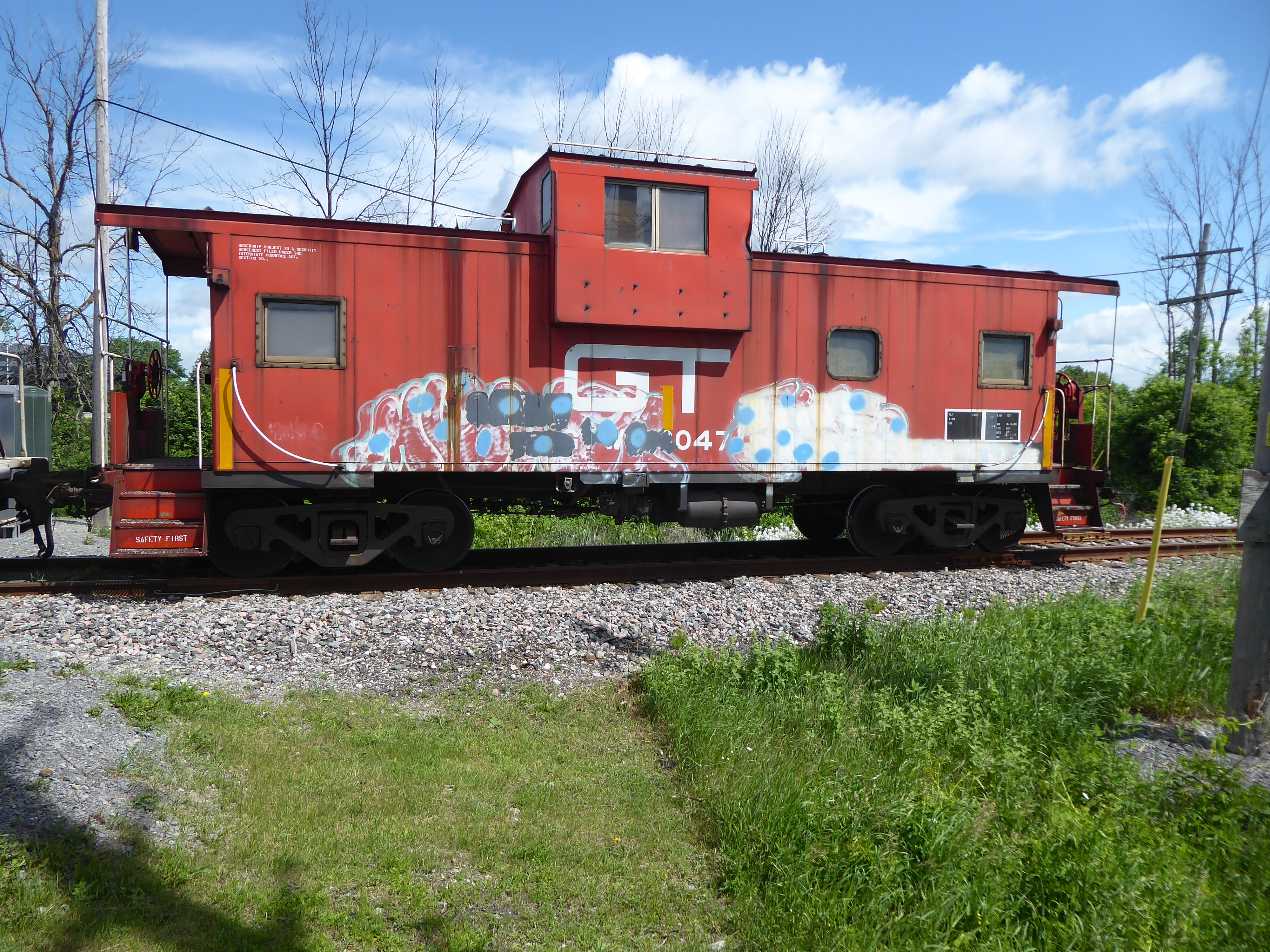
GTW 79047

The most recent caboose to ply the rails here is this relatively fit looking Grand Trunk caboose, which has been used on the Arnprior Turn of late. You don't have to look too hard online to find photos of this van in various CN yards across its system in Michigan (ex-GTW territory), Ontario and Winnipeg. It has seen a lot of yard duty, judging by the photos I have seen in various rail photo forums.

Since crews here have to do a fair bit of backward moves on the Smiths Falls Sub to Federal, not to mention on the Vankleek and former OLOR, it's not surprising that CN would want to have one of these old warhorses around to make things easier for the local crew. It certainly has provided a fair bit of excitement among railfans in the area who are making the weekly run to Arnprior a regular spectator sport of late.

Many of us bemoan the lack of variety on today's modern railways. CN's continued use of cabooses in this region certainly gives local railfans one tiny thing to brag about that those along the mainlines cannot claim.

Wednesday, June 15, 2022

Let's begin at the end

I'm old enough to remember when freight trains had cabooses at the end. I remember, in fact, the union campaign, Trains are safer with a caboose. Of course, the march of progress was unstoppable and the caboose went the way of the dodo on many railways in the 1980s. CSX maintained them on the Sarnia Subdivision until the early 1990s, which was cool for me when I watched trains when younger.

So imagine my surprise on June 8 when I heard the Arnprior Turn (CN 589) making its way through my neighbourhood and I decided to follow it, only to see this at the end. It was a GTW 79047 caboose still in its original scheme. Of course, there was no crew in the cupola, or even in the caboose. The car is clearly being used for shoving moves, giving the conductor a safe platform to watch the tracks ahead.

Of course, this isn't the first time CN has made use of an old caboose in its Ottawa operations. CN has made use of an former Devco caboose and the famous Millennium caboose in past years. Walkley Yard even hosted an old CN caboose hitched to an old RDC unit, both of which were owned by a company in Toronto and patched DAWX.

Over the course of my wanderings trackside, I did see CN using the infamous Millennium caboose once when it was shunting cars in Walkley Yard. I just managed to get this shot from the end of Albion Road on public property.

I will get into the history of CN's cabooses in its Ottawa operations in my next post, but for now, let's just admire the fact that the railway has used more than one caboose locally over the course of the last 10 years. It's an anomoly for sure, but not unexpected, given that there is a significant amount of shoving operations that the railway needs to perform in this area.

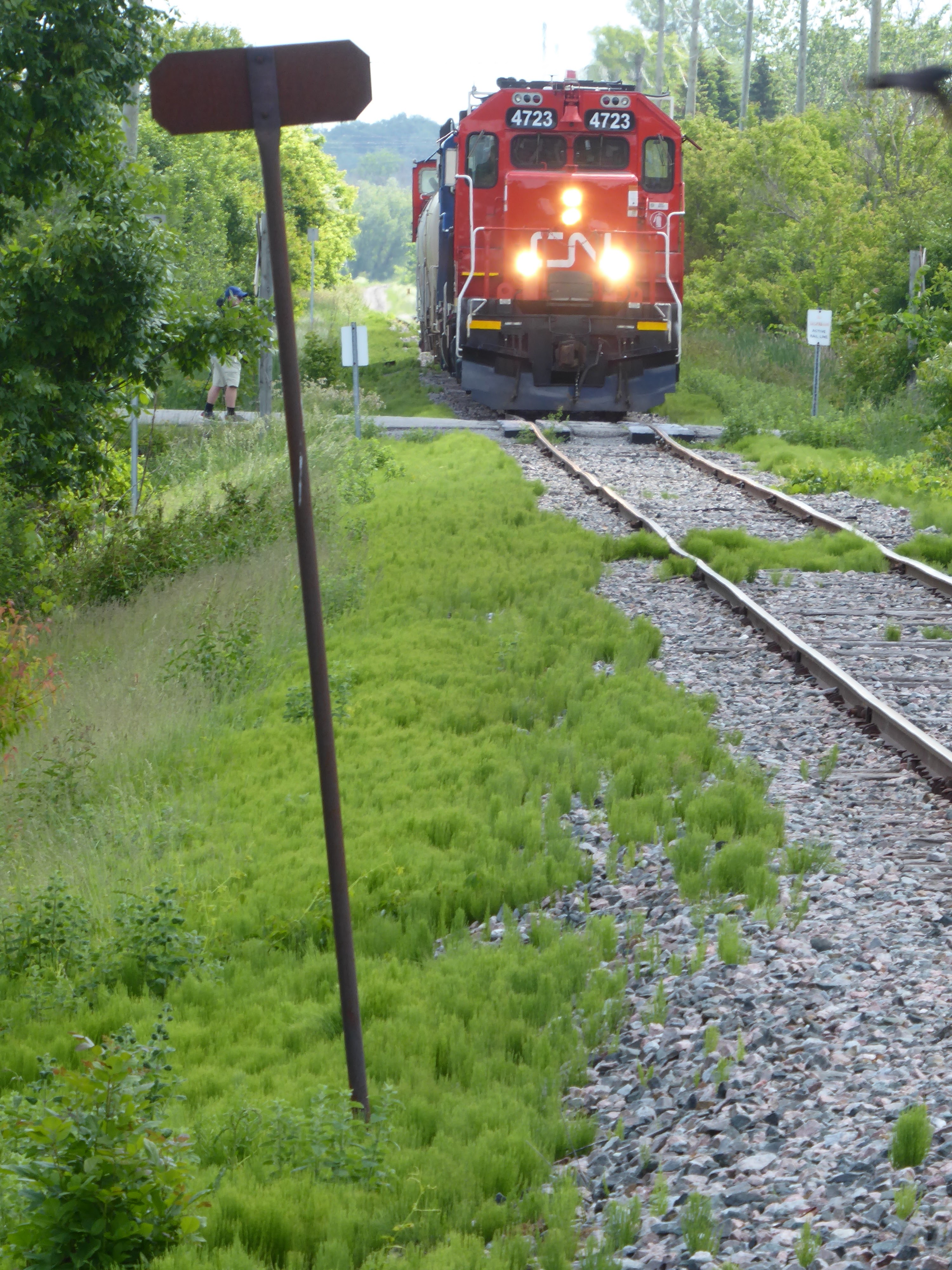
On June 8, I would not have caught up to the train if not for the fact that the crew stopped at a private crossing before March Road to grab a coffee at Tim Hortons, which sits trackside along the Renfrew Spur. That allowed me to park near the Tims and get some shots from March Road, like this head-on shot, which is not possible usually. The skies washed out on this shot, given the angle of the sun but I did manage to frame the trackside sign. You can just make out a railfan to the left of the shot. He had a camera set up on a tripod on the private crossing, which is blocked to vehicles.

Right when the train was easing to a stop, I took a quick photo of the two units from across Carling Avenue. I noticed the GATX unit doesn't seem to be a leased unit anymore. It's patched CN 4905, which suggests to me that the unit is now CN property.


As the train slowly made its way toward March Road, I tried to get some shots of the overall consist, which featured four tank cars loaded with caprolactum and the GT caboose bringing up the rear.

CN continues to use two GP38s on its run to Arnprior, including the GATX unit, which has been a common site in Eastern Ontario for the last several years. The March Road crossing offers a fairly unobstructed view of the Renfrew Spur right-of-way, although you do have to position your shots around a few guy wires and trackside poles. But at least the crossing gives you clearance against the trackside shrubbery, which can ruin your shots.

This is a shot of the March Road crossing, which gives you a better shot of the GATX unit. This is the first time I have captured anything at this crossing. Now that I know what I'm facing here, I will definitely come back, if the chance presents itself.

Even though I was on the sunny side of the train, this side of the caboose was not nearly as photogenic as the other side, which sat in the shadows. There was no graffiti on the other side, while this side was pretty marked up. 

Not knowing if I would ever see this old relic again, I tried to get it from as many angles as I could, including this profile shot, which gives you a view of the entire train as it makes its way slowly east toward the Huntmar crossing and eventually, Arnprior.

One final shot as the train made its way west. I don't take a lot of vertical shots but I took quite a few this past week, which made for some interesting shots. All in all, it was a lucky meet, as I decided at the last minute to chase this train on my break from work and caught it only because of its unscheduled stop near March Road.
It was quite a week for the Arnprior Turn, as it was featured in a story on CTV Ottawa's local newscast. The message that Nylene Canada was delivering was nothing new. There's 40 kilometres of track that the company owns that is being used by one customer. The company would obviously like to see more customers use rail service. It's a great idea in theory, but as readers of this blog know, Nylene has made this pitch before to the Ottawa Sun. I mentioned that story, which was behind a paywall, in this blog entry from 2014.  

I guess I'm skeptical that this latest pitch will get anywhere, since CN is a reluctant service provider in this case, as it is mandated to provide this service to Nylene. If CN does indeed pull out of Ottawa, as it has publicly stated that it wants to do, who steps in? All of the publicity in the world won't help if there is no railway company to provide the service.