Showing posts with label Goderich harbour. Show all posts

Monday, February 27, 2017

Goodbye Goderich

This past summer, my family's presence in the Goderich area ended as my in laws packed up their life and moved to Mitchell, Ontario. The bad news for me is that it means I will no longer be able to take in all the railway heritage and GEXR operations in this Lake Huron port town. The good news is Mitchell is still on the GEXR Goderich Sub, so I hope to catch something different this summer when I visit my in laws in their new home.


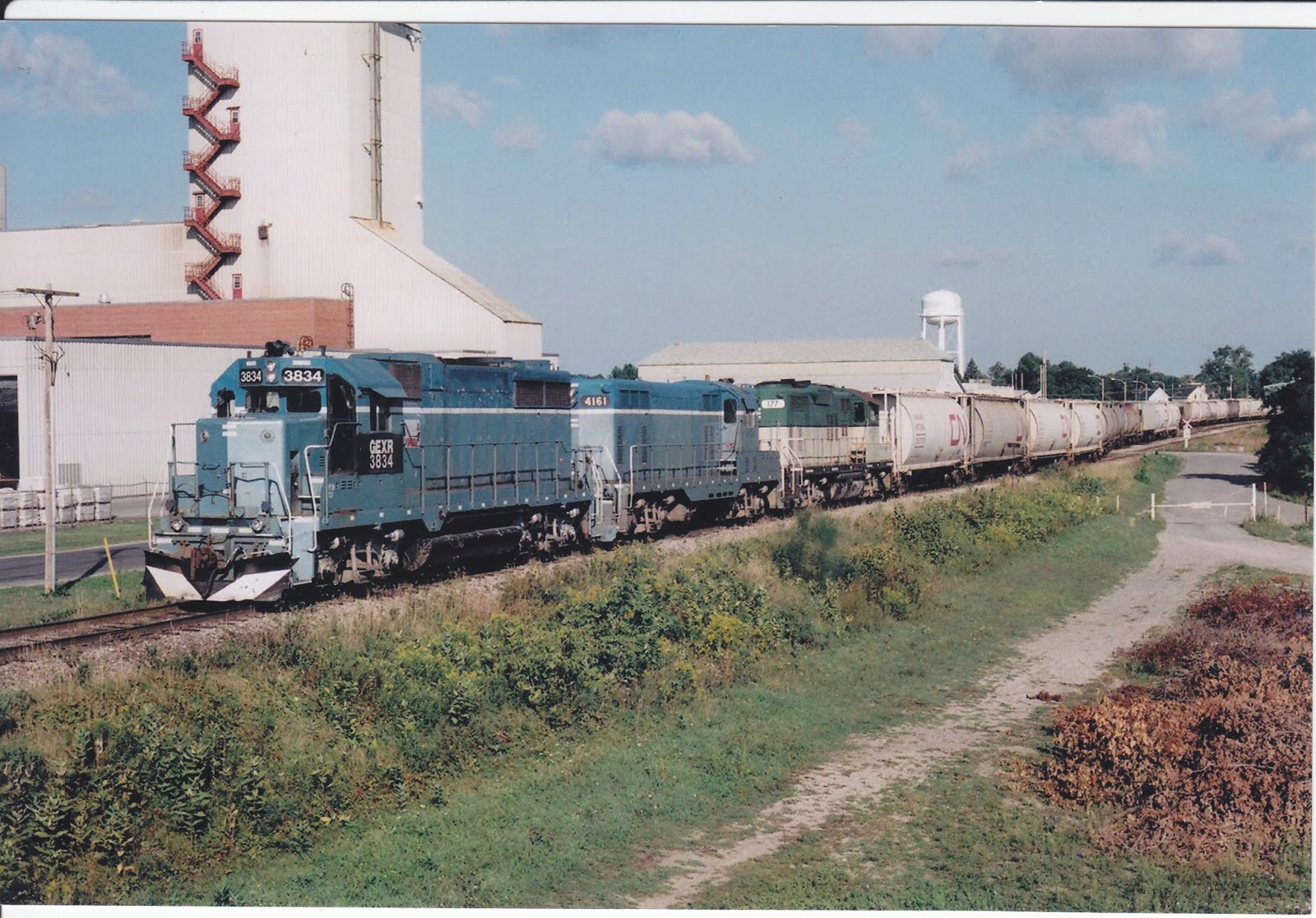
This shot, which is a scan of a print, is courtesy of my railway colleague in Kingston, Eric Gagnon. You know him by his blog, Trackside Treasure. This shot above shows GEXR GP9 177 (once named Titania) along with three other geeps working the salt mine yard in Goderich Harbour. GEXR continues to serve the Sifto salt mine and the related mining industry in the Goderich, although its traffic is lighter than it once was since the town has lost other industries over the last few decades (the Volvo heavy equipment plant being a prime example). Despite this, there are possibly better times ahead for Goderich as federal money to establish this town as a deepwater port on the lake (the only such port on the Canadian side of the lake) means better prospects could be ahead for the railway.

As you know, this town has quite a rail history. You can read about in these following posts:


Rather than get into the history again, I thought I'd share a few quick picks and memories. The first memory I have is being able to see the results of a massive project to move the old Canadian Pacific station from its original spot to its new beachside locale a few hundred metres away. I wrote about this a fair bit and am happy to share that the owner of the building has faithfully restored this building, despite some nervous locals who weren't sold on this project. The town now has a unique restaurant on the town's beach that is a perfect spot on a summer day. The inside of the building really does look sharp, as many of the original design elements were kept.


It's interesting that I've filled so much space on the blog with musings and photos from Goderich. I was actually never lucky enough to catch trains in action in all my time spent trackside in the town. I did catch some cool still lifes though. This shot below shows the local switcher, GP 4001, tied up for the day while a string of covered hoppers await their next move.


I have shown this shot, below, many times, but I always love showing it again. This is one of those shots where everything comes together. Look at the colours of all the hoppers and the grass growing between the rails. This screams small town short line to me. I was really happy when I caught this site.


Here's another view of the silent rail yard, as seen just beyond the East Street Station platform. You can see the GP9, the hoppers, the old CN station and a slowly crumbling trackside shack. Lots going on.


As much as I will miss this railway town, the silver lining is that I will soon be able to discover another trackside opportunity in Mitchell, hometown of Montreal Canadien great, Howie Morenz.


I am really hopeful that I can catch a shot like this one, possibly alongside a great elevator. That would be a fine addition to my GEXR collection.

Small piece of trivia: Do you know why GEXR once named its GP9s, such as the Titania, above?


Thursday, November 19, 2015

Notes from Goderich

My family's recent trip to southern Ontario over the Thanksgiving weekend was all about making lemonade. I was excited to catch some railway action as we made our way down the 401. Nothing. I was then excited about catching some railway action in Goderich. Nothing. I won't mention what I saw in Sarnia because it was next to nothing. However, when life sometimes hands you lemons, you make some lemonade, right?

We'll start with Goderich, the western end of the Goderich Exeter Railway's Stratford-Goderich main line, called the Goderich Sub. Usually, when my family visits this area, there is something to see. This time around, I knew there would be nothing to see, since the day's morning train had already left the town (I heard it leaving as we emerged from a restaurant after a morning snack). I still made my way to the old Canadian National East Street Station and took a look at the railway's empty yard. Still, I like this shot below. Check out the lone axle at the end of the line.


I made my way down the street to the railway's shops and even there, I felt as though my luck was nonexistent. Yes, there was a GEXR unit in the house, but there was no getting a shot.


Here's a closer look at the bottom half of the engine. GP9 I think.


I was lucky enough to bump into the owner of the old Canadian Pacific Railway Station, which was moved in recent years from its spot next to a bluff to a spot closer to the town's beach. It now faces Lake Huron. You can check out this post and this post to see this restaurant in various states of development from the past several years. What you see below is pretty close to a finished product. A deck has been added to the station for the warmer months. The day we were there, two massive evergreen trees were being delivered to the site to complete the outside aesthetics. What impressed me about this renovation is how the character of the station has been faithfully preserved. When you look inside the place, you will see many of the original station's touches have been maintained. There's still a men's waiting room and ladies' waiting room, although I'm pretty sure the restaurant doesn't enforce that old rule!


Here's a closer look at part of the restored station's architecture. This station has to be on of my favourite looking stations, simply for the various design elements that went into it and how all these piece somehow fit together into a coherent whole.


Here's a shot of the circular turret (the witch's hat) that now houses a circular eating area.


You may recall from this post that I cam across this rickety old trackside structure before and mentioned that it might be worth modelling to someone. Here's the best shot I could get from the old station platform. I didn't want to venture any closer to railway property. I'm not sure this old building is even used by GEXR anymore, but the doors were open on the day I visited. You can just see a lone hopper behind the shed, no doubt waiting to be loaded or brought down the hill to the Sifto salt mine.

 
I didn't notice a lot of work being done on Goderich's port, which was part of the previous government's plans to build a deep-water commercial port on Lake Huron. You will remember at the time that I mentioned it would be interesting to see if this port initiative would include some sort of rail connection, since GEXR's rails already extend down to the port. Stay tuned on this.

Thursday, May 14, 2015

Goderich 2014 Part II: Echoes of the past

I have raved about this town on Lake Huron several times, but I thought I'd revisit Goderich once more, after taking time to visit a number of its historic railway sites last August. You can read my first post about this trip here.

The town has a proud railway legacy that has not only been preserved, but celebrated. The first stop I made was to the city's beach, where the town's former Canadian Pacific Railway station has been relocated. The station was moved a few hundred metres last year, to make way for a new lake-facing restaurant.

The station still appeared to be undergoing extensive repairs over the summer. The developer wants to build a 300-seat restaurant with a 100-seat banquet hall. The opening has been pushed back a few times, due to the structural challenges of bringing this beautiful old building back into shape.

This station, which you first read about it this post, was officially opened in 1907 to serve as a western terminus to a CPR line between Goderich and Guelph. The station last saw passengers in 1956. The line used to host as many as three daily freights, with grain being one of its biggest commodities. The operations were officially discontinued in 1989.

Much of this information I learned simply by reading the numerous historic plaques around the harbour.


One of my other items on the railway to-do list was to visit the Tiger Dunlop Walking Trail on the northern edge of the town. The reason I wanted to check it out was that this trail crosses the Maitland River via the former Canadian Pacific Railway Trestle.

The bridge is an impressive structure, which was built in 1906 for the railway's approach to Goderich harbour. When the original wooden bridge was built, it was 212 metres long (695 feet), making it the longest railway trestle in Ontario. The bridge was not without its challenges, the chief among them the steep drop off between the rail line over the river and the rails at the harbour.

To solve this problem, the railway carted in tonnes of earth to create a gradual grade that would be able to accommodate the needs of steam locomotives approaching the rail line's terminus. It was interesting to walk this old right of way. I can say that, despite the efforts to limit the grade in and out of the low-lying harbour, this grade would likely still pose tough operational challenges for the CPR.

When the CPR discontinued service in Goderich, the fate of this old bridge was very much in doubt until a local preservation effort saved the structure for use as a walking trail. The bridge, now called the Menesetung Walking Bridge, gives you a great idea of what it was like to ride the rails in this area. It also offers great views of the city's harbour.

The shot below gives you an idea of the elevation.


This is what engineers would have seen as they approached the town. Take a moment to consider the elevation and the short distance to the harbour. That's a steep slide down to sea level in a short period of time. It makes you appreciate the skill it takes to work on the railway. You can see the town's grain elevators and parts of the salt mine operations. Can you spot the hopper cars?


The final stop on our history tour was the Huron County Museum, perhaps the best local history museum you will find in Canada. I can't begin to describe how comprehensive this facility is in documenting the history of Huron County. The museum's sister site, the Huron County Gaol, built in 1830, is similarly fascinating and thorough.

The centrepiece of the museum is Canadian Pacific Vaughan class U3e steam locomotive 6275. Built in 1913 at CPR's Angus shops in Montreal, this 0-6-0 locomotive was used as a local switcher in Goderich for years until the diesel era made it obsolete. The shot below is the cab. This gives you an idea of how complex these machines are. It gives me an immense amount of appreciation for my grandfathers, who both worked on the CPR when these brutes plied the rails.


This locomotive's history follows a familiar story. It was in danger of being scrapped when a local effort to save it managed to come up with a deal with the railway in 1958. In the end, the engine was sold for the price of scrap. It was sold for the going rate: $1 for every 5 pounds. How times have changed.

The Huron County Museum was build around this locomotive. To get this engine to the museum's site, it had to be guided down two 60-foot lengths of rail along the town's streets in order to reach its place of honour. No small feat.

This shot below is one of the few shots I took that turned out okay. The museum's lighting was unfortunately not conducive to great photography, particularly the camera I was using that day.


Here's a profile shot below. The locomotive is not resting on rails, but on an angled concrete floor, which looked like the inside of a boat. I imagine this keeps the engine in place. The steam engine is surrounded by benching, very much like the ones you would expect to find in a train station in the 1950s or earlier.


The museum even has a CPR baggage cart with some old luggage packed onto it. Nice touch!

 
In many ways, I think Goderich is a town that punches above its weight. Its preservation of its past has served the town well. And its current rail operations are a bonus.

Thursday, October 16, 2014

Goderich 2014, Part I: GEXR Operations

A family trip to the Goderich area this August allowed me to get a better look at the Goderich-Exeter Railway operations in the lakeside town. The railway's operations appear to be fairly quiet in this town these days, due to the loss of local industry in recent years, notably the Volvo Manufacturing facility. However, the railway still services the town's salt mine on the lake and related salt processing facilities. Also, a government initiative to establish Goderich as a deepwater commercial port could bode well for the GEXR, whose rails run from Lake Huron through much of southern Ontario all the way to MacMillan Yard in the Toronto area, via running rights on CN.

The day I explored some of the railway's facilities, including its rail yard at the old CN Centre Street railway station, all was quiet. GEXR GP9 4001 (right) had been parked for the day while a string of eight hoppers looked ready for placement or shipment. You can see the TPI Enterprises facility behind the yard. The plant makes industrial parts and equipment for various industries, including the salt mine.
 
 
As you can see from this shot, the yard is somewhat overgrown. GEXR is now a Genesee and Wyoming railway, but traces of its Rail America past are still visible, including the former Rail America livery on the GP9.
 
The shot below shows you the railway's descent down toward the Sifto salt mine on Lake Huron. Despite some of the overgrowth, it appears that the right-of-way was recently topped up with new ballast, judging by the bleached stones beneath the rails. As a point of interest, I crossed the right-of-way at a level crossing with a hiking trail. You can see that the level crossing with the road is marked with crossbucks, but no signals. I suspect this is because this line is not terribly busy and most movements here are slow.


If you are a fan of the big machines, then Goderich is the place for you. My wife and I like hanging out at the beach in Goderich, right next to the salt mine, whose operations jut out into the lake on a very large pier. From the beach, you can usually see a string of covered hoppers at the ready. I haven't been lucky enough to see any switching operations, but I saw something equally fascinating in August. 


On the day we were at the beach, Great Lakes salt ship Algosteel was being loaded with salt. These hulking ships are amazing to see up close. You really don't realize just how big they are until you see them in person. Algosteel, it should be noted, still bears its Algoma Central Marine colours, which closely match the Algoma Central Railway colours. This harkens back to when the railway (now a CN property) was once linked to the shipping company as part of a larger Algoma Central transportation concern.


As an added bonus, the large ship was met by a tall ship, that just happened to be coming in to dock at Goderich when we were on the beach. Again, you have to see these vessels up close to appreciate them.

 
A closer look...


Getting back to the yard up the hill from the salt mine, here's a close shot of the battered old GP9 4001. I was not able to get shot from the sunny side, since that was on private property. This was about as close as I could get.


Here's a shot of old 4001 at the railway's servicing facility, taken from the old Centre Street station platform. I tried to get the signs in this shot, as well as the lone axle resting behind the geep. Here's a shot of 4001 with its former Rail America paint scheme.


I liked the look of this string of hoppers, due to the colours. It's a man-made rainbow.
 
 
As I mentioned in my first post about Goderich, the city has a number of  preserved railway artifacts, including its two railway stations. Just west of the old CN station, a maintenance shed appears to need a little attention. Good for a model railway prototype, for those so inclined.
 
 
While in Goderich, I also managed to hike on an old CPR trestle, took in a preserved CP steam locomotive and captured shots of the old CPR station, which is being redeveloped. I will share photos and information on these relics in a future post.