Showing posts with label museum. Show all posts

Thursday, September 5, 2024

A little railway history in Toronto

As I mentioned in my previous post, a June family trip to Toronto turned out to be a gold mine of railfanning fun for me, as I watched a fair bit of downtown commuter trains in action. Then there was the railfanning I did en route to the city. It was a fun weekend, which included a chance to visit the Toronto Railway Historical Society's Roundhouse Park museum in the old roundhouse across Bremner Boulevard from the Rogers Centre and CN Tower. 

This facility, known more commonly to railfans as the old John Street roundhouse, still has a working roundtable, which the museum uses to shuttle its cars to different positions throughout Roundhouse Park. There are old vintage station buildings (the former Don station), maintenance structures and a few places to grab a bite to eat in the actual roundhouse. It's a great place to visit on a summer day. I always make it a point to visit this park when I'm in the area.

Of course, it shouldn't be a surprise to any knowledgeable railfan that there's a roundhouse near the stadium, as this part of Toronto's core was once almost exclusively railway land. You can read about the history of the area in numerous posts Eric Gagnon has shared over the years in his Trackside Treasure blog. At one point, CN, CP, Via and Ontario Northland trains all shared trackage in this area. The roundhouse is the last vestige of this industrial past.

This early piece of GO Transit equipment was new to me. The last time I was at the park, this was in the roundhouse. People who know about GO's history know that its early days were a cobbled collection of cast-offs from other railways (sound familiar? Via? Amtrak?). This cab car, an exception to this rule, was built for GO in 1967 by Hawker-Siddeley in Thunder Bay (later Bombardier). The car, RTC-85 SP/D numbered 104, allowed trains to be used in push-pull mode, with full engineer controls in the car. This car was officially retired in 1994, when it was sold to the Montreal commuter agency before ending up being used in the Gaspé region for passenger operations. Metrolinx reacquired 104 to mark GO's 50th anniversary in 2016.


This old Baldwin switcher was parked behind a fence near the old coaling tower. Its numbering had not been stencilled onto the cab. I checked the TRHA website, which only lists CP 7020 on its roster, an S2 dating back from 1944, when it was at the forefront of dieselization efforts across the system. That old switcher bore the mulitmark scheme for years until it was repainted in its original CP switcher scheme, as delivered from the manufacturer. 


Here's a shot of 7020 when it was decked out in the action scheme, from my visit to the old John Street roundhouse in 2016. There are many differences between 7020 and the unnumbered maroon unit. The side grills and the trucks are both quite different, as is the front headlight. So the identity of the engine near the old coaling tower is a bit of a mystery. Anyone out there know more?


I found it interesting that the car hitched onto the old maroon switcher was stencilled for cider purposes. A real throwback to when railways carried more perishables.

Beside the old Baldwin was Canadian National 4-8-4 U-2g class Northern steam locomotive 6213. Built by the Montreal Locomotive Works in 1942, it served in both freight and passenger operations between Nova Scotia and Saskatchewan. The engine would have been serviced at the old Spadina Street roundhouse, which is now where the baseball stadium sits. This would have been among one of the last steam locomotives built for CN, as dieselization was already well underway in the mid-1940s.

These old wooden cabooses were particularly popular with people roaming through the park, as they are anomalies for people not old enough to remember them in use. I am pleased to say that I am in fact old enough to at least remember the old steel cabooses in use, although I can't say I ever saw one of these old ones in use. The orange caboose dates back to 1920 and is clad in the classic CNR maple leaf scheme while the other, built in 1921, is in the Toronto, Hamilton & Buffalo maroon scheme.

I like this old olive green clad CN GP7 high hood unit. I had to wait quite a long time for two teenagers to get off the walkways so I could get a clean shot of this unit. This locomotive was delivered to CN from GM Diesel in London. The museum says this unit is significant in that it is one of the few GP7s that is still largely intact with its original parts. The only thing missing is its traction motors. The unit was one of the few, the museum says, that was not cosmetically altered. It still has its high hood and most of its original controls. I tried to get a shot of it with the old CNR caboose in the background.

The museum's old 50-tonne Whitcomb switcher was hiding in the roundhouse. It was built in Kingston by the Canadian Locomotive Company and was used for an aggregates company for years before making its way to a heritage operation and finally to the Toronto musueum. This unit is clad in the old TH&B scheme. It is fully operational and is often used for switching the museum's rolling stock around.

Here's the switcher on the turntable from 2016.


 I didn't stay at the roundhouse park long, as we had a lot of other things to do and a baseball game to get ready for, but I did make sure to snap a quick shot of this old heavyweight Canadian Pacific passenger car. The museum had a few such cars, one of which was later used as a work train crew car. The old maroon CP passenger cars are such a classy sight. Love to see them so lovingly preserved in their original colours. It makes me think of my grandfather, a rolling stock mechanic, who might have worked on this coach at some point in his years working for CP.


I did get some shots of the other pieces of the museum's collection in my previous visit in 2016. You can see those shots in this post and in this post

I was disappointed, after my visit, to learn that the museum had ex-Via Bombardier locomotive 6917 that was not yet on display. Having been a kid when those modern looking units prowled around the corridor, it would have been a real treat to see one again, but alas, it was not anywhere visible, as it remains at Via's Toronto maintenance centre, awaiting more cosmetic work. Next time, hopefully. I read that it is one of only two LRC locomotives that have been preserved. The other is at Exporail in Quebec.

All in all, it was a fun trip to the roundhouse. I even made sure my wife got a shot of me on one of the old GP7. It was fun to share my passion with my family for a few minutes.


Friday, January 31, 2020

Southern Comfort (Part II)

The second part of my plan to do some railfanning in Florida included a visit to the Plant City Railway Museum and the adjacent railfanning platform at the junction of the old Atlantic Coast Line A Line and the Seaboard Railroad S Line. (Here's the first post.) It all sounded very promising. The daylight wasn't terribly kind and the position of the buildings meant this was the only decent shot I could get of this caboose.


Those who read this blog know I am a fan of CSX's predecessor railways, since the Chessie System (former C&O, former Pere Marquette) served my hometown in Southwestern Ontario. That line still exists in a much reduced capacity as part of CSX's industrial switching operation for the Chemical Valley in Sarnia and a few scattered industries south of the city.

So a chance to see two historic predecessor rail lines in action was pretty exciting. The Robert W. Willaford Railroad Museum is located in the city's former Union Station in the downtown. It was not open on the morning I visited, sadly, but there was more than enough on the museum grounds to look at, including this wonderfully preserved and rehabilitated Seaboard Caboose.

Plant City is an area that is dotted with a number of railway tracks, but the activity in and around the city is mostly relegated to overnight freight action, which was a big disappointment to me.


This Whitcomb switcher is almost too small to be believed. You have to see these machines to truly appreciate what it must have taken to fit any type of railroad-grade horsepower into such a small box. I looked at the axles and wheels on this thing and wondered how it maintained its balance. This unit, ACL 508, was painted in an unknown-to-me purple and grey livery for the old Atlantic Coast Line. These engines remind me of the trackmobiles you sometimes still see in industrial switching operations.Here's an example of one, for comparison.


Since the S Line and A Line were so quiet, I made sure to seek out the details on the museum grounds, such as the Seaboard logo on the caboose. Here's an interesting piece of trivia. The Seaboard Railroad adopted the "Air Line" into its name as a way to compete with airlines. The Air Line nomenclature was meant to signify that the Seaboard routes were the straightest and most direct connections between destinations. So, in other words, it was like flying straight to your destination. Interesting marketing concept. I always liked this logo.


The ACL logo was incorporated into a number of railroad items on the grounds, including a few benches, which used old rails bent to act as supports for the wooden slats. I like that the old ACL listed its major destinations on the outside of its logo. It gives you a good idea of the reach of this old line. That tradition continued when Seaboard and ACL came together as the SCL, which in turn became part of the loosely joined Family Lines system (later Seaboard System). Here's an example of the Family Lines logo.


This is where I waited, and waited, and waited. The signals on the A Line and the S Line remained solid red in my time in Plant City, which meant that nothing was happening. I was really disappointed that not a single train passed through, although I did know going in that traffic was light to sporadic in the daytime. Welcome to modern PSR-obsessed railways. Sigh...

Another small piece of trivia I unearthed while in Plant City was that the town itself was not named after the famous strawberries that grow in the region. Chances are, if you buy strawberries with any regularity, as I do, you will likely buy Plant City strawberries at some point during the year. They are known to be some of tastiest in North America. But, the Plant in Plant City comes from the railway executive who originally laid the tracks through this area. So, like many other cities and towns across North America, the town name can be traced back to the railways.


The final insult in my time in Florida was my time spent with my kids at Disney World. Even the Magic Kingdom's famous steam railway was out of commission on the day I visited. The entire railway was undergoing significant maintenance and renewal, including the removal of some of its narrow gauge track. I will hand it to the people in charge through, who knew enough to park one of the trains in front of the Magic Kingdom train station for the Christmas season. A nice touch.

So, on the whole, my train karma wasn't great in my time in Florida, but I suppose it's better to have bad train karma and be warm than have bad train karma and shiver trackside, as many of us often do in Ottawa.

In case anyone is wondering, yes I have some strong opinions on the absolute disastrous launch of Ottawa's Confederation Line light rail service. But that post will have to wait for another day. 

Thursday, October 3, 2019

Some fascinating details at the Railway Museum of Eastern Ontario

Earlier this summer, I brought my girls to the Railway Museum of Eastern Ontario. Much to my surprise, they loved the place and are eagerly awaiting a return trip. I spent a great day with them, looking at some of the old relics in the Smiths Falls collection and explaining some basics of railways to them. We were even treated to a demonstration in railroad telegraphy from a volunteer, who was fluent in Morse code. He also explained to the girls what a railway agent was and what they did in the station.

The last time I went to this museum, I spent much of the time photographing the pieces of rolling stock and the two locomotives. This time around, since I already knew what was on display, I looked for some hidden details I missed the first time around.

I am a history nerd, so I was thrilled with all the artifacts that I didn't notice the first time around.

Here are a few shots of the railroadiana you will encounter at this gem of a museum. What really fascinated me were the signs in the old Canadian Northern station. This one below was by far my favorite.


Arrested for spitting! Imagine. I suppose that this rule was likely aimed at those spitting tobacco. I laughed when I saw it because it made me think of an actual bylaw that the old City of Kanata had, before the western suburb was amalgamated into the City of Ottawa. It was a long-running joke in this area that you could not spit in Kanata. The old city had a bylaw that prohibited the habit. I remember playing soccer there and my teammates always joked about not spitting during a game without first taking a good look around.

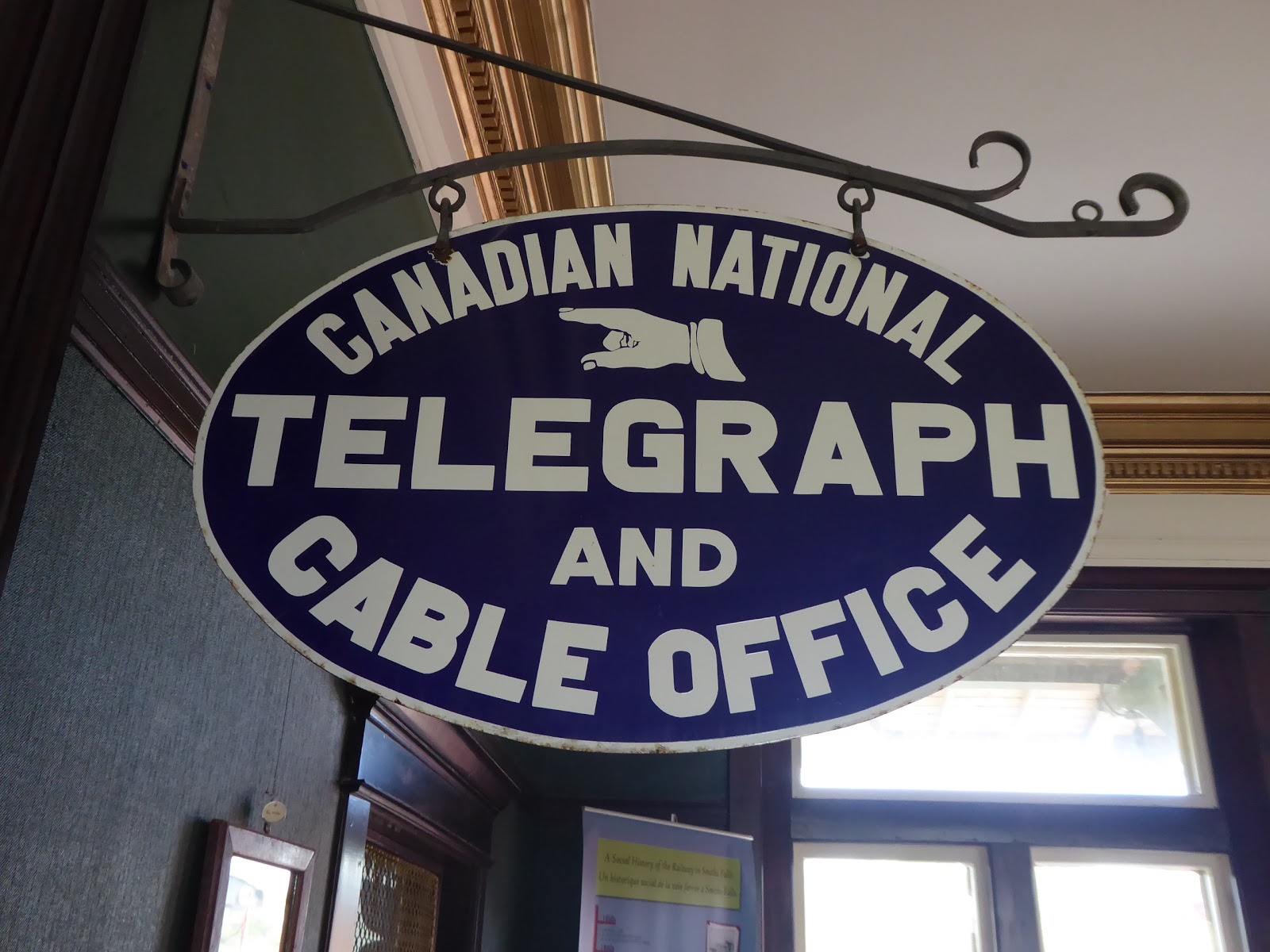
The second sign that I really loved was this old telegraph sign, perched outside the old telegraph office. Today, we still see parts of the old telegraph system still in place along railway lines, but I would imagine many younger railfans not really understanding just how important these lines were at one point.


I thought this slate timetable (below) on the outside of the station was a nice touch. Although it was quite out-of-date by the time we visited in July, it gave you a good idea of what train travel was like in the days before the technology that we take for granted today. Surprisingly, the frequency of passenger trains then is comparable to what you see today in Eastern Ontario, although Smiths Falls passengers no longer have their grand old CP passenger station to begin their trips. Instead, Via now uses a modern kiosk on Union Street. I say kiosk, but it is quite a bit larger than a bus shelter. However, whenever I see that ultramodern station, I can't help but think that it looks like an overgrown bus shelter. Functional, for sure, but lacking any style.


Before I saw this sign, I had no idea this place even existed. Forthton is a hamlet northwest of Brockville. It once had its own railway station on the Brockville, Westport & Northwestern (later Canadian Northern and Canadian National) Railway. The sign looks like it's seen its share of bad weather over the years but it now hangs in the old CNor station waiting room. I love old station signs and wish more of them had been saved. I always thought it would be a cool feature to have in my house (not sure if my wife would agree).


This old flag station for Nolans saw use for many years just north of Smiths Falls. I didn't know that this station was actually originally used as a flag station for Dwyer Hill, on the edge of Ottawa, before it was moved to Nolans to replace the original Nolans flag station after it burned down. This little station served CNor passengers between Smiths Falls and Ottawa in the early 1900s. The museum notes that in its final years, only two trains passed this station at 9:45 p.m and 2:15 a.m. Not terribly convenient!


I didn't get a shot of this caboose the last time I was at this museum, as it was parked in the museum's yard in a spot that was not accessible to visitors. As you can see, it is used for storage now and requires a fair bit of work to be fully restored, particularly on each end. I like the fact that they note that the caboose was originally CP 436757. You can also see another old CP caboose hitched to the other side. This caboose also seems to be suffering from the elements. It was in a prominent position the last time I was at this museum, but has been boarded up and shuffled off to a much less prominent spot. The yellow caboose is an older wooden van that had its slatted sides covered over with plywood sheets. It was a practical thing for railways to do at the time, but has since proven to be a headache for those who seek to restore the cars for preservation purposes.


My daughters couldn't get enough of riding in the cupolas, so I decided to follow them up one time and get this cupola's view of the station and the trailing CN caboose. This museum really does allow you to get a feel for what it was like to ride a train back in the golden era of railroading. As a parent, it means you have to watch your little ones closely, but I like that the museum trusts its visitors enough to hop aboard these fascinating relics.


Here's another shot I took from the end of the caboose lash-up in front of the station. You can see the old passenger equipment to the right, including the CN dental car, which is the best preserved piece of passenger equipment at the museum. The interiors of the other passenger cars are not open to visitors.


This is an old section house built by the Canadian Northern, that now houses some of the museum's archives. It is not open to visitors, but it is in the process of being restored after being saved from demolition in 1995. These structures were used as homes for the families of railway section hands. The museum says this is one of the last remaining such structures in all of Canada. The house was built in 1912.


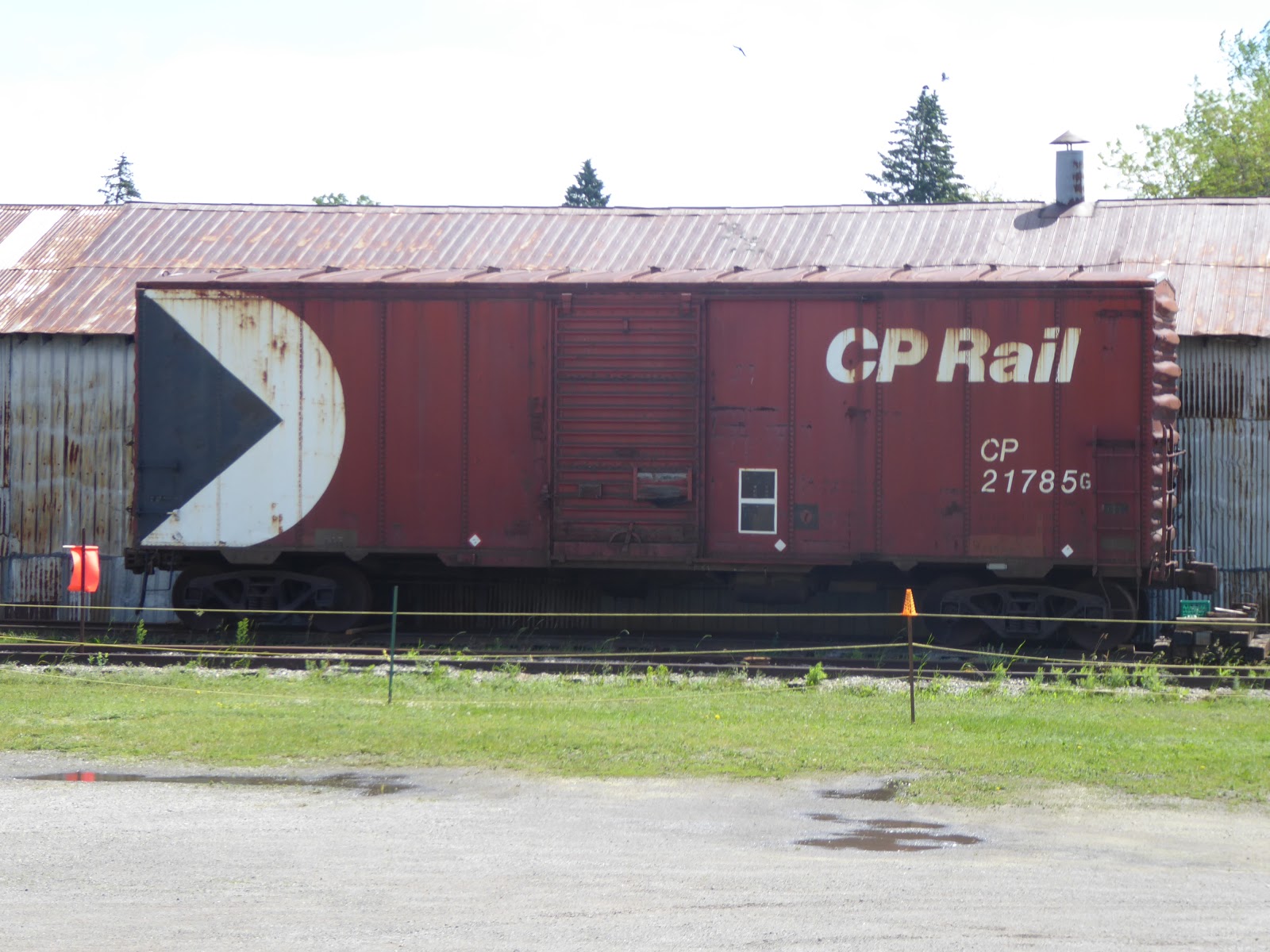
I didn't get a shot of this boxcar the last time I was at the museum. I took a quick photo because it reminded me of railfanning when I was a kid. The CP multimark was a common site for me and it remains a source of great nostalgia. Plus, I have two examples of this boxcar on my layout in my basement (although both are in boxes at the moment).


I couldn't publish a post about the museum without getting a shot of my favourite piece in the collection, its old Alco switcher. This engine still operates on occasion, when the museum offers visitors train rides on its operations days.


I couldn't get a shot of this old bench without my girls sitting on it. This bench is a new addition to the museum's collection and it is of particular significance to railfans from Ottawa. Why? Because this bench was just recently found in storage in Ottawa. It was originally one of the benches used by passengers at Ottawa's former Union Station downtown. The craftsmanship on this bench is amazing. The two lamps are part of the overall structure and were purposely crafted into the framework of this two-sided structure. It was recently donated to the museum, as it had no uses in Ottawa. I think this was the best possible outcome for this relic. Here, it will be appreciated by those who want to learn more about rail history. My girls loved it, as you can see.


For those who haven't been to the Railway Museum of Eastern Ontario lately, there are some exciting developments happening here. A volunteer told me about plans to move an 1890s-vintage passenger car to the museum grounds where staff will clean it for use in the spring. It will be on the museum's grounds in November and will spend the winter indoors. The car will be put into "revenue service" (museum's words) in the spring and possibly be used for events or as a cafe down the road. Whatever the case, there are hopes this car will provide the museum with a much-needed new source of revenue, which can then be used to further preservation efforts. For more on this, go to the museum's Facebook page.

The museum's next operations day will take place over the Thanksgiving weekend.

Thursday, April 7, 2016

Five minutes at Roundhouse Park

Toronto, Part II - The following post is the second of four I have put together to chronicle the various trains I saw on a recent trip to Toronto with my family in mid-March. You can read the first part here.
 
I was like a moth to a flame when I saw the roundhouse. When my family was recently in Toronto, I was able to find a few minutes to go for a walk along the tracks downtown. The official purpose was to make my way to the Ripley's Aquarium and check out the line before my family visited the attraction. I knew the Toronto Railway Museum was across the road, but not having been to the area in years, I forgot that the museum had all its artifacts spread throughout Roundhouse Park for anyone to see for free. So, after checking out the line at the aquarium, I figured I had about five minutes to check out the trains before heading back to our rented condo where my family would be waking up from their naps.
 
I was able to pack a lot into five minutes.


This was my favourite piece in the park. This is a 1953-built GP7 that was used throughout Canada on the CN. It was retired in 1984 and donated to the City of Toronto to celebrate the city's 150th anniversary. Given that it was retired in 1984, this unit obviously wore the red and black wet-noodle scheme when it was pulled from service, but the museum chose to apply CN's green and yellow scheme, which was used until the wet noodle scheme began to be rolled out in 1961. That means this unit was in this green and yellow scheme for a relatively short time.


When you pass by the roundhouse on Bremner Boulevard, the first thing you see is wooden Canadian National caboose 79144 and the maroon Toronto, Hamilton & Buffalo caboose 70. The TH&B caboose was built in 1921 as a wooden caboose. The car was sheeted in steel in the 1950s and was painted yellow and black, which was meant to honour Hamilton's Canadian Football League team, the Tiger-Cats. The TH&B, formed in 1892, operated until 1987. Its corporate parents were the Canadian Pacific and CSX (successor to original TH&B partner New York Central).

The CN caboose was actually a wooden boxcar built in 1920, which was transformed into a caboose in 1957. The caboose is a recent addition to the museum, having been donated in 2014. The car was in recent years used as an office at a garden supply centre and nursery in the Toronto area. The interior of the caboose is still a work in progress, according to the museum's website.


Here's a better shot, above, of  the TH&B caboose's façade and trucks. You can see that the window beneath the cupola was sheeted over at one point. Despite that, the caboose is still a striking piece of rail history, especially in the maroon paint and the classic TH&B logo. I have a beloved TH&B wooden boxcar as part of my HO scale trains (currently boxed up, sadly), so this road has always been one of my favourite fallen flags.


I like that this museum has an old Alco S2 switcher in the CP Rail multimark scheme. Despite its more modern colour scheme, this unit was built in 1944. This unit weighs 120 tonnes. It was powered by an inline six-cylinder, 1000-horsepower engine. CP soon began replacing its S2s with the lighter S3s. You can read about the S3 in this previous post. This unit was retired from service as a local switcher in Toronto in 1986. You will notice in the photo that this switcher is coupled to another switcher. Given its position behind those cement columns and fencing (not seen in photo), I was unable to get any useful shots of the maroon and grey switcher.


This is Canadian Pacific 411281, a 1931-built heavyweight sleeper, which was converted to maintenance of way service at some point, hence the CP Rail script. From what I could find, this sleeper was once called Jackman. It spent a good deal of time at the downtown CP Yard and at the John Street roundhouse before it was officially retired and donated to the museum.


This old CP station, the Don Station, has perhaps the most interesting history of any of the artifacts at the old John Street roundhouse. The station was built by the Canadian Pacific in 1896 near Queen Street as a suburban station to serve the needs of passengers who didn't want to go all the way to Union Station. This type of suburban station was quite common in big cities for decades until the development of better roads and highways eliminated the need for them.

In the case of this station, it remained operational until 1967, mainly as a stopover for passenger trains arriving from Peterborough or Havelock. After it was closed, the station was moved to the Todmorden Mills historic village in the Don Valley in 1969, where it housed a railway display. After a while, it was used for storage. It was recently moved to Roundhouse Park, where it has become a centerpiece.

It is the last remaining example of this style of turn-of-the-century station that existed all around Toronto. One note to the fine folks at the railway museum: it's time to powerwash the decking surrounding the station. I nearly slipped and fell as did a few other people.


This regal looking car is Canadian Pacific Cape Race, which was built in 1929 as River Liard. The interior was finished at CP's Angus Shops in Montreal. Typical of the heavyweight lounge cars of the time, this car had both men's and women's showers, smoking rooms and a women's lounge. These cars were not initially revenue producing, as they were placed in the consist for the exclusive use of passengers using sleeping cars. In the 1940s, the car was converted into a revenue-generating sleeper and was renamed Cape Race. The car was then used as a business car before it was acquired by a rail history society for use on railfanning trips. The years have been kind to this car. It's still a looker.


Cabin D, above, served as an interlocking tower at the rail junction just west of Bathurst Street in downtown Toronto, until it was moved to the roundhouse in 1984 and refurbished. The museum posted photos several years ago of the tower's move to its spot in the park.


One final shot of Cabin D and an adjacent rail structure located right beside the CNR GP9 and just across the tracks from the old Don Station. Next time I'm in Toronto, I will have to splurge and spend a full 10 minutes in the park to take in all this rail history. As it stands, I was happy to squeeze in this time.

Thursday, March 17, 2016

RMEO Part IV: The best of the rest

Last summer, my family visited the Railway Museum of Eastern Ontario in Smiths Falls. I made sure to take photos of just about everything. In this post, I thought I'd share some photos of a number of pieces of the museum's collection that didn't merit their own post.

You can read about the museum's S3 locomotive here.
You can read about the museum's two Canadian Pacific cabooses here.
You can read about the museum's dental car here.

The car below is an oddity for sure, at least by today's railway standards. This 1947 Cadillac sedan was originally owned by a Toronto doctor. The doctor donated the car to his friend "Buck" Crump, president of the Canadian Pacific Railway. Crump promptly sent the luxury car to Montreal where the railway converted it into possibly the most comfortable inspection vehicle the CP had ever seen.

The car, numbered M-260, was assigned to the president and used for division inspections. There are some interesting modifications on this car. One is that the steering wheel was used for air brakes while the car itself was placed on a rotating turntable, which allowed the car to avoid needing wyes or diamonds in order to turn around. An air horn and bell were also added to this eight-cylinder, seven-tonne car, which has 32,000 miles on the odometer. I also love the CPR beaver logo on the driver side door.


Canadian Pacific spanned the world at the time.


My nephew loved this locomotive, which I took him to see. This steam engine, built in 1912 for the Canadian Northern, was a 4-6-2 coal-burning locomotive later converted to oil. The locomotive was used for both freight and passenger service. It served in these two capacities for the CNoR and CNR until it was sold to the resource line Quebec, North Shore and Labrador, where it worked in revenue service until 1961. The locomotive was then donated to railway museum Exporail. In 1992, it was leased to the Smiths Falls museum, where it has been ever since. The museum had the engine laid out with a consist of two boxcars and a caboose.


This wooden caboose below was one of 15 built by the Canadian National in London, Ontario in 1947. This caboose belonged to the last roster of wooden cabooses built by the railway. It was retired from revenue service in 1983 and was donated to a museum in Cornwall. In 2001, it was donated to this museum, where it was restored. It looked like it needed a fresh coat of paint, but the interior was immaculate. Despite the fact that it is a wooden caboose, this car has some modern touches, like an oil stove, rather than a coal stove. It also was equipped with air brakes.


Inscription on this yellow boxcar (see shot above, in front of the CNR caboose) reads: "Insulated and Heated Car. For Cleaning Lading Only. Accept Bulk Commodity."


This plow was one of my favourites. One of the reasons is that it's such an odd looking car. The Goderich Exeter Railway still uses a plow just like this one to keep its lines clear, especially in the Huronia region. This car, 55400, was built in 1935 by National Steel Car in Hamilton. This plow worked by harnessing the power of the compressed air in the train's braking system.


This shot gives you an idea of what it was like to sit in the cockpit of one of these cars. The three gauges you see read main reservoir, signal line and train line. I was surprised how simplistic the setup was when I climbed into this car.


This old wooden boxcar was something of an anomaly. There wasn't much to read about it in the brochure the museum gives visitors. There was nothing on the outside to indicate the origin of this car. By digging a little, I found that this car was built in 1923 for the Canadian Pacific. There is little more out there about the story of this car.


I did find it interesting that there was this door at the end of the boxcar, which suggested to me that this car may have been modified at some point for maintenance of way duties, although that is just a guess.


I spotted this tank car at the edge of the museum's property near a maintenance shop. It reads Casco on the side. It looked like it needed a fair amount of work before it was added to the permanent collection.

 
That concludes my four-part recap of one of Eastern Ontario's more fascinating museums. My family and I had a great time wandering the grounds and the restored CNoR station. Smiths Falls should be very proud of this museum. I know I will be back.