Thursday, October 13, 2022

Guest Post: More GP9 memories from across Canada

I seemed to have hit a sweet spot in my previous post about the history of the venerable GP9 locomotive. As I mentioned in that post, this old relic is fast disappearing from most major railways, given its age. The last GP9s produced in Canada came off the line at the old GM Diesel in London, Ont. in 1963. CN and CP have used them for decades, although there are none left on CP and only a few dozen left on CN rails.

I shared a few photos of my meets with these engines over the years, including on the CP, CN and even the Goderich Exeter Railway. After I published that post, I received interesting feedback from a few fellow bloggers in appreciation of these geeps.

It occurred to me that perhaps my generation of railfan will wax poetic over these first-generation diesels the way previous generations bemoan the loss the steam locomotives after the late 1950s and early 1960s. I have to admit I don’t understand the fascination with steam locomotives at all, given my age and my lack of experience with them trackside. However, given my fond memories of old GP9s and even SW1200s, maybe I’m not all that different from steam fans after all.

One of those who seemed enthused about my GP9 retrospective is Steve Boyko, author, poet and prominent rail blogger extraordinaire. Most people who come to this blog will know Steve from his long-running railway and photography blog, traingeek.ca. It was one blog that directly influenced my decision to start The Beachburg Sub. Steve was kind enough to share a few of his own shots of GP9s from his time trackside, which I am pleased to share below.

I’ll start with a shot Steve took in Winnipeg, where he lives. The descriptions below the photos are Steve’s, not mine. Read on:
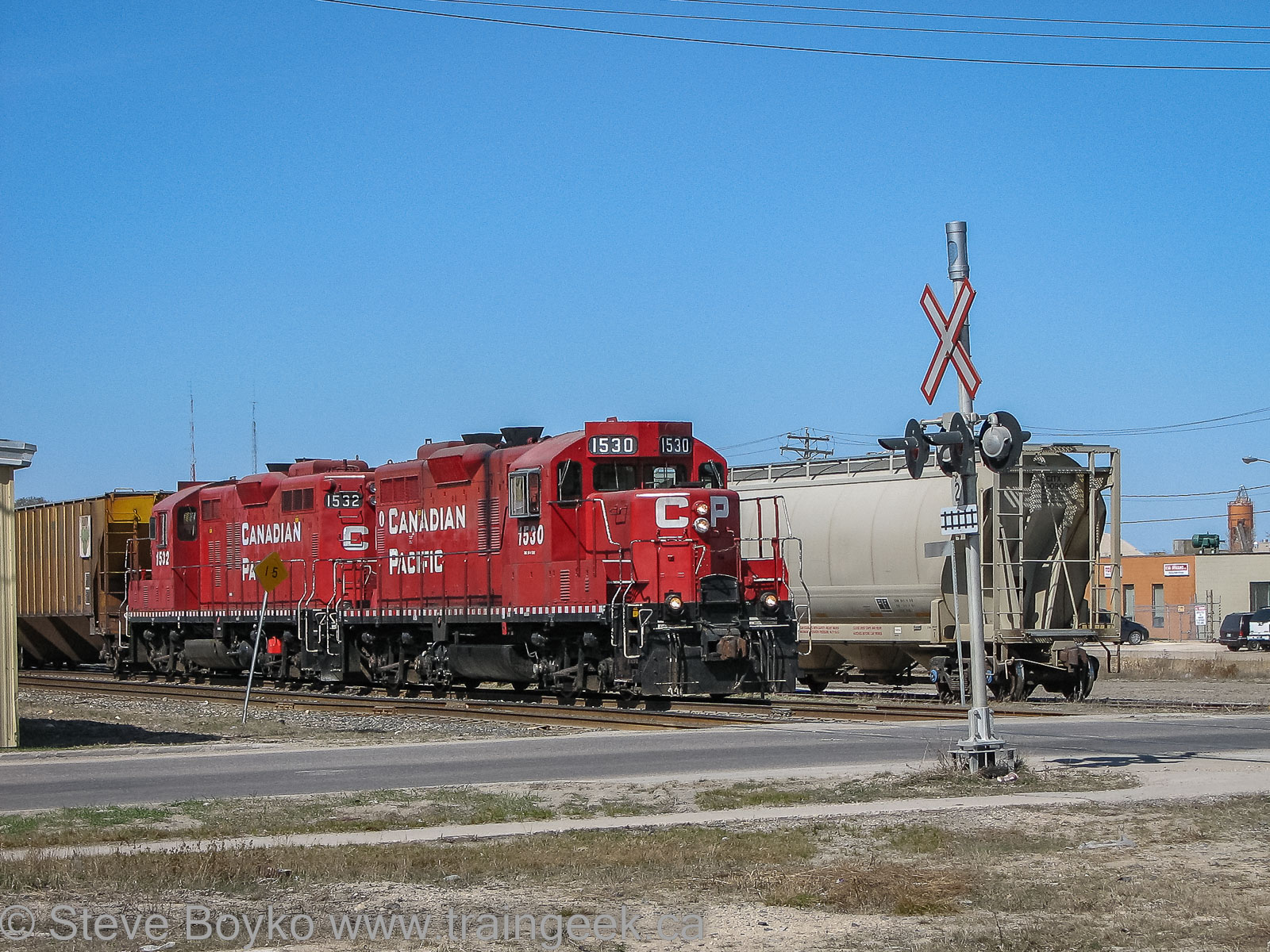
CP operated many GP7s and GP9s in Winnipeg in the first decade of the 21st century, in local switcher service and local yard service. They frequently operated in pairs, like these two about to cross Plinguet Street, south of Whittier Junction.

An overhead view of CP 1540 in yard service, October 29, 2011.

Many CP switchers met their end here in late 2009. A scrapper used a siding in Fort Garry to scrap quite a few locomotives over a few months. I documented many from a distance, including this massacre of four CP GP9s – 1558 and 1556, bracketing two SOO GP9s, 4202 and 4204.

You might wonder why a CN GP9 is at the famous McAdam, New Brunswick train station – a former bastion of CP power. This line has been owned by shortline NB Southern Railway for quite a while, and they leased a few CN GP9s for local switching in Saint John. Occasionally, one would be put on the Saint John-Brownville Junction freight for extra power. However, they are not permitted to cross into the U.S., so they would be dropped in McAdam. When I visited McAdam on July 19, 2008, 7038 was being used to switch the yard.


This is a very pedestrian shot of CN 7059 passing the Staples store near Island Yard in Saint John, coming back from perhaps switching the Irving refinery. I include it because I have one of the number boards that used to grace this locomotive, which has since donned Cando colours and a new number.

CN often used a pairing of GP9s and a slug for local switching in the Winnipeg area. Here are two pairings, with 7213 at Transcona (with modern CN.ca paint scheme) above and 7254 in Winnipeg below.

Here's an oddity below. Read Steve's caption of this scene below the image.

I’m not sure why this GP9 was on top of the hump in Symington Yard in Winnipeg. Typically, hump locomotives were GP38-2 locomotives at this time, but for whatever reason, 7258 and slug 268 were up high.

For a long time, CP 8251 was one of the very few active locomotives around Winnipeg still bearing a multimark. Here a rainbow graces the scene after a summer storm. CP 8251 was retired in 2013 but has been leased to Viterra to serve a grain elevator.

My thanks to Steve for sharing these photos. It’s a real treat to feature photographs and information outside my usual haunts here in Ottawa and southern Ontario. In keeping with this post’s theme of GP9 photos, I’d like to share three additional GP9 photos that didn’t make the cut in the previous post. 

The first is an old shot my Dad took at the GEXR yard in Startford in the early 1990s. Note the faded Shakespearan name "Falstaff" on the lead engine, in appreciation of the railway's hometown.


A few years ago, Eric Gagnon, author of the equally acclaimed Trackside Treasure blog and several railway books, shared this photo print with me of GEXR GP9 177 leading a string of old EMD power in switching the salt mine on the Lake Huron habourfront in Goderich. Date unknown, but it appears to be a 1990s shot. 


Finally, I'll add one last shot of my own that I did not manage to squeeze into my original post on these engines. Here's a great shot of GP9 720 and slug 223 leading 4761 in Sarnia Yard in August 2014.


So that just about wraps up my tribute to the venerable GP9. I am also working on a similar post about the equally venerable SW1200 and its family of switchers. Stay tuned for that one a little down the road. My thanks to Steve Boyko, the original Train Geek, for sharing his photos this week and his contribution to the cause on this blog. And thanks to Eric Gagnon of Trackside Treasure. It's been years since he shared a bunch of prints with me. I finally have the chance to share one of them.

Thursday, September 29, 2022

The GP9: A Scrappy Survivor

When I was visiting another blog a few months ago, I was interested in a comment about the fast-fading GP9s still out there in service. It hit me then that I have tonnes of photos of this unit from my years of sitting trackside. It also hit me that I might not be able to see these old beasts much longer. So I decided to create a small tribute to this unsung hero of railroading, which has done yeoman's work for decades without much glory.

The GP9 officially ended production at General Motors Diesel in London, Ontario, in 1963. The engine first sported a 16-cylinder, 1,750 horsepower engine running on four axles, not factoring in the B units and slugs that were produced as well as the CN GP9RM rebuilds. Some of the slugs are still in service in certain CN yards. Various sites online peg sales of the engine at 3,500 units in the United States and nearly 650 in Canada.

GM London's production of this unit actually ended four years later than EMD in the United States. The 2022 Canadian Trackside Guide says CN still has 29 in active service. CP has retired its fleet, with the bodies and chassis of the old locomotives used for its fleet of GP20C-ECOs. What seems strange to me is when I find references to these engines being preserved. It makes me feel old.

Searching through my photos from my teenage years, I found two early 1990s photographs of these geeps in Southwestern Ontario. The first shot is from Canadian Pacific's Windsor Yard, where GP9s were once a common sight. The most prominent GP9 in this shot is CP 1619, with a fast fading action scheme still visible, complete with the multimark at the rear. Beside it you can see CP 8226, in a more recent action red scheme. This newer one lasted a long time, as you can see it in action on the Galt Sub in this photo in 2008. Although these two units look similar, note that they are numbered in different series. Scanning through some sites online, it seems CP had these geeps numbered in the 1500s, 1600s and 8000s. I tried to find a more recent shot of 1619, but was no able to find anything worth a link. You can also see a piece of a lumber car to the left in this shot from 1991. Note CP's unique high number board plates and classification lights above the front windows.

Closer to where I grew up in Sarnia, I did come across GP9 rebuilds a few times in the 1990s, although at that time, CN's stables of SW1200s shared local switching duties with the GP9s. Here's one of my earliest shots of a GP9RM from Sarnia Yard, when you were able to roam the yard more freely.This shot below is of CN 7226 with slug 259 in front. It was an unforgiving day for sun when I took this shot in 1992. No amount of photoshop could fix this. You can see how CN's number boards were not mounted on extra high plates like their CP counterparts. In fact, their number boards were much smaller and oval shaped.

The slugs are very useful in yards like the giant Sarnia Yard, as their traction motors allow the GP9's horsepower to be distributed more widely, which gives the unit more leverage to pull long strings of cars at low speeds. Great for switching duties. There are still a few being used in Sarnia.

This shot was taken at a time when CN had yet to privatize and seemed to operate as a very different railway. It was not uncommon at this time to find 15-20 units all parked and idle near the CN roundhouse. This is not the case today.

Fast forward to the 2000s and you see that these old beasts are still kicking up a fair bit of smoke in Sarnia Yard and in CN's local operations. This shot below is one of my favourites, taken just south of Corunna near the Rokeby Line, as a CN local switched local petrochemical industries in August 2017. You can see three GP9s in this shot, two are able to be identified: 7038 in the lead and 7278 hitched elephant style as the second unit. The third unit, which is clad in the safety stripes, is not identifiable. 

This brings up another interesting point. These units, which have been able to soldier on thanks to CN's rebuild program, can be found in their original mainly black scheme with the wet noodle on the side and the more recent safety stripes scheme. I have even seen one in the CN privatization anniversary scheme, but I have never seen one in the modern CN.ca scheme.


Here's a GP9 in the CN 15 scheme, celebrating the railway's privatization. This is not a terribly common scheme. I was lucky to run into GP9 7256 a few years ago on a brief stopover at Sarnia Yard in July 2021. It was pulling a long string of hoppers in the yard, with a carbon black from Cabot Carbon first in the consist behind 7052.

I should mention as well that, in the two years I lived in Peterborough in 2003 and 2004, CP's affiliate, the Kawartha Lakes Railway, often used GP9s and even a few SW1200s to service local industries on the line, from Havelock to Peterborough. I wasn't in the habit of photographing trains at this time, so I have no hard proof of these observations other than my memory.

One of the great things about these old beasts is they put on quite a show, if you are a photographer. You might recall a post from several years ago titled Smoke! where I was treated to quite a show in Sarnia Yard in October 2016. Here's my favourite shot from that post, below. The GP9 in the shot is coupled with what looks like a GP38. The real smoke is all from the old man, though.

And speaking of those slugs, here's a more recent shot of a GP9 and slug still working the rails in Sarnia Yard in 2015 near the old roundhouse. Notice the old SW1200s in the background, which are either being repaired for industrial use or possibly scrapped for parts.

Of course, it's not just on mainline railways that this unit survives. The GP9 has long been a staple of short line railways, like the Goderich Exeter Railway. I caught this unit idle in Goderich in August 2014. Note its paint scheme. GEXR was once famous for painting its GP9s in a unique green and taupe scheme, with certain units being named after Shakepearean references. Many of the railway's units were later left in their leasing unit or previous railway schemes.

Surprisingly, even CN's operations up in Ottawa have made use of a GP9 on several occasions. Recently, the railway has made use of multiple GP38s, including some former GATX leased units. But as recently as 2017, the regional operations out to Hawkesbury and Arnprior were being handled by units like 4139, seen here near the Queensway overpass in the Greenbelt in 2017. I find this fascinating, as these units are not usually synonymous with long runs, like the 40-km turn out to Arnprior and the long 80-plus-km haul out to Ivaco in Hawkesbury. That's a lot of distance for a yard and local engine.

So why is this little runt of a locomotive worth discussing, remembering and preserving? Well, for one, it is fast becoming an antique, as the last Canadian units made are already 59 years old, and those are the youngest of the bunch. A quick glance through some sites online will show you that this unit propelled General Motors' EMD into the locomotive production lead, which was not the case before the GP9 was built. This brief article discusses how the market for road switchers was still very much the domain of Alco/MLW's RS series until the GP9 came along.

CN purchased 349 of these units while CP purchased 200. CP's numbers might be a reflection of the large number of MLW RS units it brought before the GP9 began production. Other Canadian buyers included New York Central, which purchased 12 for its Canadian operations in Ontario, Northern Alberta Railways (10), Ontario Northland (60), Toronto, Hamilton & Buffalo (3) and the Quebec North Shore & Labrador (54).

When you do see one of the surviving GP9s roaming around, take a shot. With their unique curved cab roofs and chopped noses, they are pieces of living history that are sure to fade quickly in the coming years. I am lucky that I was able to see so many of these engines in my time trackside. That's worth celebrating.

Friday, September 16, 2022

The old guy in the lead

On a trip back from Southwestern Ontario in July, I encountered this strange consist idling on an overpass over the 407, near CN's Brampton Yard. There are a few things about this consist that caught my eye after my wife snapped a few shots from the passenger side of our car, which was headed east.

I liked how the old GP9 was the lead unit of a three engine consist lashed together elephant style. The engines in the image are GP9RM 7029 followed by GP38-2 7509 and GP38-2 7512. Look closely and you can see the differences between 7509 and 7512. One noticeable change is the extended roof overhang on 7509, which 7512 does not have. Also, the placement of the horn on each is different, as 7512 has it mounted on the cab while 7509 does not, although it's hard to judge by the image. Also, there's the obvious difference in paint schemes between the GP38s and the GP9, which looks tired.

A shot from further back gives you a better idea of the size of the container train on the parallel track.

The noteworthy aspect of the image in my mind was that the GP9 is in the lead. This is not all that surprising at first glance, as I'm sure it just happened that this is how the locomotives lined up when they coupled them together.

But given that CN has only 29 of these old units left on its system, any sighting of these engines is worth noting these days, before they disappear forever. Over the years, I have come across a number of GP9s in action in Windsor, Sarnia, Lambton County and even here in Ottawa in recent years.

The GP9 is a survivor, many of which were built in the late 1950s and early 1960s. Although CP's fleet has disappeared and morphed into the GP20 ECOs, the CN roster continues to toil in its yards scattered throughout its system, but for how long.

I have been thinking about these old warhorses in recent months and thought that this image taken in late July might be a perfect opportunity to do a little retrospective on these engines and my encounters with them over the years. 

That will wait for the next post.