Wednesday, March 1, 2023

The St. Clair Branch's Last Vestiges

This past summer, I was lucky enough to visit a unique community museum that tells a fascinating story in Canada's history. And it just so happens to be the site of the last vestiges of a long-gone railway line with an interesting history. You'll be forgiven if you haven't heard of the Oil Museum of Canada. Or Oil Springs, where the museum is located. You'd also be forgiven if you didn't realize that the North American oil industry first started in Oil Springs in the 1850s. This fact is disputed by those in Pennsylvania, where oil was discovered around the same time, but historians in the Oil Springs area do have some documentation that strongly points to Oil Springs being the site of the first gusher, in oil parlance.

I'm talking about the St. Clair branch of the Canada Southern Railway, which once connected St. Thomas with Courtright through a swath of southern Ontario forest and swamps. The rails are now long gone, and the areas it served now encompass some of our country's best farmland. You can read about this line's history in this post.

The short version is the Canada Southern, an extension of the New York Central Railway, built a rail line from St. Thomas to Courtright, with spurs into Petrolia and Oil Springs. The line opened in 1874 and was active until around 1960, when it was pulled up. The St. Clair branch was a secondary route off the main CASO line, which acted as a short cut for NYC traffic from the Niagara Region to Windsor, where trains would ultimately proceed under the Michigan Central Tunnel in later years and onto Detroit and Chicago. CASO's purpose was very much to act as a bypass of Lake Ontario and Lake Erie for NYC traffic to Chicago.

At the Oil Museum of Canada in Oil Springs, not only do you get a glimpse of what it was like to discover, capture and refine oil in the industry's early days, you also get an idea of how railways benefited greatly from this discovery in innumerable ways. 

Local history buffs know that Oil Springs, a town now of less than 700, once boasted a population of 4,000 or more, with the streets jammed, several hotels jockeying for oil drillers, churches, saloons, makeshift schools and all the other assorted amenities of a boom town. That boom didn't last long, but the oil kept flowing in smaller quantities, which meant that there was business for a railway that could get there.

This is basically all that is left of the St. Clair branch, the Oil Springs train station, which was itself on a spur that originated in Oil City at the Eddys Junction. I've seen the spur referred to as the Eddys Spur and the Oil Springs Spur. The museum uses the latter term.

The museum once had a length of track between the station and an old tank car further up the line, but much of that trackage has been removed, although the old roadbed is clearly visible, although sinking into the ground slowly.

Even in the grass, the old line is still visible. I'm not sure why the museum disconnected the line, but I would assume it's a lot of work to maintain the roadbed, much of which is sinking into the ground. It's a bit of a shame for a railfan not to have this short stretch still intact. I am thinking of the way they use a short stretch of track to give rides at the Railway Museum of Eastern Ontario in Smiths Falls. But the staff for this museum likely has its hands full with the many historic structures it already maintains.

Sitting on the last piece of the St. Clair branch is an old tank car, likely in use in the last days of the St. Clair branch operations. You can see that the museum attached a wooden rail worker on the car who would have been the person to help fill the cars in Oil Springs, which the museum points out was a common occurrence until the rail line's later days. All oil brought up from the ground here was bound for the Imperial Oil refinery in Sarnia. To this day, oil from this area and Petrolia is still sold to Imperial Oil in Sarnia, although it arrives by truck now.

The station itself is a treasure trove of railway history, with many preserved pieces of rail equipment, like this sign, which was attached to the rail and acted like a chock when a car needed to be protected from any possible movements.
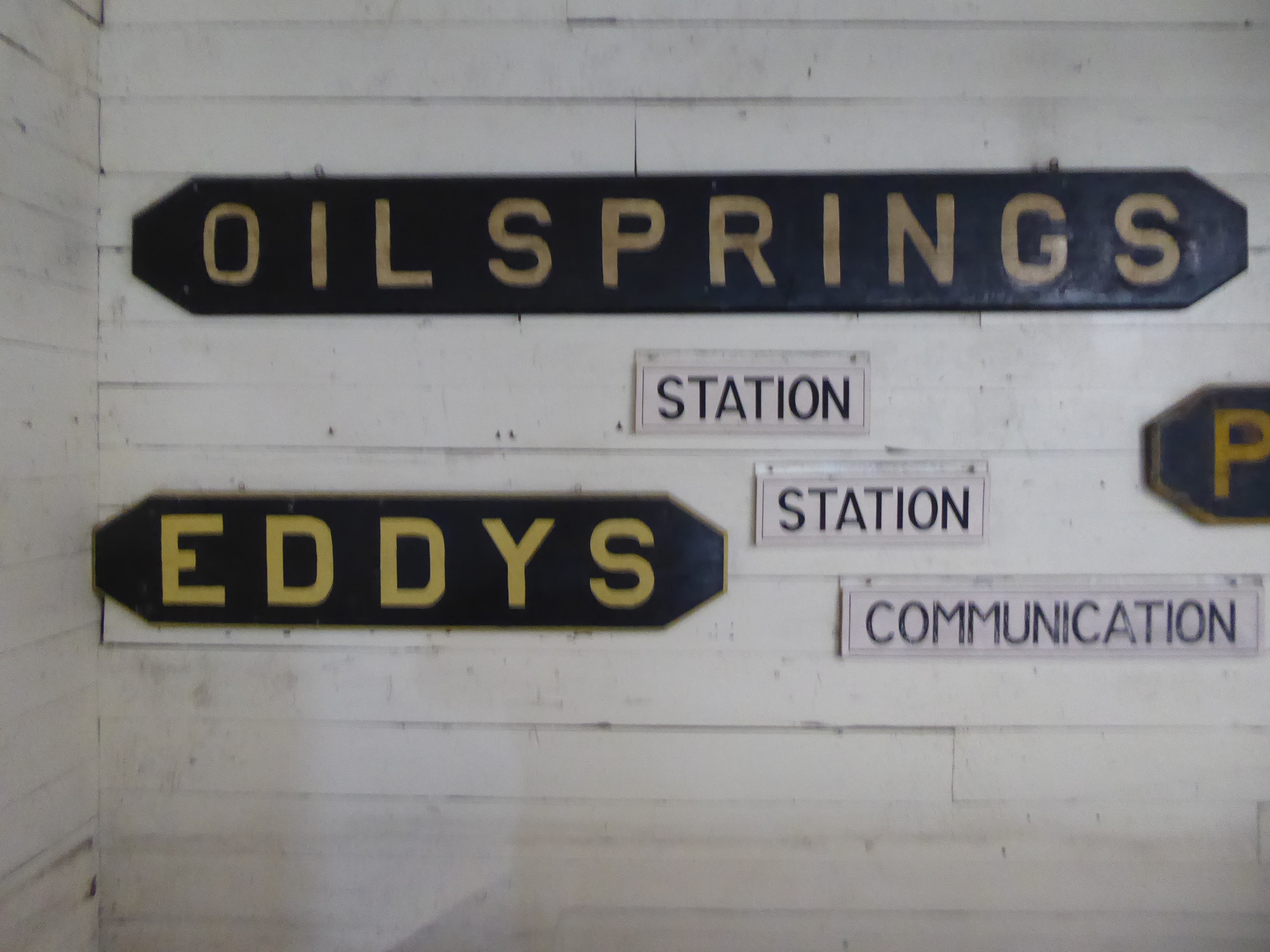
Some of the line's old station signs have been preserved, including the sign for Eddys, which was the end of the Oil Spring Spur in Eddys Mills, a tiny farming hamlet that once required rail service for loading crops.

The Petrolia Junction sign is also preserved, and its story is fascinating. The Petrolia Spur was very much CASO's me-too answer to Petrolia being served by the Grand Trunk Railway. At the time, Petrolia was flush with cash and much of the oil discoveries were focused in this town. Rich oil merchants paid out of their own pockets to build a spur to connect to the Grand Trunk Strathroy Subdivision (later CN). That spur proved lucrative to the Grand Trunk, so the Canada Southern decided it wanted in on the action, as it opened its own station on the other side of the town's main street, today called the Petrolia Line. 

The CASO Petrolia Station survives to this day, although it is a private residence in Bright's Grove, a northern suburb of Sarnia along Lake Huron. You can see the distinctive witch's hat turret facing the water. The railway did do some bustling charter and passenger business in the age before cars, which made this station a fairly busy spot in its heyday. This picture was taken from public property in March of 2022. I didn't want to go any further, as I didn't want to disturb the homeowner.

An old steam engine's number plate also adorns the walls of the Oil Springs Station. 

My wife found this sign highly amusing. It was at a time when women were not expected to be travelling alone all that much. Interesting to see how society has changed in a relatively short period of time.

I would kill to have access to some of these historic photos, but many were simply placed on the walls behind a laminate, which made them hard to photograph. This shot seems to be of a doodlebug, likely in the 1930s or 40s. Passenger service on the St. Clair branch ended long before most passenger service on secondary lines was ended. The date of this photo is unknown.

Here's another photo behind laminate of a steam engine bringing in a passenger train to the station, although in an unothodox fashion as trains had to back onto spurs before getting back on the main line. This shot appears to show a steam engine backing into the station with the tender in the lead and a passenger car in tow behind the drawbar of the cowcatcher. It was hard to make out, given the lighting and the lack of information. I would imagine there would have been some wye to ensure the train was in the right configuration on the main line. 

Curiously, although the Oil Springs station was completed in 1885, crude oil from the area wasn't hauled to Sarnia on tank cars until 1915, when a crude oil receiving station was built for Imperial Oil. So even though the oil boom was a big motivating factor behind the building of the St. Clair branch, local oil producers still had a tough time bringing their product to market, so to speak. 

The railway did still serve a purpose, as it hauled goods into isolated towns for local businesses. In the case of Oil Springs, the railway also transported children to school in Petrolia. That would have been some experience, I would imagine. Nothing like a school bus.

Of course, the St. Clair branch never really lived up to the initial promise. It was never a major player in hauling crude oil, as much of that business had already been taken by the Grand Trunk, which reached Petrolia first. 

Initial plans to have a through connection to the United States via a St. Clair River crossing at the end of the line in Courtright never materialized either. The timber that was harvested and generated initial business on the line soon thinned out, as the area became farm land. In the end, the St. Clair branch barely made it to 1960, when it was officially pulled up.

The Oil Museum of Canada in Oil Springs was recently renovated and refurbished. It is a real gem out in the countryside, which tells an important story in Canada's history that few people really know. The railways of course get their due here, even if they aren't the main attraction. It's still worth a visit, if you are a rail buff and want to see some rare mileage.

Monday, February 20, 2023

Fallowfield After Dark

Fallowfield Station has become a fixture for residents in west Ottawa over the last two decades. It is one of the few suburban stations Via Rail maintains in large cities. Other than Guildwood Station in east Toronto (Scarborough to be specific) and Dorval Station west of Montreal, Via maintains one station per city or community in just about all other cases.

Fallowfield has become a convenient place to pick up and drop off friends and family who are either visiting or departing Ottawa. Its vantage points are tricky, from the point of view of rail photography, as its platform is long and extremely narrow. To make matters more challenging, the station has 100 parking spots in two long, narrow parking lots that stretch along tracks far from the station. In other words, if you want pictures of trains that aren't almost head on or free of vehicle obstructions, you need to get creative. I have blogged about Fallowfield many times, as it is one of the few accessible, busy train spots near my home, but I have not been in the habit of visiting there all that much lately. I feel I have more than enough Via Rail photographs from my near decade of photographing there.

However, when family was visiting in early January and expected to arrive on Train 44 at 6:30 p.m., I decided to take my camera with me to attempt a little nighttime rail photography. I have done this in the past at this station, as its overhead lighting does ease the challenges.

Before the train arrived, I tried getting a shot of the signal towers to the east of the station, although the mist made it difficult to get the sharp image I wanted. However, I did like what I got, amid the mist.

At this point, the city had received quite a bit of freezing rain and flurries, which made for some tricky and messy driving. It also meant that the extreme ends of the station platform were treacherous to walk on, which I did, of course, in the search for an interesting shot.

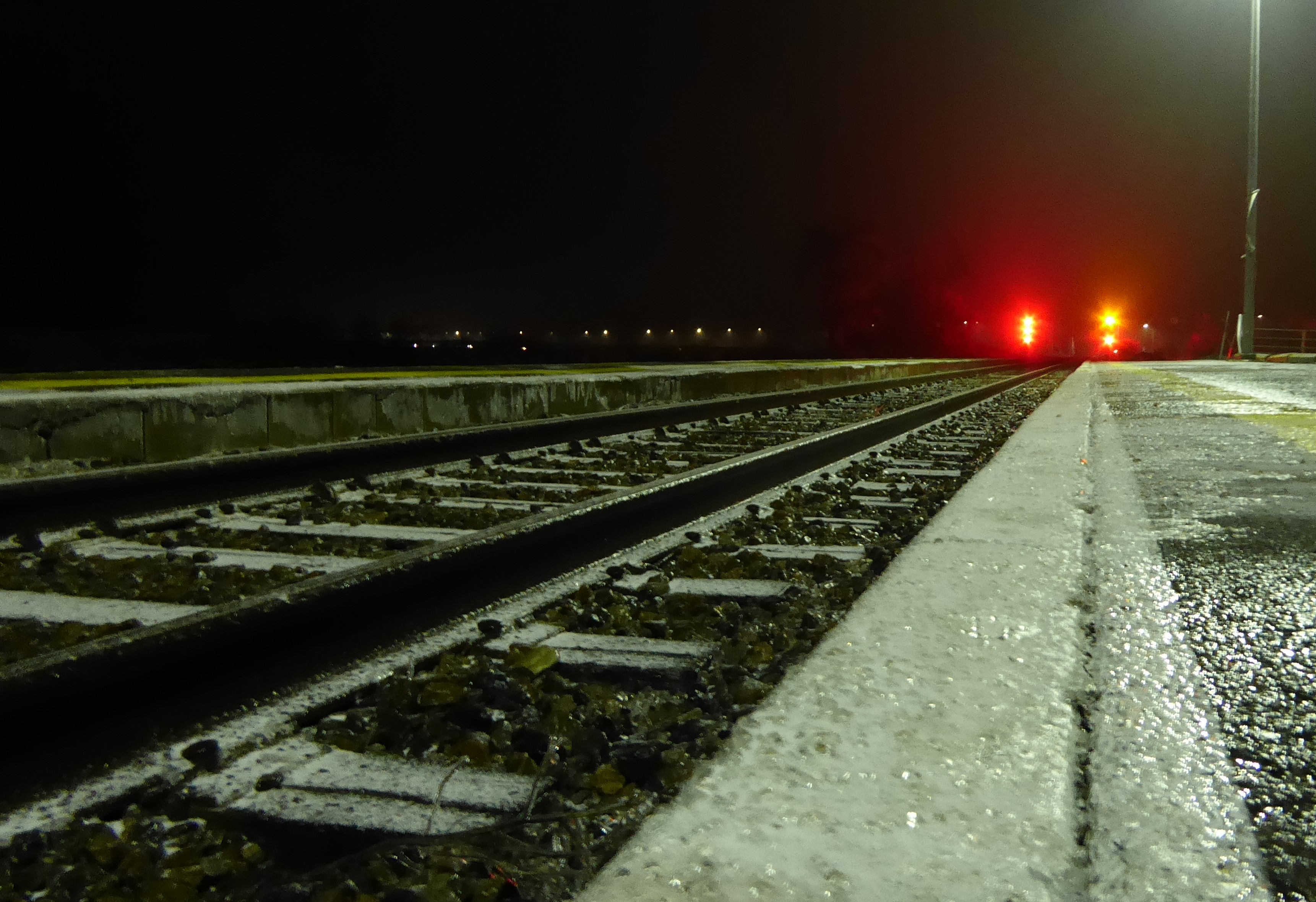
Some of these shots didn't turn out, so all my slipping and sliding didn't pay off, but it was worth a try, at least. On the safer part of the platform, I tried to get the ice and frost on the rails in an image. This time, the effort paid off.

It's not often that an image with no train in it becomes my favourite of a shoot, but this image turned out really well. I was sitting on the platform and trying to get the rails, the icy platform and the signals in one shot that was compelling. I think I had some success. This image to me is the essence of railroading in Canada in the winter. You never know what you're going to get, but it's always interesting.

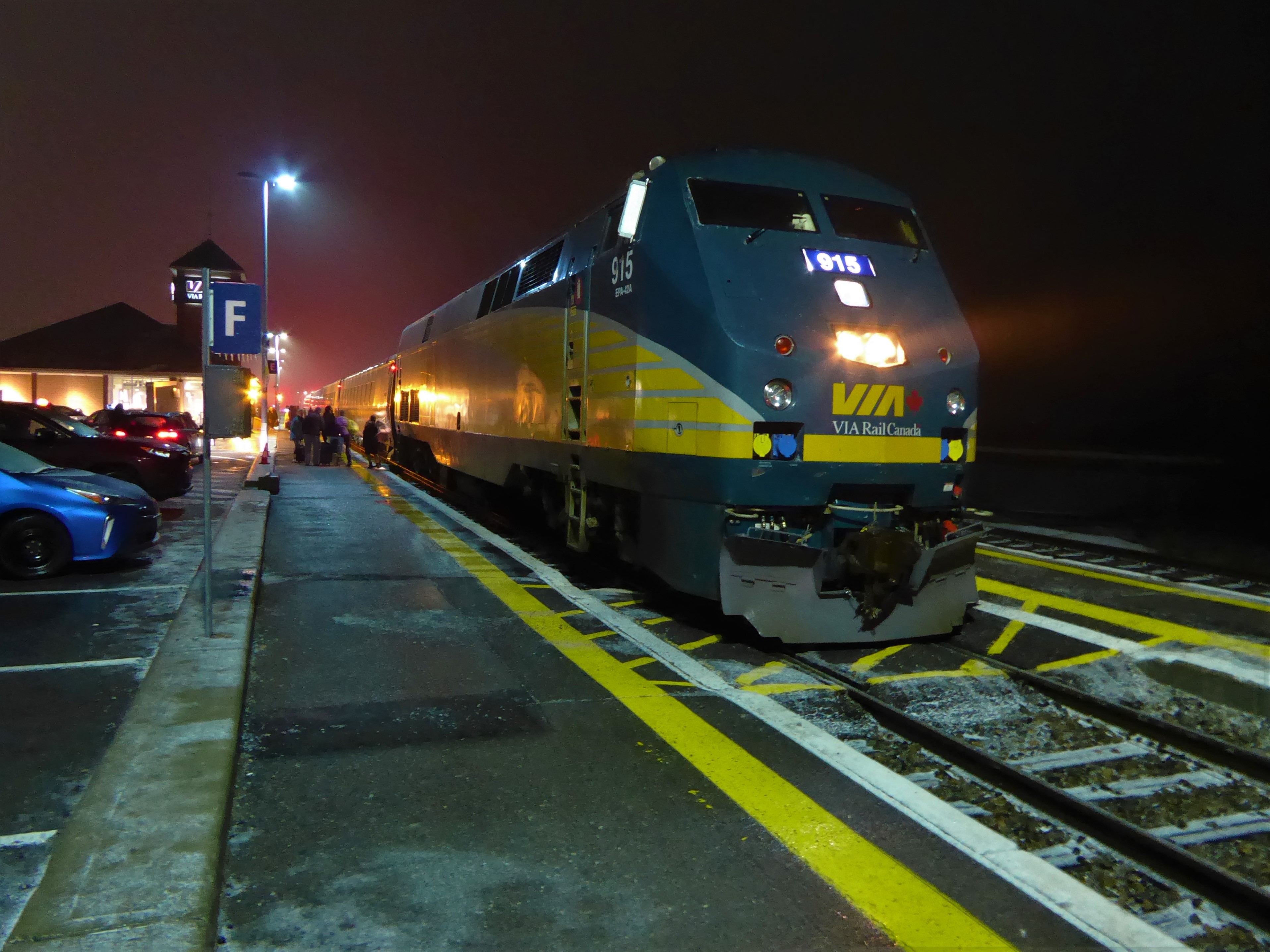
Train 44 arrived shortly after I got my frost shot. The all LRC consist was led by P42 915 in its original Via colours. The trains itself was not a double-ender, as there was no power on the other side. I do like that you can see the headlight shining in the darkness in this shot. The snow had not yet begun to fall, which would have made the shot even more wintry, but I was satisfied nonetheless.

One last vertical shot and then it was off to retrieve my family, who were in the last car on the train and likely wondering where I was. I was happy with this vertical shot, as it shows the headlight shining through the darkness much more clearly. You can also see the station lights and other passenger silhouettes on the platform. It's a timeless image of people reuniting on the holidays, being thankful to see each other and spending time together.

I don't take a lot of vertical shots anymore, as they usually mean I am taking shots of trains with very little angle. However, once in a while, I think this format suits a scene really well, as it did here.

There have been a few other times when I've been to Fallowfield in the evening and most of the shots were not worthy of sharing. Over the years, as I have gotten a bit better, I have managed to get a few cool shots in the snow at night. My favourite nighttime shot is the one in this post.

As Fallowfield Station just celebrated the 20th anniversary of its grand opening in the fall, I thought it might be worthwhile to look into the history of the station. I am in the process of going through old newspaper articles about the station and its surprising history.

Stay tuned for that post coming soon.

Friday, February 10, 2023

A busy day on the mainline in Kingston: Part II

As I mentioned in Part I, I had the chance to spend the better part of a day trackside at Kingston's Via Rail station, as my family was in the Limestone City for a music conference downtown. After dropping off my children for their musical activities, I spent much of my time watching the steady flow of rail action at Kingston station, which resulted in five Via Rail trains in the morning, including the 60/50 J-Train eastbound along with the 62/52 J-Train eastbound, along with a westbound later on. So, for those keeping score, that's five trains in just a few hours. Still, I was waiting for a freight train, as that was what I was there to see. As many railfans south of Ottawa know, much of the CN freight movements happen earlier in the morning before the onslaught of passenger trains between Montreal, Ottawa and Toronto in the mid morning to afternoon.

My afternoon began with the arrival of another westbound Via Rail corridor train, being led by an F40 in the blue-ish scheme. Once again, staff was on the platform ready to greet the crew in the engine.

For much of the day, it was cloudy, which was actually a real plus for me, as the sun was making shots from my side of the platform tricky, given the sharp shadows, as you can see in this shot. I did take this shot of the corridor train boarding passengers with 6432 reflecting the brief moment of sun through the many clouds. As it was a windy day, the blue skies didn't last long. And for once, I was thankful for the return of the clouds.

That was because the next train through was an eastbound mixed freight, just minutes after the Via Rail westbound left. The train was led by ES44AC 2993. I mentioned that the sun was mostly gone by this point, but it was still wreaking havoc with shadows as the train came closer to the station.

Given that that train was being led by a single engine, I was pretty sure I was going to see a mid-train DPU. I was right. The DPU snuck up on me, so I wasn't able to get a great shot, but I did like this shot of the unit sandwiched between an ADM covered hopper and a RailBox boxcar. It was one of the former Citi units that CN has regularly used on this main line.

As always, I was on the hunt for interesting pieces of rolling stock to shoot, possibly with fallen flags on the side. Sadly, there wasn't much to shoot, so I at least got a going away shot of the DPU 3977 in better sunlight. This shot also reveals the size and length of the RailBox car. This type of boxcar reminds me of the auto parts boxcars I used to see regularly on the CSX trains that passed through my hometown, back when CSX shuttled oversized cars from Chatham to Sarnia.

I thought getting an overall shot of the train was a good idea. I took a few going away shots toward the station, but those shots weren't as interesting as this shot, given the colour and assortment of rolling stock.

After that afternoon mixed freight passed, I stuck around to see what else there was to see, as I still had time to kill before picking up my daughters and heading home to Ottawa. Not surprisingly, the afternoon was filled with more Via Rail corridor trains, including this westbnound, led by F40 6416 at 4:17 p.m. This as on my third trip to the station. The intermittent sun peaking through the clouds cast a glare on this train, which washed out most of my shots. This one I was able to touch up a bit. It was a tricky day at times for photos.

I was still holding out hope for another freight, but the Via Rail corridor train parade continued, with an eastbound about 10 minutes afterward, led by wrapped P42 913.

The LRC cars were pretty standard, but it was nice to see this outlier, a reminder of Via's branding efforts from a few years ago, which started with Canada 150 and then continued on during Via's 40th anniversary.

A lot has been written about the early days of Via's operations, when it wasn't uncommon to see Via cars mixed with old CN cars. Even more colourful were the early Amtrak years, when any number of its predecessor passenger carriers would find their way onto early Amtrak trains. I don't know if we'll look back on this era of Via as the rainbow years. There certainly is a wide variety of different paint schemes and wraps to shoot, if that is your thing.

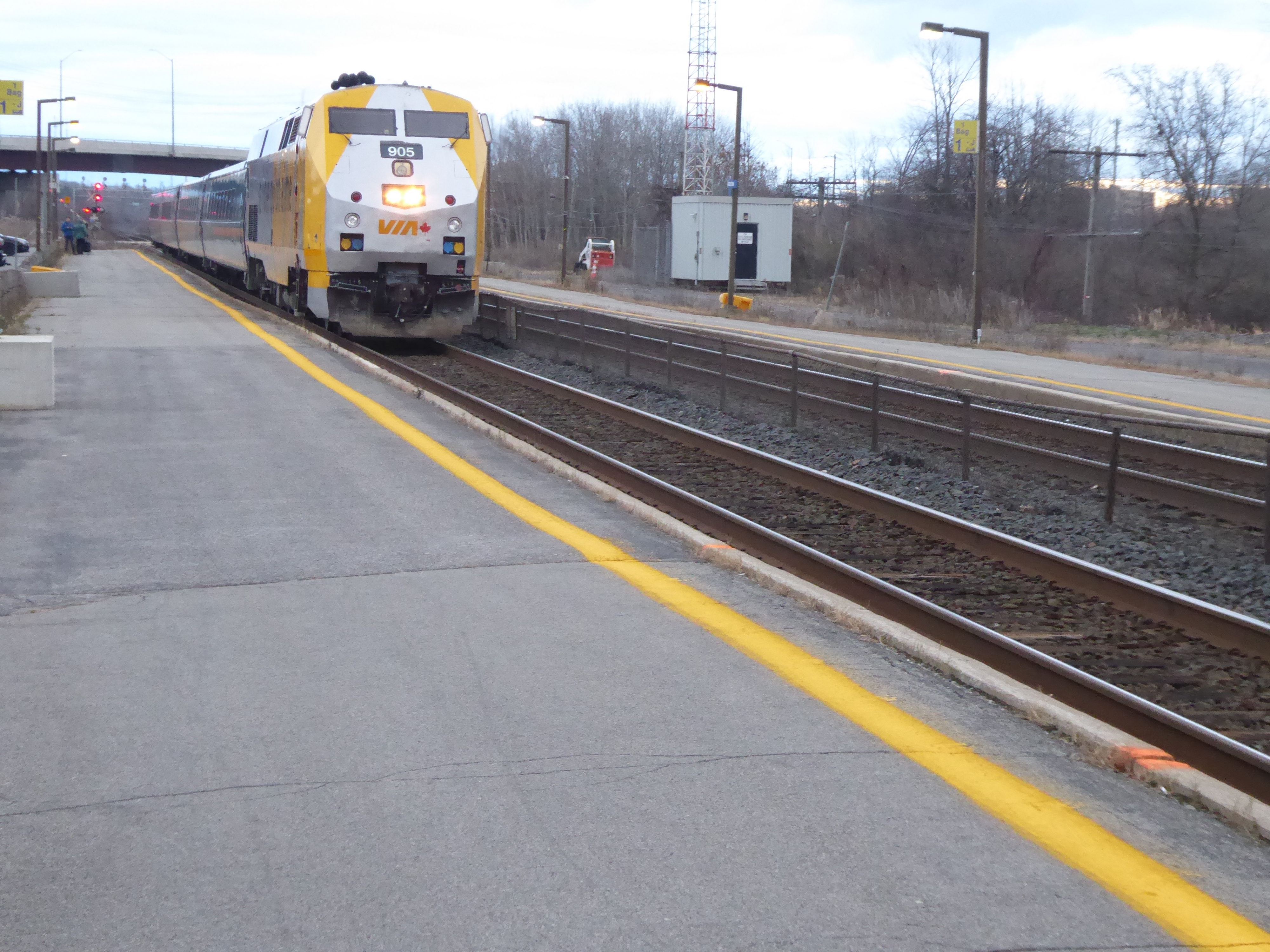
My day in Kingston ended with this westbound, led by P42 905 just after 5:30 p.m. I was a bit disappointed that the new Siemens train didn't make an appearance, as it has been in use periodically on a few Montreal-Toronto and Ottawa-Toronto trains (33 and 26 for example), but no such luck on this day.

But as I wrapped by day of railfanning, I was happy to see 10 trains, even if the ratio of Via to freight (9:1) was a bit slanted for my tastes. Overall, it was fun to watch a busy rail operation in action throughout the day. The frequency of trains, combined with the various scenes on the platform, made the day a good first effort in Kingston. I can't wait to go back.