Saturday, April 1, 2023

Capture Via's rainbow era while you can

On Jan. 12, I found myself trackside at Via Rail's Tremblay Road station east of downtown Ottawa. I didn't really have a goal in mind, other than to see what was coming and going. I was hoping to maybe catch a glance at the new Siemens Charger trainsets, but none were in operation that day. 

As is the case in Ottawa, Via Rail is often the only railway to observe some days. My first stop was the Belfast Road overpass, which gives you a great view of the station yard to the west and the Alexandria Subdivision to the east. Of course, the view of the station is obscured by a number of hydro wires, but you can work around them with some creative camera positioning and zoom. If you are hoping to catch a westbound train coming from Montreal, the Belfast Road overpass is an ideal spot to shoot facing east, as long as the east sidewalk is cleared, which is not the case in the winter. On the day I was there, a corridor train from Montreal was making its way to the station, but I could only capture it from the west sidewalk, through the traffic. Not an easy task.

Led by P42 918 in a wrap, this train featured a full consist of silver streamliner cars, complete with the requisite buffer cars that sandwich the operational coaches, thanks to a mandate from federal safety officials. 

The buffer car behind the engine was 8103 long distance coach in the traditional Via blue and yellow colours. This was originally a CP coach, and is designated by Via as an HEP1 coach. 

The last buffer car in this train is Via Rail 8318 Manor-class sleeping car, which was also a Canadian Pacific car prior to Via. The nameplate on the side of the car did not carry a name, but research showed that 8318 is officially listed as Craig Manor. This car was also still carrying its original blue and yellow Via Rail colours dating back to the late 1970s. I mention these cars in particular because I really do think we are living in a rainbow era of Via, where many different paint schemes and wraps are vying for a railfan's attention. I wonder if a day will come when we look back fondly at this point in Via's history.

Once this train had tied up, I made my way to the station to take a peak at the schedule. Given the number of people in the station, I assumed more trains were coming or going. While there, the Ottawa Valley NTrak railway club was showing off its prowess in a combined display. I took a quick peak at this model train setup, in between all the fascinated kids. I took a shot at what I assumed was an approximation of CN's Super Continental. Love those old F units!

While I was there, I decided to get a shot of the main entrance to the station. This is kind of an iconic place for me, as it was how I arrived in Ottawa to return to university or the final place I saw before heading home to visit family in the Sarnia area. The Ottawa train station is a very difficult building to capture an image of, given there aren't many good vantage points in the area where you can get the entire building in a shot. But the entrance gives you an idea of the architectural design of the station, which has won awards. Once inside the building, you can certainly appreciate the floor-to-ceiling windows, as it is a very warm, welcoming place.

Before calling it a day, another westbound made its way to the station, this time being led by another P42 (902) in its original Via paint scheme. I tried to get the train as it rounded the curve, for the sake of getting a different shot. I like this one below the best.

Once again, you can see the two buffer HEP1 cars sandwiching the cars in revenue service. This at least adds a little bit of colour to the corridor, allowing those along the rails to see cars (like the Manor sleepers) that don't often grace the rails between Windsor and Quebec City. In this case, the first buffer was HEP1 Business Class car 4000 in the updated business class grey and yellow scheme.

The rear buffer car appears to be Via Rail 8307 Blair Manor sleeping car, once again in the original Via blue and yellow scheme from the late 1970s. It was fun to see some of these cars that very rarely made it through Ottawa before the mandated buffer car order came down from federal safety regulators. I wonder how long this policy will be in place, given the outcome of the tests being done on these cars. I suppose it's a reminder to capture some rail history trackside while you can.

While I was capturing the incoming consist from Montreal, I noticed an eastbound corridor train making its start for Montreal. This consist was a little more standard with an F40 leading a typical LRC consist.

My original goal with this post was to provide a little bit of trackside commentary on winter railroading in Ottawa but I realized that the photos I took tell the story of the many faces of Via Rail right now. There are many different colour schemes at play these days, including the newest scheme in the Siemens trainsets. This seems to be the direction that all of Via's equipment is heading in, or at least the equipment that will remain in use in the years to come. A look at the HEP1 4000 Business Class buffer seems to be a decent match for the newest Via equipment.

But it's interesting that you can see the original Via blue and yellow colours on both the HEP1 and LRC cars, not to mention the various updates and wraps from the Canada 150 and Via 40 years. Then there's the Love the Way wraps, which carried over in recent years. I'm not even mentioning the slightly iridescent scheme on the Renaissance equipment. Put it all together and you have a lot of interesting design elements worth capturing while you can. What seems mundane today might seem fascinating in the years to come. So go ahead and take that additional shot. You'll be happy you did.

Monday, March 20, 2023

Random photos from a random year

Last year was an odd year for my railfanning activities. There were some great moments where I was able to capture lots of images and material and then there were moments where high expectations met flat reality. In other words, it was a year of highs and lows. The challenge I always face as a blogger from Ottawa is that there isn't nearly enough going on here for me to maintain a weekly blog. You can only photograph Via Rail trains so many times before it gets old and before you run out of things to mention on a blog. I suppose if I had focused my blog on passenger trains exclusively, then I would be in better shape, but I never intended for this blog to be so narrowly focused.

Bloomington, Indiana, USA

Naturally, whenever I get out of Ottawa, I have high hopes of capturing something to share. In September, my wife and I travelled to Bloomington, Indiana, to attend a wedding. I was excited, as Bloomington was situated along the Indiana Rail Road's Indianapolis Subdivision, south of the state's biggest city. Sadly, in my research, it became apparent that this part of the railway's subdivision saw sparse traffic, with much of it passing through at night, mainly coal trains. Our hotel was within walking distance of the rail line, but it was quiet for much of my time there, except for a weekly local, which passed by on Friday evening. I only know this because I heard it while eating dinner in the city's downtown.

But the city has some fascinating railway history that is visible and accessible. Although Bloomington hasn't seen regular Amtrak service in many years, the town's former passenger station is still standing next to the rails, although it wasn't clear to me if it was a private residence, art studio or business. It looked like it could be any of the three, although there was no signage to indicate what it was used for. I decided to confine my photographs to shots taken from a small winding road that led to the station on the hill.

It looked to me like the station once housed a restaurant, where the station had an addition added on the left. The originals stone structure appeared to be a residence. Interestingly, the station sign still hangs on the side of the building. It would be a good thing, in my opinion, if some civic-minded person saved this sign, cleaned it up and housed in a local museum. I am always fascinated when I see old station signs and relics in local museums. They are a part of a community's history.

While in the city, I also came across what locals call the freight station. The building is a fairly nondescript maroon wooden building, which has an elevated main level, which is your first clue that it served the railways. Since the building served only freight purposes, it really doesn't have the architectural flourishes you would see on a passenger station. Still, the building was significant enough that it was declared a national historic site. After closing in the 1960s, it served as a restaurant at various points. Today, it is an office building.

The building has an interesting history. It was built by the Illinois Central Railway in 1906 in response to a local effort to attract a railway to compete with the Manon Railroad, which was the sole railway serving the city at the time. The IC depot was built after the IC finished its railway line through the city. The presence of the depot spawned economic growth in its immediate vicinity, which sustained the city for decades. It wasn't until 1963 when it closed, due to a decrease in demand for rail service. 

Still, as you can see, the elements of the building have been well maintained, including signage on the side of the building, indicating its original purpose. You can also read about the building's importance on the plaque amid the hostas. This was the rail line that connected America from north to south through its heartland, from Chicago to New Orleans. You might recall the famous Willie Nelson song, City of New Orleans. That song is about the train of the same name that rolled through Bloomington for decades.

Corunna, Ontario

This shot below could have been something special, had I been just a bit quicker. I was in the middle of a visit to my sister's house. My sister's property backs onto the CSX Sarnia Subdivision, just south of Corunna. I was caught in a bad place when an unexpected CSX local rolled by carrying a string of gondolas destined for the the old Ontario Power Generation Lambton Generating Station power plant, which is in the process of being demolished. I have meant to get a shot of one of these trains, which are a rarity on the CSX line, since this operation deals almost exclusively with tank cars and covered hoppers for petrochemical customers.

The biggest issue at this moment was I was in the middle of a conversation with one of my sister's neighbours and didn't want to be rude by bolting for the tracks. So I politely turned around and got this shot of a CSX local poking out from between the trees. There were two GP38s with the new CSX scheme pulling a load of about 10 AIM gondolas. A big missed opportunity, but at least I got something, right?

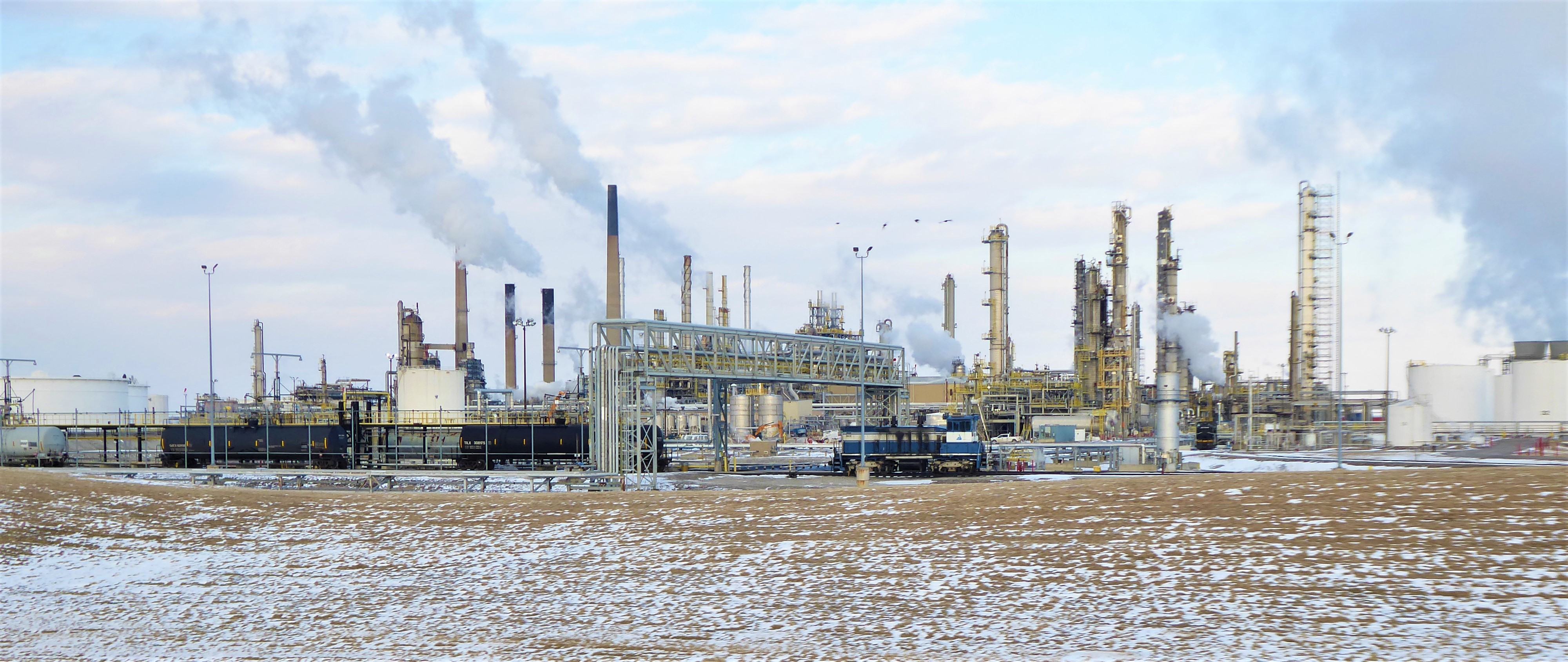
Earlier in the year, I was visiting family on the March Break when I passed by the Nova Corunna refinery on the Highway 40. Its rail operations have expanded a great deal in recent years, as the facility has undergone an immense multi-billion dollar expansion. The problem with getting a shot of rail operations here is you need to shoot overtop of the earthen berms. That means getting a shot from the highway overpass, which goes over a spur connecting Nova to the CN St. Clair River Industrial Spur. This can only be done if you are on the highway when it is empty or when you are in a passenger seat. In this case, I was riding shotgun in my brother's car, which made the shot easy to capture.

These are not easy shots to get, so any time I can capture Nova's old SW switcher, it's a win. I like the colours of the sky in this shot mixed with the smoke from the stacks. As I have mentioned a fair bit in the last year, I am much more interested in train photos that incorporate the surrounding landscape. I could have zoomed in on the switcher, but I wouldn't be getting the old story behind the shot. I will be doing a deeper dive into the SW switcher, as I have a few cool shots of these old beasts. They are rapidly fading from railways. Most of the survivors are in use on short lines or industrial operations. 

Ottawa, Ontario 

Most of what I captured in Ottawa in 2022 was shared in my posts. I only made it out to Via's Tremblay Road station once. When I was there, I got a quick shot of an O-Train on the Confederation Line heading west toward Tremblay Station. It was not a good year for the O-Train as its operations were disrupted a number of times by various mechanical issues, accidents and even a lighting strike. I don't generally like to shoot these operations, as I don't find them all that compelling from a photography point of view, but I made the exception on this turn, since the sunlight made for a quality image at that moment.

There are a few more odds and ends from last year that I considered throwing into this pot pourri of a post, but I have plans for those shots in some upcoming themed posts, so they will have to wait. I can't really complain about my adventures trackside last year. There were definitely more hits than misses, which you can see in this year-end post. But I am always taking shots trackside, no matter what. You never know when those random shots will come in handy.

Friday, March 10, 2023

The Past and Future of Rails in Kitchener-Waterloo

This past August, my family travelled to Waterloo, Ont. for a week-long music camp at Wilfrid Laurier University. The weather was ideal with sunny skies and muted summer temperatures. It was also a homecoming of sorts, as I used to live and work in Kitchener from 2007-2009.

While the music camp portion of our trip was exhausting, with parental participation a key component to the day, I did managed to sneak away a few times to explore the city's railway scene. There are a number of facets to this region's railway scene, if you are so inclined to railfan in the region.

For the uninitiated, Waterloo, the city, is situated in Waterloo Region, which consists of the conjoined cities of Waterloo (furthest north), Kitchener, and south of Highway 401, Cambridge. In the south end, CP's Galt Subdivision runs through Cambridge. CP is busy in this area, as it serves both Toyota automotive plants and numerous industrial customers. Sadly, I didn't have the time to explore these operations.

CN serves Kitchener, as its Guelph Subdivision runs through the city. This is the former Goderich Exeter Guelph Sub. The CN line also gives way to Metrolinx trackage, as GO Trains operate from the Kitchener Via Station into downtown Toronto. There is a Metrolinx spur in Kitchener, where trains are kept in off-hours, but it is not accessible to photograph. 

Waterloo does have rails, but they are mainly used by the region's Ion light rail trains. That's probably the best place to start, as I saw more of these trains than anything during the week. This shot below is of a northbound Ion train, having just crossed Seagram Avenue, near the Laurier campus.

Waterloo's light rail system is a highly reliable service, which uses Bombardier trains that ply the rails both off and along city streets. In many places, it's more like a streetcar, as it stops at red lights, makes turns onto streets like vehicles and observes fairly tame speeds. This is a real difference between Waterloo and Ottawa, where the O-Trains do not go anywhere near city streets and run at higher rates of speed, albeit not nearly as reliably.

Here's a shot of the Seagram level crossing. I was surprised by the frequency of trains crossing this street. The number of times the gates are activated makes it a frequent occurrence for drivers to consider when driving in the city. As far as I could see, the trains were seeing light ridership in early August, which is not a surprise, but they were far from empty. The uptake on this service seems to be pretty brisk to my eye, anyway.

Later in the week, my daughter and I had a break in her schedule, which allowed us to check out the rails near Kitchener's Via station along the Guelph Sub. I've had good luck with trains here in the past, as you can see from this post. On this day, however, the rails were quiet. There wasn't even a local in action. The Kitchener train station is quite nice, even if it is a bit dusty looking at times. You can just make out the GO Train ticket machine to the right of the image. This photo was taken from the platform looking back onto Victoria Street.

Here's another shot of the station's trademark outdoor waiting area, with its distinctive arches. Across the tracks is the old Krug industrial building, which is still in use.

One major change I noticed near the station is that the old King Street level crossing at Victoria has been eliminated, as the Ion trains that go north and south along King require a separation from the Guelph Sub. This is a major change since I lived in the city, when this track was a level crossing and often caused a fair bit of commuter distress when longer freight trains made their way slowly over King Street. When I was in Kitchener this past summer, I noticed a few level crossings had been eliminated by flyovers.

There wasn't much happening in the CN yard, which is visible from the sidewalk along Lancaster Road.

Here's another angle. The mainline is the track farthest to the right in the image.

Like I said, not even a local at work! It was a quiet day to say the least. Disappointing.

Later in the week, I took a few shots of the rails in Waterloo itself, as the city still has the remnants of the old CN Elmira Subdivision going through its downtown. Much of this trackage is now in use for light rail trains, but you can still see the remnants of traditional railways in the city. Waterloo's old train station still sits trackside, but is now a men's clothing store.

In the back of the men's clothing store along the rails, an old CN caboose still sits on a disconnected piece of track.

The store's name is Paul Puncher menswear, hence the branding on the caboose. But if you look closely, the old caboose's original number is still visible on the roof ledge. This is former CN caboose 79664. 

I also took this shot of a piece of trackage down an alleyway in Waterloo's core. These rails do still host CN trains, but those operations happen overnight and in the wee hours of the morning, when the Ion light rail operation is not operating.

This was one of my favourite pictures from the week, considering I had almost no luck capturing any live railway action. My schedule just didn't allow me to catch the early morning GO Train or go down to Cambridge to capture some CP action. I had to make do with what I had in Waterloo, which was light rail and any other assorted pieces of vintage railway scenes that crossed my path. 

At one point during the week, I was able to make my way up to St. Jacobs, a small tourist friendly town north of Waterloo, which is home to the Waterloo Central Railway tourist operation. I have blogged about this unique railway before, which you can read about here. I really wanted to go and take some photos of its unique roster of rolling stock and motive power, all of which is able to be photographed from public property. 

I will save these images for a later post.