Monday, January 30, 2023

A busy day on the mainline in Kingston: Part I

In November, my wife was attending a music conference and my daughters were participating in the music class portion, which gave me a free day to railfan in Kingston. This was worth the early morning wake-up and nearly two-hour drive from Ottawa. Having seen countless photos and historic commentary about the Kingston Subdivision from the Trackside Treasure blog, I was eager to get some of my own images from this rail hotspot. I have caught the occasional freight while driving through Kingston on Highway 401, but this opportunity was far different. This time, I didn't have to rely on lucky timing. I could sit at the Kingston Via Rail station and wait. Oh, the luxuries of living along a main line!

The day was punctuated with trips to downtown Kingston to drop off my daughters at various activities and then more time spent trackside at the station.Here are the first three trains I saw.

P42 917 leads an eastbound J-Train, with a F40 mid-consist for the moment. This was shortly before 11 a.m. The daily trains travelling east toward Brockville are Via Trains 60 and 50. Once they arrive at Brockville, they separate, with one proceeding east on the Kingston Sub toward Montreal while the other branches off onto the Via Rail Brockville Sub (ex-CP) toward Smiths Falls and from there, the Via Rail Smiths Falls Sub (ex-CN) into Ottawa. It's not often you get to see a Via Rail train this long, excluding the Canadian, which I have yet to encounter in person.

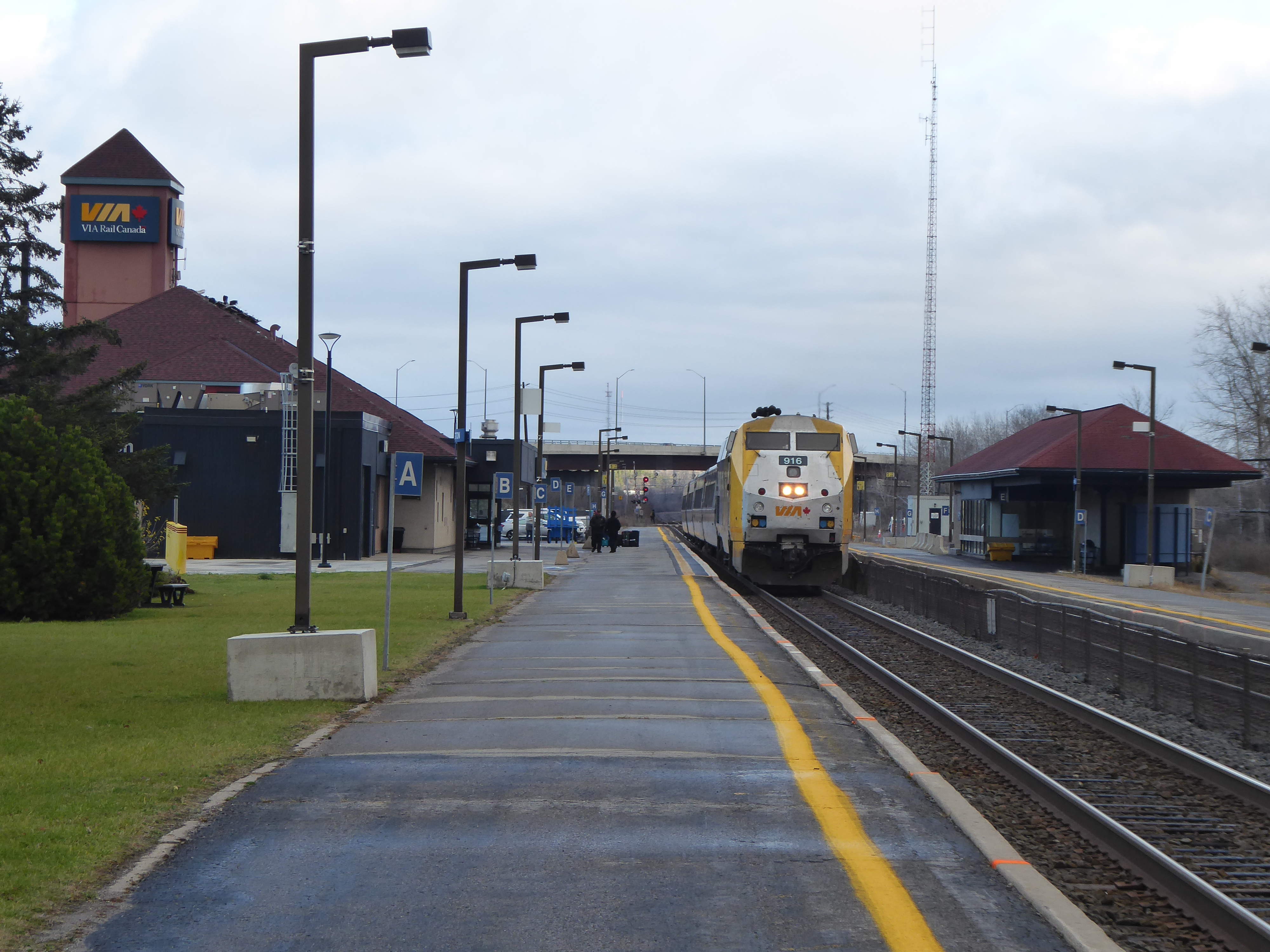
Not long after 60/50 arrived, it had company, as a westbound made its way to the platform, under the watch of the local Via staff on the platform. P42 916 was leading what I assume was Train 51 toward Toronto. If you're keeping count, that's three trains in one meet.

I made sure to get a shot of Train 51 with the entire Kingston station in a frame. It seemed silly to post about the station and not actually take a photograph of the structure itself. Kingston's station dates back to 1974, which predates the birth of Via Rail by a few years. It replaced the famous 1855 Outer Station on Montreal Street, which dated back to the Grand Trunk Railway. Of course, you likely know all this history if you visit Trackside Treasure. It's not my goal to get into an extensive history of this station other than to mention it. I found it funny that there is a line on the Wikipedia entry about this station that states: "The current 1974 mainline station has no notable historic or architectural value." Seems kinda harsh for Wikipedia, no?
Here's the next train I saw. which brought my total up to four. Actaully, it is five, as this was another J-Train, which was destined to separate at Brockville. This consist was led by F40 6436, with the French wrap showing on my side. The mid-train power was P42 911, also with the French slogan wrap showing on my side.

This is Train 62/52. As is the custom with these trains, one heads to Montreal from Brockville while the other heads northeast to Smiths Falls and Ottawa. Since I was on the platform, I decided to take some extra shots of this consist, as I have been trying of late to find images that show detail, rather than just the straight consist. As the P42 went by, I noticed a vestige of its original paint scheme still visible beneath the wrap. It's the old Government of Canada logo. I'm glad Via has done away with this bureaucratic government logo. I am assuming it was forced on them. 

I also took a quick shot of Via coach 8126 acting as a buffer car, is as the case with the old streamlined coaches these days. All the shades were down. It's interesting to see how many paint schemes Via has going on its entire rolling stock roster these days. The original silver and blue is my favourite scheme, but Via has for some time opted for different shades of blue and black on its silver fleet. It's also nice to see the Canada logo taken off the centre of the coaches. I found this to be visually distracting.

One final shot of the J-Train. I took a shot between two coaches to illustrate my point about how much the Via livery has changed over the years. The newer scheme is much more in the blue-green or teal hue. I still think that government logo is out of place on the grooved silver surface. From a business point-of-view, I don't think it's terribly appealing to remind your customers that you are subsidized by the federal government. 

Some have suggested the newer Via scheme is reminiscent of the old C&O passenger scheme, which is something I can appreciate, being a fan of Chessie System and its predecessors. However, I will always prefer the original Via blue and yellow. I'm sure there are marketing reasons to adopt newer schemes, but I maintain the right to be old (40+ anyway) and set in my ways in this case.

That covers my first few meets at the station with five different Via Rail corridor trains. In the next post, I will share images of the lone CN freight train I saw, along with more interesting Via corridor action. I will admit that I was hoping to see more than a single CN freight train, but the sheer volume of activity on my visit to Kingston station more than made up for the lack of freight trains.

Friday, January 20, 2023

New for 2023

Since I brought this blog back in August 2021, I have been blessed with an abundance of material to share, which was made easier by the fact that I have slowed my pace to one post every other week. This means that I posted 24 times last year. That didn't seem like enough.

Those who have been following this blog since the beginning know that I maintained a weekly post pace for years, until the pandemic hit in 2020, when things became different. Personally, I found that I was running short on material and my posts were not up to my personal standards. I like to include elements of railfanning, a little bit of railway technical knowledge, some history, lots of storytelling and some big-picture commentary. I found I was not hitting many of those goals in my posts, so I parked the blog, not knowing if I wanted to resume what I was doing. 

I found that I had begun to rediscover my passion for sharing railway stories in August 2021, although I was wary of falling into the same trap of overpromising and underdelivering. That said, I now find myself in the position of having at least a half year's worth of posts in planning or production, which means I am creating a backlog. That is not a huge problem to have, until such time as when some of the posts cease to be fresh. I know I have a few posts that need significant updating.

Chatham, Ontario Via Rail station, March 2022. Expect to see a post about this railway town.

My solution this year is to post three times each month. I am aiming to post 10 days apart. That means you will see new content on the 1st, 10th and 20th of each month, with a gap a little bit longer at the end of each month. 

With this change of pace, I am going to continue developing content that is more far-reaching than ever. In the past, I have explored the various elements in a single railway photograph. I did the same thing earlier this year when I shared the various elements of two photographs I took of boxcars in Ogdensburg, New York. When I say far-reaching, I mean that I aim to explore more than just the nuts-and-bolts of where I shot a certain train, its number, what type of engine was pulling the consist and in which direction it was travelling. These are all elements I have included in the past, but it doesn't interest me as much as the intangibles of railroading. I thrive on my family railway stories, the challenges of getting shots in tight spaces and what railroading means to people. I find that sometimes railfanning becomes tiresome to me when it becomes more about the technical aspects rather than the intangibles. 

We all remember the thrill trains gave us as kids, I assume. I want to keep that spirit alive in my posts. I have a hard time understanding when people count axles on a train, for example. I see that a fair bit and I find it a bit mystifying to be honest. That's not a critique, by the way. If that is what people thrive on, that's great. You just won't find that level of detail here.

I will never profess to be the best photographer. You can visit any number of other blogs to see more proficient imagery and more informed technical information about railways. But for me, the stories will continue to be the main emphasis of my writing. I think it's just as important to show shots that didn't quite turn out and explain why.

I will try to maintain a strong focus on Eastern Ontario, but given its limitations, I will continue to branch out whenever I can and tell railway stories from wherever I happen to be.

All this to say, this blog will continue to evolve. I know that, since my hiatus, a large chunk of my readership has scattered, many to Facebook. I see some people slowly coming back, which is exciting to see. However, I am aware that blogs aren't what they used to be and it seems as if the trend toward railfans clustering on social media rather than on blogs will continue. That's okay. To each, their own. 

I will continue doing my thing here as honestly and actively as I can. I thank everyone for continuing to visit. Please feel free to make suggestions for content you'd like me to cover or pass along any information or images you'd like to share.

Cheers,

Michael

hammond.michael77 AT gmail dot com.


Tuesday, January 10, 2023

End of the line in Ogdensburg, New York

It's always fun to get photos of railway action in new places. For me in December, an emergency run to Ogdensburg, New York for children's medicine turned out to be a unique chance to get a photo of the end of the New York & Ogdensburg Railway line in the small upstate New York town. It was not an easy photo to capture and I think I may have aroused suspicion. In any case, here's the story and some thoughts on this seemingly ordinary picture.

First, a little background. The NYOG is a shortline railway connecting the St. Lawrence River port in Ogdensburg with a junction with the CSX in Norwood, New York. The connection is with the CSX St. Lawrence Division, which is ex-Conrail, ex-Penn Central, ex-New York Central. The Ogdensburg rail line is 26 miles (41.8 km) long and serves some vital purposes that might not be apparent to the casual observer. It serves as a transloading facility for trucks that serve Ontario, Quebec and northern New York. According to the port authority in Ogdensburg, it carries plastic pellets, resins, oils, lubricants, fuels, adhesives, chemicals, feed, grain, fertilizers, minerals and some unique cargo like wind turbine blades. The railway is owned by the Vermont Rail System. This is the railway that took over much of what was known as Central Vermont, a one-time CN subsidiary.

Getting shots near the port is almost impossible, as the area is surrounded by chain link fence with razor wire on top. Not surprising. However, there is a small vantage point near the end of Paterson Street, where it intersects with a tiny dead-end Railroad Street. From this point, where there is a riverside parking lot, where you can see the end of one of the spurs that are scattered throughout the port area. This is the shot I got. 

Big deal, right? Look closer. You can see the green boxcar at the end of the line has a roll-top door at the end that opens up. I have a closer image (see below) where I could make out that the car's numbering and lettering was changed to read "MW" which is code for maintenance of way. You can also see the remnants of an old Conrail logo on the maroon car to the right of the loading machinery. There is also a Vermont Rail System car in the lineup, not to mention some covered hopper to the right. It was hard to make out from where I was standing, next to the fence.

Here's a closer look.

This shot gives you a better look at the faded Conrail logo, as well as the Vermont Rail System logo to the right. I still had a hard time making out what was loaded in the cars, although it looked like something bailed, like compressed recycled material or something like that. You can also see a group of buoys on the asphalt, likely due to the ice in the St. Lawrence River. Here's a blown up shot of the cargo.

Here's a closer look at that MW car at the end of the line, which appears to have a rolling garage door installed at the end. Seems like this car is no longer fit for any revenue movement.

Here's where the story gets interesting. I was setting up to take more shots of various cars in the consist, thanks to my camera's zoom, but then I realized people working in a nearby building had taken an interest in what I was doing. I suppose that's natural, as this place is fenced off for a reason. I turned away from the fence and checked my phone, but the people in trucks on the other side were watching me like a hawk, so I decided, even though I was on public property, it was time to move on. I went back to my car in the parking lot, but noticed that the people watching me were not going to be satisfied until I drove away, which I did reluctantly.

There weren't any other obvious vantage points to view this rail yard and I was on the clock, as my kids needed the medicine, so I decided to move on. So ended my brief experience of photographing a new-to-me railway in New York state.

This is a good example of the type of railway photos I have come to appreciate more and more. There isn't anything exciting going on. There are no movements, no engines, no action. It's just a string of old boxcars. But I have come to realize that railway photography can be as much about where the railway is situated as what's on the rails. The background details provide more to the story and make the hobby more interesting.